
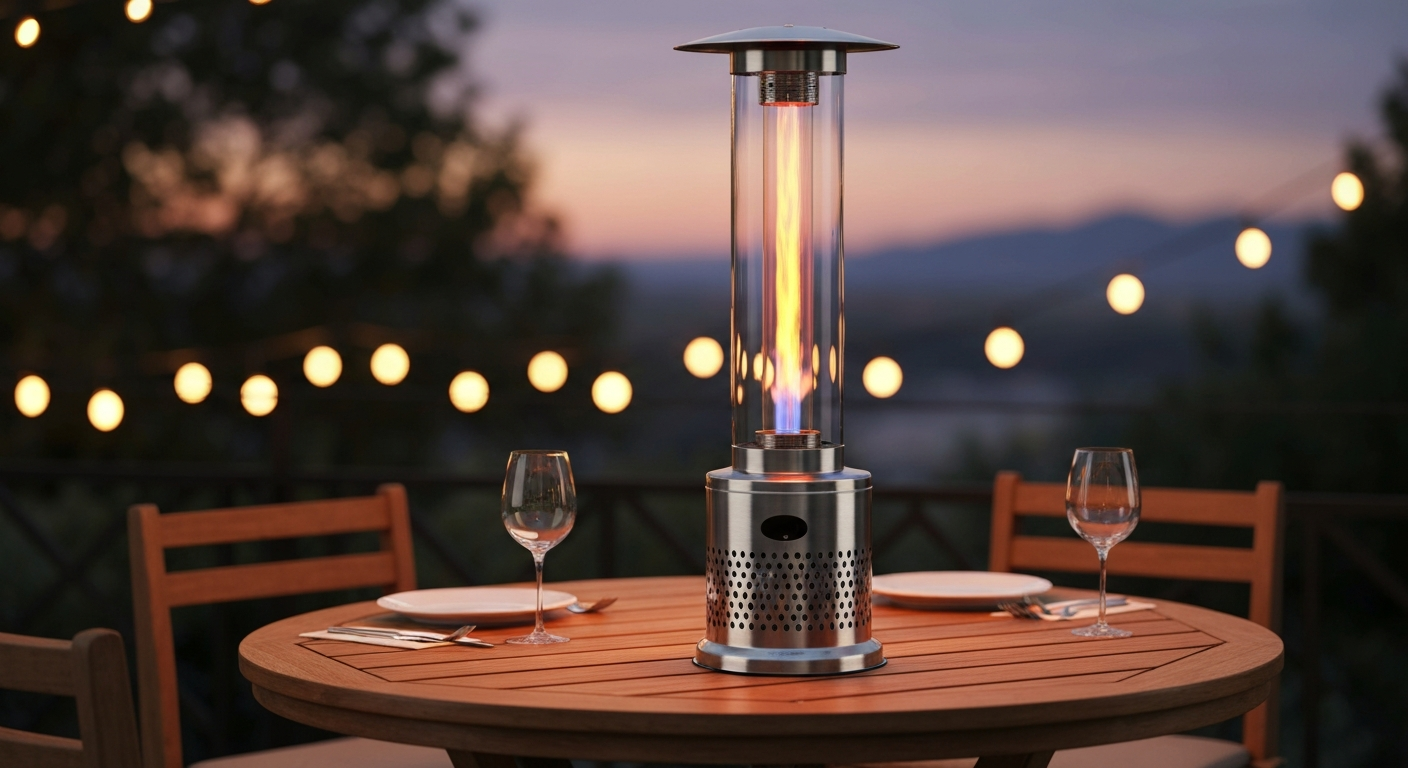
A tabletop glass tube patio heater is a compact, freestanding heater designed to sit on a table or flat surface and warm the people seated around it, typically within a 5 to 8-foot radius. Most run on a small 1 lb propane cylinder tucked inside the base, though electric versions with quartz tube emitters also exist. They heat through radiant infrared energy directed outward from a glowing quartz or borosilicate glass tube, which means you feel the warmth directly on your skin rather than waiting for the surrounding air to heat up. They're genuinely useful for small patios, bistro setups, covered outdoor dining areas, and anyone who wants a heat source that doubles as a centerpiece without hauling out a full-sized standing heater.
Table Top Glass Tube Patio Heater: Review & Buying Guide

Willa Brennan
18 Jul 2026
What exactly is a tabletop glass tube patio heater?
The term 'glass tube patio heater' gets used loosely, but there are really three distinct product subtypes you'll encounter when shopping. Knowing which one you're looking at saves a lot of confusion, especially since they have very different fuel sources, heat output ranges, and use-case limits.
- Propane/LP quartz glass tube tabletop heaters: These are the most common type. They use a visible-flame burner inside a metal housing topped with a quartz glass tube column (often called a pyramid or tower design). The flame travels up through the tube and radiates heat outward. Brands like AZ Patio Heaters, Hiland, and Costway/Garden Treasures fall into this category. Output typically runs 10,000 to 11,000 BTU and they connect to a standard 1 lb disposable cylinder or a 20 lb tank via adapter hose.
- Bioethanol or gel-fuel glass cylinder burners: These use a borosilicate glass cylinder as a decorative fire bowl or column. They burn denatured ethanol or gel fuel and produce real flame, but heat output is much lower (roughly 2,000 to 4,000 BTU equivalent). They blur the line between a patio heater and a fire feature and are mostly decorative with limited practical warmth.
- Electric quartz tube tabletop heaters: These use a resistance-heated quartz tube emitter powered by a standard 120V outlet. They produce infrared radiant heat without combustion, making them safe for covered and enclosed spaces. Output generally ranges from 1,000 to 1,500 watts (roughly 3,400 to 5,100 BTU equivalent).
The vast majority of people searching for a 'tabletop glass tube patio heater' are looking for the propane pyramid-style models, and that's where most of this guide is focused. But I'll cover how the electric and bioethanol options stack up in the comparison section, because for some setups they're genuinely the better choice.
How glass tube tabletop heaters actually work
The basic design is straightforward. A propane glass tube tabletop heater has a weighted metal base (usually stainless steel or powder-coated steel) that houses the fuel cylinder. A burner assembly sits above it, connected via a regulator and valve, and the quartz glass tube column mounts on top of the burner housing. When you ignite the burner, the flame runs up inside the glass tube, heating the quartz to a visible orange-red glow. That glowing surface then radiates infrared energy outward in a roughly 360-degree horizontal pattern, warming objects and people within range.
The key word here is radiant, not convective. Radiant heat travels in straight lines from the source to whatever it hits, similar to how the sun warms you on a cool day. Convective heat, by contrast, warms the air and relies on air circulation to spread. Outdoors, convective heat loses its effectiveness quickly in any breeze because warmed air simply blows away. Radiant heat from a glass tube is far more wind-resistant, which is one of the main reasons these heaters work reasonably well on semi-exposed patios.
The common components across most propane models include: a piezo or battery-assisted push-button igniter, a thermocouple or flame sensor (a safety device that cuts the gas if the flame goes out), a tip-over cutoff switch in the base, a pressure regulator on the gas hose, and the quartz glass tube itself, which on most tabletop models is roughly 12 to 18 inches tall and 2 to 3 inches in diameter. The glass tube is the most fragile component and also the most commonly replaced part, which is worth keeping in mind when choosing a brand that has readily available replacement parts.
Honest pros and cons from real-world use
Glass tube tabletop heaters have a genuinely appealing combination of compact size, visual warmth, and ease of setup. But they also have real limitations that some reviews gloss over. Here's what I've consistently found matters in practice.
- Immediate radiant warmth: You feel the heat within seconds of ignition, and because it's radiant, it works even in light wind better than a convective heater would.
- Compact and portable: Most models weigh between 5 and 12 lbs, fit comfortably on a 30-inch or larger table, and can be moved easily between spaces.
- Decorative appeal: The visible flame inside the glass tube looks genuinely attractive at night, doubling as ambient lighting and a conversation piece.
- No electrical hookup needed (propane models): A 1 lb propane cylinder makes these fully cordless and setup takes under a minute.
- Affordable entry price: Most quality propane tabletop glass tube heaters land between $60 and $130 at major retailers.
- Limited heat radius: A 10,000 to 11,000 BTU output covers roughly 5 to 7 feet in diameter in calm conditions. In wind or cold weather, effective coverage shrinks noticeably.
- Short runtime on small cylinders: A standard 1 lb disposable propane cylinder contains about 0.24 gallons of propane, which at 91,452 BTU per gallon gives you roughly 2 to 2.5 hours of runtime at full burn. That's one dinner, not an evening.
- Glass tube fragility: The quartz tube is the Achilles heel. Multiple consumer reviews across Lowe's and Amazon specifically mention broken glass tubes arriving in shipping or cracking after a season of use. Always check that replacement tubes are available for your specific model before buying.
- Not for fully enclosed spaces: Propane combustion produces carbon monoxide. These heaters require open-air or well-ventilated outdoor use. Do not run them in a screened-in porch, tent, or garage.
- Running cost of disposable cylinders: If you're using 1 lb disposable canisters, you're paying $3 to $6 per 2-hour burn. A 20 lb tank adapter brings that cost down dramatically and extends runtime to roughly 18 to 20 hours at 10,000 BTU.
Best tabletop glass tube patio heaters right now
I've reviewed the major options available at Home Depot, Lowe's, Amazon, Wayfair, and specialty retailers. Here are the models that consistently perform well based on verified buyer feedback, spec accuracy, parts availability, and value for money. For aggregated reviews and model testing/selection notes, see Money.com, Best Patio Heater (aggregated reviews, model testing/selection notes) For aggregated reviews and model testing/selection notes, see Money.com — Best Patio Heater (aggregated reviews, model testing/selection notes)..
Best overall: AZ Patio Heaters 39-inch Stainless Steel Tabletop Quartz Glass Tube
This is the benchmark model that most competitors are compared to. The AZ Patio 39-inch stainless steel tabletop unit runs at 11,000 BTU on propane, uses a standard 1 lb cylinder in the base, and is built from hammered stainless steel with a non-reflective finish that resists fingerprints and looks sharp in most outdoor settings. The quartz glass tube is a proprietary fit, but AZ Patio sells replacement tubes directly, which is a big deal for long-term ownership. Ignition is piezo push-button, and the thermocouple flame sensor shuts the gas if the flame extinguishes. At around $80 to $100, it's a solid buy for anyone who wants a dependable, good-looking tabletop heater for a small patio table or bistro setup. The main limitation is the same as every 1 lb cylinder model: roughly 2 hours of runtime per tank.
Best budget pick: Garden Treasures 11,000-BTU Tabletop Liquid Propane Patio Heater
Sold primarily through Lowe's, the Garden Treasures tabletop glass tube heater is typically priced $20 to $30 less than the AZ Patio model and hits the same 11,000 BTU output. The build quality is a step below in terms of fit and finish, and consumer reviews more frequently mention glass tube breakage, including some shipping damage reports. That said, for someone who wants to try a tabletop glass tube heater without a major investment, it's a functional starting point. Just make sure you keep the original packaging if you need to return it, and verify replacement glass tube availability before purchasing.
Best for flexible fuel use: Hiland HLDS01-GTGT Tabletop Glass Tube Heater with Adapter
The Hiland HLDS01 series is one of the few tabletop propane glass tube heaters that ships with or is widely compatible with a 5-foot adapter hose, letting you connect to a standard 20 lb propane tank. This is a game-changer for runtime. At 10,000 BTU on a 20 lb tank, you're looking at roughly 18 to 20 hours of heat, which makes this a practical choice for anyone who hosts frequently. The Hiland manual explicitly lists anti-tilt safety, thermocouple flame protection, and CSA certification, so it checks the safety boxes. Priced around $90 to $120 depending on whether the adapter is included.
Best electric option: 1,500-watt infrared quartz tube tabletop heater
For covered patios, screened porches, or any space where you can't use an open flame, a 1,500-watt electric quartz tube tabletop model is the right call. These plug into a standard 120V/15A household outlet (most draw around 12.5 amps at full power), produce no combustion byproducts, and are safe to use in enclosed spaces. The heat footprint is smaller than a propane model, typically effective within 4 to 5 feet, but the directional infrared output is still meaningfully warm for two to four people seated close together. Look for models with an adjustable heat setting (750W/1,500W), a tip-over shutoff, and a power cord long enough to reach your nearest outlet without an extension cord.
Spec comparison: top tabletop glass tube heater models side by side
| Model | Fuel Type | BTU / Watts | Height | Base Footprint | Weight | Runtime (1 lb cylinder) | Ignition | Safety Devices | Approx. Price |
|---|---|---|---|---|---|---|---|---|---|
| AZ Patio 39" Stainless Tabletop | Propane (LP) | 11,000 BTU | 39 in | ~12 x 12 in | ~8 lbs | ~2 hrs | Piezo push-button | Thermocouple, tip-over cutoff | $80–$100 |
| Garden Treasures 11,000 BTU Tabletop | Propane (LP) | 11,000 BTU | ~36 in | ~12 x 12 in | ~7 lbs | ~2 hrs | Piezo push-button | Thermocouple, tip-over cutoff | $55–$75 |
| Hiland HLDS01 Tabletop Glass Tube | Propane (LP) | 10,000 BTU | ~38 in | ~11 x 11 in | ~7.5 lbs | ~2.2 hrs / ~18–20 hrs (20 lb tank) | Piezo push-button | Thermocouple, anti-tilt, CSA certified | $90–$120 |
| Electric Infrared Quartz Tube Tabletop (typical) | Electric (120V) | 1,500W (~5,100 BTU eq.) | ~24–30 in | ~8 x 8 in | ~5–7 lbs | N/A (corded) | Switch/dial | Tip-over shutoff, overheat protection | $40–$80 |
| Bioethanol Glass Cylinder Tabletop (typical) | Bioethanol/gel | ~3,000–4,000 BTU eq. | ~12–20 in | ~6 x 6 in | ~3–5 lbs | ~2–3 hrs per fill | Lighter/match | None standard | $50–$150 |
Glass tube vs other tabletop heater types
Tabletop glass tube heaters share shelf space with several competing styles, and it's worth knowing what each type actually offers before you commit. The table top halogen heater is a close relative, using a halogen bulb element instead of a gas flame or quartz resistance tube. Halogen units are typically electric, plug-in, and produce a warm orange glow that looks similar to a gas flame but requires no fuel. They're safe for covered spaces, easy to control, and usually cheaper to run than disposable-cylinder propane models, but their heat output is generally lower and more directional. Ceramic tabletop heaters are another electric option, but they work convectively rather than radiantly, which means they're notably less effective outdoors where wind disperses warm air quickly.
| Type | Fuel/Power | Heat Method | BTU/Watt Range | Best For | Covered Space Safe? | Runtime/Cost |
|---|---|---|---|---|---|---|
| Propane glass tube (pyramid) | Propane LP | Radiant infrared | 10,000–11,000 BTU | Open or semi-open patios, portable use | No (CO risk) | ~2 hrs/1 lb can; ~18–20 hrs/20 lb tank |
| Electric quartz tube | 120V electric | Radiant infrared | 1,000–1,500W | Covered patios, screened porches | Yes | Continuous; ~$0.15–0.20/hr at 1,500W |
| Halogen tabletop | 120V electric | Radiant (halogen) | 700–1,200W | Covered patios, indoor/outdoor zones | Yes | Continuous; ~$0.10–0.16/hr |
| Bioethanol/gel cylinder | Bioethanol/gel fuel | Radiant + ambient flame | ~2,000–4,000 BTU eq. | Decorative ambiance, light warmth | Ventilated spaces only | ~2–3 hrs per fuel fill |
| Ceramic tabletop | 120V electric | Convective | 1,000–1,500W | Indoor use, calm enclosed spaces | Yes (indoors best) | Continuous; ~$0.13–0.20/hr |
My honest take: if your patio is open-air and you want real warmth for two to four people at a table, the propane glass tube model delivers the best heat output per dollar spent upfront. If you have a covered patio or a screened-in area, go electric quartz tube. Halogen tabletop heaters are a solid middle ground for light-use covered spaces. Ceramic heaters outdoors are generally a waste of money. The bioethanol style is mostly about the look, not the heat.
Style, materials, size, and aesthetics guidance
Most propane tabletop glass tube heaters come in one of three finishes: brushed or hammered stainless steel, black powder-coated steel, or bronze/antique powder-coat. For help matching finishes and proportions, see our style tabletop patio heater guide. Stainless steel is the most weather-resistant and tends to look cleaner in modern or contemporary outdoor settings. Powder-coated finishes are fine but can chip over time, especially if the heater gets knocked over. For a rustic or Mediterranean aesthetic, the bronze or dark finish models blend in nicely with wrought iron furniture.
In terms of tabletop footprint, most propane glass tube models have a base of roughly 10 to 13 inches square. That means you need a table at least 30 inches wide to accommodate the heater without crowding dishes and glasses. Round tables 36 inches or larger work best because they allow the 360-degree heat pattern to reach all seated guests. Always check your table's weight rating before placing a heater, especially on glass-top tables. A typical glass tube tabletop heater weighs 7 to 12 lbs, well within most patio table limits, but the base design concentrates weight on a small contact point, so a protective pad or coaster is a smart move on glass or composite surfaces.
Height matters more than most buyers realize. A 39-inch tall heater puts the glass tube at roughly eye level when seated, which is ideal for directing heat toward people's upper body and face. Shorter models in the 28 to 32-inch range heat more toward the table surface, which is less effective for warming people. If you're choosing between two similar models, go taller.
For buyers who care deeply about matching their existing outdoor furniture, it's worth noting that the style range for tabletop glass tube heaters is still fairly narrow compared to the broader tabletop patio heater category. If aesthetics are a top priority, looking at style-focused tabletop patio heater options alongside glass tube models can give you a better sense of what finishes and designs are available across the full category.
Fuel, performance, BTU, coverage, and runtime explained
How BTU and coverage actually work outdoors
BTU stands for British Thermal Unit and is a measure of heat energy output per hour. A 10,000 BTU heater produces 10,000 BTU of heat per hour at full output. That sounds like a lot, but outdoors, heat dissipates rapidly. As a rough rule of thumb, 10,000 to 11,000 BTU from a radiant tabletop heater will noticeably warm people within 5 to 7 feet in calm conditions (under 5 mph wind). Add wind and the effective radius shrinks, sometimes to 3 to 4 feet. These numbers are experiential estimates common in the industry, not lab-measured standards, because outdoor testing variables make precise standardization impractical.
The coverage comparison between radiant and convective heat outdoors is significant. Radiant heat warms surfaces and bodies directly, so a 10,000 BTU radiant glass tube heater will feel warmer to seated guests than a 10,000 BTU convective heater of the same output rating, specifically because wind can't carry radiant energy away. This is why tabletop glass tube heaters outperform their BTU numbers might suggest, and why ceramic convective tabletop heaters underperform theirs in outdoor settings.
Propane runtime: what the numbers really mean
Propane contains approximately 91,452 BTU per US gallon (per EIA energy unit references). A standard 1 lb disposable propane cylinder holds roughly 0.24 gallons of liquid propane, giving you about 21,948 BTU total energy. At 10,000 BTU per hour output, that's just under 2.2 hours of runtime. At 11,000 BTU, you're looking at about 2 hours. In practice, most users find they get 1.75 to 2.25 hours from a fresh 1 lb cylinder, which aligns with manufacturer specs. A 20 lb tank holds roughly 4.7 gallons, or about 430,000 BTU total, giving you 43 hours at 10,000 BTU or about 39 hours at 11,000 BTU. With typical use patterns (not running at maximum continuously), real-world runtime from a 20 lb tank is commonly reported as 15 to 20 hours.
| Cylinder Size | Propane Volume (approx.) | Total BTU Energy | Runtime at 10,000 BTU/hr | Runtime at 11,000 BTU/hr | Typical Cost |
|---|---|---|---|---|---|
| 1 lb disposable | 0.24 gal | ~21,900 BTU | ~2.2 hrs | ~2.0 hrs | $3–$6 per cylinder |
| 5 lb refillable | ~1.2 gal | ~109,700 BTU | ~11 hrs | ~10 hrs | $4–$8 to refill |
| 20 lb standard tank | ~4.7 gal | ~429,800 BTU | ~43 hrs | ~39 hrs | $15–$25 to refill |
One practical note on propane availability: 1 lb disposable cylinders are widely sold at hardware stores, big-box retailers, and camping supply stores, but they generate a lot of single-use waste. If you plan to use your tabletop heater more than a few times per season, an adapter hose and a 20 lb tank is dramatically more cost-effective and environmentally friendlier. Uline carries tabletop patio heaters and accessories for commercial buyers, and adapter hoses are available through Amazon, Home Depot, and most hardware stores for $15 to $30. Always verify your heater's regulator is compatible with a larger tank before purchasing an adapter.
Electric tabletop heaters: power requirements and performance
Electric quartz tube tabletop heaters run on a standard 120V/15A household circuit. At 1,500 watts, they draw approximately 12.5 amps, which means they'll run fine on a standard 15A outdoor outlet but you should not run them on the same circuit as other high-draw appliances. Many models offer a lower 750-watt setting, which draws about 6.25 amps, useful for mild evenings or when sharing a circuit. The operating cost at 1,500W is roughly $0.18 to $0.22 per hour depending on your local electricity rate (using the US average of around $0.13 to $0.15 per kWh as a baseline). Over a season, electric models often cost less than disposable propane cylinders.
Ignition systems: piezo vs battery-assisted vs match
Most propane tabletop glass tube heaters use a piezo push-button igniter, which creates a spark mechanically without batteries. These are reliable in new condition but can become unreliable after a season or two as the igniter tip wears or corrodes. Battery-assisted electronic igniters (found on some premium models) produce a more consistent spark and tend to last longer. Some budget models require a lighter or match for ignition, which is inconvenient but not a deal-breaker if you're comfortable using one. Bioethanol tabletop units almost always require a long lighter or match. Electric models are simply switched on.
Wind, seating, and real-world performance notes
Wind is the single biggest variable in outdoor heater performance. A 10 mph wind can cut the effective warmth radius of a 10,000 BTU radiant heater roughly in half compared to calm conditions. If your patio gets regular wind, a windscreen, a covered pergola, or strategic furniture placement can make a real difference. Positioning the heater at the center of the table and seating guests in a circle within 4 to 5 feet is the most efficient arrangement. Avoid placing the heater near the edge of the table where wind hits it directly.
Safety: what you need to know before you light up
Propane tabletop glass tube heaters have multiple built-in safety features, but they still require responsible use. The thermocouple (or flame sensor) is the most important: it's a heat-sensitive probe that keeps the gas valve open while the flame is present. If the flame blows out, the thermocouple cools within seconds and the valve closes automatically, stopping gas flow. The tip-over cutoff switch is a second independent safety device that shuts off the gas if the heater is knocked over. CSA-certified models (including those certified to ANSI Z83.26, which specifically covers gas-fired outdoor infrared tabletop heaters) have had these systems independently verified to meet minimum performance standards.
Carbon monoxide is the critical ventilation concern. Propane combustion produces CO, and even a small 10,000 BTU heater running in an enclosed space can build up dangerous CO concentrations within minutes. Never use a propane glass tube heater in a garage, tent, screened-in porch, or any enclosed space. Well-ventilated covered patios with open sides are generally acceptable, but when in doubt, choose an electric model instead. Many manufacturer manuals, including the Uline H-5221 tabletop heater manual, include explicit CO warnings and minimum clearance distances.
Keep a minimum of 3 feet of clearance above and around the glass tube while operating, per standard manufacturer guidance. Don't place the heater under low-hanging string lights, fabric covers, or overhanging branches. Store propane cylinders in a cool, dry place away from direct sunlight and never in an enclosed vehicle. DOT regulations (49 CFR) govern propane cylinder labeling and transport, and most retailers will not ship heaters with cylinders attached, which is worth knowing if you're ordering online.
Maintenance, cleaning, and replacing the glass tube
Maintenance on a propane tabletop glass tube heater is minimal but the glass tube deserves specific attention. The quartz tube can crack or discolor from rapid temperature changes (like a cold rain hitting a hot tube), from physical impact, or simply from UV exposure over time. Before each season, inspect the tube for hairline cracks by holding it up to light. A cracked tube should be replaced before using the heater, as it can shatter during operation.
Replacing the glass tube is usually a straightforward process involving removing a top cap or bracket, sliding out the old tube, and sliding in the replacement. Most OEM replacement tubes are secured with a set screw or friction fit. The critical step is making sure the replacement tube is specified for your exact model; tubes vary in diameter and length, and using a wrong-size tube is both ineffective and potentially unsafe. AZ Patio sells model-specific replacement tubes directly, and Hiland replacement parts are available through authorized dealers and Amazon. Third-party universal tubes exist but compatibility can be hit or miss.
For general cleaning, let the heater cool completely, wipe down the metal housing with a damp cloth, and clean the glass tube with a non-abrasive glass cleaner. Avoid spraying cleaning products directly onto the burner assembly. If the igniter becomes unreliable, the tip can often be cleaned with fine sandpaper, and igniter replacement kits are widely available. The thermocouple is another wear item: if the heater lights but won't stay on when you release the igniter button, the thermocouple is likely worn and needs replacement, a common repair that typically costs $10 to $20 in parts. A tabletop patio heater cover is a worthwhile accessory for extending the life of both the glass tube and the metal finish between uses.
Warranties, parts availability, and where to buy
Warranty terms on tabletop glass tube heaters are generally modest. Most mid-range models carry a 1-year limited warranty covering manufacturer defects, with some brands offering 90-day coverage on glass components given their fragility. AZ Patio Heaters and Hiland both offer parts support through their websites and authorized dealers, which is a meaningful advantage over generic brands that may be discontinued within a season. Always verify that replacement glass tubes, igniters, and thermocouples are actively stocked before buying a specific model.
For purchasing, Home Depot, Lowe's, and Amazon offer the broadest selection with in-store pickup options for faster access during the season. Wayfair often stocks a wider range of finishes and styles. For commercial or bulk purchases (restaurants, event venues), Uline stocks tabletop patio heater SKUs and offers business-oriented shipping options, though their selection is more limited in terms of style variety. Keep in mind that propane models cannot ship with fuel attached, and some carriers (UPS/FedEx) have specific packaging and hazardous materials requirements for any propane-related accessories.
Quick buying checklist before you order
- Measure your table: confirm it's at least 30 inches wide and check the weight rating for the heater's base footprint.
- Open or covered space: propane for open-air patios, electric for covered or enclosed outdoor areas.
- Runtime needs: if you host for more than 2 hours at a time, budget for a 20 lb tank adapter or choose an electric model.
- Check replacement glass tube availability for the specific model before buying.
- Verify certifications: look for CSA, UL, or ETL certification marks on the product listing or packaging.
- Look for thermocouple and tip-over shutoff in the spec sheet, not just the marketing copy.
- Compare warranty terms: 1-year minimum is the standard; shorter glass-component coverage is common but acceptable.
- Factor in fuel costs: 1 lb disposables are convenient but expensive per hour; a 20 lb tank is far more economical over a season.
- Check local propane refill availability if going with a larger tank, especially in rural or suburban areas.
- If buying online, confirm whether a cover is included or available, since storing the heater protected between uses significantly extends the glass tube life.
Troubleshooting common issues
The most common issue reported by owners is the heater lighting briefly then shutting off when the igniter button is released. This almost always means the thermocouple isn't hot enough before you let go of the button. The fix: hold the igniter button down for a full 20 to 30 seconds after the flame lights before releasing, giving the thermocouple time to heat up and signal the valve to stay open. If the problem persists after that, the thermocouple needs replacement.
If the heater won't ignite at all, check the propane cylinder connection first (hand-tighten the regulator connection), then test the igniter by pressing it in a dark space to see if a spark is visible. No spark usually means a worn igniter tip or a broken igniter wire, both of which are inexpensive repairs. If the cylinder is new and there's no gas smell when you turn the valve, the regulator may have locked into a safety mode (a common propane regulator quirk): turn off the valve completely, disconnect the cylinder, wait 30 seconds, reconnect slowly, and try again.
Discolored or cloudy glass tube? Some yellowing or slight cloudiness on the interior of the glass tube is normal after extended use as combustion residue builds up. It doesn't affect performance significantly, but it does reduce the visual appeal of the flame. A gentle cleaning with a paper towel on a thin rod (the heater fully cooled and disconnected) can help, though once the tube is significantly discolored, replacement is the more practical solution.
FAQ
What definitive product taxonomy and definitions should be established first?
Document clear definitions and mutually exclusive subtypes (e.g., A: propane/liquid‑propane visible‑flame quartz glass‑tube tabletop heaters; B: bioethanol/gel‑fuel tabletop burners with borosilicate glass cylinders; C: electric/quartz infrared or resistance glass/quartz‑tube emitters). Verify vendor/manufacturer terminology and any standards language that maps manufacturer names to these subtypes.
Which manufacturer and product sources must be consulted to assemble representative 'best picks'?
Collect product pages, spec sheets, and owner manuals from primary manufacturers and brand storefronts (AZ Patio, Hiland, Costway, Garden Treasures, etc.) and authorized resellers to capture canonical model names, SKUs, full specs, materials, and warranty language.
How should the active market and top‑selling SKUs be surveyed?
Scan major national retailers and marketplaces (Home Depot, Lowe's, Amazon, Wayfair, Walmart, Bed Bath & Beyond/Crate & Barrel, PatioLiving/BBQGuys, Uline) to gather availability, MSRP, typical selling prices, best‑seller lists, and retailer reviews for model selection and popularity signals.
What technical specifications and performance fields must be extracted for each candidate model?
Extract fuel type, BTU (or watts), energy consumption/runtime, dimensions (height, footprint), weight, materials/finish, ignition type, safety features (anti‑tilt, thermocouple, flame failure), required clearances, certification marks (UL/ETL/CSA), and warranty terms from manufacturer spec sheets and owner manuals.
Which standards, certifications and codes must be checked against each model?
Consult CSA/ANSI Z83.26 (gas‑fired outdoor infrared patio heaters) for tabletop class bounds, UL/ETL listing claims on product pages, NFPA 58 and DOT/49 CFR for cylinder/transport/handling rules, and local building/fire codes where relevant.
What independent performance and test data sources should be used to validate manufacturer claims?
Search Consumer Reports (if available), accredited HVAC/test labs, published test reports, and reputable review aggregators (Money.com, BestReviews) for measured heat output, coverage testing, runtime validation, and clearly documented test methods.