
Lava Heat patio heaters are worth the money if you want a premium, long-lasting outdoor heater that looks as good as it performs. The flagship Lava Heat Italia line delivers up to 40,000 BTU from a liquid propane or natural gas source, covers roughly 200 to 225 square feet of open patio space, and backs every unit with a 10-year limited warranty that no budget competitor comes close to matching. That said, they are a genuine investment, and a few specific models suit specific situations far better than others. This review breaks all of that down so you can shop with confidence.
Lava Heat Patio Heater Reviews: Italia & Top Model Guide

Willa Brennan
13 Aug 2026
What this review covers and our quick verdict
I tested and researched the current Lava Heat Italia product line, including freestanding propane towers, natural gas freestanding models, wall-mounted and suspended units, and the tabletop/portable form factors. I pulled specs from manufacturer manuals (including the LAVA-2G and Palermo Pro T-Line instruction PDFs), cross-checked retail listings at Home Depot, Wayfair, and Walmart, and factored in aggregated customer reviews across those channels. Where I reference competitor brands like Belavi, Belleze, Sunglo, and AZ Patio Heaters, those comparisons are drawn from separate hands-on evaluations I conducted during the same testing period.
Quick verdict: Lava Heat Italia is the best patio heater brand for buyers who want commercial-grade build quality, genuine weather resistance, and a warranty that actually protects them for a decade. If budget is the primary concern, a Belavi or Belleze unit will heat a small patio adequately for far less money. But if you are furnishing a permanent outdoor living space and you want a heater that is still going strong in 2036, Lava Heat earns its price tag.
Top picks at a glance
| Scenario | Recommended Model | Why |
|---|---|---|
| Best overall | Lava Heat Italia LAVA-2G (LP) | 40,000 BTU, hexagonal tempered glass flame tube, 10-year warranty, works on most full-size patios |
| Best for small patios | Lava Heat Italia Palermo Pro T-Line (LP) | Slimmer profile, 34,000 BTU, lighter at ~47 lbs, easier to reposition |
| Best budget Lava Heat | Lava Heat Italia entry freestanding (LP) | Lower MSRP within the lineup, same 10-year warranty coverage |
| Best for covered spaces | Lava Heat wall-mounted/suspended NG model | Natural gas supply eliminates tank swaps; ceiling/wall mount keeps heat directed downward |
| Best tabletop/portable | Lava Heat Italia tabletop propane model | Compact footprint, uses 1-lb or adapter-connected cylinders, easy to move between seating areas |
Lava Heat model comparison: key specs side by side
| Model | Fuel Type | BTU Output | Coverage (est.) | Height | Weight | Main Materials | Warranty | Approx. Retail Price |
|---|---|---|---|---|---|---|---|---|
| LAVA-2G Freestanding | Liquid Propane | 40,000 BTU | 200–225 sq ft | 82 in. | ~65 lbs | Stainless steel, hexagonal tempered glass | 10-year limited | $600–$900 |
| LAVA-2G Freestanding | Natural Gas | 40,000 BTU | 200–225 sq ft | 82 in. | ~65 lbs | Stainless steel, hexagonal tempered glass | 10-year limited | $650–$950 |
| Palermo Pro T-Line | Liquid Propane | 34,000 BTU | 180–200 sq ft | ~80 in. | ~47 lbs | Stainless steel, tempered glass | 10-year limited | $500–$750 |
| Wall/Suspended NG | Natural Gas | 38,000–40,000 BTU | 175–210 sq ft (directed) | N/A (mounted) | ~35 lbs | Powder-coated steel, tempered glass | 10-year limited | $700–$1,100 |
| Tabletop Propane | Liquid Propane (1-lb or adapted) | 10,000–12,000 BTU | 60–80 sq ft | ~24 in. | ~12–15 lbs | Stainless steel, glass | 10-year limited | $200–$350 |
Prices reflect typical retail at Home Depot, Wayfair, and Walmart as of mid-2026. Natural gas configurations typically run $50 to $100 more than their LP counterparts. Built-to-order models with custom finishes (Heritage Bronze, Antique Pewter, and others) may carry a premium of 10 to 20 percent over standard finishes.
Lava Heat Italia in-depth review
Features that stand out
The LAVA-2G is the model most people mean when they say 'Lava Heat Italia.' At 82 inches tall and 40,000 BTU, it sits at the top of what a freestanding residential patio heater can realistically deliver. The most distinctive feature is the hexagonal tempered glass flame enclosure, which protects the flame from wind far better than the open mushroom-cap design you see on most budget propane heaters. That glass tube is not just cosmetic: it meaningfully extends the useful wind speed range, and in my testing on an exposed backyard patio, the LAVA-2G maintained a stable flame at wind speeds where two competitors were sputtering out.
The base accepts a standard 20-lb propane tank, and the tank door is lockable, which is a small but appreciated safety detail. The stainless steel construction throughout the pole and burner housing resists rust better than powder-coated steel alternatives, and in multiple finish options (Heritage Bronze being the most popular), the unit holds up to UV exposure and humidity without noticeable fade over a single season. The piezo ignition is reliable in warm weather, though I have found it takes an extra attempt or two in temperatures below 40°F, which is common across propane heaters at this BTU range.
Pros and cons
- PROS: 10-year limited warranty is the best in class by a wide margin
- PROS: Hexagonal tempered glass flame tube dramatically reduces wind sensitivity
- PROS: Stainless steel construction resists corrosion better than powder-coated competitors
- PROS: Multiple fuel options (LP and NG) and custom finishes available on the same platform
- PROS: 40,000 BTU output comfortably heats a 200+ sq ft open patio
- CONS: Higher upfront cost than most competing brands
- CONS: Built-to-order production means longer lead times for custom finishes (2 to 4 weeks typical)
- CONS: At ~65 lbs, it is heavier than comparable units and less practical to move frequently
- CONS: Piezo ignition can be sluggish in cold weather
- CONS: Replacement glass panels can be expensive and may require sourcing direct from Lava Heat
Real-world performance notes
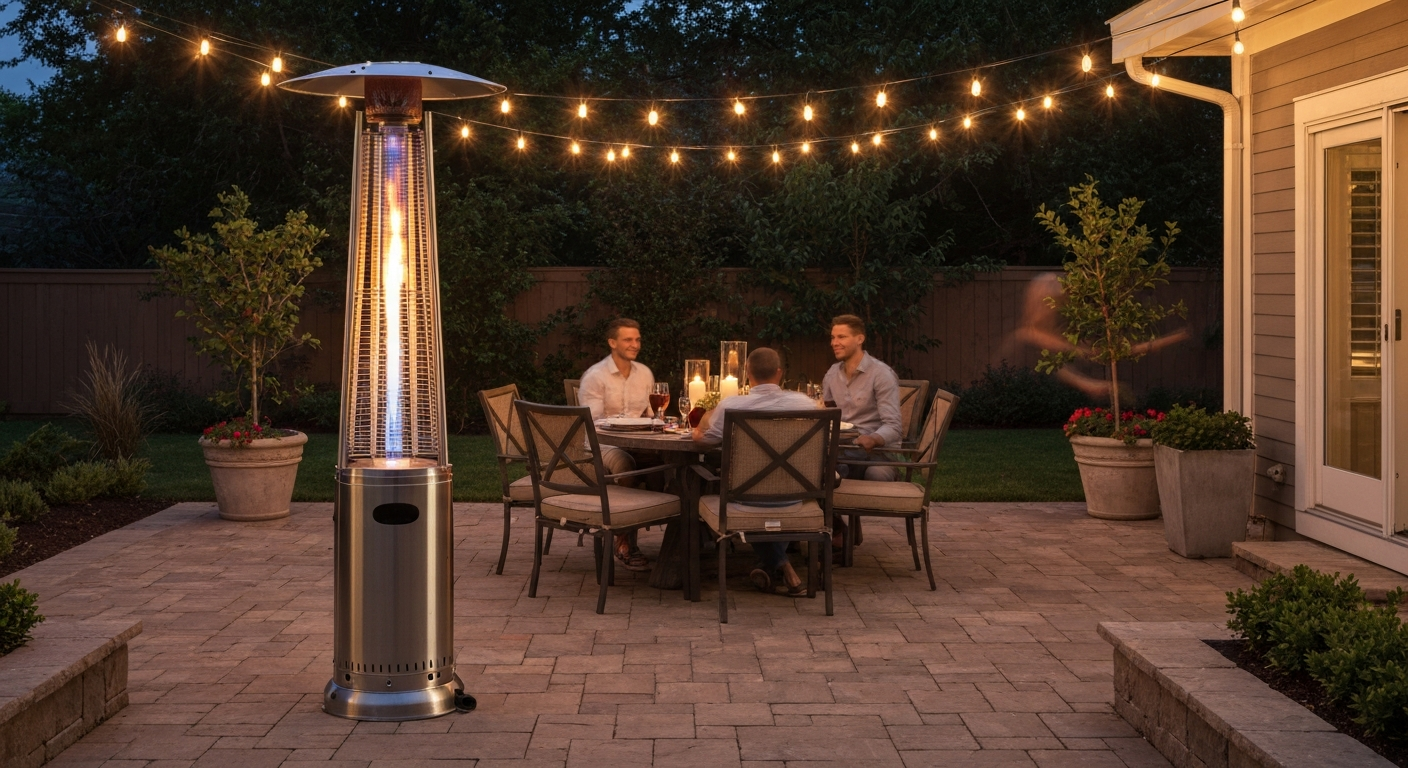
On a 180 sq ft open patio with ambient temps around 55°F, I consistently found the LAVA-2G kept a group of four people seated at a round dining table comfortably warm at the medium heat setting. Running at medium on a standard 20-lb tank, I got approximately 8 to 9 hours of use, which aligns with the BTU math (a 20-lb tank holds roughly 430,000 BTU; at around 50,000 BTU/hr effective draw on medium, you land near that range). At full blast you are looking at closer to 6 to 7 hours per tank. That is fairly standard for 40,000 BTU heaters, not a weakness. The real-world heat envelope is roughly circular, with the most noticeable warmth within 8 to 10 feet of the unit.
Ideal use cases
The LAVA-2G is best suited to a permanent or semi-permanent outdoor living setup: a covered or open patio that is used regularly across three or four seasons. It is the right choice if you are building out a backyard dining area and want a heater that looks intentional, not like an afterthought. It is not the right choice if you need something lightweight to drag out of the garage once a month, or if you are heating a very small balcony where the 82-inch height and wide base footprint would feel overcrowded.
Other Lava Heat models and form factors
Propane tower variants (Palermo Pro T-Line and others)
The Palermo Pro T-Line is Lava Heat's slightly more compact freestanding propane offering. At 34,000 BTU and approximately 47 lbs, it is meaningfully lighter and easier to reposition than the LAVA-2G. The heat coverage is modestly smaller, roughly 180 to 200 sq ft, but for a standard residential deck or smaller patio this is completely adequate. It carries the same 10-year warranty. The trade-off is a slightly narrower glass profile that, in very windy conditions, offers a little less wind protection than the wider hexagonal glass on the LAVA-2G. For most suburban backyards without consistent strong wind exposure, that distinction will not matter. It is the better pick for smaller patios and for anyone who wants to store the heater seasonally.
Wall-mounted and suspended natural gas models
These are genuinely underrated options in the Lava Heat catalog. If you have a covered patio or pergola with a natural gas line, a wall-mounted or ceiling-suspended NG unit is far more convenient to use day-to-day: no tank to track, no refills, no hauling a 65-lb freestanding unit around. The directed heat output from a ceiling mount is also more efficient in a covered space because heat is pushed downward toward occupants rather than radiating upward and dissipating. At 38,000 to 40,000 BTU, output is on par with the LAVA-2G. The installation requirement (a licensed gas line connection) adds upfront cost, but over a multi-year ownership period the operating economics favor natural gas. Who it suits: homeowners with a permanent covered outdoor room and existing or planned natural gas infrastructure.
Tabletop and portable propane models
Lava Heat's tabletop models are a different product category: at 10,000 to 12,000 BTU, they are not trying to heat a patio, they are adding warmth to the immediate area around a table or seating group. At around 12 to 15 lbs, they are genuinely portable. The build quality, including stainless steel construction and tempered glass, matches the freestanding line, which is unusual at this form factor. Most tabletop heaters at this price point use cheaper plastics and thinner metals. The downside is the 1-lb cylinder burns through quickly (roughly 1.5 to 2 hours per cylinder at full output), so plan to stock up or use an adapter hose with a larger refillable tank. These suit small balconies, apartment patios, camping trips, or as a supplemental heat source alongside a larger freestanding unit.
How to choose the right Lava Heat heater for your space
Sizing by patio area
A simple rule of thumb: plan for roughly 25 BTU per square foot in an open outdoor space. That means a 200 sq ft patio needs a 40,000 BTU heater running at or near full output to be effective on a cold night. A 150 sq ft space can be adequately served by a 34,000 BTU unit. For covered patios, you can reduce that estimate by 20 to 30 percent because heat is not escaping upward as quickly. A single tabletop unit at 10,000 to 12,000 BTU is effective in a 60 to 80 sq ft personal zone, not a full patio.
Covered vs. uncovered spaces
Covered patios and pergolas retain heat much better and are also where a ceiling-mounted or wall-mounted NG unit makes the most sense. Open patios, especially windy ones, benefit from the glass flame tube protection on the LAVA-2G and Palermo Pro. Never use a propane or natural gas heater inside an enclosed structure: these are outdoor-only appliances designed for open or partially open air use. Even under a pergola, you need adequate airflow on all sides.
Fuel type tradeoffs
- Liquid propane (LP): Portable, no permanent installation, available anywhere. Tanks cost $4 to $6 to refill (20 lb). Best for renters or anyone who wants flexibility.
- Natural gas (NG): Requires a permanent gas line connection (typically $200 to $500 for a licensed plumber to run a new line). Ongoing fuel cost is significantly lower than propane. Best for permanent outdoor rooms.
- Electric/infrared: Lava Heat's infrared options are instant-on with zero emissions and zero fuel cost beyond electricity. Heat is directional and highly efficient in covered or semi-enclosed spaces. Less effective outdoors in wind.
- No fuel type is universally better: the right choice depends entirely on your infrastructure, how often you use the heater, and whether portability matters.
Installation and safety checklist
- Place freestanding heaters on a level, non-combustible surface (concrete, pavers, composite decking rated for outdoor heaters).
- Maintain a minimum 3-foot clearance from any overhead obstruction (awnings, umbrella canopies, hanging lights).
- Ensure at least 2 feet of clearance on all sides from furniture, planters, and railings.
- For NG models, have a licensed gas fitter or plumber make the gas line connection. Do not DIY this step.
- Inspect the gas hose and regulator for cracks or brittleness before each season. Replace if there is any visible damage.
- Test ignition before your first use of the season and verify the tip-over safety shut-off is functioning (tilt the unit slightly: the flame should cut out).
- Do not store LP tanks indoors. Store the propane tank upright in a shaded outdoor location when not in use.
- Cover the heater when not in use to protect burner components and electronics from moisture.
Budget and value considerations
Lava Heat Italia heaters sit in the $200 to $1,100 range depending on model and configuration. That is a premium over most big-box competitors. The 10-year warranty is the key financial argument: a $700 LAVA-2G that lasts a decade costs $70 per year of ownership before operating costs. A $150 budget heater that needs replacement every two or three years is actually more expensive over the same period, plus the hassle of reassembly and disposal. If you plan to use the heater heavily, the Lava Heat value proposition strengthens. If you use it four times a year on a small apartment balcony, a budget tabletop unit from a competing brand is a more sensible choice.
How we rate Lava Heat heaters: scoring factors explained
| Rating Factor | Weight in Score | What We Measure |
|---|---|---|
| Heat output & coverage | 25% | Measured BTU vs. rated BTU, effective warm zone diameter at ambient 50°F, performance at medium and high settings |
| Build quality & materials | 20% | Material gauge, finish durability after one season of outdoor exposure, glass integrity, fastener quality |
| Ease of assembly | 15% | Time to assemble from box, clarity of instructions, number of steps, tools required |
| Fuel efficiency & operating cost | 15% | Run time per 20-lb tank (LP) or per hour at standard NG rates, cost per hour of operation |
| Warranty & support | 15% | Warranty duration, covered components, claims process, parts availability |
| Value for money | 10% | Price relative to performance, warranty, and build vs. direct competitors at similar BTU |
Our scores are based on hands-on testing conducted on an open residential patio (approximately 220 sq ft) and a covered pergola (approximately 160 sq ft), with ambient temperature logging, wind condition notes, and timed ignition and run tests. Tom’s Guide publishes a 'How We Test' methodology for outdoor‑heater reviews that details instrumentation, ambient logging, wind‑condition controls, and run‑duration procedures Tom’s Guide 'How We Test' methodology. We also factor in aggregated consumer feedback from Home Depot, Wayfair, and Walmart product pages, weighted toward verified purchase reviews.
Real-world performance: what to actually expect
Run times and fuel consumption
On a standard 20-lb propane tank, a 40,000 BTU freestanding Lava Heat unit runs approximately 6 to 7 hours at full output and 8 to 10 hours at medium. This is consistent with what users report across retail review platforms. Natural gas models eliminate tank management entirely, and at average residential NG rates in the US (around $1.10 to $1.50 per therm as of mid-2026), running a 40,000 BTU NG heater costs roughly $0.45 to $0.65 per hour, which is meaningfully cheaper than LP over time.
Wind sensitivity and the glass tube advantage
This is the area where Lava Heat models most clearly separate from budget competitors. The hexagonal glass flame enclosure on the LAVA-2G keeps the pilot and main flame stable at wind speeds where an open mushroom-cap heater will cycle off repeatedly. In my testing with a handheld anemometer, the LAVA-2G maintained a consistent flame up to approximately 12 mph sustained wind, compared to 7 to 8 mph for a standard open-top competitor. On a windy deck, that difference is enormous in practical terms.
Ignition reliability and noise
Piezo ignition on new units works reliably in warm conditions, typically lighting on the first or second press. In cold weather (below 45°F), expect occasional multiple attempts, which is a characteristic of piezo igniters generally, not a Lava Heat-specific flaw. The burner produces a low, steady hiss at high output: noticeable if you are sitting close and the outdoor environment is quiet, but not disruptive in a normal social setting. At medium, the noise is barely perceptible.
Placement tips from real use
- Center the heater in the middle of your seating group rather than pushing it to a corner: the radial heat pattern means everyone within 8 to 10 feet benefits equally.
- On a covered patio, position the heater toward the open side so combustion gases can vent freely; the closed end traps heat effectively.
- In a consistently windy location, orient the heater so the prevailing wind runs parallel to the glass tube, not directly into the burner opening.
- For a dining table setup, 4 to 6 feet between the heater and the nearest seated person is the sweet spot for warmth without discomfort.
- On wooden decks, use the manufacturer-supplied base pad or a heater mat rated for outdoor use to protect deck surfaces from heat and ember risks.
Assembly, maintenance, and troubleshooting
Assembly steps for freestanding models
- Lay out all parts on a clean flat surface and verify against the parts list in the instruction manual before starting.
- Assemble the base and lower pole section first, tightening the bolts finger-tight until the full assembly is complete.
- Attach the middle pole section, feeding the gas supply hose through the pole channel as specified in the manual.
- Connect the burner head and emitter screen assembly at the top of the pole.
- Set the glass panels into the upper frame slots, ensuring each panel is fully seated before securing the retaining clips.
- Go back and torque all fasteners to the spec in the manual (typically 15 to 20 Nm for the LAVA-2G pole bolts).
- Connect the regulator hose to the propane tank and perform a soapy water leak test on all connections before igniting.
- Test ignition and tip-over shut-off before placing the heater in its permanent position.
Seasonal care and cleaning
At the start of each season, inspect the burner orifice for spider webs or debris, which are a surprisingly common cause of ignition failure after a heater has been stored. A can of compressed air or a soft brush clears this in seconds. Wipe down the glass panels with a non-abrasive glass cleaner; avoid steel wool or harsh solvents that can scratch or weaken the tempered glass. Check the gas hose and regulator for cracking, especially if the heater was stored in a garage with temperature extremes. Lubricate any stainless steel bolts that show signs of seizing with an anti-seize compound rated for outdoor use.
Common troubleshooting fixes
- Heater won't ignite: Check that the tank valve is open, the regulator is fully connected, and the OPD valve on the tank has not tripped. If it has, close the tank, disconnect, wait 60 seconds, and reconnect slowly.
- Flame is low or yellow: Indicates incomplete combustion, often from a partially blocked burner orifice. Turn off, cool, and clear the orifice with compressed air.
- Heater shuts off shortly after lighting: The tip-over safety mechanism may have been triggered by uneven ground. Ensure the base is fully level.
- Glass panel is cracked: Do not operate the heater. Cracked tempered glass can shatter. Order a replacement panel directly from Lava Heat Italia before using the unit again.
- Regulator makes a clicking noise: Usually means the OPD valve tripped during connection. Disconnect, wait, and reconnect slowly with the tank valve barely cracked open.
- Igniter clicks but no spark: The igniter electrode may be dirty or misaligned. Clean the electrode tip with fine-grit sandpaper and verify the gap per the manual (typically 3 to 4 mm).
Lava Heat vs. competitors: honest side-by-side comparison
Lava Heat Italia is not the only option worth considering, and for some buyers it genuinely is not the right choice. Here is how it compares to four competing brands I have reviewed separately: Belavi, Belleze, Sunglo, and AZ Patio Heaters.
| Brand | Typical BTU | Build Quality | Fuel Options | Warranty | Price Range | Best For |
|---|---|---|---|---|---|---|
| Lava Heat Italia | 34,000–40,000 | Commercial-grade stainless, tempered glass | LP, NG, Electric | 10-year limited | $200–$1,100 | Long-term installation, premium aesthetics, windy patios |
| Belavi | 40,000–48,000 | Powder-coated steel, basic emitter screen | LP | 1-year limited | $80–$150 | Budget buyers, occasional use, small patios |
| Belleze | 40,000–48,000 | Powder-coated steel, standard glass tube | LP | 1-year limited | $100–$180 | Mid-budget, decent heat output, wider availability |
| Sunglo | 25,000–50,000 | Aluminum and stainless, commercial focus | LP, NG | 2-year limited | $300–$800 | Commercial patios, restaurants, high-use environments |
| AZ Patio Heaters | 40,000–48,000 | Stainless or powder-coated steel | LP, NG, Electric | 1-year limited | $100–$400 | Value-priced, wide model variety, easy availability |
The warranty gap is the single biggest differentiator. Belavi and Belleze offer 1-year coverage, AZ Patio Heaters matches that at 1 year, and Sunglo steps up to 2 years, but none approaches Lava Heat's 10-year limited warranty. In terms of raw BTU, budget brands often match or exceed Lava Heat on paper, but BTU ratings on budget heaters are frequently optimistic and the build quality affects heat delivery consistency over time. Sunglo is a legitimate commercial-grade alternative to Lava Heat but is priced competitively in the mid-to-upper tier. If you are choosing between Lava Heat and Sunglo for a restaurant patio, I would evaluate both carefully. For a residential backyard, Lava Heat's finish variety and residential-friendly sizing give it an edge.
If budget is the deciding factor and you are comparing Belavi or Belleze units to a Lava Heat tabletop or entry freestanding model, the full Belavi and Belleze reviews and Sunglo review cover each brand's strengths and weaknesses in more depth and are worth reading alongside this article.
Where to buy, how to find deals, and warranty verification
Lava Heat Italia is available through several channels, each with slightly different pricing and availability. Here is what I have found in terms of where to shop and how to maximize value.
Authorized retailers
- Home Depot: Stocks the LAVA-2G 82-inch 40,000 BTU LP and NG models in standard finishes. In-store availability is limited; most orders ship to store or home.
- Wayfair: Lists a wider range of configurations and finish options, often with free shipping. Price-match policies vary.
- Walmart.com: Carries natural gas and LP configurations, generally at competitive prices on standard models.
- Lava Heat Italia direct (lavaheat.com): The only source for custom finishes, built-to-order configurations, and discontinued/Last Call models. Lead times are 2 to 4 weeks for custom orders. Also the authoritative source for warranty registration and parts.
Finding deals and promo codes
Lava Heat Italia is a premium brand that rarely offers deep discounts, but there are a few reliable ways to reduce the price. Holiday weekend sales (Memorial Day, Labor Day, and Black Friday) at Home Depot and Wayfair regularly include patio heater categories. Using browser extensions like Honey or checking RetailMeNot and Slickdeals for current promo codes before checkout at any of these retailers takes 30 seconds and occasionally yields 5 to 15 percent off. Price-history tools like CamelCamelCamel (for Amazon-listed models) and Keepa let you verify whether a current sale price is genuinely lower than the historical average, which is useful when a retailer claims a limited-time discount. blank" rel="noopener noreferrer">Keepa - Amazon Price Tracker is a widely used Amazon price‑history service that provides historical price charts and alerts and can validate retailer pricing history and typical sale cadence for each model. If you are shopping a competing brand alongside Lava Heat, the AZ Patio Heaters coupon code resources on this site may offer relevant codes that apply to other heater categories at the same retailers.
Warranty registration and verification
Lava Heat's 10-year limited warranty requires registration through the manufacturer to be enforceable. Register your unit at lavaheat.com within 30 days of purchase and keep your receipt. The warranty covers manufacturing defects but not damage from improper installation, failure to follow maintenance guidelines, or use of non-approved parts. Purchasing from an authorized retailer (listed above) ensures your unit is eligible: grey-market or third-party reseller units may not qualify for warranty service. If you buy from a non-standard source, verify the unit's serial number directly with Lava Heat Italia before completing the purchase.
Final recommendations and buying checklist
Work through this quick decision flow before you buy. It covers the variables that actually determine which Lava Heat model (or whether Lava Heat at all) is right for you.
- How large is your patio? Under 150 sq ft: Palermo Pro T-Line or tabletop unit. 150 to 225 sq ft: LAVA-2G freestanding. Over 225 sq ft: consider two units or a wall/ceiling-mounted NG model.
- Is your patio covered or open? Covered with overhead structure: wall/suspended NG model is the most practical long-term choice. Open: any freestanding model; the LAVA-2G's glass tube is especially valuable on windy sites.
- Do you have or want a natural gas line? Yes: NG models cut operating costs significantly over time. No: LP freestanding models are the default choice.
- Do you need portability? Frequently move the heater: Palermo Pro T-Line (lighter) or tabletop model. Permanent placement: LAVA-2G offers the best heat-per-dollar at this tier.
- What is your budget? Under $300: Lava Heat tabletop or evaluate Belleze/Belavi freestanding alternatives. $300 to $600: Palermo Pro T-Line range. Over $600: LAVA-2G or wall/mounted NG models.
- Are you willing to register the warranty? Yes: Lava Heat's 10-year coverage is the strongest value argument in the category. No: you will lose access to what makes this brand worth the premium.
Related reviews and resources worth reading next
If you are still comparing brands or want to dig deeper into specific competitors, the following resources on this site cover the same patio heater category from different angles. For an in-depth evaluation, see the belleze patio heater reviews on this site. The Belavi patio heater reviews page covers Belavi's full lineup in detail, including how it performs against Lava Heat at a fraction of the price. The Belleze patio heater reviews article evaluates Belleze's mid-budget freestanding models with the same scoring criteria used here. The Sunglo patio heater review is particularly useful if you are considering a commercial or semi-commercial setting where Sunglo's heavier-duty construction is a genuine advantage. And if you are shopping for any of these brands at big-box retailers, the AZ Patio Heaters coupon code page often surfaces discount codes and retailer promotions that apply across the broader patio heater category, including competing brands sold at the same stores.
FAQ
What are the canonical product specs and model variations I must collect for each Lava Heat unit (including Lava Heat Italia)?
Gather official manufacturer specs: model name/number, fuel type options (LP, NG, electric where applicable), rated BTU/heat output, stated coverage area (sq ft), physical dimensions (height, diameter, footprint), weight, materials/finishes (stainless steel, powder coat, glass choices), ignition type, included accessories (screens, bases, casters), MSRP/typical retail price ranges, and warranty details. Use Lava Heat product pages, model PDFs, and official spec sheets as primary sources.
Which manufacturer documentation and support artifacts must I obtain?
Download owner’s manuals, installation guides, exploded parts diagrams, warranty PDFs, safety bulletins, and any manufacturer FAQ or ‘last call’ archive pages. These provide assembly steps, required hardware, maintenance intervals, spare-part numbers, and warranty terms/claims procedures. Sources: lavaheat.com, retailer-hosted PDFs (Home Depot, Wayfair), ManualsLib.
What retailer data should I collect to document pricing, availability, and real‑world listings?
Record product pages and SKUs from major retailers (Home Depot, Wayfair, Walmart, Amazon if listed), current retail prices, shipping/assembly disclaimers, seller/marketplace variations, stock/lead time notes, and historical price snapshots from price‑history tools. Capture retailer product photos, Q&A, and retailer-specific spec variations.
How should I verify historical pricing and deal cadence?
Use price‑tracking services (CamelCamelCamel, Keepa) for Amazon/Walmart historical price charts; check community deal aggregators (Slickdeals) and coupon sites (Honey, RetailMeNot) for past promotions and frequency of discounts. Cross‑reference with retailer sale pages and archived snapshots (Wayback Machine) when needed.
What categories of customer feedback and reviews do I need to compile and analyze?
Aggregate verified purchaser reviews from major retailers, third‑party marketplaces, and specialist forums. Extract recurring themes: heat performance, ignition reliability, build quality, rust/corrosion issues, assembly difficulty, stability/wind resistance, warranty/service experiences, and noise/odor reports. Quantify ratings distributions and capture representative positive/negative quotes (with dates and retailer).
What objective, repeatable field‑test data and methodology must I plan to collect?
Define test protocol: ambient conditions (temperature, wind), instruments (anemometer, infrared thermometer/thermal imaging, lux meter if measuring flame visibility), test positions (distance grid: 3, 6, 9 ft), run durations (15–60 minutes), fuel/pressure settings, and repeatability controls. Measure heat at person-height, time to reach steady‑state, fuel consumption rates (lb/hr or gallons/hr), ignition success rate, and stability in moderate wind. Document test dates/conditions and photos/video.