
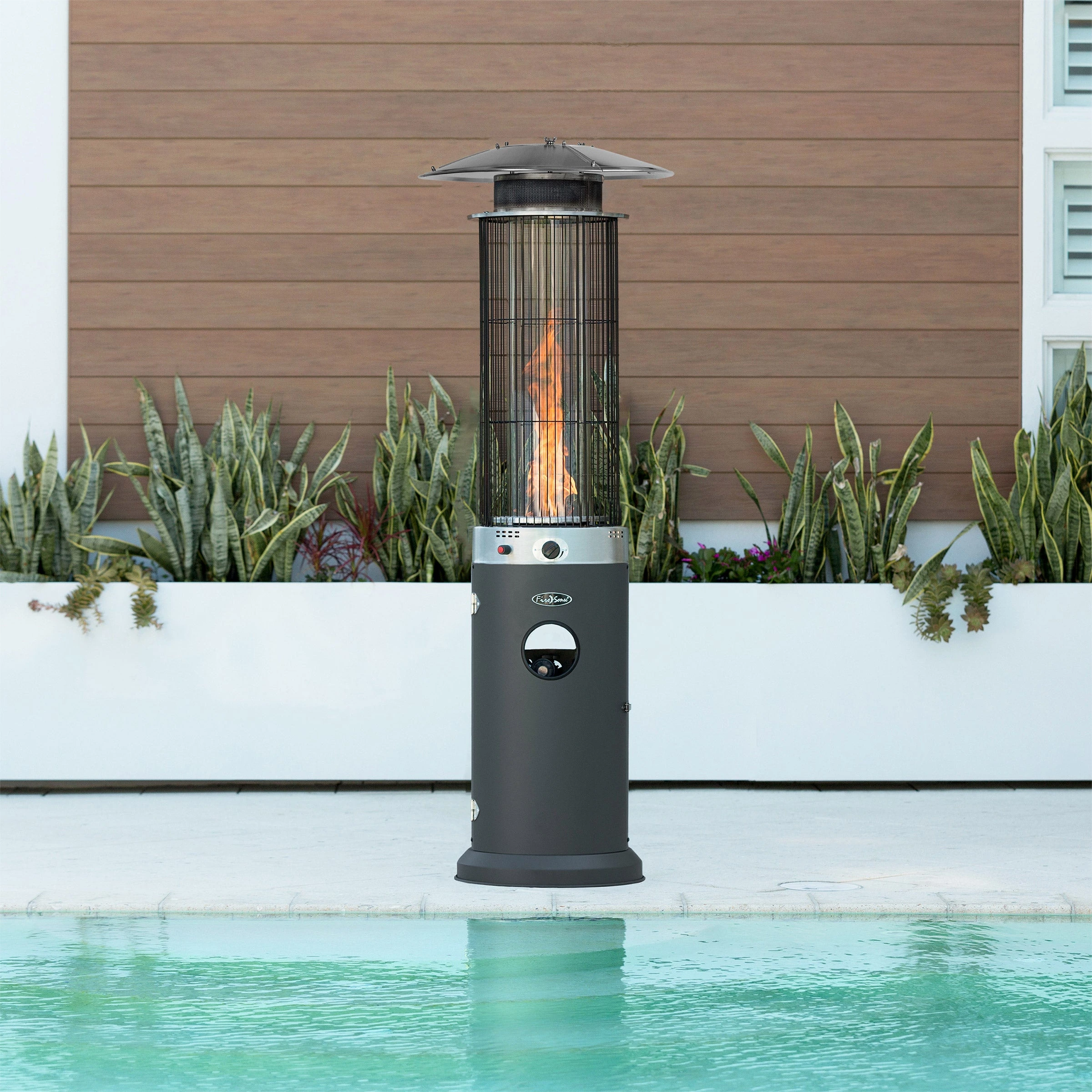
The 'Lux Patio Heater' sold at Costco is a Fire Sense-branded propane standing heater with 50,000 BTU of heat output, electronic ignition, and a wheel kit included. It's a solid mid-to-large patio heater for open or semi-covered outdoor spaces, but it has real limitations, particularly a 10 mph wind tolerance that makes it less practical in breezy yards. If that matches your setup, it's a reasonable buy. If not, there are better-suited options in the Fire Sense lineup or from competing brands worth considering first.
Lux Patio Heater Reviews: Best Models for Small to Large Patios

Willa Brennan
21 Jun 2026
Which 'Lux' patio heater are we actually talking about?
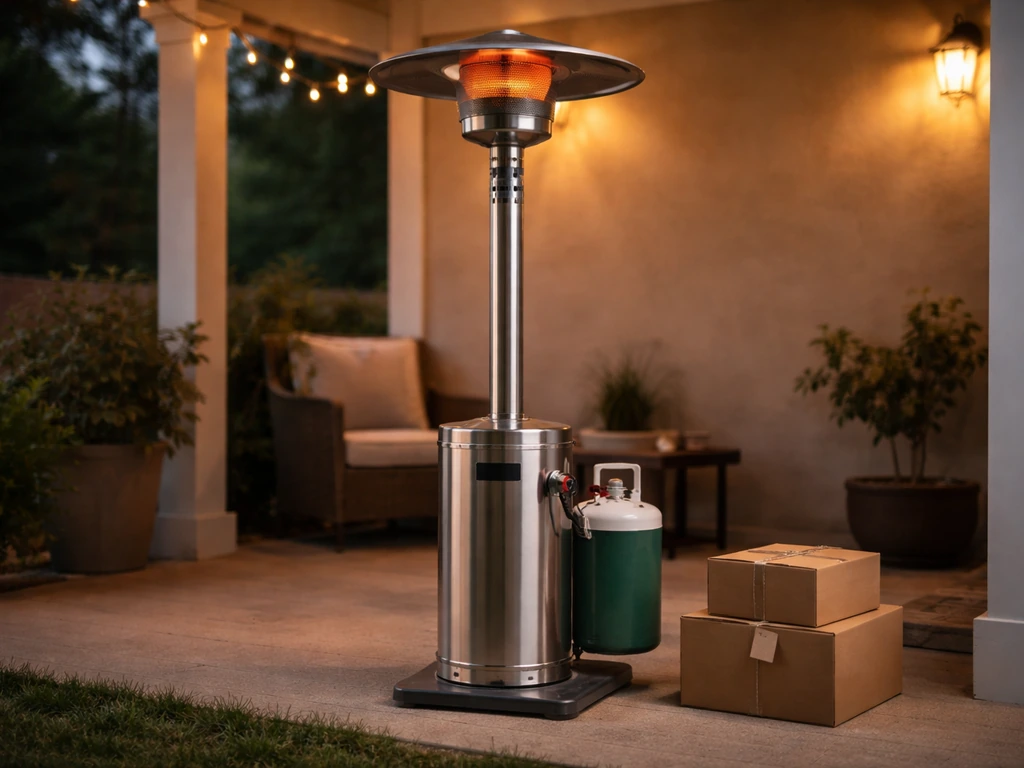
The name 'Lux' isn't a standalone heater brand, it's a product line label used by Costco for a Fire Sense propane patio heater (Costco Item 1452771 and 1452776). Fire Sense is the actual manufacturer, and they make a wide range of outdoor heaters across different BTU ratings, finishes, and styles. When people search for 'Lux patio heater reviews,' they're almost always looking for feedback on this specific Costco model, so that's the primary focus here.
Fire Sense also sells through Lowe's (for example, a 46,000 BTU stainless steel model under item 01775) and other major retailers, so you may encounter very similar units under slightly different names. The specs are close enough that reviews and real-world performance data across these models are largely interchangeable. The key differences come down to BTU rating, finish (stainless vs. hammered bronze vs. black), and minor feature variations like a square vs. round flame head.
Real-world performance: how the Lux/Fire Sense heater actually holds up
Heat output and coverage
At 50,000 BTU, the Costco Lux model is on the higher end for a residential propane standing heater. In calm conditions, you can expect to heat a circle roughly 15 to 18 feet in diameter, enough for a table of six to eight people on a medium-to-large patio. The 46,000 BTU Lowe's version covers slightly less but performs similarly in practice. Warm-up time is fast: you'll feel meaningful heat within a minute or two of lighting, which is one of the real advantages of propane over electric infrared in cold-weather situations.
That said, some buyers report feeling a little underwhelmed, particularly those expecting the heater to make a large open patio feel warm on a cold night. The honest reality is that no freestanding propane heater at this price point can heat a fully open 20x20 patio when it's 40°F outside. Think of it as a comfort zone creator: position it close to where people are sitting and it works very well. Treat it as a whole-patio space heater and you'll be disappointed.
Wind resistance and outdoor conditions
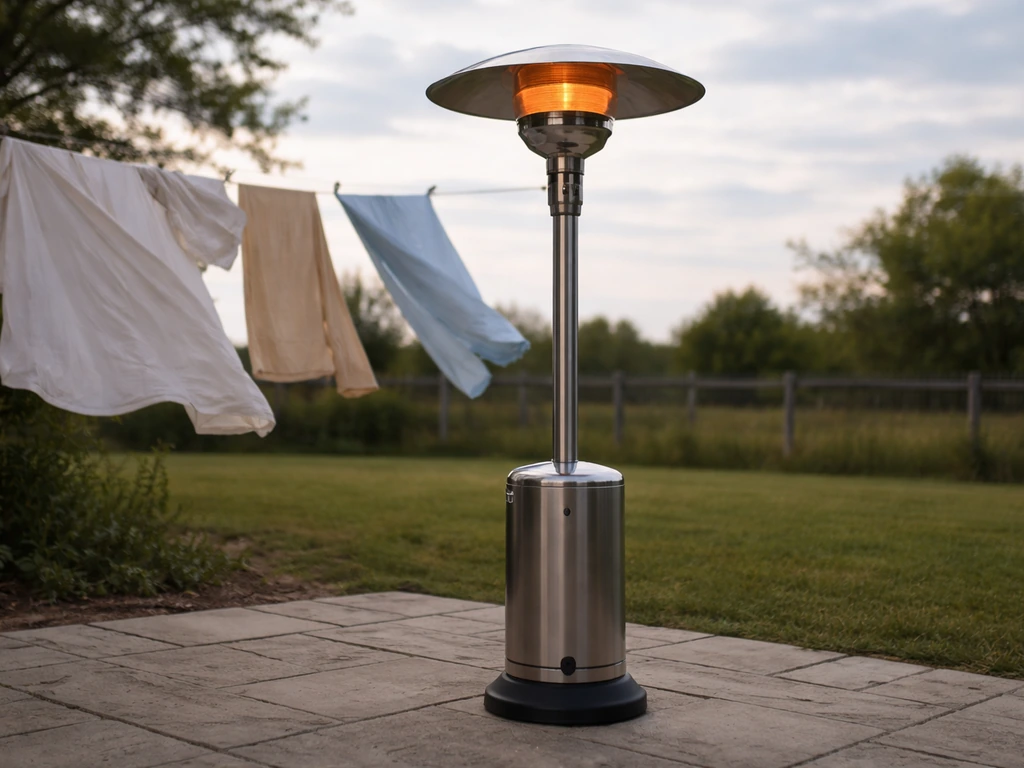
This is the biggest real-world limitation of the Lux/Fire Sense heater. The official manual states clearly: do not operate if wind velocity exceeds blank" rel="noopener noreferrer">10 mph. At that threshold, the flame becomes unreliable, the heater may cycle off, and heat output drops sharply because radiant warmth gets blown away before it reaches anyone. If you live in a coastal area, a hilltop, or anywhere that gets consistent evening breezes, this heater will frustrate you. It's best suited for still evenings in sheltered patios, covered pergolas, or backyards with natural windbreaks like fences or hedges. If you are also looking at a la hacienda patio heater, compare its heating coverage and wind behavior against the Lux/Fire Sense style to see which matches your outdoor setup Flex heater.
Build quality and stability
The unit weighs 56 pounds, which gives it a reasonably solid base. At 89 inches tall and 33 inches wide at the base, it's a standard mushroom-style standing heater. The included wheel kit makes repositioning easy, which is useful when you need to move it for storage or rearrange your patio layout. Build quality is acceptable for the price, this isn't a commercial-grade unit, but the materials hold up fine through typical residential seasonal use. Avoid leaving it outside uncovered through hard winters; the finish will deteriorate faster without a cover.
Fuel type and heating technology compared
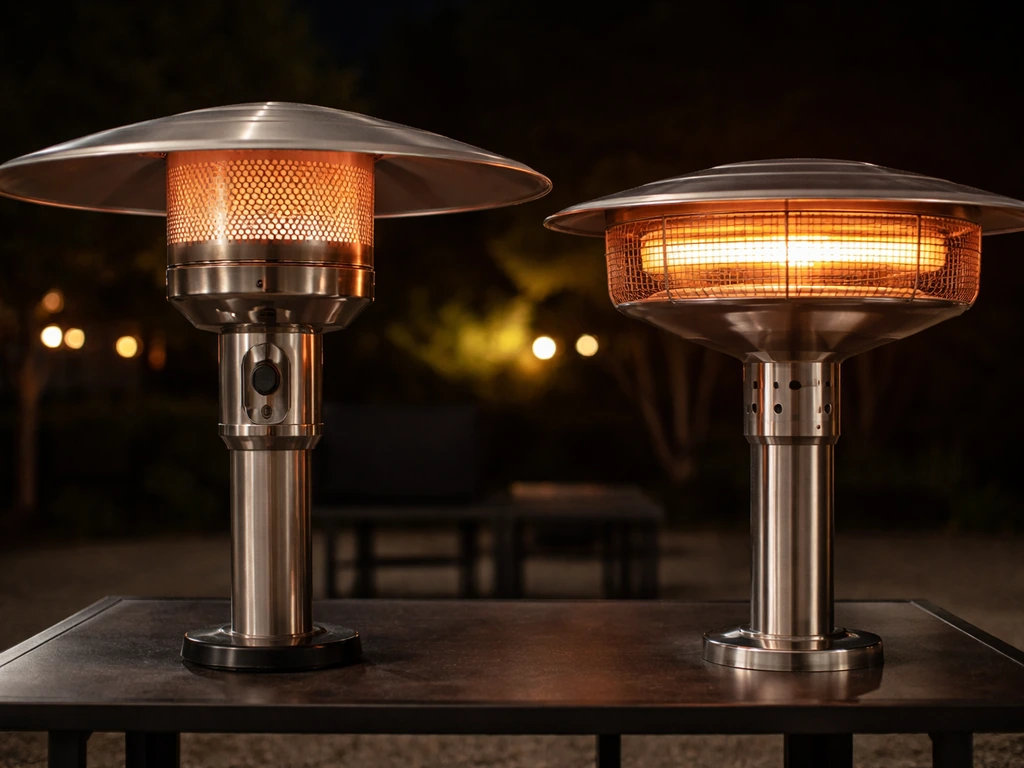
The Lux heater uses liquid propane with a mushroom-style radiant burner, the most common configuration for residential freestanding patio heaters. Here's how that stacks up against the main alternatives you'll encounter when shopping:
| Fuel/Type | Heat Output | Best For | Main Trade-off |
|---|---|---|---|
| Propane (Lux/Fire Sense) | 46,000–50,000 BTU | Open patios, portability, no wiring needed | Wind-sensitive, ongoing fuel cost, tank swaps |
| Electric infrared | 1,500–5,000W (5,100–17,000 BTU) | Covered patios, decks, wiring available | Lower output, needs outlet, less portable |
| Natural gas | 40,000–60,000 BTU | Permanent setups, frequent use, lower fuel cost | Requires gas line, professional install |
| Tabletop propane | 10,000–15,000 BTU | Small patios, bistro setups, apartments | Very limited coverage area |
| Pellet | Varies widely | Ambiance + heat combined, off-grid | Slower startup, more maintenance |
For most buyers who end up at the Lux/Fire Sense propane heater, propane makes sense because it's portable, doesn't require any wiring or gas line work, and delivers instant high output. The trade-off is that you're buying and swapping 20-pound propane tanks, which adds to operating costs and requires storage. If you run your patio heater heavily, a natural gas conversion or a permanently mounted natural gas heater will pay for itself over a few seasons.
How to choose based on your actual patio setup
Patio size
For a patio up to roughly 200 square feet with seating clustered together, the 50,000 BTU Lux heater is more than adequate, you may actually run it on the lower setting most of the time. For larger patios (300+ square feet), consider buying two heaters and positioning them at opposite ends of the seating area rather than trying to heat the whole space with one unit. A single 50,000 BTU heater is not going to warm a large open patio evenly.
Covered vs. uncovered spaces
Using any propane heater under a covered structure requires careful attention to clearance. The Fire Sense manuals require minimum clearance from combustible materials, and real users wrestling with louvered pergolas and covered patios have found that the tall mushroom-style heater can be tricky to fit safely under lower rooflines. If your covered patio has a ceiling height under 8 feet, a wall-mounted electric infrared heater or a lower-profile tabletop unit will be a safer and more practical choice than the standing Lux model.
Wind and exposure
Run through this quick check before buying: does your patio get wind gusts above 10 mph regularly in the evenings or fall/spring? If yes, the Lux propane heater will underperform. Your better options are a wall-mounted infrared heater (wind has far less effect on infrared panels than on open-flame heaters), or positioning the heater in a more sheltered corner of your yard with a windbreak behind it.
Controls, safety features, and convenience
The Lux/Fire Sense heater uses electronic ignition, which means no matches or manual lighters, you turn the knob, press a button, and it lights. This is a meaningful quality-of-life feature, especially compared to older piezo-style igniters that require multiple attempts. In practice, electronic ignition is reliable as long as the unit is well-maintained and the battery in the igniter is fresh.
The tip-over safety switch is the most important safety feature on this heater. It automatically shuts off the gas if the unit tilts beyond a set angle, critical for a tall, top-heavy unit like this one. Always make sure the heater is on a level, stable surface, and never place it on soft ground or decking with gaps that could allow the base to shift. The manual also emphasizes turning off the cylinder valve and disconnecting the regulator when the heater is not in use, not just turning off the burner knob. That two-step shutdown is important and easy to skip.
- Electronic ignition: no matches needed, but replace the igniter battery at the start of each season
- Tip-over safety switch: shuts off gas automatically if the heater tilts — make sure it's on level, firm ground
- Propane regulator and hose included: check for cracks or wear before each season
- No thermostat: output is controlled manually with the gas knob, not automatically
- No weather rating for operation in rain: bring it in or cover it when not in use
- Wheel kit included: makes moving and storing much easier
What it actually costs to run
A standard 20-pound propane tank holds about 430,000 BTU worth of fuel. Running the Lux heater at full 50,000 BTU output burns through that in roughly 8 to 9 hours. At current propane prices (exchange programs typically run $20 to $25 per 20-pound tank as of mid-2026), you're paying about $2.50 to $3 per hour at maximum output. In practice, most people run these heaters at medium output, which stretches a tank to 12 to 15 hours and drops the hourly cost closer to $1.50 to $2.
For context, electric infrared heaters running at 1,500W cost roughly $0.20 to $0.30 per hour at average U.S. electricity rates, significantly cheaper to operate. Natural gas standing heaters cost even less per BTU. If you're running your patio heater four or five nights a week through a full fall season, those propane costs add up noticeably. That's a real reason to consider natural gas if you have access to a gas line, or to look at electric infrared for a covered patio where the lower output is acceptable.
The shortlist: who should buy which option
Here's the practical breakdown based on patio size and situation:
| Situation | Best Pick | Why |
|---|---|---|
| Medium open patio, calm evenings, want portability | Lux/Fire Sense 50,000 BTU (Costco) | High output, easy to move, no wiring needed |
| Small patio or balcony | Tabletop propane or small electric infrared | Lux is too large and powerful for tight spaces |
| Covered patio with ceiling under 8 ft | Wall-mounted electric infrared | Safer clearances, wind-proof, no flame |
| Windy yard or coastal location | Wall-mounted electric infrared | Wind doesn't affect infrared output |
| Large patio, frequent use, gas line available | Natural gas standing heater | Lower long-term fuel cost, no tank swaps |
| Budget buyer, occasional use, open patio | Fire Sense 46,000 BTU (Lowe's model) | Similar performance, sometimes lower price |
Before you buy: quick checklist
- Measure your patio and identify where people will actually sit — one 50,000 BTU heater heats a zone, not a whole yard
- Check your ceiling height if the patio is covered — the Lux unit is 89 inches tall and needs clearance above
- Assess your typical wind conditions in the evening — if it regularly exceeds 10 mph, choose a different technology
- Confirm you have a level, stable surface for the heater base
- Budget for propane: plan on one 20-pound tank per 8 to 12 hours of use
- Buy a quality weatherproof cover to protect the finish between uses
- Check the regulator and hose for cracks before firing it up each season
- If buying for a covered pergola, verify clearances against the manufacturer's manual before installing
Common buying mistakes to avoid
- Expecting a single heater to warm an entire large open patio — it won't
- Installing under a low-ceiling covered patio without checking clearance requirements
- Ignoring the wind limitation and then wondering why the heater keeps cutting out
- Forgetting to turn off the cylinder valve (not just the burner knob) between uses
- Leaving it outdoors through winter without a cover, which accelerates finish deterioration
- Not budgeting for ongoing propane costs — they're modest per session but add up over a season
If you're comparing the Lux/Fire Sense against other brand-specific options, it's worth knowing that brands like Hiland, AZ Patio Heaters, Calcana, and La Hacienda offer their own takes on propane and gas standing heaters, each with slightly different build quality, BTU ranges, and price points. If you're also considering a Hiland unit, these Hiland patio heater reviews can help you compare coverage, wind tolerance, and overall value before you buy. The Fire Sense at Costco competes well on price, but those alternatives are worth a look if you want more finish options or commercial-grade durability.
Bottom line: the Lux patio heater from Costco is a practical, capable propane heater for calm-weather use on a medium open patio. If you are specifically looking for calcana patio heater reviews, compare its performance and coverage claims against propane and electric infrared alternatives like the Lux/Fire Sense model discussed here. Buy it if that's your situation. If your patio is windy, covered, very small, or you use a heater heavily enough that fuel costs matter, put that money toward a better-matched technology instead.
FAQ
Can I use the Lux/Fire Sense propane heater under a pergola or covered patio?
Check two things before purchase: the manufacturer’s clearance spec from combustibles, and the ceiling height over the flame path. For lower rooflines, a tall mushroom-style heater can be hard to position safely, so if your covered patio has a ceiling under about 8 feet, a lower-profile tabletop or wall-mounted infrared option is usually a better fit.
What happens if my yard has wind above 10 mph sometimes, not all the time?
Do not rely on “average” wind. The 10 mph limit is about gust conditions at heater height. If you regularly see gusty evenings in fall and spring, the flame can become unstable and you may get cycling or reduced warmth even when the heater seems to be running normally.
How should I position the Lux patio heater to get the best coverage for my seating area?
Because propane heat is directional and radiant, placement matters as much as BTU. A practical approach is to center the heater near where people sit, keep it within a few feet of the seating cluster, and avoid trying to heat the entire backyard footprint with one unit.
Is it worth switching from propane to natural gas for this style of heater?
If you have natural gas service available, a permanently connected natural-gas heater or a conversion option can lower operating cost and eliminate tank swaps. A propane heater is still reasonable for occasional use or if you do not have a gas line, but for frequent nightly use the fuel savings typically justify switching.
Why does electronic ignition sometimes fail, and what maintenance helps?
A fresh battery helps electronic ignition reliability, and you should also keep the burner area clean so airflow and ignition are consistent. If you notice repeated ignition attempts, inspect for debris and confirm the unit is level before troubleshooting further.
How many hours will a propane tank last on low or medium, not just full blast?
Fuel use is highest when you run full output. At 50,000 BTU it can be roughly 8 to 9 hours per 20-pound tank, while medium output typically stretches runtime to about 12 to 15 hours. If you are budgeting for the season, plan around your expected average setting, not the maximum.
What’s the best way to store the Lux patio heater between seasons?
First, move it only with the heater completely cool and secured, then store the propane tank safely. Leaving the unit outdoors uncovered through hard winters can shorten finish life, so use a real cover and store it sheltered when possible.
Are there specific safety tips for storing the propane tank and hose?
Propane tank storage matters. Keep the tank upright and never store it in living areas or where it can be exposed to high heat, and ensure the regulator and hose connection are in good condition before reconnecting.
Will the tip-over safety switch shut off the heater on uneven ground, and what surface is safest?
The heater is designed for a stable, level surface, and it is safest on hard, even ground or appropriate decking without gaps. If your outdoor surface is soft ground or has uneven boards, the base can shift and the tip-over switch can shut it down.
Why do some buyers say the Lux patio heater feels underpowered even though it’s 50,000 BTU?
Often, yes. Many users feel disappointed because they expect an open 20x20 patio to feel uniformly warm at 40°F with one standing propane heater. If your patio is large and fully exposed, consider multiple heaters or a technology that suits broad heating better.