
For most covered patios up to about 150 square feet, a wall-mounted or ceiling-mounted infrared electric heater in the 1,500W to 2,000W range is the best starting point. For open or semi-open spaces, you'll want to push to 3,000W or higher, and a freestanding tower-style unit gives you the flexibility to reposition it as conditions change. Tabletop electric heaters are fine for supplemental warmth right at the table but won't heat a whole patio. The type, wattage, and placement matter far more than brand name, and most real-world complaints in reviews come down to mismatched heater size, wrong placement, or ignoring the covered-vs-uncovered distinction.
Patio Heaters Electric Reviews: Best Picks by Patio Size

Willa Brennan
4 May 2026
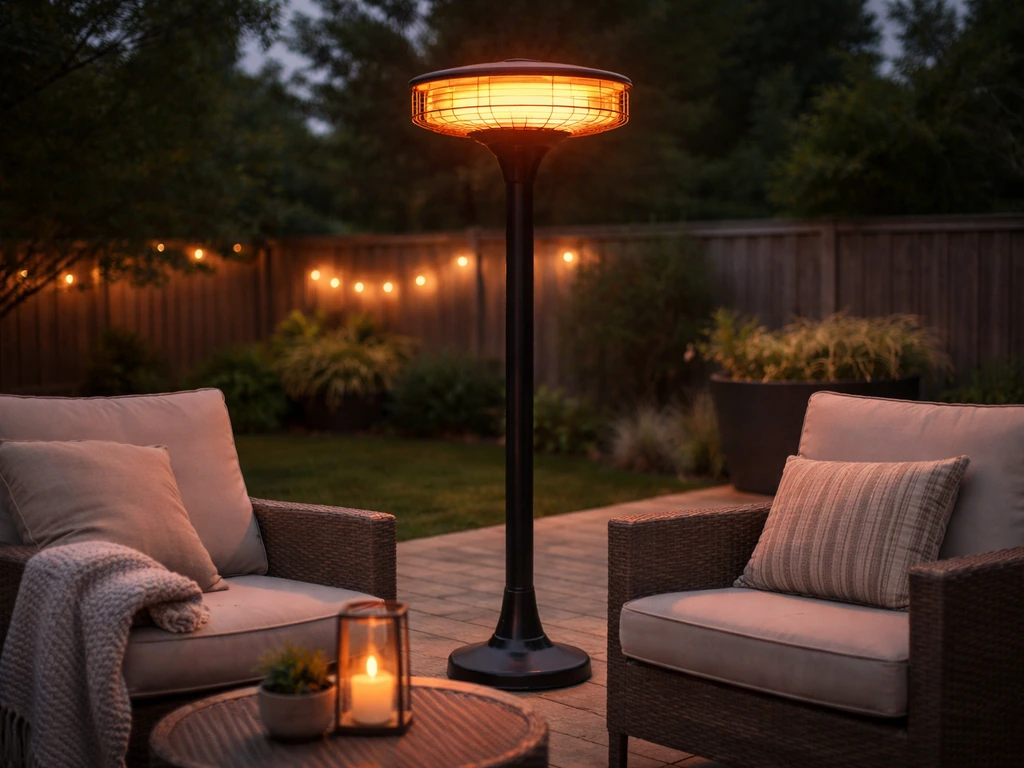
Which electric patio heater to buy for your specific setup
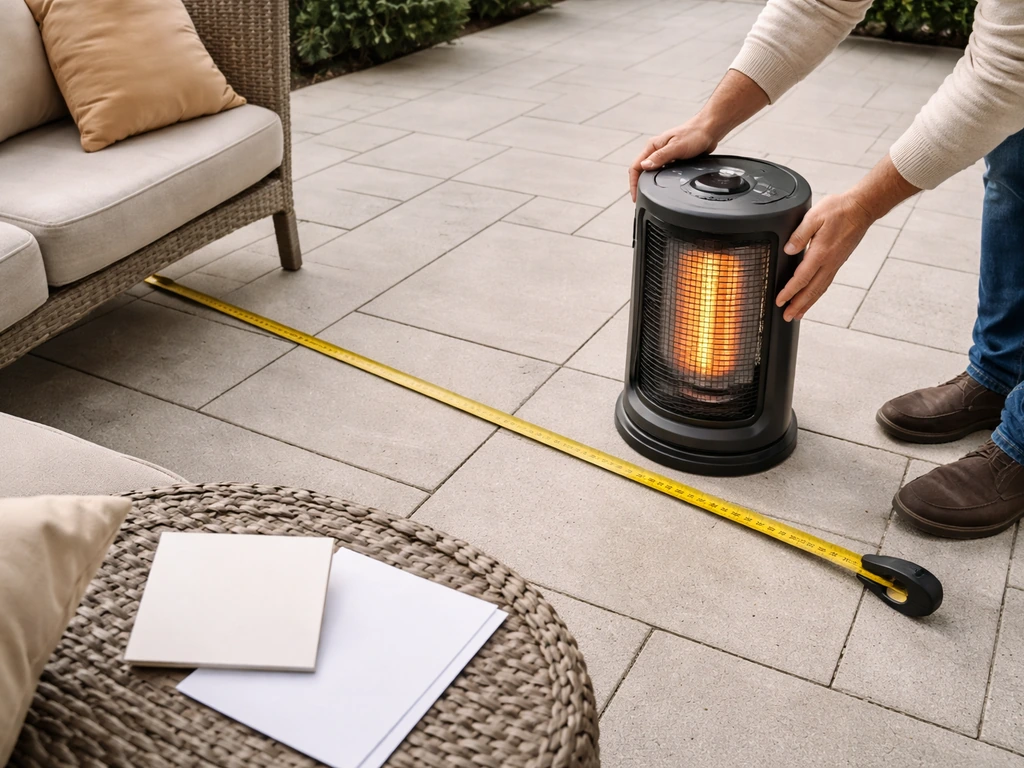
Rather than declaring one heater the universal winner, here's how to match the type to your actual patio situation. Electric heaters are genuinely not one-size-fits-all, and the scenario matters more than any single product recommendation.
| Your Patio Scenario | Best Electric Heater Type | Suggested Wattage | Notes |
|---|---|---|---|
| Small covered patio or pergola (under 100 sq ft) | Wall-mounted or ceiling infrared | 1,500W | Mount at 7–9 ft height, angled down toward seating |
| Medium covered patio (100–200 sq ft) | Wall-mounted infrared or hardwired ceiling unit | 2,000W–3,000W | May need two units for even coverage |
| Large covered patio or screened room (200+ sq ft) | Multiple wall-mounted units or commercial infrared | 4,000W–5,000W total | Zone heating works better than one large unit |
| Open or semi-open patio with some wind exposure | Freestanding tower electric | 2,000W–3,000W | Position close to seating; wind kills range fast |
| Apartment balcony or small deck | Freestanding tower or tabletop | 1,500W | Check outlet amperage; many balconies have 15A circuits |
| Supplemental warmth at the dining table | Tabletop electric heater | 700W–1,500W | Not a primary heating solution; adds comfort within 2–3 ft |
One standout model that earns consistent praise across multiple roundups is the Dr. Infrared Heater DR-238. Tom's Guide highlighted it for delivering clean, instant warmth with three switchable power steps at 900W, 1,200W, and 1,500W, plus remote control. It's a solid middle-ground pick for a covered patio up to about 150 square feet. For larger spaces, you'll need to either add a second unit or step up to a 3,000W or 4,000W hardwired model.
Electric heater types and how they actually differ
The biggest distinction in electric patio heaters is the heating technology: infrared versus resistive (halogen or quartz element). Most top-rated outdoor electric heaters today use infrared, and there's a good reason for that.
Infrared heaters
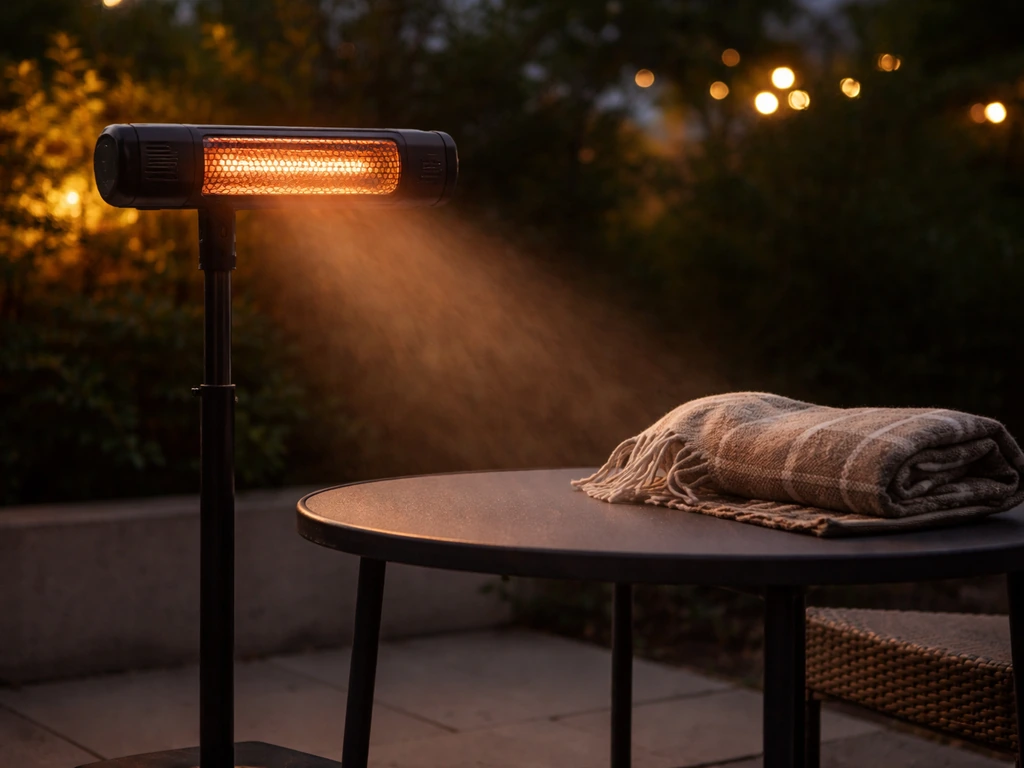
Infrared heaters work by radiating heat directly onto people and objects, not by warming the air. That's a meaningful difference outdoors because warm air dissipates instantly in a breeze. When you're sitting under an infrared panel on a chilly evening, you feel the warmth on your skin even if the ambient air temperature hasn't changed much. They also heat almost instantly, typically within seconds to a minute. The trade-off is that infrared heat is directional: you need to be in the beam's path, and if you move away or something blocks the line, you feel cold again. This is why placement is critical.
Halogen and quartz resistive heaters
Halogen-element heaters glow orange-red and produce a mix of radiant and convective heat. They're common in lower-cost freestanding tower units. They work reasonably well in still, calm conditions but lose effectiveness faster in wind. Quartz tube heaters fall in a similar category. These are fine for budget-conscious shoppers, but reviewers consistently note they feel less powerful than infrared panels of the same wattage rating.
Freestanding tower vs. wall-mounted vs. tabletop
Freestanding electric towers are portable and require no installation, which makes them popular for renters and anyone who wants flexibility. The downside is that they take up floor space, they can tip over, and the heat element is usually lower to the ground than a ceiling or wall unit, reducing its effective spread. Wall-mounted and ceiling-mounted units get the heat source up high (ideally 7 to 10 feet), which allows a wider, more even downward spread across your seating area. They're harder to install but are generally more effective for actual patio heating. Tabletop units are compact and convenient but are really just comfort additions within 2 to 3 feet of the heater, not whole-patio solutions.
Coverage in real life: patio size, placement, and wind

Manufacturer coverage claims are almost always optimistic. A heater marketed as covering 200 square feet might realistically heat a comfortable 100 to 120 square feet in calm, covered conditions. Take those specs as a ceiling, not a floor.
For wall-mounted infrared units, mounting height matters enormously. At 7 to 8 feet, a 1,500W unit covers roughly an 8x8 foot zone below it. Raise it to 10 feet and coverage expands but intensity drops. Most manufacturers publish an angle and height chart; use it. For ceiling mounts, tilt the unit 30 to 45 degrees toward the seating area rather than pointing it straight down.
Wind is the enemy of all outdoor heaters, but electric infrared handles wind better than propane convection heaters because it heats objects and people directly rather than relying on warm air. That said, wind still matters for how warm you feel. On an exposed deck in a 10 to 15 mph breeze, even a quality 2,000W infrared panel will feel noticeably weaker. In those conditions, positioning the heater closer to the seating area (closer than the manufacturer's maximum range) and using windbreaks like privacy screens or planters will help considerably.
Covered patios are where electric heaters genuinely shine. A pergola, roof overhang, or screened enclosure traps some warmth, reduces wind, and lets the heater work much closer to its rated output. Open, exposed patios are harder. If your patio is fully uncovered and regularly gets wind, a propane or natural gas heater with higher BTU output may genuinely outperform an electric option in raw warmth delivery, even if electric is cleaner and quieter.
Safety and weather ratings you need to check
This is one of the most important things to verify before buying, and one of the most commonly skipped steps. Not all electric heaters are rated for outdoor use, and using an indoor-rated unit outside is a genuine safety hazard. CPSC discusses NEC 210.8(F) as a GFCI (personnel protection) requirement for outdoor outlets, reflecting the need for proper outdoor-rated electrical protection Not all electric heaters are rated for outdoor use.
IP ratings explained simply
IP (Ingress Protection) ratings tell you how well a device resists dust and water. For outdoor electric heaters, look for at least IP44, which means protection against water splashing from any direction. IP55 is better for more exposed locations. IP65 means it's dust-tight and protected against water jets, which is suitable for most open patios. Anything below IP44 should only be used in fully covered, sheltered spaces. If a product listing doesn't mention an IP rating at all, that's a red flag worth investigating before purchasing.
Safety features to require, not just prefer
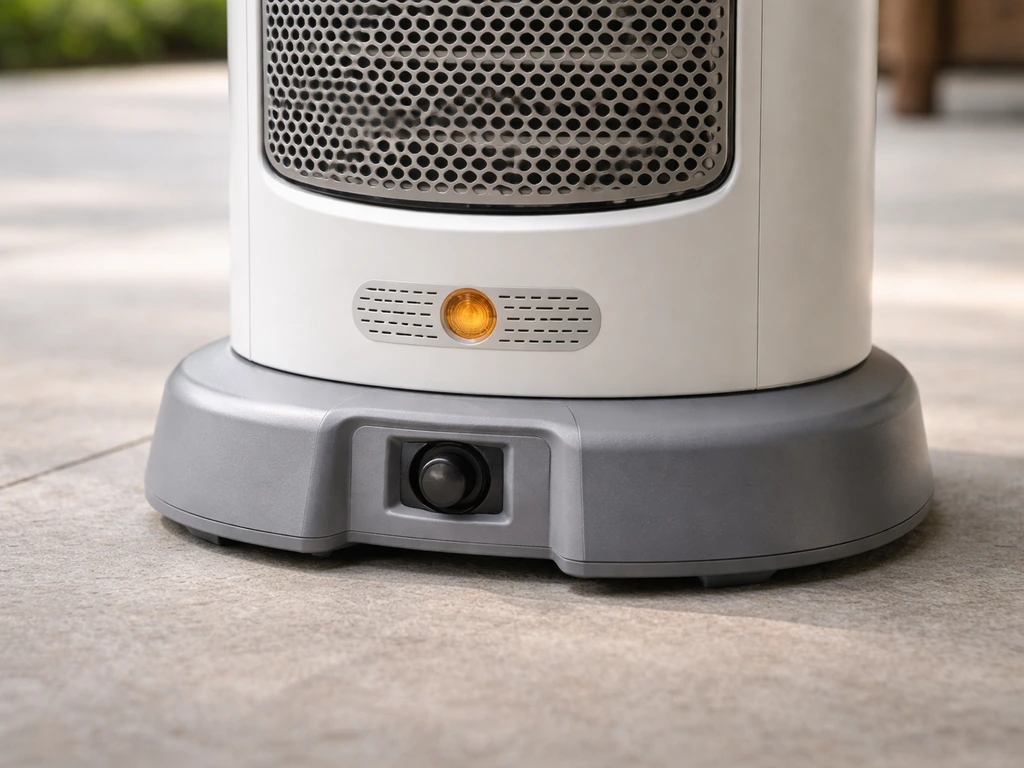
- Tip-over protection: automatic shutoff if the unit falls or tilts beyond a safe angle, critical for freestanding models
- Overheat protection: thermal cutoff that shuts the unit down if internal temps get too high
- Cool-touch housing: the outer casing should not reach dangerous temperatures even during extended operation
- Appropriate UL or ETL listing: look for certification marks confirming the unit has been tested to safety standards
- GFCI outlet compatibility: electric heaters outdoors should always be plugged into a GFCI-protected outlet, or be hardwired with proper protection
For covered patios with a ceiling clearance of less than 8 feet, always check the minimum clearance distance specified in the manual. Infrared units radiate significant heat upward as well as downward, and too little clearance can damage ceiling materials or create a fire risk.
What it actually costs to run an electric patio heater
Electric heaters are simple to calculate because wattage is wattage. There's no combustion efficiency variable, no fuel waste, and no pilot light burning when you're not using it. The math is straightforward: watts divided by 1,000 equals kilowatt-hours (kWh) per hour of use. At the average U.S. residential electricity rate of around $0.17 per kWh (as of 2026), here's what you're looking at: The EIA’s Short-Term Energy Outlook reports that electricity prices paid by U.S. residential customers average about 18.2 cents per kilowatthour in 2026.
| Heater Wattage | kWh per Hour | Cost per Hour ($0.17/kWh) | Est. Monthly Cost (3 hrs/day) |
|---|---|---|---|
| 900W | 0.9 kWh | $0.15 | $14 |
| 1,500W | 1.5 kWh | $0.26 | $23 |
| 2,000W | 2.0 kWh | $0.34 | $31 |
| 3,000W | 3.0 kWh | $0.51 | $46 |
| 4,000W | 4.0 kWh | $0.68 | $61 |
| 5,000W | 5.0 kWh | $0.85 | $77 |
Compared to propane, electric runs cheaper per hour at the 1,500W level but can become comparable or more expensive as you scale up wattage. A standard 20-pound propane tank powering a 40,000 BTU propane heater gives you roughly 10 hours of runtime at a tank cost of around $25 to $30, working out to about $2.50 to $3.00 per hour. A 4,000W electric heater at $0.68 per hour is significantly cheaper than propane for equivalent heat, though electric at that wattage may require a dedicated 240V circuit. Natural gas, where available and piped in, is typically the cheapest per hour but requires installation. Electric wins on convenience, zero emissions, and no fuel logistics, which is often worth the slightly higher operating cost for casual use.
One practical note on power requirements: most 1,500W and under heaters plug into a standard 120V/15A or 20A outlet. Units above 2,000W often require a dedicated 20A circuit or a 240V outlet. Check your patio's electrical setup before buying a high-wattage unit. Tripping a breaker repeatedly is a common review complaint that's entirely avoidable with a five-minute check upfront.
What real reviewers actually complain about
Digging through reviews across multiple roundups and consumer reports reveals a consistent pattern of complaints. If you're trying to compare options more directly, you can also look at patio heater reviews australia to see what buyers consistently flag for coverage, wind performance, and warm-up time. Knowing these in advance helps you avoid a frustrating purchase.
Hot spots and uneven warmth
This is the most common frustration. Infrared heaters heat in a cone or beam pattern, so the person sitting directly under or in front of the unit feels warm while someone two feet to the left feels little. If you want a shortcut, patio heat lamp reviews can help you compare which models actually perform for your space, mounting style, and weather conditions Infrared heaters. Reviewers often describe this as the heater being "too directional." The fix is usually a second unit to create overlapping coverage, or repositioning the existing one. One unit rarely heats a whole gathering evenly.
Warm-up time (or lack thereof)
Most quality infrared electric heaters reach full output within 30 to 60 seconds, which is a genuine advantage over propane heaters that take longer to heat up the surrounding air. But some lower-cost halogen and quartz models take 3 to 5 minutes to hit full intensity. If instant heat is important to you, check reviews specifically for warm-up comments, and lean toward carbon or ceramic infrared elements rather than halogen.
Controls and remote reliability
Remote controls and timers are popular features, but reviewers frequently report remotes failing within a season, having limited range, or losing pairing after a power interruption. If remote operation is a priority, look for models with app control or at least a remote that uses standard batteries and has verifiable replacement parts. Wall-switch compatible models (where the unit can be wired to a standard light switch) are often more reliable for mounted units.
Build quality and weather durability
Several reviewers note that cheaper freestanding towers show rust or element degradation after one to two seasons if left outdoors. Even IP-rated units benefit from a weather cover when not in use. The bracket hardware on wall-mounted units is another common weak point, with some units arriving with thin, poorly finished mounting hardware that doesn't feel secure at height. If the mounting bracket looks flimsy in product photos, trust that instinct. Patio heater cover quality is a related concern worth factoring into your total cost. If you want to compare options before buying, patio heater cover reviews can help you spot which covers actually protect well in real weather.
Not enough heat at distance
This is almost always a sizing issue, not a defect. Reviewers who chose a 1,500W unit for a 300-square-foot open patio are going to be disappointed. The heater is working as designed; it's just undersized for the space. Using BestReviews' general guidance, plan for 1,500W for small, sheltered spaces and scale up to 3,000W to 5,000W for larger or more exposed areas. Manufacturers' coverage claims tend to be generous, so going one tier up from what you think you need is usually the right call.
How electric stacks up against other fuel types
Electric isn't always the right answer, and it's worth being honest about that. Here's a plain-language comparison to help you decide if electric is genuinely the best choice for your setup.
| Fuel Type | Best For | Heat Output Range | Running Cost (approx) | Key Trade-off |
|---|---|---|---|---|
| Electric infrared | Covered patios, no fuel logistics, apartments, renters | 900W–5,000W | $0.15–$0.85/hr | Requires electrical outlet; higher wattage needs dedicated circuit |
| Propane | Open patios, large spaces, portability, no outlet needed | 30,000–48,000 BTU | $2.50–$3.50/hr | Fuel tank logistics, combustion produces moisture and CO |
| Natural gas | Permanent large patios, frequent use, lowest operating cost | 30,000–50,000 BTU | $0.50–$1.20/hr | Requires gas line installation, not portable |
| Pellet | Ambiance-focused setups, off-grid areas | Varies widely | Moderate | Higher maintenance, slower heat response, niche product |
Electric makes the most sense for covered or partially covered patios where you have a nearby outlet, for spaces under 200 square feet, and for anyone who values zero-emissions operation and plug-and-play simplicity. Propane is still king for large open patios and situations where running a long extension cord isn't practical. Natural gas wins on long-term operating cost if you already have a gas line. Pellet heaters serve a different need entirely, more about ambiance and a fire-like experience than raw heat output.
Specs to verify before you buy: your decision checklist
Before clicking buy on any electric patio heater, run through this list. It takes about ten minutes and will save you from the most common review complaints.
- Wattage vs. your patio size: aim for 10 watts per square foot for covered spaces, 15 to 20 watts per square foot for open or breezy areas
- IP rating: minimum IP44 for covered patios, IP55 or IP65 for exposed or semi-exposed locations
- Outlet and circuit compatibility: confirm whether the heater needs a standard 15A/120V outlet, a 20A dedicated circuit, or a 240V outlet before purchasing
- Mounting height clearance: check the manual for minimum ceiling clearance and confirm your space meets it
- Element type: carbon or ceramic infrared for fastest warm-up; halogen and quartz are acceptable but slower and less wind-resistant
- Safety features: verify tip-over protection (for freestanding units), overheat shutoff, and UL or ETL safety listing
- Heat settings: look for at least two or three power levels so you can dial back heat on milder evenings and save on electricity
- Controls: decide whether you need a remote, a timer, or app control, and read specific reviewer feedback on remote reliability for that model
- Mounting hardware quality: for wall or ceiling units, check whether the bracket is rated for the heater's weight with a safety margin
- Warranty and weather protection: look for at least a one-year warranty and check whether the manufacturer explicitly states the unit is rated for outdoor use
If you're comparing specific brands and models, patio heater ratings reviews and patio comfort heater reviews can give you a deeper look at user satisfaction trends across multiple seasons. And if you're planning to store the unit seasonally or leave it mounted year-round, having a properly fitted cover makes a real difference in longevity, especially for freestanding towers with exposed elements. For the best seasonal trends patio heater reviews, focus on how performance changes from fall to spring and how well each model holds up between uses.
The bottom line is that electric patio heaters are genuinely excellent tools for the right situation. Get the wattage right for your space, mount infrared units at the right height, respect the IP rating requirements for your level of weather exposure, and confirm your electrical setup can handle the load. Do those four things, and you'll avoid the majority of complaints that show up in reviews. If you want to narrow options faster, look for patio comfort heater reviews that specifically call out heat coverage, warm-up time, and how well the unit performs in wind. Most unhappy buyers didn't get a bad heater; they got the wrong heater for their specific patio.
FAQ
Do I need an outdoor-rated extension cord for patio heaters electric reviews often mention this, but how do I choose one?
Yes, if your heater is not hardwired. Choose a heavy-duty, outdoor-rated cord with the correct gauge for the heater’s wattage and keep the run as short as possible to reduce voltage drop. If the heater manual specifies a maximum cord length or requires a certain plug rating, follow that instead of relying on reviews.
What’s the safest way to use an electric patio heater near umbrellas, pergola beams, or railings?
Treat the heater like a heat-source that needs clearance in all directions, not just above it. Verify minimum clearance distances for the sides and any nearby combustible materials, and make sure fabric (umbrellas, curtains, covers) is not within the heater’s required keep-out zone. Also avoid placing heaters where people brush against the hot face or reflective element.
Can I use a ceiling-mounted infrared heater on a patio with low clearance (under 8 feet)?
You can sometimes, but you must follow the manufacturer’s minimum clearance distance from the warm radiating surfaces to the ceiling and any wiring. Infrared units can radiate upward, and too little gap can overheat the structure over time. If the manual gives only one “ideal” height and no “minimum safe” number, do not guess.
Are tower-style heaters or wall-mounted units better for uneven seating, like a couch and chairs at different distances?
For mixed seating distances, wall or ceiling mounts usually win because they create a broader downward footprint. If you stick with a tower, consider placing it closer to the farthest seating and aim it to cover both zones, or plan for two smaller units to create overlapping warmth. A single directional beam often leaves one side of the group noticeably cooler.
How do I interpret conflicting “coverage area” claims in patio heaters electric reviews when wind is involved?
Use the published coverage as a best-case ceiling, then reduce expectations for exposed patios. If a listing doesn’t say the assumed conditions (wind level, mounting height, outdoor temperature), assume fewer people will feel warm at the edges. For windy locations, prioritizing placement behind windbreaks often improves comfort more than buying a slightly higher wattage.
Will a 1,500W electric patio heater be enough if I only need warmth for people sitting close to it?
Often yes for “close comfort,” especially on covered patios, but you should not expect it to warm the whole surrounding air. Infrared works best in the beam path, so if your seating is mostly within a tight zone directly in front of the unit, 1,500W can be sufficient. If people sit off to the side or the group spreads out, you may need a second unit or a higher wattage.
What should I do if my patio is on a GFCI circuit and the heater trips it?
First, verify the heater’s stated electrical requirements and confirm the circuit can handle the load. Some heaters, especially higher wattage models, can trip breakers or GFCIs if the patio wiring is marginal or if an extension cord is undersized. Try a direct outlet connection (no extension cord), reset, and if it still trips, stop using it and consult an electrician rather than continuing to troubleshoot by trial.
How long should it take for an electric heater to feel warm, and why do reviews report different warm-up times?
Infrared designs typically feel warm within seconds to about a minute at full effect, but warm-up varies by element type (infrared ceramic or carbon generally faster than halogen or quartz). Reviews differ when users stand at different angles or distances, since radiant output is directional. Also check whether the unit has multiple power steps, some users only test at the lowest setting.
Do timers and remotes have common reliability issues, and what’s the best alternative?
Common complaints include limited remote range, pairing problems after power interruptions, or timer behavior that doesn’t match expectations. If you want the most dependable control, consider a model that supports wall-switch operation or uses a simple, non-proprietary battery remote. For mounted units, confirm that wall-switch wiring is allowed by the manual.
What’s the best way to protect an electric patio heater from weather when it’s stored seasonally?
Use a fitted outdoor cover and keep it dry between uses, especially for freestanding towers with exposed elements. Don’t rely only on the IP rating; covers reduce salt air and dust buildup and help prevent rust at brackets and fasteners. If the heater was wet, let it fully dry before covering and storing it to reduce trapped moisture issues.
Is it okay to mount an infrared electric heater under a pergola if it’s not directly attached to ceiling joists?
Only if the mounting system is rated for the load and the installer can attach to appropriate structural members. Thin or improvised mounting can loosen over time from vibration and heat cycles. Check for a specific mounting method in the manual, and if the bracket looks minimal or the hardware is generic, budget for stronger mounting hardware before installing at height.
Should I treat infrared directional heat as a deal breaker if I have a mixed crowd position?
Not necessarily. It becomes a problem when your seating spreads beyond the beam path. A practical solution is overlapping coverage using two units positioned so the main beam targets the center of the seating area and the outer seats fall within at least part of a second beam. If repositioning isn’t possible, consider a setup with broader spread, often achieved by higher mounting and correct tilt.