
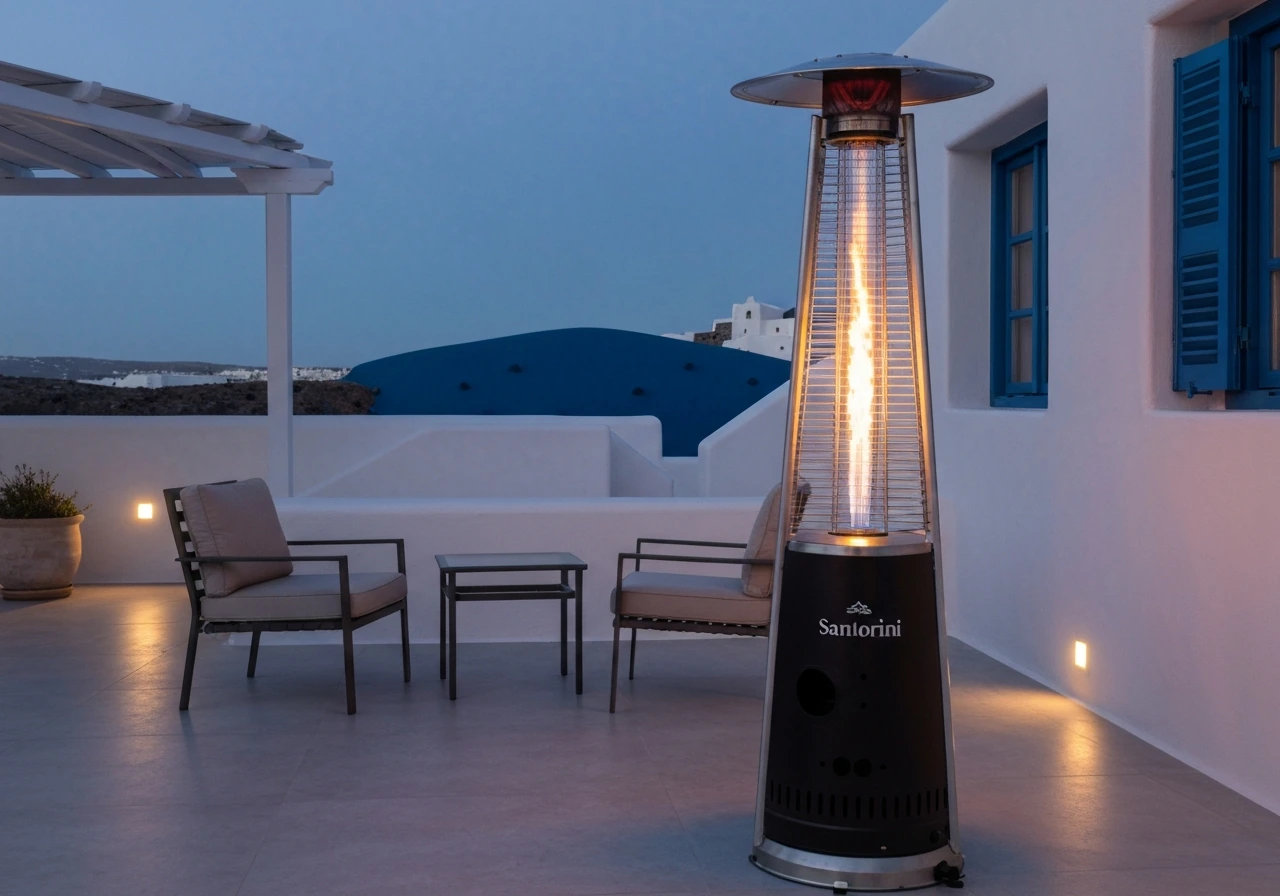
The two Santorini patio heaters worth knowing about are the Lifestyle Appliances Santorini Flame (LFS822) and the O.W. Lee Santorini fire table. The Lifestyle LFS822 is a freestanding gas patio heater with variable output up to 11 kW (roughly 37,554 BTU/hr), a retractable real-flame design, and electric ignition, solid for open patios and entertaining areas up to about 15 feet across. The O.W. Lee Santorini is a propane or natural gas fire table built for lounging setups where aesthetics and low, ambient warmth matter more than blasting heat across a large space. Which one is right for you comes down to how you use your patio, how exposed it is, and whether you want a dedicated heater or a centerpiece that also warms.
Santorini Patio Heater Review: Best Models for Patio Sizes

Willa Brennan
11 Jul 2026
Quick take: which Santorini patio heater is worth it
If you need functional heat output for guests on a mid-to-large open patio, the Lifestyle Santorini Flame LFS822 is the stronger performer. For more on what to expect, you can read our Dimplex patio heater review for practical guidance before you buy. At 11 kW with infinitely variable output (some retailers spec it as low as 5 kW on the low end), you can dial it back for mild nights or crank it up when temperatures drop. The retractable flame column looks great at a party and the tip-over safety cut-off is a reassuring feature. It weighs 26 kg and stands about 176–180 cm tall, so it's stable without being immovable.
The O.W. Lee Santorini fire table (model 5110-3658O) is a better fit if you want something permanently installed, dual-fuel capable (propane or convertible to natural gas), and built around a seating arrangement rather than a standing crowd. It's the kind of piece you put in the center of a conversation set, and people warm their hands over it rather than standing under a heat column. It's a premium product with premium pricing, and it shines in covered or semi-covered entertaining spaces where you want ambiance as much as warmth.
| Model | Fuel Type | Max Output | Best For | Install Style |
|---|---|---|---|---|
| Lifestyle Santorini Flame LFS822 | Gas (propane or natural gas) | 11 kW / ~37,554 BTU/hr | Open patios, parties, portable use | Freestanding, portable |
| O.W. Lee Santorini Fire Table 5110-3658O | Propane or natural gas (convertible) | Listed BTU (fire table range) | Lounging setups, covered patios, permanent installs | Semi-permanent, tabletop/fire table |
Fuel type and performance: gas, propane, electric, and pellet options
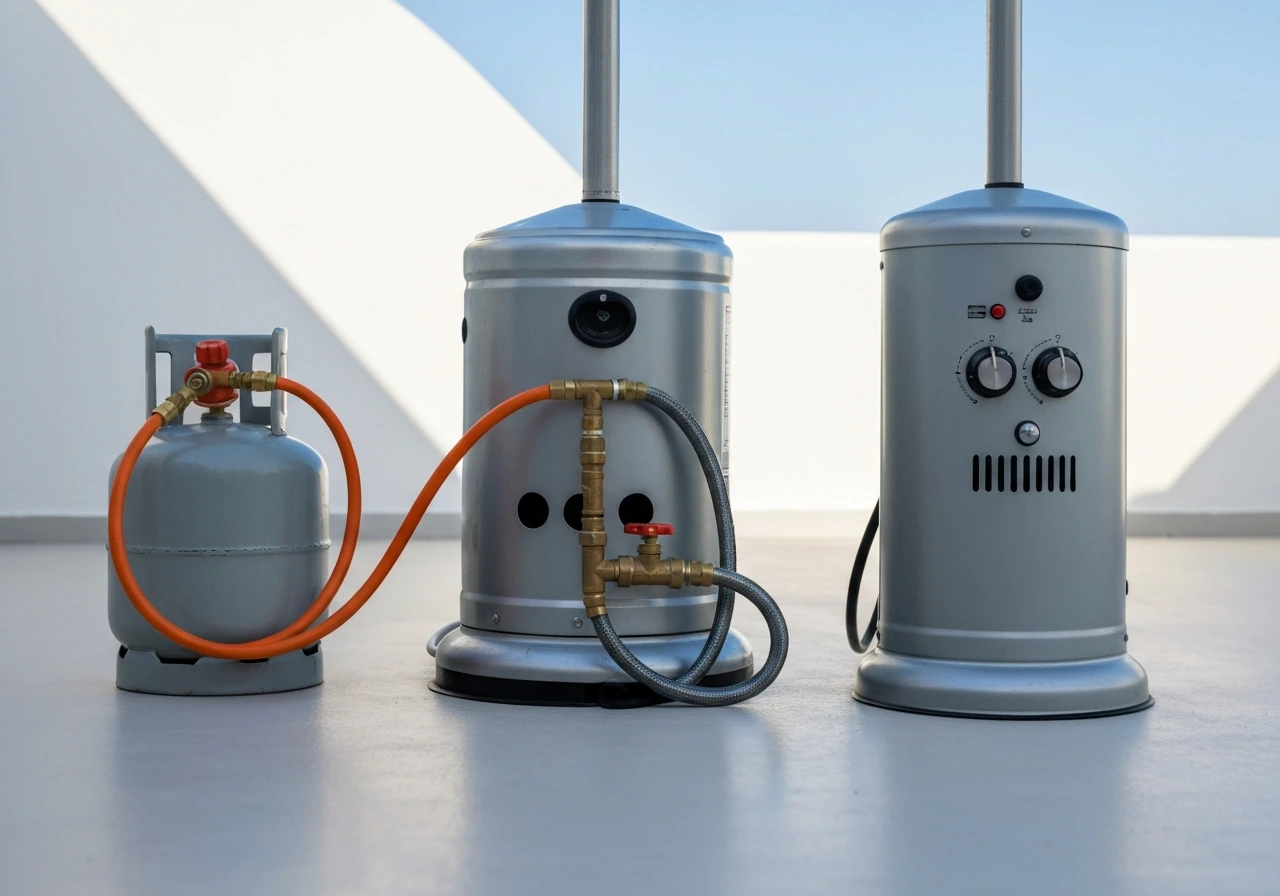
Both main Santorini products run on gas, either bottled propane (LPG) or natural gas with the appropriate conversion. There are no Santorini-branded electric or pellet models in the current lineup, which matters if you were hoping to avoid a gas connection. That said, gas heat has real advantages for outdoor use: instant ignition, high BTU output, and the visual appeal of an actual flame. The LFS822's electric ignition makes lighting easy, and variable output means you're not locked into full blast all night.
Propane is the more flexible option because you just swap the cylinder, no permanent gas line needed. A standard 13 kg propane cylinder running an 11 kW heater at full output will last roughly 5 to 6 hours, so factor that into event planning. If you're running the O.W. Lee fire table on natural gas, you get unlimited fuel but you need a qualified installer to run the line. Either way, both Santorini products support both fuel paths, which is more versatility than many competitors offer.
If you specifically need electric, pellet, or infrared panel options, you're looking at different brands. Dimplex makes well-regarded electric infrared patio heaters, and Dyna-Glo covers a wide range of propane and electric models at various price points. The Santorini range is purpose-built around flame-based gas heat, and that's what it does best.
Heating coverage: matching the heater to your patio size
A rough rule for gas patio heaters: 10,000 BTU covers roughly 100 square feet on a calm night. The LFS822 at 37,554 BTU can theoretically handle around 300 to 375 square feet, but that's ideal conditions. In real life, coverage shrinks with wind, open-sky exposure, and colder ambient temps. For an uncovered 15x20 foot patio (300 sq ft) with moderate wind, one LFS822 placed centrally will keep people within about 8 feet comfortably warm. If you want a quick lynx patio heater review angle for buying decisions, focus on heat coverage, fuel type, and how well it performs in wind. For larger spaces, two units staged at opposite ends works better than trying to maximize a single heater.
The O.W. Lee fire table works differently. It's not designed to heat a large area, it creates a warm zone around the seating arrangement, typically 6 to 8 feet in diameter. It excels in covered outdoor rooms, pergolas, or enclosed patios where the heat isn't instantly escaping into open sky. Think of it as a campfire replacement: people gather around it, and that's the warmth experience.
Wind exposure and covered vs open setups
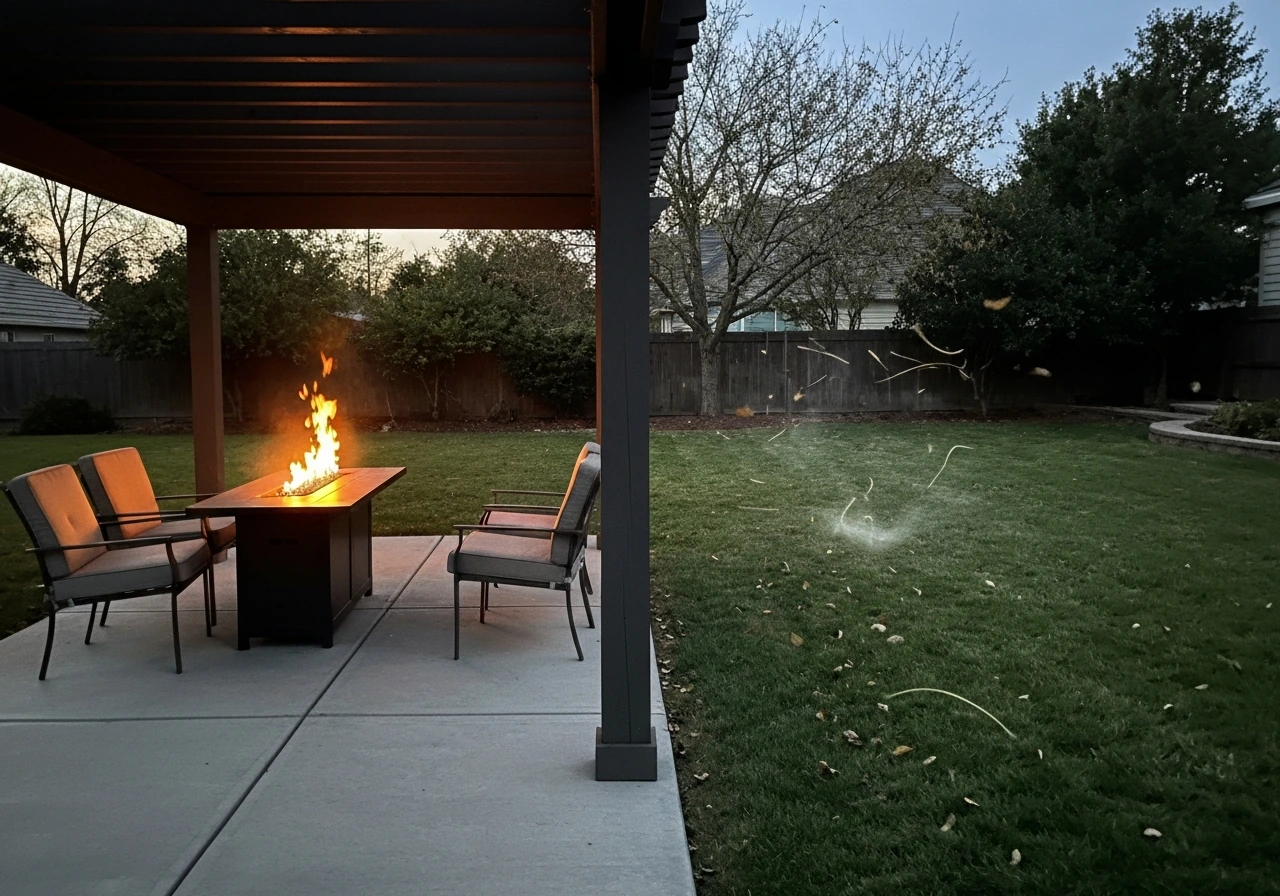
Wind is the single biggest enemy of outdoor heat. An 11 kW gas column heater in a completely open backyard on a breezy evening will feel noticeably weaker than the same heater on a sheltered patio. For windy, open environments, position the LFS822 so it's slightly upwind of where people are sitting, and consider adding a wind break like a fence panel or outdoor screen. The retractable design of the LFS822 can also help, lower the flame column on very windy nights for more stable combustion.
Covered patios and pergolas are where the O.W. Lee fire table really earns its value. The overhead surface traps rising heat and reflects it back down, meaning you feel more warmth from fewer BTUs. Just be very careful about clearances, more on that below.
Infrared vs radiant flame heat: what you actually feel
Neither Santorini product is an infrared heater in the technical sense. Both produce convective and radiant heat from an open gas flame, which means they warm the air around them as well as objects and people in line of sight. Dedicated infrared heaters (think quartz or ceramic-element electric panels) work differently: they emit directional infrared radiation that heats surfaces and people directly without warming the air in between. That makes pure infrared heaters more efficient in windy spaces because the wind can't carry the heat away as easily.
With the LFS822 and O.W. Lee fire table, you're getting traditional flame radiant heat. It feels warmer and more natural to most people, the glow and visual warmth of a real flame is part of the experience, but it's less targeted than an infrared panel. On a still night, both Santorini products feel excellent. On a gusty night, a directional infrared heater would outperform them. If wind is a consistent issue on your patio, that's worth weighing before committing.
Warmup time is basically instant with both Santorini units, light them and you're feeling warmth within seconds. That's a genuine advantage over some electric infrared systems that need a minute to reach operating temperature, and a big advantage over pellet heaters that can take 10 to 15 minutes to get going.
Safety, clearances, and what the codes actually say
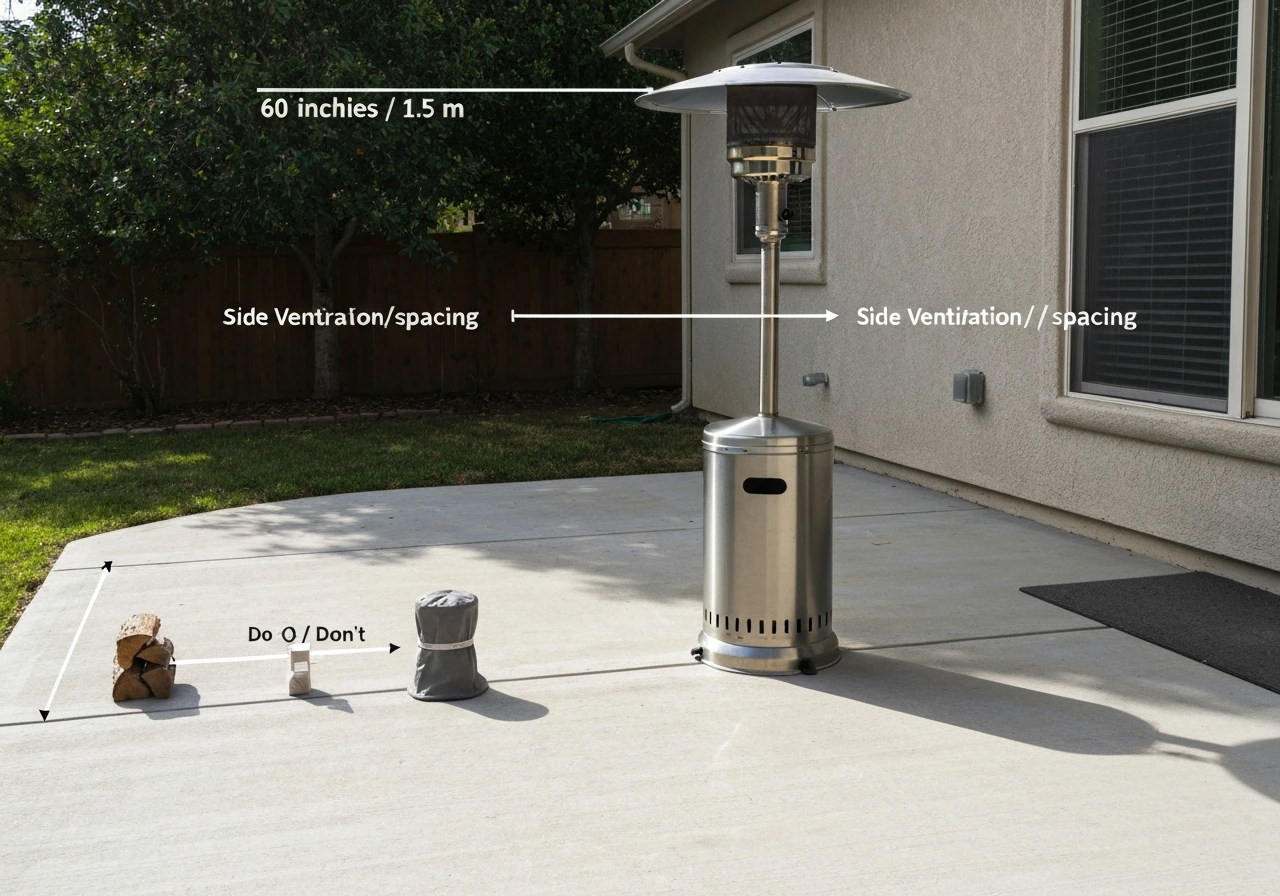
This is where people skip ahead and then regret it, so read this part carefully. The O.W. Lee installation guidance requires a minimum of 60 inches (1.5 meters) of clearance above the fire pit to any ceiling or overhang, and 60 inches from the center of the unit to any combustible sidewall. That's a 5-foot bubble in every direction, which is more than most people assume. If your pergola rafters are only 7 feet up, a fire table centered under them doesn't leave the required clearance.
The LFS822 manual is equally firm about ventilation: the heater must only be used outdoors or in amply ventilated areas. Use in any enclosed space is explicitly prohibited, and the manual notes that the unit does not have an atmosphere sensing device (a carbon monoxide safety shutoff). That means it won't warn you if CO is building up in a semi-enclosed space. Keep this in mind if you're thinking about using it inside a screened porch or under a low-clearance gazebo.
Gas connections must comply with the relevant fuel-gas codes. In the U.S., that's ANSI Z223.1/NFPA 54 for natural gas and CSA B149.1 for propane. Before installing a natural gas line to either unit, have a licensed gas fitter make the connection. Even if you're just hooking up a propane cylinder, do a leak test with soapy water on every gas fitting before the first light-up.
- Minimum 60 inches clearance above (O.W. Lee) — measure your pergola or overhang before you buy
- Minimum 60 inches from center to any combustible sidewall (O.W. Lee)
- Never use the LFS822 or any open-flame gas heater in enclosed or poorly ventilated spaces
- No atmosphere sensing device on LFS822 — don't rely on it as a safety shutoff for CO buildup
- Leak-test all propane connections before first use
- Natural gas installs require a licensed gas fitter and must meet local codes (ANSI Z223.1/NFPA 54 in the U.S., CSA B149.1 in Canada)
- The LFS822 has tip-over protection — don't disable it, and place the heater on flat, level ground
- Store propane cylinders upright, outdoors, and away from heat sources
How to pick the right Santorini heater: a buying checklist
Before you buy, work through these steps in order. It takes about 10 minutes and will save you from returning a heater that technically works but doesn't fit how you actually use your patio.
- Measure your patio and note whether it's covered (pergola, roof), semi-covered (sail shade, open pergola), or completely open. This determines which Santorini product is even appropriate and what clearances you need to check.
- Estimate the square footage you want to heat. Multiply length by width in feet. Under 200 sq ft with light use: either product works. 200–400 sq ft open patio: the LFS822 is better suited. Larger than that or multiple zones: plan for two heaters.
- Check your wind exposure. Regularly breezy? The LFS822 with a windbreak, or consider whether a directional infrared heater from another brand might serve you better. Still evenings only? Both Santorini options work beautifully.
- Decide on fuel. Want portability and no gas line? Propane with the LFS822. Want 'set it and forget it' with unlimited fuel? Natural gas connection with either unit. No gas access at all? Look at electric options — the Santorini range doesn't cover that.
- Confirm clearances before finalizing. Measure the height of your overhang or ceiling. If it's under 60 inches above where the heater will sit, neither Santorini gas product is safe there — period.
- Match the heater to the use case. Dining and conversation circles around a table: the O.W. Lee fire table. Standing parties, large open gatherings, general patio warmth: the LFS822 column heater. Both functions on the same patio: consider one of each if budget allows.
- Check your local permit requirements. Some municipalities require permits for permanent gas line installations or fire features. Call your local building department if you're installing the O.W. Lee on a natural gas line or hardscaping the LFS822 into a permanent spot.
- Compare warranty and service access. Both products carry a 1-year guarantee as a baseline. The O.W. Lee is a premium brand with established dealer service; confirm a local dealer can support you before purchasing.
One last thing worth saying: the Santorini name appears on two quite different products from two different manufacturers, and the buying experience is not the same. The Lifestyle LFS822 is widely available through general retailers and hire companies, making parts and service relatively accessible. For example, a hire partner page for the 11.0kW Santorini Flame gas patio heater provides rental setup and operating context specifically for the LFS822 blank" rel="noopener noreferrer">Lifestyle LFS822 is widely available through general retailers and hire companies. The O.W. Lee Santorini is a specialty outdoor furniture product typically sold through higher-end hearth and patio dealers. If you're comparing either of these against other brands, say, you're also looking at Crown Verity or Lynx for a high-output professional-grade setup, the deciding factors will usually come down to dealer support and long-term serviceability as much as initial specs. If you want a professional-grade alternative, a Crown Verity patio heater review can help you compare heat output, build quality, and how it performs in real outdoor conditions. Buy from a brand and a dealer you can actually reach when you need a replacement igniter three winters from now.
FAQ
Can I use the Lifestyle Santorini Flame (LFS822) in a screened porch or under a gazebo?
Check whether your space is open-air, screened, or partially covered. Even with a screen, semi-enclosed setups can trap combustion byproducts, and the LFS822 does not include an atmosphere or CO-sensing shutoff. If you plan to use it under a gazebo, confirm the manual’s “outdoors or amply ventilated” requirement still holds for your exact layout.
What clearance mistakes cause the most problems with the O.W. Lee Santorini fire table under a pergola?
For the O.W. Lee fire table, clearance is based on distance from the unit and from the fire area to overhead surfaces. A common mistake is measuring to rafters rather than to the specified clearance envelope, so verify your overhead height and that there are no nearby combustible side elements within the required sidewall clearance.
Which fuel choice is better for event planning, propane cylinders or natural gas?
Yes, but do it intentionally. Propane bottles typically have a finite run time, so plan events with the heater’s BTU output set correctly for the night, not always at full. For natural gas, you avoid refills but must ensure code-compliant gas line work and a reliable shutoff valve accessible to you.
Why does the heater coverage estimate often feel inaccurate in real life?
Do not assume one size fits all based on patio square footage alone. Wind, how exposed the area is, seating layout, and whether guests stand or sit all change effective coverage. For open spaces, staging two units at opposite ends usually delivers more consistent warmth than centering one heater and expecting it to blanket the whole patio.
How should I place the LFS822 if my patio is windy?
Positioning matters for wind. The LFS822 is generally best placed slightly upwind of where people sit so the flame and heat delivery stay more consistent. Adding a practical wind break like an outdoor screen or fence panel can noticeably improve comfort without changing the heater itself.
If I deal with frequent wind, are Santorini flame heaters still a good choice?
If you want to heat people directly in gusty conditions, you may be better served by a directional heater style. The Santorini models use flame-based radiant and convective heat, which still works, but wind can carry away the warmed air and reduce comfort. This is where true infrared panel heaters tend to outperform for targeted, surface-level warmth.
Do I need to leak-test propane connections too, or only natural gas lines?
A standard leak test is a must, and it is not just for natural gas installs. Even when using propane with a cylinder, check all fittings with soapy water on first setup (and after any disconnect/reconnect). If you see bubbling, stop and correct the connection before lighting again.
How does warm-up time compare if I’m deciding between gas Santorini units and other heater types?
The instant lighting and fast “feels warm quickly” behavior is one of the advantages of these gas models. Still, if you are comparing to electric options, note that some electric infrared units ramp up more slowly, while pellets can take longer to reach full operating output. Decide based on how soon guests need usable warmth.
Which Santorini model is better for a conversation set versus a guest crowd?
If you are buying for a centerpiece experience, the fire table design is typically the better match because it warms a zone around seating rather than providing crowd-wide coverage. If most people will be spread out standing or moving around, the standing flame column style generally makes more sense.
Are parts and service interchangeable between the two Santorini products mentioned in this review?
Yes, but confirm whether the retailer is tied to the same manufacturer and service channel. The two “Santorini” products are from different manufacturers, so parts like igniters or specific components may not be interchangeable. Buy from a dealer that can supply the correct parts for your exact model years later.