
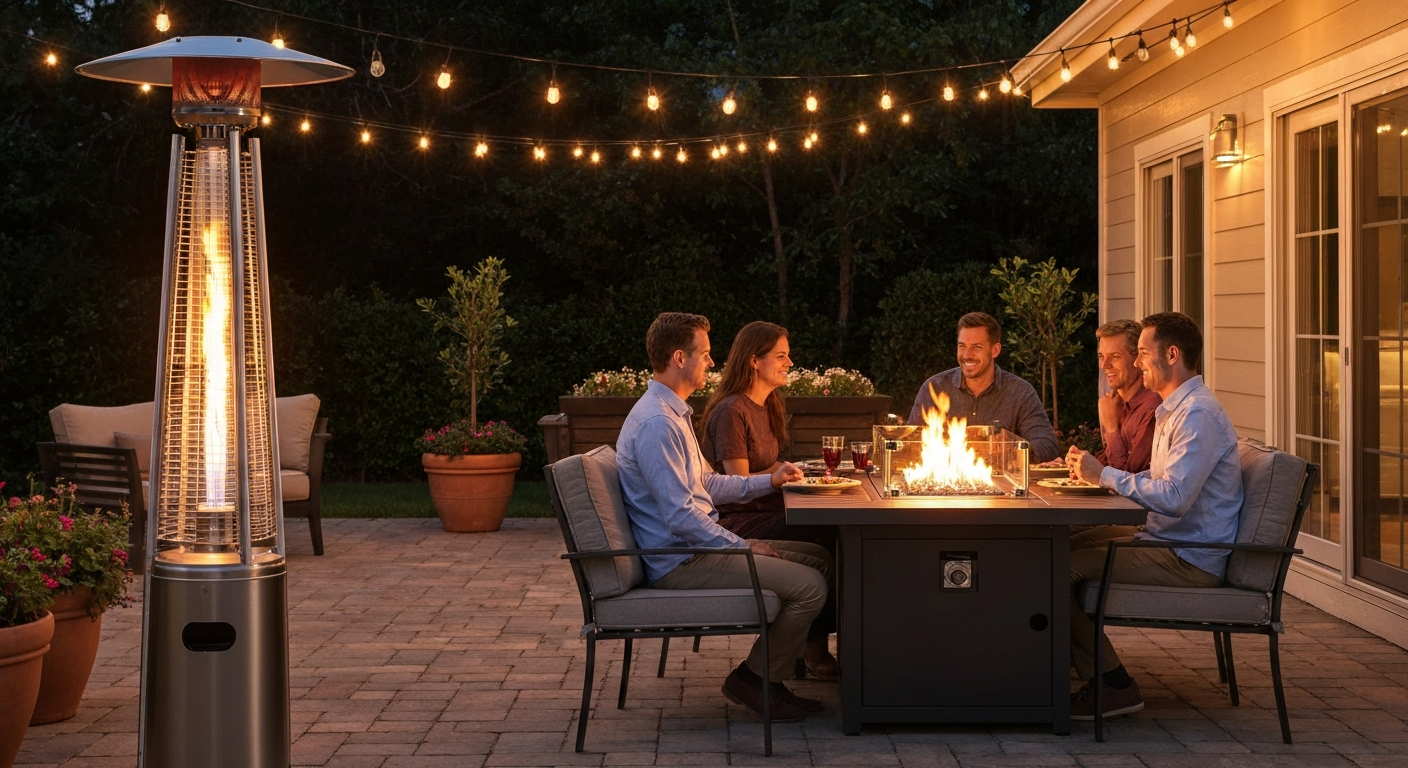
Better Homes & Gardens patio heaters sold through Walmart give you a surprisingly solid entry point into outdoor heating without a big-brand price tag. The standing steel propane heater puts out around 46,000 BTU and can warm roughly 150 to 200 square feet on a calm night, while the Harbor City 63-inch propane fire-pit dining table combines ambient warmth (rated around 55,000 BTU) with a full outdoor dining surface and a concealed 20 lb tank in the base. Neither unit is a professional-grade workhorse, but for a homeowner who wants a functional, good-looking heater at a budget-friendly price, they genuinely deliver, as long as you understand their limits and match them to the right space.
Better Homes and Gardens Patio Heater Review & Buyer Guide

Willa Brennan
20 Jul 2026
Quick verdicts: which BHG heater is right for you
Before diving deep, here is where each model sits in practical terms. If you want a classic mushroom-style tower heater you can move around a medium patio and fire up in minutes, the BHG standing steel propane heater is the pick. See the Better Homes & Gardens standing steel propane patio heater for full specs and current pricing. If you want a central gathering piece that doubles as a dining table, and you do not mind the lower usable heat radius that comes with a fire-pit style burner, the Harbor City dining table is hard to beat at its price point. If neither fits (covered patio, small balcony, electricity-only building, or a space that needs something greener), you will want to read the alternatives section below.
- Best for open patios up to 200 sq ft: BHG Standing Steel Propane Heater — portable, quick heat, straightforward setup
- Best for outdoor dining + ambiance: BHG Harbor City Propane Fire-Pit Dining Table — doubles as furniture, concealed tank, social focal point
- Best for covered or enclosed patios: electric or infrared wall/ceiling heater — no combustion products, no ventilation concerns
- Best for large open spaces: natural gas or high-BTU freestanding propane tower (46,000–48,000+ BTU), permanently plumbed
- Best for small balconies or tabletop use: electric tabletop or low-output propane tabletop heater — compact and portable
- Best for eco-minded buyers: infrared electric or pellet-powered hearth units that reduce propane dependency
BHG standing steel propane heater vs. Harbor City fire-pit table: detailed comparison
I have spent time with both of these units across different patio setups, and the honest takeaway is that they serve fundamentally different purposes despite both running on propane. The standing heater is a pure heating tool. The Harbor City is primarily a furniture piece with a fire feature attached. That distinction matters more than any spec on a sheet.
Specs at a glance
| Spec | BHG Standing Steel Propane Heater | BHG Harbor City Fire-Pit Dining Table |
|---|---|---|
| Fuel type | Propane (LP) | Propane (LP) |
| BTU rating | ~46,000 BTU | ~55,000 BTU |
| Effective heat radius | ~9 ft (approx. 150–200 sq ft) | ~5–7 ft ambient radius (fire-pit style) |
| Tank capacity | Standard 20 lb cylinder (external) | Concealed 20 lb cylinder in base |
| Height | ~88 inches (standard tower) | ~63 inches (dining table height) |
| Tip-over safety shutoff | Yes (most models) | No (fixed table — not applicable) |
| Ignition type | Piezo push-button | Piezo push-button |
| Certifications | Check label for CSA/ETL listing | Check label for CSA/ETL listing |
| Primary use case | Focused overhead radiant heat | Ambiance + dining surface |
| Portability | High — wheels or lift-and-move | Low — bulky furniture piece |
| Approx. retail price (2026) | $120–$180 | $350–$500 |
Standing steel propane heater: real-world performance
In calm conditions (wind under 5 mph), the standing propane heater creates a genuinely warm cone of radiant heat directly underneath and around the reflector dome. At roughly 46,000 BTU, it sits right in the range Consumer Reports identifies as typical for warming about 200 square feet, though that figure assumes a still night and people seated within about 8 to 9 feet of the emitter. Crank up the wind and that effective radius shrinks noticeably. The piezo ignition works consistently when the regulator and hose are in good shape, but budget units like this can develop regulator droop over a season or two, which shows up as a smaller, lazy flame. The tip-over safety shutoff is a real and important feature: the valve closes automatically if the unit falls, which satisfies a key safety checkpoint. I cross-reference this against whether the unit carries a CSA or ETL listing (look for the certification mark stamped on the label or listed in the owner manual) because a listing confirms the safety cutoff was actually tested against ANSI Z83.26/CSA 2.37 or an equivalent standard.
Harbor City fire-pit dining table: real-world performance
The Harbor City unit (model references BH19-092-097-26 and FHWS80029 appear in various assembly documents) is a steel-frame, 63-inch dining table with a central fire-pit burner. See the Better Homes & Gardens Harbor City patio fire pit listing on Walmart for the official product specs and images. The roughly 55,000 BTU rating sounds impressive, but fire-pit style burners radiate heat laterally and upward from a low central point rather than directing it downward from a dome reflector. The practical warmth people actually feel at their seats depends heavily on proximity to the burner and whether there is a glass-wind guard installed. For ambient warmth and atmosphere, it works very well. For keeping eight people warm on a 45-degree evening, you will likely want a supplementary overhead heater too. The concealed tank compartment in the base is a genuine design win, it keeps the LP cylinder out of sight and makes the unit look like proper furniture. The assembly is involved (expect 60 to 90 minutes), and the manual downloaded from third-party aggregator sites like Manuals.plus matches the Walmart product listing specs. Always verify the exact model number on the unit's label because slight variants exist.
Honest pros and cons
| BHG Standing Steel Propane | BHG Harbor City Fire-Pit Table | |
|---|---|---|
| Pros | Portable, focused radiant heat, affordable, tip-over shutoff | Furniture-quality look, concealed tank, large gathering surface, strong BTU rating |
| Cons | Exposed cylinder looks utilitarian, heat footprint shrinks in wind, budget build quality | Low seated warmth vs. overhead heater, complex assembly, limited portability, higher cost |
| Best weather condition | Calm to light breeze evenings | Calm evenings, primarily for ambiance |
| CPSC check needed? | Yes — query recall database by model number | Yes — CPSC has flagged gas fire-pit tables in prior recalls; always verify current status at CPSC.gov |
One thing I always flag: before buying either unit (or any gas fire-pit product), run the model number through the CPSC recall database at CPSC. Check the CPSC Recalls & Safety Alerts (CPSC.gov Recall Database) for recalls, dates, and recall numbers for your exact model. gov and check SaferProducts.gov. The CPSC has issued recalls and safety alerts for gas fire-pit tables, and their 2024 to 2026 warnings about tabletop firepots and flame-jetting hazards are a live concern across the category. A few minutes of checking can save real headaches.
Close alternatives: electric, infrared, natural gas, pellet, and tabletop heaters
BHG's propane lineup covers the mainstream cases, but it does not cover everyone. Here is when each alternative fuel type or format makes more sense than a BHG propane unit.
Electric patio heaters
Electric heaters are the right call for covered patios, screened porches, and any space where you cannot safely vent combustion gases. They plug into a standard 120V or 240V outlet (depending on output), produce zero on-site emissions, and require virtually no maintenance beyond keeping the element clean. Look for models that carry a UL 1278 or ETL listing, which confirms they have been tested to the applicable standard for outdoor electric heaters. The trade-off is that without a gas supply, you are limited to roughly 1,500 to 4,800 watts (about 5,100 to 16,400 BTU equivalent), so a single electric unit will not heat a large open patio the way a 46,000 BTU propane tower will.
Infrared patio heaters
Infrared heaters (both electric and gas-fired) work differently from convection heaters, they warm objects and people directly rather than heating the air around them. This makes them far more effective in breezy or open conditions because wind does not carry the warmth away. Gas-fired infrared units should be listed to ANSI Z83. Confirm gas infrared units are certified to ANSI Z83.26-2014/CSA 2.37, Gas‑fired outdoor infrared patio heaters (ANSI Webstore) by checking the product label or manual ANSI Z83.26-2014/CSA 2.37 — Gas‑fired outdoor infrared patio heaters (ANSI Webstore). 26/CSA 2.37 (the consensus standard for gas-fired outdoor infrared patio heaters), check the product label or manual for that certification identifier. Electric infrared models should carry a UL or ETL listing. For covered patios or pergolas where you can mount a heater overhead, an electric infrared strip heater is often the cleanest, most efficient solution.
Natural gas patio heaters
If you have an outdoor natural gas line, a plumbed-in gas patio heater eliminates the need to swap propane tanks and typically costs less per BTU to operate. The catch is installation: you need a qualified installer to make the gas connection, and depending on your municipality, a permit may be required. Natural gas heaters are ideal for permanent outdoor kitchen setups, large patios where you run the heater frequently, and situations where LP cylinder storage is impractical. Output and coverage are otherwise comparable to propane equivalents at the same BTU rating.
Pellet and alternative-energy hearth options
Pellet-burning outdoor heaters and fire pits are a growing niche, and they appeal to buyers who want the visual and social appeal of a real flame without propane. Wood pellets are a renewable fuel source, and modern pellet fire-pit designs produce far less smoke than traditional wood burning. The trade-off is higher unit cost, the need to store dry pellets, and more hands-on management. For readers interested in alternative-energy hearth and patio options, which span everything from pellet burners to bioethanol fire features, that category deserves its own detailed look given how fast the products are evolving.
Tabletop heaters and firepots
Tabletop propane heaters are genuinely useful for small balconies, bistro setups, or supplementing a larger heater. Electric tabletop infrared models are the safest choice for enclosed spaces. One major caution: liquid or gel-fuel tabletop firepots, the kind you pour isopropyl alcohol or gel fuel into, carry real safety risks. The CPSC has issued ongoing warnings (through 2024 and into 2026) about flame-jetting incidents caused by adding fuel to a hot or still-lit burner. Any tabletop liquid/gel fuel device should conform to ASTM F3363, which sets performance and labeling requirements for these products. If the unit lacks clear refueling warnings or the approved fuel type is not labeled on the device, treat that as a red flag.
Fuel-type breakdown: costs, performance, and environmental notes
Choosing a fuel type is not just about heat output, it affects what you pay per hour, your carbon footprint, and how involved the installation gets. Here is a straightforward comparison across all the main options.
| Fuel Type | Typical Output | Approx. Operating Cost (2026 US avg.) | Environmental Impact | Best Suited For |
|---|---|---|---|---|
| Propane (LP) | 30,000–55,000 BTU | $1.50–$3.00/hr (varies by tank size and local LP price) | Higher CO2 per BTU than electricity from renewables; portable | Open patios, portability, no utility connection |
| Natural Gas | 30,000–50,000 BTU | $0.50–$1.20/hr (lower fuel cost, but install cost applies) | Similar to propane; slightly cleaner burn | Permanent installations, high-frequency use |
| Electric (resistive) | 1,500–4,800W (~5,100–16,400 BTU equiv.) | $0.18–$0.72/hr at $0.12/kWh avg. | Depends on grid mix; zero on-site emissions | Covered/enclosed patios, zero-emission requirements |
| Infrared (electric) | 750–4,000W | $0.09–$0.48/hr | Same as electric grid; highly efficient directional heat | Breezy spots, covered patios, spot heating |
| Infrared (gas) | 10,000–40,000 BTU | $0.60–$2.00/hr | Similar to standard gas but more efficient per sq ft heated | Commercial patios, high-BTU covered spaces |
| Pellet | Varies widely; 10,000–40,000 BTU equiv. | $0.40–$1.20/hr (pellet price dependent) | Lower net CO2 if sustainably sourced pellets used | Eco-conscious buyers, ambiance-focused setups |
| Bioethanol/Gel (tabletop) | 5,000–12,000 BTU | $1.00–$3.00/hr (high fuel cost) | Lower CO2 than propane; significant safety risks if misused | Decorative/ambiance only; small spaces with great caution |
A note on heat-exchange efficiency: the heat-exchange concept matters most when comparing infrared versus convective heaters in breezy conditions. A convective heater (like a standard propane tower) warms the air around it, wind disperses that warm air immediately. An infrared heater transfers energy directly to solid objects (furniture, people), so a 30,000 BTU infrared unit can feel warmer in a 10 mph breeze than a 46,000 BTU convective tower. If your patio is exposed, infrared is almost always the smarter investment regardless of fuel type. Specialty hearth and patio retailers, including shops focused on alternative energy hearth and patio solutions, often stock a wider infrared selection than big-box stores and can help match output to your space.
Matching the right heater to your patio size and coverage
BTU numbers on product listings can be misleading because they represent maximum input, not what you actually feel. The ASTM F2644 standard, which defines how commercial patio heater performance should be measured, including temperature distribution mapping and effective heated area, is the framework rigorous testers use to translate BTU into real square footage. Consumer-grade reviews rarely apply it formally, but the principles are still useful: effective heated area shrinks with wind, ceiling height, ambient temperature, and distance from the source.
| Patio Size | Coverage Type | Recommended Heater Type | Suggested BTU / Wattage | Notes |
|---|---|---|---|---|
| Small (under 100 sq ft) | Covered/enclosed | Electric infrared (wall or ceiling mount) | 1,500–3,000W | No combustion products; safe for enclosed use |
| Small (under 100 sq ft) | Uncovered/open | Propane tabletop or small freestanding tower | 30,000–40,000 BTU | Position heater to block prevailing wind direction |
| Medium (100–200 sq ft) | Covered | Electric infrared or natural gas infrared | 3,000–4,800W or 20,000–30,000 BTU | Ceiling/wall mount maximizes effective zone |
| Medium (100–200 sq ft) | Uncovered/open | BHG standing propane (46,000 BTU) or equivalent tower | 40,000–48,000 BTU | One tower heats the core zone well on calm nights |
| Large (200–400 sq ft) | Covered | Multiple electric infrared or one high-BTU gas infrared | Two 4,800W units or 40,000+ BTU gas infrared | Zone the space; one heater rarely covers 400 sq ft well |
| Large (200–400 sq ft) | Uncovered/open | Two propane towers or plumbed natural gas heater | Two units at 46,000 BTU each, or 50,000+ BTU NG | Wind management is the biggest challenge |
| Extra large / commercial | Any | Permanent natural gas or high-output infrared installation | 50,000+ BTU per zone | Consult NFPA 58 for LP siting; professional install required |
One practical rule of thumb: a single well-placed 46,000 BTU propane tower like the BHG standing heater comfortably warms a circle of people about 8 to 9 feet in diameter on a calm 45-degree night. That maps to roughly 150 to 200 square feet, but only the people actually in that cone benefit. The Harbor City fire-pit table, while rated at ~55,000 BTU, distributes heat laterally at table height. Seated guests within 3 to 5 feet of the flame feel ambient warmth; those on the outer edge of the table feel the atmosphere more than the heat. Plan accordingly.
Safety, installation, and placement: what you actually need to know
Patio heaters are not particularly dangerous when installed correctly, but they do carry real risks when the basics are ignored. Here is a consolidated checklist I run through for every propane and gas unit I review.
Propane (LP) siting and clearance rules
NFPA 58 (the Liquefied Petroleum Gas Code, 2024 edition) is the governing document for propane cylinder siting, storage limits, and installation requirements in the US. For a typical 20 lb (approximately 5 gallon) propane cylinder used with a freestanding patio heater, you are well below the threshold that triggers formal permit requirements in most jurisdictions, but local codes vary, always check with your municipality. Key points from NFPA 58 and standard manufacturer manuals: cylinders must be stored and used upright; do not use a cylinder that shows visible rust, damage, or an expired inspection date; keep the cylinder connection area clear of combustible materials; and never use a propane appliance in an enclosed space without adequate ventilation.
Clearance distances for freestanding and fire-pit style heaters
- Maintain at least 36 inches of clearance from any combustible material (curtains, wooden overhead structures, patio umbrellas, fabric furniture) to the top of a propane tower heater dome — verify your specific model's manual for the exact required clearance
- The Harbor City fire-pit table should be kept at least 36 inches from any combustible structure on all sides — confirm the assembly manual figure for your exact model
- Never operate a propane or gas heater under a low ceiling or fabric canopy unless the heater is explicitly rated and listed for that application
- Do not use any unvented gas heater in an enclosed garage, tent, or screened room without consulting the manufacturer's application guidance
- For electric infrared heaters mounted on walls or ceilings, follow the manufacturer's specified mounting clearances for combustible framing — these are different from gas clearances and are verified during UL/ETL listing
Anchoring, stability, and tip-over protection
Freestanding tower heaters can tip in wind gusts or if bumped. The BHG standing propane heater should include a tip-over safety shutoff, confirm this is functioning by gently testing the tilt mechanism (with the gas OFF) before the first use of the season. For permanent or semi-permanent installations, consider anchoring the base with a weighted sandbag ring or a purpose-made heater anchor. The Harbor City dining table is heavy enough that tipping is a minor concern, but the gas connection and burner assembly should be inspected before each season.
Gas connections and regulator checks
Always use the regulator that ships with the heater, do not substitute a third-party regulator without confirming it matches the required inlet pressure (most residential LP heaters run at 11-inch water column, roughly 0.4 PSI). Check the hose for cracks, kinks, or UV degradation at the start of each season. A simple leak check: apply soapy water to all connections with the gas on and look for bubbles. If you see bubbles, shut off the cylinder immediately and replace the faulty connection before use. For natural gas installations, a qualified installer (and in many areas, a permitted installation) is required, do not DIY a hard-pipe gas connection.
Certifications to verify before buying
- Look for a CSA, ETL, or UL certification mark on the product label — this confirms the unit was tested against a recognized safety standard
- Gas infrared units should reference ANSI Z83.26/CSA 2.37 in their certification listing
- Electric outdoor heaters should reference UL 1278 or an equivalent standard
- Tabletop liquid/gel fuel devices should conform to ASTM F3363 and carry explicit refueling warnings
- Check the CPSC recall database (CPSC.gov) and SaferProducts.gov for the specific model number before purchase — this takes under five minutes and is genuinely worth doing
Maintenance, troubleshooting, and getting through winter
Most patio heater problems I see are caused by neglect between seasons, not manufacturing defects. A little routine care makes a big difference in lifespan and reliability.
Routine seasonal maintenance
- Start of season: inspect hose and regulator for cracks, UV damage, or brittleness; perform a soapy-water leak test on all connections; clean the burner screen and emitter screen of spider webs and debris (a common cause of ignition failure); check the tip-over safety switch function
- During the season: wipe down the exterior with a damp cloth to remove grease and environmental residue; check that the reflector dome (on tower heaters) is clean and unobstructed; monitor flame color — a healthy LP flame is mostly blue with an orange tip; a predominantly orange or yellow flame can indicate incomplete combustion
- End of season: disconnect and remove the propane cylinder per NFPA 58 guidelines; cover the heater with a purpose-fit cover or store it indoors; for fire-pit tables, drain any standing water from the burner pan and dry thoroughly; apply a light coat of automotive wax to unpainted steel surfaces to prevent rust
Common problems and fixes
| Symptom | Likely Cause | Fix |
|---|---|---|
| Pilot lights but main burner won't stay lit | Thermocouple or thermopile failure | Replace thermocouple/thermopile — parts available from heater parts retailers or manufacturer |
| Flame is very small or lazy | Regulator lock-out (over-pressure protection triggered) | Slowly open LP cylinder valve; disconnect and reconnect regulator with gas off; try a fresh cylinder |
| Piezo clicks but no ignition | Spider web or debris blocking burner orifice | Clean burner orifice with compressed air; check igniter electrode gap |
| Heater shuts off unexpectedly | Tip-over switch activating, or regulator pressure drop | Verify heater is level; check cylinder is not near empty; inspect regulator |
| Rust forming on steel body | Moisture/condensation without cover | Sand light rust, apply rust-inhibiting primer and outdoor paint; use a cover between uses |
| Fire-pit table flame uneven | Wind or debris in burner pan | Install a glass wind guard; clean burner ports; check gas supply pressure |
Winterizing for cold climates
If you live in a climate with hard freezes, store freestanding propane heaters indoors or in a ventilated garage, never in a living space with the cylinder attached. Fire-pit dining tables are bulky to move, so at minimum use a heavy-duty, ventilated outdoor cover and place moisture-absorbing packets in the burner pan area. Steel frames will develop surface rust over multiple winters without protection; a season-end wax or protective coating goes a long way. Check the burner assembly in spring before the first use, insects love to overwinter in burner tubes.
Pricing, warranty, and where to buy
Better Homes & Gardens patio products are sold almost exclusively through Walmart, both in-store and on Walmart.com. That concentration has real implications for buyers.
Current price ranges (July 2026)
| Model | Price Range | Primary Retailer | Sold By |
|---|---|---|---|
| BHG Standing Steel Propane Heater | $120–$180 | Walmart | Walmart direct or Marketplace — verify at checkout |
| BHG Harbor City 63" Fire-Pit Dining Table | $350–$500 | Walmart | Walmart direct or Marketplace — verify at checkout |
| Generic propane tower (non-BHG, comparable BTU) | $150–$300 | Home Depot, Lowes, Amazon | Varies |
| Mid-range electric infrared (wall mount) | $80–$200 | Amazon, Home Depot, specialty retailers | Varies |
| Natural gas freestanding tower | $200–$600+ | Home Depot, specialty hearth shops | Varies |
Warranty: what BHG actually covers
Better Homes & Gardens patio products typically carry a limited 1-year manufacturer warranty covering defects in materials and workmanship. The exact warranty text varies by model and is documented in the assembly manual, always download the PDF for your specific model number from the product listing or a manual aggregator and read the warranty section before buying. Key things to verify: what is covered (parts, labor, or parts-only), what voids the warranty (improper assembly, commercial use, replacement of non-approved parts), and how to initiate a claim (most BHG warranty claims go through Walmart customer service as the point of sale, with manufacturer support as a backstop).
Retailer return policy notes
Walmart's standard return policy gives most customers 90 days to return items purchased in-store or online, but there are important nuances. Products sold by Walmart directly follow Walmart's return policy. Products sold by third-party Marketplace sellers on Walmart.com may have different return windows set by the seller, this can be as short as 30 days. Always confirm whether the listing says 'Sold and shipped by Walmart' or 'Sold by [third-party seller]' before purchasing, especially for higher-priced items like the Harbor City dining table. If you are buying at the end of a season (September or October), a 90-day return window means you may not be able to return a unit you discover has a defect when you try it in the spring.
Specialty retailers: hearth and patio shops vs. big-box stores
For BHG products specifically, Walmart is your only realistic retail option. But if you are considering alternatives, natural gas units, high-output infrared, pellet, or specialty fire features, a dedicated hearth and patio specialty retailer is genuinely worth visiting. Shops like the Heat Exchange Hearth & Patio Shoppe category of retailers tend to carry a curated selection with knowledgeable staff who can match a unit to your specific patio dimensions, fuel supply, and local code requirements. They also handle factory-authorized warranty service on the brands they carry, which is a significant advantage over returning a box to a big-box store. The trade-off is price: specialty retailers are typically 10 to 20 percent higher than big-box pricing, but that premium often includes installation guidance, real demo units, and post-purchase support that can be worth the difference for a gas line installation or a high-BTU permanent unit.
How we test and rate patio heaters
Our testing approach draws from the ASTM F2644 standard methodology for patio heater performance, measuring energy input, warm-up time, temperature distribution across a mapped footprint, and effective heated area. In practice, that means recording ambient temperature, relative humidity, and wind speed before each test run; using a calibrated thermal imaging camera and thermocouple array to map the heat cone or radiant zone; measuring fuel consumption with a NIST-traceable flow meter (for gas units) or a true-RMS wattmeter (for electric units); and running multiple trials to confirm repeatability. We document instrument calibration certificates and report uncertainty ranges rather than claiming false precision. On top of the lab-style testing, we do extended real-world use, running heaters through multiple evenings across different ambient temperatures and wind conditions to capture the practical user experience that pure instrumented testing misses. We also cross-reference each model against the CPSC recall database, verify certification marks against the claimed standards (ANSI Z83.26/CSA 2.37 for gas infrared, UL 1278 for electric, ASTM F3363 for tabletop gel/liquid units), and note any gaps between what the label claims and what the manual actually says.
Final recommendations by use case and budget
If you are shopping for a BHG unit specifically, the standing steel propane heater is the better value for pure heating performance and versatility, it is portable, affordable, and does the core job well on any open patio up to about 200 square feet. The Harbor City fire-pit dining table is a lifestyle purchase: buy it because you want a beautiful outdoor dining centerpiece with a live flame, not because you need maximum heating efficiency. Both are reasonable products at their price points, but neither is a premium appliance. Build quality reflects the price.
If your patio is covered, enclosed, or you have any concern about carbon monoxide accumulation, step away from propane entirely and go electric infrared. If you run your heater three or more evenings a week, a natural gas connection will likely pay for itself in fuel savings within one to two seasons compared to 20 lb LP cylinder refills. If you care about your carbon footprint, electric infrared on a utility grid with meaningful renewable generation is the cleanest available option today, and as grids get greener, that advantage grows. Whatever you choose, spend five minutes checking the CPSC database for your model number. It is the easiest safety step most buyers skip and one of the most important.
FAQ
What standardized performance metrics must a rigorous patio‑heater review collect?
Follow ASTM F2644: record energy input rate (BTU/hr or Watts), warm‑up/preheat energy and time, steady‑state and time‑series temperature maps (thermal camera/thermocouples), temperature distribution and effective heated area (isotherm contours), and repeatability across runs. Also capture fuel or electrical consumption vs time and stated vs measured output.
Which safety and product‑listing certifications should reviewers verify for each model?
Check UL/ETL/CSA listings and quote the exact standard (e.g., UL 1278 for electric; ANSI Z83.26/CSA 2.37 for gas infrared). For tabletop liquid/gel devices, check ASTM F3363 compliance. Document presence/absence of tip‑over switches, flame‑failure devices, overheat cutouts and the exact wording of manufacturer warnings in the manual.
Which authoritative regulatory and safety sources must be queried for recalls and hazard advisories?
Query the U.S. CPSC Recall Database and SaferProducts.gov for each model and related SKUs, plus relevant state AG consumer‑complaint portals. Cite recall numbers, dates, reported incidents, and official advisories (e.g., CPSC flame‑jetting alerts for tabletop firepots).
What manufacturer and retailer documentation is required to confirm specs, warranty and installation guidance?
Capture product pages and downloadable owner/assembly manuals (manufacturer/retailer PDFs) for exact model numbers, BTU/watt ratings, burner type, tank/cylinder specs, clearance diagrams, listed coverage area, listed certifications, and full warranty text including claim procedures. Note retailer SKU/‘sold by’ path (e.g., Walmart direct vs marketplace seller) and retailer return policies.
What field instrumentation and calibration traceability is required to make measurements authoritative?
Use NIST‑traceable or calibrated instruments: thermal camera with calibration traceability (NISTIR guidance), contact thermocouples, calibrated IR thermometer, anemometer for wind, NIST‑traceable gas/propane flow meter or weighed tank method, and true‑RMS wattmeter for electric units. Provide calibration certificates and estimate measurement uncertainty.
What test‑protocol controls and ambient measurements must be recorded?
Record ambient air temperature, relative humidity, wind speed and direction, test geometry (heater height, sample positions, seating height), platform or mounting conditions (covered vs uncovered), steady‑state duration, number of repeats, warm‑up profiles, and instrument setup photos. Report uncertainty and describe any environmental mitigation (windbreaks, enclosures).