
Calcana patio heaters are worth serious consideration if you want a permanent or semi-permanent overhead infrared heater that genuinely works in wind, rain, and cooler temperatures. They are not cheap, off-the-shelf mushroom heaters. These are commercial-grade, tube-style infrared units that hang from a ceiling or overhead structure, burn natural gas or propane, and radiate heat downward onto people and surfaces rather than trying to warm the open air.
Calcana Patio Heater Reviews: Best Models Compared

Willa Brennan
2 Jul 2026
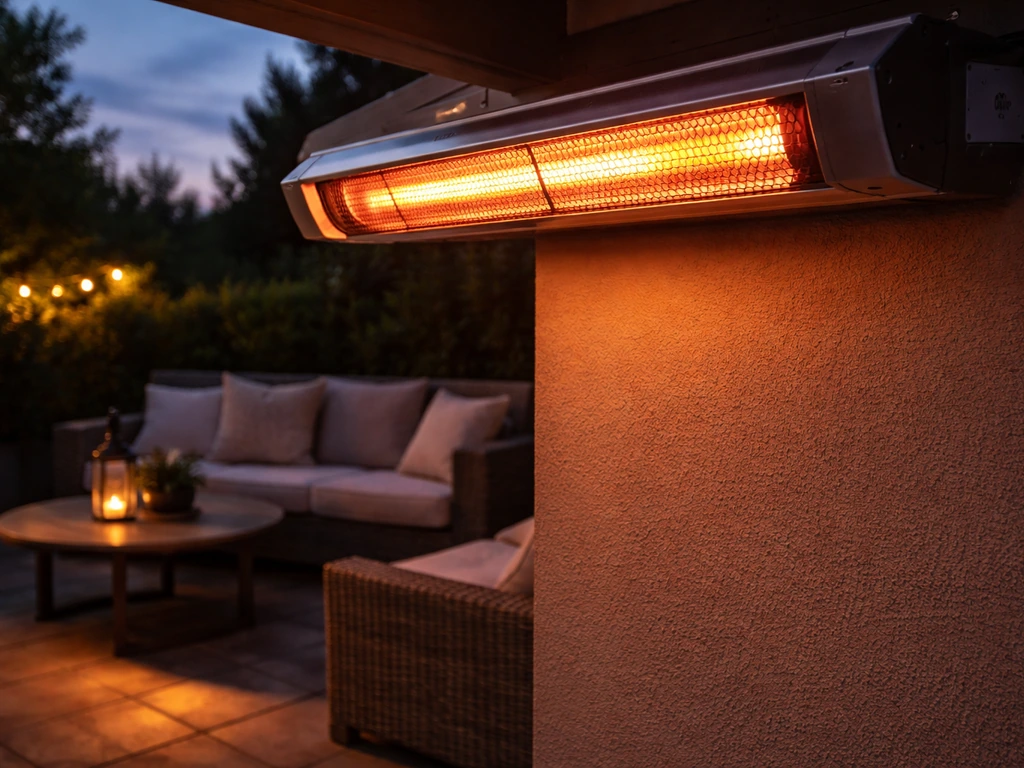
For anyone with a covered patio, a screened porch, a restaurant deck, or even a large open pergola, Calcana's PH-series and CAL-series heaters deliver real, usable warmth at lower running costs than most alternatives. The trade-off is that they require professional installation, a fixed gas line or propane supply, and some ceiling clearance. If you just want a plug-in space heater for your apartment balcony, keep looking.
But if you are ready to invest in a proper outdoor heating setup, read on.
Quick verdict: are Calcana patio heaters worth it
Yes, but for the right buyer. If you are comparing options, these Calcana patio heaters are a good starting point for lux patio heater reviews focused on real outdoor performance. Calcana earns its reputation as a commercial-quality brand because the heaters are built from stainless steel, run on natural gas or propane, and use an infrared tube design that is genuinely more efficient than forced-air or convection heaters.
Calcana claims up to 40% less fuel consumption compared to traditional forced-air units, and that tracks with real-world feedback. The infrared approach heats objects and people directly, so you feel warm even when there is a breeze moving through your patio. That is the core appeal. On the downside, these are fixed overhead installations, the upfront cost is higher than a freestanding propane tower heater, and setup requires gas line work.
They are not portable. But for a homeowner or restaurant operator who wants reliable season-long outdoor heating without constantly refilling tanks or dragging a heater in and out, Calcana is one of the best options on the market.
Which Calcana models to consider (and who they fit best)
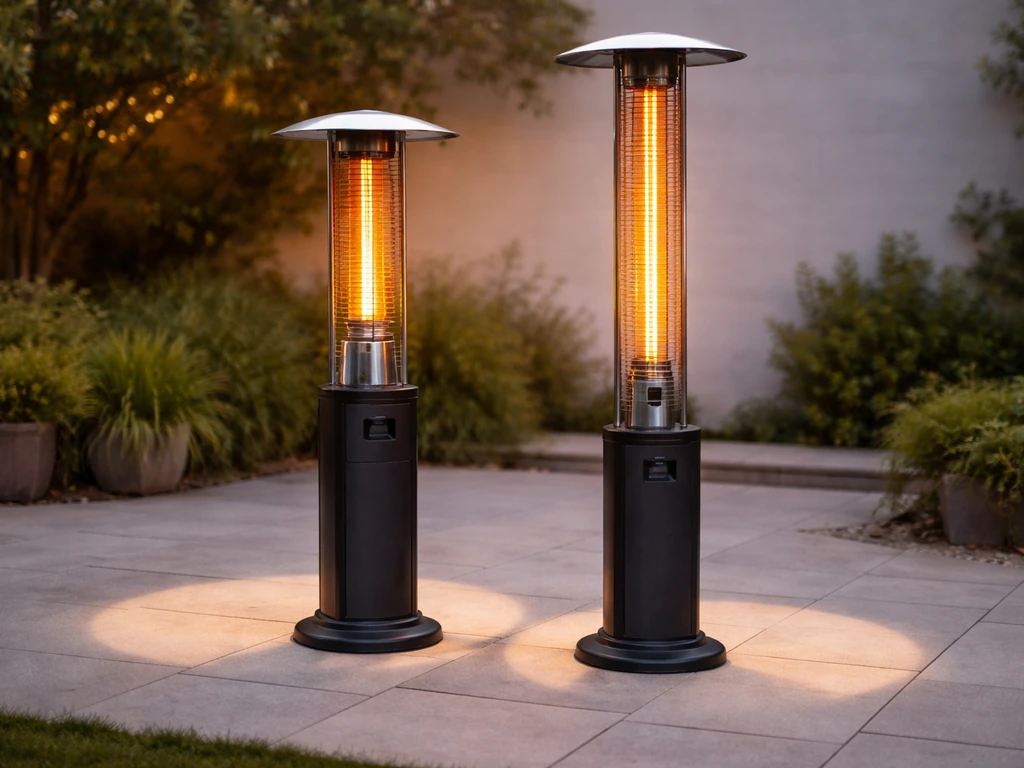
Calcana sells two main product families: the PH-Series (patio heaters with a single burner head and radiant tube) and the CAL-Series (longer tube heaters more suited to commercial and large residential applications). Within those families, the key variable is BTU output and tube length. Here is a breakdown of the models most homeowners and small commercial buyers are likely to compare.
| Model | BTU Range | Tube Length | Coverage | Best For |
|---|---|---|---|---|
| PH-40A | 20,000–40,000 BTU/hr | 10 ft | Up to ~400 sq ft | Small patios, single-zone residential |
| PH-50A | 25,000–50,000 BTU/hr | 15 ft | Mid-range patios | Medium covered decks and porches |
| PH-75A | 37,500–75,000 BTU/hr | 20 ft | Up to ~800 sq ft | Large patios, semi-enclosed spaces, multi-zone use |
| PH-75 HO 10' | 37,500–75,000 BTU/hr | 10 ft (high output) | Up to ~800 sq ft | Spaces with lower ceilings needing high heat density |
| PH-75 HO Marine Grade | 37,500–75,000 BTU/hr | 10 ft | Up to ~800 sq ft | Coastal or humid environments with salt/corrosion risk |
| CAL-40A | Up to 40,000 BTU/hr | 10 ft | Smaller zones | Commercial spot heating, zone setups |
| CAL-75A | Up to 75,000 BTU/hr | 20 ft | Large zones | Commercial patios, larger residential multi-zone |
For most homeowners, the PH-40A or PH-50A is the sweet spot for a single covered patio or deck. The PH-75A is better if you have a generous covered space or want to heat a large pergola area. The PH-75 HO models are worth paying extra for if your ceiling is lower than average and you need concentrated heat in a tighter footprint.
If you live near the ocean or in a humid coastal climate, the Marine Grade model is the one to get. The 316 marine-grade stainless steel resists corrosion in ways standard stainless simply cannot match long-term. The CAL-Series is more of a commercial or multi-zone product, so unless you are outfitting a restaurant patio or a very large residential structure, the PH-Series covers most needs.
Heat performance and coverage (patio size, distance, wind)
Calcana's infrared heaters warm people and objects, not the air itself. In practical terms, this means you feel the heat even when a breeze is blowing through your patio, which is the biggest real-world advantage over freestanding mushroom-style propane heaters or electric halogen models. Those convection-type heaters lose most of their output the moment wind picks up. Calcana's tube heaters radiate downward and sideways, and moving air does not carry that radiant warmth away.
Coverage numbers from Calcana put the PH-40 at around 400 square feet per unit and the PH-75 at up to 800 square feet in enclosed or large patio scenarios. For average, open-air conditions, the per-unit coverage estimate is more conservative at roughly 60 to 80 square feet of very comfortable warmth directly beneath the heater. Think of it this way: the 60-to-80-square-foot figure is the sweet spot where guests sitting directly under the heater feel genuinely warm on a cold night. The 400-to-800-square-foot figures represent the broader space the heater can take the chill off, not the area where you feel intense, immediate warmth.
Mounting height matters. These are ceiling or overhead mount heaters, and the tube length (10, 15, or 20 feet) affects how wide the heat dispersion is at ground level. A 20-foot PH-75A spreads warmth across a wider footprint than a 10-foot PH-40A. For a covered patio around 10 to 12 feet wide, one PH-50A or PH-75A can be the difference between a usable outdoor room in November and a space nobody wants to sit in.
In genuinely windy, exposed environments, performance will be reduced compared to a sheltered covered porch, but the infrared technology still outperforms most alternatives in those conditions. If you are specifically comparing la hacienda patio heater reviews, focus on how reviewers describe heat output, coverage, and whether setup requirements match your patio setup.
Power source, costs, and efficiency
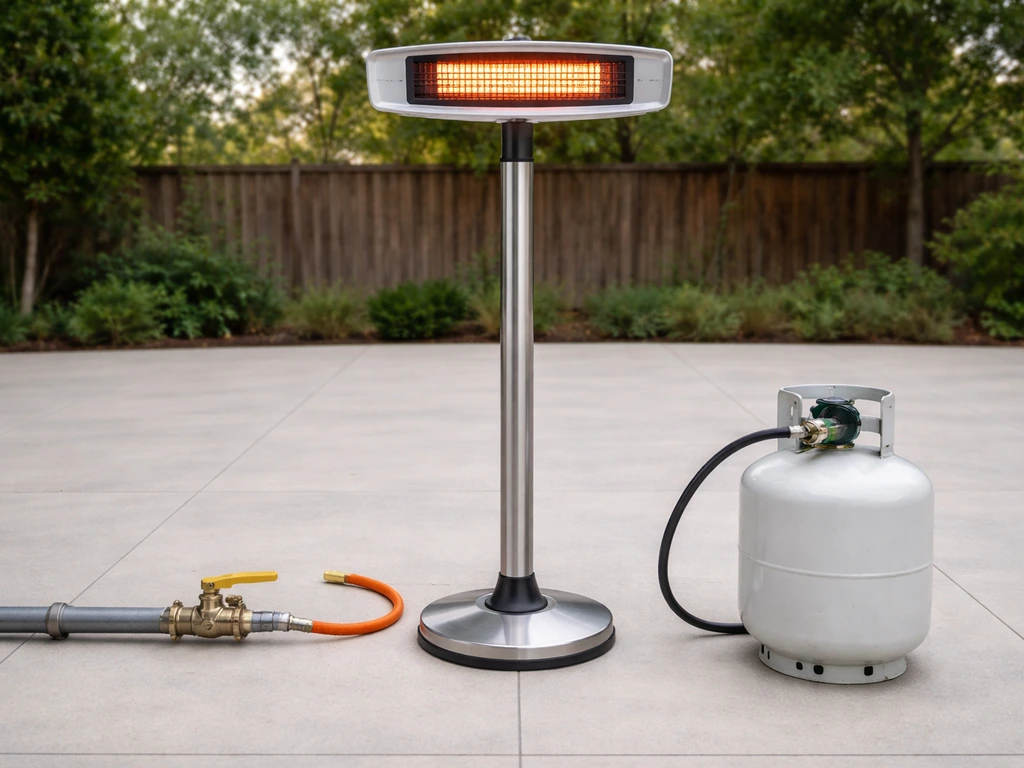
All Calcana PH-series and CAL-series heaters run on either natural gas or propane. You choose one or the other at purchase since the two versions are configured differently internally. Natural gas is the more economical long-term choice if you already have a gas line at your home or business. Propane works well if you do not have natural gas service, but you will need a properly sized tank and regulator. Both versions require an electrical connection for ignition and controls, though the power draw is very low (just for the control module and igniter).
Efficiency is a genuine strength here. Calcana claims 30% to 40% less fuel consumption versus forced-air heaters, which is credible given the infrared design. Forced-air heaters push warm air outward, and most of that heated air disperses without warming anyone. Infrared radiation travels directly from the heater surface to objects and people, wasting almost nothing.
At 40,000 BTU/hr on the PH-40A, you are burning roughly 0. 44 therms of natural gas per hour (about $0. 04 to $0. 07 per hour depending on local gas rates) or approximately 0.
44 gallons of propane per hour (roughly $0. 80 to $1. 20 per hour at current propane prices). Running a PH-75A at full output (75,000 BTU/hr) would roughly double that.
In practice, modulating controls mean you will rarely run at full output unless it is genuinely cold, so real-world costs are lower.
Ease of use, setup, and everyday comfort
Day-to-day use is refreshingly simple. You turn the heater on or off with a switch, and if you have the modulating remote control panel, you adjust the heat output up or down from your seat. The US Fireplace Store listing for the PH, 75HO-10' notes that you can turn the heater on or off with a flick of a switch and use a modulating remote control panel to adjust heat output.
No open flames are visible and there are no glowing red elements, which many homeowners prefer both aesthetically and from a safety standpoint. The heater warms up fairly quickly once ignited, though the manual does note a minimum recommended run time of 10 minutes per cycle to prevent condensation buildup and tube corrosion. That is a real consideration: do not turn it on for five minutes and shut it off repeatedly in quick succession.
A small amount of condensation from the heater is normal at startup and stops once the unit reaches operating temperature. This is not a defect, just the nature of gas combustion producing water vapor initially. The ignition system is electronic, using a DSI (direct spark ignition) module. If the igniter does not catch after three attempts, the system goes into lockout and requires a manual reset, which typically means cycling power for about five seconds. This is standard safety behavior on gas appliances and not a Calcana-specific quirk, but it is good to know so you are not puzzled the first time it happens.
Installation is the main friction point. These are overhead, ceiling-mounted units that need a gas supply line, proper venting, and ideally a qualified installer. The venting requirements are real: for models between 40,000 and 125,000 BTU input, the maximum vent length is 45 feet (about 13.7 meters), and bends in the vent run count toward that total (a 180-degree U-bend or a 90-degree elbow each reduce available vent run). This is not a weekend DIY project unless you are already comfortable with gas appliance installation. Budget for a professional installation alongside the product cost.
Build quality, durability, weather resistance, and maintenance
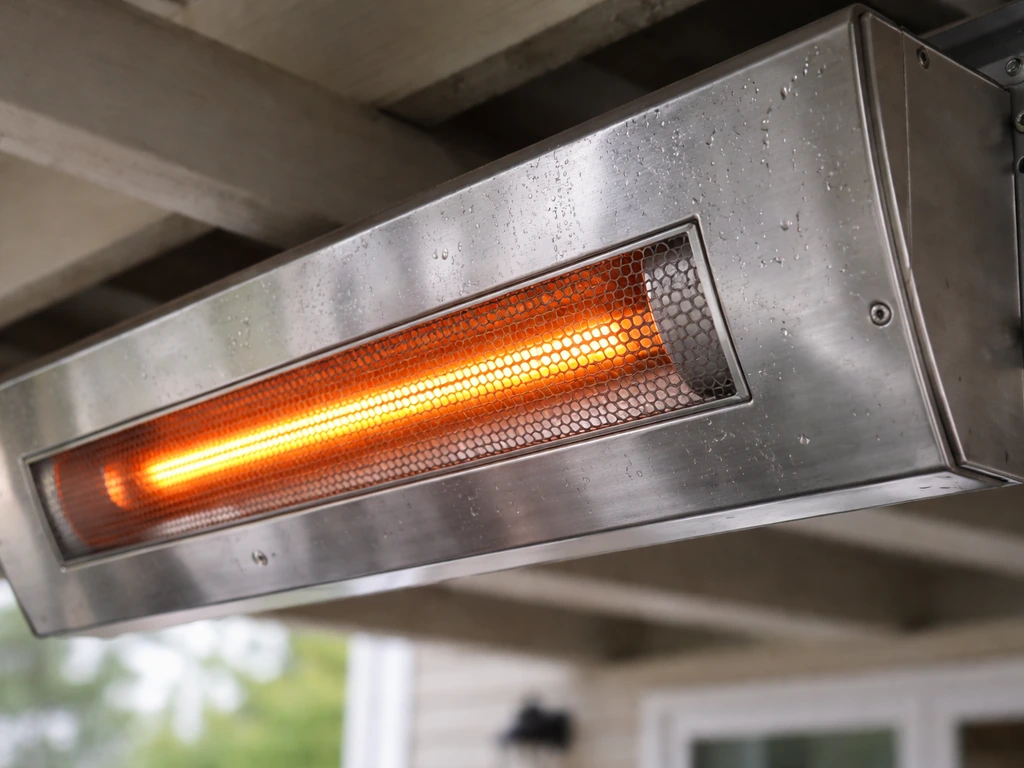
Calcana builds its heaters from stainless steel, and the quality is noticeably above what you get from budget patio heater brands. Standard models use commercial-grade stainless, which handles typical outdoor exposure very well. The Marine Grade variant steps up to 316 marine-grade stainless steel, the same material specification used on boats and coastal architecture, specifically for environments with salt air, high humidity, or chemical exposure. If you are anywhere near the coast, the Marine Grade is worth the premium. Standard stainless will eventually show surface rust in salt-air environments regardless of how well it is made.
Because these are fixed overhead installations rather than portable units, they are not being knocked over, dragged across the patio, or stored improperly, which eliminates a lot of the wear and damage that affects freestanding heaters. The main maintenance tasks are keeping the burner and tube clean, checking the igniter periodically, and ensuring the venting stays clear and unobstructed. Given the minimum 10-minute run time recommendation, the heaters are also designed with tube longevity in mind. Following that guideline consistently will meaningfully extend the service life of the radiant tube.
Compared to some competing brands like Hiland or AZ Patio Heaters (which mostly offer freestanding propane designs at lower price points), Calcana's overhead installation and commercial-grade construction put it in a different durability category. The gap is most obvious over multiple seasons of heavy use. Budget freestanding heaters often show rust, burner degradation, and igniter failure within two or three years. A properly installed Calcana unit should last well over a decade with basic maintenance.
Safety, installation considerations, and troubleshooting common complaints
Calcana's infrared design has some practical safety advantages. There are no open flames and no glowing red-hot surfaces visible during operation, which reduces the fire risk compared to open-flame patio heaters. However, clearance to combustibles is a critical installation requirement. The manual specifies that stated clearances represent a surface temperature of 90 degrees Fahrenheit (32 degrees Celsius) above ambient, and it explicitly warns that materials with low heat tolerance, such as vinyl siding, canvas awnings, and engineered wood products, can degrade at temperatures below the heater's rated clearance threshold. This means you need to pay close attention to what is near and above the heater, not just directly beneath it.
The ignition lockout behavior is the most commonly reported user confusion. As described above, if the DSI module fails to ignite after three attempts, it locks out and the heater will not try again until reset. This is a safety feature, not a flaw. If lockouts happen repeatedly, the likely causes are a dirty or misaligned igniter electrode, low gas pressure, or an issue with the gas supply. Checking gas pressure at the heater and cleaning the igniter tip are the first troubleshooting steps.
The flame fault detection system is worth understanding. Calcana's controls include a full-time flame sense circuit that detects if the main valve fails to close properly. If it senses a flame when there should not be one, it energizes the combustion blower as a safety response. This is sophisticated safety engineering that you would not find on a cheap portable heater. It also means that if you ever see the combustion blower running unexpectedly, a valve issue is the first thing to check rather than assuming an electrical problem.
Common complaints and how to handle them
- Repeated ignition lockouts: Check gas supply pressure and inspect the igniter electrode for fouling or misalignment. Cycle power for five seconds to reset the DSI module.
- Condensation dripping at startup: Normal and expected. It stops once the heater warms up. Running the unit for at least 10 minutes per cycle prevents tube corrosion from this moisture.
- Uneven heat distribution: Usually a mounting height or tube angle issue. Confirm the installation matches the manufacturer's specs for ceiling height and tube orientation.
- Visible surface corrosion on standard models: Happens faster in coastal or humid climates. Clean and treat the stainless exterior regularly, or upgrade to the Marine Grade version for those environments.
- Higher-than-expected installation cost: Professional gas line work and proper venting are non-negotiable. Factor $300 to $600 or more into your total budget for installation, separate from the heater price.
One final note on the decision: if your patio is small, open on all sides, or you need something portable and budget-friendly, brands like Hiland, AZ Patio Heaters, La Hacienda, or Lux offer freestanding or tabletop options that are much easier to set up and cost far less upfront. Calcana is genuinely the better long-term investment for covered, semi-enclosed, or large outdoor spaces where permanent installation makes sense and performance in colder or windier conditions is a priority. Match the product to the actual space, and Calcana is hard to beat in its category.
FAQ
Can I use a Calcana patio heater outdoors under a pergola if it is not fully enclosed?
Yes, but you should plan for more heat loss at the edges. Because Calcana is an overhead infrared design, you will still feel warmth beneath the heater even with some airflow, yet coverage will be closer to the lower “very comfortable warmth directly beneath” estimate when the pergola is open on multiple sides.
What ceiling height do I need for a PH-Series model, and what happens if my clearance is tight?
You need enough vertical clearance so the heater can radiate safely without putting heat-stressed materials too close. If you are short on clearance, prioritize the models specifically designed for lower ceilings (such as the PH-75 HO variant) and have the installer verify clearances to siding, trim, and any awning materials that can soften.
Do Calcana heaters need to be vented like a gas furnace, and can I vent through a short run?
Calcana requires proper venting for the input range listed in the manual, with a maximum total vent run and reduced allowance for elbows and U-bends. If you want a short vent path, discuss your exact route with the installer early, because even a few extra bends can push you beyond the allowable length.
How should I set expectations for “coverage” on a windy patio?
Use the “direct warmth beneath the unit” area as your reliable comfort zone. In exposed or gusty conditions, the effective warmed footprint shrinks, so you may need multiple heaters or a different layout to keep guests comfortable consistently rather than relying on a single unit.
Is it normal for the heater to produce condensation at startup, and should I leave it running longer to prevent issues?
Small condensation at ignition is expected, it typically stops once the unit reaches operating temperature. More importantly, follow the minimum run-time guidance (the manual recommends at least 10 minutes per cycle) because rapid on-off cycling can contribute to tube corrosion and shorten service life.
What should I do if the heater goes into ignition lockout after a few tries?
First, confirm the gas supply is adequate (including regulator performance if on propane) and check for issues that can prevent reliable ignition. The two most common quick checks are cleaning the igniter electrode and verifying alignment, then checking gas pressure at the heater if lockouts repeat.
Why would the combustion blower run even when the heater appears to be acting oddly?
The controls include flame sensing and safety logic. If the system detects a flame when it should not be, it may run the combustion blower as a protective response, so a “blower unexpectedly running” symptom points you toward checking gas valve behavior and related components before assuming a purely electrical problem.
Can I convert a Calcana unit from natural gas to propane (or the other way around)?
Typically you must purchase the correct configuration for the fuel type because the unit is set up internally for either natural gas or propane. If conversion is possible for your exact model, it should be done through the installer with the correct parts and verification, not by swapping tanks alone.
Will the infrared heat warm my outdoor furniture and floor, or only people?
It will warm both, since infrared radiation targets objects and surfaces below and around the beam. That is useful for comfort, but it also reinforces why clearance to combustibles matters, because nearby vinyl, canvas awnings, and certain engineered wood can be damaged if placed too close.
How do I decide between PH-Series and CAL-Series for a residential installation?
For most homes, PH-Series models are the practical choice because they fit single-zone patio setups and typical residential coverage needs. CAL-Series units are better when you are planning multi-zone or larger commercial-style coverage, where tube length and output alignment to a bigger roof span matters.
What maintenance schedule should I expect for a ceiling-mounted gas infrared heater?
Expect periodic cleaning of burner and tube surfaces and periodic checks of the igniter. Also ensure the vent stays unobstructed and clear of debris, and plan maintenance around the heater’s minimum run-time behavior because proper cycles reduce stress on the tube and combustion components.
Are Calcana heaters truly safer than freestanding propane mushroom heaters?
They have safety advantages, such as less visible open-flame behavior and no obvious glowing elements during operation. However, safety still depends heavily on correct installation clearances, venting, and the surrounding materials, so treat clearance verification as a core part of ownership, not an afterthought.