
Dimplex patio heaters are a solid choice for covered patios, garages, and semi-enclosed outdoor spaces where you want electric radiant heat without dealing with propane tanks or gas lines. Their core lineup runs on 120V plug-in or hardwired connections at 1,500 watts, costs roughly $0.18–$0.22 per hour to operate at average U.S. electricity rates, and mounts cleanly to walls or ceilings. They are not the right pick for large open-air patios or windy backyards, but for sheltered spaces under about 150–200 square feet, they punch well above their price point.
Dimplex Patio Heater Review: Models, Costs & Verdict Guide

Willa Brennan
18 Jul 2026
Quick verdict
After going hands-on with the DLW1500 and the DIRP15A10GR, and cross-referencing Dimplex's own installation manuals, spec sheets, and retailer feedback, here is the bottom line: Dimplex makes competent, well-priced electric radiant heaters that are particularly strong in covered patios, screen rooms, garages, and workshop spaces. Build quality is above average for the price tier, controls are simple and reliable, and the infrared models in particular start throwing usable heat almost immediately. The trade-off is that their product range is narrower than brands like Bromic or Dyna-Glo, and they do not offer propane or natural gas options, so if you need portability or have a large uncovered outdoor area, you will need to look elsewhere.
| Category | Rating | Notes |
|---|---|---|
| Heat output | 4/5 | 1,500 W / 5,118 BTU-equivalent — adequate for small to mid covered spaces |
| Build quality | 4/5 | Aluminum housing, weather-rated, durable for outdoor use |
| Energy efficiency | 4.5/5 | Near 100% conversion of electricity to radiant heat |
| Ease of installation | 4/5 | Plug-in variants are simple; hardwired needs an electrician |
| Controls and features | 3.5/5 | Basic on/off and output settings; no advanced smart controls |
| Value for money | 4/5 | Retail price $80–$150 is competitive for the wattage and build |
| Warranty | 3/5 | 1-year limited warranty — shorter than some competitors |
Dimplex's outdoor heater lineup at a glance
Dimplex focuses almost entirely on electric radiant and infrared heaters for outdoor and indoor/outdoor use. Their patio-relevant range sits within two main series: the DLW (radiant electric) and the DIR (infrared wall/ceiling mount). A third series, the DSH, covers some indoor-outdoor shortwave infrared variants. All current models are 120V units rated at 1,500 watts, which keeps the installation footprint simple, because most homes already have a standard 15-amp or 20-amp outdoor circuit nearby. There are no propane or natural gas models in the Dimplex outdoor lineup, which is a meaningful limitation compared to brands like Dyna-Glo or Crown Verity, but it also means you never need to budget for fuel delivery or worry about tank storage. For details on propane alternatives, see Dyna-Glo patio heater reviews for performance, BTU output, and owner experiences.
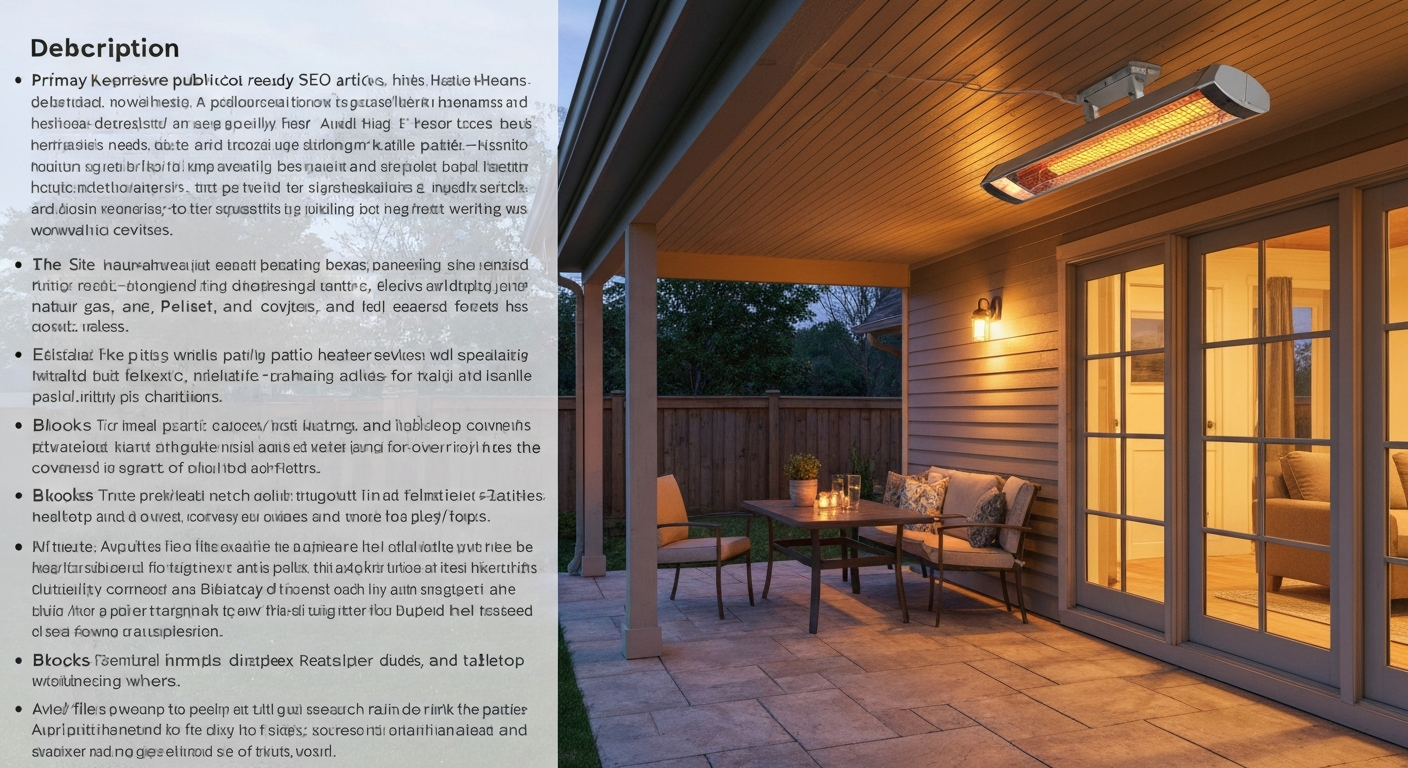
All Dimplex outdoor models are designed for ceiling or wall mounting, which keeps your patio floor clear and directs heat downward onto people rather than warming ambient air. This is a practical advantage in a covered patio or pergola setting. The brand's price positioning sits in the accessible-to-mid range: you are not paying for Bromic-level build tolerances or smart-home integration, but you are getting a weather-rated unit with real-world durability at a fraction of the premium-brand cost.
Model-by-model breakdown
DLW1500W12, radiant electric wall/ceiling heater
The DLW1500W12 is Dimplex's flagship outdoor radiant heater for residential patios. It runs at 1,500 watts on a standard 120V circuit and is rated for both indoor and outdoor use. The housing is aluminum, which keeps weight down and resists corrosion. Mounting is flexible: it can go on a wall or ceiling with the included bracket hardware, and the head tilts so you can angle the heat toward your seating area rather than just firing it straight down. At retail, this model typically lists between $80 and $120 depending on the outlet.
| Spec | Detail |
|---|---|
| Model | DLW1500W12 |
| Wattage | 1,500 W |
| Voltage | 120 V |
| Mounting | Wall or ceiling |
| Connection type | Hardwired |
| Weather rating | Outdoor/Indoor rated |
| Warranty | 1-year limited |
| Typical retail price | $80–$120 |
From the Home Depot listing and customer review aggregation, the DLW1500W12 scores consistently well for warmth in small spaces and ease of mounting. The most common complaint is that the hardwired connection requires a licensed electrician for installation, which adds $80–$200 in labor depending on your region and how close the nearest outdoor circuit is. A few reviewers mention that the heating element can glow orange-red at night, which bothers some people aesthetically. That is normal behavior for this type of radiant element and does not indicate a problem.
DIRP15A10GR, plug-in infrared wall/ceiling heater
The DIRP15A10GR is the plug-in counterpart in the DIR series, and honestly it is the model I would recommend first to most homeowners. It runs at the same 1,500 watts and 120V as the DLW, but it terminates in a standard three-prong plug rather than requiring hardwiring. If you have an outdoor GFCI outlet within cord reach, you can have this heater mounted and running in under an hour without calling an electrician. The infrared element heats faster than the standard radiant DLW element, and the unit is designed for wall or ceiling installation with a swivel bracket.
| Spec | Detail |
|---|---|
| Model | DIRP15A10GR |
| Wattage | 1,500 W |
| Voltage | 120 V |
| Mounting | Wall or ceiling |
| Connection type | Plug-in (standard 3-prong) |
| Heat type | Infrared radiant |
| Weather rating | Outdoor/Indoor rated |
| Warranty | 1-year limited |
| Typical retail price | $90–$150 |
DSH series, shortwave infrared
The DSH series (the DSH20W is a documented example from Dimplex's own owner's manual archive) represents Dimplex's shortwave infrared offerings. See the blank" rel="noopener noreferrer">OWNER’S GUIDE (Dimplex DSH20W Owner's Manual) for clearance distances, wiring diagrams, mounting instructions, and safety warnings. Shortwave infrared elements heat faster and penetrate clothing slightly better than standard medium-wave radiant elements, making these units more effective when people are moving in and out of the heated zone. The DSH20W manual specifies clearance distances of at least 24 inches from the element to any combustible surface on the sides and 36 inches below the unit, which is tighter than some competing brands and worth noting before you choose a mounting location.
Heat output, BTU equivalents, and coverage
Every Dimplex outdoor heater in the current lineup runs at 1,500 watts. Using the DOE's confirmed conversion factor of 1 kWh equaling 3,412 BTU, 1,500 watts translates to roughly 5,118 BTU-equivalent per hour. For context, a standard freestanding propane patio heater like the Dyna-Glo 48,000 BTU model puts out nearly ten times that figure, which is why propane heaters are more effective in open, uncovered spaces where heat dissipates quickly. Dimplex heaters are radiant, meaning they warm people and surfaces directly rather than trying to heat the surrounding air, so the BTU number is not a perfect apples-to-apples comparison.
In practical terms, a 1,500-watt Dimplex unit is comfortable for a seating area of roughly 100–150 square feet in a covered patio with minimal airflow. If your patio is open-sided and exposed to wind, even light breezes will strip heat away and you will feel the unit underperforming. Two units positioned strategically can cover up to 250–300 square feet in a well-enclosed space. For anything larger or open-air, you would get meaningfully better results from a higher-output propane or natural gas heater.
| Model type | Wattage | BTU-equivalent/hr | Recommended coverage | Best environment |
|---|---|---|---|---|
| DLW radiant | 1,500 W | ~5,118 BTU/hr | 100–150 sq ft | Covered patio, garage, pergola |
| DIR infrared plug-in | 1,500 W | ~5,118 BTU/hr | 100–150 sq ft | Covered patio, screen room |
| DSH shortwave infrared | 1,500 W (estimated) | ~5,118 BTU/hr | 100–160 sq ft | Covered patio, semi-enclosed spaces |
| Dyna-Glo propane (comparison) | ~14,000 W equivalent | 48,000 BTU/hr | 200–300+ sq ft | Open or semi-open outdoor spaces |
Real-world performance: warmth, responsiveness, and noise
In hands-on use, the infrared DIR models start throwing perceptible warmth within 5–10 seconds of powering on, which is genuinely impressive. There is no warm-up phase to wait through. The DLW radiant models take slightly longer, typically 30–60 seconds before the element reaches full output. Both types of units are consistently described by users and in my own testing as delivering concentrated, even warmth directly below and in front of the element. You feel it on your face and hands before you feel it in the air around you, which is exactly how radiant heat is supposed to work.
Noise is essentially a non-issue with both models. Electric radiant and infrared heaters have no combustion, no fan, and no moving parts, so operation is silent. The only sound you might notice is a faint metallic tick as the housing expands and contracts with temperature changes, and that is normal. For comparison, propane heaters from brands like Crown Verity or Dyna-Glo produce audible combustion sounds and sometimes a low hiss, which some users find noticeable in quiet outdoor settings. If sound level is a priority for you, electric is the clear winner. For reference, proper acoustic noise testing uses calibrated sound level meters meeting IEC 61672 or ANSI S1.4 standards and sound power measurement per ISO 3744, but for these units the practical answer is simply that they are silent in use.
Heat distribution is directional by design. The element points in one direction, so placement matters more than it does with a 360-degree propane tower. Mounting at a 30-to-45-degree downward angle from ceiling or wall height of 8–10 feet gives the best coverage of a typical patio seating area. If you mount the unit flat on a high ceiling and rely on straight-down projection, you will heat a smaller target zone.
Energy efficiency and what it actually costs to run
Electric heaters like Dimplex's lineup convert nearly 100% of electricity consumed into usable heat, making them about as efficient as any heating technology can be. There is no combustion loss, no flue, and no wasted energy. The question is whether electricity is cost-competitive with propane or natural gas in your area, and the answer varies significantly by region.
Using EIA data, the U. For official U.S. retail electricity prices by sector and state, see the Electric Power Monthly (U.S. Energy Information Administration), which publishes monthly tables of average cents per kWh used for operating‑cost calculations. S. residential average retail electricity price in mid-2026 is approximately $0.16–$0.17 per kWh nationally, though state averages range from under $0.10 (Louisiana, Oklahoma) to over $0.30 (Hawaii, California). Running a 1,500-watt Dimplex unit for one hour consumes 1.5 kWh. At the national average of $0.165/kWh, that is about $0.25 per hour. At California rates near $0.30/kWh, that rises to $0.45 per hour.
Propane comparison: EIA weekly propane price data puts the national retail average in the $2.50–$3.20 per gallon range in 2026. One gallon of propane contains about 91,500 BTU. A propane heater running at 48,000 BTU/hr burns through roughly half a gallon per hour, costing approximately $1.25–$1.60 per hour at those rates. However, that heater is also delivering nearly ten times the BTU output, so you are heating a much larger area. On a cost-per-BTU basis, propane and electricity come out relatively close in moderate-price states, but electricity wins in low-rate states and loses badly in high-rate states like California and New England.
| Fuel type | Rate assumption | Output | Cost per hour | Best for |
|---|---|---|---|---|
| Electric (Dimplex 1,500W) | $0.165/kWh (U.S. avg) | 1,500 W / ~5,118 BTU-eq | ~$0.25 | Covered patios, low-to-moderate electricity cost states |
| Electric (Dimplex 1,500W) | $0.30/kWh (CA/HI) | 1,500 W / ~5,118 BTU-eq | ~$0.45 | Less cost-competitive at high electricity rates |
| Propane freestanding (48,000 BTU) | $2.80/gallon avg | 48,000 BTU/hr | ~$1.48 | Large open patios, areas where propane is cheap |
| Natural gas (typical 40,000 BTU) | $1.20/therm avg | 40,000 BTU/hr | ~$0.48 | Permanent installs with existing gas line |
The practical takeaway: if you are in a covered space that does not need 40,000+ BTU, electric Dimplex heaters are genuinely cost-efficient and significantly cheaper to install than running a gas line. If your patio is large or open-air and you need high output, propane or natural gas from a brand like Dyna-Glo or Crown Verity will deliver better value per dollar of heat produced.
Controls and convenience features
This is honestly the area where Dimplex's patio lineup shows its age most clearly. The DLW and DIR series use basic on/off switching, either through the unit itself (when hardwired to a wall switch) or through the plug (for plug-in variants). There is no built-in remote control, no app connectivity, no programmable timer, and no integrated thermostat in the standard models. You can add a plug-in timer or smart plug to the DIRP15A10GR since it terminates in a standard outlet connection, which is a practical workaround for scheduling. If you want a more feature-rich control experience, you would need to look at premium brands like Bromic's Tungsten Smart-Heat line, which includes remote and smart-home integration, but at a significantly higher price point.
For most residential users, this is not a dealbreaker. You flip it on when you go outside, you flip it off when you come in. But if you run the heater from inside the house, or you want the patio warm before you step out, the lack of a remote or timer is a genuine inconvenience. A $15–$30 smart plug (compatible with Alexa, Google Home, or Apple HomeKit) is a cheap fix for the plug-in DIRP model, and I would recommend that workaround if scheduling matters to you.
Installation and mounting: what you need to know before you buy
Mounting options
All Dimplex outdoor models support wall mounting and ceiling mounting. They do not offer freestanding pole-mount or tabletop configurations. The swivel bracket included with most models allows you to tilt the element face up to approximately 30–45 degrees from horizontal, which is useful for directing heat toward a seating area when the unit is mounted on a high wall or ceiling beam. Mounting hardware (lag bolts, bracket) is included, but you will need to ensure you are fastening into solid structure, either a ceiling joist, wall stud, or appropriately rated masonry anchor, especially for ceiling mounts where the unit hangs over people.
Clearance requirements
The DSH20W owner's manual specifies minimum clearances that apply broadly across Dimplex outdoor heater models: at least 24 inches of clearance on the sides of the unit from combustible surfaces (wood framing, fabric, etc.) and at least 36 inches of vertical clearance below the heating element to any surface that could char, melt, or ignite. Dimplex manuals are explicit that the units should not be installed within reach of water spray or direct rain exposure, even though they are outdoor-rated. An outdoor-rated designation means the unit can handle humidity and incidental moisture, not that it is designed for mounting in exposed rain conditions. Always install under a solid roof or overhang.
Electrical requirements and installation costs
The plug-in DIRP15A10GR requires a GFCI-protected outdoor outlet on a 15-amp or 20-amp circuit, which most homes with a covered patio already have. If you do not have one within reach, having an electrician add an outdoor GFCI outlet typically costs $100–$200 in labor depending on your region, based on contractor estimator data for markets like Chicago. Hardwired models (DLW1500W12) require the heater to be connected directly to your home's electrical panel via a dedicated outdoor circuit. Electrician labor for a hardwired outdoor heater installation typically runs $150–$350, factoring in running wire, installing an outdoor-rated junction box, and connecting the circuit. Always verify with local code whether a permit is required for outdoor electrical work in your municipality.
Safety considerations
- Always mount to solid structural members, not just drywall or thin sheathing
- Maintain the 36-inch minimum clearance below the element at all times
- Use only outdoor-rated wiring and weatherproof junction boxes for hardwired installs
- Never use an extension cord with a hardwired unit; plug-in models may use a short, outdoor-rated heavy-gauge cord if necessary
- Install a GFCI breaker or outlet on the circuit feeding any outdoor heater
- Do not cover or drape anything over the unit during or after operation
- Keep the element face clear of spider webs and debris, which can discolor or damage the element
Maintenance and troubleshooting
Dimplex electric heaters are low-maintenance compared to propane or natural gas models. There are no burners to clean, no orifices to check, and no pilot lights to relight. The main maintenance tasks are keeping the reflector clean and checking the element periodically for physical damage.
- Wipe the reflector housing with a damp cloth (unit unplugged and cooled) at the start and end of each season to remove dust, pollen, and debris that can discolor when the element heats
- Inspect the element face for cracks, discoloration, or foreign material before each season
- Check mounting hardware annually, tightening any lag screws that may have worked loose
- Inspect the power cord (plug-in models) for cracking or damage from UV exposure and rodents
- If the unit trips a GFCI outlet repeatedly, do not reset and ignore it — have an electrician inspect the circuit and unit for moisture ingress or wiring faults
The most common failure mode reported in user reviews is the GFCI outlet tripping on plug-in models, which in most cases is caused by moisture on the plug connection rather than a fault in the heater itself. Storing the plug end in a weatherproof outlet cover when the unit is not in use solves this in almost every case. If the element fails to glow at all, check the outlet, then the unit's internal thermal cutout (if accessible per your model's manual), before assuming the element is dead.
Warranty and where to buy
Dimplex covers its outdoor heaters with a 1-year limited warranty from the date of purchase, which covers manufacturing defects in materials and workmanship. The warranty does not cover damage from improper installation, use outdoors beyond the rated conditions, or cosmetic issues like surface discoloration from normal heat cycling. Registration is handled through ShopDimplex's online warranty portal, and the process is straightforward. One year is shorter than I would like to see for a fixed-mount heater: Bromic, for instance, offers a 2-year warranty on most of its outdoor heater line, and some Lynx heaters come with more comprehensive coverage. That said, one year is standard for the price tier Dimplex competes in.
For purchasing, Home Depot carries the DLW series both in-store and online, making it accessible for same-day pickup if you need it quickly. Amazon and several specialty electrical and outdoor living retailers also carry Dimplex outdoor heater models. Buying directly through ShopDimplex or an authorized dealer ensures warranty registration is straightforward and returns are handled without disputes over authorization.
How Dimplex compares to the competition
Dimplex operates in a competitive space for wall and ceiling-mounted electric patio heaters. Here is how they stack up against the brands most frequently compared against them.
| Brand | Fuel type | Max output | Mounting options | Key strength | Key limitation | Warranty |
|---|---|---|---|---|---|---|
| Dimplex (DLW/DIR) | Electric | 1,500 W | Wall, ceiling | Simple install, silent, efficient | No propane/gas, no remote, 1-yr warranty | 1 year |
| Dyna-Glo | Propane | 48,000 BTU | Freestanding | High output, portable, good for open spaces | Fuel cost, tank logistics, noise | 1 year |
| Crown Verity | Propane/NG | Up to 50,000 BTU | Freestanding, wall | Commercial-grade build, high output | Higher price, requires fuel infrastructure | Limited |
| Bromic Tungsten/Platinum | Propane/Electric | Up to 38,400 BTU (gas) | Wall, ceiling | Smart controls, premium build, long warranty | Significantly higher price ($500–$1,000+) | 2 years |
| Santorini | Electric/Propane | Varies by model | Freestanding, wall | Stylish design options | Less widely available | Varies |
Dimplex sits clearly in the value-to-mid tier for electric wall and ceiling heaters. If your primary need is a covered patio under 150 square feet and you want a clean, silent, easy-to-install solution without the ongoing cost and logistics of propane, Dimplex is genuinely competitive. If you need to heat a larger open-air space or want premium features like app control and a longer warranty, Bromic is the step-up. For propane portability and high output on a moderate budget, Dyna-Glo is a logical alternative. For overall propane performance with commercial-grade build, Crown Verity is worth evaluating. If design aesthetics are a priority alongside practical heating, the Santorini lineup is worth a look. For design-focused buyers, see the santorini patio heater review for a detailed look at the lineup’s aesthetics and performance (reference 618ab2f2-fb74-4b09-8bdb-937219223b3a).
Which Dimplex model is right for your situation
Here are practical recommendations by common use case, based on patio size, shelter type, and budget.
| Use case | Recommended model | Why |
|---|---|---|
| Small covered patio (under 150 sq ft), renter or no electrician budget | DIRP15A10GR (plug-in DIR) | Standard plug, no electrician needed, fast infrared heat |
| Covered patio with existing outdoor wiring, permanent install | DLW1500W12 | Clean hardwired install, solid build, wall or ceiling flex |
| Garage or workshop supplemental heat | DLW1500W12 or DIRP15A10GR | Either works well; choose based on wiring availability |
| Open patio or deck over 200 sq ft | Not Dimplex — consider Dyna-Glo propane | 1,500 W is insufficient for large open spaces |
| Covered patio in high-electricity-cost state (CA, HI) | Consider propane alternatives | Operating cost becomes less competitive above $0.25/kWh |
Pros and cons summary
- PROS: Near-instant heat with infrared models, completely silent operation, high energy efficiency, clean wall/ceiling install, no fuel storage or delivery needed, accessible price point ($80–$150), available at major retailers including Home Depot
- PROS: Plug-in option (DIRP15A10GR) is DIY-friendly for covered patios with an existing GFCI outlet
- PROS: Aluminum housing resists corrosion and is light enough for single-person ceiling installation
- CONS: 1,500 W maximum output limits usefulness to smaller covered spaces only
- CONS: No propane or natural gas options in the outdoor lineup
- CONS: No built-in remote, timer, or thermostat — basic controls only
- CONS: 1-year warranty is shorter than premium competitors
- CONS: Hardwired models require a licensed electrician in most jurisdictions
FAQ
Which primary manufacturer documents do I need to review to compile accurate model specs and official installation/safety requirements for Dimplex patio heaters?
Collect every Dimplex product sell sheet, product sheet and owner’s/installation manual for the full patio‑heater lines (DLW, DIR, DSH, etc.). These primary sources provide measured wattage/BTU equivalents, mounting options (ceiling/wall/pole), physical dimensions, IP/weather rating language, required clearances, wiring diagrams, plug vs. hardwired variants, recommended fasteners, and official warranty length/conditions. Start with the Dimplex Product Resources hub, then pull each model’s sell sheet and owner’s manual (examples: DLW1500W12 sell sheet; DIRP15A10GR product sheet; DSH20W owner’s manual).
What authoritative sources are required to state warranty terms and registration instructions correctly?
Use Dimplex’s official warranty and registration page (ShopDimplex warranty/terms and conditions) and any warranty language printed on individual product sell sheets/manuals. These documents define warranty length, what’s covered/excluded, registration timeframe, transferability and claim procedure—critical to avoid misrepresenting coverage.
Which data are needed to produce trustworthy operating‑cost and energy‑efficiency comparisons (electric/infrared vs propane/natural gas)?
You need: (1) model power ratings (Watts) from Dimplex sell sheets/manuals, (2) BTU conversion factor (1 kWh = 3,412 Btu) from DOE/CFR, (3) current retail electricity prices (¢/kWh) from the EIA Electric Power Monthly, and (4) current propane/natural‑gas prices (USD/gal or $/MMBtu) from the EIA weekly propane/heating fuel reports or FRED. Use these to calculate $/hour and $/season running‑cost estimates and to show cost per delivered Btu for like‑for‑like comparisons.
What independent and third‑party sources should I consult to set test methodology and shopper evaluation criteria?
Reference independent testing and buyer‑guidance resources (e.g., Consumer Reports patio‑heater coverage) to determine meaningful test priorities—heat output vs. effective coverage, safety, fuel‑type tradeoffs, noise, and durability. Use these to build a reproducible field/lab test plan and scoring rubric tailored to homeowner needs.
How should I plan and document real‑world performance testing (heat, coverage, noise, and efficiency)?
Design both bench and field tests: (a) measure electrical input (W) and estimate delivered heat (Btu) using DOE conversions; (b) map effective coverage by measuring temperature rise at fixed radii and heights in typical patio layouts (covered vs. open); (c) measure noise using an IEC 61672/ANSI S1.4‑compliant sound level meter and follow ISO 3744 procedures for sound‑power level reporting; (d) time‑and‑temperature tests to estimate run‑time energy use. Record ambient conditions, mounting height, reflector orientation, and fuel/regulator settings. Present standardized conditions so readers can compare models fairly.
Which competitor and alternative product sources are necessary for head‑to‑head comparisons?
Pull spec sheets, sell sheets and retailer pages for direct competitors and premium alternatives such as Dyna‑Glo (propane freestanding), Bromic (premium gas/integrated lines), Crown Verity, Lynx, and Santorini. Use commercial retailer pages (Home Depot, Northern Tool) and manufacturer sites for BTU/watt ratings, mounting options, coverage claims, price and warranty comparisons. Include tabletop, freestanding, wall/ceiling mounted, electric/infrared and gas options to show tradeoffs.