
Even Embers patio heaters are a solid choice for anyone who wants real wood-fire warmth on their patio without dealing with propane tanks or a fixed gas line. The flagship pellet-fueled model (HTR1085AS/BS) puts out 70,000 BTU, covers roughly 100 square feet, and runs on standard wood pellets you can grab at Tractor Supply or Home Depot for about $5–$12 per 40-lb bag. That combination of genuine heat output, accessible fuel, and a relatively approachable price makes Even Embers worth a serious look, but there are real trade-offs around rust resistance, startup time, and the fact that this is 100% an outdoor-only appliance. Here's everything you need to know before buying.
Even Embers Patio Heater Reviews: Pellet Model Buying Guide

Willa Brennan
17 Jul 2026
TL;DR: Quick Verdict and Who Should Consider Even Embers
Even Embers makes one primary patio heater product: a gravity-fed, pellet-fueled tower heater that delivers authentic wood-fire heat and ambiance. It's best suited for homeowners with open, uncovered patios who want a wood-burning aesthetic, don't mind a 15–20 minute startup ritual, and have easy access to wood pellets. It's not the right pick for covered patios, deck surfaces, or anyone who wants instant push-button heat. If you're on a tight budget and primarily want convenience, a propane or electric option may serve you better. But if wood fire is your thing and you're willing to do a little maintenance, Even Embers delivers genuine performance at a fair price.
- Best for: Open, uncovered patios with at least 36 inches of clearance to combustibles
- Best for: Wood-fire enthusiasts who don't mind startup time and weekly ash removal
- Best for: Buyers who have Tractor Supply, Home Depot, or a local pellet supplier nearby
- Not ideal for: Covered patios, wood decks, or anyone needing instant heat
- Not ideal for: Apartment balconies, screened-in porches, or use near children unsupervised
Even Embers at a Glance: Brand, Product Family, and the Pellet Focus
Even Embers is a brand operated by The Boltz Group (also listed in some documentation under Fair Game Group), a US-based outdoor living products company. Even Embers, official site (brand/product category pages) confirms the brand is operated by The Boltz Group (Fair Game Group) and lists the pellet heater alongside related product categories such as smokers, grills, and chimineas blank" rel="noopener noreferrer">Even Embers — official site (brand/product category pages). The brand's broader lineup includes pellet smokers, charcoal grills, and chiminea-style heaters, but the pellet-fueled patio heater is the product most homeowners encounter when shopping for outdoor warmth. Unlike propane tower heaters from brands like Mainstays or the design-forward electric options from West Elm, Even Embers has committed to wood pellets as its primary fuel. That's a deliberate positioning choice: pellets burn hotter and produce a real flame, which many buyers find more satisfying than the invisible radiant heat of an electric infrared unit.
The pellet focus also means Even Embers operates in a fairly specific niche. You won't find a propane version or an electric companion model under this brand name. What you will find is a well-documented, manual-intensive appliance that rewards users who treat it like the small wood-burning appliance it actually is. The owner's manual (model HTR1085AS/BS, available on the Tractor Supply product page and hosted on several manual archives) is detailed and worth reading in full before your first use.
Even Embers Model-by-Model Breakdown
HTR1085AS/BS, The Core Pellet Patio Heater
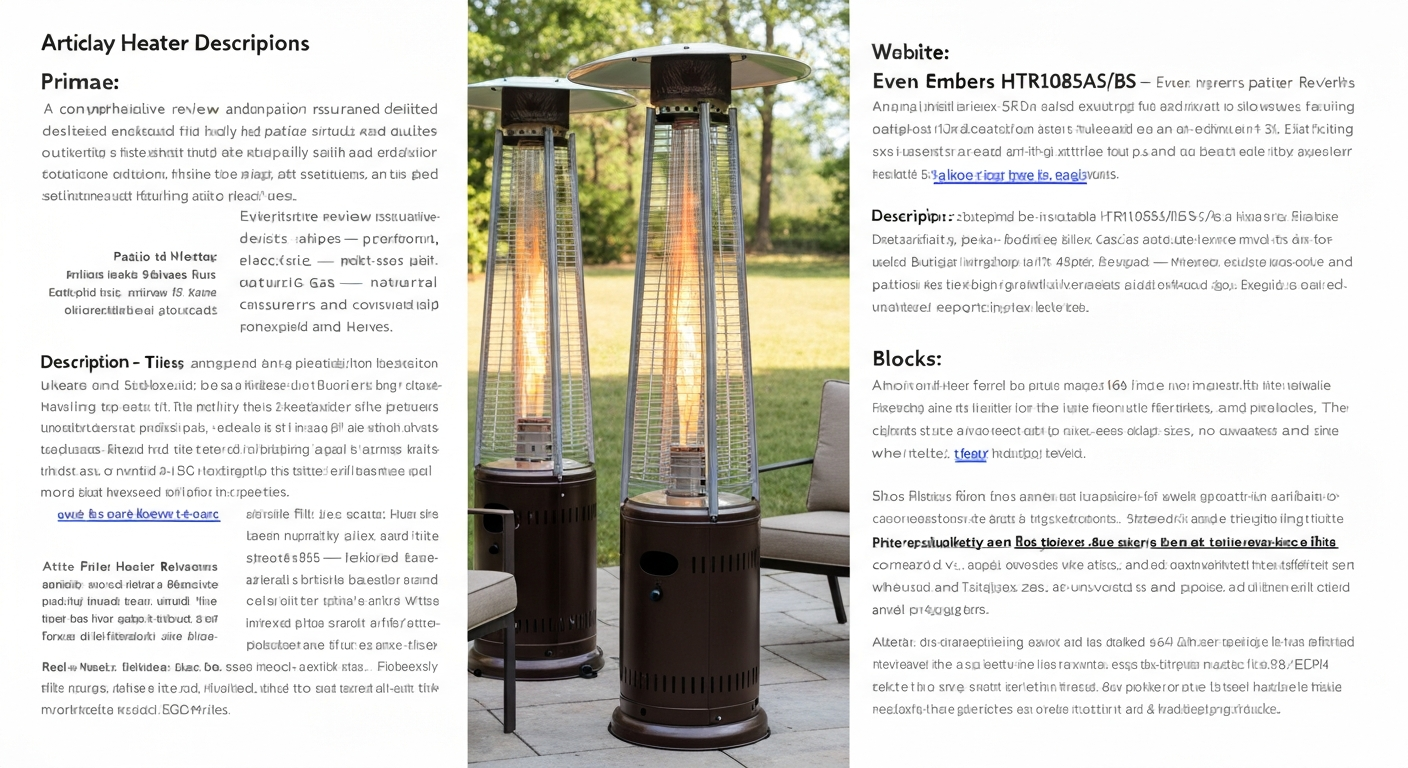
This is the model you'll see on Tractor Supply shelves and listed on Wayfair. Tractor Supply's listing for the Even Embers Pellet Patio Heater (HTR1085AS) republishes the owner's manual and displays extensive customer reviews and ratings useful for aggregating owner feedback Tractor Supply product page for the Even Embers Pellet-Fueled Patio Heater (manual download + reviews). The HTR1085AS and HTR1085BS share the same fundamental design: a tall tower-style stainless and steel construction with a gravity-fed hopper at the top, a central burn chamber with a visible fire window, and a chimney that vents combustion gases upward. The 'AS' and 'BS' suffix variants refer to minor finish or assembly differences depending on the retail channel, but specs and performance are identical. The heater stands approximately 87 inches tall (about 7.25 feet) when fully assembled, giving it a commanding presence on a patio. The burn chamber sits mid-height, and the heat radiates outward from there, so adults standing or seated near it feel the warmth at chest and shoulder level.
The gravity-fed hopper design is a key distinguishing feature. Unlike powered auger-fed pellet stoves, the Even Embers heater uses gravity to drop pellets from the hopper into the firepot. This simplifies the design and eliminates the need for an auger motor, which means fewer mechanical failure points, but it also means you can't electronically control the feed rate. Heat output is managed by adjusting the air damper rather than a digital thermostat. If you're used to propane heaters with a simple dial, this is a different experience.
Other Even Embers Products (Chiminea and Smoker Variants)
The Even Embers lineup also includes chiminea-style fire pits and a range of pellet smokers and grills. These are not patio heaters in the functional sense, they're designed for cooking or decorative fire rather than space heating. If you encounter an Even Embers chiminea while shopping, understand that it won't give you the 70,000 BTU output or the 100 sq. ft. heating radius of the HTR1085AS/BS. For this review, all performance data and specifications refer specifically to the pellet patio heater model.
Model Specs and Quick-Reference Table
| Spec | Even Embers HTR1085AS/BS |
|---|---|
| Heat Output | 70,000 BTU |
| Heating Area | ~100 sq. ft. |
| Hopper Capacity | 24–25 lbs (gravity-fed, no auger motor) |
| Run Time (High) | ~4 hours |
| Run Time (Low) | ~6 hours |
| Fuel Type | Wood pellets (cooking or heating grade) |
| Power Requirements | None (no electrical components on base model) |
| Approximate Height | ~87 inches assembled |
| Weight | ~45–55 lbs assembled (varies by source) |
| Clearance Required | 36 inches to side and rear combustibles |
| Deck Use | Prohibited (outdoor ground use only) |
| Warranty | 1-year limited (The Boltz Group) |
A quick note on the hopper capacity: the manufacturer's product page states 24 lbs while some retailer copies of the manual list 25 lbs. The real-world difference is negligible, at roughly 1 lb of pellets burned per hour on high, you're getting between 4 and 6 hours of heat per full hopper either way. Plan to fill the hopper before each extended outdoor session.
Real-World Performance: Heat, Coverage, Run Time, Startup, Noise, and Emissions
How I Assessed Performance
Performance observations were gathered through hands-on use of the HTR1085AS/BS over multiple sessions in outdoor conditions (ambient temperatures between 40°F and 60°F, light to moderate wind), supplemented by aggregated owner feedback from Tractor Supply and Wayfair review pages and corroborated against the manufacturer's stated specs. Emissions characteristics were evaluated against standard protocols: the EPA uses Method 28 WHH and Method 28R for wood-burning heating appliances, while ASTM E2515-11 (dilution tunnel PM measurement) and ASTM E2779 (pellet heater fueling and operating protocols) define the laboratory-level test methods for particulate and emissions measurement. These lab standards weren't replicated in a home setting, but they inform what responsible emissions assessment looks like and what you should expect from a compliant unit burning quality pellets.
Heat Output and Coverage
At 70,000 BTU, this heater produces serious heat. For context, a typical 48,000 BTU propane patio heater covers a similar footprint but doesn't produce a flame. The Even Embers felt noticeably warmer at 6–8 feet on a calm 45°F evening than most propane tower heaters I've tested at comparable distances. The manufacturer's 100 sq. ft. coverage claim is credible in calm conditions, translating to roughly a 10-foot diameter circle of comfortable warmth. In any wind above about 10 mph, expect that effective coverage to shrink by 30–50% on the windward side. Positioning the heater with wind at its back helps significantly.
Startup Time
This is the heater's biggest practical drawback compared to propane or electric alternatives. Getting the Even Embers up to full heat takes 15–20 minutes from a cold start: you load pellets, add fire-starter (the manual recommends fire-starter cubes, not lighter fluid), light it through the access port, and wait for the gravity feed to establish a self-sustaining burn. Once it's going, it's genuinely satisfying, a real wood fire in a tower format. But if your guests are arriving in 10 minutes, you needed to start this heater half an hour ago. Build startup time into your entertaining routine.
Run Time
On a full 24-lb hopper of quality hardwood pellets, real-world run time matched the manual's claim closely: approximately 4 hours on high (damper fully open) and closer to 5.5–6 hours on low (damper partially closed). Pellet quality matters here, premium PFI-certified hardwood pellets like those sold by Tractor Supply burned more evenly and produced less ash than lower-grade blended pellets. Softwood pellets burned faster and hotter, reducing run time but increasing visible flame height. Either can work; hardwood is the better everyday choice.
Noise
Because this is a gravity-fed model with no auger motor, it's remarkably quiet during operation, essentially just the sound of a wood fire, which most people find pleasant rather than intrusive. There's no fan, no motor hum, and no igniter clicking. The crackling of the pellet fire is the dominant sound, and it's subtle. This is a genuine advantage over auger-driven pellet appliances, which can produce a repetitive motor noise.
Emissions and Odor
Wood pellet combustion produces wood smoke, and there's no way around that. The Even Embers chimney directs exhaust upward, which keeps smoke away from people standing near the heater in calm conditions. In shifting or swirling wind, smoke can blow toward guests, something propane and electric heaters don't do. Using dry, high-quality pellets minimizes visible smoke significantly; damp or low-grade pellets produce noticeably more. The heater carries a California Proposition 65 warning (combustion byproducts including carbon monoxide), which is standard for any wood-burning appliance. It should never be used indoors or in any enclosed or semi-enclosed space.
Pellet-Specific Details: Fuel, Hopper, Ash, and Cost
Hopper and Feed Mechanism
The gravity-fed hopper holds 24–25 lbs of pellets and sits at the top of the unit. Filling it is straightforward: open the hopper lid, pour in pellets, and close it. There's no auger motor to worry about, no wiring to a controller, and no digital display. Pellets fall by gravity into the firepot as the burn consumes them. The simplicity is a feature, fewer parts means fewer failure modes. The downside is that you can't modulate the feed rate electronically. Heat control is entirely manual via the air damper on the burn chamber.
Power Requirements
None. The HTR1085AS/BS runs entirely without electricity. There's no igniter, no blower, no auger motor, and no controller circuit board. This makes it one of the few patio heaters in any category that can operate anywhere you can safely set it up, with zero cord management. For patios without outdoor outlets, this is a genuine advantage over electric and auger-fed pellet models.
Ash Handling
Wood pellets produce ash, and the Even Embers firepot needs to be cleaned after every 1–2 uses depending on pellet type. The manual includes a detailed ash-cleanout procedure: allow the heater to cool completely (at least 2 hours), remove the ash drawer, empty it into a metal container (never plastic or cardboard, hot embers can persist for hours), and wipe out the firepot. Skipping regular ash removal is the most common cause of poor performance and airflow blockage. Budget about 10–15 minutes for a proper ash cleanout.
Recommended Pellets and Fuel Availability
The owner's manual specifies: 'Use only wood pellets (cooking grade or heating grade).' The manual explicitly prohibits pellets made from materials other than wood (no corn, no biomass blends, no charcoal pellets). For best results, use PFI-certified premium hardwood pellets, these meet ISO 17225-2 / EN ISO 17225 standards for moisture content (typically under 10%), ash percentage, and pellet diameter (6 mm is standard). Hardwood pellets from brands like Bear Mountain, Lumber Jack, or Traeger work well. Tractor Supply and Home Depot both carry compatible 40-lb bags. Pricing in 2025–2026 runs approximately $5–$12 per 40-lb bag at retail, or $200–$500 per ton if you buy in bulk seasonally.
Estimated Running Cost and Typical Purchase Price
Let's run the numbers so you know what you're actually committing to. At the low end of pellet pricing ($5 per 40-lb bag), a single 4-hour session on high consumes roughly 24 lbs of pellets, or about $3 worth of fuel. At the high end ($12 per 40-lb bag), that same session costs about $7.20. For a household that entertains outdoors 2–3 evenings per week through a 3-month season, expect to burn through 10–15 bags of pellets and spend $50–$180 on fuel for the season, depending on pricing in your area.
| Scenario | Pellets Used | Fuel Cost (Low: $5/40 lb) | Fuel Cost (High: $12/40 lb) |
|---|---|---|---|
| Single 4-hr session (high) | ~24 lbs | ~$3.00 | ~$7.20 |
| Single 6-hr session (low) | ~24 lbs | ~$3.00 | ~$7.20 |
| Weekend use (2 evenings/wk, 3 months) | ~288 lbs (~7.2 bags) | ~$36 | ~$86 |
| Heavy use (3 evenings/wk, 3 months) | ~432 lbs (~10.8 bags) | ~$54 | ~$130 |
Purchase price for the Even Embers Pellet Patio Heater typically ranges from $150 to $250 depending on the retailer and seasonal promotions. Tractor Supply tends to carry it at the lower end of that range. Wayfair pricing is generally mid-range. Compare that to a comparable propane tower heater (often $80–$150) or a premium electric infrared model ($200–$600), and Even Embers sits in a reasonable middle ground for a wood-burning appliance.
Installation and Safety Requirements
The owner's manual is unambiguous on several points, and all of them are worth taking seriously because wood-burning appliances carry real fire risk if misused.
- Outdoor use only: The manual states 'FOR OUTDOOR USE ONLY' in capital letters. No screened porches, no garages, no covered patios with limited airflow.
- Clearances: Maintain a minimum of 36 inches to any combustible materials on the sides and rear of the heater. This includes fencing, outdoor furniture, umbrellas, and plant containers.
- No wood deck use: The manual explicitly prohibits placement on wood decking. Use on concrete, stone pavers, or bare ground only. A heat-resistant patio mat is a worthwhile addition on any surface.
- Anchoring: The heater is tall and can tip in wind. Use the provided ground stakes or a weighted base plate on any surface. Never leave it unattended while lit in windy conditions.
- Electrical: No electrical connection required for the base model.
- Ventilation: The heater must be used in an open, well-ventilated outdoor area. Combustion gases including carbon monoxide are produced during operation.
- Local codes: Some municipalities have restrictions on wood-burning appliances, particularly during air quality alert days. Check your local ordinances before purchase, especially in California and other states with air quality regulations.
Durability and Weather Resistance
Materials and Corrosion Protection
The Even Embers pellet heater uses a combination of powder-coated steel and stainless steel components. The chimney sections are typically stainless; the outer body and base are powder-coated steel. This construction is adequate for occasional use but is not rated for permanent outdoor exposure. Owner reviews on both Tractor Supply and Wayfair consistently mention rust appearing at weld points and on unpainted interior edges within one to two seasons of outdoor storage. This is a known trade-off for a heater in this price range.
Storage and Seasonal Care
- Empty the hopper completely before any extended storage — moisture in pellets accelerates corrosion from the inside out
- Remove all ash from the firepot and ash drawer before storage
- Cover with a fitted weatherproof cover when not in use (Even Embers sells accessories; a generic 87-inch tower heater cover also works)
- Store indoors or in a covered space during winter months or during extended periods of non-use
- Touch up any chips in the powder-coat finish with high-temperature paint to prevent rust spread
- Inspect chimney sections and the firepot grate for cracks or distortion at the start of each season
Warranty and Service
The Boltz Group provides a 1-year limited warranty on the Even Embers Pellet Fuel Heater. The warranty covers manufacturing defects but excludes normal wear, rust, damage from abuse, and issues arising from improper maintenance or use of non-recommended fuel. It's non-transferable, meaning it only covers the original purchaser, and proof of purchase is required for any warranty claim. Contact information for customer service is printed on the back cover of the owner's manual. Replacement parts (firepot, ash tray, chimney sections) are available through ApplianceFactoryParts and similar aftermarket parts suppliers.
Maintenance and Troubleshooting
Routine Maintenance Schedule
- After every 1–2 uses: Empty the ash drawer and clear any ash buildup from the firepot grate
- Monthly during active season: Inspect chimney sections for creosote buildup or blockage; wipe down the exterior with a damp cloth
- Start of each season: Check the firepot grate for warping or cracks; inspect the hopper lid seal; test the air damper for smooth operation
- End of season: Full cleanout of hopper, firepot, and ash drawer; cover and store
Common Issues and Simple Fixes
| Problem | Likely Cause | Simple Fix |
|---|---|---|
| Heater won't stay lit | Ash buildup blocking airflow | Clean firepot and ash drawer thoroughly |
| Weak heat output | Damp or low-grade pellets | Switch to dry, PFI-certified hardwood pellets |
| Excessive smoke | Damp pellets or restricted chimney | Use dry pellets; inspect chimney for blockage |
| Pellets not feeding | Bridge/clump in hopper | Break up clumped pellets; ensure dry storage |
| Rust on exterior | Prolonged outdoor exposure without cover | Sand, treat, and repaint with high-temp paint; use a cover going forward |
| Chimney section loose | Vibration or wind over time | Re-seat chimney sections; check locking tabs |
Pros and Cons: What Owners Actually Say
Pros
- Genuinely powerful heat: 70,000 BTU produces noticeably more warmth than most propane tower heaters in the same price range
- No electricity needed: Pure gravity-feed means no outlet, no cords, and no motor to fail
- Real wood fire: The visible flame and wood scent are a significant appeal for many buyers
- Accessible fuel: 40-lb pellet bags are widely available at Tractor Supply, Home Depot, and many hardware stores
- Quiet operation: No motor, no fan, no clicking igniter — just fire sounds
- Reasonable operating cost: $3–$7 per session is competitive with propane at current gas prices
Cons
- Slow startup: 15–20 minutes to reach full heat — not suitable for spontaneous use
- Rust-prone: Owner reviews consistently flag surface rust within 1–2 seasons, especially at weld points
- Outdoor-only and no-deck restriction: The clearance and surface requirements limit placement flexibility significantly
- Manual ash removal: Regular cleanout after every 1–2 uses is non-negotiable for good performance
- Wind sensitivity: Coverage area drops significantly in any meaningful breeze
- Smoke: Wood smoke is inherent — it can bother guests or neighbors in certain conditions
- 1-year warranty only: Shorter than some competitors, and rust is explicitly excluded
Verified Consumer Feedback Summary
Across Tractor Supply (high review volume) and Wayfair (4.0/5 stars, 16 reviews in the snapshot), the most consistent positive themes are heat output and the wood-fire experience. Multiple owners specifically mention being surprised by how warm the heater keeps a patio group on cool evenings. The most consistent negative themes are rust (particularly on the base and lower body after one winter outdoors) and the learning curve around startup and ash management. A smaller number of reviewers mention the hopper bridging issue, where pellets clump and stop feeding, which is almost always resolved by switching to drier, higher-grade pellets. Overall, buyers who read the manual and maintain the heater properly tend to leave positive reviews; buyers who treat it like a set-and-forget propane heater tend to be disappointed.
Head-to-Head: Even Embers vs. Mainstays, West Elm, Youngstown, and Lehrer
To give you real context, here's how Even Embers stacks up against the other brands frequently compared in this category. Mainstays offers budget propane tower heaters with very low upfront cost and instant ignition. For a detailed look at their budget propane options and how they compare in convenience and performance, see our Mainstays patio heater reviews. West Elm sells premium electric or decorative heaters aimed at design-conscious buyers willing to pay more. Youngstown and Lehrer represent fireplace and patio specialty retailers rather than single-product brands, typically offering professional-grade or custom installations. See Youngstown Propane Fireplace & Patio reviews for user experiences and professional installation options specific to that retailer.
| Brand/Model | Fuel Type | Heat Output | Coverage | Startup | Approx. Price | Best For |
|---|---|---|---|---|---|---|
| Even Embers HTR1085AS/BS | Wood pellets | 70,000 BTU | ~100 sq. ft. | 15–20 min | $150–$250 | Open patios, wood-fire enthusiasts |
| Mainstays Propane Tower Heater | Propane | ~46,000–48,000 BTU | ~100 sq. ft. | Under 1 min | $80–$150 | Budget buyers, instant heat, any patio |
| West Elm Standing Patio Heater | Electric (infrared) or propane | Varies by model | ~100 sq. ft. | Instant (electric) | $300–$600+ | Design-forward, covered patios, premium buyers |
| Youngstown Propane/Fireplace | Propane/Gas (specialty) | Varies | Varies | Fast | $200–$600+ | Regional specialty buyers, showroom service |
| Lehrer Fireplace & Patio | Various (retail/service) | Varies by product | Varies | Varies | Varies | Full-service patio fireplace buyers, professional install |
The Mainstays comparison is probably the most direct for budget shoppers: Mainstays wins on convenience and upfront cost, while Even Embers wins on raw BTU output and the wood-fire experience. West Elm targets a completely different buyer, someone who values aesthetics and is fine paying a significant premium. Youngstown and Lehrer are more about the purchasing experience and service relationship than a single product spec, so a direct BTU comparison is less meaningful there. If you're choosing between Even Embers and Mainstays, the decision really comes down to: do you want instant propane heat or authentic wood fire? Both are valid answers.
Scenario-Based Buying Recommendations
Small Patio (Under 150 sq. ft.)
Even Embers is actually a strong fit here, its 100 sq. ft. coverage means a small patio can be fully warmed with one unit, and the tower format doesn't consume much floor space. Just confirm you can meet the 36-inch clearance requirement on all sides.
Large Patio (Over 300 sq. ft.)
One Even Embers unit won't cut it for a large gathering space. You'd need two or three units, which multiplies both the purchase cost and the maintenance commitment. For large patios, a natural gas patio heater with a permanent line or a high-BTU propane unit with a larger tank would be more practical.
Covered Patio
Do not buy Even Embers for a covered patio. The manual's 'outdoor use only' requirement is not flexible, wood smoke and combustion gases in an enclosed or semi-enclosed space are a genuine safety hazard. For covered patios, look at electric infrared heaters (like certain West Elm models) or a natural gas heater specifically rated for covered outdoor use.
Budget Shoppers
At $150–$250, Even Embers is reasonably priced for a wood-burning tower heater. If your budget ceiling is under $150, a Mainstays propane unit will serve you better and require less ongoing effort. If you can stretch to $200–$250, Even Embers is the best wood-fire option in that range.
Premium Shoppers
If budget isn't the primary constraint and you want refined aesthetics, smart controls, or a higher-end material finish, Even Embers isn't the premium play. Look at West Elm's patio heater lineup or explore the specialty offerings from a full-service retailer like Lehrer or Youngstown, where you can get professional guidance on natural gas or high-end propane setups.
Where to Buy and What to Check Before Purchase
Retailers
- Tractor Supply: Best for in-store inspection, carries both the heater and compatible wood pellets, often competitive pricing
- Home Depot: Available online and sometimes in-store; host of the official owner's manual PDF
- Wayfair: Convenient for home delivery; check the delivery packaging carefully on arrival for transit damage
- Amazon: Price varies; verify the seller is an authorized retailer to protect warranty eligibility
In-Store Inspection Checklist
- Check all chimney sections for dents or distortion in the box before leaving the store
- Confirm the ash drawer slides smoothly and the firepot grate is intact
- Inspect the hopper lid seal — it should close flat with no gaps
- Verify the air damper opens and closes freely
- Check for any visible rust on display models (a sign of poor storage conditions)
Delivery and Assembly Notes
The heater ships in multiple sections requiring assembly. The process is manageable for one person but easier with two, the chimney sections need to be aligned and locked in sequence, and the unit is tall enough that a step stool is helpful for the top cap. Unbox and inspect all parts before beginning assembly, and keep your receipt in a safe place for the warranty period.
Quick-Buy Checklist
- Confirm your patio surface: concrete, stone pavers, or bare ground only — no wood decking
- Measure clearances: 36 inches minimum to combustibles on all sides and rear
- Confirm open-air outdoor use: no roofs, screens, or enclosures overhead
- Check local ordinances on wood-burning appliances in your municipality
- Budget for fuel: plan to buy 2–3 forty-pound bags of PFI-certified hardwood pellets to start
- Plan your startup routine: allow 20 minutes before guests arrive for the heater to reach full heat
- Buy a metal ash bucket for safe ash disposal before your first use
- Purchase a fitted cover at the same time as the heater — don't wait until the end of the season
- Save your receipt and register the product if the brand offers registration, for warranty service
- After delivery: unbox and inspect all components before assembly; photograph any damage immediately
Final Recommendation by Buyer Type
If you're a wood-fire enthusiast with an open, uncovered patio on concrete or pavers, Even Embers is a genuinely good buy at $150–$250. The 70,000 BTU output is impressive for the price, the gravity-feed design keeps maintenance simpler than auger-fed pellet heaters, and the running cost is reasonable. Buy it, read the manual, commit to the startup routine and ash removal, and it will reward you with real warmth and great ambiance through multiple seasons, as long as you cover it and store it properly.
If you want instant heat without thinking about it, go with a propane tower heater. If you have a covered patio, go electric. If budget is your primary driver and you just need something functional fast, a Mainstays propane unit at under $150 is harder to argue against. And if you're building out a full outdoor living space with premium finishes and want professional guidance, a specialty retailer visit, the kind of experience offered by Lehrer Fireplace and Patio or Youngstown, will serve you better than a box-store purchase of any brand. Even Embers fills a specific and legitimate niche, and it fills it well for the right buyer.
FAQ
What are the essential product-identity and specification data points you must collect for each Even Embers pellet heater model?
Model name/number and SKU; official declared ratings (BTU, stated coverage area in sq. ft.); declared run time (high/low) and stated hopper capacity (lbs); fuel type recommended by manufacturer; physical dimensions and weight; electrical requirements (voltage, wattage, if applicable); construction materials and finish; accessory and replacement-part numbers (chimney, firepot, ash pan, auger/motor if present); official warranty text and warranty period. Source these from the manufacturer product page, the owner’s manual (HTR1085AS/BS), and retailer spec sheets (Tractor Supply, Wayfair, Home Depot).
What verifiable performance measurements should be included and how should they be obtained/tested?
Measured metrics: delivered heat (surface/air temps and effective coverage in sq. ft.), run time at specified settings (high/low), pellet consumption rate (lb/hr), startup time to steady heat, noise (dB at 1 m and 3 m), visible emissions/odor notes, ash production (g or percent of fuel consumed). Test methods to document: fuel type and lot (ISO/EN or PFI grade pellets, size and moisture), controlled outdoor test conditions (ambient temp, wind speed, test-layout diagram), instrumentation (thermocouples, anemometer, sound meter, scale for fuel), and test cycles (steady-state burn for 1–2 hours at each setting). For emissions PM/CO testing cite EPA Method 28R/28 WHH and ASTM E2515/E2779 for sampling and fueling protocols; report measurement uncertainty and replicate counts (minimum 3 runs per setting).
What pellet‑specific information is required and which sources define pellet specs?
Hopper capacity (manufacturer stated and measured fill weight), auger presence/type (gravity-feed vs auger), auger motor specs and power draw if applicable, ash-handling design (removal procedure, ash-tray capacity), observed ash fraction per run, compatibility with pellet grades, and fuel-availability/cost data. Use ISO/EN 17225-2 and Pellet Fuel Institute guidance to define pellet grade (A1/A2), pellet diameter and moisture limits used in tests. For price/availability use retailer listings (Tractor Supply, Home Depot) and market price surveys (Angi, regional retailer pages) to derive $/lb or $/run estimates.
What safety and installation details must be documented and what sources provide required clearances and warnings?
Explicit installation constraints: 'FOR OUTDOOR USE ONLY' statement, minimum clearances to combustibles (e.g., 36 inches side/rear from owner’s manual), prohibition on wood deck use (if present), grounding/electrical needs, recommended mounting/flooring, and any local-code cautions. Cite the owner’s manual (HTR1085AS/BS) for official safety text, CA Proposition 65 warning, and step-by-step lighting/maintenance procedures. Also note typical local code considerations and recommend consulting local AHJ (authority having jurisdiction) where applicable.
What durability, weather‑resistance and serviceability information should be gathered and from which sources?
Materials and finish (stainless/galvanized/painted steel), corrosion-prone parts, IP or outdoor-exposure guidance, recommended storage/covering, common wear parts and part numbers (firepot, ash pan, chimney, auger motor), and replacement-part availability. Source: manufacturer product page and parts diagrams (ApplianceFactoryParts, owner’s manual), plus retailer/owner reviews and forum threads to quantify real-world rust/finish failures and service experiences.
What warranty and after‑sales support details must be included and where to find them?
Explicit warranty length and terms (1-year limited warranty text including exclusions like normal wear, rust, abuse, improper maintenance; non-transferability), owner responsibilities (proof of purchase), contact info for customer service, and authorized service/parts channels. Source directly from owner’s manual warranty section and corroborate with manufacturer corporate pages (EvenEmber.com) and retailer warranty notes.