
A pyramid heater is a specific style of patio heater, not a separate category entirely. It gets its name from the four-sided pyramid-shaped frame that surrounds a central flame tower, usually a glass or quartz tube. So when people search 'pyramid heater vs patio heater,' they're usually trying to figure out whether that tall, elegant flame-column design is actually better for their space than a traditional mushroom-top propane heater or an electric infrared panel. The honest answer: pyramid heaters are a great fit for open, uncovered patios where the visual appeal of a live flame matters and you want warmth in a focused zone around the heater. Standard patio heaters, depending on the type, can cover more ground, work better in covered spaces, and often cost less to run. Your best pick depends on your patio size, whether it's covered, how windy it gets, and what fuel you have access to.
Pyramid Heater vs Patio Heater: Which Warms Better?

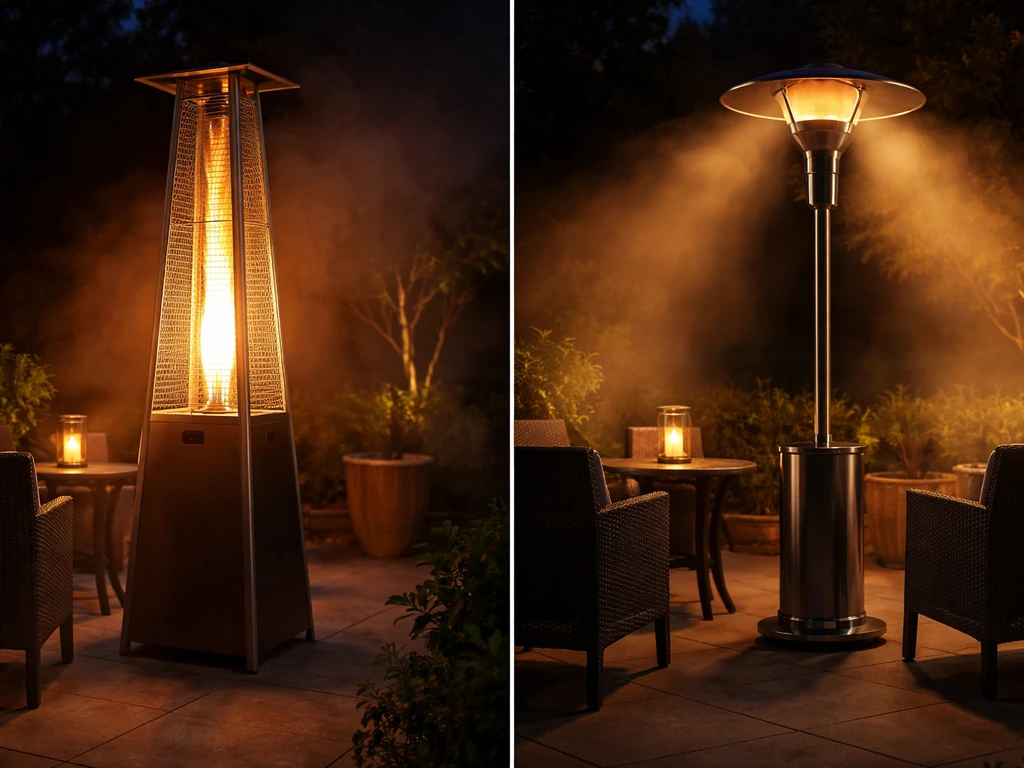
What a pyramid heater actually is (and what 'patio heater' covers)
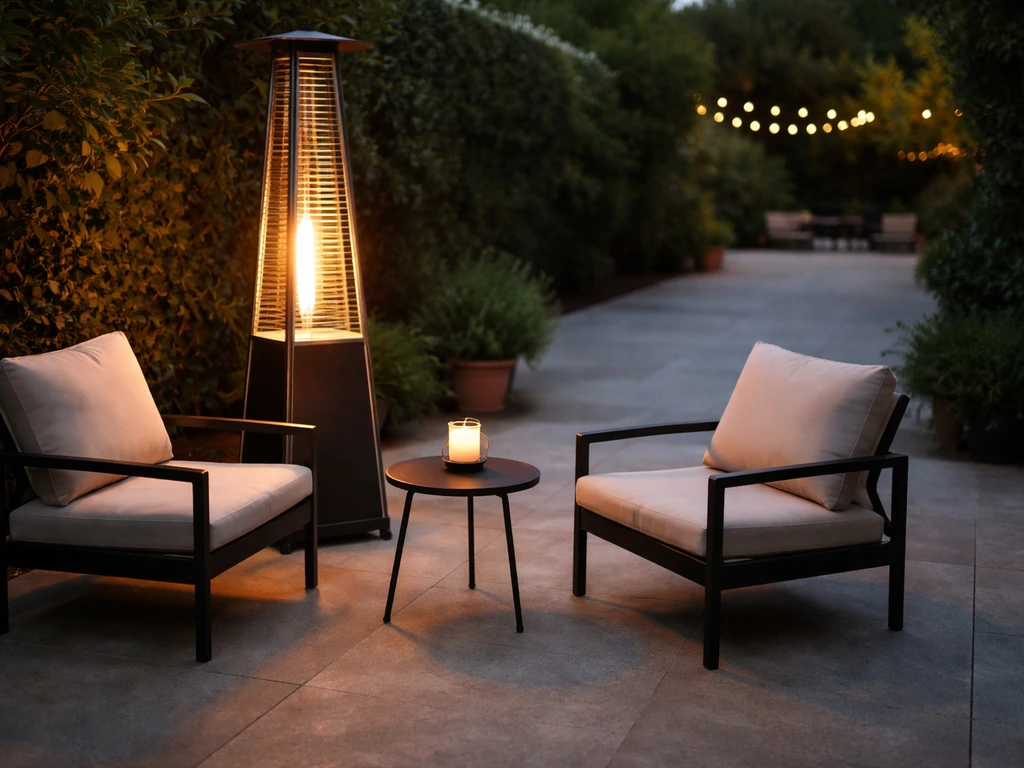
A pyramid heater is a freestanding outdoor gas heater with a tall, tapered frame, typically square at the base and narrowing toward the top, with a glass or quartz tube running up the center that shows a live flame. They're sold as a distinct style in both the US and UK markets, sometimes called flame-tower heaters or glass-tube patio heaters. Most run on propane from a tank stored inside or beneath the base. Output is typically in the 40,000 to 46,000 BTU range (around 13 to 15kW in UK spec), and a single unit is rated to effectively warm around 8 square meters, or roughly an 85-square-foot seating zone.
'Patio heater' is the broader umbrella term that covers every style of outdoor heater: the classic mushroom or umbrella-top propane heater, wall-mounted or ceiling-mounted infrared electric panels, portable infrared propane units, natural gas post-mount heaters, pellet-burning outdoor heaters, and tabletop models. A pyramid heater is technically a type of patio heater, but most people use 'patio heater' to mean the traditional mushroom-cap style. That's the comparison worth making: pyramid flame-tower design vs. the other common styles.
Heat coverage and what you'll actually feel
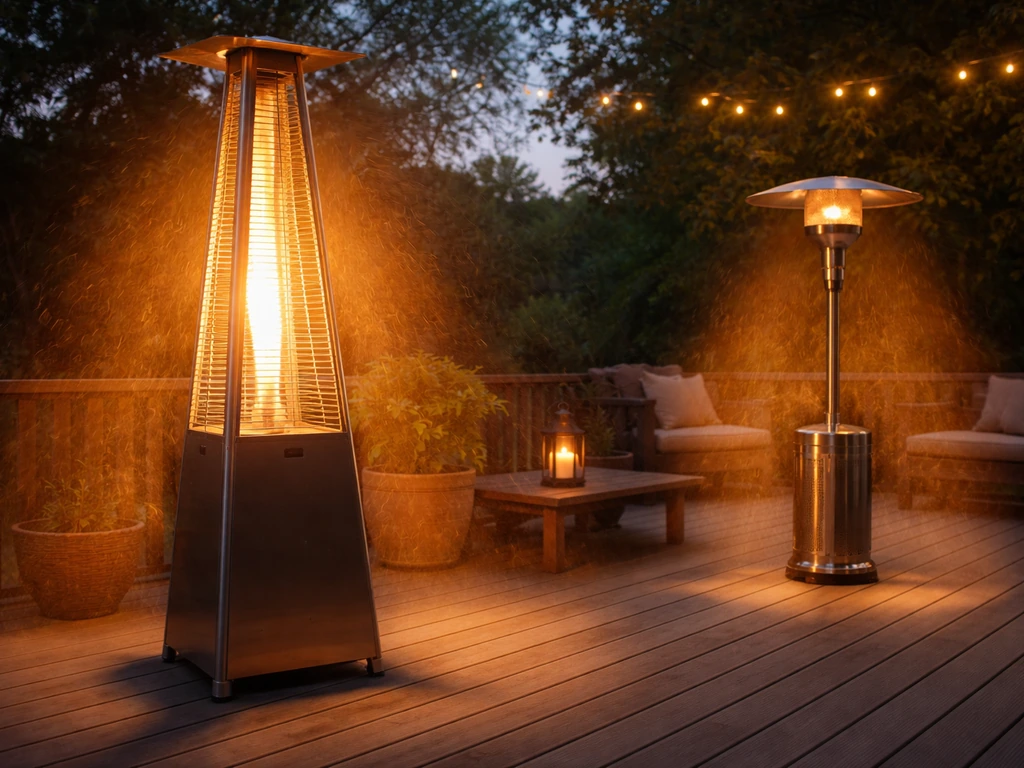
Both pyramid heaters and traditional propane patio heaters use radiant heat, which means the warmth travels directly to people and objects in range rather than trying to heat the surrounding air. That matters outdoors because any heat that warms the air simply floats away. Radiant heat is perceived almost instantly when it reaches your skin, which is why these heaters feel effective even in cool weather.
Where they differ is in how that heat spreads. A comparison on beellen.com describes pyramid or flame-tower heater designs as differing from other patio heater designs in how the heat is presented, using a “fire column” style versus other radiating approaches how that heat spreads. A pyramid heater radiates heat outward from the central flame tube in all directions along its height, so people sitting close to the unit (within about 6 to 8 feet) get warmth from the sides of the flame column. The warmth is more concentrated and directional rather than spread wide. A traditional mushroom-top heater is designed for 360-degree distribution from the top dome, and many models claim a 10 to 12 foot heat coverage radius, with some infrared propane models advertising a 10 to 15 foot radiant circle. For a larger gathering spread around a central heater, the mushroom style tends to cover more people at once.
In windy conditions, radiant heat from both styles holds up reasonably well compared to convective heating (which is basically useless outdoors), but wind does reduce comfort at the edges of the heat zone. Pyramid heaters with an enclosed glass tube protect the flame better visually, but the radiant warmth you feel is still affected by a strong wind pulling heat away from your body before it fully registers.
Fuel types and power options
Pyramid heaters are almost exclusively propane gas units. That's both a strength and a limitation. Propane is portable, you don't need an electrical outlet or a gas line, and you can move the heater wherever you need it. The downside is ongoing propane costs and the need to keep a spare tank on hand.
Standard patio heaters come in a wider range of fuel types, and the right one depends heavily on your setup.
| Fuel Type | Best For | Typical Output | Key Trade-off |
|---|---|---|---|
| Propane (portable) | Open patios, no gas line or outlet | 30,000–46,000 BTU | Ongoing fuel cost, tank management |
| Natural gas (fixed) | Permanent installs with gas line access | 30,000–50,000 BTU | Requires professional install, not portable |
| Electric infrared | Covered patios, low-noise needs, easy install | 1,000–4,000W (3,400–13,600 BTU equivalent) | Needs outdoor-rated outlet, lower peak heat |
| Pellet | Aesthetic appeal, off-grid | Variable | More maintenance, slower heat-up, less common |
If you want the convenience and visual drama of a pyramid heater but need to run it on natural gas, look for a pyramid-style unit with a natural gas conversion option or a dedicated NG model. They exist but are less common than propane versions. Electric infrared patio heaters are widely considered the most efficient option for covered patios since there's no combustion and no wasted fuel, and they deliver near-instant warmth. They just can't match the raw BTU output of a large gas unit in a fully exposed outdoor space on a cold night.
Which heater fits your outdoor space
This is where the choice gets very practical. Think about three things: your patio size, whether it's covered or open, and how much wind you deal with.
Patio size and seating layout
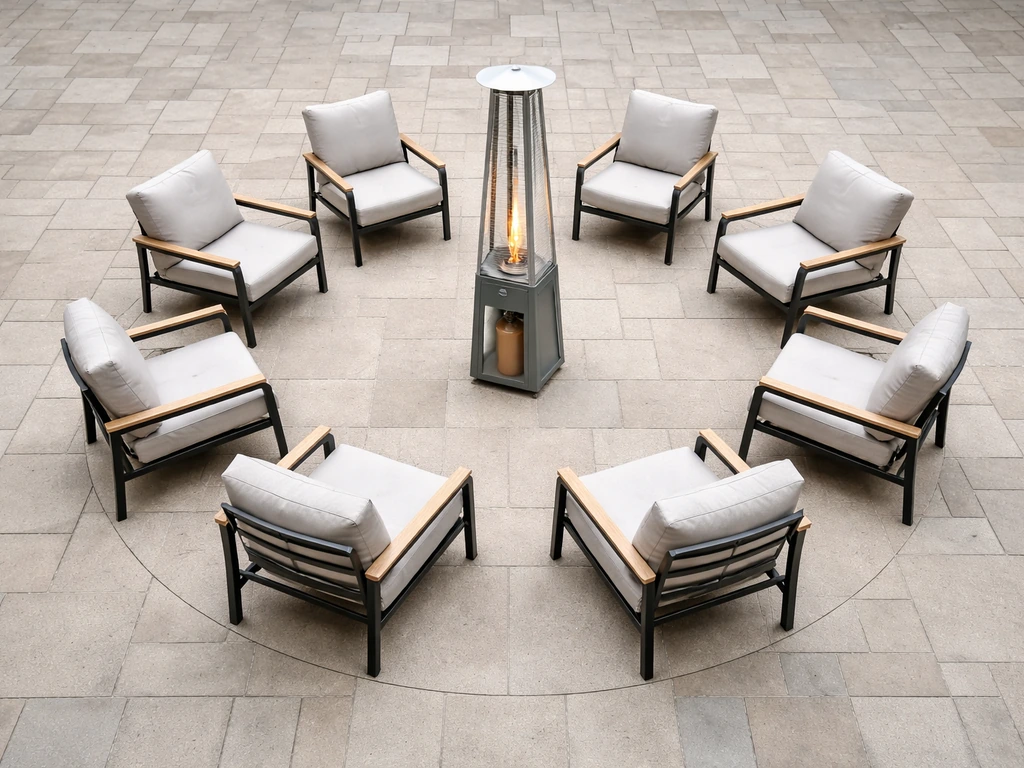
A single pyramid heater at 13kW (around 46,000 BTU) comfortably warms roughly 8 square meters, which is about an 8 to 9 foot diameter seating zone. If you have a small intimate seating area, one pyramid heater placed centrally works well. For a larger patio with guests spread out, either go with a traditional mushroom-top heater that pushes heat in a wider 12-foot radius, or plan to use two pyramid heaters positioned at opposite ends of the space. One heater of either style won't heat a 20x20 foot patio evenly on its own.
Covered vs. uncovered patios
Pyramid heaters and other gas heaters require outdoor use in adequately ventilated, open-air conditions. If your patio has walls on multiple sides or a solid roof with limited airflow, combustion heaters become a carbon monoxide risk and should not be used there. For covered, enclosed, or partially enclosed patios, electric infrared heaters are the right tool. They're safe in covered spaces, easy to mount overhead, and don't produce combustion gases. Open, uncovered patios are fair game for any gas heater style.
Wind exposure
In a windy yard, radiant heat holds up better than convection, but placement still matters. Position any freestanding heater so it's not directly downwind of your seating area, and look for a location with a natural windbreak like a fence or wall at the far side. Pyramid heaters are relatively stable at the base but tall, so in a consistently gusty environment, choose a model with a wide base and consider where you'll anchor it. Low-profile infrared electric panels mounted on a wall or fence are a smart choice for very exposed spots because they're fixed, not freestanding.
Safety, clearances, and ventilation
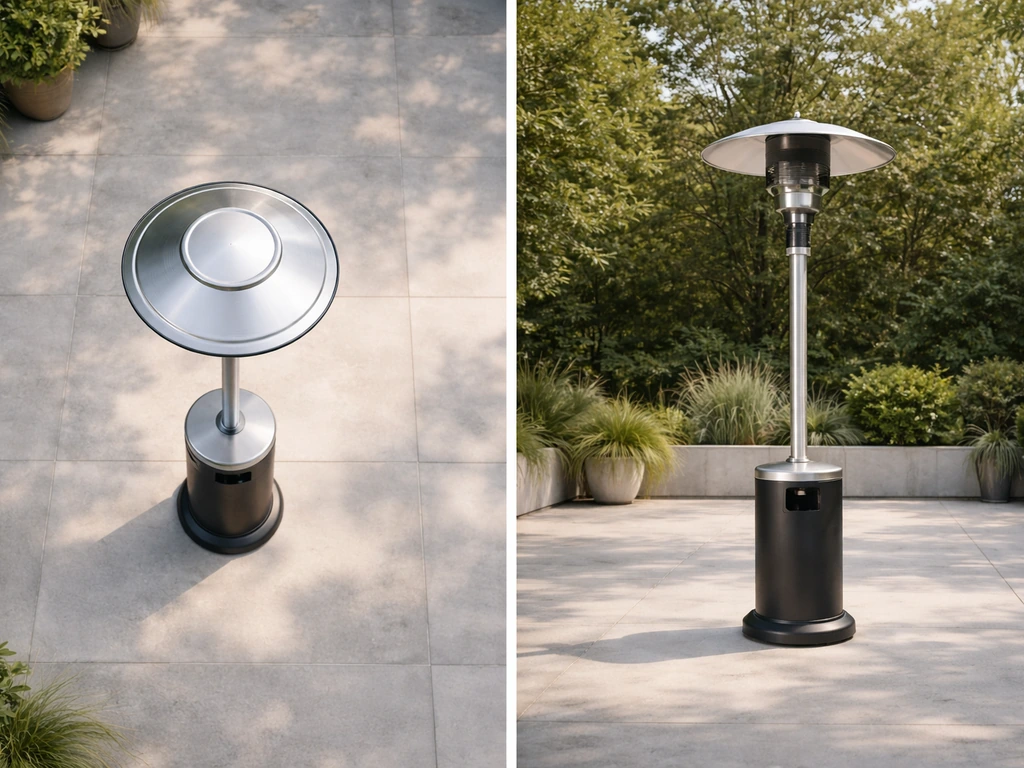
Gas patio heaters of any style need to be treated with respect. Here are the non-negotiable safety rules that apply to pyramid heaters and most gas patio heaters. Always follow the owner’s manual for the recommended clearance to combustibles and use gas patio heaters outdoors in open, well-ventilated areas with plenty of airflow, and choose units that are UL-approved or CSA-certified non-negotiable safety rules.
- Maintain at least 24 inches of clearance above the heater top and at least 36 inches from the sides to any combustible material like wood, fabric, or an overhead pergola.
- Never use a combustion gas heater in a fully enclosed or poorly ventilated space. Adequate fresh air is required to prevent carbon monoxide buildup.
- Keep people at least 5 to 6 feet from the heater body when it's operating, especially children.
- Look for UL-approved or CSA-certified units. Modern gas patio heaters should include an oxygen depletion sensor (ODS) that shuts the unit off if combustion air runs low, a tip-over auto-shutoff that triggers if the heater tilts more than about 30 degrees, and a safety pilot that stops gas flow if the flame goes out.
- Always check for gas leaks after connecting a new propane cylinder. Apply soapy water to connections and look for bubbles before lighting.
- When storing the heater or not using it for an extended period, disconnect the propane cylinder.
- Never use an unregulated propane cylinder. The heater requires a regulator to maintain safe operating pressure.
- Keep the area around the heater clear. Don't drape furniture, covers, or clothing near it while it's running.
The tall, narrow profile of pyramid heaters means the overhead clearance requirement is real: you need enough height above the flame tube for at least 24 to 36 inches of clearance to anything overhead. On an open patio with no roof, this is never an issue. Under a pergola or low awning, measure before you buy.
Cost to run, install, and maintain
Pyramid heaters and propane patio heaters have similar running costs because they use the same fuel at similar output levels. A standard 20-pound propane tank holds roughly 430,000 BTU of energy. Running a 40,000 BTU heater on high burns through a tank in about 10 hours. At current US propane prices (roughly $3 to $5 per gallon for small cylinder exchange), that's around $10 to $17 per tank fill, or $1 to $1.70 per hour at full output. At medium output the runtime roughly doubles. Natural gas units cost less per hour to run if you have a gas line, but the upfront installation cost for running a gas line and a fixed mount can be $300 to $800 or more depending on your setup.
Electric infrared heaters have a lower upfront cost (often $100 to $300 for a wall-mount panel) and straightforward installation if you have an outdoor outlet. Running a 1,500W panel at the average US electricity rate of around $0.15 per kWh costs about $0.22 per hour. They're the cheapest to run for shorter sessions in covered spaces.
Pyramid heaters and glass-tube gas patio heaters need routine maintenance to keep performing safely. That includes cleaning the reflector and glass tube (a dirty tube reduces radiant output and can cause uneven flame), checking burner ports for blockages, inspecting the hose and regulator for cracks each season, and storing the unit properly when not in use. Most manufacturers recommend cleaning as frequently as conditions demand, especially if you're in a dusty or high-pollen environment. Warranties on these units typically run one year from most major brands, so factor that into your long-term ownership cost.
How to choose: quick decision guide
Before you buy anything, take two minutes to answer these questions about your situation.
- Is your patio covered or enclosed? If yes, go electric infrared. Gas heaters of any style are not safe in poorly ventilated covered spaces.
- What is the size of your seating area? Measure it. One heater (pyramid or mushroom-top) covers roughly an 8 to 12 foot diameter. If your space is larger, plan for multiple units or a higher-output fixed natural gas heater.
- Do you have a natural gas line nearby? If yes, a fixed natural gas heater is the most cost-effective long-term choice. If not, propane (including pyramid style) is your portable option.
- Do you have an outdoor outlet? If yes, electric infrared is worth serious consideration, especially for a covered patio.
- How important is visual appeal? Pyramid heaters with their live-flame column are genuinely beautiful at night and double as a focal point. If that matters to you, a pyramid heater earns its place.
- How much wind do you deal with? In a very exposed yard, a wall-mounted electric panel or a lower-profile infrared propane unit may outperform a tall freestanding heater.
Quick use-case recommendations
| Scenario | Best Heater Style | Why |
|---|---|---|
| Small open patio, aesthetic matters | Pyramid heater (propane) | Great visual, focused warmth, portable |
| Large open patio, group gathering | Mushroom-top propane (40,000+ BTU) or 2 pyramid units | Wider 360° heat spread covers more people |
| Covered pergola or enclosed porch | Electric infrared panel (wall/ceiling mount) | No combustion risk, safe for covered spaces |
| Permanent backyard install, gas line available | Natural gas post-mount or fixed infrared | Lowest long-term running cost, no tanks |
| Windy exposed backyard | Wall-mounted electric infrared or low-profile propane infrared | Fixed position, not affected by tip-over risk |
| Tight budget, flexibility needed | Portable propane tabletop or budget propane heater | Low upfront cost, easy to reposition |
| Low noise, no open flame | Electric infrared panel | Silent, flameless, instant heat |
If you're specifically drawn to the pyramid flame-tower style, it's a legitimate, well-performing heater in the right setting: an open patio, a small to medium seating zone of up to about 85 to 90 square feet, no low overhead obstructions, and access to a propane tank. For a broader look at the top-rated models in that style, the best pyramid patio heaters and best outdoor pyramid patio heater guides on this site walk through specific model comparisons with real-world ratings. If you're shopping around, these best outdoor pyramid patio heater picks help you compare heat output, coverage, and ease of setup best pyramid patio heaters. For a quick shopping starting point, check the guides and comparisons for the best pyramid patio heaters in your fuel and coverage range. If you're comparing pyramid vs. mushroom-top specifically, the pyramid patio heater vs mushroom comparison digs into that head-to-head in more detail. And if you want to see how specific models have held up for real buyers, the pyramid flame patio heater reviews section covers hands-on owner feedback.
The bottom line: pyramid heaters work well and look great, but they're one tool for one job. Match the heater type to your actual space and conditions first, then pick the style that fits within that shortlist. That's how you end up warm and happy instead of dragging a beautiful heater back inside because it wasn't built for your setup.
FAQ
How do I decide how many pyramid heaters I need if my patio is bigger than the stated coverage area?
Use the heater’s effective circle only as a starting point. For groups spread out, plan for overlaps, not edge-to-edge coverage. As a quick rule of thumb, a single unit typically won’t heat a 20 by 20 foot patio evenly, so you usually need two units spaced apart (often opposite ends) or switch to a wider-coverage mushroom style for a central “warm zone.”
Can I use a pyramid heater on a covered patio or under a pergola?
Usually not, unless ventilation is clearly open-air. Gas heaters create combustion byproducts, so enclosed or multi-sided covered areas increase risk and discomfort. If you do use one near a roof, confirm you have substantial airflow and meet the heater’s stated clearance requirements, especially height and distance from overhead structure.
What clearance and placement mistakes most often reduce pyramid heater performance?
Placing it too close to walls, furniture, or overhead structures can block radiant reach and force you to keep a larger safety gap than the manual expects. Also avoid putting it directly in line with your seating so wind blows the heat away from people, and keep it off uneven or soft ground because the tall base can become less stable if it tilts.
Do pyramid heaters require electricity or batteries to work?
Most propane pyramid heaters are stand-alone and don’t need a mains outlet, but some include electronic ignition or a blower depending on the model. Check whether it uses piezo ignition, battery assist, or external power so you aren’t surprised during setup.
How does running a pyramid heater at medium or low affect cost and comfort?
Most units that support multiple heat settings will reduce propane consumption roughly in proportion to output. Comfort will still feel strong near the heater because radiant heat hits quickly, but the warmed “circle” shrinks at lower settings, so you may need to sit closer or run longer for the same overall experience.
What maintenance should I do beyond basic cleaning to prevent uneven flames?
If you notice flickering, reduced glow in the flame tube, or inconsistent heating, inspect burner ports for debris and make sure the tube is seated correctly. Dust and pollen can partially block ports, and a dirty or oxidized glass/quartz tube can dim output even if the flame looks normal.
Can I store a propane cylinder attached to the heater when it’s not in use?
In most setups, propane cylinders should be stored safely outdoors and away from ignition sources, not left attached in a way that violates your local rules or the heater’s manual. Follow the manufacturer guidance for cylinder connection, shutoff valve position, and weather protection, particularly if you leave it through rain or cold snaps.
Is natural gas an option for a pyramid-style flame heater?
It can be, but it’s less common than propane. If you want pyramid appearance with a gas line, look for a dedicated natural gas unit or a conversion option the manufacturer explicitly supports, then plan for proper fixed mounting and any required regulator and connection components.
Do pyramid heaters work in very windy conditions, and how should I position them?
They hold up better than heaters that rely on warming air, but wind still reduces how much radiant warmth reaches your body at the edge of the zone. Position the heater so wind isn’t blowing heat directly away from your seating, and use a fence, wall, or windbreak on the far side if possible. In gusty yards, a wider base model and stable anchoring matter.
Why does my pyramid heater feel hot at first but less warm later?
Common causes include a partially blocked burner, a dirty glass/quartz tube, or a regulator issue that changes pressure as the session continues. Also confirm you’re using the correct tank type and that the cylinder isn’t nearly empty, since low pressure can reduce flame intensity and radiant output.
What safety checks should I do before the first use each season?
Inspect the hose and regulator for cracks, confirm the connection is leak-tight, and verify the heater’s clearance points. Test ignition and watch the flame pattern for consistency, then do a quick functional check in a safe open-air area before bringing anyone near the seating zone.
Are pyramid heaters safer than other patio heaters?
They’re not inherently safer, but their design changes risks to manage. You still have combustion hazards with propane gas units, and the tall flame-tube profile makes overhead clearance critical. Treat them with the same precautions as other gas patio heaters: use outdoors only where ventilation is adequate, keep combustibles away, and follow automatic shutoff or tip-over requirements if your model has them.