
If you're choosing between a pyramid and an umbrella patio heater, here's the honest answer: umbrella heaters (also called mushroom heaters) push a focused cone of heat downward over roughly an 8–10 foot radius and work best when people are seated directly underneath. Pyramid heaters spread warmth outward in a wider, more even 360-degree pattern, covering a radius of roughly 3–5 meters (10–16 feet) depending on BTU output, making them better for groups arranged around a central point. Neither is universally better, the right one depends on your patio layout, how many people you're heating, and whether you have a covered or open space.
Pyramid vs Umbrella Patio Heater: Which Heats Better?

Willa Brennan
16 Jun 2026
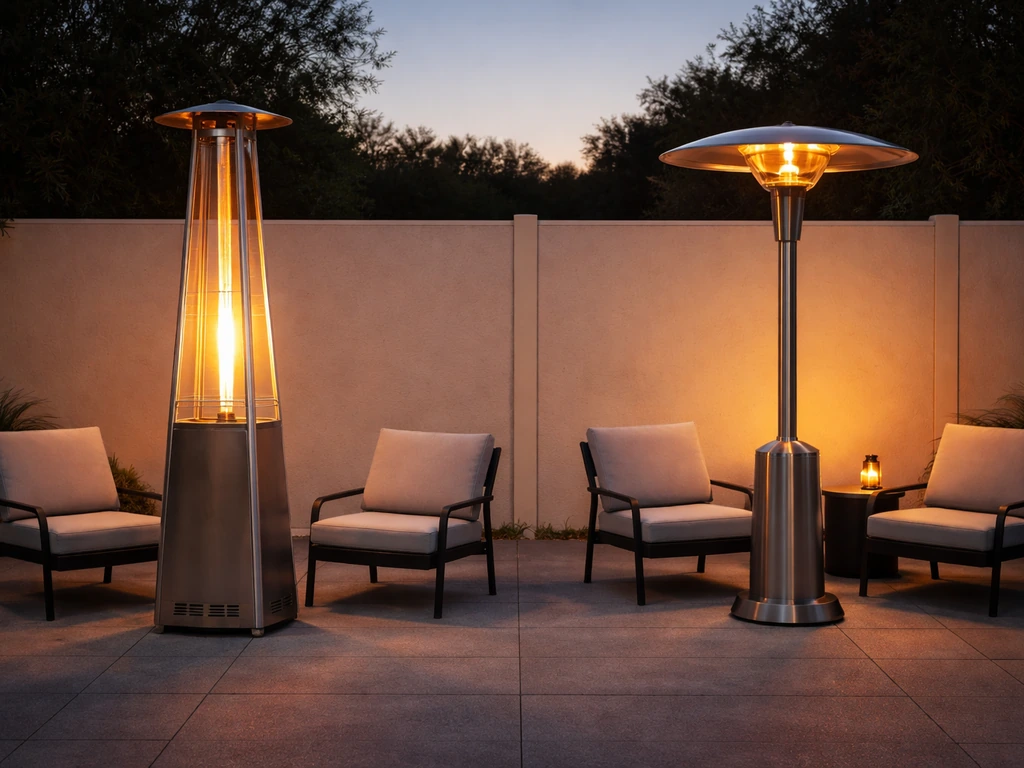
What a pyramid vs umbrella patio heater really means
The terms can get confusing because marketing doesn't always agree with common usage. An blank" rel="noopener noreferrer">umbrella heater (sometimes called a mushroom heater or standard standing patio heater) is the tall, pole-mounted style you've seen at restaurant patios everywhere. It's typically 86–88 inches tall, burns propane or natural gas, and has a domed reflector cap at the top that pushes heat downward in a cone shape. The burner sits near the top of the pole, and the reflector above it redirects what would otherwise be wasted upward heat back down toward people.
A pyramid heater looks completely different. It has a wide, heavy base, a vertical glass tube or open flame column running up the center, and a pyramid-shaped reflector at the top. That reflector is designed to direct heat outward and downward in all directions simultaneously, giving you that 360-degree coverage. Most propane pyramid models run between 30,000 and 48,000 BTU. Some people also call them "glass tube" heaters because many feature a clear glass surround around the flame, which makes them double as a visual focal point on the patio.
It's worth noting there's a third related shape called a mushroom heater, which is similar to an umbrella style but with a slightly different reflector profile. If you've been reading about the best mushroom patio heater options, you'll recognize the overlap with umbrella designs. The core heating mechanics are essentially the same.
Heat style and coverage: where the warmth actually goes
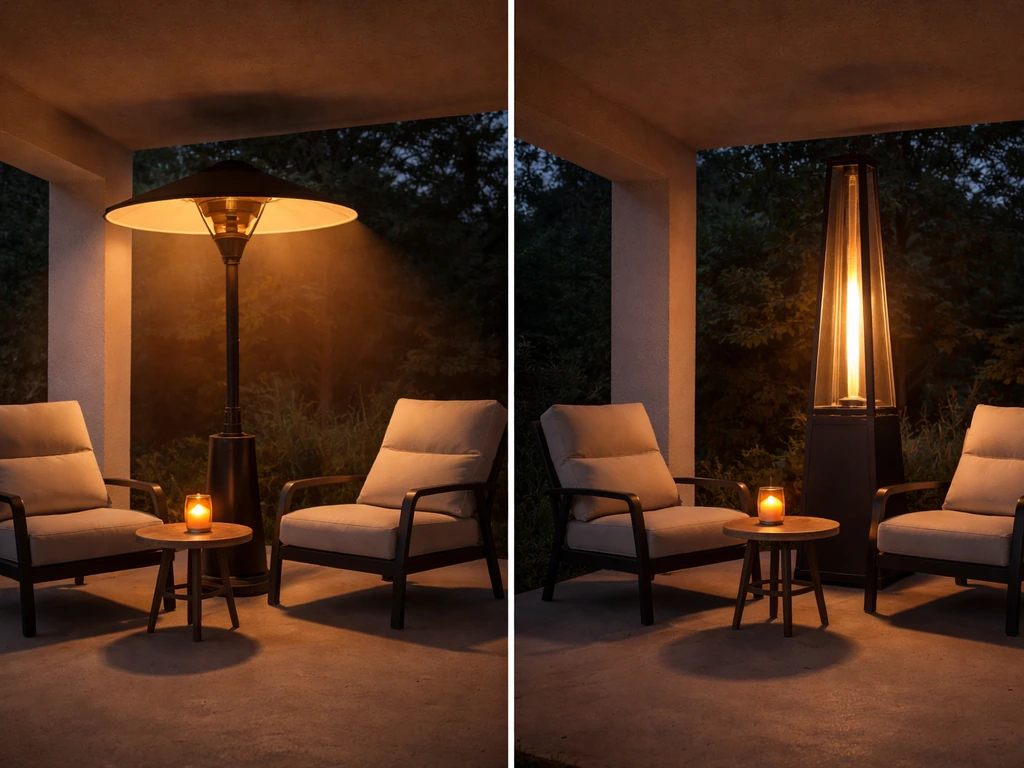
Both styles use radiant (infrared) heat as their primary mechanism, meaning they warm people and objects in their path rather than heating the surrounding air. This is what makes outdoor heaters practical at all, heating open-air spaces by warming the air is mostly futile because the air just drifts away. Radiant heat hits you directly, like sunlight, and you feel it immediately.
Where they differ is in the shape and direction of that radiant output. An umbrella heater's reflector focuses heat in a downward cone. If you're sitting within about 8–10 feet of the pole and directly under the reflector, you'll feel plenty of warmth. Step outside that cone and the warmth drops off noticeably. It's great for a table of four gathered closely around a single heater.
A pyramid heater's 360-degree output means it can warm people on all sides simultaneously. A 13kW (roughly 44,000 BTU) gas pyramid heater can cover a radius of around 3 meters in all directions. That's genuinely useful if you have guests spread around the heater in a circular or semi-circular arrangement, or if you want a single central heater to cover a larger open area. The tradeoff is that the heat is spread thinner, you won't get the intense focused warmth directly under an umbrella heater, but more people share in a more even spread.
| Feature | Pyramid Heater | Umbrella/Mushroom Heater |
|---|---|---|
| Heat direction | 360° outward and downward | Focused cone downward |
| Typical BTU range | 30,000–48,000 BTU | 36,000–48,000 BTU |
| Coverage radius | ~10–16 ft (all sides) | ~8–10 ft (cone below) |
| Best seating layout | Groups around a central point | Compact table directly underneath |
| Visual appeal | High (flame visible) | Moderate (functional look) |
| Stability | Very stable (wide base) | Less stable (tall pole, narrower base) |
| Typical height | ~6–7 ft | ~86–88 inches (7+ ft) |
Fuel types and efficiency tradeoffs
Most pyramid heaters run on propane, full stop. You'll occasionally find natural gas conversion kits, but the vast majority are propane-powered and use a standard 20 lb tank housed in the base. This is convenient because the base doubles as a tank cabinet, keeping everything tidy. Umbrella heaters come in more fuel variety: propane, natural gas (with a fixed line connection), and even electric versions exist, though electric umbrella heaters are less common than electric infrared wall or ceiling mounts.
On the electric side, infrared electric patio heaters are a distinct category that can look like neither a pyramid nor an umbrella, they're typically wall or ceiling-mounted panels or tubes. If you're considering electric, that usually means moving away from the freestanding pyramid or umbrella format entirely and into a mounted infrared heater, which has its own set of tradeoffs (great for covered patios, not portable, requires wiring).
For gas models, propane prices in the US currently average roughly $2.40–$3.20 per gallon depending on your region and the time of year. A 40,000 BTU propane heater burns approximately 0.44 gallons per hour at full output. At $2.80/gallon, that's about $1.23 per hour of operation. A standard 20 lb propane tank holds roughly 4.7 gallons, so you're looking at about 10–11 hours of run time per tank at full blast, costing around $13–$15 per fill depending on local pricing. Both pyramid and umbrella heaters in the 40,000 BTU range will run at nearly identical fuel costs because the BTU output is what drives consumption, not the shape.
Natural gas umbrella heaters, when connected to a fixed line, are generally cheaper to run than propane equivalents because residential natural gas rates are lower per BTU. The downside is you lose portability and need a gas line run to your patio, which adds installation cost. If you have the infrastructure already, a natural gas umbrella heater will cost less per hour to run long-term.
Best use cases by patio size and layout
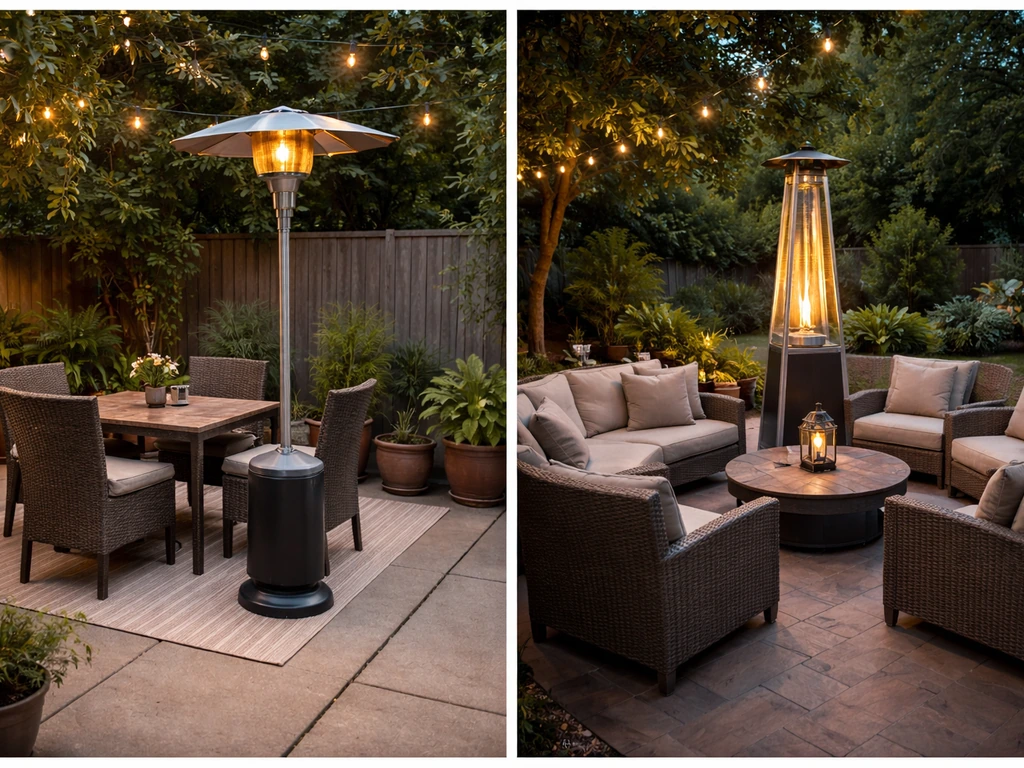
A small, compact patio (think a 10x10 ft space with a dining table and four chairs) is honestly ideal for a single umbrella heater. Place it at the edge of or between tables, and everyone sitting close gets that focused downward warmth. You don't need 360-degree coverage if all your guests are on one side of the heater anyway.
A medium to large open patio (15x20 ft or bigger) with seating arranged in a circle or spread across the space benefits more from a pyramid heater. Because it radiates in all directions, one well-placed pyramid heater in the center can warm a wider ring of guests more evenly than a single umbrella heater trying to cover the same area. For very large patios, you'd likely need multiple heaters of either type.
Covered patios change the calculus. Under a pergola, awning, or covered porch, the reflected and retained warmth from any heater becomes more effective because it can't escape upward as quickly. Both styles work well here, but be more careful with clearances under a covered space, pyramid heaters need roughly 3 feet of clearance above the reflector, and umbrella heaters need the reflector cap to be well clear of any combustible overhead surface. Heaters mounted or placed so the heat source is more than 10 feet below the ceiling lose effectiveness noticeably, so a covered patio with standard 8–9 ft ceiling height is actually ideal.
- Small patio (under 150 sq ft), dining table setup: umbrella heater is the better fit
- Medium open patio with circular seating: pyramid heater wins for even coverage
- Covered patio or pergola: both work well, just mind your clearances
- Large open backyard space: consider multiple umbrella heaters placed strategically, or one high-output pyramid as a centerpiece
- Portable/move-around use: pyramid heaters are more stable to move; tall umbrella heaters are tippier in transit
- Social gathering focal point aesthetic: pyramid heaters with visible flames add ambiance umbrella heaters can't match
Safety, wind performance, and ventilation differences
Wind is the biggest enemy of any outdoor gas heater, and both styles handle it differently. Umbrella heaters, because of their height and narrower base, are more susceptible to tipping in wind. Most quality models include a tip-over safety switch and a thermocouple that automatically shuts off the propane supply if the flame gets blown out, this is a critical safety feature to verify before you buy. The tip-over mechanism typically triggers at around 15–30 degrees from vertical. Some manufacturers explicitly state not to use their heaters if wind exceeds 8–15 mph. The CSA/ANSI Z83.26/CSA 2.37 patio heater standard scope includes wind-related coverage, including referenced details addressing failure under wind conditions via an annex or change wind exceeds 8–15 mph.
Pyramid heaters have a physical stability advantage. The wide, heavy base (which typically houses the propane tank) makes them much harder to tip over accidentally. They sit lower to the ground and have a lower center of gravity than a tall umbrella pole. That said, the flame in a glass-tube pyramid heater can still be affected by strong gusts, and the same thermocouple flame-out safety shutoff applies. For windy patios, the pyramid's lower profile and heavier base is a meaningful benefit.
On ventilation: both pyramid and umbrella heaters are designed for outdoor use only. They should never be used in enclosed spaces. Propane and natural gas combustion produces carbon monoxide, and even a well-burning heater will accumulate dangerous CO levels in an enclosed area quickly. A covered patio with open sides is fine; a screened-in porch with the screens fully closed and the doors shut is not. This applies equally to both heater types.
For clearances, keep at least 3 feet between the heater (especially the top reflector) and any overhead combustible surface like a wood pergola, fabric awning, or market umbrella. Keep the heater away from curtains, cushions, and anything that could catch a spark. The propane cylinder should always be secured upright and never stored near a heat source. For electric infrared models (if you go that route instead), clearance requirements are stated per manufacturer but follow a similar principle: the Sunpak guidance, for example, recommends a minimum mounting height of 7 feet from the floor and notes that anything over 10 feet up loses effectiveness.
Cost to buy and cost to run
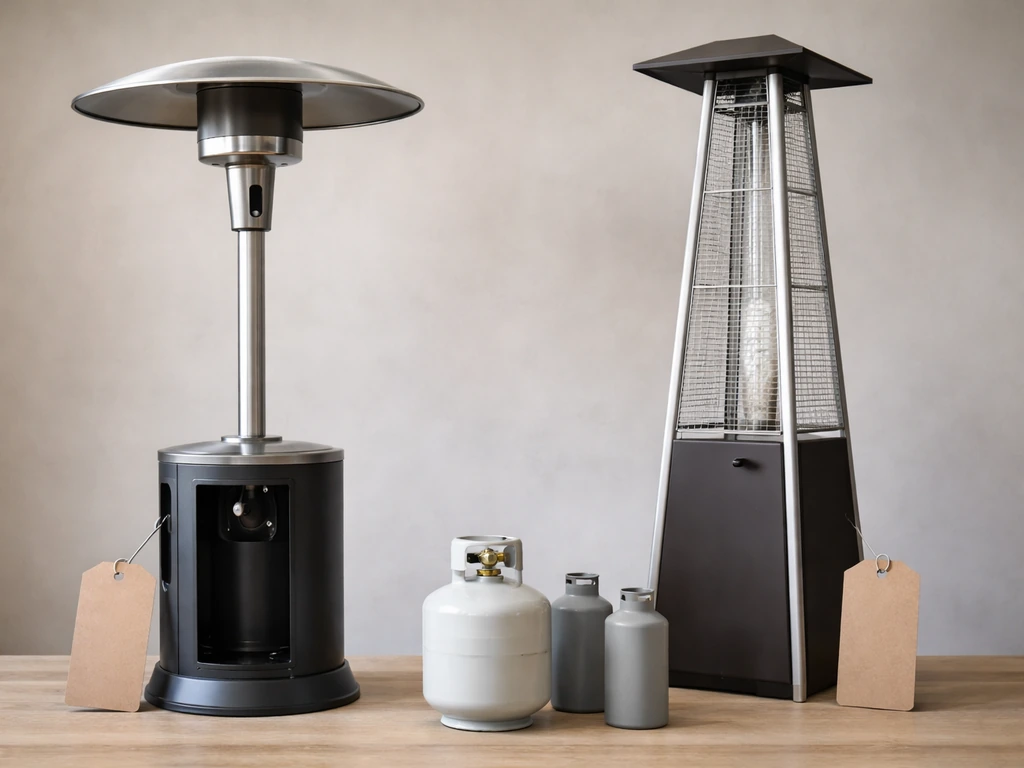
Upfront, pyramid heaters tend to cost more than entry-level umbrella heaters. A basic propane umbrella heater starts around $80–$150 at big-box retailers. A mid-range umbrella heater with better build quality and safety features runs $150–$300. Pyramid heaters typically start around $200–$250 for budget models and go up to $400–$600 for higher-quality glass-tube designs with better materials and more stable bases. Premium commercial-grade versions of both styles can exceed $600–$1,000.
Running costs are determined almost entirely by BTU output and fuel type, not by heater shape. Here's a practical estimate for a 40,000 BTU propane model of either type, at $2.80/gallon propane:
| Usage Scenario | Hours per Week | Tanks per Month (approx.) | Monthly Fuel Cost (approx.) |
|---|---|---|---|
| Occasional evenings (2–3 nights/week, 2 hrs) | 4–6 hrs | 0.5 tanks | $6–$8 |
| Regular entertaining (4–5 nights/week, 3 hrs) | 12–15 hrs | 1.5 tanks | $18–$22 |
| Heavy use (daily, 3–4 hrs) | 21–28 hrs | 2.5–3 tanks | $35–$45 |
Natural gas models cost less per hour to run once you have the line installed, roughly 40–60% less per BTU than propane depending on local rates, but the upfront installation of a gas line can run $300–$700 or more depending on how far your patio is from your gas meter. That makes natural gas umbrella heaters a better long-term investment for people who entertain frequently, and a poor choice if you only use the heater a handful of times per season.
Electric infrared heaters, if you go that direction, typically cost $0.15–$0.30 per kilowatt-hour to run depending on your electricity rate. A 2kW electric heater running 3 hours costs roughly $0.90–$1.80. But electric models in this format are almost always wall or ceiling-mounted, which takes them out of the pyramid vs umbrella comparison in terms of form factor, though they're worth considering for covered patios where permanent mounting is an option.
Choosing between them: what to look for and a quick decision checklist
The honest recommendation: if you have a compact patio with a fixed dining setup and guests seated close together, get an umbrella heater with a tip-over switch and a quality thermocouple. It'll do the job efficiently and cost less upfront. If you have a larger open patio, entertain groups in a social circle layout, or want the heater to double as a visual centerpiece, a pyramid heater is worth the extra cost and will provide more even warmth for more people simultaneously.
A few features matter regardless of which style you choose. Look for a tip-over safety shutoff (critical for freestanding propane heaters), a thermocouple flame-out safety valve, a sturdy base that won't wobble on uneven surfaces, and clearance guidance in the manual for your specific covered or open patio situation. If you're evaluating pyramid-style heaters on their own merits in more depth, the broader question of whether pyramid patio heaters are genuinely worth it is worth exploring separately. If you're wondering whether pyramid patio heaters are genuinely worth it for your patio, the answer depends on how your seating is laid out and how windy the space is. If you're wondering, "are table top patio heaters any good," the key is whether you can position the heat where people are and avoid losing warmth to wind or open airflow whether pyramid patio heaters are genuinely worth it.
Here's a quick checklist to land on the right choice:
- Measure your patio and identify where guests sit: if they're all within 8–10 feet in one direction, umbrella works; if they surround a central spot, go pyramid
- Check if your patio is covered or open: both work under covers, but verify clearance to overhead surfaces (3 ft minimum to combustibles)
- Assess wind: if your patio is exposed and gusty, the pyramid's wider, heavier base is a genuine safety and stability advantage
- Decide on fuel: propane for portability and flexibility, natural gas for lower long-term running costs if you have an existing line
- Set your budget: under $200 points you toward umbrella heaters; $250 and up opens the pyramid market meaningfully
- Confirm safety features before buying: tip-over shutoff and thermocouple flame-out protection are non-negotiable for any freestanding propane heater
- If you want a tabletop option for a small balcony or tight space instead, that's a separate category worth considering on its own terms
- Think about how often you'll use it: high-frequency users should consider natural gas umbrella or electric infrared (mounted) for lower operating costs over time
Neither the pyramid nor the umbrella heater is perfect for every situation, but knowing your patio layout, your group size, and your wind exposure will point you clearly to one over the other in most cases. Use the checklist above, match it to your setup, and you'll have a confident answer without second-guessing yourself at the store.
FAQ
How do I choose the winner based on where my guests will actually sit?
It usually comes down to where your seating sits relative to the heater’s effective cone or ring. If you will have most guests within about a 8–10 foot radius directly under the unit, an umbrella-style cone is easier to feel immediately. If people will form a wider circle or semi-circle around a center point, a pyramid’s 360-degree pattern generally reduces “hot on one side, cold on the other” complaints.
What happens if my patio is open on all sides (lots of airflow)?
Assume performance will drop faster in open air than on a covered patio. If your patio has open sides and breezes, you should plan on either adding distance buffer (place the heater closer to seating) or using multiple heaters rather than trying to “stretch” one unit across a large area.
Which safety features matter most for windy conditions on propane umbrella or pyramid heaters?
Look for a listed tip-over safety switch plus an auto shutoff that uses a flame-out mechanism (often thermocouple-based). Also verify the manufacturer’s specified wind limit and that the base footprint is large enough for your patio surface, especially on slightly uneven pavers where wobble can reduce stability.
Do coverage claims on the box always match real heating?
If you’re comparing two heaters with different advertised coverage, use their stated BTU output and confirm how they measure coverage. Shape can make coverage feel different, but fuel burn and heat intensity are still driven primarily by BTUs, so a higher-BTU unit can outperform a lower-BTU one even if the “cone” sounds smaller.
Can I use a pyramid or umbrella heater on a screened-in porch if the screens are open?
Avoid running gas heaters under partially closed screens, louvered walls, or near openable doors that create a semi-enclosed pocket. “Outdoor use only” means you need genuine air movement, not a room-like setup, because carbon monoxide buildup can happen quickly even if the heater is working properly.
What are the most common setup mistakes that make these heaters feel weak?
Start by measuring overhead clearances, then plan for people and furniture that can block radiant heat. A common mistake is placing the heater too close to overhead structures or too far from seating, which makes the radiant output miss people and makes you think the heater “isn’t strong enough.”
When does switching from propane to natural gas actually make sense?
Yes, you can, but you need to account for gas line routing and local codes. Natural gas is typically cheaper per BTU and more consistent for frequent entertaining, but the installation cost and the fixed-location requirement mean you should only switch if you’re likely to use it regularly and the line can reach the patio.
What should I verify about the propane tank/regulator setup before buying?
For propane tank models, check whether the regulator and hose are designed to match that specific heater and fuel type. Also confirm you can access the tank for exchange safely, and that the tank cabinet is ventilated and not treated like a storage compartment for other items.
Can I rely on one heater to warm two separate seating areas?
Generally, no. Because they produce radiant heat, both types can feel uneven when placed off-center relative to a group. If you’re heating multiple seating zones, you often get better comfort by repositioning the heater toward the busiest seating or using two smaller units rather than one unit that’s far away.
How close do people need to be to feel the heat with each style?
For umbrella heaters, the ideal zone is near the centerline under the reflector, since the cone narrows in effective comfort. For pyramid heaters, you can usually be more flexible, but the heaviest “comfort band” still tends to be at practical human distance from the unit, not at the maximum stated radius.
How does patio surface (pavers, gravel, slope) affect safe performance?
On uneven patios, stability matters more than people expect. Ensure the base sits flat and doesn’t rock, because rocking can worsen the tipping risk on umbrella heaters and reduce safe clearance consistency for both. If needed, level the placement area rather than placing the heater on a slight slope.
Why do two heaters with similar BTUs sometimes seem to use fuel differently?
Even if BTU output is similar, runtime depends on how often the heater operates at full output and how wind affects flame efficiency and safety cycling. A model that frequently triggers flame-out or safety shutoff will “feel” weaker and can run less time per tank than expected.
If I want portability, which fuel type and heater style should I prioritize?
If you need portability, propane models in either shape are typically the easiest path. Natural gas generally sacrifices mobility due to the fixed line. For electric infrared, portability is usually limited because many are designed for mounting, which is a different category than freestanding pyramid vs umbrella.