
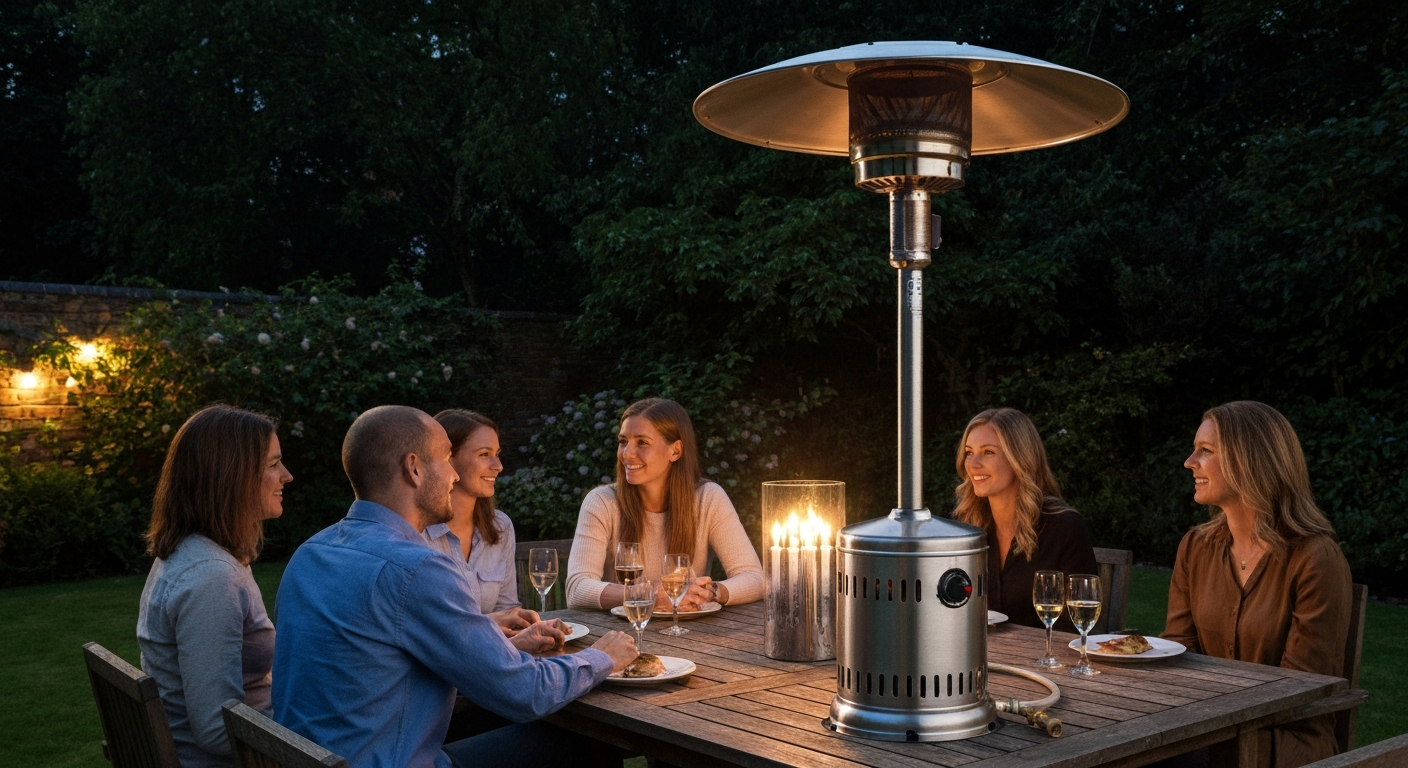
The Sahara table top patio heater is a propane-fuelled LPG radiant heater rated at 4 kW (roughly 15,000 BTU/h NET per the manufacturer manual), designed for outdoor or well-ventilated covered spaces. Schedule of applicable standards for gas appliances (includes EN 14543 and ANSI/CSA references), New Zealand MBIE regulatory document notes that Standards/regulatory references to request or check for gas/outdoor patio heaters: EN 14543:2017 (Dedicated LPG parasol/patio heaters, flueless radiant heaters for outdoor/amply ventilated use) and, for North American outdoor infrared patio heaters, ANSI/CSA Z83.26-20 / CSA 2.37-2020 (Gas‑fired outdoor infrared patio heaters) are the relevant standards to cite when requesting certification/test reports for propane patio heaters Schedule of applicable standards for gas appliances (includes EN 14543 and ANSI/CSA references) — New Zealand MBIE regulatory document. It connects to a minimum 10 kg LPG cylinder, ships with a hose and regulator set to 37 mbar outlet pressure, and carries CE approval (2797/22). For a compact tabletop unit, that heat output is genuinely useful, enough to keep a small group of four to six people comfortable on a cool evening. If you want a portable, mains-free solution for a garden table or small terrace and you are based in the UK or Europe where LPG is the norm, the Sahara tabletop delivers solid performance for a fair price.
Sahara Table Top Patio Heater Review and Buyer's Guide 2026

Who this guide is for and how to use this review
This review is written for homeowners and outdoor enthusiasts in the UK and Europe who are weighing up a compact tabletop propane heater for a garden table, decking area, or sheltered patio. It is also useful if you are deciding between the Sahara and competing tabletop models such as the Cimarron stainless steel table top halogen heater, the Lifestyle Sirocco table top patio heater, the Mosaic table top patio heater, or the Living Accents table top heater, all of which take a different approach to fuel type or heat source.
I have structured this review so you can read it straight through for a full picture, or jump to the section most relevant to your situation. If you just need a spec snapshot, go to the quick specs table. If you are concerned about safety on a covered pergola, skip to the safety and installation section. If you are comparing the Sahara head-to-head with halogen or electric alternatives, the comparison table near the end is your fastest route to an answer.
Sahara table top patio heater: overview, design, and materials
The Sahara model 688A is a freestanding tabletop propane heater built around a classic mushroom-cap radiant head sitting on a cylindrical body that houses the burner and gas controls. Overall dimensions run approximately 970 mm tall by 515 mm wide (some retail listings note the footprint at 540 x 540 mm with a 980 mm height, which is consistent once you account for the base plate). Shipping weight comes in around 7 kg, which makes it genuinely portable, one person can carry it from a shed to a table without drama.
Build materials are stainless steel across the key exposed surfaces, which matters more than it might sound for a product that lives outdoors in UK weather. Stainless construction resists surface rust far better than powder-coated or painted finishes, though the quality of that steel and the gauge used will still determine long-term durability. The reflector dome, burner housing, and control column are all stainless on this model. Variable heat control is included, allowing you to dial output down from the full 4 kW, which helps with both comfort and gas economy on milder evenings.
The heater ships with a gas hose and regulator already included, which is a practical touch, you are not hunting down a compatible regulator separately. The hose must conform to EN16436-1 (or an equivalent standard) and the manual explicitly states it should not exceed 1.5 m in length, keeping the cylinder close to the table. Setup is straightforward: assemble the column, attach the head, connect the regulator to your LPG cylinder, and follow the ignition procedure in the manual.
Fuel type and key specifications to check
The Sahara tabletop is a propane/LPG appliance only, there is no electric, infrared element, or halogen lamp variant in this range. That distinction matters when you are comparing it to alternatives. LPG radiant heat from this type of burner is warm and pleasant outdoors because it heats objects and people in the radiant path rather than just the air. That said, it comes with the practical constraints of any gas appliance: you need a cylinder nearby, you need to check gas levels, and you cannot use it in a truly enclosed space.
The regulator outlet pressure is set at 37 mbar, which is the standard UK butane/propane regulator pressure for most garden appliances. The injector size is 1.0 mm. The manual specifies the gas consumption at maximum output as 288 g/h. Using the accepted propane energy density of approximately 91,000 BTU per US gallon (roughly 12,800 BTU per kg of LPG), a 10 kg cylinder gives you approximately 34 to 35 hours of runtime at full output, in practice, longer, because most users run the heater at a lower setting. For fuel‑to‑runtime and BTU‑to‑fuel conversions, authoritative references such as the ASHRAE Handbook list liquid propane energy content at approximately 91,000–91,500 BTU per US gallon, which you can use with cylinder volume and appliance input BTU to calculate runtime ASHRAE Handbook reports liquid propane energy content of about 91,000–91,500 BTU per US gallon.. The EN 14543:2017 standard covers dedicated LPG parasol and patio heaters of exactly this type for outdoor or amply ventilated use, and is the relevant European standard to check when verifying certification claims.
If you are considering an electric or halogen tabletop heater instead, the Cimarron stainless steel table top halogen patio heater and the Lifestyle Sirocco table top are worth a look for comparison, since both eliminate the cylinder and regulator entirely. For another option, see the Living Accents table top patio heater for a similar electric alternative. Electric and halogen units typically run on a 13-amp socket, making setup simpler, but they do tether you to a power outlet. For patio surfaces without easy cable routing, the Sahara's cord-free LPG operation is a genuine convenience advantage.
Quick specs at a glance
| Specification | Detail |
|---|---|
| Model | Sahara Table Top Patio Heater 688A |
| Heat input (NET) | 4 kW / ~15,000 BTU/h |
| Fuel type | LPG (propane/butane) |
| Gas consumption (max) | 288 g/h |
| Regulator outlet pressure | 37 mbar |
| Injector size | 1.0 mm |
| Overall height | ~970–980 mm |
| Overall width/footprint | ~515–540 mm |
| Weight | ~7 kg |
| Minimum cylinder size | 10 kg (manufacturer recommendation) |
| Hose max length | 1.5 m (EN16436-1 compliant) |
| Clearance: side wall/ceiling | Min. 0.6 m |
| Clearance: combustible surfaces | Min. 1.5 m from sides |
| Certification | CE approval 2797/22 |
| Applicable standard | EN 14543:2017 (LPG outdoor/vented patio heaters) |
| Warranty (most parts) | 5-year limited |
| Warranty (thermocouple, tilt switch) | 2 years |
| Hose/regulator included | Yes |
Real-world heating performance: output, coverage, and runtime
At 4 kW / 15,000 BTU/h, the Sahara sits in the upper range for tabletop propane heaters. For context, popular US competitors like the Fire Sense model 60262 output around 10,000 BTU/h and the Cuisinart COH-500 runs to approximately 11,000 BTU/h, so the Sahara has a meaningful heat advantage on paper. In practice, a 15,000 BTU/h mushroom-cap tabletop unit creates a usable warmth radius of roughly 1 to 1.5 metres around the table, enough for four people seated closely, less effective beyond that range.
I want to be honest here: independent third-party lab data for this specific model are not publicly available. I have not found measured heat contours, thermal imaging data, or independently verified coverage tests for the Sahara 688A. The specifications above come from the manufacturer manual and UK retailer listings, which are consistent with each other. Consumer review sites confirm that the heater produces noticeable warmth at table height, but the numbers are manufacturer-stated rather than independently certified performance figures. For a review site grounded in evidence, that is worth flagging, if independent lab data become available, I will update this review.
On runtime, the math is straightforward: 288 g/h gas consumption at max output means a 10 kg cylinder lasts approximately 34 hours running flat-out. Turn the variable control down to a moderate setting and you could comfortably stretch that to 50-plus hours across multiple evenings. That makes the running cost reasonable, a 10 kg LPG cylinder in the UK typically costs between £25 and £35 depending on the supplier and whether you are renting or own the cylinder.
Ignition reliability, wind resistance, and portability
The Sahara uses a piezo ignition system, which is standard for LPG patio heaters in this price bracket. Piezo ignition is reliable in dry conditions but can be less cooperative in cold or damp weather, if the heater has been sitting outside in heavy rain, a few extra attempts at the piezo are not unusual. The unit includes a thermocouple safety device: if the flame blows out, the thermocouple cuts the gas supply within seconds, which is an important safety feature for any outdoor gas appliance.
Wind resistance is a legitimate concern for any tabletop radiant heater with an open burner. The mushroom cap design provides some shielding, but a sustained wind above roughly 15–20 km/h will noticeably reduce heating efficiency and may cause nuisance flame-outs. For exposed terraces or coastal gardens, a purpose-built windbreak or positioning the heater on the sheltered side of a screen will make a measurable difference. If wind is a regular issue in your garden, it is worth comparing the Sahara's open-burner design against enclosed halogen or infrared element heaters, which are less wind-affected.
Portability is one of this heater's genuine strengths. At 7 kg, it is light enough to move from table to shed and back without needing a second person, and the self-contained design means there is no cable to trip over. The cylinder connects underneath or adjacent to the column, keeping everything tidy. If you want to take it to a campsite, a friend's garden, or a BBQ away from home, it travels well, provided you handle the LPG cylinder safely and keep it upright during transport.
Durability and build quality assessment
Stainless steel construction is the right call for a product that will spend much of its life outdoors in the UK. The key risk with stainless garden products is that lower-grade steel (below 304 grade) can develop surface staining or pitting in coastal environments with salt air. The Sahara manual and product pages do not specify the steel grade, which is a gap worth raising directly with the manufacturer if you live within a few kilometres of the coast. For most inland UK gardens, stainless construction at this price point should hold up well for several seasons.
The 5-year warranty on most parts is a positive sign of manufacturer confidence, though the thermocouple and tilt switch are covered for only 2 years, which is reasonable given that these are wear components. The manufacturer's advice is to service the heater every 100 hours of use or annually, whichever comes first. In practice, an annual check of the hose, regulator, burner injector, and thermocouple is sensible practice for any LPG appliance. Sahara's website includes a product maintenance page covering cover storage and cleaning, which is worth bookmarking.
Compared to painted-finish tabletop heaters, the stainless exterior avoids the peeling and chipping that afflicts cheaper models after a couple of seasons. The Mosaic table top patio heater uses a decorative mosaic tile design that adds aesthetic character but requires more careful weatherproofing, while the Living Accents table top heater tends to use powder-coated finishes, both of which need protective covers during prolonged storage to maintain appearance. For pure long-term durability without maintenance fuss, the Sahara's stainless build has a clear advantage.
Safety and installation for tabletop use
Covered vs. uncovered patios
The Sahara manual is explicit: this heater is for outdoor or amply ventilated use only. It is an LPG combustion appliance, and using it in an enclosed conservatory, garage, or unventilated room creates a carbon monoxide risk. Under a pergola with open sides, a large covered terrace with full airflow, or in a gazebo with multiple open panels, all of these are acceptable settings provided the clearances below are respected. A fully enclosed garden room with windows shut: not acceptable.
Clearances you must respect
- Minimum 0.6 m from any adjacent side wall or ceiling directly above the heater
- Minimum 1.5 m clearance from any combustible surface on all sides of the appliance
- Hose length must not exceed 1.5 m and must comply with EN16436-1 or equivalent
- Never operate under a solid roof with inadequate ventilation
- Cylinder must be placed on a stable, level surface — the tilt switch will cut gas if the heater is knocked over
In practice, the 1.5 m combustible surface clearance means you need to think carefully about pergola beams, timber decking overhead, fabric parasols, and outdoor cushion storage nearby. If your setup is a solid timber pergola with a closed polycarbonate roof, the Sahara is not the right choice, consider an electric infrared model mounted at the ceiling or wall instead. For an open-sided aluminium pergola or a straightforward garden table on a patio, the clearances are easy to achieve.
Maintenance and annual safety checks
Before each season, inspect the gas hose for cracks, perishing, or kinks, and replace it if in doubt, this is not a component to economise on. Check the regulator connection is secure and apply a soapy water test to the joint after reconnecting to confirm there are no gas leaks before igniting. Clean the burner head of any debris or spider webs (a common cause of poor ignition in heaters stored over winter). The thermocouple should be checked annually; if the flame cuts out quickly after ignition, a failing thermocouple is usually the cause and replacement is straightforward and inexpensive.
How the Sahara compares to other tabletop heaters
The tabletop heater market splits fairly clearly into LPG/propane models and electric/halogen/infrared models. The Sahara is firmly in the propane camp. Its closest category siblings on this site include the Cimarron stainless steel table top halogen patio heater, which uses a halogen infrared element rather than a gas burner, making it completely portable from an electrical standpoint but requiring a power outlet. See the Cimarron stainless steel table top halogen patio heater for a direct comparison of specifications, heat output, and construction details. Halogen elements typically last 2,000 to 5,000 hours depending on duty cycle and environment, and replacement elements run approximately £20 to £80 depending on the lamp type and wattage.
The Lifestyle Sirocco table top patio heater takes a similar electric-infrared approach with a modern aesthetic. Like the Cimarron, it avoids the LPG cylinder logistics but cannot match the Sahara's BTU output in raw heat terms, most electric tabletop heaters run between 1.5 and 2 kW (roughly 5,100 to 6,800 BTU/h equivalent), compared to the Sahara's 4 kW. For a cold autumn evening with four or five people, the heat difference is noticeable.
| Model | Fuel/Heat Source | Output | Construction | Portability (no cable?) | Approx. Warranty |
|---|---|---|---|---|---|
| Sahara 688A | LPG propane | 4 kW / ~15,000 BTU/h | Stainless steel | Yes (cylinder required) | 5 years (most parts) |
| Cimarron SS Halogen | Electric halogen infrared | Typically 1.5–2 kW | Stainless steel | No (needs power outlet) | Varies by retailer |
| Lifestyle Sirocco | Electric infrared | Typically 1.5–2 kW | Mixed/modern finish | No (needs power outlet) | Varies by retailer |
| Mosaic Table Top | Electric/LPG (model-dependent) | Varies by model | Decorative mosaic/ceramic | Depends on fuel type | Varies by retailer |
| Living Accents Table Top | Electric or propane (varies) | Varies by model | Powder-coated steel | Depends on fuel type | Varies by retailer |
| Fire Sense 60262 (US ref.) | LPG propane | ~10,000 BTU/h | Steel/aluminium | Yes (cylinder required) | CSA approved |
| Cuisinart COH-500 (US ref.) | LPG propane | ~11,000 BTU/h | Steel | Yes (cylinder required) | Standard limited |
The headline takeaway from this comparison: if you need maximum heat output, cylinder-free logistics are not a priority, and you want the most durable outdoor finish, the Sahara's 4 kW LPG output and stainless construction make it the strongest performer in raw heating terms among these tabletop options. If you want zero gas logistics and a simpler setup, the Cimarron halogen or Lifestyle Sirocco are cleaner solutions, just manage your expectations on heat output during the coldest evenings.
Buying guide: who should buy the Sahara tabletop and who should look elsewhere
Best use cases for the Sahara
- Garden tables without nearby power outlets where LPG cylinder storage is practical
- Open patios or open-sided pergolas where ventilation is not a concern
- Households already using LPG for a BBQ who have a cylinder and regulator setup
- Situations where maximum heat output at the tabletop level is the priority
- Anyone wanting a portable heater that can move between different outdoor spaces easily
When you should consider an alternative
- Covered patios with enclosed roofs or poor ventilation — use an electric infrared model instead
- Gardens with persistent strong wind — enclosed halogen or infrared element heaters lose less performance to gusts
- Balconies or apartments where LPG cylinder storage and transport creates safety or building-regulation concerns
- Situations where simplicity of setup (plug and go) matters more than maximum heat output
- Decor-led settings where the Mosaic or a design-forward model fits the aesthetic better
Pros and cons
| Pros | Cons |
|---|---|
| Strong 4 kW / 15,000 BTU/h heat output for a tabletop unit | Requires LPG cylinder — adds cost, storage, and logistics |
| Stainless steel construction resists corrosion better than painted alternatives | Steel grade not specified — caution advised in coastal environments |
| Cylinder-free from mains power — true portability | Open burner design is susceptible to wind above ~15–20 km/h |
| Hose, regulator, and hardware included in the box | Not suitable for enclosed or poorly ventilated spaces |
| 5-year warranty on most parts is better than many competitors | Thermocouple and tilt switch only covered 2 years |
| CE approved (2797/22) and designed to EN 14543:2017 standard | No independent lab performance data publicly available |
| Variable heat control for comfort and fuel economy | Piezo ignition can be less reliable in cold, damp conditions |
Common troubleshooting
- Flame cuts out immediately after ignition: the thermocouple needs more time to heat up — hold the ignition button down for a full 10–15 seconds before releasing. If the problem persists, the thermocouple may need replacing.
- Flame keeps extinguishing in light wind: reposition the heater with the reflector dome facing into the prevailing breeze, or use a portable windbreak screen around the table.
- Weak or yellow flame: the injector or burner head may be partially blocked by debris. Turn off, disconnect the cylinder, and clear the burner with a soft brush or low-pressure compressed air.
- Difficulty igniting in cold weather: LPG vaporises less readily below around 0°C. If the cylinder is very cold, move it to a slightly warmer spot (not indoors, but out of direct frost) for 10–15 minutes before attempting ignition.
- Hissing or smell of gas at the regulator connection: turn off the cylinder valve immediately. Check and re-seat the regulator connection. Retest with soapy water. If the leak persists, replace the hose or regulator before using the heater again.
Where to buy and what to check before you purchase
The Sahara table top patio heater is available through the Sahara BBQs website directly and through UK garden and outdoor leisure retailers including specialist online stores. Retail prices vary, so it is worth checking current listings at the time of purchase. Before buying, confirm that the listing includes the hose and regulator (most do, but some regional retailers list these separately), verify the warranty registration process, and check that spare parts, particularly the thermocouple and regulator, are available from the manufacturer or a local stockist. Sahara provides a helpline for service and spare parts, which is listed in the assembly manual.
If you are comparing the Sahara directly against the Cimarron stainless steel table top halogen heater, the Lifestyle Sirocco, or any of the other tabletop models reviewed on this site, the main decision is really: LPG portability and maximum heat output versus electric simplicity and lower-maintenance operation. For most UK garden settings with a table four or more people gather around from late spring through to October, the Sahara's 4 kW output earns its place. For a sheltered balcony or a space very close to a socket, one of the electric alternatives may serve you better day-to-day.
FAQ
What primary manufacturer documents and product data are required to write an evidence‑based review of the Sahara table top patio heater?
The product's official assembly/user manual and technical specification sheet (model 688A) including declared heat input (4 kW / ~15,000 Btu/h), dimensions, weight, clearances, fuel type, regulator/outlet pressure, injector size, CE approval number, service intervals and warranty terms. The manufacturer product page for MSRP/availability, and any OEM part numbers for replacement components (burner, igniter, regulator, hose). Request the EU Declaration of Conformity and the CE test/certification dossier referenced by the CE approval number (2797/22) to validate compliance claims.
What independent certification and regulatory standards should I check or cite?
For LPG tabletop patio heaters in Europe cite EN 14543:2017 (dedicated LPG parasol/patio heaters). For North America check ANSI/CSA Z83.26-20 / CSA 2.37-2020 (gas‑fired outdoor infrared patio heaters) or applicable CSA/UL listings. Confirm CE/DoC for EU models, the specific certification number, and any national approvals. Note which standard the Sahara model claims compliance with and request lab reports if available.
What field measurements are necessary to document real‑world heating performance and how should they be conducted?
Measure and record: steady‑state heat flux or air temperature vs. distance (radial) from the heater at fixed grid points; surface/object temperature of directly illuminated targets; ambient and perceived temperature at seated height (e.g., 0.9 m) both on‑axis and off‑axis. Use calibrated instruments: thermocouples or data‑logging thermometers for air temps, FLIR thermal camera with emissivity settings documented for radiometric images, and anemometer (e.g., Kestrel) to log wind speed/gusts. Report camera model, NETD/accuracy, probe type and calibration status, measurement distances, duration, and environmental conditions (temperature, humidity, wind). Repeat tests across multiple heat settings and fuel states (full vs. near‑empty cylinder) for propane units.
How should runtime and fuel‑consumption be calculated and verified?
Use the manufacturer's input BTU/kW rating and measured cylinder capacity to compute theoretical runtime (propane energy content ≈91,000–91,500 BTU/US gallon). Validate with empirical drain tests: weigh or measure cylinder volume before and after a fixed burn period at each setting to calculate g/h or BTU/h consumed. Record regulator pressure, ambient temperature and elevation (affects consumption). Show both manufacturer‑stated runtime and measured runtime with method and uncertainty.
What wind‑resistance and outdoor stability tests are appropriate for a tabletop heater?
Measure operation and flame stability at incremental wind speeds (calm to typical gusts) using a calibrated anemometer at test height and multiple approach directions. Record ignition success, flame distortion, automatic shut‑off behavior (if equipped), and measurable heat reduction (temperature contours). Note tipping/tilt‑switch performance and any fuel leakage. For safety, test only in controlled outdoor conditions and with appropriate safety oversight.
What safety, installation and maintenance evidence should be collected and reported?
Document manufacturer installation clearances and siting (distances to combustibles and overhead structures), hose/regulator specification (EN16436‑1 or equivalent) and maximum allowed hose length, recommended cylinder sizes, service/inspection intervals, and warranty coverage. Inspect build quality around thermocouple, tilt switch, regulator connection, and flame guards. Report recommended safe practices for covered vs. uncovered patios, including minimum ventilation, mounting/placement guidance, and recommended protective covers and storage procedures.