
Home Depot carries a solid lineup of tabletop patio heaters right now, and if you are shopping for one today, the two main options you will find are propane tabletop heaters in the 10,000–11,000 BTU range (like the Fire Sense 60262 at around $108 and the Living Accents Model 4561361) and electric infrared tabletop heaters around 1,500 watts (like the DWELLCOZY HD-SP10N at $159.99). Propane is the better pick if you need heat with no outlet nearby or want maximum output on a calm evening. Electric is easier to manage, safer around kids and pets, and needs zero maintenance. Both formats are legitimately stocked at Home Depot, not special-order items, so you can compare them in person or online today.
Table Top Patio Heater Home Depot Guide: Choose Safely

Willa Brennan
15 Jun 2026
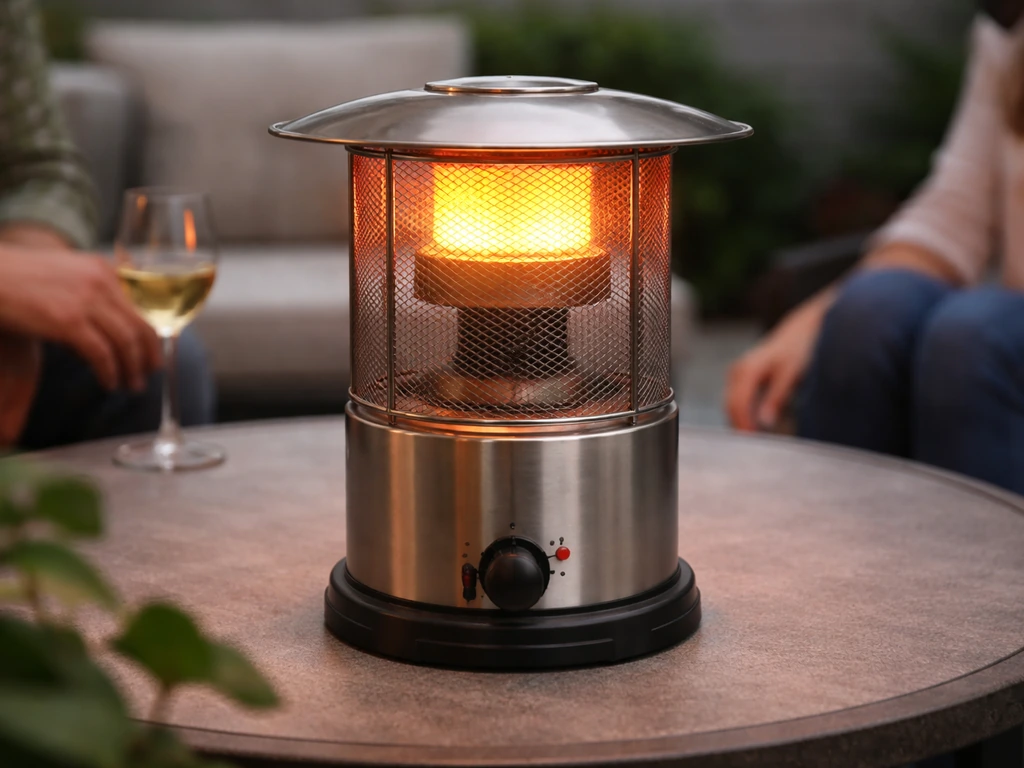
What a tabletop patio heater actually is (and when it makes sense)
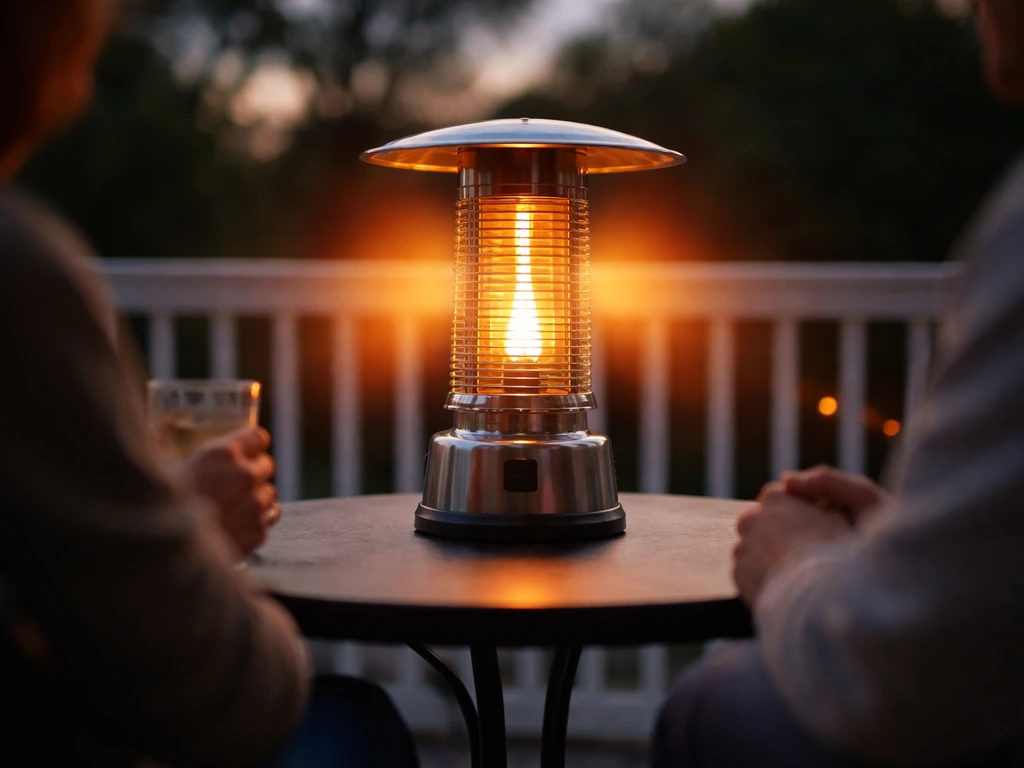
A tabletop patio heater is a compact heater designed to sit directly on your outdoor table or any stable raised surface, putting radiant heat right at seated body level. Unlike a tall freestanding tower heater that radiates heat from overhead, a tabletop unit warms the people sitting close around it from roughly chest height. That focused, localized delivery is the whole point. These heaters are not trying to warm a large patio. They are designed to take the chill off a small group sitting right at the table, usually two to four people within about three feet of the unit.
A tabletop heater is the right call when you have a small patio, balcony, apartment deck, or dining area where a full-size freestanding heater would be impractical or overkill. They are also popular as a second heat source at a larger patio table when one floor-standing heater does not quite reach everyone. If your gatherings are small, you move furniture around a lot, or storage space is tight, a tabletop heater is genuinely more practical than anything larger. If you are trying to heat a large uncovered patio with multiple seating zones, you need a freestanding or wall-mounted unit instead.
Fuel types: propane vs electric (and a word on pellet)
Home Depot's tabletop heater section is split between propane gas and electric infrared, and the choice between them is the most important decision you will make. Here is how each fuel type actually plays out in real use.
Propane tabletop heaters
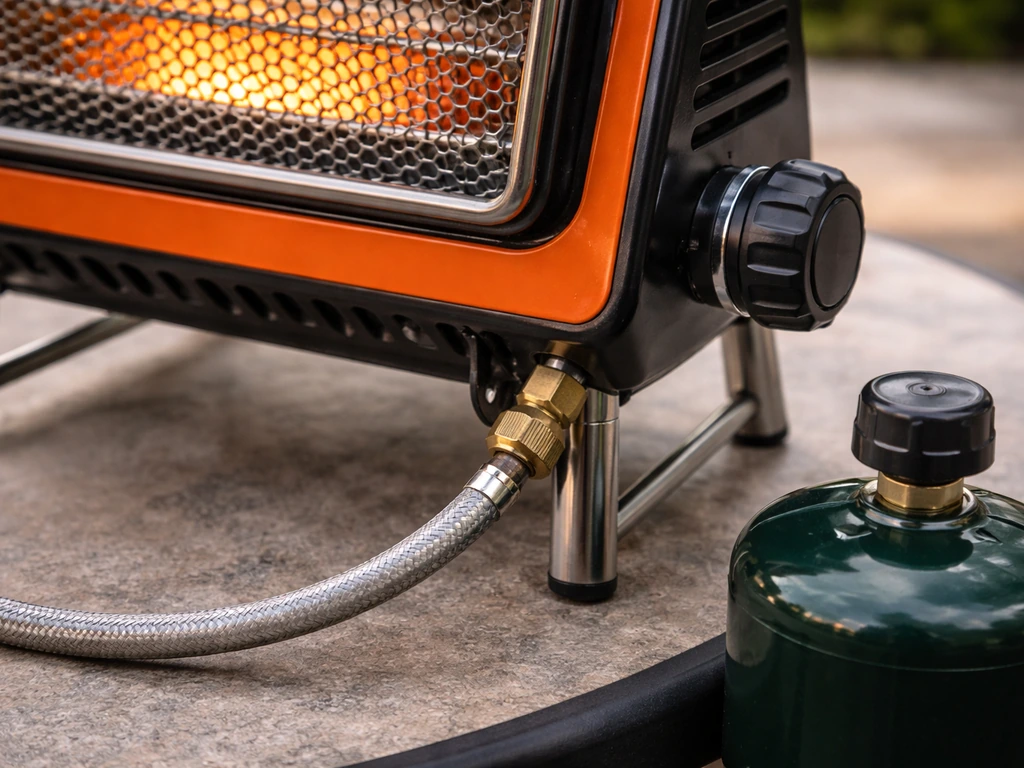
Most tabletop propane heaters at Home Depot run on standard 1 lb disposable LP cylinders. The Fire Sense 60262 and Living Accents 4561361 are both in the 10,000 BTU class, which is about as much heat as you can reasonably expect from a small cylinder.
At full output, a 1 lb cylinder lasts roughly three hours, so plan to keep a few spares on hand for longer evenings. You get Piezo push-button ignition (no matches needed), adjustable output so you can dial down the heat, and completely wireless portability since there is no cord involved. The trade-off is ongoing fuel cost, cylinder storage and disposal, and the fact that these units require outdoor-only use because they involve open combustion. Wind is also a real limitation.
Most Fire Sense tabletop gas manuals specify a maximum safe operating wind speed of around 10 mph, so a gusty, exposed patio will frustrate you with a propane tabletop.
Electric infrared tabletop heaters
Electric tabletop heaters like the DWELLCOZY HD-SP10N run at 1,500 watts, which draws about 12. 5 amps from a standard 120V outlet. They use infrared technology, meaning the heat is instant the moment you flip the switch and it warms objects and people directly rather than heating the air. You need an outdoor-rated outlet nearby, but there is no fuel to buy, no cylinder to swap, and no combustion happening, so they are inherently safer around children and pets.
The Home Depot listing for the DWELLCOZY 1500 watt plug-in electric tabletop patio heater describes it as infrared instant heat with plug-in electric operation and no gas or combustion, which supports the safety advantage around kids and pets inherently safer around children and pets. They handle light wind better than propane because there is no flame to blow out, though in heavy wind any radiant heater loses effectiveness.
The plug-in design also means you can use an electric tabletop on a covered porch or screened lanai where a propane heater would never be appropriate.
Pellet tabletop heaters
Pellet-burning tabletop heaters do exist, but they are not a format Home Depot typically stocks in the tabletop category. They function more like small fire pits and produce visible flame and smoke, which makes them a completely different experience (and safety category) from a radiant patio heater. If you want that campfire ambiance, look at tabletop fire bowls. For practical outdoor heating at a dining table, stick with propane or electric.
| Feature | Propane Tabletop | Electric Infrared Tabletop |
|---|---|---|
| Heat output | ~10,000–11,000 BTU | 1,500W (~5,100 BTU equivalent) |
| Effective coverage | Up to ~30 sq ft / ~3 ft radius | Similar localized range, 2–4 seats |
| Portability | Fully wireless | Requires outdoor outlet within cord reach |
| Ignition | Piezo push-button | Instant-on switch |
| Fuel cost | ~$5–8 per 1 lb cylinder (~3 hrs) | Electricity (~$0.18/hr at avg rate) |
| Wind sensitivity | High (limit ~10 mph) | Moderate (no flame to extinguish) |
| Safe for covered spaces | No (combustion) | Yes |
| Safe near kids/pets | Use with caution | Easier to manage |
| Maintenance | Cylinder swaps, check ODS | Near zero |
| Home Depot price range | ~$108–$130 | ~$160 |
Matching the heater to your patio size and setup
The honest truth about tabletop heaters is that they warm people, not spaces. A 10,000 BTU propane tabletop covers roughly 30 square feet, and some manufacturers express this as a 3-foot heating radius. That means you are realistically keeping two to four people comfortable if they are sitting close around the table. If your table seats six or more and people are spread out, one tabletop unit will leave those at the edges feeling the cold. In that case, you either need two tabletop heaters placed at opposite ends of the table or a larger freestanding heater for the space.
For a small balcony or apartment deck, a single tabletop heater is usually perfect. For a standard 4-person patio dining set, one unit in the center works well on calm nights. For a 6-8 person table in a partially exposed yard, consider whether a freestanding unit might serve you better overall. If you have a covered patio or screened porch, the electric infrared option is the clear winner because propane combustion in an enclosed or semi-enclosed space is a genuine hazard.
Placement, clearances, and safety basics
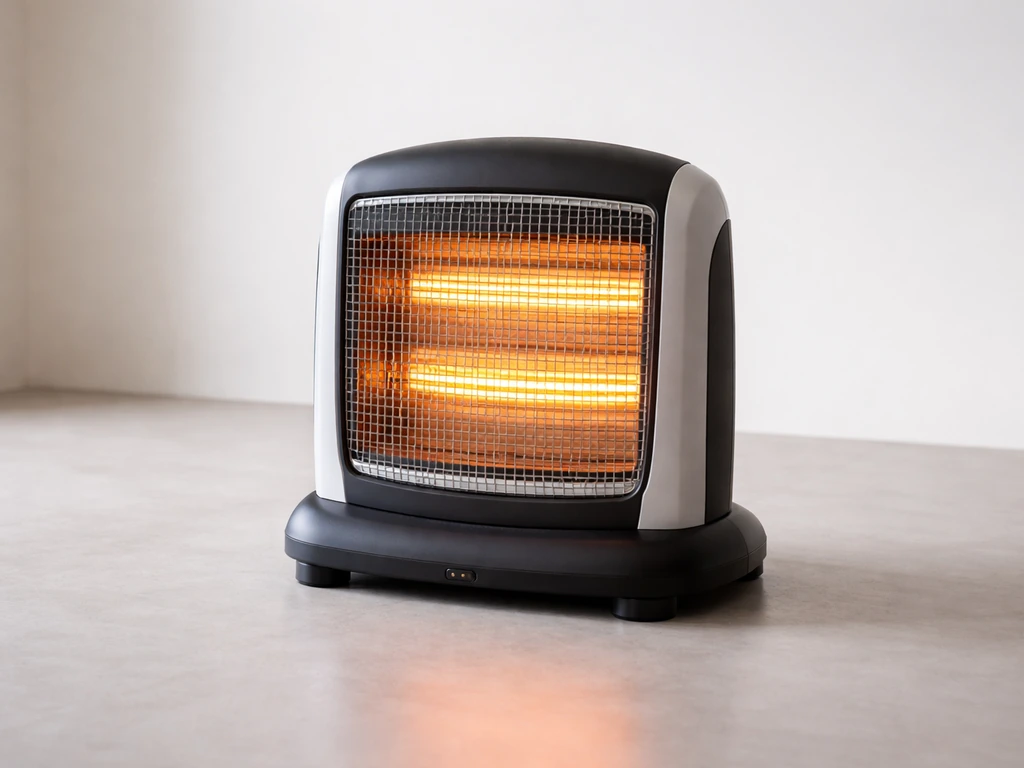
Getting placement right matters as much as picking the right heater. Tabletop heaters concentrate heat at close range, which means the risk of burns or fire from nearby materials is real if you ignore clearance requirements. Every heater comes with a minimum clearance spec in its manual, and you should verify the exact number for your model rather than guessing. As a general benchmark, many electric tabletop heaters specify a minimum clearance of around 18 inches from combustible materials. For propane units, that number can be similar or greater, and it applies in all directions, including overhead.
- Always place the heater on a flat, stable surface. Anti-skid feet and tip-over shutoffs (standard on the DWELLCOZY electric model) are backup protection, not a substitute for stable placement.
- Keep at least 18 inches of clearance between the heater head and any overhead structure, umbrella fabric, cushions, or tablecloth edge. Verify your specific model's manual for exact clearances.
- Propane tabletop heaters are for outdoor use only. Never use them in a garage, screened enclosure, or covered porch where combustion gases can build up.
- Electric tabletop heaters can be used on covered patios, but keep the cord managed so it cannot be pulled on by children, pets, or foot traffic.
- Wind above about 10 mph makes propane tabletop heaters unsafe and unreliable. On windy evenings, switch to electric or move to a sheltered spot.
- Check for an ODS (oxygen depletion sensor) on propane models. This system automatically shuts off the burner if oxygen drops too low, which is a critical safety feature.
- Always confirm the auto shut-off and tip-over protection features actually activate before relying on them. Test tip-over shutoff on the electric unit when you first set it up.
- Never leave any operating patio heater unattended, especially around kids or pets.
The specs that actually matter
Heat output: BTUs and wattage in plain English
For propane tabletop heaters, 10,000 BTU is the standard you will see at Home Depot across Fire Sense, Living Accents, and Hampton Bay models. Some stretch to 11,000 BTU. That output difference is minor in real-world comfort terms. For electric, 1,500 watts is the standard tier, and that converts to roughly 5,100 BTU equivalent in heat output. That sounds like less than propane, but infrared electric heat feels more direct and efficient per watt because it warms surfaces and people rather than air. On a calm night in mild cold (45–55°F), both formats get the job done at a small table.
Coverage area and heating radius
Look for heaters that express coverage as a radius (like Hampton Bay's "up to 3 ft radius") or square footage (around 30 sq ft for most 10,000 BTU propane units). Both tell you roughly the same thing: you are heating the zone right around the table, not an entire patio. Set realistic expectations and you will not be disappointed.
Controls and adjustability
Adjustable heat output is worth having on both fuel types. On propane, it lets you reduce flame and extend cylinder life on mild nights. On electric infrared models, look for at least a high/low setting or a dial control. Simple is fine for a tabletop heater since you are not trying to program a thermostat schedule, but the ability to reduce heat on a warmer evening is genuinely useful.
Wind resistance and stability
This is where propane tabletop heaters have a hard limit. The Fire Sense manual, for example, calls out a 10 mph wind ceiling for safe operation. Above that, the flame destabilizes and the heater may not function correctly. If your patio is regularly exposed to wind, an electric infrared tabletop is a more reliable performer. On either type, a wide, weighted base and anti-skid feet reduce the risk of the unit tipping in a gust.
Safety shutoffs
For electric models, look for tip-over protection (auto shutoff when knocked over) and an anti-skid base. The DWELLCOZY HD-SP10N at Home Depot includes both. For propane models, look for an auto shutoff described in the listing and an ODS sensor in the product documentation. The Living Accents 4561361 explicitly lists an auto shut-off feature, and the Fire Sense 60262 is a well-established model with documented safety systems. Do not buy a tabletop propane heater without confirming the auto shutoff and ODS are present.
Your Home Depot shopping checklist
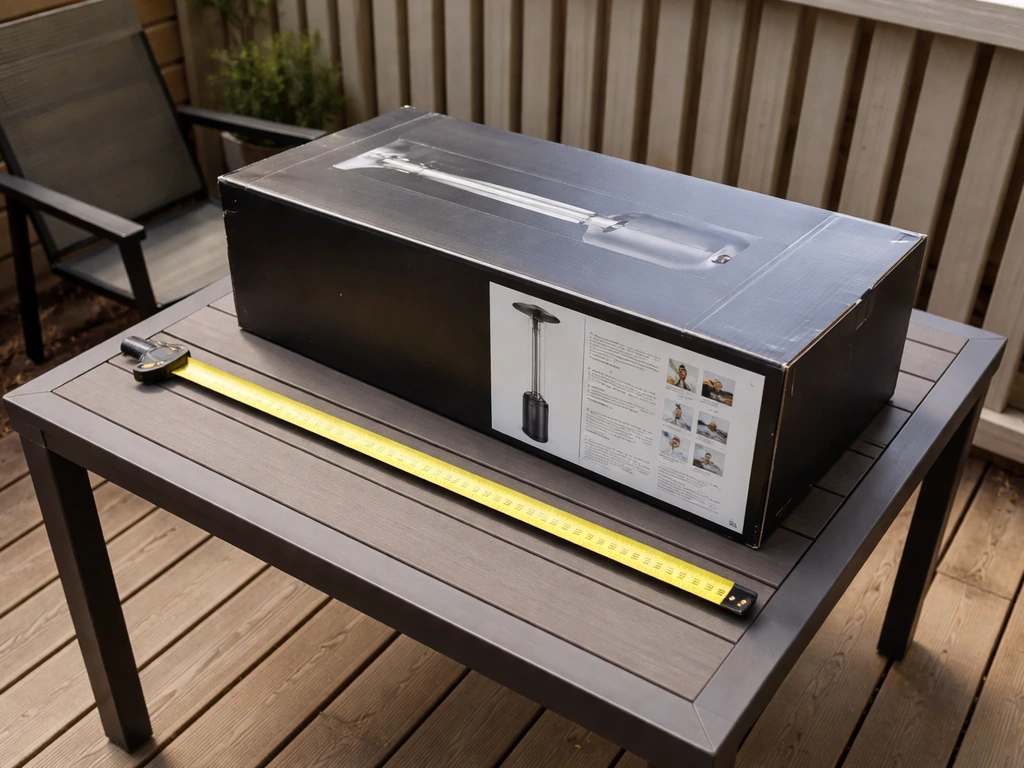
Whether you are buying in-store or online at homedepot. If you are shopping during table top patio heater black friday deals, double-check the fuel type, coverage radius, and safety features before you buy. com, run through this checklist before you add anything to your cart. It will save you a return trip.
- Confirm the fuel type matches your setup: propane if you need wireless portability on an open patio, electric if you have an outdoor outlet and want low maintenance or plan to use it on a covered space.
- Check the heat output: look for 10,000–11,000 BTU for propane, or 1,500W for electric. Anything significantly below these numbers will underwhelm in real weather.
- Read the coverage spec: look for a heating radius of at least 3 feet or a coverage area around 25–30 sq ft. If it is not listed, search the product name plus "manual" to find the spec sheet.
- Verify the safety shutoffs: auto shut-off and ODS on propane; tip-over protection and anti-skid base on electric. These are non-negotiable features.
- Check the ignition type on propane models: Piezo push-button ignition is the standard and most convenient.
- Look at the base dimensions relative to your table: measure your tabletop and make sure the heater base leaves at least 12–18 inches of clearance to the table edge so it cannot be easily knocked off.
- Confirm maximum wind rating in the product manual, especially for propane. If the listing does not say, download the PDF manual from the product page before buying.
- Compare in-store availability vs online: Home Depot's tabletop heater inventory fluctuates by season. If a model is out of stock in-store, check if it ships free to store.
- Note the return window and assembly requirements: most tabletop heaters have minimal assembly, but check what is included versus what you need to buy separately (1 lb LP cylinders, for example, are typically not included with propane models).
Which heater to buy based on your situation
Here is the fast version based on the most common situations people are actually shopping for.
| Your situation | Best pick at Home Depot | Why |
|---|---|---|
| Small balcony or apartment deck, outdoor outlet available | DWELLCOZY 1500W Electric (HD-SP10N, ~$160) | No cylinder storage, no combustion risk, instant heat, tip-over shutoff |
| Open patio table, no nearby outlet | Fire Sense 60262 or Living Accents 4561361 (~$108–$130) | Wireless propane, 10,000 BTU, standard safety features |
| Covered porch or screened enclosure | Electric only (DWELLCOZY HD-SP10N) | Propane combustion in enclosed spaces is unsafe |
| Kids or pets regularly nearby | Electric infrared (DWELLCOZY HD-SP10N) | No open flame, tip-over shutoff, no hot cylinder to handle |
| Windy exposed patio | Electric infrared | No flame to extinguish; propane unreliable above 10 mph wind |
| Need instant heat, no fuss | Either; electric is fastest (truly instant infrared) | Propane Piezo ignition is fast too but takes 30–60 sec to stabilize |
| Lowest upfront cost | Fire Sense 60262 (~$108) | Cheapest entry point, but factor in cylinder cost over time |
| Lowest ongoing operating cost | Electric infrared (~$0.18/hr vs $1.50–2.50/hr for propane cylinders) | Electricity wins for regular use; propane better for occasional use |
| Occasional use, portability matters most | Propane tabletop (Fire Sense 60262 or Living Accents 4561361) | No outlet needed; easy to move to different tables or locations |
One thing worth noting: if you are also comparing prices and inventory at other retailers, Home Depot is not the only place to check. Similar tabletop propane and electric heaters show up at Costco, Lowe's, Ace Hardware, and Amazon, sometimes at different price points or with slightly different model specs. If you are comparing deals, the table-top patio heater options at Costco are often worth checking alongside Home Depot table-top patio heater at Costco. Home Depot's advantage is in-store availability so you can see the size and footprint before buying, plus their return policy if the heater does not fit your table the way you expected.
Bottom line: if you have access to an outdoor outlet and you regularly use your patio through shoulder-season evenings, the DWELLCOZY 1500W electric is the easier long-term choice. If you want to take the heater to different spots or you have no outdoor outlet, the Fire Sense 60262 at around $108 is a well-proven propane tabletop that Home Depot stocks consistently.
If you want to take the heater to different spots or you have no outdoor outlet, the Fire Sense 60262 at around $108 is a well-proven propane tabletop that Home Depot stocks consistently, and you can also compare similar table top patio heater lowes options for pricing and availability.
Either way, you are looking at a practical, compact heater that will meaningfully extend your comfortable outdoor time at a dining table, and that is exactly what this format is built to do. If you want to compare Amazon options too, search for a table top gas patio heater on Amazon that matches your BTU and wind conditions.
FAQ
Can I use a table top patio heater indoors or in a garage?
No. Propane tabletop heaters require outdoor-only use because of open combustion. Electric models can be safer, but tabletop heaters are still intended for outdoor use, especially since many require an outdoor-rated outlet and clearances from combustibles, so use only in the setting the manual specifies.
What outdoor outlet setup do I need for the electric tabletop model?
You generally need a properly grounded, outdoor-rated (weather-protected) 120V outlet. If the outlet is not covered or does not have the right weather rating, use a suitable covered receptacle or have one installed, because a normal indoor outlet or an unprotected connection can fail in rain or condensation.
How do I avoid heat gaps at a larger table (like 6 people)?
A single tabletop heater usually covers only the zone right around it, so people at the far ends may feel the cold. A practical fix is to add a second unit placed near the opposite ends of the table, or switch to a freestanding heater if your table is wide or uncovered.
Do I need to pre-position the heater every time, or can I leave it outdoors?
Keep tabletop heaters in mind for quick relocation, but do not assume outdoor storage is safe. Propane units should be stored with the cylinder disconnected per instructions, and electric units should be protected from moisture when not in use, especially where the cord connection and controls are located.
How far from the table edge should the heater sit to prevent overheating items?
Do not rely on “it seems fine.” Use the model’s minimum clearance in all directions, including overhead, and keep it away from table edges where chairs, covers, or tablecloths could shift. A common mistake is placing it too close to a hanging umbrella or nearby cushions.
What wind speed is “too windy” for propane tabletop heaters?
If the manual lists a wind ceiling, follow it. Many propane tabletop manuals specify around a 10 mph maximum, and gusts can reduce performance or make flames unstable, so if your patio is frequently exposed, electric is usually the more predictable choice.
How long does a 1 lb propane cylinder last in real use?
Expect roughly a few hours at full output, then typically less comfortable warmth as the cylinder drops. If you want longer evenings, plan to use the adjustable flame setting on high only when needed, and keep spare cylinders ready rather than running down to emptiness mid-event.
Is infrared electric heat actually effective, or does it just feel different?
It is effective in the zone because it warms surfaces and people directly, not the air. That said, it still loses comfort if people move farther away, if the patio is very cold, or if wind constantly strips heat from the front of the heater.
What safety features should I verify before buying a propane tabletop heater?
Confirm the listing or manual explicitly includes both auto shutoff (often tied to tip-over) and an ODS (oxygen depletion sensor). Avoid buying a model without those listed features, because tabletop propane heaters are easy to knock over on a patio and you want those protections clearly documented.
How important is tip-over protection for tabletop heaters?
Very. A tabletop heater sits at knockable height, and pets, chairs, or guests brushing past can tip it. For electric, check for auto shutoff, and for propane, verify documented shutoff behavior plus proper base stability and anti-skid feet.
Can I control the heater settings, or is it usually full on/off?
Most tabletop propane models have adjustable output, and many electric infrared tabletop models include high/low or dial control. If you plan to use it in warmer evenings, choose a model with true output adjustment so you are not heating at maximum all the time.
Do these heaters work on covered porches or screened lanais?
Electric infrared models are generally the better fit for covered or semi-enclosed spaces since there is no flame. Propane tabletop heaters are not appropriate for enclosed areas, and even semi-enclosed spaces can be risky unless the manual clearly allows it, so default to electric for those setups.
How do I compare “coverage” claims between propane and electric?
Look for coverage expressed as a radius or square footage, and use the same baseline for your setup (how many people, how far apart, and how far from the heater they sit). Also remember infrared electric is more direct per watt, so “BTU equivalent” can mislead if you focus only on numbers instead of the stated radius.