
A tabletop patio heater sits right on your outdoor table or a low surface, putting warmth exactly where you and your guests are sitting rather than trying to heat a large open space from six feet overhead. If you have a small balcony, a bistro table for two, or a covered patio where a full standing heater would feel oversized or impractical, a tabletop model is almost always the smarter buy. The Range stocks several tabletop options, and the category spans electric models like the Tepro Monterey (1.2 kW, IP44-rated, Ø50 cm footprint) right through to propane units pushing 10,000–11,000 BTU. Which one fits your space comes down to fuel type, material, and a few key specs that manufacturers do not always explain clearly.
The Range Table Top Patio Heater Review & Buying Guide

Willa Brennan
16 Jul 2026
What a tabletop patio heater actually is
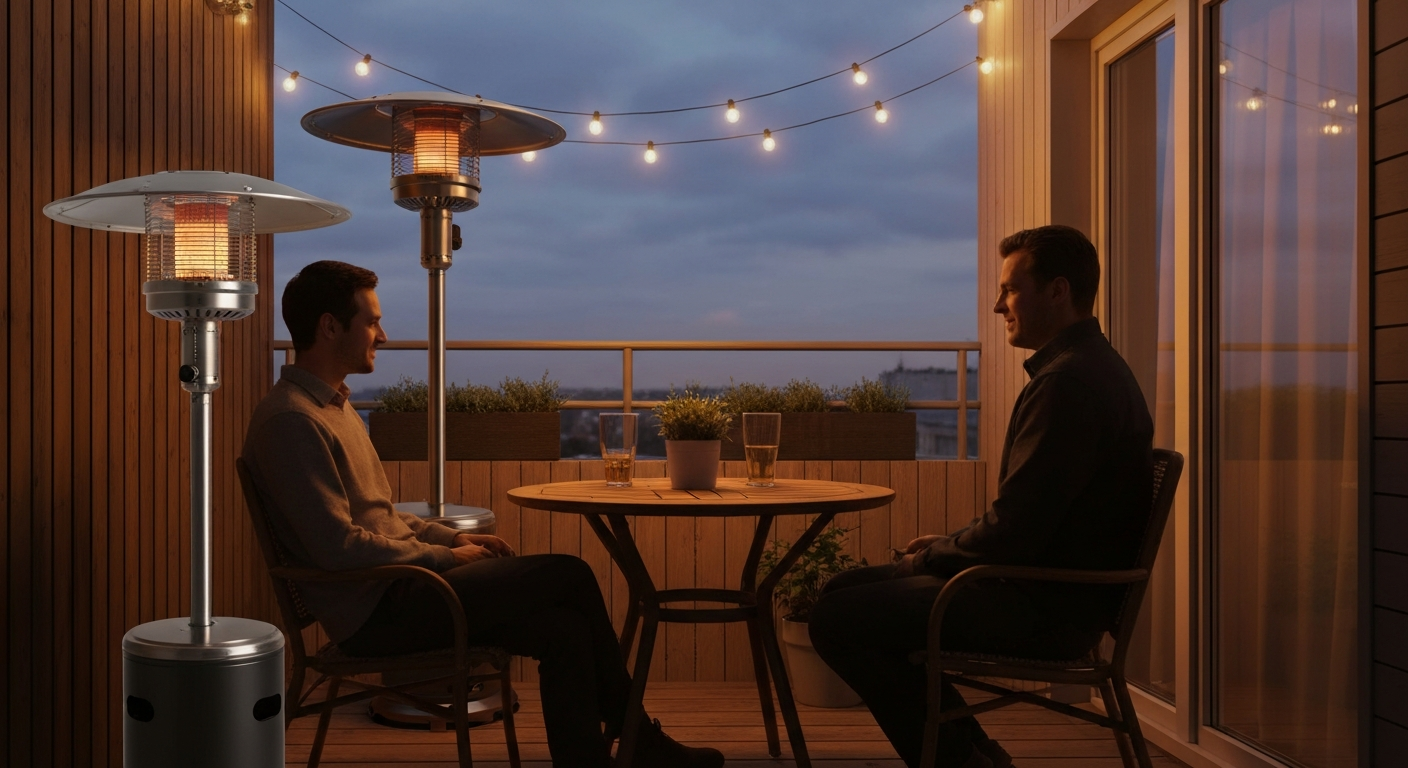
Think of a tabletop patio heater as a compact, self-contained heat source designed to sit at table height. Most are roughly 60–90 cm tall when assembled, weigh between 7 and 17 lb depending on material, and are meant to warm a tight radius of roughly 3–5 feet around the unit rather than broadcasting heat across a full patio. That close-range focus is a feature, not a limitation: it means the unit can efficiently warm two to four people at a dining table without needing hundreds of watts or tens of thousands of BTU. They suit homeowners with limited outdoor space, renters who cannot install fixed wall heaters, and anyone who wants portable heat they can move from table to table or store away quickly.
How tabletop patio heaters work
Every tabletop heater converts a fuel source into heat, but the mechanism differs meaningfully by type. Propane models burn liquefied petroleum gas through a burner head, typically producing convective and radiant heat that rises and radiates outward from a reflector dome. Electric models pass current through a resistive element or an infrared emitter, converting electricity directly to radiant heat with no combustion, no flame, and no need for ventilation. Infrared-specific designs (whether propane- or electric-powered) emit electromagnetic radiation in the near- or medium-infrared spectrum, which heats objects and people directly rather than heating the surrounding air first.
The practical consequence of that difference is real. On a breezy evening, a convective propane heater loses a chunk of its warmth as the heated air drifts away, while an infrared unit keeps radiating directly at whatever it is pointed at. Electric infrared tabletop heaters are worth understanding in their own right, and if you want to go deeper on that technology, the infrared table top patio heater category is covered in detail separately on this site.
Propane vs electric vs infrared: head-to-head
Here is how the three main technologies stack up across the specs that actually matter for a tabletop unit. Note that BTU and watts measure different things (fuel energy release vs. electrical power draw), but you can roughly compare them: 1 BTU/hr equals about 0.293 watts, so a 10,000 BTU propane heater is outputting the thermal equivalent of roughly 2,930 watts of heat energy from the fuel, though real-world efficiency losses reduce what actually reaches you.
| Feature | Propane Tabletop | Electric Tabletop | Electric Infrared Tabletop |
|---|---|---|---|
| Typical output | 10,000–11,000 BTU/hr | 1,200–1,500 W | 1,500 W |
| Effective coverage | Up to ~5 m² (close range) | 2–5 m² | 2–5 m² (directional) |
| Runtime (portable) | ~3 hrs on 1-lb cylinder; ~10 hrs on 20-lb tank | Unlimited (plugged in) | Unlimited (plugged in) |
| Ignition | Piezo or push-button | On/off switch | On/off switch |
| Wind resilience | Moderate (flame can be disrupted) | N/A (no flame) | Good (heats objects, not air) |
| Safety certifications | CSA / ANSI Z83.26 | UL / ETL / IP44 (splash) | UL / ETL |
| Fuel cost per use | Low (1-lb cylinder ~$3–5) | Varies by electricity rate | Varies by electricity rate |
| Portability | High (no cord) | Limited by 1.8 m cable | Limited by cord length |
| Best for | Uncovered patios, no outlet nearby | Covered patios, balconies | Wind-exposed or covered spaces |
One thing worth flagging about propane runtime: the Hampton Bay tabletop manual explicitly warns that a 1-lb disposable cylinder can freeze up and stop delivering rated heat after as little as 25 minutes at full output, because the small canister cannot re-vaporize propane fast enough. If you plan to run a propane tabletop heater through a full evening, connecting to a 20-lb tank via a hose adapter (as the Hampton Bay HPS-C-PC is designed for) is a much more reliable approach. Fire Sense's 60262 model documents roughly 3 hours on a 1-lb canister and up to 10 hours when run from a 20-lb tank, which better reflects real-world expectations.
Performance metrics you need to understand
BTU and watts: what the numbers mean
BTU per hour (BTU/hr) measures how much heat energy a propane heater releases from its fuel each hour. A 10,000 BTU/hr unit is burning through propane fast enough to release 10,000 British Thermal Units of energy every hour. Using the EIA's propane energy content figure of roughly 21,548 BTU per pound, a 10,000 BTU/hr heater consumes about 0. Per the U.S. Energy Information Administration, one gallon of propane contains about 91,452 British thermal units (Btu) one gallon of propane ≈ 91,452 Btu. 46 lb of propane per hour, which is why a 1-lb canister runs close to two to three hours at rated output. Watts measure electrical power draw for electric models; 1,200 W and 1,500 W are the two most common tabletop ratings, and running a 1,500 W unit for two hours uses 3 kWh of electricity.
Coverage area: treat manufacturer claims with caution
Independent consumer-testing reviewers consistently note that manufacturers overstate coverage area for tabletop units. The Tepro Monterey electric model specifies 2–5 m², which at least provides a range. In practice, tabletop heaters are most effective within about 3–5 feet of the unit. Think of them as providing comfortable warmth for people sitting right at the table, not as devices that will heat an entire patio. If your goal is larger-area coverage, a standing mushroom-head propane heater or a wall-mounted infrared unit is a better fit.
ANSI/CSA limits for tabletop propane heaters
The relevant safety standard, ANSI Z83.26 / CSA 2.37, sets an input ceiling of 15,000 BTU/hr for tabletop gas patio heaters. This is why you will not find a compliant propane tabletop unit rated much above 11,000–12,000 BTU/hr. Units with CSA certification have been tested against this standard, which also governs cylinder mounting, safety device requirements, and required markings. When you are shopping at The Range or any retailer, CSA or equivalent certification is the minimum safety credentialing to look for on a propane tabletop heater.
Materials and finishes: what to choose and why
The material and finish on a tabletop heater affects how long it lasts outdoors, how much maintenance it needs, and how well it fits your patio aesthetic. There are four main options in this category, each with real trade-offs.
Bronze finish
Bronze-finished tabletop heaters are almost always steel or aluminum with a bronze-tone coating rather than solid bronze. The appeal is visual: bronze reads as warm and traditional, pairs well with natural materials like teak or rattan, and tends to hide minor weathering better than bright silver or black finishes. The trade-off is that the underlying metal still needs protection from moisture, so you want a clear coat over the bronze or a powder-based application rather than bare paint. The bronze table top patio heater style is one of the more popular finish choices for buyers who want the heater to blend into a classic garden or heritage-style patio setup.
Powder-coated steel
Powder coating is the most durable finish option for outdoor steel heaters. The electrostatic application process creates a thick, even layer that resists chipping, fading, and rust far better than wet paint. Black powder-coated tabletop heaters are common and practical: the dark finish absorbs heat rather than reflecting it back, which can marginally improve perceived radiant warmth toward the user. If you live somewhere with high humidity or salty air, powder-coated steel is a more weatherproof long-term choice than untreated or lacquered finishes. The powder coated table top patio heater range also tends to be priced in the mid-tier, making it a solid value pick.
Granite tops
Some tabletop heater bases or surround surfaces incorporate granite or granite-look stone, which adds substantial visual weight and stability. Granite does not corrode, does not scratch easily, and looks premium on a patio dining table. The downside is weight: a granite-topped base adds several kilograms compared to an aluminum equivalent, which reduces portability. If you want a near-permanent installation on a covered patio where you will not be moving the heater around, the patio heater with granite top category is worth exploring, as the added mass also helps with wind stability.
Wood and 'East Oak' style finishes
Some tabletop models feature wooden accents or panels in an oak or walnut-style finish, marketed under style names like 'East Oak.' These finishes work visually when the heater needs to complement a timber deck or wooden garden furniture. The practical concern is moisture: untreated or lightly treated wood components will absorb water, swell, and eventually crack or discolor if left outdoors uncovered. Models with wood-look polymer or treated composite panels address this problem better than real timber. The east oak table top patio heater style is best suited to covered patios or seasonal use where the unit comes indoors during wet months.
| Finish/Material | Durability | Weather Resistance | Visual Style | Best For |
|---|---|---|---|---|
| Bronze-tone coating | Moderate | Moderate (depends on base coat) | Classic, warm | Traditional garden patios |
| Powder-coated steel | High | High | Modern, minimal | Year-round outdoor use |
| Granite top/base | Very high | Excellent | Premium, heavy | Covered patios, fixed placement |
| Wood/East Oak finish | Low–moderate | Low (unless composite) | Warm, natural | Covered use, seasonal storage |
Design and footprint: size, stability and placement
Tabletop heaters vary more in footprint than you might expect. The Tepro Monterey from The Range measures Ø50 cm at the base with a height of 65 cm, which is a fairly typical electric column design. Propane models like the Fire Sense 60262 sit at roughly 34.65 inches tall (about 88 cm) with a 20.9-inch (53 cm) width, and weigh around 17 lb. Before you buy, measure your table: a Ø50 cm base takes up meaningful real estate on a 90 cm bistro table, and a taller unit can obstruct sightlines across a dining table for four.
Stability is the other design factor worth taking seriously. Heavier bases (cast iron, granite, or a broad steel base) resist tipping better than narrow or lightweight designs. All reputable tabletop heaters include a tip-over auto shutoff, but the goal is to avoid triggering it in the first place. If your table is on an uneven patio surface or is lightweight itself, a heavier-base model is worth the extra cost. For patios with a central umbrella, look specifically for models that describe themselves as umbrella-compatible, meaning the heater housing and heat shield are designed not to direct excessive heat toward a fabric umbrella canopy above.
Real-world use cases
Small dining tables and bistro setups
This is the sweet spot for tabletop heaters. A 10,000–11,000 BTU propane unit or a 1,500 W electric model placed in the center of a table for two to four comfortably extends outdoor dining by an hour or more into cooler evenings. Keep the unit in the center of the table, clear of placemats and centerpieces, and maintain the clearances in the manual: Fire Sense specifies at least 18 inches above and 24 inches to the sides from any combustible material. A tablecloth is a combustible material, so bare tables or non-flammable surfaces are safer.
Balconies and small patios
Electric tabletop heaters are the right choice for enclosed balconies or any space where propane combustion products (CO2, water vapor, trace carbon monoxide) could accumulate. The Tepro Monterey's IP44 splash-proof rating also means it handles the occasional rain splash, which matters on a balcony without full overhead cover. Its 1.8 m power cable is just long enough for most balcony outlet placements, though an outdoor extension cable may be needed depending on your setup.
Covered vs. uncovered patios
Propane tabletop heaters can be used on uncovered patios where an electrical outlet is not accessible, making them genuinely portable. On a covered patio or pergola, either fuel type works, but check that ceiling height is sufficient: the Fire Sense clearance specs (18 inches above the unit) mean a low pergola ceiling at 2 m could be marginal with a 88 cm tall heater. Always ensure any covered space has adequate ventilation when burning propane. Electric models eliminate this concern entirely and are straightforwardly the safer choice for enclosed pergolas, gazebos, and conservatories.
Safety and stability: what you genuinely need to know
Tip-over protection and ignition safety
Every credible tabletop heater on the market now includes a tip-over auto shutoff. On propane units this is typically a thermocouple or tilt switch that cuts gas flow if the unit tips more than a set angle. The Tepro Monterey electric model has a built-in tip-over safety switch as a standard safety feature. Piezo and push-button ignition systems (used on the Fire Sense 60262 and SunHeat models) are reliable in normal conditions, but performance drops below about 40°F because propane vaporizes less readily in cold air. If you are lighting up on a cold night and the igniter is clicking without catching, wait 30 seconds, re-pressurize slowly, and try again rather than releasing large amounts of unburned gas.
Wind limits and outdoor conditions
Fire Sense's manual explicitly states not to operate the unit if wind speed exceeds 10 mph. This is not an arbitrary rule: at higher wind speeds a propane flame becomes unstable, the thermal output drops significantly, and there is a risk of flame blow-out followed by a brief release of unburned gas before the safety device triggers. Electric and infrared models are more wind-tolerant because they heat by radiation rather than convection, but they still lose perceived warmth to the user faster in wind. If your patio is regularly exposed to wind above light-breeze levels, a windscreen or a sheltered corner placement will materially improve performance of any tabletop heater.
Surface protection and clearances
The base of a propane tabletop heater gets warm during use, and placing it directly on a glass, composite, or lacquered wood table surface without a heat-resistant mat risks surface damage. Use a silicone trivet or the included base pad if one is provided. Maintain the manufacturer's minimum clearances: 18 inches above and 24 inches to the sides for most propane models. Keep the area below the reflector dome clear and do not store items under or around the unit while it is operating.
Certifications to look for
- CSA certification: verifies the unit meets ANSI Z83.26 / CSA 2.37 requirements for gas-fired outdoor patio heaters, including tabletop-specific input limits (max 15,000 BTU/hr) and safety device requirements.
- UL or ETL listing: the standard for electric tabletop heaters, confirming electrical safety testing by an OSHA-recognized nationally recognized testing laboratory.
- IP44 rating (electric models): confirms the unit is protected against solid objects over 1 mm and water splashes from any direction, appropriate for outdoor use.
- ODS (Oxygen Depletion Sensor): found on some propane models, shuts off the unit if oxygen levels drop too low, especially relevant for semi-enclosed covered spaces.
Maintenance, durability and weather resistance
Tabletop heaters do not need much maintenance, but a few simple habits significantly extend their lifespan. For propane models: check the burner head and emitter screen every season for spider webs or debris, which are a genuine blockage and ignition problem. Wipe down stainless steel or powder-coated surfaces with a damp cloth and dry thoroughly before storing. Disconnect and remove 1-lb canisters when the unit is not in use, and store the heater in a dry location during winter. For electric models: keep the heating element free of dust and moisture, check the power cable for nicks or damage before each season, and do not leave an IP44-rated (splash-proof rather than waterproof) unit out in sustained heavy rain.
Warranty coverage on tabletop heaters is generally limited. Fire Sense's 60262 comes with a 1-year limited warranty, which is typical for this price bracket. Budget models from general retailers often have no meaningful warranty beyond the statutory consumer rights that apply in your country. If long-term durability is a priority, powder-coated steel or all-aluminum construction is more weather-resistant than models with exposed bare steel or real-wood panels.
Buying guide: matching heater to budget and patio size
The tabletop heater market roughly splits into three price bands. Budget models (under $80 / under £60) tend to be electric with limited output (around 1,200 W), simple on/off controls, and basic plastic-and-aluminum construction. They work fine for covered patios in mild climates but are not built for year-round outdoor exposure. Mid-range models ($80–$150 / £60–£120), like the Fire Sense 60262 (listed at around $109 at Lowe's and $140 at Home Depot), offer certified propane performance at 10,000 BTU, metal construction, and proper safety features. Retail listing: Fire Sense 10,000 BTU Stainless Steel Tabletop Propane Heater, Home Depot (product page & price) is shown at about $139.58, illustrating typical retailer variation Fire Sense 10,000 BTU Stainless Steel Tabletop Propane Heater — Home Depot (product page & price). This is where most buyers will find the best balance of value and performance. Premium models (above $150 / above £120) typically include heavier materials, higher output, variable heat settings, and better fit-and-finish, and are worth the extra spend if the heater will be a permanent or near-permanent fixture on a quality patio.
| Budget Tier | Price Range (approx.) | Best Fuel Type | Recommended For | Watch Out For |
|---|---|---|---|---|
| Budget | Under $80 / £60 | Electric | Covered balconies, mild climates | Limited output, basic build quality |
| Mid-range | $80–$150 / £60–£120 | Propane or electric | Most homeowners, dining tables | Verify CSA/UL certification |
| Premium | Over $150 / £120+ | Propane or infrared electric | Quality patios, frequent use | Check if granite/heavy base fits your table |
Quick top picks by use case
- Best for small covered balconies: an IP44-rated electric model like the Tepro Monterey (1.2 kW, Ø50 cm, tip-over switch) — no fuel to manage, safe for enclosed spaces.
- Best for uncovered dining tables: a CSA-certified propane tabletop unit at 10,000–11,000 BTU (Fire Sense 60262 or SunHeat equivalent) connected to a 20-lb tank for full-evening runtime.
- Best for wind-exposed patios: an electric infrared tabletop heater at 1,500 W — infrared radiation reaches you directly even when wind disperses hot air.
- Best value for occasional use: a mid-range powder-coated propane model using 1-lb canisters — lower upfront cost, no installation, but budget for canister costs over time.
Common questions answered
Why won't my propane tabletop heater stay lit?
The most common causes are a depleted or freezing 1-lb cylinder, a blocked burner orifice, or a thermocouple that needs resetting after a tip-over event. As documented in the Hampton Bay manual, small 1-lb cylinders can freeze up after as little as 25 minutes of continuous use at full output because the rapid gas draw cools the canister below the vaporization point. Switching to a 20-lb tank with a hose adapter typically resolves the freeze-up issue entirely. If the unit runs fine but the flame extinguishes in wind, check that you are within the manufacturer's wind-speed limit (typically 10 mph for most propane models).
Can I use any propane cylinder with a tabletop heater?
Most propane tabletop heaters are designed to accept standard 1-lb disposable LP cylinders directly or to connect to a larger tank via a separately purchased low-pressure hose adapter. Do not attempt to use non-standard adapters or cylinders not specified in the manual: ANSI Z83.26 certification covers the heater only when used with the fuel connection type it was tested with. If the manual specifies a 20-lb tank connection as the primary supply (as the Hampton Bay HPS-C-PC does), that is the configuration in which the heater is certified to perform correctly.
Are tabletop patio heaters safe on a wooden deck?
Yes, with the right precautions. Place the heater on a heat-resistant mat or trivet rather than directly on wood. Maintain minimum clearances (18 inches above, 24 inches to sides for propane models) from any combustible surface including overhead timber joists, pergola beams, and furniture. Never leave the heater unattended on a wooden deck while it is running, and ensure the tip-over shutoff is functional before each use. Electric models with a lower surface-temperature base are inherently lower risk on wooden surfaces than open-flame propane units.
What does an IP44 rating mean for an outdoor electric heater?
IP44 means the unit is protected against solid objects larger than 1 mm entering the housing (the first '4') and against water splashed from any direction (the second '4'). It does not mean the heater is waterproof or suitable for use in heavy rain. IP44 is suitable for typical outdoor placement where rain splash is possible, but you should still bring the unit undercover or fit a weatherproof cover during sustained downpours or when storing it between uses.
FAQ
What is a tabletop patio heater and why include one in a buying guide for 'the range table top patio heater'?
Define tabletop patio heaters as compact, low‑profile outdoor heaters designed to sit on tables or low stands to warm people within close range (typically 2–5 ft radius). Explain common uses (dining tables, small patios, balconies) and how they differ from standing/ceiling heaters. State scope: consumer focus (homeowners/outdoor enthusiasts), comparisons across fuel types, materials, safety and maintenance, plus buying recommendations and short top picks.
Which authoritative standards, certifications and supplier specs should be referenced and verified?
Cite ANSI/CSA standards for gas‑fired patio heaters (ANSI Z83.26 / CSA 2.37), NRTL listings (UL/ETL/CSA) for electrical models, manufacturer manuals (clearances, cylinder use, safety features), and retailer/spec pages for rated BTU/W and run‑time. Use NIST unit conversions and PERC/EIA fuel energy data for conversions and emissions. Use editorial test protocols (BobVila, Tom’s Guide, Consumer Reports) as test‑method templates.
What fuel and heating technologies must be compared and what objective metrics are needed?
Compare propane (LP) gas, electric (resistive/infrared), and infrared gas heaters. Required metrics: rated output (BTU/hr and watts — include BTU→W conversion), effective coverage area (m² or ft² with distance contours), run‑time on fuel (1‑lb canister and 20‑lb tank for propane), fuel consumption (BTU/hr→lb or gallons/hr), startup/ignition type, controllability (variable flame/thermostatic or fixed), warm‑up time, and operating temperature/wind sensitivity. Include safety devices (tip‑over, ODS, thermocouple) and required clearances.
How should performance be tested and reported to be consumer‑facing and reproducible?
Provide test protocol: measure ambient baseline, record surface and air temperatures at 1 ft/2 ft/3 ft/around table, use thermal imaging or multiple thermistors for contours, run wind tests at defined speeds (0, 5, 10 mph), measure run‑time on a full 1‑lb cylinder and (if applicable) 20‑lb hookup, log time‑to‑reach target delta‑T, and note ignition reliability (attempts to light cold) and fuel consumption (mass or volume over time). Report uncertainty, test conditions (temperature, humidity, wind) and repeat measurements.
What material and finish guidance should be included for homeowners comparing bronze, powder‑coated steel, granite tops, and wood/East Oak styles?
Describe pros/cons: bronze and powder‑coated steel — durable and weather resistant; powder coats provide corrosion protection but chips can lead to rust; stainless vs. alloy differences. Granite and stone tops — heavy, stable, premium look, resist heat staining but can crack in freeze‑thaw if wet; adds inertia (stability). Wood/East Oak styles — aesthetic warmth but require sealed finish, vulnerable to heat and moisture; avoid direct heat contact and follow clearances. Include maintenance tips per material (cleaning, touch‑up paint, sealing stone/wood) and guidance on matching heater finish to patio décor.
What buying criteria should be presented by budget and patio size?
Define price bands with examples: budget (~$70–$150) basic propane/electric small‑output units (≈1,200 W or 10,000–11,000 BTU), midrange (~$150–$300) better materials and ignition/control, premium (>$300) heavier granite/bronze and brand features. Size criteria: tabletop use for intimate seating (up to 3–4 people, effective 2–5 ft radius), small patio (choose higher BTU or 1500 W electric and consider wind resilience), covered spaces (prefer electric or carefully vented gas units), uncovered larger patios (consider standing heaters instead). Provide recommended BTU/W per intended coverage: e.g., intimate table 6,000–12,000 BTU (≈1,760–3,516 W) or electric 1,200–1,500 W for close‑range warmth.