
A Garden Sun or Garden Treasures tabletop patio heater is a compact, propane-fired radiant heater that sits on your outdoor table or deck surface and throws heat to a circle of roughly 10 to 15 feet around it. The Garden Treasures line covers a range from an 11,000 BTU model (PG169T-A) all the way up to a 48,000 BTU tank-top unit, with at least one mid-range 15,000 BTU model (PG169T-C) that even ships with a natural gas conversion kit. These are the right pick when you want close-to-body warmth for a small seating group without hauling out a full-size standing heater, but they have real limits you need to understand before you buy.
Garden Sun Table Top Patio Heater Guide: Gas vs Electric

Willa Brennan
28 Apr 2026
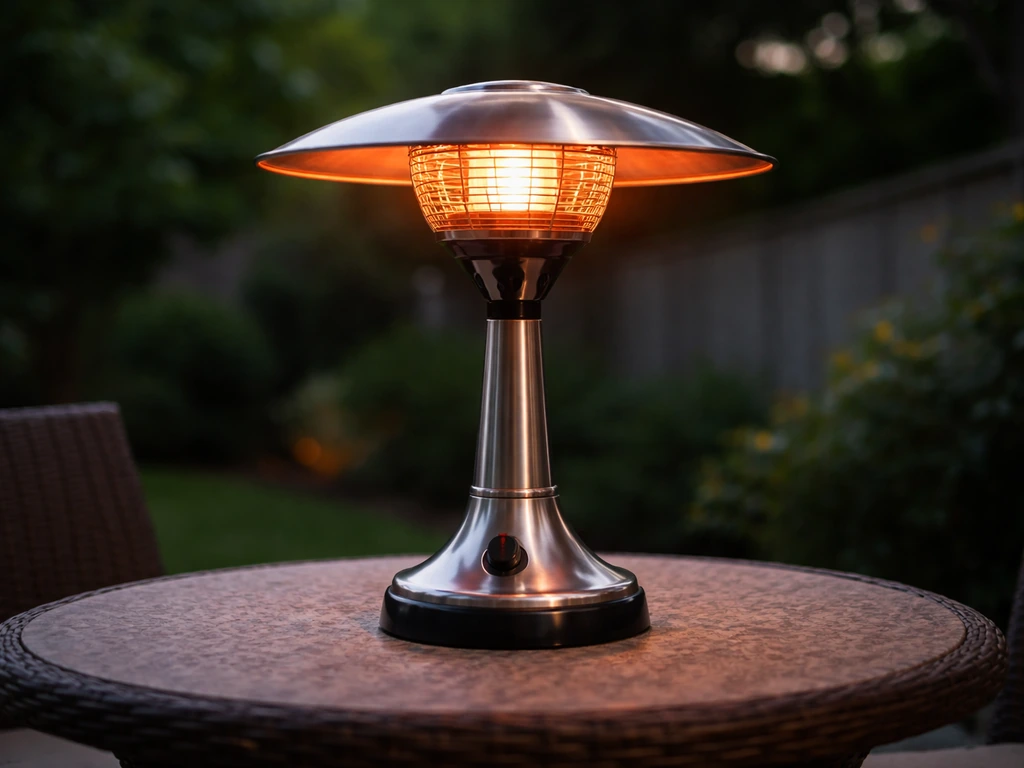
What a garden tabletop patio heater is and when to choose one
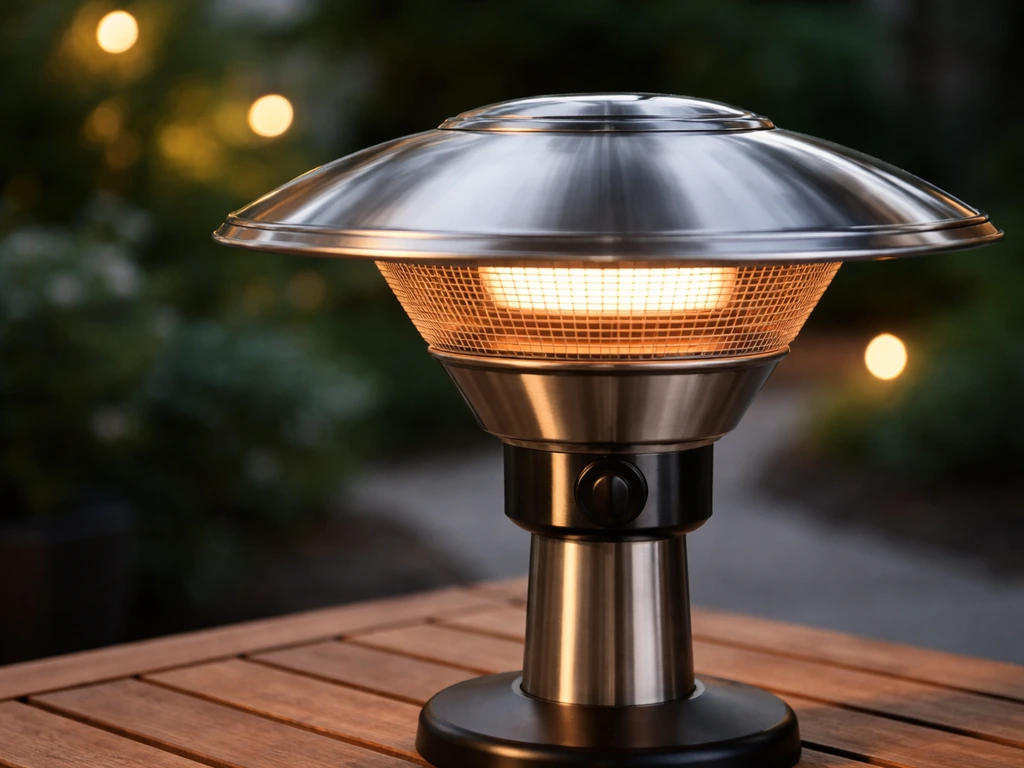
Garden Sun and Garden Treasures tabletop heaters are gas-fired infrared radiant units. The ANSI/CSA certification on the Garden Sun GS3000SS (ANSI Z83.26-2007/CSA 2.37-2007) labels it explicitly as a "gas-fired outdoor infrared patio heater," which tells you exactly how it works: a burner heats an emitter surface inside a dome reflector, and that dome throws radiant heat outward and downward toward people seated nearby, rather than warming the air around the flame.
The physical form factor is consistent across the Garden Sun and Garden Treasures tabletop models. The GS3000SS and PG169T-A both stand about 35 to 37 inches tall with a reflector dome roughly 20 to 21 inches in diameter. They are designed to sit on a table surface or stable flat deck area, so the heat comes down from above toward the people around it, much like a smaller version of a full-size mushroom-style standing heater.
Choose a tabletop model when your situation includes at least one of these: a small patio or balcony where a full floor-standing heater would be impractical, a bistro or cafe table setup where you want heat right at seated level, a screened porch or partially covered space where a low-output unit is enough, or you want something portable that stores easily and packs into a car for a camping trip or tailgate. If you are shopping specifically for an outdoor patio heater table top, start by matching the BTU output and coverage to your seating layout and how sheltered the space is tabletop patio heater. If you have a large open patio with 6 or more people spread out, a tabletop unit will not do the job alone. Pair it with a full-size heater or go straight to a floor-standing model.
Gas vs. electric tabletop heaters: which fuel type fits your setup
The Garden Sun and Garden Treasures heaters in this category are almost exclusively propane-gas units, and for most small outdoor patio setups, propane is the right call. Gas radiant heat feels more like sunlight: it warms objects and people directly rather than the air, which makes it noticeably more effective on a breezy evening than an electric resistive heater of equivalent rated wattage. The trade-off is that you are dealing with a live flame, a pressurized fuel cylinder, and an outdoor-only restriction.
| Feature | Propane tabletop gas (e.g., Garden Treasures PG169T-A / PG169T-C) | Electric tabletop (e.g., La Hacienda or similar) |
|---|---|---|
| Heat output | 11,000 to 48,000 BTU depending on model | Typically 1,200 to 2,000W (around 4,000 to 6,800 BTU equivalent) |
| Heat type | Infrared radiant, feels like direct sun warmth | Infrared or resistive, generally lower intensity |
| Portability | Very high: no cord, runs on portable cylinder | Limited by power cord and outlet proximity |
| Setup | Attach LP cylinder, perform leak check, light burner | Plug in, press button |
| Running cost | Depends on propane price and BTU draw; 1-lb canister lasts 1-2 hrs at full output | Metered electricity; ~$0.20/hr at average rates for 1,500W |
| Outdoor-only restriction | Yes: never indoors, garages, or enclosed spaces | Electric units can sometimes be used in covered/screened porches |
| Wind performance | Loses efficiency in high wind; screened porch or windbreak strongly recommended | Similar wind sensitivity at low output levels |
| Natural gas option | PG169T-C comes with NG conversion kit | N/A |
If you have a screened porch with no outdoor power outlet, propane wins on portability. If your tabletop heater will always sit next to an outlet and you want zero fuel hassle, electric is simpler. But if you want genuine warmth on a cold night at around 45 to 50 degrees Fahrenheit, the higher BTU output of a propane model like the 15,000 or 48,000 BTU Garden Treasures options will outperform most electric tabletop alternatives.
For rattan-framed setups or other combustible table surfaces, keep in mind the clearance requirements discussed later and consider whether electric might be safer for your specific furniture. For rattan-framed setups or other combustible table surfaces, rattan table top patio heater clearance and surface safety are worth double-checking against the clearance guidance later, and electric can be a safer related option.
Heat output, coverage area, and where to position the heater
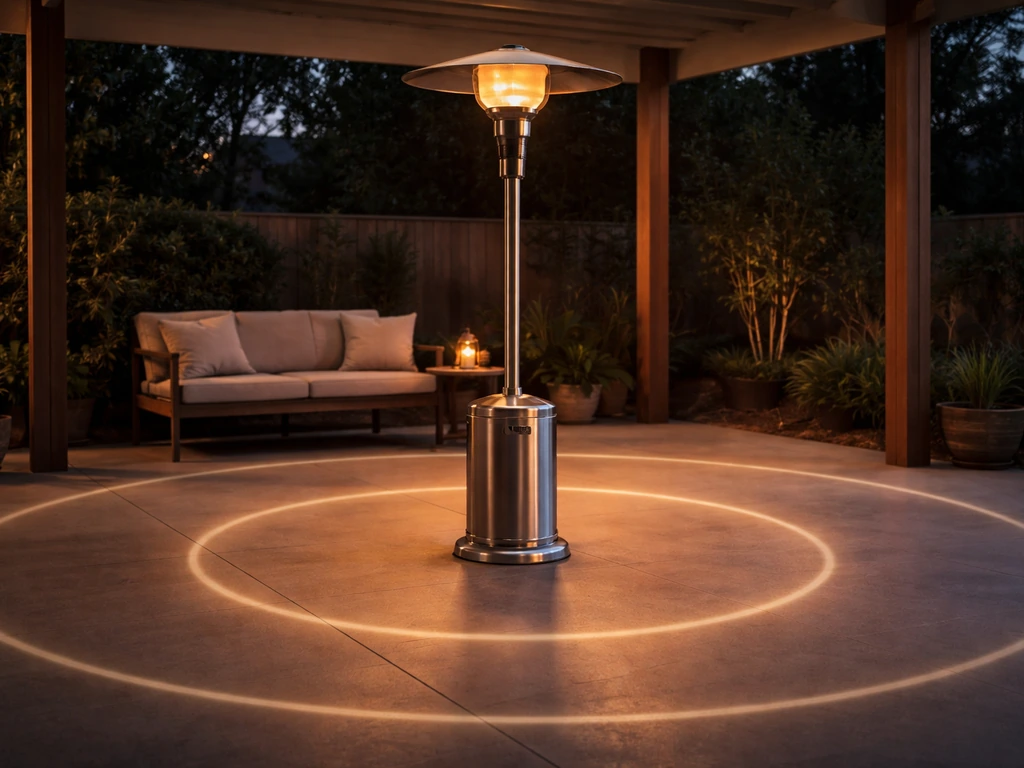
The Garden Sun GS3000SS is rated at 11,000 BTU, and the Garden Treasures PG169T-A matches that at 11,000 BTU/HR. The PG169T-C steps up to 15,000 BTU, and the Garden Treasures 48,000 BTU tank-top model is a different beast entirely, more appropriate as a standalone heat source for a wider area. Product listings claim up to 175 square feet of coverage with a 15-foot radius for these units, but a more practical real-world expectation is comfortable warmth within a 10-foot circle, which is what you get at seated distance from the dome.
The difference between the 11,000 BTU and 48,000 BTU models is not just intensity, it is use-case. At 11,000 to 15,000 BTU, you are supplementing ambient outdoor temperature for a table of 2 to 4 people. At 48,000 BTU, you are approaching the output of a full-size propane patio heater. Unless you need that volume of heat, the 11,000 or 15,000 BTU tabletop is easier to manage and cheaper to run.
Placement tips to get the most heat where you need it
- Center the heater on the table so the reflector dome projects heat evenly to all seated guests. The dome diameter is around 20 to 21 inches, so it needs to clear dishes and glasses by several inches on all sides.
- Keep people within about 8 to 10 feet for noticeable warmth. Radiant heat intensity drops off quickly with distance.
- Use a windbreak: a fence, wall, or screened enclosure dramatically improves performance. An open windy patio will waste a large portion of the BTU output.
- Do not place the heater under a low patio umbrella or low overhead covering. The Garden Sun manual specifies at least 24 inches clearance above the dome and 36 inches clearance to combustibles on the sides.
- On uneven or tippy table surfaces, consider using a separate stable stand or placing the heater on a flat surface beside the table rather than on it.
Powering and setting up a tabletop gas patio heater
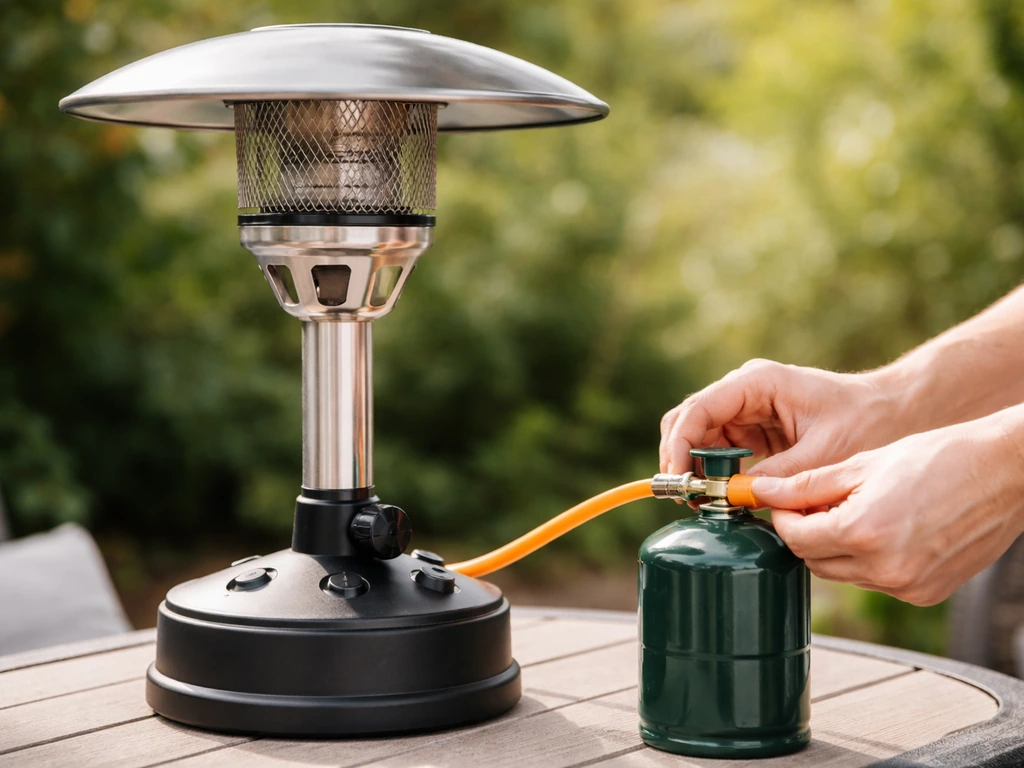
Garden Treasures and Garden Sun tabletop gas heaters connect directly to a standard 1-lb disposable propane canister for portable use, or to a 20-lb LP cylinder via a hose-and-regulator assembly depending on the model and manual configuration. The PG169T-A manual references a 20-lb LP cylinder as the gas supply with a manifold pressure of 11 in. W.C., so check your specific model's documentation before assuming it runs on a 1-lb camp-style canister.
- Assemble the unit fully (pole, burner, dome) before connecting any fuel.
- Attach the LP-gas cylinder to the regulator fitting and hand-tighten. For 20-lb cylinders: attach the regulator to the tank valve and turn the regulator until the tank sits upright and secure.
- Perform a leak check before the first use and any time you reconnect the fuel supply: apply soapy water to all gas connections and fittings and watch for bubbles. If bubbles appear, immediately turn off the gas, disconnect, and do not operate until the leak is resolved.
- To light: turn the control knob to the ignition/pilot position. For models with a push-button piezoelectric igniter (like the GS3000SS), press the igniter button while holding the knob in. For models with a separate piezo button, follow the manufacturer's lighting sequence.
- On first use, expect some smoke or odor for the first 20 to 30 minutes as protective coatings burn off the emitter. This is normal and clears on its own.
- Adjust the control knob to your desired heat level. Low settings conserve fuel; high settings maximize warmth.
- To shut off: turn the control knob fully to OFF and allow the burner to cool before moving the unit.
If you have the PG169T-C model, a natural gas conversion kit is included. Natural gas hookup requires a fixed gas line connection and should only be done by a qualified technician. The advantage is that you never run out of fuel mid-evening, but you lose the portability that makes tabletop heaters appealing in the first place.
Safety essentials you cannot skip with a tabletop gas heater
Tabletop gas heaters have a live flame and a pressurized fuel source sitting on a surface at chest or head height. That combination makes setup and safety habits more important than with a floor-standing heater. Both the Garden Sun and Garden Treasures manuals are explicit on the following points, and ignoring any one of them creates real hazard.
Ventilation and where not to use it
Both the Garden Sun GS3000SS and the Garden Treasures PG169T-A are designed and approved for outdoor use only. The PG169T-A manual is direct: do not use inside a building, garage, or any other enclosed area. This is a carbon monoxide risk, not just a fire risk. A screened porch with open screening panels counts as adequately ventilated for most purposes, but a fully enclosed screen room, a tent, or any indoor space is off-limits.
Clearances and stable placement
- Maintain at least 24 inches of clearance above the top of the dome to any overhead surface, including umbrella canopies and patio covers.
- Keep at least 36 inches of clearance on all sides of the unit to combustible materials (curtains, fabric furniture, cushions, wood structures).
- Never place the heater on an unstable or uneven surface. Both Garden Sun and Garden Treasures models include a tilt-switch auto shut-off that cuts the gas if the unit tips, but this is a backup, not a substitute for stable placement.
- Do not leave the heater unattended while burning, and keep children and pets away from the immediate table area while it is operating.
Wind, leak checks, and storage
On very windy days, the burner can extinguish or burn unevenly. If the flame goes out and gas continues to flow momentarily, do not attempt to relight immediately. Turn the knob to OFF, wait at least 5 minutes for any residual gas to dissipate, then relight following the normal sequence. Always perform a soap-and-water leak check on gas connections after any reconnection of the fuel supply, as outlined in the Garden Sun manual. The GardenSun BFC-A-SS assembly instructions specify using a dishwashing detergent and water leak check solution after any fuel supply reconnection Always perform a soap-and-water leak check on gas connections after any reconnection of the fuel supply.
For storage: turn the control knob fully OFF, disconnect the LP cylinder, move the cylinder to a secure outdoor location away from direct weather, and store the heater upright in a sheltered area. Never store a connected propane cylinder in an enclosed space. The Garden Treasures manual specifically calls out storing the disconnected cylinder outdoors in a secure, well-ventilated location.
Buying checklist: the specs that actually matter
When comparing Garden Sun, Garden Treasures, or any other tabletop gas heater, these are the numbers and features worth checking side by side before you commit.
| Spec / Feature | What to look for | Why it matters |
|---|---|---|
| BTU rating | 11,000 BTU for 2-person supplemental; 15,000 BTU for 4-person; 48,000 BTU for standalone area heat | Determines how warm the heater feels at seated distance and how fast fuel is consumed |
| Coverage area claim | 10-15 ft radius is typical tabletop claim; real comfort zone is closer to 8-10 ft | Sets realistic expectations; do not buy a tabletop unit expecting to heat a 20-ft patio |
| Fuel type and cylinder compatibility | Confirm 1-lb canister vs. 20-lb cylinder; check if NG conversion is included | Affects portability, running cost, and setup requirements |
| Ignition type | Push-button piezoelectric preferred; match-light is less convenient | Ease of use and reliability in cold or wet conditions |
| Safety features | Tilt-switch auto shut-off and thermocouple are minimum requirements | Tilt switch cuts gas if knocked over; thermocouple kills gas if flame extinguishes |
| Clearance dimensions | Dome diameter (20-21 inches typical) vs. your table size | Heater must fit the table without crowding dishes or people |
| Height | 35-37 inches is standard; ensures heat projects at a useful angle over seated guests | Too short and heat goes sideways; too tall and it becomes unstable |
| Build material | Stainless steel or powder-coated steel; stainless resists rust better | Longevity in outdoor conditions and through weather exposure |
| Certifications | Look for CSA or ANSI/CSA certification (e.g., ANSI Z83.26/CSA 2.37) | Confirms the unit passed third-party safety and performance testing |
| Portability | Weight and whether it disassembles quickly for storage or transport | Important if you plan to move it between locations or store seasonally |
Top picks and how the Garden Treasures tabletop gas models compare
If you are specifically shopping for a Garden Treasures or Garden Sun branded tabletop gas heater, here is how the main models stack up and who each one is best for. If you are also looking at the Member's Mark patio heater with an LED table, reading real-world reviews can help you judge build quality, heat output, and practical usability before you buy member's mark patio heater with led table reviews.
| Model | BTU | Fuel | Key safety features | Best for |
|---|---|---|---|---|
| Garden Sun GS3000SS | 11,000 BTU | Propane (LP) | Tilt switch, push-button igniter, CSA/ANSI certified | 2-4 person bistro table, screened porch, casual supplemental warmth |
| Garden Treasures PG169T-A | 11,000 BTU | Propane-LP (20-lb cylinder) | Thermocouple, tilt switch, CSA certified | Small patio table, close-range warmth, budget-conscious buyers |
| Garden Treasures PG169T-C | 15,000 BTU | Propane-LP (NG conversion kit included) | Thermocouple, tilt switch, CSA certified | 4-person seating group, anyone wanting NG conversion option later |
| Garden Treasures 48,000 BTU tank-top (PG183H-style) | 47,000-48,000 BTU | Propane-LP | Thermocouple, tilt switch, piezoelectric ignition | Standalone heat source for a small open patio, cold-climate users who want maximum output from a tabletop footprint |
For most people buying a "garden sun table top patio heater" style unit, the 11,000 to 15,000 BTU range hits the sweet spot. The GS3000SS and PG169T-A are nearly identical in output and both carry the certifications and safety features you need. If you are in a cooler climate or want one unit to handle a slightly larger group, step up to the 15,000 BTU PG169T-C, especially if a future natural gas hookup is on your radar. The 48,000 BTU model is worth considering if you live somewhere with genuinely cold winters and want a tabletop heater that functions as a primary heat source rather than just supplemental warmth.
One honest note on the category overall: tabletop gas heaters perform best in sheltered, semi-enclosed outdoor spaces. A screened porch will feel notably warmer with one of these than an open breezy patio will, and that is worth factoring into your decision. If you’re looking for endless summer patio heater reviews, you can compare how well different models warm a screened porch versus an open patio.
If your patio is fully exposed and frequently windy, you may get more reliable performance from a floor-standing propane heater or a wall-mounted electric infrared unit. But for a covered patio, a screened porch, or a calm evening around a small table, a Garden Sun or Garden Treasures <a data-article-id="3D055689-E1DB-4BC9-B130-090E7E1B54D4">tabletop gas heater is a compact, effective, and well-priced solution.
If you are comparing options, the member's mark patio heater with led table reviews category is a useful place to gauge real-world performance and convenience. If you want additional buying guidance, you can also check east oak patio heater reviews to compare real-world performance and value against tabletop gas heater options.
FAQ
How do I figure out whether a garden sun table top patio heater will cover my table setup?
Start with the seating spacing, not the stated square-foot coverage. These units typically give comfortable warmth in about a 10-foot circle at seated distance. If your guests are spread out (for example, 5 to 6 seats staggered farther than arm’s length), you will likely feel uneven heat and may need a second heater or a floor-standing model.
What clearance do I need between the tabletop heater and the table surface or nearby furniture?
Treat any tabletop gas heater as a radiant and heat-surface risk, especially with rattan, resin, wood, or glass tabletops. Verify clearance in your exact manual, then err on the larger side if your heater will sit on a combustible or heat-sensitive surface. If you do not have room for the recommended stand-off, switch to electric or relocate to a non-combustible deck area.
Can I use a garden sun table top patio heater under a fully covered patio roof?
You can use it on covered patios only if the area is still outdoor and provides adequate ventilation, but a fully enclosed cover or near-zero airflow can be unsafe. The key rule is no enclosed or indoor spaces, including tents. If the roof is close enough that heat and combustion products pool, use a different heater designed for tighter clearances or increase ventilation.
Should I choose propane or electric if I want warmth on a breezy night?
For windy conditions, propane radiant heat usually performs better because it warms objects and people directly. Electric tabletop heaters can struggle outdoors because wind carries heat away and many electric units rely on convective warming. If wind is consistent, plan for a gas radiant unit or increase shelter instead of relying on wattage alone.
How do I tell whether my model is meant for a 1-lb disposable propane canister or a 20-lb LP cylinder?
Do not assume based on appearance. Confirm the gas supply type and manifold pressure in your manual, because some setups call for an LP cylinder via hose and regulator while others use a 1-lb canister. Using the wrong cylinder or regulator can lead to poor flame performance or safety issues.
What should I do if the burner goes out in wind, but the gas valve is still on?
If the flame extinguishes, turn the control knob to OFF. Wait at least 5 minutes to let any residual gas dissipate, then relight using the normal ignition sequence. Avoid immediate relighting while gas may still be present.
How often should I perform a leak check on a tabletop propane setup?
Do a soap-and-water leak check on all gas connections after reconnecting the fuel supply, and anytime you notice a smell of gas. If you transport the heater frequently, check connections again after travel because fittings can shift slightly.
Is it safe to leave the propane cylinder connected during storage?
No. Disconnect the cylinder and store it outdoors in a secure, well-ventilated location. Store the heater upright in a sheltered area, and never store a connected cylinder in an enclosed space like a garage, shed interior, or basement.
Can I convert a tabletop heater to natural gas myself?
For models that include a natural gas conversion kit, the natural gas hookup still requires a fixed line connection and should be installed by a qualified technician. DIY conversion work can create leaks or improper burner performance, which is especially risky with tabletop units at head and chest height.
Will a high-BTU tabletop model like 48,000 BTU replace a floor-standing heater?
It can help for a wider group, but it still acts like a table-level radiant source with directional heat. If you have a large open patio and people move around, a floor-standing heater provides more uniform coverage and easier placement. Use the 48,000 BTU tabletop option only if you understand the target coverage and seating layout.