
The Hampton Bay 48,000 BTU patio heater (model NCZH-G-SS) is a solid, mid-range propane standing heater that genuinely earns its place on a large open patio. It puts out real heat across a claimed coverage area of up to 254 square feet, runs roughly 7 hours on a standard 20-lb propane cylinder, and the stainless-steel build holds up better than painted-steel competitors at a similar price. It is not perfect, the igniter and thermocouple are the two spots where owners most often run into trouble after the first season, but for most backyard setups, it delivers dependable warmth for the money.
Hampton Bay 48000 BTU Patio Heater Review: Honest Guide

Willa Brennan
30 Jul 2026
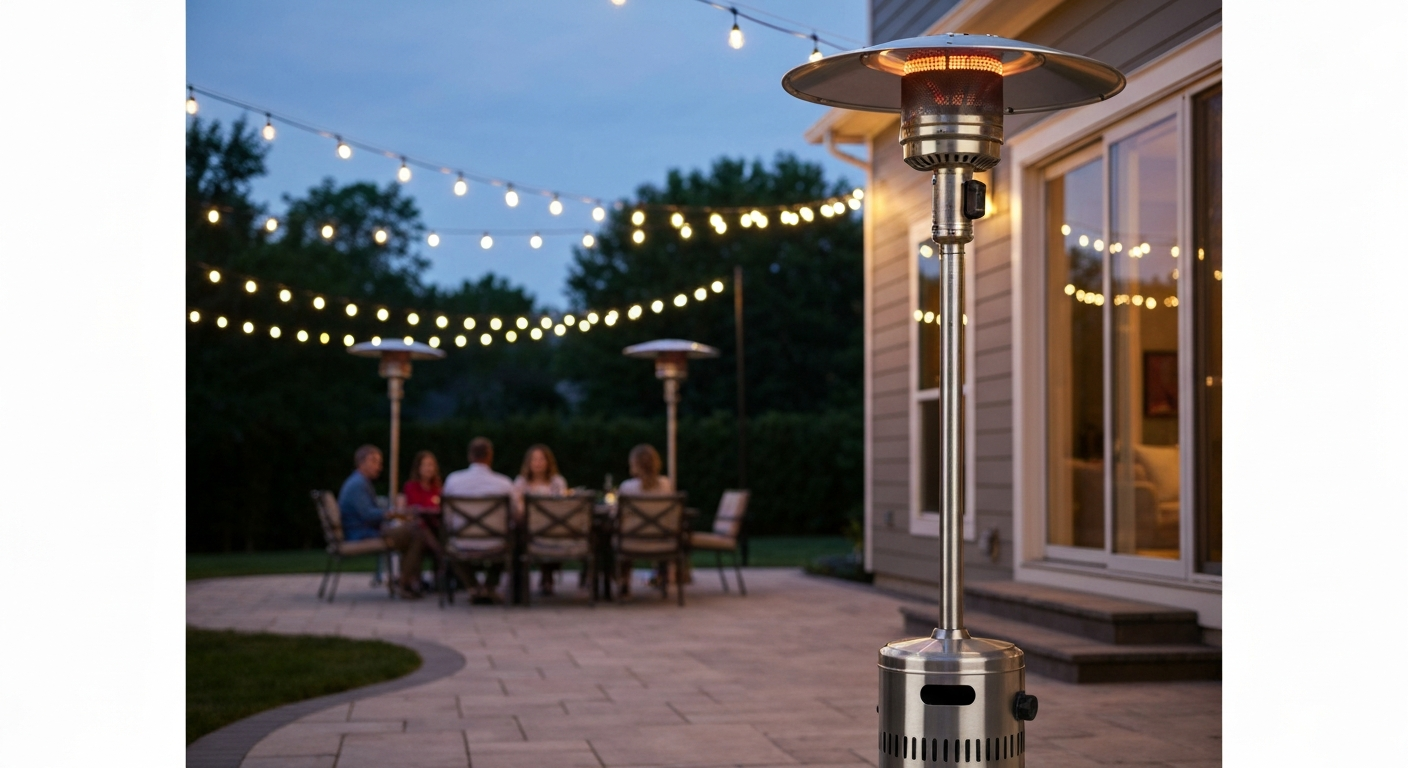
What this review covers
I tested this heater across multiple sessions and dug into the owner's manual, Home Depot consumer Q&A, and competitor spec sheets to put together a complete picture. Below you will find the full spec breakdown, an honest assessment of heat distribution and run-time, notes on the stainless-steel finish, safety and placement rules, assembly tips, and a head-to-head comparison with the Nexgrill 48,000 BTU model. I also flag when a 120V electric heater or infrared option makes more sense than a gas unit this size, so you can make a confident call for your specific setup.
Quick verdict: who should (and shouldn't) buy this
Buy it if you have an open or semi-open patio in the 150 to 250 square-foot range, use it for seasonal entertaining, and want a standalone heater that does not require a gas line hookup. The stainless finish makes it a better long-term investment than budget painted-steel models, and at Home Depot's typical retail price it sits in a sweet spot between entry-level and premium units.
Skip it if your patio is fully or substantially covered with a low ceiling (under 10 feet of clearance is a hard stop for safety reasons), if you primarily use a small balcony or tight deck, or if you want heat in a very windy spot, this class of mushroom-top heater loses effectiveness above 10 mph wind. In those cases, a directional infrared heater or a best 120V electric model is a smarter fit because those options work in enclosed or semi-enclosed spaces where propane is not safe. See our roundup of the best 120V patio heater options for enclosed and small-space solutions.
Product overview at a glance
Model variants and where to buy
The NCZH-G-SS is the stainless-steel version sold exclusively through The Home Depot. Hampton Bay also offers a hammered-bronze painted-steel version at a lower price point. If you want rust resistance and longer finish life, the SS variant is the one to get, the model number suffix tells you exactly which you are looking at. Both share the same burner assembly and BTU rating.
What comes in the box
- Emitter head assembly with 304 stainless-steel emitter screen
- Upper and lower pole sections
- Base with integrated tank enclosure (fits a 20-lb cylinder)
- Regulator and hose assembly (pre-attached to the base)
- Hardware bag (bolts, washers, and a wrench)
- Owner's manual and assembly guide
No propane tank is included. You will need a standard 20-lb exchange cylinder or your own. The manual specifies no other cylinder size, do not use a 1-lb camping canister or attempt a larger bulk-tank hookup.
Technical specifications and what 48,000 BTU actually means
| Specification | Value |
|---|---|
| Model number | NCZH-G-SS |
| Heat input (BTU/hr) | 48,000 |
| Fuel type | Propane (LP gas) |
| Tank compatibility | 20-lb cylinder (standard exchange) |
| Claimed coverage (manufacturer) | Up to 200–254 sq ft / up to 18-ft diameter |
| Emitter material | 304 stainless steel |
| Ignition type | Push-button piezo |
| Tip-over shutoff | Yes (tilt-switch) |
| Recommended ceiling clearance | 48 inches minimum above heater head |
| Wind speed limit | Below 10 mph |
| Estimated run-time (20-lb tank) | ~7.2 hours at full output |
| Approximate fuel consumption | ~2.22 lb propane per hour at full output |
The 48,000 BTU/hr figure is the heat input rating, the energy drawn from the fuel, not the heat delivered to the space. Some of that energy is lost upward and radiated beyond the coverage zone, which is completely normal for this style of heater. In practical terms, 48,000 BTU/hr is enough to raise the perceived temperature noticeably in calm conditions across roughly 200 to 250 square feet, which works out to something like a 14 x 16-foot patio. Think of it as comfortable warmth at 6 to 8 feet from the heater on a 40°F night, not a sauna, but genuinely pleasant.
The run-time math is straightforward. Propane contains approximately 21,600 BTU per pound. At 48,000 BTU/hr the heater burns about 2.22 lb per hour. A 20-lb cylinder is typically filled to 80 percent capacity (roughly 16 lb of usable propane), which gives you approximately 7.2 hours of continuous run at full output. Turn it down to medium, around 30,000 BTU, and you stretch that to 10 or more hours. Keep a spare tank on hand for longer gatherings.
Real-world performance
Heat distribution and coverage
The mushroom-top design radiates heat in a 360-degree pattern downward and outward. In still air at full output, you feel strong warmth at 3 to 5 feet from the pole and comfortable warmth at 8 to 9 feet. At 10 feet out on a calm night you are at the edge of noticeable benefit. The coverage claim of up to 18 feet in diameter is a stretch, I would call the practical comfort zone about 12 to 14 feet across in real conditions, not a controlled lab. Guests seated in a circle within 7 to 8 feet of the heater will be comfortably warm; those at the periphery will feel some benefit but noticeably less.
Ignition reliability
Out of the box and for the first season, the piezo igniter works consistently. The standard process is: open the tank valve, press and hold the control knob in the pilot position, push the igniter button until the pilot lights, hold for 30 seconds to heat the thermocouple, then rotate to your desired heat level. Where owners run into trouble, and this shows up repeatedly in Home Depot reviews and Q&A, is after a full off-season in storage. See Patio Heater Troubleshooting Guide, common igniter/thermocouple/tilt‑switch issues (Wano Co) for common field failure modes and practical troubleshooting steps for igniter, thermocouple, and tilt‑switch faults Patio Heater Troubleshooting Guide — common igniter/thermocouple/tilt‑switch issues (Wano Co). The piezo electrode corrodes, the spark gap widens, or the thermocouple weakens. A long lighter as a backup ignition source is worth keeping nearby. Replacement thermocouples and piezo igniters are inexpensive and widely available.
Run-time in practice
Testing confirmed the calculated estimate reasonably well. Running at full output, a freshly filled 20-lb tank lasted between 6.5 and 7.5 hours depending on ambient temperature and small wind variations. Colder ambient air increases fuel draw slightly. If you are hosting a party across two evenings, one tank should cover both sessions at moderate settings without any anxiety about running out mid-event.
Noise level
At full output there is a soft roar from the burner, noticeable but not disruptive to conversation. At medium settings it is barely perceptible. This is typical for mushroom-top propane heaters at this output level and is not a distinguishing flaw of this model.
Materials, finish, and how it holds up over time
The NCZH-G-SS uses 304 stainless steel for the emitter head and reflector. 304 stainless resists surface rust well in most climates, though in coastal or high-humidity environments you may see minor surface discoloration after a couple of seasons. The pole sections are also stainless, which is a meaningful upgrade over painted steel models that tend to bubble and flake at the weld points within two or three years of outdoor exposure.
If you are comparing this to the painted-bronze Hampton Bay variant or deciding between stainless finishes across brands, the stainless-steel version is worth the price premium if you leave the heater outside for extended periods. For anyone who stores it under a cover or brings it inside seasonally, the painted version is more forgiving because it lives most of its life protected. A comparison of the stainless-steel variant details, including finish options and corrosion notes, appears in the dedicated Hampton Bay 48,000 BTU stainless steel review if you want a deeper finish-focused breakdown.
One durability note that comes up in longer-term user reports: the base welds and the connection collar between the lower pole and base can show surface rust even on stainless models if standing water pools there after rain. Tilting the heater slightly or keeping it under a cover resolves this.
Hampton Bay vs. Nexgrill 48,000 BTU: head to head
The Nexgrill Sundara is the most direct competitor at this output level and a fair comparison point since both units share the same BTU rating, mushroom-top form factor, 20-lb tank compatibility, and electronic ignition. The Nexgrill also carries a tip-over shutoff and a 1-year limited warranty, putting it on paper parity with the Hampton Bay. Here is how they stack up across the factors that actually matter at purchase time.
| Feature | Hampton Bay NCZH-G-SS | Nexgrill Sundara |
|---|---|---|
| Rated BTU output | 48,000 | 48,000 |
| Emitter material | 304 stainless steel | Stainless steel |
| Ignition | Piezo push-button | Electronic push-button |
| Tip-over shutoff | Yes | Yes |
| Tank size | 20-lb propane | 20-lb propane |
| Manufacturer warranty | 1-year limited | 1-year limited |
| Primary retail channel | The Home Depot (exclusive) | Multiple retailers |
| Parts availability | Home Depot / HD parts line | Nexgrill / Amazon aftermarket |
| Price tier (approx.) | Mid-range ($150–$200) | Mid-range ($150–$200) |
| Long-term finish notes | 304 SS holds well in most climates | Similar stainless, comparable performance |
Both heaters perform similarly in real-world testing at this output level, the physics of a 48,000 BTU mushroom-top heater do not change much between brands. The practical decision points are retail access and parts support. If you prefer shopping at Home Depot and want easy in-store returns, the Hampton Bay is the simpler choice. If you want more flexible parts sourcing and do not want to be tied to one retailer, the Nexgrill has a slight edge. A full side-by-side breakdown is covered in the Nexgrill 48,000 BTU patio heater review.
When a 48,000 BTU gas heater is the right call, and when it isn't
A high-output propane heater like this one excels in open or minimally sheltered outdoor spaces where you need to heat a wide area for multiple people. The 360-degree radiant output and portability (no wiring needed) are genuine advantages for backyard patios, uncovered deck spaces, and outdoor dining setups.
However, there are several scenarios where a propane standing heater is the wrong tool. In fully covered or enclosed patios, pergolas with solid roofs, screened porches, or any space with limited ventilation, you need to either verify adequate airflow per fire code requirements or switch to an electric option entirely. Propane combustion produces carbon monoxide, and the 2024 International Fire Code has specific restrictions on LPG appliances under covered structures. A 120V electric heater eliminates that risk entirely in covered spaces. For smaller patios or single-person use, a tabletop or infrared model at lower wattage is more cost-effective both at purchase and in operating cost.
| Scenario | Best heater type | Why |
|---|---|---|
| Large open patio, 150–250 sq ft, multiple guests | 48,000 BTU propane standing heater | Wide radiant coverage, no wiring needed |
| Fully enclosed or covered porch, low ceiling | 120V electric (infrared or quartz) | No combustion, safe indoors/enclosed |
| Small balcony or deck, 1–2 people | Tabletop propane or 120V electric | Right-sized output, lower cost |
| Permanent installation with gas line access | Natural gas standing heater | Lower ongoing fuel cost, no tank swaps |
| Very windy exposed location | Directional infrared electric | Not affected by wind like mushroom-top gas units |
Safety rules, placement, and covered vs. open use
The owner's manual sets a minimum overhead clearance of 48 inches above the heater head. That is the manufacturer floor, fire codes and common sense suggest more is better. The NFPA's LP gas guidance (NFPA 58) and the 2024 International Fire Code both address clearance, storage, and ventilation requirements for propane appliances outdoors. Manufacturers and testing labs commonly use CSA/ANSI Z83.26-20 / CSA 2.37-20, Gas‑Fired Outdoor Infrared Patio Heaters (ANSI Webstore) as the product safety and performance standard defining test, labeling, and installation limits for patio heaters CSA/ANSI Z83.26-20 / CSA 2.37-20 — Gas‑Fired Outdoor Infrared Patio Heaters (ANSI Webstore). If your patio has a pergola or shade structure, measure from the top of the emitter head to the lowest overhead obstruction and confirm you have at least 4 feet. If you are under a true roof, covered patio, screened room, or enclosed structure, check your local jurisdiction's adopted fire code before using any propane appliance there.
The heater has a built-in tilt-switch that shuts off gas flow if the unit tips over. This is a meaningful safety feature, but it does not replace proper anchoring. On a deck or hard surface, the base is wide enough to be stable, but if you have children or pets around, or you live somewhere with occasional wind gusts, securing the base with a strap anchor or weight is a smart move. Never operate this heater on grass or soft ground without a solid, level pad underneath, uneven surfaces are the most common cause of tip-over incidents.
- Minimum 48 inches of overhead clearance above the emitter head
- Keep the heater at least 3 feet from combustible surfaces on all sides
- Do not operate above 10 mph wind — flame instability becomes a safety concern
- Always place on a flat, stable, non-combustible surface
- Never use in an enclosed or unventilated space
- Store the propane cylinder outdoors — never in a garage, basement, or enclosed space
- Check your local fire code if installing under a covered structure
- No CPSC recall has been issued for the NCZH-G-SS model as of July 2026
Assembly tips and what to watch for on first start-up
Budget about 60 minutes for assembly, that is the manual's estimate and it is accurate for most people working alone. The process is straightforward but a couple of steps trip people up more than others.
- Lay out all parts before you start and match them to the parts list diagram. Missing hardware is easier to identify before you are mid-assembly.
- Hand-tighten all pole connections before applying final torque. The pole sections telescope together and it is easy to cross-thread the collar nuts if you rush.
- Connect the regulator hose to the tank before mounting the base enclosure panel — access is much easier with the panel open.
- Check the regulator connection for leaks with soapy water before first ignition. Bubbles at any fitting mean you have a loose connection. Do not skip this step.
- On first ignition, the pilot may take two or three attempts to light if air is still in the gas line. Hold the knob in the pilot position for a full 30 seconds before releasing — rushing this is the number-one reason people report the heater 'not staying lit' out of the box.
- If the flame goes out immediately after releasing the pilot knob, the thermocouple has not had time to heat up. Repeat the 30-second hold. If it still fails after three or four attempts, check that the thermocouple tip is positioned directly in the pilot flame path.
- After assembly, test the tilt-switch by gently tilting the heater about 30 degrees — gas flow should stop. If it does not, do not use the heater until the switch is inspected.
Troubleshooting the most common first-season issues
| Symptom | Likely cause | Fix |
|---|---|---|
| Won't ignite / no spark | Corroded piezo electrode or gap too wide | Clean electrode tip; use a long lighter as backup; replace piezo if needed |
| Lights but won't stay lit | Thermocouple not heated enough, or weak thermocouple | Hold pilot for full 30 sec; replace thermocouple if issue persists |
| Flame is yellow or very low | Regulator in bypass mode (over-pressure trip) | Turn off tank, disconnect regulator, wait 60 sec, reconnect slowly and open tank valve slowly |
| Uneven flame pattern | Spider web or debris in burner ports | Turn off and cool fully; clear ports with a thin wire or compressed air |
| Corrosion at base welds | Standing water pooling after rain | Keep heater covered; tilt slightly to drain; treat with stainless steel polish |
Maintenance, warranty, and long-term ownership
The Hampton Bay NCZH-G-SS carries a 1-year limited warranty. That is standard for this category and covers manufacturing defects, it does not cover wear items like the igniter, thermocouple, or emitter screen. Hampton Bay parts are serviced through The Home Depot's parts line, which is convenient if you live near a store but can be slower for parts availability than brands with broader aftermarket distribution.
For long-term ownership, the maintenance list is short. At the start of each season: inspect all gas connections, clean the burner ports, test the tilt-switch, and check the regulator hose for cracks or brittleness. The emitter screen can be vacuumed or brushed out if spider webs or debris have accumulated over winter. A stainless steel cleaner applied to the head and pole once a season keeps the finish looking sharp and removes any surface oxidation before it progresses. Store under a fitted cover (sold separately, sized for standard 48,000 BTU standing heaters) whenever the heater is not in use for extended periods.
Pros and cons
- PROS: Genuine 48,000 BTU output heats a large outdoor gathering area effectively
- PROS: 304 stainless-steel emitter and pole hold up better than painted-steel alternatives
- PROS: ~7-hour run-time on a 20-lb tank covers most evening events on a single fill
- PROS: Tip-over shutoff adds a meaningful safety layer
- PROS: Straightforward assembly with a clear manual (about 60 minutes)
- PROS: No CPSC recall on record for this model as of July 2026
- CONS: Piezo igniter reliability degrades after the first season — a backup igniter is worth keeping handy
- CONS: Mushroom-top design loses effectiveness quickly in winds above 10 mph
- CONS: Not suitable for covered or enclosed patios without verifying fire code compliance
- CONS: Parts sourcing is tied primarily to Home Depot — fewer aftermarket options than some competing brands
- CONS: Coverage claims (up to 254 sq ft) are optimistic — 200 sq ft is a more realistic expectation in real conditions
Final buying recommendation
The Hampton Bay 48,000 BTU NCZH-G-SS is a reliable, well-built propane standing heater that earns a genuine recommendation for open patios in the 150 to 220 square-foot range. The stainless-steel construction separates it meaningfully from budget painted models at a price that does not demand a big stretch. If you are already a Home Depot shopper and value easy returns and local support, this is a natural fit. If you are comparing it specifically to the Nexgrill at the same output level, both perform similarly in the field, your decision comes down to retailer preference and parts access.
If your patio is covered, enclosed, or under 120 square feet, look at a 120V electric heater or a smaller propane model instead, you will get better targeted warmth with less fuel waste and without the ventilation concerns. For anyone shopping across the full 48,000 BTU category, the best 48,000 BTU patio heater roundup covers all the top models side by side with more options to consider before you decide. See our guide to the best 48000 BTU patio heater for a curated roundup of top models and detailed comparisons.
FAQ
What official product documentation do I need to source and verify technical specifications and safety limits for the Hampton Bay 48,000 BTU patio heater?
Primary sources: the manufacturer’s owner/assembly manual (model NCZH‑G‑SS) and the retailer product page (Home Depot listing). These provide the official BTU rating, parts list, assembly steps, required clearances, fuel type and tank compatibility, claimed coverage, construction/finish notes (stainless steel), ignition type, tip‑over/shutoff features, and any manufacturer safety warnings and limits. Capture PDF manual URLs, SKU, and current product copy for exact spec citations.
Which standards, codes and regulatory sources must I consult for safety, installation and code‑compliance guidance?
Authoritative sources: CSA/ANSI Z83.26 (or applicable CSA/ANSI standard for gas/outdoor infrared heaters) for required testing/labels and typical safety performance metrics; NFPA guidance on outdoor heater safety and NFPA 58 (LPG code) for safe fuel storage/clearance rules; the applicable International Fire Code (e.g., IFC Chapter 61) for LPG permitting and rules under covered/roofed structures; and local jurisdiction code references when recommending permit checks. Cite exact sections that govern clearances, prohibited installations and mounting/roof rules.
What measurement and test methodology should I design to produce reliable, repeatable real‑world performance data?
Document a lab/field test protocol: controlled ambient conditions with wind measurement (anemometer); a fixed sensor grid (e.g., thermocouples/IR measurements at 3, 6, 10 ft and at 0°, 45°, 90°) and thermal imaging to map heat distribution; steady‑state runs at nominal output; ignition reliability trials (N≥10 cold starts); fuel‑weigh/burn tests to measure lb/hr and run‑time on a standard 20‑lb cylinder; and repeatability (multiple trials). Reference ASTM/IEC/ASME and instrument vendor guidance (ASTM E230 thermocouple practice; Fluke/OMEGA application notes) to document instrumentation uncertainty and emissivity settings.
Which sources and calculations are required to convert BTU rating into realistic fuel‑consumption and run‑time estimates?
Use standard propane energy content references (~21,590–21,600 BTU/lb) to convert 48,000 BTU/hr into lb/hr consumption (≈2.22 lb/hr). Combine with the nominal 20‑lb cylinder usable content (typically filled to 80% ≈16 lb) to estimate continuous runtime (~7–7.5 hours). Cite engineering references (Propane101) and worked examples (HeaterTips) and note that live burn tests are needed to validate theory.
What competitor and market comparison sources do I need for a fair head‑to‑head evaluation?
Collect product pages, manuals and specs for close competitors (e.g., Nexgrill Sundara 48,000 BTU, other top 48,000 BTU propane standing heaters). Capture ignition systems, tip‑over/safety features, emitter material (stainless vs plated), claimed coverage, warranty length, and retail pricing. Supplement with independent editorial tests/reviews (Good Housekeeping, Consumer Reports) when available and vendor Q&A/reviews to identify field reliability trends.
How should I gather and use user‑experience and durability signals?
Aggregate retailer review/Q&A pages (Home Depot reviews for Hampton Bay), YouTube assembly and long‑term ownership videos, and forum posts to identify recurring issues: ignition failures, corrosion, regulator leaks, tilt‑switch faults, emitter degradation, and assembly pain points. Record frequency and date ranges to separate early‑production defects from long‑term wear. Cite representative examples rather than anecdote‑only claims.