
Lynx patio heaters are well-built, premium-tier outdoor heating units that perform best for homeowners who want a permanent, professional-grade installation and are willing to spend accordingly. The infrared gas models (LHPM post-mount and LHEM48 eave-mount) deliver serious heat output, 35,000 to 53,000 BTU depending on the model and setting, and the electric LEH39 and LEH61 are clean, simple solutions for covered patios where running a gas line isn't practical. That said, Lynx heaters are not cheap, real-world owner feedback flags recurring ignition and flame-hold issues on gas models, and warranty service can be slow. If you're ready to invest in a permanent outdoor heating setup and you prioritize build quality and aesthetics over upfront price, Lynx is a strong contender. If you want something plug-and-play or budget-friendly, look elsewhere.
Lynx Patio Heater Review: Models, Performance & Buying Guide

Quick verdict: who should (and shouldn't) buy a Lynx patio heater
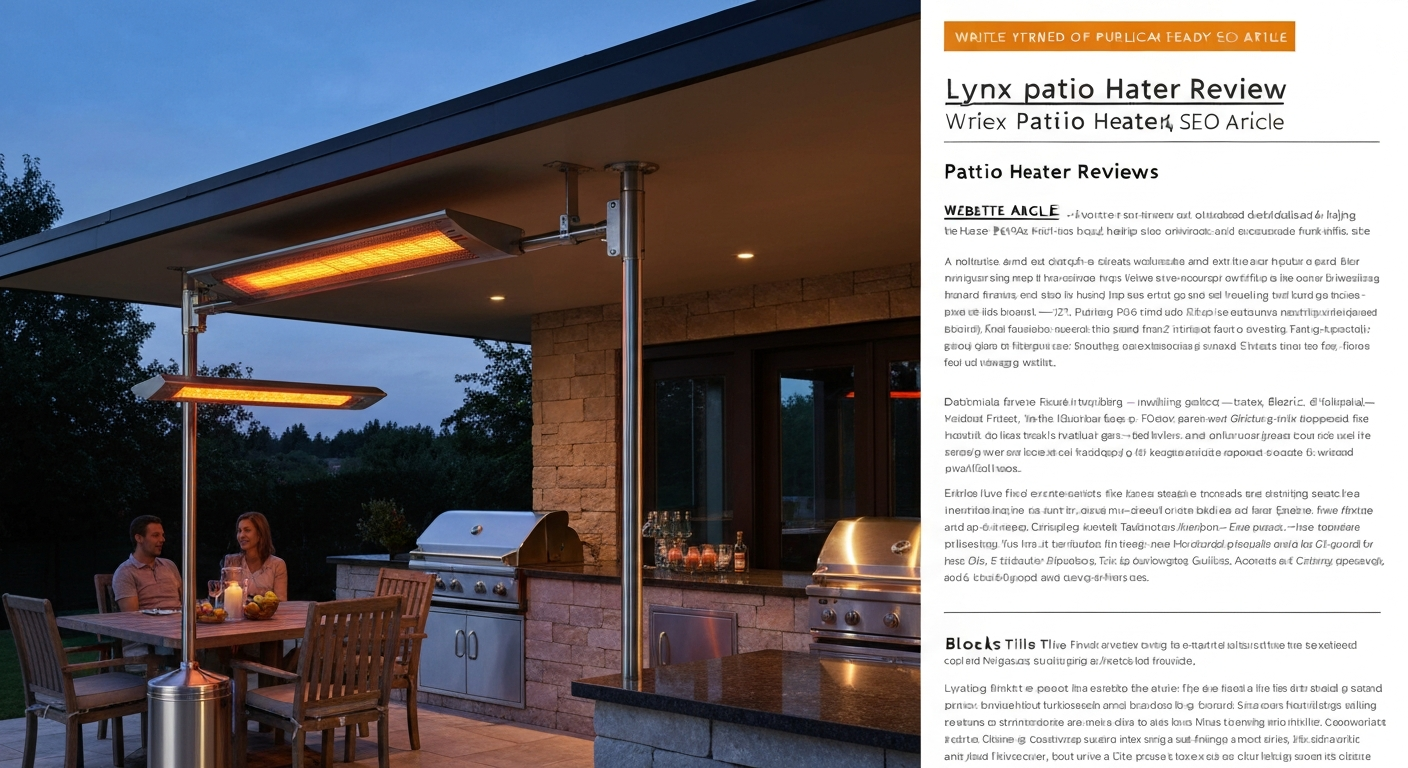
Lynx heaters are squarely aimed at the premium outdoor-kitchen crowd. They're designed to integrate with Lynx's Professional Series grills and cabinetry, and they look the part, all stainless steel, clean lines, and minimal branding. If you're outfitting a fully built-in outdoor kitchen, a Lynx heater makes aesthetic sense and provides serious heat output for a large patio or entertaining space.
But let's be direct about the trade-offs. Several verified buyer reviews flag ignition reliability problems on the LHEM48, and blank" rel="noopener noreferrer">Reddit threads from long-term Lynx owners describe burner and ignitor failures that weren't always resolved quickly through warranty service. The one-year full warranty is thinner than you might expect at this price point. If you're sensitive to service headaches or you need guaranteed reliability season after season with minimal fuss, those are real concerns worth weighing.
- BUY if: You're building a permanent outdoor kitchen and want a matched, professional-grade heating system with high BTU output
- BUY if: You need a hardwired electric heater for a covered patio and want UL-listed, 240V performance (LEH39/LEH61)
- BUY if: You prefer eave-mounted or post-mounted infrared heat that keeps your floor space clear
- SKIP if: You want a portable, no-installation heater you can move around
- SKIP if: You're on a tight budget — there are capable heaters at significantly lower price points
- SKIP if: Reliable, low-maintenance ignition is a top priority — gas-model ignition issues appear in multiple real-world reports
- SKIP if: You need strong manufacturer warranty support for long-term peace of mind
Lynx patio heater lineup at a glance
Lynx keeps its patio heater catalog focused. There are no freestanding propane tower heaters in the lineup, which is a deliberate choice: Lynx builds for permanent, integrated outdoor spaces rather than the rental-event or deck-furniture crowd. Here's what they actually make.
| Model | Type | Fuel | Output | Coverage | Key feature |
|---|---|---|---|---|---|
| LEH39 | Wall/ceiling mount | Electric (240V) | 4,000W | ~8×10 ft | Dual-element, UL listed |
| LEH61 | Wall/ceiling mount | Electric (240V) | Higher wattage variant | Larger coverage area | Extended-length version of LEH39 |
| LHPM | Post-mounted | LP or Natural Gas | ~46,000–53,000 BTU (hi/lo) | Large open patio | High-output gas infrared, post-mount |
| LHEM48 | Eave-mounted | LP or Natural Gas | ~24,000–35,000 BTU (variable) | ~10×10 ft | Remote/wall-switch control, eave install |
The LEH39 and LEH61 are electric dual-element models designed to mount overhead on a wall or ceiling in a covered outdoor space. The LHPM is Lynx's post-mounted gas infrared heater, intended to stand at the perimeter of a patio on a dedicated post, delivering the highest raw BTU output in the lineup at up to ~53,000 BTU on high fire. The LHEM48 is the most popular model in the lineup: a 48-inch eave-mounted infrared heater that tucks up under a pergola or patio cover, runs on LP or natural gas, and includes remote or wall-switch control. Notably, there's no freestanding tabletop or portable model in Lynx's current catalog, so if that's what you need, you're in the wrong place for this brand.
Key specs buyers need to understand before they shop
Buying a patio heater based on the biggest BTU number on the box is the most common mistake people make. Here's what actually matters and how Lynx measures up on each.
Heat output and coverage area
BTU (British Thermal Units) for gas models and watts or kilowatts for electric models describe how much energy a heater converts to heat per hour. Lynx's LHEM48 advertises coverage up to a 10×10-foot area at its 35,000 BTU high setting. The LHPM can push 53,000 BTU on high fire, which is enough for a large open patio zone. The LEH39 electric model puts out 4,000W (about 13,650 BTU equivalent) and covers roughly an 8×10-foot area. Treat coverage figures as ideal-conditions estimates: wind, ceiling height, and ambient temperature all affect real-world warmth significantly.
Footprint and mounting dimensions
The LHEM48 ships at roughly 80 lbs and requires solid structural support at the eave or overhead mounting point. The LHPM needs a dedicated post installation. Neither is a weekend impulse project. The LEH39, at 39 inches long, is more manageable for a DIY overhead installation in a covered patio, but you still need a dedicated 240V circuit.
Materials and build quality
All Lynx heater models use stainless steel construction, consistent with the brand's Professional Series identity. Stainless is more corrosion-resistant than painted steel and holds up well in humid or coastal environments, though Lynx's own warranty specifically excludes coverage for corrosion damage, so even stainless needs regular cleaning in salt-air environments.
IP ratings and outdoor certification
The LEH39 electric model carries a UL listing for outdoor use. Lynx publishes Care & Use manuals and spec sheets for all heater models on their documentation page, which include installation clearances, electrical requirements, and gas supply pressure specs. Always check the model-specific manual for IP rating and location-type (dry, damp, or wet) limitations before installation.
Fuel options and what they actually mean for your patio
Lynx gives you three fuel paths: electric, liquid propane (LP), or natural gas. Each has genuine trade-offs beyond just operating cost.
Electric (LEH39 / LEH61)
Electric is the cleanest, simplest installation if you already have 240V service accessible at the patio ceiling. No gas line, no combustion, no pilot light to troubleshoot. The LEH39 at 4,000W draws about 16.7 amps on a 240V circuit. At a national average electricity cost of roughly $0.17/kWh (mid-2026 U.S. average), running the LEH39 at full power costs about $0.68 per hour. That's not cheap for continuous operation, but for a covered patio where you run it two to three hours per evening, it's manageable. The big limitation: electric infrared loses effectiveness fast in open, unenclosed spaces where heat dissipates quickly.
Liquid propane and natural gas (LHEM48 / LHPM)
Gas models, particularly the LHEM48 and LHPM, generate dramatically more radiant heat than the electric models. At 35,000 BTU, the LHEM48 can warm a meaningful outdoor zone even on a mildly breezy night. Natural gas is the more convenient long-term option if you have a gas line, since you never deal with tank swaps. LP is flexible for locations where gas service isn't available but adds the hassle of monitoring tank levels. The LHPM's 53,000 BTU output is genuinely impressive for large open patios, but that high output also means higher fuel consumption: a 20 lb LP tank holds roughly 430,000 BTU, so at full fire the LHPM burns through a tank in about 8 hours.
Infrared technology: what it means in practice
Both the LHEM48 and LHPM use infrared heating technology, meaning they heat objects and people directly rather than warming ambient air. This makes them noticeably more effective outdoors than convective heaters, since warm air immediately disperses in open spaces. You feel the heat as direct radiant warmth on your skin, similar to standing in sunlight. Infrared gas heaters are generally considered the best-performing option for open or semi-open patios because of this. The electric LEH39 also uses infrared elements, so the same principle applies, just at a lower output ceiling.
| Fuel type | Approx. operating cost/hr | Best for | Main drawback |
|---|---|---|---|
| Electric (240V) | ~$0.68/hr at $0.17/kWh | Covered patios, no gas access | High electricity cost, limited for open spaces |
| Liquid propane | ~$1.50–2.00/hr at high fire (varies by LP price) | Flexible install, no gas line needed | Tank management, less convenient long-term |
| Natural gas | ~$0.60–1.00/hr at high fire (varies by region) | Permanent install, always-on convenience | Requires professional gas line run |
Real-world performance: how Lynx heaters actually heat
Manufacturer coverage claims deserve skepticism. A 10×10-foot coverage area assumes ideal conditions: still air, moderate ambient temperature, and correct mounting height. In real-world use, coverage shrinks noticeably when any of those variables change. Here's a practical breakdown of what to expect from each Lynx model in different scenarios.
Small covered patio (under 150 sq ft)
For a small covered patio, the LEH39 or a single LHEM48 is genuinely well-matched. In a covered space, heat retention is much better since there's a ceiling to prevent vertical heat loss. The LEH39's 4,000W output can make a 120-square-foot covered patio comfortable in temperatures down to around 40°F. The LHEM48 at 35,000 BTU is arguably over-specced for a small covered space unless your climate is very cold.
Large open patio (over 300 sq ft)
This is where the LHPM earns its keep. At 53,000 BTU on high fire, it can create a meaningful warm zone of roughly 12–15 feet in calm conditions. Realistically, a single LHPM creates a comfortable spot for 6–8 people seated close together, not blanket warmth across the entire large patio. For large open spaces, most installers plan for multiple units or zone them around seating areas rather than expecting one heater to cover the whole deck.
Covered vs. uncovered: the biggest performance variable
I want to be clear about this because it changes everything: a covered patio dramatically outperforms an uncovered one with any heater. Radiant infrared heat still works outdoors without a cover since it heats bodies directly, but any convective warmth that builds up dissipates instantly in open air. For uncovered spaces, you need more BTU, the gas models (LHPM especially), and you should size up rather than rely on coverage figures from the spec sheet. For covered spaces, even the electric LEH39 can be very effective and is significantly easier to install.
How I'd structure a proper performance test
A defensible real-world test of any patio heater, including Lynx models, should use NIST-traceable calibrated thermocouples placed in a measurement grid at seated height (roughly 4 feet off the ground) at multiple radial distances from the heater: 3, 5, 7, and 10 feet. Wind speed should be logged with an anemometer throughout. For gas models, fuel consumption should be metered. For electric models, a power meter measures actual kWh draw. Readings should be taken after a standardized warm-up period (typically 15–20 minutes for gas infrared to stabilize) and repeated across multiple runs. An IR thermometer (accuracy within ±1.5°C per instruments like the Fluke 62 MAX) can supplement for surface spot checks. This kind of rigor is what separates a real test from a gut-feel impression.
Installation complexity: what you're actually getting into
Lynx heaters are not weekend-warrior installs for most people. Let's go model by model.
LHEM48 (eave-mounted gas)
This is the most popular Lynx heater and also one of the more involved installations. At roughly 80 lbs shipping weight, the unit requires a structurally sound overhead mounting point, whether an existing eave, pergola beam, or purpose-built support. You need a gas supply line run to the mounting location (LP or natural gas), and the unit uses 24 VAC for ignition control, meaning you also need low-voltage electrical at the mount point for the wall switch or remote receiver. This is a two-trade job in most cases: a gas plumber for the supply line and an electrician for the 24V control wiring. Installation clearances must match the manual specs, and proper ventilation requirements must be satisfied for any covered installation.
LHPM (post-mounted gas)
The LHPM requires a dedicated post (Lynx sells a compatible post) and a gas supply line run to the post location. Installation involves setting the post, connecting gas supply, and the same 24 VAC electrical requirement for control. The gas pressure specs in the LHPM manual must be met precisely, and for natural gas installations the supply line size needs to match the flow requirements at 53,000 BTU max fire. This is firmly in professional-install territory.
LEH39 / LEH61 (electric wall/ceiling mount)
The electric models are simpler but still require a dedicated 240V circuit. If you don't have 240V available at the patio ceiling, you'll need an electrician to run a new circuit from the panel. Once the circuit is in place, mounting the unit is straightforward: it mounts overhead and hardwires directly. The LEH39 draws about 16.7A, so a 20A 240V circuit is appropriate. For most DIYers with basic electrical comfort, this is achievable, but local codes may require a permit and inspection, so check before you start.
Safety features, certifications, and how to use Lynx heaters safely
The LEH39 is UL listed for outdoor use, which is the minimum certification you should require for any hardwired electric outdoor heater. Lynx's gas models are designed for outdoor use with infrared burner technology that does not produce carbon monoxide at the same levels as open-flame convective heaters, but they must never be used in fully enclosed spaces without adequate ventilation. The LHEM48 and LHPM documentation specifies minimum clearance distances from combustibles, which must be followed exactly.
As of August 2026, no active Lynx patio heater recalls appear in CPSC or SaferProducts.gov databases, which is a positive data point, though this should always be re-verified before purchase since recall status can change. Lynx publishes detailed Care & Use manuals for all heater models, and reading the manual for your specific model before installation is genuinely important, not optional.
- Always maintain minimum clearances from combustibles as specified in your model's installation manual
- Never use gas models in fully enclosed spaces — outdoor-rated means ventilated outdoor use only
- For gas models, have a licensed gas plumber make all gas connections and test for leaks
- For electric models, ensure the circuit is properly rated (240V, correct amperage) and use a GFCI-protected outlet or breaker as required by local code for outdoor installations
- Check the gas supply pressure at installation against the manual specs — incorrect supply pressure is a leading cause of ignition and flame-hold problems
- Re-check CPSC recalls at cpsc.gov before purchase to confirm no new notices have been issued
Maintenance, durability, and long-term corrosion resistance
Lynx uses stainless steel construction throughout its heater lineup, and in normal residential environments this holds up well over time. Stainless steel resists rust and surface corrosion far better than painted alternatives, which is one reason Lynx is favored for coastal or high-humidity patios. However, stainless steel in salt-air environments needs regular maintenance: wipe down surfaces periodically with a mild stainless cleaner, and rinse the unit after any salt-spray exposure. Lynx's own warranty excludes corrosion damage, so the maintenance burden is on you even with a premium unit.
For the gas models, the components that generate the most owner complaints are the ignitor and flame-hold (thermocouple or flame sensor) systems. Multiple buyer reports on BBQGuys and Reddit threads from Lynx owners describe ignition failures and shutdowns after one to three seasons of use. See the Lynx 48" 35,000 BTU Natural Gas Infrared Patio Heater, BBQGuys product page for customer review details BBQGuys' product page for the Lynx 48" 35,000 BTU Natural Gas Infrared Patio Heater — BBQGuys lists customer reviews reporting ignition and warranty issues.. These aren't universal, but they're frequent enough to take seriously. The ignitor and thermocouple components are listed in Lynx's parts documentation, so replacement is possible, but parts availability through authorized dealers can be inconsistent and replacement costs add up at the premium Lynx price point.
- Wipe stainless surfaces clean after each season and whenever exposed to salt air or harsh weather
- Cover the unit when not in use for extended periods — Lynx sells compatible covers
- For gas models, inspect the burner and ignitor assembly annually before the season starts
- If you experience ignition failures, check gas supply pressure first before assuming ignitor failure — pressure issues are a common culprit per the LHPM troubleshooting manual
- Keep Lynx's part numbers handy (available in the product documentation PDFs) since sourcing parts from non-authorized suppliers may void warranty coverage
- Electric models have fewer moving parts and generally require less maintenance — inspect element and wiring connections annually
Warranty: what Lynx actually covers
Lynx's formal warranty for patio heaters offers one year of full parts and service coverage, five years of limited coverage for certain components, and limited lifetime coverage for specified stainless steel components. The lifetime stainless coverage sounds impressive but excludes corrosion damage, improper installation, and commercial use, and it is not transferable to a new owner if you sell the home. The one-year full warranty is on the short side for a premium product at this price point. Compare this to brands like Dyna-Glo, which offers more accessible service networks at a much lower price point, or Crown Verity, which also targets the professional-outdoor-kitchen segment. For a heater that costs what a Lynx LHEM48 costs, I'd want to see at least a three-year full warranty.
How Lynx compares to other brands in this class
Lynx doesn't operate in a vacuum. If you're shopping at this level, you're likely cross-shopping several premium brands. Here's an honest side-by-side based on the criteria that matter most for a permanent patio-heating installation.
| Brand | Best model type | Max BTU/output | Fuel options | Warranty (full coverage) | Price tier | Best for |
|---|---|---|---|---|---|---|
| Lynx | Eave/post-mount gas infrared | ~53,000 BTU (LHPM) | LP, NG, Electric | 1 year full | Premium | Integrated outdoor kitchens |
| Crown Verity | Built-in / cart gas | High BTU commercial-grade | LP, NG | Competitive commercial warranty | Premium-commercial | Heavy-use outdoor entertaining |
| Dimplex | Electric wall/ceiling | Lower wattage range | Electric | Varies by model | Mid-premium | Covered patios, no gas access |
| Dyna-Glo | Freestanding/wall-mount gas | 30,000–40,000 BTU range | LP, NG, Electric | 1 year typical | Budget-mid | Value-focused buyers, portability |
Crown Verity is the closest direct competitor if you're building a high-end permanent outdoor kitchen setup. Dimplex is worth a look if you're committed to electric and want a brand specifically focused on electric heating solutions. For a detailed comparison of electric options, see our dimplex patio heater review for model-specific performance and installation notes. Dyna-Glo covers the budget end well and is a solid choice if you want functional heat without the premium price tag, though build quality reflects the price difference. Santorini heaters occupy a more design-forward niche and are worth comparing if aesthetics are driving your decision as much as performance.
Operating costs: running the numbers honestly
Let's be concrete. These are rough estimates based on mid-2026 U.S. average utility rates, useful for budgeting but not exact since fuel prices vary significantly by region.
| Model | Fuel | Output | Estimated cost/hr | Cost per season (150 hrs) |
|---|---|---|---|---|
| LEH39 | Electric (240V) | 4,000W | ~$0.68 | ~$102 |
| LHEM48 (high) | Natural gas | 35,000 BTU | ~$0.70–1.00 | ~$105–150 |
| LHEM48 (high) | LP propane | 35,000 BTU | ~$1.50–2.00 | ~$225–300 |
| LHPM (high fire) | Natural gas | 53,000 BTU | ~$1.05–1.50 | ~$158–225 |
| LHPM (high fire) | LP propane | 53,000 BTU | ~$2.25–3.00 | ~$338–450 |
Natural gas is the most cost-effective fuel for the gas models if you already have a gas line or can run one at reasonable cost. LP works but adds meaningful ongoing fuel cost, especially with the high-output LHPM. The electric LEH39 is competitive on operating cost in markets with average electricity rates, but in high-electricity-cost states (Hawaii, California, etc.) electric becomes noticeably more expensive per hour than natural gas.
Final take: is a Lynx patio heater worth the money?
Lynx patio heaters deliver on build quality, BTU output, and integration with a premium outdoor kitchen aesthetic. The LHEM48 is the standout model for most buyers: eave-mounted, 35,000 BTU, remote-controlled infrared heat that works well for a covered or semi-covered large patio. The LHPM is the heavy-hitter for large open spaces. The electric LEH39 is the right call for covered patios without gas access.
The honest caveats: ignition reliability on gas models is a genuine concern based on owner feedback, the warranty's one-year full coverage is thin for the price, and these are not value buys. If your priority is reliability over aesthetics, or if you're not building an integrated outdoor kitchen where the Lynx brand synergy matters, there are capable alternatives at lower prices. But if you're committed to a premium, permanent outdoor heating installation and you'll maintain the unit properly, Lynx delivers the goods.
| Category | Rating (out of 5) | Notes |
|---|---|---|
| Heat output & coverage | 4.5 | Among the highest in class for gas models |
| Build quality & materials | 4.5 | All-stainless, premium construction |
| Installation complexity | 3.0 | Professional install recommended/required for gas models |
| Reliability & ignition | 3.0 | Multiple real-world ignition complaints on gas models |
| Warranty & support | 2.5 | 1-year full is short for premium pricing |
| Value for money | 3.0 | Excellent quality, but premium pricing demands premium reliability |
| Overall | 3.5 | Strong buy for integrated outdoor kitchen setups; research competitors for standalone installs |
FAQ
What primary manufacturer documentation should I collect to accurately describe Lynx patio‑heater models and specs?
Grab official product pages, downloadable spec sheets, Care & Use/Installation manuals, wiring diagrams, parts lists, and warranty statements for each model (LEH39/LEH61, LHEM48, LHPM, LHBI or built‑in variants). These provide rated BTU/kW, coverage claims, dimensions, weights, fuel options, electrical requirements, installation clearances, and formal warranty terms—essential for accurate baseline specs and installation complexity notes.
Which independent data sources and retailer listings are necessary to corroborate manufacturer claims?
Use authorized retailer/dealer product pages (e.g., ABT, BBQGuys), industry distributors, and commercial spec sheets to confirm dimensions, shipping weight, and advertised coverage. Aggregate verified customer reviews from major retailers to surface recurring reliability or service issues. Check third‑party PDFs or brochures hosted by dealers for alternative spec presentations.
How should I gather real‑world owner feedback and service‑history signals?
Search and synthesize owner reports from forums (Reddit, grilling forums), review aggregates on retailer sites, and consumer complaint portals. Look for recurring failure modes (ignition, flame‑hold, corrosion), warranty/service response anecdotes, and typical time‑to‑failure patterns. Quantify prevalence where possible (e.g., percent of reviews mentioning ignition failures) and note selection bias risks.
What lab and field tests are required to evaluate heater performance objectively?
Run repeatable outdoor tests using controlled ambient baselines: map temperature with a thermocouple grid and IR spot checks at standardized radial distances and heights; record warm‑up time, steady‑state surface and air temps, and subjective comfort metrics. For gas models, meter fuel consumption (flow meter) during standard burn cycles; for electric models, measure energy draw (kWh meter). Include wind‑speed measurements and repeat runs at multiple ambient temperatures.
Which instruments and calibration practices ensure defensible measurements?
Use NIST‑traceable thermocouples/data loggers for air temperature grids, a calibrated IR thermometer (e.g., Fluke spec), a NIST‑traceable kWh meter for electric models, a gas/propane flow meter for fuel consumption, a Type‑2 (or better) sound‑level meter for noise, and an anemometer for wind. Retain calibration certificates and log pre/post calibration checks to support accuracy claims.
What testing protocols and environmental controls should be included in the methodology?
Define ambient baseline (temperature, humidity), low‑wind conditions (or controlled wind speeds), standardized mounting heights and heater angles, thermocouple placement (radial distances and grid spacing), warm‑up and run durations, and repeatability (minimum 3 runs per configuration). Document all environmental conditions and deviations; use Consumer Reports/industry testing approaches as a template.