
The Optimus 1500W infrared patio heater (model PHE-1500BR and the floor-standing PHP-1500DIR) is a single unit that runs at three power settings: 500W, 1000W, or 1500W. That means you are essentially buying three heaters in one box. For most covered patios, balconies, or small garages in mild-to-cool climates, the 1500W setting delivers genuine warmth in a compact, affordable package. If you only need spot heating for one or two people in a tight space, the 500W setting keeps running costs to almost nothing. The main caveats are a modest IP34 weather rating (sheltered use only), a warranty process that requires some patience, and a 2013 CPSC recall history that makes due diligence on your specific SKU worthwhile.
Optimus 500/1000/1500W Electric Patio Heater Reviews & Buyer's Guide

Willa Brennan
14 Jul 2026
At-a-Glance Verdict: Which Model Should You Buy?
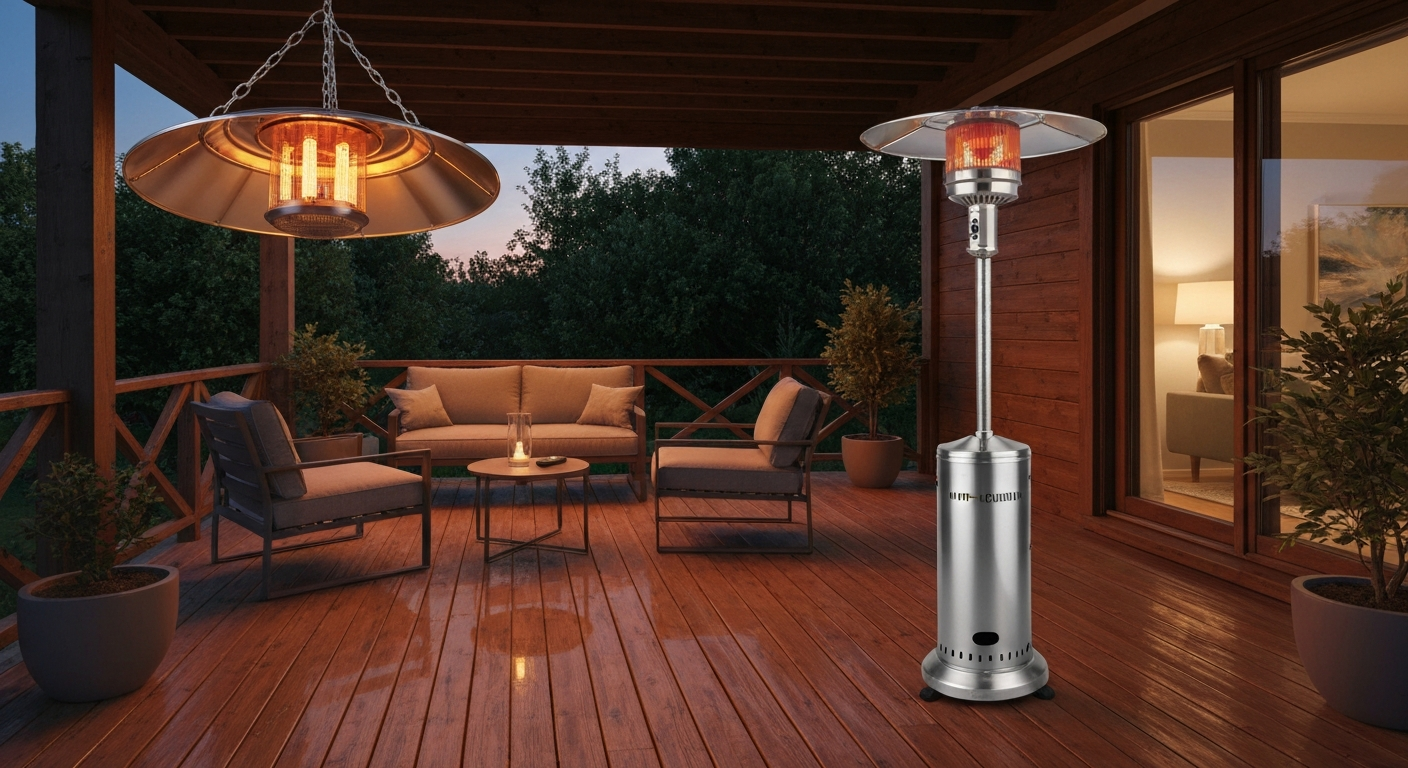
Here is the short version before we get into the details. If you have a small covered patio or balcony under roughly 60 square feet and want the flexibility to dial heat up or down, buy the Optimus 1500W (PHP-1500DIR floor-standing or PHE-1500BR hanging). The three-step power selector gives you genuine flexibility and the remote control on the floor-standing version is a genuine convenience. If you genuinely only heat a tiny corner seating area (think a small apartment balcony or a workshop corner), the 500W or 1000W modes on that same unit cover your needs without buying a separate heater. There is no standalone Optimus model sold exclusively at 500W or 1000W, those are operating modes of the 1500W unit, which is an important point this guide clarifies fully.
- Best for small covered patios and balconies: Optimus PHP-1500DIR (floor-standing, remote included, three heat settings)
- Best for ceiling or wall mounting in a covered space: Optimus PHE-1500BR (hanging/chain-mount, IP34, same 500/1000/1500W steps)
- Best budget entry point: Run either model at 500W — costs roughly $0.07 per hour at the U.S. average electricity rate
- Not recommended for open, rain-exposed patios: IP34 is splash-resistant only, not rain-proof
How to Use This Guide
This guide is built for homeowners, renters, and outdoor enthusiasts comparing the Optimus multi-wattage electric patio heater lineup before buying. I have structured it around the three power modes (500W, 1000W, 1500W) because that is exactly how shoppers search for them, even though you are buying one physical unit. Each section covers specs, real-world coverage estimates, installation and wiring requirements, running costs, and honest pros and cons. I also flag the 2013 CPSC recall history and explain what to check on your specific unit, walk through the warranty and RMA process with actual contact details from the official manual, and compare Optimus against competitors including Blumfeldt and the Heller 2000W so you can see where Optimus sits in the broader electric patio heater market. If you want to zoom out further and compare electric heaters against propane or infrared options as a category, the broader electric patio heater reviews on this site give you that wider context. For detailed model comparisons and user feedback, see our optimus electric patio heater reviews. See our electric patio heater review for full category comparisons and buying guidance.
Quick Model Snapshot
Before diving into full reviews, here is a one-line summary of each power mode so you can orient yourself quickly.
- 500W mode: The lowest setting on the Optimus 1500W unit — ideal for light chill on very small covered areas (up to roughly 25–30 sq ft), costs about $0.07/hr to run, and is genuinely whisper-quiet with minimal glow.
- 1000W mode: The mid-step — a practical everyday setting for a small covered porch or single-car garage corner (roughly 40–50 sq ft effective zone), running at approximately $0.13/hr.
- 1500W mode: Full power, the primary reason to buy this heater — covers a modest covered patio up to roughly 60–70 sq ft, draws 12.5A at 120V, and costs around $0.20/hr at average U.S. rates.
Detailed Review: Optimus 500W Mode
Specs and Performance at 500W
Running the Optimus PHE-1500BR or PHP-1500DIR at 500W activates one of the three halogen infrared tubes inside the unit. At this level the heater produces a gentle, localised warmth rather than broad-area coverage. Realistically, you are warming one or two people seated within about 3–4 feet directly in front of the unit. The infrared glow is subdued at this setting, which some users appreciate for evening ambiance without harsh brightness. Power draw is roughly 4.2 amps at 120V AC, well within any standard 15A household circuit.
Materials, Controls, and Mounting
The physical unit is identical regardless of which wattage step you use. The heater body is constructed from powder-coated steel with a polished metal reflector. The PHE-1500BR hangs via a supplied chain with a mounting hook, the manual specifies that the hook must be capable of supporting three to four times the unit's weight, so verify your ceiling hook or beam anchor before installation. Minimum hanging height is 71 inches (1.8 m) from the floor, with at least 20 inches (0.5 m) of clearance to the ceiling. The floor-standing PHP-1500DIR variant includes a stand and remote control, making it more flexible for renters or anyone who cannot drill into overhead structures. Controls on the hanging model are a rotary selector on the unit body; the floor-standing version adds an included remote for switching between the three power steps without getting up.
IP Rating and Weather Suitability
Both SKUs carry an IP34 rating. Under IEC 60529, IP34 means protection against solid objects larger than 2.5 mm (first digit: 3) and protection against water splashing from any direction (second digit: 4). In practical terms, IP34 is sufficient for a covered patio, a pergola with a roof, or an enclosed porch where rain cannot hit the unit directly. It is not suitable for open, exposed decks where rain or heavy spray can reach the heater. If your patio is uncovered, look at IP44 or IP55 rated competitors, the Blumfeldt Cosmic Beam series, for example, is commonly rated IP44, meaning better dust and water protection.
Warranty at 500W / General Warranty Notes
This is where Optimus documentation gets a little inconsistent. Different manuals and retail listings for Optimus heater models reference either a one-year or a three-year limited warranty. The Office Depot listing for the 1500W floor-standing model states a three-year limited warranty, while some older or alternate-SKU manuals found in online repositories declare a one-year term. My strong recommendation: check the warranty card and manual included in the specific box you receive, because the warranty term can vary by SKU and retailer. For the 500W mode specifically, since it is just the lowest power step of the same unit, the warranty covers the full unit, not individual power settings. Returns within 30 days go back through your retailer. After 30 days, Optimus requires you to ship the unit freight prepaid to Optimus Enterprise, Inc., 2201 E. Winston Road Unit J, Anaheim, CA 92806, with proof of purchase and a $35 handling and packaging charge. Contact: phone 1-888-672-5832, email [email protected].
Detailed Review: Optimus 1000W Mode
Specs and Performance at 1000W
At 1000W, the unit activates two of its three halogen infrared tubes. This is the mode I find myself recommending most often for everyday use on a small covered porch, it hits a sweet spot between heat output and running cost. Current draw is approximately 8.3 amps at 120V, still comfortably within a 15A circuit. The heat beam becomes noticeably broader and you can feel warmth from about 5–6 feet away depending on ambient temperature and whether you are in a sheltered or semi-open space. For a covered balcony of around 40–50 square feet, 1000W is often plenty on a cool (50–60°F) evening.
Materials, Controls, and Mounting
Again, the physical hardware is the same unit as the 500W and 1500W configurations, you are selecting a power step, not purchasing a different heater. The three-tube halogen infrared design means the reflector plays an important role in directing heat output. The manual calls for monthly cleaning of the reflector surface to maintain efficiency, and recommends replacing the reflector every two years. At the 1000W step, two tubes run simultaneously, so tube longevity is a real consideration for frequent users. Optimus states that user repairs are not recommended and may void the warranty; tube replacement should go through their service contact.
IP Rating and Practical Placement
IP34 applies equally at the 1000W step. For a covered patio setting where 1000W is your go-to operating level, the IP34 rating is adequate as long as the heater is not exposed to direct rain or significant moisture. Avoid positioning the unit where gutters might drip onto it or where condensation from a metal roof accumulates and runs down the mounting chain. In humid climates, a monthly wipe-down of the reflector and a visual check of the power cable and plug are good habits at this usage intensity.
Warranty at 1000W
Same warranty structure applies as described in the 500W section above. The inconsistency between one-year and three-year warranty language across Optimus documentation is the single most important thing to clarify at point of purchase. Ask the retailer to confirm the warranty term for your specific SKU before you buy, and photograph the warranty card from the box as soon as you open it. The RMA process and contact details (Anaheim, CA address, $35 handling charge after 30 days) apply regardless of power setting.
Detailed Review: Optimus 1500W Mode
Specs and Performance at 1500W
Full power fires all three halogen infrared tubes simultaneously. The heater draws 12.5 amps at 120V, 60Hz. Under NEC guidelines, heating loads are treated as continuous loads, so the practical circuit-sizing rule is to multiply by 125%: 12.5A x 1.25 = 15.625A. That means a dedicated 20-amp circuit on 12 AWG wiring is the safest choice for the 1500W mode used regularly. A 15A circuit is technically within the continuous-load limit only if nothing else shares that circuit. Optimus's own manual requires connection to an individual, properly grounded branch circuit and explicitly warns against using extension cords. For ceiling-mount installations, the manual recommends installation by a qualified electrician.
Heat output at 1500W is genuinely effective for a small to mid-sized covered patio in the 55–75 square foot range, depending on how well the space retains heat. Open-air patios will see significantly reduced effective range because infrared heaters warm objects and people directly rather than the air, so wind dispersal matters less than it does with convective heaters, but a fully exposed location still cuts effective warmth noticeably. Expect to feel comfortable warmth from about 6–8 feet away in a still, covered setting.
Materials and Build Quality
The powder-coated steel housing feels solid for the price point (typically $109–$182 depending on retailer and variant). The three quartz halogen tubes are the main consumable. The polished reflector behind the tubes focuses the infrared beam forward. Product aggregator/roundup pages for Optimus patio heaters (example: BestReviews.guide) list SKUs and retailer details but do not include independent lab thermal‑camera or IR bench tests measuring beam pattern, surface temperatures, or laboratory energy draw; if you need quantitative heat‑pattern data, commission or perform thermal‑camera/IR measurements Product aggregator/roundup pages for Optimus patio heaters (example: BestReviews.guide) — shows product listings but not independent lab thermal tests. One consistent complaint in user reviews across eBay, Walmart, and Northern Tool listings is that the tubes can be fragile during shipping, inspect the unit before mounting. The floor-standing PHP-1500DIR includes a stable base stand; the hanging PHE-1500BR uses a supplied chain and hook, and the manual is explicit that the mounting hook must support three to four times the unit's full weight.
Controls and Remote
The floor-standing PHP-1500DIR includes a remote control for switching between 500W, 1000W, and 1500W steps from your seat, which is a meaningful quality-of-life feature. The hanging PHE-1500BR relies on a rotary selector on the unit body, fine for a fixed installation where you set it and leave it, but less convenient if you want to adjust output frequently. Neither model includes a thermostat or timer in the base configuration, which is a genuine gap compared to some competitors.
IP Rating and Weather Suitability
IP34 at full 1500W. Same limitations apply: covered, sheltered locations only. Do not use this heater in rain-exposed positions. If you want a heater for a partially open pergola or a deck that gets occasional spray, consider IP44-rated alternatives. The Blumfeldt Cosmic Beam Smart at 2400W is IP44 and designed for tougher outdoor exposure, though it comes at a higher price point and is a European-market product, worth considering if weather resistance is your top priority.
Warranty and Safety History
At 1500W full power, the warranty question matters most because this is the mode that puts the most demand on the unit. Confirm your specific SKU's warranty term at purchase. More importantly: Optimus had two significant CPSC recalls in 2013 (recall numbers 13-191 and related 13-186 via Family Dollar) for fire and overheat hazards across multiple portable electric heater models. The U.S. Consumer Product Safety Commission recall page 'Optimus Recalls Portable Electric Heaters Due to Fire Hazard, CPSC recall page (2013)' (recall numbers 13‑191 and related 13‑186) documents the 2013 recalls of multiple Optimus portable electric heater models for fire and overheat hazards Optimus Recalls Portable Electric Heaters Due to Fire Hazard — CPSC recall page (2013). These recalls involved specific model numbers from that era. While current PHE-1500BR and PHP-1500DIR units are distinct SKUs, it is worth checking the CPSC recall database at cpsc.gov with your exact model number to confirm your unit is not affected. This is straightforward due diligence for any electric heater purchase, and I always recommend it.
Apples-to-Apples Comparison: 500W vs. 1000W vs. 1500W
The table below compares the three operating modes side by side. Running cost figures use the U.S. national average electricity rate of approximately $0.14 per kWh (2025–2026 EIA average). Your actual cost will vary by utility rate and local tariff, use the formula (Watts / 1000) x Hours x Your Rate ($/kWh) to calculate your own figure. Coverage estimates are real-world approximations for a covered, still-air environment and assume the heater is properly positioned at recommended height. A printable or downloadable version of this table is useful to keep handy when shopping in-store, simply screenshot this section or print the page.
| Feature | 500W Mode | 1000W Mode | 1500W Mode |
|---|---|---|---|
| Heat output | 500W / ~1,706 BTU/hr | 1000W / ~3,412 BTU/hr | 1500W / ~5,118 BTU/hr |
| Estimated coverage (covered, still air) | ~25–30 sq ft | ~40–50 sq ft | ~60–70 sq ft |
| Current draw (120V) | ~4.2A | ~8.3A | ~12.5A |
| Recommended circuit | 15A shared OK | 15A shared OK | Dedicated 20A preferred |
| Running cost per hour (at $0.14/kWh) | ~$0.07 | ~$0.14 | ~$0.21 |
| Running cost per 4-hr evening session | ~$0.28 | ~$0.56 | ~$0.84 |
| Running cost per month (4 hrs/day, 30 days) | ~$8.40 | ~$16.80 | ~$25.20 |
| Tubes active | 1 of 3 | 2 of 3 | 3 of 3 |
| IP rating | IP34 (unit-level) | IP34 (unit-level) | IP34 (unit-level) |
| Remote included (PHP-1500DIR) | Yes | Yes | Yes |
| Extension cord permitted | No (manual) | No (manual) | No (manual) |
A few things jump out from this table. First, the jump from 1000W to 1500W adds only about $0.07 per hour in running cost, roughly $25 extra per month if you run it four hours a day every day. That is a modest premium for a noticeably larger heat zone. Second, the 500W mode is genuinely economical as a top-up or ambient setting: under $9 a month at four hours daily. Third, coverage area drops sharply in open or windy conditions, cut the covered estimates by 30–40% if your patio is partially exposed. Finally, for the 1500W mode used as a primary heater, the dedicated 20A circuit recommendation is not optional if you are running it as a continuous load alongside other circuits.
Real-World Performance: Covered vs. Open Spaces
Infrared heaters like the Optimus work by radiating heat directly onto objects and people rather than warming the surrounding air. This is a genuine advantage in partially open spaces, you feel warmth even when there is air movement, because the heat is absorbed by your body and nearby surfaces rather than being blown away. However, IP34 imposes a hard limit: rain exposure is not acceptable, so this heater must always be under cover. For a covered pergola, a screened porch, or a solid-roof patio cover, the Optimus 1500W performs well. For an open deck or an area that gets direct rainfall, the IP34 rating means you either need to bring the heater inside when it rains or choose a better-rated unit.
User feedback from multiple retail platforms consistently highlights that the 1500W mode warms a small covered patio seating area effectively in temperatures down to around 40–45°F. Below that, particularly if the space is open on two or more sides, most users report the heat is pleasant but not sufficient for extended outdoor sitting without additional layering. That is an honest and expected performance boundary for a 1500W unit at this price point, not a flaw, just physics.
Installation and Safety: What You Need to Know
Clearances and Mounting Requirements
The official Optimus manual for the PHE-1500BR specifies: minimum 71 inches (1.8 m) from the floor to the bottom of the unit, and minimum 20 inches (0.5 m) of clearance between the top of the unit and the ceiling. These are not suggestions, they are safety minimums to prevent fire risk from heat accumulation near the ceiling. The mounting hook must be rated to support three to four times the unit's full weight. Use the supplied chain; do not substitute third-party chain or rope without verifying load ratings. For the floor-standing PHP-1500DIR, place it on a stable, level, non-combustible surface and keep it clear of curtains, furniture, or any flammable materials.
Electrical Requirements and Wiring
The unit operates on AC 120V, 60Hz only, standard U.S. household current. At full 1500W it draws 12.5A. Because NEC guidelines classify heating appliances as continuous loads (loads expected to run for three or more hours), the practical circuit-sizing requirement is 12.5A x 1.25 = 15.625A, making a dedicated 20A circuit on 12 AWG wiring the appropriate choice for permanent or regular full-power use. The Optimus manual explicitly prohibits the use of extension cords and requires connection to an individual, properly grounded branch circuit. For ceiling-mount installations, the manual recommends having a qualified electrician handle the wiring. These are not suggestions you should skip to save money.
Safe Operation Checklist
- Verify the mounting hook load rating before installing the hanging PHE-1500BR — it must support 3–4x the heater's weight.
- Maintain minimum 71-inch floor clearance and 20-inch ceiling clearance at all times.
- Never use an extension cord — plug directly into a grounded outlet on a dedicated or lightly loaded circuit.
- For 1500W continuous use, have a licensed electrician verify or install a dedicated 20A branch circuit.
- Keep combustible materials (furniture, fabric, paper) well clear of the heat beam.
- Check your specific model number against the CPSC recall database (cpsc.gov) before first use.
- Do not use in rain-exposed locations — IP34 means splash-resistant, not weatherproof.
Maintenance and Longevity
The official Optimus manual lays out a clear maintenance schedule that I think is worth following closely, especially because the halogen tubes and reflector are the unit's most critical components. Monthly, do a visual inspection of the reflector surface and wipe it clean of dust and grease, a dirty reflector reduces heat output noticeably. Also inspect the power cable and plug monthly for any signs of fraying, discolouration, or heat damage. Every two years, replace the reflector itself; Optimus recommends this interval to maintain efficient infrared output because the reflective surface degrades with repeated heating and cooling cycles. For tube replacement or any internal repairs, Optimus's manual specifically states that users should not attempt repairs themselves, as doing so may void the warranty. Contact Optimus Enterprise at 1-888-672-5832 or [email protected] for authorized service and spare parts.
Pros and Cons
- PROS: Three power steps in one unit — genuine flexibility for different conditions and budgets
- PROS: Competitive price point ($109–$182 depending on variant and retailer)
- PROS: Remote control included on the floor-standing PHP-1500DIR
- PROS: Infrared heating warms people directly — effective even with some air movement
- PROS: Standard 120V plug-in operation — no special gas line or complicated installation for the floor-standing model
- PROS: Compact footprint — works well in small covered patios, balconies, and garages
- CONS: IP34 only — not suitable for rain-exposed positions, limiting placement options
- CONS: No thermostat or timer in base configuration — manual control only
- CONS: Inconsistent warranty documentation (1-year vs. 3-year) depending on SKU — verify before buying
- CONS: $35 RMA handling charge after 30 days adds friction to warranty claims
- CONS: 2013 CPSC recall history requires model-number verification — creates extra due diligence step
- CONS: No independent lab thermal-camera test data publicly available — coverage estimates rely on manufacturer specs and aggregated user reports
- CONS: Extension cords prohibited — outlet placement matters for installation flexibility
Troubleshooting Common Issues
- Heater not turning on: Check the outlet is live and the circuit breaker has not tripped. Confirm you are not using an extension cord on an underpowered circuit. Try a different outlet.
- One or two tubes not lighting: A tube may have failed. Do not attempt to replace tubes yourself — contact Optimus service. Running on fewer tubes than intended drops heat output to the next lower wattage step.
- Reduced heat output over time: Clean the reflector. A dusty or greasy reflector significantly reduces forward heat projection. If cleaning does not help and the unit is over two years old, the reflector may need replacement.
- Remote not responding (PHP-1500DIR): Check or replace the remote batteries first. Ensure no obstructions between remote and the unit's receiver. Reset by unplugging the unit for 30 seconds and replugging.
- Burning smell on first use: A small amount of burn-off from manufacturing residue on the tubes is normal on initial startup. Run the unit outdoors at full power for 10–15 minutes to clear it. If the smell persists after that, stop use and contact Optimus service.
- Unit trips breaker repeatedly: You are likely overloading a shared circuit at 1500W continuous. Move to a dedicated 20A circuit or reduce to 1000W mode on a 15A circuit.
Which Patio Size and Use Case Is the Right Fit?
Here is how I map the three operating modes to real-world scenarios to make the decision straightforward.
| Use Case | Recommended Mode | Why |
|---|---|---|
| Apartment balcony (under 30 sq ft, covered) | 500W or 1000W | Low running cost, adequate for one or two people in a sheltered space |
| Small covered patio (30–50 sq ft) | 1000W | Balanced output and economy, suitable for cool evenings down to ~50°F |
| Mid-size covered porch (50–70 sq ft) | 1500W | Full output needed to warm the space; ensure dedicated circuit |
| Single-car garage or workshop corner | 1500W | Enclosed space retains heat well; good fit for the Optimus hanging model |
| Open deck (exposed to rain) | Not recommended | IP34 rating insufficient for rain-exposed placement |
| Commercial or large-venue outdoor area | Not recommended | 1500W is too small; consider commercial-grade infrared units |
How Optimus Stacks Up Against Competitors
The Optimus 1500W sits in the budget-to-mid-range segment of the electric patio heater market. Understanding where it sits relative to key competitors helps you know whether it is the right choice or whether you should spend more for better specs.
| Model | Max Wattage | IP Rating | Remote | Thermostat/Timer | Approx. Price | Best For |
|---|---|---|---|---|---|---|
| Optimus PHP-1500DIR / PHE-1500BR | 1500W | IP34 | Yes (floor-stand) | No | $109–$182 | Small covered patios, balconies, garages |
| Blumfeldt Cosmic Beam Smart 2400W | 2400W | IP44 | Yes | Yes (smart controls) | Higher (EU market) | Larger patios, better weather resistance |
| Heller 2000W Electric Outdoor Heater | 2000W | IPX4 | Varies by SKU | Varies by SKU | Mid-range | Mid-size covered or semi-exposed patios |
The Blumfeldt Cosmic Beam Smart is a step up in almost every measurable way: more wattage, better IP rating (IP44 vs. IP34), and integrated smart controls including thermostat and timer. If you are comfortable spending more and need weather-resistant heating for a larger or partially exposed space, Blumfeldt is worth the premium. The Heller 2000W sits between the two on output, and its IPX4 rating (equivalent water protection to the Optimus IP34 splash protection) makes it a closer comparison for semi-sheltered use. Where the Optimus genuinely wins is price accessibility and the three-in-one wattage flexibility, which no direct competitor in this price bracket matches as cleanly. For a detailed look at these and other electric models in broader context, the electric patio heater reviews section of this site covers the category comprehensively.
Final Buying Recommendation
The Optimus 1500W electric patio heater (in either the hanging PHE-1500BR or floor-standing PHP-1500DIR configuration) is a solid, honest performer for its price tier. The three-step power system is genuinely useful rather than a marketing gimmick, being able to run at 500W for a light evening and dial up to 1500W when guests arrive is a real-world convenience. The IP34 rating is the hard constraint: this heater belongs under cover, full stop. The warranty inconsistency and the 2013 CPSC recall history mean you need to do a quick model-number check before first use and clarify the warranty term with your retailer before buying. Neither of those is a dealbreaker, but both require a few minutes of due diligence that some budget heaters do not demand. If those boxes are checked and your patio is covered, the Optimus 1500W delivers reliable infrared warmth at one of the most competitive price points in the category.
FAQ
What official manufacturer documents should I collect for accurate specs, installation and warranty details?
Download the exact SKU manuals (PHE‑1500BR, PHP‑1500DIR, and any 500/1000‑step documents) from Optimus or retailer product pages (Lowe’s, Office Depot). Capture installation clearances, electrical ratings (AC 120V/60Hz), mounting instructions, IP rating claims, maintenance intervals (reflector replacement), RMA/warranty language and service contact/address. Save PDFs and quote verbatim for installation/safety and warranty sections.
Which retailer and marketplace listings are needed for cross‑checking specs, features and current pricing?
Collect major seller pages and snapshots from Office Depot, Walmart, Northern Tool, Lowe’s, Amazon, Newegg and eBay. Record SKU variants, stated wattages (500/1000/1500 step settings), IP ratings (IP34 claims), included accessories (remote, stand/chain), and current street prices/availability for the pricing/comparison table.
What authoritative safety and recall sources must be checked?
Search the U.S. Consumer Product Safety Commission (CPSC) recall database and similar authorities in other markets for any Optimus recalls (e.g., 2013 recalls). Include recall summaries, hazard descriptions, and links to official notices when discussing safety, reliability and historical issues.
What electrical code and electrician guidance is required for installation and breaker sizing advice?
Reference NEC guidance/trade summaries for continuous load sizing (e.g., 125% rule). Use credible trade/expert explainers (Electrical Contractor Magazine or NEC interpretive guides) to calculate amps for 500/1000/1500W units at 120V, recommended breaker/circuit sizing (typically 20A/#12 AWG for 1500W) and the manufacturer’s manual requirement for dedicated, grounded branch circuits and qualified‑electrician ceiling mounts.
How should IP/ingress protection and weather‑use claims be verified?
Cite IEC 60529 reference material or an accredited lab explainer (Nemko/NRTL) to define IP codes (IP34, IP44, IPX4) and what each allows for in sheltered vs exposed outdoor use. Verify each SKU’s claimed IP rating from manufacturer manuals and retailer specs and explain real‑world implications.
What user feedback sources are needed to gather performance, reliability and installation anecdotes?
Aggregate verified customer reviews and Q&A from Office Depot, Walmart, Amazon, eBay, Northern Tool and specialist forum threads. Extract common praise/complaints, failure modes, installation tips and real‑world coverage/cold‑weather notes for pros/cons and troubleshooting sections. Note review date and sample size for credibility.