
A style table top patio heater does two things at once: it keeps the people sitting around your outdoor table warm, and it looks good doing it. The right one fits your decor, runs on a fuel source you can actually manage, and pushes out enough heat (roughly 10,000 to 13,000 BTU for propane models, or 1,200 to 1,800 watts for electric) to make a real difference for a small seating group within about an 8-foot diameter. The wrong one is an eyesore, runs out of fuel in two hours, or poses safety risks in a covered space. This guide walks you through every technology type, the style trade-offs that actually matter, and a clear set of buying decisions so you can match the right heater to your specific patio, table, and budget.
Style Table Top Patio Heater: Choose by Design & Performance

Willa Brennan
24 Jul 2026
Who needs a style table top patio heater (and what this guide covers)
Tabletop patio heaters are built for a specific situation: you have a dining table, a bistro setup, or a small seating area where one or two people (or a small group of four to six) want localized warmth without the footprint of a full standing tower heater. If you're working with a small apartment balcony, a compact covered porch, a restaurant patio with tight table spacing, or a backyard corner where you only need heat for a few chairs, a tabletop model is exactly right. They're also the answer when you rent and can't install anything permanent, or when you want a heater you can move from the deck to the patio table to the garage workshop as the seasons change.
Style matters more with tabletop heaters than with most other outdoor heating options, because the unit sits right in the middle of your table or on a surface-level shelf, front and center in your line of sight. This guide covers everything you need: aesthetic and material choices, the five main heating technologies (glass-tube, halogen, infrared, electric ceramic/radiant, and small propane), heat output and run-time numbers, safety requirements including key clearances and CO risks, where to buy, and what accessories (like covers and protectors) are worth adding.
Style vs function: getting both right without compromising either
The biggest mistake people make when shopping for a tabletop heater is picking purely on looks or purely on BTU output. A heater that looks stunning but runs on a 1-lb propane cylinder with no wind protection will frustrate you every time there's a breeze. Equally, a high-output ceramic unit that looks like a construction site space heater ruins the atmosphere of a nice patio dinner. The good news is that the tabletop heater market has matured enough that you don't have to choose one over the other, you just have to know what the trade-offs are.
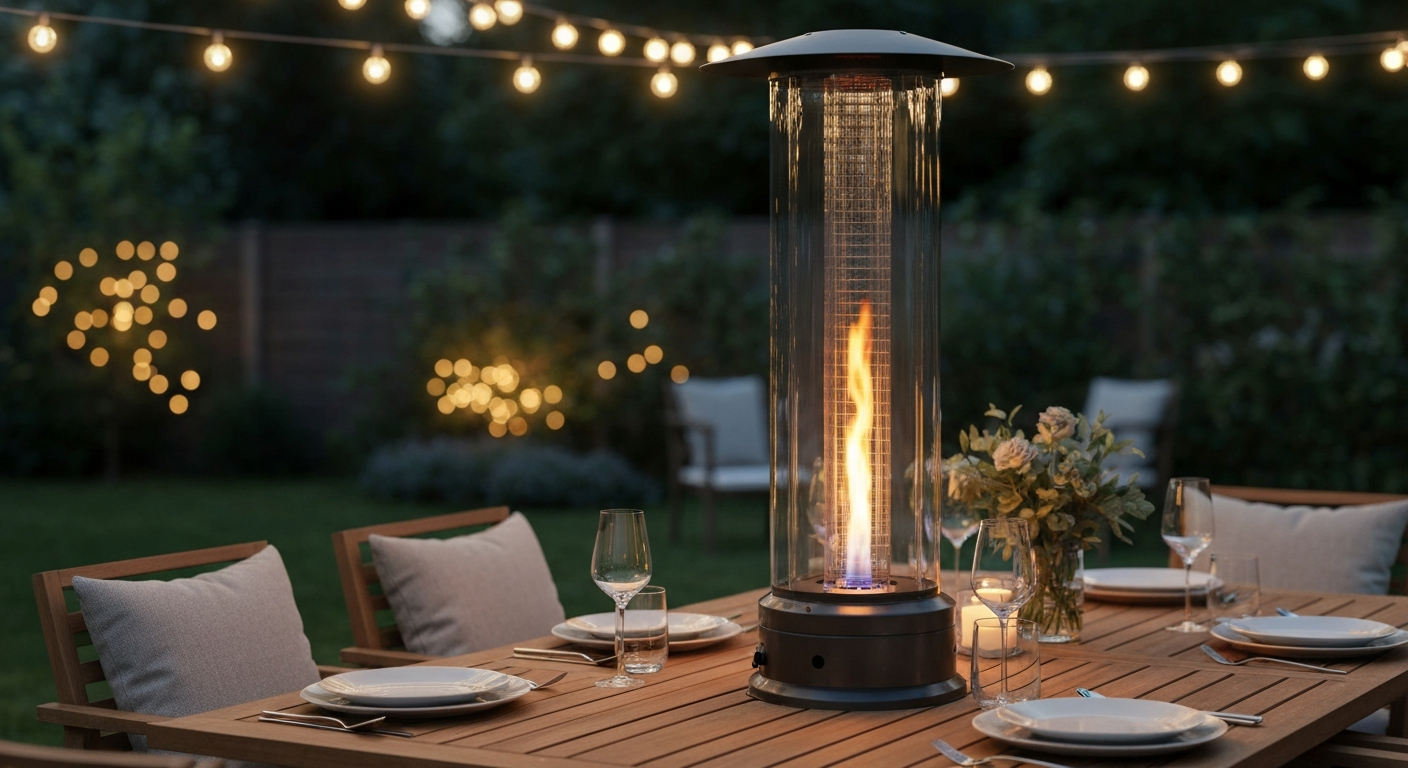
Finish and form factor are the two style levers you control. For finishes, stainless steel and hammered bronze are the most common on propane tabletop models (Fire Sense's lineup is a clear example, retailing at $100 to $160 in stainless or hammered finishes). Matte black and brushed nickel appear on higher-end electric and infrared units. Glass-tube pyramid styles bring a decorative flame element that looks genuinely attractive on a patio table. For form factor, the main split is between tall column-style units that sit at the center of a table and low-profile radiant panels or mushroom-cap units that sit at the edge. Column styles look more intentional; low-profile units are easier to move and store.
Size is a function consideration that also affects style. Tabletop heaters are compact by definition, typically standing 18 to 30 inches tall, but you need to check manufacturer minimum clearances before you buy. The Fire Sense 60262, for example, requires 18 inches of clearance above and 24 inches to each side, that affects how it fits on a table with an umbrella or a pergola overhead. Electric models are generally more forgiving on clearances and work better in covered or enclosed spaces because they produce no combustion byproducts.
Quick technology overview: five types, five different use cases
Before going deep on each technology, here's the short version of what you're choosing between. Propane tabletop heaters (including glass-tube pyramid styles) deliver the most heat per unit but require fuel management and outdoor-only use. Halogen heaters glow with visible orange light and warm up instantly. Infrared units (electric) heat objects and people rather than air, making them efficient for breezy spots. Electric ceramic and radiant heaters are the safest and lowest-maintenance option for covered patios. Each technology has a real use case where it beats the others, the sections below break down exactly when and why.
| Type | Fuel | Typical Output | Best Environment | Avg. Street Price |
|---|---|---|---|---|
| Glass-tube propane | Propane (1-lb cylinder) | 9,000–13,000 BTU | Open, uncovered, calm wind | $100–$180 |
| Halogen electric | 120V plug-in | 1,200–1,500 W (~4,100–5,100 BTU) | Covered patio, balcony | $60–$150 |
| Infrared electric | 120V plug-in | 1,200–1,800 W (~4,100–6,200 BTU) | Covered/partially covered | $80–$300 |
| Ceramic/radiant electric | 120V plug-in | 1,000–1,500 W (~3,400–5,100 BTU) | Covered, enclosed porch | $60–$200 |
| Small propane (mushroom/column) | Propane (1-lb cylinder) | 10,000–11,000 BTU | Open outdoor, portable use | $80–$160 |
Table top glass-tube patio heaters: decorative flame meets real heat
Glass-tube tabletop heaters, often called pyramid or firecolumn tabletop heaters, burn propane through a burner at the base, sending a visible flame up through a cylindrical or tapered glass tube. See our table top glass tube patio heater guide for model comparisons, run-time expectations, and safety tips. The glass protects the flame from wind and creates a visual focal point that genuinely looks good on a patio table. Most run on a standard 1-lb disposable propane cylinder and put out 9,000 to 13,000 BTU, which is enough heat for a small group sitting within roughly 6 to 8 feet.
The biggest practical limitation is run-time. Propane contains about 21,548 BTU per pound, so a heater drawing 10,000 BTU per hour burns through roughly 0.46 lb of propane per hour, meaning one standard 1-lb cylinder lasts around 2 hours at full output. That's one dinner, maybe two if you run it low. You'll want a small stock of cylinders on hand, or look for a model that accepts a larger cylinder via an adapter hose. Most glass-tube tabletop units are CSA/ANSI Z83.26-certified, which limits tabletop propane appliances to a maximum input of 24,000 BTU/hr and requires self-contained propane supply systems, so you're working within a defined safety framework even at the high end.
Because these are propane combustion devices, they are strictly outdoor-only products. Carbon monoxide is a real hazard in enclosed or semi-enclosed spaces: the CDC and EPA are clear that portable fuel-burning heaters should never be used in spaces without adequate ventilation. On an open deck or patio they're safe when used with the manufacturer clearances respected. On a covered porch with walls on three sides, choose an electric unit instead.
Glass-tube tabletop heater: pros, cons, and best use cases
- Pros: Highest heat output in the tabletop category; attractive flame aesthetic; fully portable with no cord; wind protection from the glass tube
- Cons: Short run-time (~2 hours per 1-lb cylinder); outdoor use only due to CO risk; glass tube is fragile and can crack with thermal shock; cylinder cost adds up over a season
- Best for: Open decks and patios without overhead enclosures; entertaining where you want ambiance and heat combined; spaces with no access to outdoor power outlets
Table top halogen patio heaters: instant warmth with a glowing element
Halogen tabletop heaters use a tungsten-halogen bulb as the heating element, producing both visible orange-red light and radiant heat simultaneously. They warm up almost instantly, within a few seconds of switching on, which makes them feel satisfying to use. Output typically falls in the 1,200 to 1,500 watt range (roughly 4,100 to 5,100 BTU equivalent), which is meaningful warmth for one or two people sitting close to the unit, though lower than a propane tabletop heater. See our detailed section on the table top halogen patio heater for model recommendations and maintenance tips.
The glow is a genuine style feature for some buyers and a dealbreaker for others. If you're going for a warm, ambient atmosphere on a covered patio, the orange light can enhance the mood. If you want invisible heat that doesn't affect the visual environment, look at infrared or ceramic electric units instead. Halogen elements do burn out over time and are not always easy to replace depending on the brand and model, so check parts availability before buying.
Because halogen tabletop heaters are electric, they're safe for covered patios and balconies with no combustion emission concerns. They do need a nearby outdoor outlet, and per the National Electrical Code (NEC Section 210.8), any 120V outlet used outdoors at a dwelling must be GFCI-protected. A 1,500W heater draws about 12.5 amps at 120V, which is within a standard 15A circuit but leaves little room for other loads on the same circuit.
Halogen tabletop heater: pros, cons, and best use cases
- Pros: Instant heat with no warm-up delay; visible glow adds ambiance; safe for covered patios and balconies; no fuel to manage; tip-over protection standard on most units
- Cons: Visible orange glow may be unwanted in some settings; halogen bulbs burn out and may be hard to source; lower BTU output than propane tabletop units; requires an outdoor GFCI outlet
- Best for: Covered patios and pergolas where propane isn't appropriate; small bistro setups where the warm glow complements the atmosphere; renters who need a plug-in solution
Infrared tabletop heaters: efficient spot heating that works with your body, not the air
Infrared tabletop heaters are electric units that emit infrared radiation rather than warming the surrounding air. This is an important distinction in practice: infrared heat warms you directly, the way sunlight does, so a breeze doesn't carry the warmth away the way it does with convective air heating. For a patio table in a spot that gets occasional wind gusts, infrared is noticeably more effective than an electric fan-forced or ceramic heater.
Electric infrared tabletop models like the Westinghouse WES31 run at 1,500W, carry an IP44 weather rating (meaning they handle splashing water and light rain), and include tip-over and overheat protection. At 1,500W they cover a realistic small seating zone of roughly 60 to 80 square feet under calm, covered conditions. Expect to pay $80 to $300 depending on IP rating, wattage, and brand. Higher-end units add remote controls, dimmer settings, and better weatherproofing, which are worth the premium if the heater is staying outdoors year-round.
One note on running costs: at the U.S. average residential electricity rate (around $0.16/kWh as of mid-2026), a 1,500W infrared heater costs roughly $0.24 per hour to run. Compare that to the cost of a 1-lb propane cylinder (typically $4 to $6 at retail) lasting about 2 hours in a propane tabletop unit, the per-hour fuel cost is similar, but the electric unit involves no cylinder logistics and no CO risk.
Infrared tabletop heater: pros, cons, and ideal scenarios
- Pros: Wind-resistant radiant heat; no combustion, no CO risk; suitable for covered patios and balconies; weatherproof models (IP44+) available; quiet operation
- Cons: Lower peak output than propane tabletop heaters; requires an outdoor GFCI outlet; infrared light may be mildly visible on some models; effectiveness drops significantly at distances over 4-5 feet
- Best for: Partially covered or semi-enclosed patios; windy spots where convective heaters underperform; situations where a clean, invisible heat source is preferred over a visible flame or glow
Electric tabletop heaters (ceramic and radiant): lowest risk, easiest setup
Ceramic and radiant electric tabletop heaters are the safest and simplest option in the category. They plug into any outdoor GFCI outlet, have no open flame, and are available in compact designs that can sit on a small side table or the corner of a dining table. Output is typically 1,000 to 1,500 watts (roughly 3,400 to 5,100 BTU), which is meaningful warmth for one or two people but less powerful than propane options for heating a full table of six.
Ceramic models use a ceramic heating element that distributes heat more evenly than a single-point halogen or infrared element, and they don't produce visible light, if you want invisible, silent warmth, ceramic is the closest you'll get in the tabletop category. These units are well-suited to covered porches, screened-in patios, and any spot within reach of an outdoor outlet. Running costs at 1,500W work out to roughly $0.24 per hour at average U.S. electricity rates, consistent with other electric options.
From a pure safety standpoint, electric tabletop heaters are the recommended choice for any space that isn't fully open-air. A covered porch, a pergola with shade curtains, or a screened room all benefit from the no-combustion design. Always confirm the outlet serving the heater is GFCI-protected as required by NEC Section 210.8 for outdoor receptacles, and check that your circuit can handle the draw, a 1,500W heater at 120V pulls 12.5 amps, leaving very little headroom on a 15A circuit if other devices share it.
Electric tabletop heater: pros, cons, and where they shine
- Pros: No combustion, no CO risk, no fuel cylinders to manage; quiet and invisible heat; safe for covered or semi-enclosed spaces; lowest barrier to setup
- Cons: Lowest peak output in the tabletop category; tied to an outlet, limiting placement flexibility; less effective in open windy environments compared to infrared; small heating radius
- Best for: Covered porches, screened patios, and balconies; anyone who wants zero maintenance and maximum safety; supplemental heating paired with a larger primary heater for a main seating area
Small propane tabletop heaters: the most portable and most powerful option
Small propane tabletop heaters, think the classic mushroom-cap column style from Fire Sense, Hampton Bay, or Cuisinart, are the most popular tabletop heater category by sales volume, and for good reason. The Fire Sense 60262 puts out 10,000 BTU from a standard 1-lb disposable propane cylinder. The Cuisinart COH-500 runs at 11,000 BTU with similar cylinder compatibility. Both are fully cordless, genuinely portable, and capable of keeping a small group warm on a cool evening. Hampton Bay's product guidance similarly classifies these as compact units designed for roughly 5 to 8 feet of personal warmth, not whole-patio heating, but enough for the people sitting right around your table.
Run-time is the main practical limitation. Using the known energy density of propane (approximately 21,548 BTU per pound), a 10,000 BTU/hr heater burns through about 0. Propane Technical Pocket Guide / industry references (data on propane Btu per lb), used for run‑time calculation (inference) lists propane energy content as ≈21,548 Btu per pound, which is the input used to calculate the heater run‑time Propane Technical Pocket Guide / industry references (data on propane Btu per lb) — used for run‑time calculation (inference). 46 lb per hour, which means a single 1-lb cylinder lasts around 2 hours at full output. The Cuisinart COH-500 at 11,000 BTU/hr is marginally faster, closer to 1.9 hours per cylinder. Plan accordingly: buy a six-pack of cylinders before your next dinner party, or invest in an adapter hose to connect a larger 1-lb exchange tank if your model supports it.
Safety features are non-negotiable on any propane tabletop unit. The Fire Sense 60262 includes an auto-shutoff tilt valve, oxygen-depletion sensor (ODS), and a safety grill over the burner head. The Cuisinart COH-500 adds a tip-over safety switch. These features are required by the CSA/ANSI Z83.26 standard that governs tabletop gas patio heaters, so any certified unit should have them, but confirm the safety feature list before buying, and always follow the manufacturer's clearance minimums (18 inches above, 24 inches to each side on the Fire Sense 60262). And again: outdoor use only. Propane combustion in a partially enclosed space is a CO hazard.
One consideration that often surprises buyers is where to source replacement cylinders conveniently, especially for commercial settings. Home Depot, Tractor Supply, Walmart, and hardware stores all stock 1-lb disposable cylinders, and commercial buyers sometimes turn to industrial supply channels for bulk quantities. Propane tabletop heaters in this category typically retail at $80 to $160, the lower end for basic models, the upper end for finishes like hammered bronze or brushed stainless with premium safety features.
Small propane tabletop heater: pros, cons, and best uses
- Pros: Highest BTU output in the tabletop category; fully cordless and portable; widely available at major retailers; no outlet required; genuine 8-foot warming radius in calm conditions
- Cons: Short run-time (~2 hours per 1-lb cylinder); outdoor use only due to CO risk; ongoing cylinder cost; requires checking and replacing cylinders; clearance requirements limit placement on smaller tables
- Best for: Open decks and patios without overhead enclosures; tailgating and portable outdoor entertaining; spaces with no nearby outlets; anyone who needs maximum heat output in a tabletop footprint
Safety essentials: what to check before you buy or light up
Regardless of which technology you choose, a few safety checks apply to every tabletop heater purchase. For propane models, verify that the unit carries a UL, CSA, or ETL certification mark, this confirms it has been tested to ANSI/CSA Z83.26, the standard that specifically covers tabletop gas patio heaters. Confirm the presence of a tip-over shutoff and an ODS (oxygen-depletion sensor) or thermocouple flame failure device. Follow the manufacturer clearance specs exactly: placing a heater too close to a patio umbrella, a fabric shade sail, or low overhead pergola beams is a fire risk. NFPA guidelines consistently advise keeping combustibles at least 3 feet from portable heaters, and many manufacturer manuals set even tighter minimums.
For electric models, confirm the outlet is GFCI-protected (required by NEC Section 210.8 for all outdoor receptacles at dwelling units) and that the circuit can carry the load. A 1,500W heater at 120V draws 12.5 amps, fine on a 20A circuit, tight on a 15A circuit if anything else is plugged in. Never run an extension cord to a patio heater unless it's rated for outdoor use at the heater's full wattage. Store propane cylinders outdoors in a shaded, ventilated spot away from heat sources, per NFPA 58 (the LP Gas Code).
Covered vs uncovered patios: matching the heater to your space
The single most important environmental factor in choosing a tabletop heater is whether your space is covered, open, or somewhere in between. Open decks and patios can use any technology, but propane models perform best there because they deliver more heat and don't depend on an outlet. Covered patios, pergolas with fabric panels, screened porches, and balconies with glass wind barriers should use electric-only heaters, halogen, infrared, or ceramic/radiant. The CO risk from propane combustion in a space with limited air exchange is serious and well-documented. If your space falls in the middle (say, a pergola that's open on two sides), electric infrared is the safest practical choice, and its wind-resistant radiant heat works well in that configuration.
Maintenance, covers, and accessories that extend heater life
Tabletop heaters are low-maintenance compared to full-size standing units, but a few habits make a real difference in longevity. For propane models, wipe down the burner screen and exterior after each season, check the regulator hose for cracks or brittleness before reconnecting, and perform the soap-water leak test on hose connections every time you swap a cylinder. Store the unit indoors during winter months to prevent moisture damage to the igniter and valve.
A tabletop patio heater cover is worth buying for any model you plan to leave outdoors between uses. You can find a durable table top patio heater cover in sizes and materials to fit most models; look for UV-resistant fabric and secure straps for outdoor storage. UV rays and moisture degrade finishes, electronics, and burner components faster than most people expect. Purpose-made covers sized to tabletop heaters are widely available and inexpensive, typically $15 to $35. For glass-tube models specifically, the glass enclosure is the most vulnerable component, so careful handling during setup and storage is important to avoid thermal cracking. For electric models, confirm the IP rating (IP44 covers splashing water, IP65 covers low-pressure jets) to understand how much weather exposure the unit can handle uncovered.
Where to buy: retailers, commercial suppliers, and what to look for on the shelf
For most buyers, Home Depot, Lowe's, Walmart, Kohl's, Tractor Supply, and Amazon cover the full range of tabletop heater options. Uline also lists table top patio heater options suitable for commercial and retail buyers table top patio heater Uline. Propane tabletop heaters in the $80 to $160 range from Fire Sense, Hampton Bay, Cuisinart, and Hiland are all widely stocked at those retailers, with in-store and online availability. Electric tabletop heaters in the $60 to $300 range from brands like Westinghouse, Dr. Infrared, and various imported labels are predominantly available online, with some in-store presence. For commercial buyers, restaurant patio operators, event rental companies, or businesses buying in volume, industrial supply channels can be a cost-effective source for tabletop heaters and accessories.
When buying in person, check the product certification marks on the box or label before anything else. A UL, ETL, or CSA mark on a propane tabletop heater confirms it has been tested to the applicable safety standard. Look for the safety feature list (tip-over switch, ODS, safety grill) explicitly called out on the packaging. If buying online, cross-reference the model number against the manufacturer's product page to confirm you're getting the full spec and not a gray-market or clone unit without proper certification.
Buying checklist: what to confirm before you order
- Confirm your space type: open/uncovered for propane, covered or enclosed for electric only
- Measure your table and available clearance overhead and to the sides (minimum 18 inches above, 24 inches to sides for most propane tabletop units)
- Check for a nearby outdoor GFCI outlet if you're going electric, or a propane cylinder supply plan if going propane
- Look for a UL, CSA, or ETL certification mark on the product
- Confirm these safety features: tip-over shutoff, ODS or thermocouple flame failure (propane), overheat protection (electric)
- Calculate run-time or running cost for your typical evening: propane 1-lb cylinder = roughly 2 hours at 10,000 BTU/hr; electric 1,500W = approximately $0.24/hour at average U.S. rates
- Choose a finish and form factor that works with your existing furniture style
- Budget for a protective cover and a stock of replacement cylinders (propane) or a suitable outdoor extension cord if needed (electric)
- For glass-tube models, confirm glass-tube replacement parts availability from the manufacturer
Which style table top patio heater should you actually buy?
If you're on an open deck and want maximum heat with visual impact, a small propane column heater or glass-tube propane model in stainless or hammered finish is hard to beat, just stock up on cylinders and respect the clearances. If your space is covered or you're on a balcony, go electric: infrared if it's breezy, ceramic or halogen if it's calm and fully sheltered. For the best combination of aesthetics and practicality in a covered setting, an electric infrared tabletop unit with an IP44 or better rating gives you weather resistance, wind-resistant heat, and no combustion risk. Budget buyers can find solid options in the $60 to $100 range; if you're outfitting a restaurant patio or entertaining regularly, spending $150 to $200 on a well-certified unit with good safety features is worth it.
FAQ
How do I choose between style and function for a tabletop patio heater?
Decide which matters more for your space: function (heat output, coverage, fuel type) delivers comfort while style (finish, form factor, size) matches decor. If you need stronger localized warmth choose a higher‑output propane tabletop (commonly 9,000–13,000 BTU). If you need a cleaner, balcony‑friendly option choose an electric infrared/halogen unit (typically 1,200–1,800 W). Match material and finish (stainless, hammered, powder‑coat) to outdoor furniture and consider size so the heater sits stably on your table without crowding seating.
What tabletop heater technologies are available and how do they compare?
Main types: propane glass‑tube/pyramid and small cylinder heaters (9k–13k BTU) — high radiant heat, portable but produce combustion emissions; small propane models using disposable 1‑lb cylinders are common. Electric infrared/halogen (1,200–1,800 W ≈4k–6k BTU) — cleaner, no CO, safer under some covered conditions but lower max output; require GFCI‑protected outdoor outlet. Quartz/halogen and electric radiant units heat quickly but cover less area than propane. Choose propane for stronger spot‑heat, electric for cleaner, quieter use and covered‑space flexibility.
How much area will a tabletop patio heater actually heat?
Tabletop heaters are intended for personal/small‑group warmth. Typical manufacturer claims: roughly a 5–8 ft diameter (≈20–50 sq ft) for many tabletop propane units; electric tabletop units market ~60–80 sq ft but real coverage depends on wind, shelter and placement. For larger areas use multiple units or a freestanding heater.
How do BTU and watts translate for performance and run‑time?
Propane is rated in BTU/hr (tabletop ≈9,000–13,000 BTU). Electric units are in watts (1,500 W ≈5,100 BTU/hr). A 10,000 BTU/hr propane tabletop will use ≈0.46 lb/hr, so one 1‑lb disposable cylinder yields ~2 hours at full output. Higher BTU gives stronger radiant heat but uses more fuel; electric heaters draw steady amps from outlets (1500 W ≈12.5 A at 120 V).
What safety features should I look for?
Required/recommended features: tip‑over shutoff, flame failure/thermocouple or ODS (oxygen‑depletion) on propane units, protective grills, clear labeling of outdoor‑use only, leak‑check instructions and proper regulator fittings. Confirm manufacturer clearances (example: Fire Sense 60262 lists 18 in top, 24 in sides) and look for UL/CSA/ETL listings and compliance with CSA/ANSI Z83.26 for gas patio heaters.
Can I use a propane tabletop heater on a covered patio or balcony?
No — combustion heaters produce CO and must be used only in open, well‑ventilated outdoor spaces. Manufacturer manuals and public‑health guidance warn against indoor or enclosed‑space use. For covered or partially enclosed spaces, prefer electric infrared heaters or consult local code and appliance labeling.