
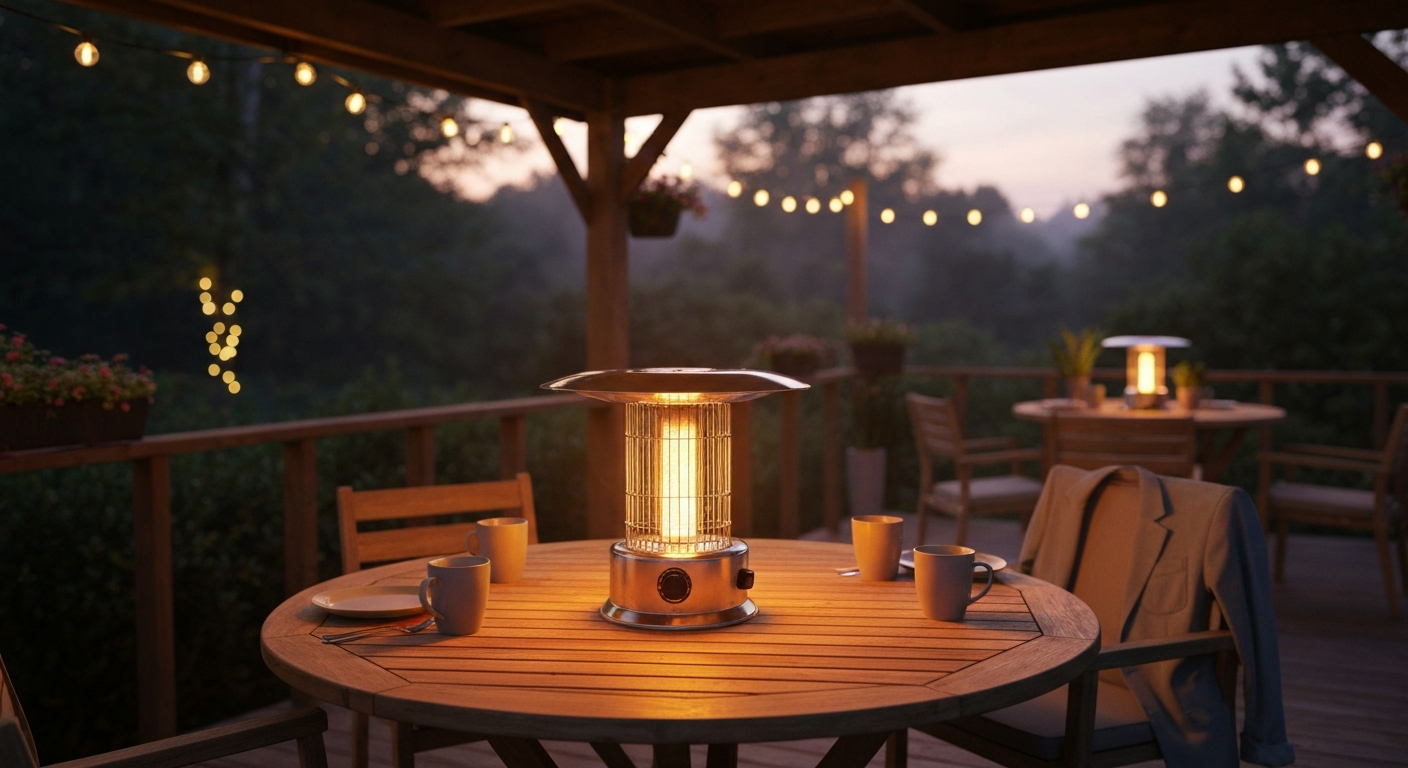
A table top halogen patio heater is a compact, plug-in electric heater that uses a halogen lamp (a tungsten filament sealed in a quartz tube filled with halogen gas) to produce near-infrared radiant heat almost instantly. Most consumer models run at 1,500 watts (about 5,100 BTU/hr) on a standard 120 V household outlet, weigh under 10 lbs, and sit directly on a patio table or side surface. They are best suited to small outdoor spaces, a balcony, a 4-person dining table on a covered porch, or a bistro corner, where a full-size standing heater would be overkill and a propane unit is too much hassle.
Table Top Halogen Patio Heater: Compact Buying Guide

Willa Brennan
23 Jul 2026
What this guide covers and who it's for
This guide is written for homeowners, renters, and outdoor enthusiasts who want targeted, portable warmth without a permanent installation. If you're trying to figure out whether a halogen tabletop heater is the right call for your patio, balcony, or covered deck, and which specs actually matter when you're comparing models, this is the article for you. I'll walk through how halogen heating works, what to look for on the spec sheet, safety requirements, maintenance, and how these units stack up against propane, infrared quartz, and glass-tube alternatives. By the end, you'll have a clear checklist and a good sense of which type of model fits your situation.
What is a table top halogen patio heater?
The term 'halogen infrared' (or HIR) refers specifically to a lamp design where a tungsten filament sits inside a quartz glass envelope filled with halogen gas. The halogen gas runs a regenerative cycle that redeposits evaporated tungsten back onto the filament, which increases lamp life and maintains brightness over time. In heating applications, the quartz envelope also reflects heat back toward the filament, which improves efficiency compared with a plain incandescent bulb. The result is a compact, high-intensity heat source that emits primarily in the near/short-wave infrared band (roughly 0.8 to 1.4 micrometers). In a patio heater context, this element is mounted inside a tabletop-sized housing, typically stainless steel, aluminum, or powder-coated steel, that sits directly on your outdoor table or surface without any floor space footprint.
Most tabletop halogen models you'll find at retail (Star Patio 1566-CT, Fire-Sense 60403, DWELLCOZY HD-SP10N) share nearly identical core specs: 1,500 W, 110-120 V, roughly 12.5 A draw, and a cord that plugs into a standard grounded outdoor outlet. The physical housing is where the real design variation happens, which I'll cover in the design variants section below.
How halogen infrared heating works, and what to realistically expect
Halogen heaters work by radiant heat transfer, not convection. The element heats up and emits infrared radiation that warms objects and people in its direct line-of-sight rather than heating the surrounding air. This is a critical distinction for outdoor use: wind doesn't carry the warmth away the way it does with convective heaters like propane mushroom-tops. The short-wave infrared that halogen lamps produce is absorbed by skin and clothing relatively efficiently, which is why you feel the heat almost immediately after switching the unit on. Warm-up time is essentially instantaneous, measured in seconds rather than the minutes required by resistive panel or ceramic heaters.
That said, the near-infrared wavelength band produced by halogen elements is perceived differently than the medium or far-infrared output of quartz tube heaters. Some users describe halogen heat as more intense and focused (similar to sitting near a bright lamp), while medium-wave infrared from quartz tubes tends to feel gentler and more diffuse. Neither is objectively better, it comes down to preference and application. In open or semi-exposed spaces, the directional nature of halogen radiant heat is a genuine advantage. In a fully enclosed covered porch where you want ambient warmth to build up, a medium-wave or quartz tube unit may feel more comfortable over a long session.
Who benefits most from a tabletop halogen heater
Tabletop halogen heaters punch well above their size for a specific set of situations. Here's where they genuinely shine and where they fall short.
- Small patios and balconies (under roughly 110 sq ft of usable seating area): A 1,500 W unit can maintain comfort for 2 to 4 people seated around a table in mild to cool conditions.
- Covered porches and pergolas: Radiant heat reflects off overhead surfaces and keeps more warmth focused on the seating area. These are ideal environments for halogen tabletop units.
- Renters or people who can't install permanent fixtures: No gas line, no mounting hardware, no landlord approval needed — just plug in.
- Occasional or seasonal use: If you only use your outdoor space a handful of times in shoulder seasons, a lightweight, storable plug-in unit makes far more sense than a permanent propane installation.
- Restaurants and hospitality operators: Tabletop heaters supplement overhead or standing units at individual tables without requiring fuel delivery or gas infrastructure.
- Spaces with restricted propane use: Many apartment buildings, rooftop terraces, and covered event spaces prohibit open-flame or propane heaters. Electric halogen units sidestep that restriction entirely.
Where they fall short: if you're heating a large open patio (over 150 to 200 sq ft), or you want to warm multiple zones simultaneously, a single tabletop halogen unit won't do enough work. For those situations, consider a full-size freestanding electric or propane heater instead.
Design variants: glass-tube, style-forward, and compact portable types
Not all tabletop halogen heaters look or function the same. The market has split into a few distinct design categories that each involve real trade-offs between aesthetics, output, and durability.
Glass-tube tabletop models
Glass-tube (or 'ruby halogen') models expose a visible glowing tube element, often amber or red in color. They produce a visible warm glow alongside the heat, which many users find pleasant for evening ambiance. The visible element also acts as a clear 'on/off' indicator. The trade-off is that the exposed glass tube is more vulnerable to impact damage and requires more careful handling during storage. If this style appeals to you, the dedicated guide to table top glass tube patio heaters on this site goes deeper into that specific category.
Style-first and lantern-style units
A growing segment of the market prioritizes design as much as heat output. Lantern-style housings, brushed stainless columns, and rattan-wrapped bases (like the Maze Rattan Hestia) are designed to look like decorative outdoor accessories rather than appliances. These units typically run the same 1,500 W halogen element inside a more premium enclosure. The visual element enclosure in a lantern-style design also provides better protection for the lamp. If aesthetics are a priority alongside performance, the style table top patio heater category on this site covers this segment in detail.
Compact and purely portable types
The most common format is a low-profile cylinder or dome-shaped housing that sits flat on any surface. These prioritize portability and price over aesthetics. Most weigh between 4 and 8 lbs, fold or disassemble for storage, and come in at the lower end of the price range. They are the workhorses of the category and represent the majority of units sold at mass retailers.
Key specifications to compare when shopping
When you're looking at spec sheets, here are the numbers that actually matter and what they mean in practice.
| Specification | Typical Range | What to Look For |
|---|---|---|
| Wattage | 750 W – 1,500 W | 1,500 W is the sweet spot for outdoor use; 750 W models work only in very mild conditions or fully enclosed spaces |
| BTU/hr equivalent | ~2,559 – ~5,118 BTU/hr | 1,500 W = ~5,118 BTU/hr (1 W = 3.412 BTU/hr); useful for comparing with propane units |
| Coverage area | 50 – 110 sq ft | Manufacturer claims; real-world coverage depends heavily on wind exposure and ambient temperature |
| Voltage / current draw | 110–120 V / ~12.5 A at 1,500 W | Confirm it works on a standard 15 A circuit; avoid running with other high-draw appliances on the same circuit |
| Cord length | 4 ft – 6 ft typically | Measure your outlet distance before buying; most cords are shorter than you expect |
| Weight | 4 – 12 lbs | Lighter is easier to move; heavier bases are more stable in wind |
| IP rating (weather resistance) | IP44 – IP55 for outdoor-rated models | IP44 = splash-resistant; IP55 = jet-water resistant; always verify this claim on the actual spec sheet |
| Lamp life | 3,000 – 5,000 hours (manufacturer claim) | Star Patio lists ~5,000 hours; actual life varies with on/off cycling frequency |
| Warm-up time | Near-instant (seconds) | A genuine advantage of halogen/infrared vs. resistive or oil-filled heaters |
One number worth paying close attention to is current draw. A 1,500 W model on a 120 V circuit pulls 12.5 A continuously. A standard 15 A circuit is rated for that load, but you should not have other high-draw appliances (a kettle, a second heater, an air fryer) running on the same circuit at the same time. If you're not sure which outlets share a circuit in your home, check with an electrician or test with a simple circuit identifier.
Power, cords, and plugs: what you need at your outlet
Almost every consumer tabletop halogen heater on the market uses a standard NEMA 5-15P grounded three-prong plug rated for 110-120 V. This is the same plug as most household appliances, so there's no special outlet or adapter required. That said, there are three electrical considerations you should sort out before you buy.
First, use a GFCI-protected outlet for any outdoor electric heater. GFCI (Ground Fault Circuit Interrupter) protection is required by the National Electrical Code for outdoor receptacles and is a genuine safety essential, not an optional add-on, for any electric appliance used in a damp or outdoor environment. If your outdoor outlet doesn't have a GFCI built in, use a GFCI adapter or have an electrician install one.
Second, if you need to use an extension cord, use only a heavy-duty outdoor-rated cord with a minimum 14 AWG conductor. Municipal electrical guidance (including recommendations from sources like the City of Toledo's outdoor heater guidance) and manufacturer manuals consistently require 14 AWG or heavier for 1,500 W loads. A thinner cord creates a voltage drop and a fire risk. Keep the cord as short as practically possible to minimize those risks further.
Third, check your cord length before you buy. Most tabletop halogen heaters ship with cords between 4 and 6 feet. If your nearest outdoor outlet is 8 feet away, a 6-foot cord plus a proper extension cord is fine, but a 3-foot cord with no outlet nearby is a frustrating surprise. Measure before you order.
Safety and installation best practices
Halogen elements run extremely hot. The surface temperature of the lamp itself is high enough to ignite nearby combustibles, which means clearance distances are non-negotiable. Most manufacturer manuals specify a minimum clearance of at least 3 feet from any combustible overhead surface (umbrellas, pergola fabric, awnings) and 2 feet from the sides. Always follow your specific model's manual, these numbers vary. The primary voluntary safety standard for portable electric heaters in North America is ANSI/UL 1278; listings to UL, ETL, or CSA indicate third‑party testing to recognized standards and should be verified on the model page or the UL/ETL/CSA certification databases.
- Look for tip-over auto shut-off: if the unit tips over, it should cut power within seconds. The Star Patio 1566-CT manual lists this as a required feature; verify it on any model you're considering.
- Overheat/thermal cutout protection: a thermal fuse or automatic cutout that shuts the heater down if internal temperature exceeds a safe threshold. Check the spec sheet or manual — not just the marketing copy.
- Mesh guard or cool-touch grill: the element housing should prevent direct contact with the hot lamp surface, especially important in households with children or pets.
- Anti-skid base: rubber feet or a weighted base reduces the chance of the unit being knocked over on a table surface.
- Third-party safety certification: look for UL, ETL, or CSA listing. These indicate testing to ANSI/UL 1278 or equivalent standards for portable electric heaters. Do not rely solely on CE markings for products used in North America.
- Never leave a halogen tabletop heater unattended or running while indoors — these are outdoor-rated appliances and the halogen element creates a genuine fire risk near soft furnishings.
- Keep the unit away from open water, rain, and direct spray unless your model is rated IP55 or higher for that level of exposure.
Stability, anchors, and mounting for windy or uneven spaces
A tabletop heater sitting on a patio table in moderate wind is a fall risk. Most compact halogen units have a relatively narrow base and a relatively high center of gravity when the element housing is extended. There are a few practical ways to address this. First, place the unit in the center of the table rather than at the edge. Second, look for models with a wide, weighted base or anti-tilt design. Third, for consistently windy spaces, consider a model with a lower profile or one that can be secured to the table surface with an accessory clamp or mounting bracket, some manufacturers offer these as optional add-ons.
For uneven surfaces like a stone patio or wooden deck with gaps, make sure all four feet of the base are in full contact with the surface before plugging in. A wobbly base is a tip-over risk even without wind. A small silicone mat under the unit can both improve grip and protect the table surface from heat transfer to the tabletop.
Routine maintenance, cleaning, covers, and seasonal storage
Halogen tabletop heaters are relatively low-maintenance, but a small amount of regular care will extend lamp life and keep the unit performing safely.
- Unplug and allow the unit to cool completely before touching any surface or element — the lamp housing retains significant heat for several minutes after shutoff.
- Wipe the exterior housing with a damp cloth and mild detergent every few uses. Avoid abrasive pads that can scratch protective coatings.
- Never touch the halogen lamp directly with bare hands. Skin oils on the quartz surface create hot spots that can crack the lamp. If you need to handle the lamp, use a clean cloth.
- Inspect the power cord and plug before each season for cracks, fraying, or discoloration. Replace the cord or the unit if you see damage.
- Clean the mesh guard or protective grill of dust and debris with a soft brush or compressed air — blocked airflow around the element increases heat buildup.
- At the end of the season, store the unit in a dry indoor space. Use a purpose-made cover if storing outdoors or in a garage. Purpose-made table top patio heater covers (covered in detail separately on this site) are available for most standard tabletop sizes.
- Check that all protective guards and safety cages are securely seated before each use after storage.
Pros and cons of tabletop halogen patio heaters
| Pros | Cons |
|---|---|
| Instant-on heat — full radiant output in seconds | Limited coverage area (typically 50–110 sq ft) |
| No fuel to buy, store, or connect — just plug in | Requires an outdoor GFCI-protected outlet nearby |
| Compact and portable — most weigh under 10 lbs | Visible glowing element can be distracting in some settings |
| Works well in wind because heat is radiant, not convective | Halogen lamps are fragile — impact or rough handling shortens lamp life |
| No emissions, no combustion, safe for covered/enclosed spaces | Shorter effective range than full-size freestanding heaters |
| Wide range of designs and price points | Ongoing electricity cost at 1,500 W (roughly $0.20–$0.30/hr depending on local rates) |
| No installation required — ideal for renters | Tip-over risk on table surfaces in wind without proper placement |
How tabletop halogen compares with other heater types
One of the most common questions I get from readers is how halogen tabletop units compare with propane, electric-resistive, infrared quartz, and glass-tube tabletop styles. Here's an honest side-by-side.
| Type | Heat Output | Warm-Up Time | Portability | Best For | Key Limitation |
|---|---|---|---|---|---|
| Tabletop halogen (electric) | ~1,500 W / ~5,100 BTU/hr | Instant (seconds) | High — plug in anywhere | Small covered patios, balconies, no-flame zones | Needs an outlet; limited range |
| Tabletop propane | 10,000–15,000 BTU/hr typical | ~30–60 seconds | Very high — no cord | Open patios, camping, areas without outlets | Open flame; fuel logistics; banned in some spaces |
| Electric resistive (panel/ceramic) | 750–1,500 W | 1–5 minutes | High — plug in | Fully enclosed porches where ambient heat is wanted | Wind reduces effectiveness; slower warmth |
| Infrared quartz (medium-wave) | 1,000–2,000 W / up to ~6,800 BTU/hr | ~30–60 seconds | High — plug in | Covered patios, long sessions, comfort-focused use | Slightly slower than halogen; larger units common |
| Glass-tube ruby halogen | ~1,500 W typical | Instant (seconds) | High — plug in | Patios where ambiance/glow is a priority | Fragile exposed tube; see glass-tube guide for detail |
My honest recommendation: if you have an outdoor outlet, a small to medium covered or semi-exposed space, and you want something you can move between the patio and the balcony without thinking about fuel, a halogen tabletop unit is hard to beat for convenience and value. If you're heating a large open space or you entertain in a spot with no nearby outlets, a propane tabletop or freestanding unit is more practical. If long-duration comfort in a fully covered porch is the goal and you don't mind waiting a minute for warm-up, a quartz infrared model may feel more pleasant over a 3-hour session.
Price ranges and typical warranty terms
Consumer tabletop halogen patio heaters generally fall into three price tiers at major retailers (Home Depot, Lowe's, Wayfair, Amazon, Walmart) as of mid-2026. Entry-level compact models typically run $80 to $120. Mid-range models with better build quality, IP55 weather ratings, and wider bases land in the $120 to $180 range. For example, electriQ lists an IP55 rating for its electriQ Portable Table Top Electric Patio Heater 1500W on the product page electriQ Portable Table Top Electric Patio Heater 1500W (product page: IP55 listing). Premium style-forward units (lantern design, premium steel or rattan housing, dual-element configurations) can reach $180 to $250 or more.
Warranty coverage is typically thin in this category. Most manufacturer warranties on consumer tabletop halogen heaters run 1 year on parts and electrical components, with halogen lamps frequently excluded from warranty coverage (lamps are usually treated as consumables). A few mid-to-premium brands offer 2-year limited warranties. Commercial and hospitality-grade units (including some available through commercial suppliers like Uline, which stocks tabletop heaters for commercial and event use) sometimes carry extended service agreements, but you'll pay accordingly for those. Always read what's excluded before assuming a warranty covers the element.
Actionable buying checklist
Before you add anything to your cart, run through this checklist. It'll save you a frustrating return.
- Confirm you have a GFCI-protected outdoor outlet within a practical cord distance (measure it — don't guess).
- Verify the model is rated 1,500 W if you're using it in real outdoor temperatures below 55°F. Lower wattage models won't keep up.
- Check for UL, ETL, or CSA certification on the model page — not just CE marking.
- Confirm the IP rating: IP44 minimum for occasional rain exposure, IP55 if the unit will be left outdoors between uses.
- Verify tip-over auto shut-off and overheat/thermal cutout are listed in the actual manual or spec sheet — not just the marketing description.
- Check the cord length against your outlet distance. If you need an extension cord, confirm 14 AWG outdoor-rated is available.
- Weigh the base against your typical wind conditions. A unit under 5 lbs with a narrow base is a poor choice for a rooftop terrace.
- Consider table size: a large housing on a small bistro table reduces usable surface area significantly.
- Check the lamp replacement policy: can you buy a replacement halogen lamp for this model, and at what cost?
- Read the 1-star reviews specifically for the model you're considering — they surface real failure modes faster than any spec sheet.
Recommended model types by common use case
Rather than naming a single winner, here's how I'd match model types to the four most common situations I hear about from readers.
| Use Case | Recommended Model Type | Key Specs to Prioritize |
|---|---|---|
| Small uncovered patio, mild climate | Compact 1,500 W with weighted base and IP44 rating | Wind stability, tip-over protection, cord length |
| Covered porch or pergola | Any 1,500 W model; style-forward or glass-tube works well here | Coverage area, ambiance/glow preference, cord management |
| Occasional entertaining (store most of the year) | Lightweight compact unit under 8 lbs with good storage form | Portability, foldability, cover compatibility, storage size |
| Apartment balcony with outlet | Low-profile compact with IP44+, short cord, anti-skid base | Footprint, no-flame compliance, easy storage between uses |
Accessory recommendations
The right accessories can meaningfully extend the life of your unit and make it easier to use safely. Here's what's worth budgeting for alongside the heater itself.
- Tabletop heater cover: a fitted weatherproof cover protects the housing and lamp from dust, bird droppings, and moisture during storage. Purpose-made covers sized for standard tabletop heaters are widely available — the table top patio heater cover guide on this site covers sizing and material options in detail.
- 14 AWG outdoor extension cord (if needed): buy a short one rated for outdoor use with a three-prong grounded end. Brands like Southwire and Husky make reliable outdoor-rated versions. Keep it as short as practically possible.
- GFCI outlet adapter: if your outdoor outlet isn't already GFCI-protected, a plug-in GFCI adapter (available for under $20) is an inexpensive safety upgrade.
- Non-slip silicone mat: placed under the heater base, this prevents sliding on smooth table surfaces and provides a small amount of thermal insulation between the base and the tabletop.
- Table clamp or ballast weight: for consistently windy environments, a weighted ring or clamp accessory that fits the base column adds meaningful stability.
- Replacement halogen lamp: check availability for your specific model before you buy the heater. Having one spare on hand avoids downtime at the worst possible moment.
Where to buy
Tabletop halogen patio heaters are widely stocked at major consumer retailers in the US. Home Depot and Lowe's carry several models year-round (with the widest in-store selection in spring and fall), and their online listings typically include full spec sheets and user manuals for download, which is the fastest way to verify specs before buying. Wayfair carries a broader range of style-focused and rattan-wrapped designs. Amazon and Walmart have the widest selection at the budget end of the market, though spec documentation on those platforms is less reliable than manufacturer websites.
For commercial buyers, restaurants, event planners, hospitality operators, Uline is a notable option. Uline stocks commercial-grade tabletop and portable patio heaters and is set up for bulk ordering, which makes it practical for outfitting a full restaurant patio or event fleet. Pricing at Uline tends to be higher per unit than consumer retail, but the commercial-grade build quality and availability of replacement parts can justify the difference for high-use environments. The table top patio heater Uline section of this site covers commercial purchasing in more detail.
For the best combination of current pricing and verified specs, I'd recommend starting at the manufacturer's own website for the model you're considering, then cross-checking the retail price at Home Depot or Amazon. Manufacturer pages are the most reliable source for the spec sheet, manual download, and warranty documentation, all of which you want in hand before you buy.
Explore more on Patio Heater Reviews
Tabletop halogen is one piece of a larger patio heating picture. If you're weighing other fuel types or formats, the full-size freestanding electric patio heater reviews and the propane patio heater buying guides on this site give you the same level of specification detail and real-world comparison for those categories. For readers specifically interested in the glass-tube element variant, the table top glass tube patio heater guide digs into that subcategory's lamp construction, ambiance characteristics, and replacement part availability. And if you've already settled on a tabletop style but want to explore premium design options beyond the functional basics, the style table top patio heater section is worth a look before you finalize your purchase.
Choosing, testing, and installing your tabletop halogen heater
The case for a tabletop halogen heater comes down to this: if you have a small outdoor space, an accessible GFCI outlet, and you want instant plug-in warmth without fuel logistics or a permanent installation, this category delivers that better than almost anything else at the price. The 1,500 W sweet spot covers 2 to 4 people comfortably in mild to cool conditions, the instant warm-up is genuinely useful when you step outside on a chilly evening, and the portability means you can bring it in when the season ends.
Once you've selected a model using the checklist above, setup is straightforward: place on a stable center surface, confirm clearances from overhead combustibles (minimum 3 feet), plug into a GFCI outlet, and test the tip-over switch before your first real use by gently tilting the unit to confirm it shuts off. Run it for a full session on the first use to confirm the unit heats evenly and the thermal cutout doesn't trip unnecessarily. From there, keep a cover on it between uses, check the cord before each season, and have a replacement lamp on hand. For protection and storage, consider a table top patio heater cover specifically sized for your model to prevent moisture and dust during the off-season. That's genuinely all the maintenance this type of heater needs.
FAQ
What is the single most important definition and technical fact to confirm about 'table top halogen patio heaters' before writing the guide?
Verify that the product uses a halogen infrared (HIR) lamp (tungsten filament in a quartz envelope with halogen gas) and note the emission band (near/short‑wave infrared, ~0.8–1.4 µm). Cite manufacturer lamp datasheets or industry references (e.g., IES/HIR definitions) to avoid conflating halogen with other IR technologies.
Which basic product specifications must be collected for every model benchmarked?
Wattage (W), nominal BTU/hr (convert W × 3.412), rated voltage and current (V and A), claimed coverage area or effective radius (sq ft / ft), lamp type and spectral info (HIR, quartz, ruby), lamp life (hours), warm‑up time, dimensions and weight, cord length/plug type, IP/weather rating, and listed safety features (tip‑over shutoff, thermal cutout). Use manufacturer datasheets or user manuals as primary sources.
What electrical and installation specifications are essential to report?
Rated voltage (e.g., 110–120 V), full‑power current draw (A), recommended circuit type (GFCI if specified), allowable extension cord gauge (manufacturer guidance; commonly minimum 14 AWG), cord length, plug type, and any explicit installation/clearance distances from combustibles. Pull these from model manuals and local electrical code references where relevant.
What safety standards and certifications should be checked and reported for each model?
Check for third‑party listings to ANSI/UL 1278, ETL or CSA marks and reference to UL/ETL/CSA test reports. Also note IP ingress protection ratings for outdoor use (e.g., IP44, IP55). Cite UL/ETL/CSA databases or manufacturer certification statements in manuals/spec sheets.
Which measurable performance metrics and test data should be gathered or tested?
Wattage and actual draw (measured with a clamp meter), surface temperatures of the emitter and housing, warm‑up time to steady output, effective comfort radius (measured temperature rise at set distances and angles), lamp spectral output if available, and measured power consumption (kW and kWh over time). When testing, report ambient conditions and measurement methods.
What consumer‑facing claims require verification and how should they be validated?
Claims like 'heats X sq ft' or 'instant heat' should be backed by measured temperature rise at specified distances and the test methodology. 'Outdoor rated' must be supported by an IP rating or explicit outdoor use statement and certification. Verify wattage/BTU conversions and any lamp life claims against datasheets.