
You can find solid tabletop gas patio heaters on Amazon in the $40–$150 range, but the real challenge is knowing which listings are worth trusting. The best units run on standard 1-lb propane canisters (the kind you grab at any hardware store), put out roughly 8,000–11,000 BTU, and include basic safety features like a tip-over shutoff and a thermocouple flame-failure device. This guide walks you through every step: what to look for in specs, how to vet Amazon listings and sellers, what the realistic price tiers look like, how to set one up safely, and when it makes more sense to shop at Costco, Home Depot, or Lowe's instead.
Table Top Gas Patio Heater Amazon Buying Guide & Safety Tips

Willa Brennan
15 Jul 2026
What a tabletop gas patio heater actually is, and who needs one
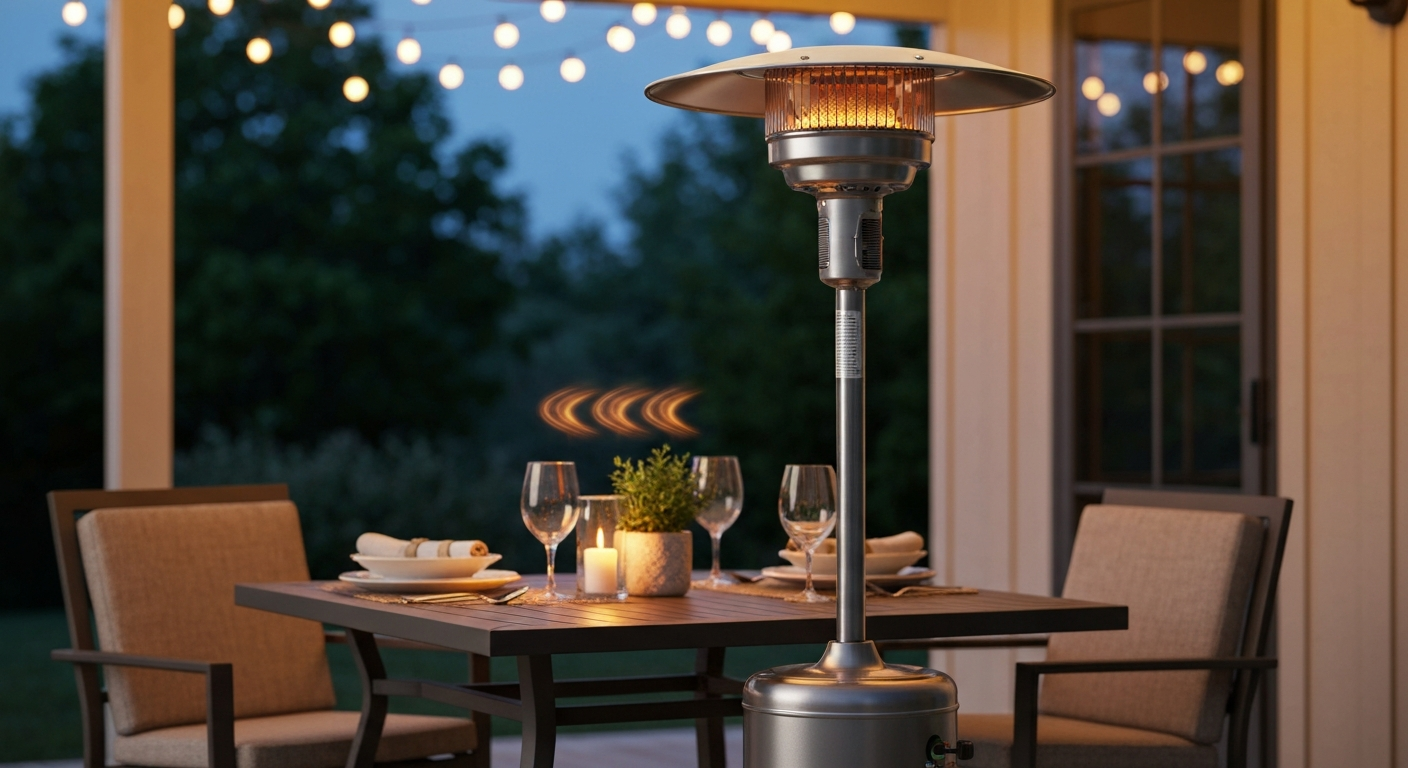
A tabletop gas patio heater is a compact, low-profile propane-burning unit designed to sit on an outdoor table and warm the immediate area around it, typically a radius of 3 to 6 feet. Unlike freestanding tower heaters that radiate heat downward from 7 or 8 feet up, a tabletop model heats at seated-person level, which makes it surprisingly effective for small groups gathered around a dining or cocktail table. Most run on 1-lb disposable propane cylinders that screw directly into the base, though some models accept an optional hose-and-regulator adapter to connect a larger 20-lb tank for extended run time.
These heaters are genuinely useful for specific situations: a small apartment balcony, a bistro table on a covered patio, a tailgate setup, a camping trip, or a restaurant wanting to add heat at individual tables without running a tower heater at every seat. They are portable, relatively inexpensive, and require no permanent installation. That said, they are not the right tool for heating a large open deck or a roofed room, and they come with real limitations worth understanding before you buy.
Honest pros and cons
| Pros | Cons |
|---|---|
| Compact and easy to move or store | Limited heat radius (3–6 ft max) |
| No installation required — just screw in a canister | 1-lb canisters last only 1–3 hours at full output |
| Works anywhere outdoors with no power source | Not suitable for enclosed or poorly ventilated spaces |
| Affordable entry price ($40–$150) | Wind significantly reduces efficiency and can blow out the flame |
| Easy to find fuel at hardware and grocery stores | Some budget models have unreliable igniters after prolonged use |
| Great for small tables, camping, tailgating | Produces carbon monoxide — outdoor use only |
Key specs to check before you buy
When you look at a listing, the spec table tells the real story. Here is what each field actually means for how the heater performs day to day.
BTU rating
BTU (British Thermal Unit) measures heat output per hour. Most tabletop propane heaters land between 7,500 and 11,000 BTU. To put that in perspective: a typical example like the Backyard Creations model lists 9,500 BTU, which is a reasonable midpoint. Higher BTU means more warmth but also faster fuel consumption. At 9,500 BTU, a standard 1-lb propane canister, which contains roughly 21,548 BTU of usable energy per pound per PERC technical references, gives you approximately 2 to 2.5 hours of run time at full output, possibly longer if you dial it back. Use EIA conversion factors (British thermal units (Btu), U.S. EIA) to validate energy‑content and run‑time calculations; EIA lists propane energy content such as 1 gallon ≈ 91,452 Btu Use EIA conversion factors (British thermal units (Btu) — U.S. EIA) to validate energy‑content and run‑time calculations; EIA lists propane energy content such as 1 gallon ≈ 91,452 Btu..
Fuel type and canister compatibility
Nearly all tabletop gas patio heaters sold on Amazon use propane (LP gas), not natural gas. The most common configuration accepts standard 1-lb disposable camping-style cylinders (the green Coleman-style cans). Some models include or sell separately a low-pressure hose-and-regulator kit that lets you connect to a standard 20-lb BBQ tank, a much better option if you plan to use the heater regularly, since a 20-lb tank holds roughly 400 hours of potential fuel at the same BTU output. Before buying any hose adapter sold separately, confirm the thread type matches your heater's inlet valve.
Materials and build quality
Budget heaters typically use painted steel with a hammered-bronze or black finish. Step up to mid-range or premium models and you get powder-coated steel or stainless steel components around the burner head, both of which handle moisture and heat cycling better over time. Weight is a practical proxy for build quality: most tabletop units weigh 5 to 12 lbs. Heavier units tend to be more stable on a table but harder to pack for travel.
Ignition type
You will see two ignition types: push-button piezo (battery-free, mechanically sparked) and pulse electronic ignition (battery-powered, typically more reliable for sustained sparking). Both work, but cheaper piezo igniters can become unreliable after a season or two of use. Confirm from the listing or manual whether the igniter is replaceable, because at some point it likely will need to be.
| Spec | What to look for | Why it matters |
|---|---|---|
| BTU output | 8,000–11,000 BTU for tabletop | Determines warmth radius and fuel burn rate |
| Fuel type | Propane (LP) — disposable 1-lb or 20-lb via adapter | Affects run time and ongoing cost |
| Run time (1-lb canister) | 1.5–3 hours at full output | Sets expectations for canister cost and usage |
| Ignition | Push-button piezo or electronic pulse | Affects reliability over time |
| Materials | Powder-coated or stainless steel burner preferred | Affects corrosion resistance and longevity |
| Dimensions (H x diameter) | Typically 18–24 in tall, 8–14 in wide | Determines fit on your specific table |
| Weight | 5–12 lbs typical | Affects portability and table stability |
| Adapters/accessories | 20-lb hose adapter included or available | Extends run time significantly |
Safety features and certifications to look for
This is the section where I see the most cutting of corners in cheap listings. A heater that lacks the right safety devices is not just a minor inconvenience, the CPSC has logged recalls and incidents involving portable propane heaters with CO hazards and burn injuries. Check for every item on this list before you click Buy.
- Tip-over/anti-tilt shutoff: A switch or valve that cuts gas flow automatically if the heater is knocked over. This is non-negotiable on a table — a breeze or an elbow can send a lightweight unit over.
- Thermocouple / flame-failure device (FFD): Senses whether the flame is actually lit. If the flame goes out from wind or low gas pressure, the thermocouple cuts fuel flow within seconds, preventing unburned propane from escaping.
- Overheat protection: Some units include a secondary shutoff triggered by abnormal temperature at the burner head or housing — worth having on covered patios.
- Pressure regulator: Controls the pressure from the cylinder to the burner. A listed, tested regulator (not a generic unmarked part) matters for both performance consistency and safety.
- Certifications: Look for CSA (Canadian Standards Association), CE (European Conformity), or ETL certification marks — these indicate the unit has been tested against recognized safety standards. Some budget imports lack any third-party certification, which is a significant red flag.
- CPSC recall check: Before finalizing any purchase, search the model number and brand at the CPSC recall database (cpsc.gov) to confirm there are no active recalls.
The NFPA 58 LP-Gas Code, which most U.S. states adopt as their model code for propane appliances, sets standards for cylinder use, storage, and some clearance guidelines. Consult NFPA 58, LP‑Gas Code (code handbook reference) for specific compliance, clearance, and fuel‑handling requirements adopted by many U.S. jurisdictions. You do not need to read the full code, but knowing that a certified product must meet these standards gives you a baseline for what legitimate certifications should cover.
Where you can and cannot safely use a tabletop gas heater
The most important rule is also the simplest: propane combustion produces carbon monoxide, and CO is invisible, odorless, and lethal in sufficient concentrations. CPSC technical testing has documented measurable CO emissions from portable propane heaters even at normal operating conditions, and those emissions accumulate rapidly in enclosed or semi-enclosed spaces. NIOSH and CDC guidance is unambiguous: fuel-burning heaters are for outdoor use only. That means any space you can fully close, a garage, sunroom, or enclosed porch with windows shut, is off limits.
Covered and semi-open spaces: what's actually safe
A pergola with open lattice sides, a partially covered patio with at least two fully open sides, or a canopy tent with all walls open and good cross-ventilation can be acceptable with caution, but only if airflow is genuinely continuous. The practical test: if you can feel a breeze moving through the space, combustion gases are dispersing. If the air feels still and the space feels enclosed, move the heater to a more open area or switch to an electric tabletop heater instead. A battery-powered or plug-in CO detector placed near seated height is a smart addition any time you use a propane heater under any kind of overhead cover.
Clearance distances and wind considerations
- Maintain at least 3 feet of horizontal clearance from combustible materials (wood fencing, fabric furniture, umbrellas, overhead foliage).
- Maintain at least 3–4 feet of vertical clearance from anything overhead — a market umbrella directly above a tabletop heater is a fire risk.
- Do not use on a table that rocks or wobbles — the tip-over shutoff should be the last line of defense, not the first.
- In winds above 10–15 mph, the flame will struggle to stay lit and the heat disperses before reaching seated occupants. Either use a wind block or switch to a shielded model.
- Keep children and pets at least 3 feet away from the unit during operation — the reflector and burner housing get very hot.
- Never store a mounted canister indoors after use. Let the heater cool completely before disconnecting and storing the cylinder outside or in a detached shed.
How to choose: a decision checklist before you shop
Work through these questions before you open an Amazon search. Knowing your answers makes it much easier to filter listings and avoid buying something that does not actually fit your situation.
- How large is the space you want to heat? A radius of 3–5 feet is realistic for a tabletop unit. If you need to heat a larger area, consider a freestanding tower heater instead.
- How many people are you heating? Tabletop heaters work best for 2–4 people seated close together at one table.
- Is the space covered or fully open? Covered spaces require more careful ventilation planning — factor this in before choosing gas over electric.
- How portable does the heater need to be? If you want to carry it camping or to a tailgate, keep weight under 7 lbs and stick to disposable 1-lb cylinders. For regular home patio use, a heavier unit with a 20-lb adapter is more economical.
- What is your table surface? Measure the diameter and confirm you have at least a 6-inch clearance ring around the heater base. Check that the table can hold 8–12 lbs without wobbling.
- What ignition preference do you have? Push-button is simpler; electronic pulse is more reliable in cold conditions.
- How much ongoing fuel cost can you absorb? At $4–$6 per 1-lb canister and 1.5–2.5 hours of run time, frequent use adds up. The 20-lb adapter pays for itself quickly if you use the heater more than 10 hours per season.
- Do you have a place to store the unit off-season? These heaters should be stored dry, with the canister removed. Plan for that before buying.
Shopping on Amazon: how to evaluate listings like a pro
Amazon is genuinely a good place to buy a tabletop gas patio heater, the selection is broad, Prime shipping is fast, and the A-to-Z Guarantee gives you a real return backstop. But the platform also has well-documented problems with low-quality marketplace listings, uncertified imports, and manipulated reviews. Here is how I evaluate any propane heater listing before recommending it.
Listing quality signals
- Product images: A trustworthy listing shows the unit from multiple angles, includes a close-up of the control knob and burner, and ideally shows a photo of the spec/rating plate and any certification marks. If photos are generic or clearly low-resolution, that is a warning sign.
- Spec table completeness: The listing should explicitly state BTU output, compatible fuel/cylinder type, dimensions (H x W), weight, and safety features. If any of these are missing, look for them in the linked user manual PDF. If there is no manual, proceed with caution.
- Certification marks in listing copy: Words like 'CSA certified,' 'ETL listed,' or 'CE marked' should appear in the product description or bullet points — not just vague references to 'safety tested.'
- ASIN: Every Amazon product has a unique ASIN (visible in the URL or product details). Use the ASIN to look up price history on CamelCamelCamel or Keepa to see whether the listed price is actually a deal or an inflated 'was' price.
Seller type and fulfillment
Check who is actually selling the item. 'Ships from and sold by Amazon.com' means Amazon holds and ships the inventory, that is the cleanest buying experience and the easiest return path. 'Sold by [brand name], fulfilled by Amazon' (FBA) is also generally reliable: the brand shipped inventory to Amazon's warehouse and Amazon handles logistics. 'Sold and shipped by [marketplace third party]' carries the most risk, returns can be slower, warranty claims harder to navigate, and counterfeit goods more likely. For a propane heater specifically, where safety certifications matter, I prioritize brand-direct or Amazon-fulfilled listings. The BBB Institute for Marketplace Trust has documented counterfeit and unsafe goods sold through third-party marketplace channels, which is a real concern for safety-critical products.
Reading reviews without being misled
Review manipulation is a documented problem on Amazon, and academic research has identified patterns that flag suspicious activity: reviews that cluster on launch day, a high proportion of 5-star ratings with no 1- or 2-star reviews, reviewers with short account histories, and generic praise that doesn't mention specific product details. Tools like ReviewMeta (reviewmeta.com) can flag statistically abnormal review patterns, run any heater listing through it before trusting the aggregate star rating. Also read the 1- and 2-star reviews specifically for recurring, reproducible issues: igniter failures after a few uses, regulator leaks, or units arriving damaged. One or two complaints mean little; a pattern across many reviewers is a real signal. The Q&A section and customer-submitted photos are often more honest than written reviews.
Returns, warranties, and the A-to-Z Guarantee
Amazon's standard return window is 30 days for most items. For third-party sellers, Amazon's A-to-Z Guarantee lets you escalate a return or refund dispute directly to Amazon if the seller is unresponsive, this is a meaningful protection for higher-priced items. Before buying, check the listing's return policy section for any non-returnable flags (some gas appliances are listed as non-returnable for safety reasons, read carefully). For warranty claims beyond 30 days, you will need to contact the manufacturer directly, which requires having a valid model number and proof of purchase. Save your order confirmation email and take a photo of the model/serial plate when the unit arrives.
Shipping and import notes
Propane heaters ship without fuel cylinders, so there are no hazmat shipping restrictions on the unit itself. However, check the shipping origin: units shipped directly from overseas warehouses (sometimes flagged as 'imported' or with long delivery windows) may arrive with non-US connector threads, voltage-incompatible components if there is an electric ignition, or without US-market certifications. Prime-eligible, US-warehouse listings generally avoid these issues.
Realistic price ranges and when deals actually happen
Tabletop gas patio heater prices on Amazon fall into three reasonably consistent tiers based on build quality, safety certifications, and brand reputation. Here is what I have observed across listings and confirmed via price-history tracking tools.
| Tier | Typical Price Range | What You Get | Trade-offs |
|---|---|---|---|
| Budget | $40–$70 | Painted steel, 7,500–9,000 BTU, piezo ignition, basic tip-over shutoff | May lack third-party certifications; igniter reliability varies; fewer accessories |
| Midrange | $70–$110 | Powder-coated or partial stainless steel, 9,000–11,000 BTU, electronic ignition, thermocouple FFD, CSA/ETL likely | Best value tier; covers most home patio use cases |
| Premium | $110–$150+ | Stainless steel construction, higher BTU, adjustable heat settings, 20-lb adapter included, full certifications | Diminishing returns for casual use; better for frequent or commercial use |
The biggest factors that push a unit into a higher price tier are stainless steel construction (more corrosion-resistant), inclusion of a 20-lb adapter hose, and demonstrated third-party safety certification. A heater without a thermocouple flame-failure device should not command midrange prices regardless of its materials.
Best times to find deals
Price history tools like CamelCamelCamel and Keepa show clear seasonal patterns for patio heaters. The deepest discounts typically arrive in late October through early December, overlapping with the Black Friday and Cyber Monday windows, when retailers clear warm-weather inventory. Amazon Prime Day (mid-July) occasionally features patio heater deals from brands running Lightning Deals, but discounts are smaller than fall clearance. End-of-season clearance in late August through September can also surface 20–30% discounts as summer inventory winds down. Spring launches (March to April) see new models arrive at full price, so that is generally the worst time to buy unless you need something immediately. If you are comparing deal timing across retailers, the Black Friday and end-of-season windows at Home Depot and Lowe's often align with Amazon's pricing drops, worth checking all three simultaneously.
A shortlist approach to finding the best options on Amazon
Rather than naming specific models that may go in and out of stock, the more durable approach is to define criteria for each category and then apply them to current listings when you shop. Amazon's inventory changes frequently, and a model that ranked highly last season may have been discontinued or replaced with a revised version. Here is the framework I use.
Compact budget pick (under $65)
Look for: CSA or ETL certification mark in the listing, a thermocouple flame-failure device explicitly listed in safety features, tip-over shutoff, weight under 7 lbs for portability, and a 4.0+ star rating with at least 200 reviews that pass a ReviewMeta filter. Avoid any listing that does not specify certification or omits safety device descriptions, these omissions at this price point often indicate an uncertified import.
Best-value midrange pick ($70–$110)
Look for: 9,000–10,000 BTU output, electronic push-button or pulse ignition, stainless steel burner head (even if the body is powder-coated steel), a 20-lb hose adapter either included or available as a listed accessory from the same brand, CSA or ETL certification, and a brand that has a direct Amazon storefront (not anonymous marketplace sellers). Read Q&A sections for confirmation that the 20-lb adapter fits without modification.
Premium portable pick ($110–$150+)
Look for: predominant stainless steel construction, 10,000–11,000 BTU with variable heat control, a 20-lb adapter included in the box, full CSA or UL certification, a domestic brand with a US customer service phone number, and a verified manufacturer warranty of at least one year with clear instructions on how to claim it. At this price, the brand should have an established Amazon presence with consistent review history going back at least 18 months, use Keepa to verify.
Setup, first use, and safe operation
Most tabletop heaters arrive partially assembled, the base, cylinder cavity, and reflector often ship in two or three pieces that connect with a few bolts or a twist-lock collar. Read the manual before you start, specifically the leak-test and lighting procedure sections. Here is the standard process I follow with any new unit.
- Unbox and inspect: Check for shipping damage, especially to the burner tip, control knob, and cylinder thread. If anything is bent or cracked, do not use the heater — contact the seller.
- Assemble fully before connecting fuel: Complete all mechanical assembly with the heater off any table. Do not connect a cylinder until assembly is confirmed complete.
- Perform a soap-bubble leak test: With the cylinder attached but the heater OFF and the control knob closed, apply soapy water (dish soap works) to every gas connection point — the cylinder-to-valve joint and, if using a hose adapter, both hose fittings. Turn the cylinder valve slightly open. If you see bubbles, close the valve immediately, disconnect, and do not use the heater until the connection is reseated or replaced.
- Place the heater on a flat, stable table surface: Confirm the table does not wobble and that the heater sits level. Allow at least 6 inches of clear table surface around the base in all directions.
- Verify all clearances: Minimum 3 feet from combustibles on all sides, minimum 3–4 feet below any overhead cover including umbrellas.
- Light according to manual procedure: Typically: turn control knob to 'high/ignite' position, depress the piezo button repeatedly or hold the electronic ignite button for 3–5 seconds. If it does not light after three attempts, turn the knob to OFF, wait 5 minutes for any propane to disperse, then retry.
- Once lit, confirm the flame is stable before leaving unattended: A stable blue flame with a yellow tip is normal. An orange, sooty, or sputtering flame may indicate a partially blocked burner jet.
- Never leave a lit heater unattended or run it while sleeping.
Refueling and canister replacement
Turn the control knob to OFF and let the unit cool for at least 5 minutes before disconnecting a spent cylinder. Unscrew the cylinder counterclockwise, residual pressure may cause a brief hiss, which is normal. Never attempt to refill a disposable 1-lb cylinder; they are not designed for refilling and doing so is dangerous. If you are switching to or from a 20-lb tank via a hose adapter, follow the same leak-test protocol for the hose fittings each time you reconnect.
Maintenance and troubleshooting
A well-maintained tabletop propane heater can last 5 or more seasons. The main failure points are the igniter, the burner jet (which can clog), and the rubber O-ring at the cylinder connection. Here is a practical maintenance schedule.
Routine cleaning (every 2–4 uses)
- Wipe the reflector and housing with a damp cloth — do not use abrasive pads on painted or powder-coated surfaces.
- Inspect the burner ports (the small holes or slots in the burner ring) for spider webs, debris, or rust. A blocked port produces uneven flames. Use a soft brush or compressed air to clear it.
- Check the cylinder thread and valve seat for debris or corrosion — a dirty thread can cause micro-leaks.
- Inspect the hose (if you use a 20-lb adapter) for cracks, kinks, or brittleness.
Common problems and fixes
| Problem | Likely Cause | Fix |
|---|---|---|
| Igniter clicks but no flame | Empty cylinder, clogged burner jet, or wet igniter tip | Check cylinder, clear jet with compressed air, dry igniter tip |
| Flame goes out shortly after lighting | Thermocouple not heating up / needs longer hold time at ignition | Hold ignite position for 15–20 seconds to warm thermocouple before releasing |
| Sputtering or uneven flame | Partially clogged burner ports | Use a soft brush or compressed air to clear ports; do not use metal picks |
| Hissing at cylinder connection | Loose connection or worn O-ring | Retighten and leak-test; replace O-ring if worn (inexpensive part) |
| Igniter produces no spark | Dead battery (electronic models) or worn piezo element | Replace battery or order replacement igniter module from manufacturer |
| Heater shuts off when tilted slightly | Tip-over switch too sensitive (can occur with table vibration) | Ensure table is fully level; if persistent, contact manufacturer |
Winter storage and seasonal checks
Before storing for winter, remove the propane cylinder and store it upright outdoors or in a detached, ventilated structure, never in a basement, attached garage, or living space, per NFPA 58 guidelines. Clean the unit thoroughly, lightly oil any exposed metal fittings to prevent corrosion, and store the heater in a dry location in its original box or a padded bag. At the start of each new season, conduct a fresh leak test before the first use, inspect hoses for cracking, and test the igniter before relying on it.
Alternatives to tabletop gas heaters, and when to shop elsewhere
A tabletop gas heater is not the right answer for every situation. Here is how it compares to the main alternatives, and where each type of retailer fits into the buying picture.
Tabletop electric heaters
Electric tabletop heaters, typically infrared or ceramic, plug into a standard outdoor outlet and produce no combustion gases, making them the right choice for covered patios, screened porches, or any space where propane ventilation is a concern. They tend to cost $50–$120 and output 750–1,500 watts (roughly 2,560–5,100 BTU equivalent). The trade-off is that they need a power outlet nearby and are not suitable for off-grid use. If your patio is covered or semi-enclosed, a tabletop electric heater is simply the safer choice.
Freestanding propane and infrared tower heaters
If you need to heat a larger open patio or a group of more than four people, a freestanding 40,000–48,000 BTU tower heater is a better investment than stacking multiple tabletop units. These typically run on a 20-lb tank and radiate heat downward over a 10–15 foot radius. They cost more ($100–$300+) and are less portable, but the heat output and coverage are dramatically higher.
Where to shop besides Amazon
Amazon has the widest selection and generally competitive pricing, but it is not always the best option. Costco carries tabletop patio heaters seasonally, typically with strong value-to-quality ratios and Costco's generous return policy, which is more flexible than most Amazon third-party sellers. Home Depot and Lowe's carry a curated selection from established brands (often different models than Amazon), allow in-store inspection before purchase, and have straightforward in-store returns. Check Lowe's selection for table top patio heater models and in-store availability if you want to inspect units before buying table top patio heater Lowe's. You can also compare models in person by searching for table top patio heater Home Depot (reference 210ca1d9-f1be-4aca-8f1c-15b96aa44689) at your local store or on Home Depot's website. Ace Hardware typically carries a smaller but well-vetted selection and is a strong option if you need same-day availability or hands-on advice from staff. Local hearth and patio specialty dealers are worth visiting if you are spending $120 or more, they can demonstrate units and often carry parts and offer service that online retailers cannot.
| Retailer | Selection | Price Competitiveness | Return Policy | Best For |
|---|---|---|---|---|
| Amazon | Widest — hundreds of models | High, with seasonal deals | 30-day standard; A-to-Z Guarantee | Research, variety, Prime shipping |
| Costco | Seasonal, curated | Excellent value per tier | Very generous (no set window) | Best value if available; Costco members |
| Home Depot | Moderate, established brands | Competitive with price match | 90-day standard | In-store inspection, same-day pickup |
| Lowe's | Moderate, established brands | Competitive with price match | 90-day standard | In-store inspection, same-day pickup |
| Ace Hardware | Small, well-vetted | Slightly higher | Store policy varies | Same-day availability, local advice |
| Local patio dealer | Specialty, premium-focused | Premium pricing | Varies | High-end purchases, service, parts |
Final buying checklist: one page before you click purchase
Run through every item below before finalizing your Amazon purchase. Print this out or screenshot it if you find that helpful, it covers every failure point I have seen in the research and in reader feedback.
Must-have specs confirmed in listing
- BTU output stated (8,000–11,000 BTU for tabletop)
- Compatible fuel type listed (propane, 1-lb cylinder)
- Dimensions and weight stated — fits your table
- Ignition type stated (piezo or electronic)
- Tip-over/anti-tilt shutoff listed in safety features
- Thermocouple or flame-failure device listed
- Third-party certification mark listed (CSA, ETL, or CE)
Amazon seller checks
- Seller is brand-direct or Amazon-fulfilled (not anonymous third-party shipped)
- Listing has at least 100 reviews passing a ReviewMeta filter
- No pattern of repeated igniter, regulator, or leak complaints in 1–2 star reviews
- Return policy confirmed — unit is not listed as non-returnable
- Price verified against CamelCamelCamel or Keepa history — not an inflated 'sale' price
- CPSC recall search completed for model name and brand
Accessories to budget for
- 2–3 spare 1-lb propane canisters for first use (or a 20-lb adapter hose if using larger tank)
- CO detector (battery-powered, for any use under overhead cover)
- Soapy water spray bottle for leak testing
- Protective cover or storage bag for off-season storage
Pre-use safety tests
- Assembly fully completed before any gas connection
- Soap-bubble leak test passed at all connection points
- Tip-over switch tested manually (tilt unit slightly — heater should shut off or gas should cut)
- Table confirmed flat, stable, and able to bear unit weight
- All clearances measured: 3 ft horizontal from combustibles, 3–4 ft below overhead cover
- Ventilation confirmed adequate for the space
- Model and serial plate photographed and order confirmation email saved
FAQ
What are the essential factual definitions and scope items to establish about 'tabletop gas patio heater' before writing the article?
Define the product class (compact/portable gas‑fired heaters intended for tabletops or low‑profile placement), typical use cases (small patios, balconies, camping, restaurant tabletop heat), and the boundary with related products (full‑size freestanding patio heaters, electric tabletop heaters). Consult manufacturer manuals and Amazon product pages for advertised intended use and compatibility notes.
Which specific technical specifications should the article extract and explain for each candidate model?
BTU output (max and adjustable settings), fuel type (propane/natural gas), compatible cylinder types (1‑lb disposable, 16‑oz camp, or hose/regulator to 20‑lb tank), run‑time claims and assumptions, physical dimensions and weight, materials and finish (stainless steel, powder coat), ignition type (piezo/pulse, match), safety features (tilt/anti‑tip switch, thermocouple/flame failure device, pressure regulator), and warranty. Primary sources: manufacturer manuals, Amazon spec fields, and third‑party tester reports.
What safety and regulatory topics must be researched and cited?
Applicable codes and standards (NFPA 58 for LP‑gas), CPSC recall/advisory history and technical reports on CO emissions, and NIOSH/OSHA guidance on ventilation and CO exposure. Use official NFPA code text, CPSC reports/recalls, and CDC/NIOSH/OSHA publications to support recommendations on ventilation, clearance, and detector use.
What empirical questions will validate run‑time, heating effectiveness, and CO risk?
How many Btu per pound/gallon of propane (use EIA and PERC data), how manufacturer run‑time claims map to energy content and cylinder capacity, and what independent CO emission tests show for tabletop/tank‑top heaters. Sources: EIA conversion tables, PERC/Propane Handbook, and CPSC/third‑party test reports.
Which independent testing and review sources should be consulted for performance and safety comparisons?
Consumer Reports, Wirecutter (NYT), Tom's Guide, and reputable lab or magazine tests. Also check any peer‑reviewed technical evaluations and CPSC technical reports. These provide independent performance metrics, documented test procedures, and safety findings.
What Amazon‑specific listing, seller, and review data should be collected for each ASIN?
ASIN, product title, manufacturer name, seller name(s), FBA vs merchant‑fulfilled, Prime eligibility, price and shipping, return policy language, warranty statements, links to manufacturer manuals, and the visible review summary (ratings, number of reviews). Use Amazon listing metadata, seller help pages, and the product detail pages as primary sources.