
A tabletop patio heater is one of the most practical ways to extend outdoor time in Ireland, particularly for a small seating area, a bistro table, or a compact covered patio where a full-height standing heater would be overkill. They are compact, easy to move, and start at under €50 for a basic electric model. The catch is that they are spot heaters, not area heaters, they warm the people sitting close to them, not an entire patio. If you go in knowing that, and you match the right fuel type to your setup, they work brilliantly in the Irish climate.
Table Top Patio Heater Ireland: Buyer's Guide & Best Choices

Willa Brennan
10 Aug 2026
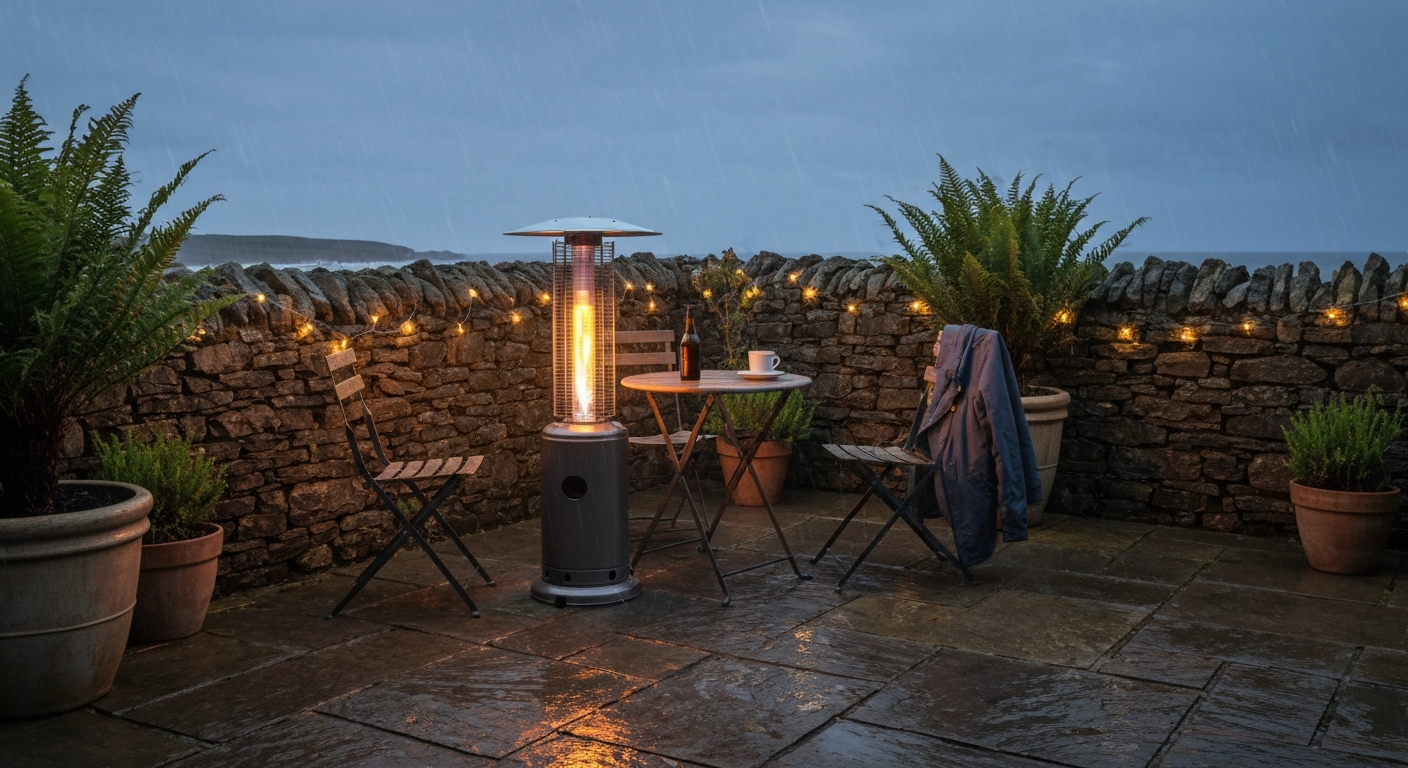
Is a tabletop patio heater right for your Irish patio?
Ireland's climate makes outdoor heating less of a luxury and more of a necessity for most of the year. Temperatures regularly drop into single figures from September through May, and even summer evenings can be brisk. The challenge with tabletop heaters is that they are designed for close-range comfort, typically an effective radius of around 0.6 to 1.2 metres depending on model and conditions. That is plenty for two or three people gathered around a bistro table, but it will not heat a large open terrace.
The good news is that for covered patios, conservatories with open sides, garden rooms, or any space where you can sit within a metre or so of the heater, a tabletop unit genuinely delivers. Irish retailers from Argos and B&Q to specialist suppliers like Flogas Shop and TheFirePlace.ie all stock models suited to local conditions, with prices ranging from around €50 for a basic electric unit to €170 or more for a gas-powered model. The buying decision mostly comes down to your patio setup, whether you want a permanent fuel source or something fully portable, and how much you want to spend per hour of heat.
Quick buying summary: pick the right heater type at a glance
If you want a straight steer before diving into detail, here is how the main options shake out for typical Irish use cases.
| Heater type | Best for | Typical output | Approx. Irish price | Main trade-off |
|---|---|---|---|---|
| Electric (plug-in) | Covered patios, conservatories, areas near an outdoor socket | 700 W – 2 kW | €50 – €120 | Needs a mains socket; not portable away from power |
| Infrared electric | Covered or semi-exposed patios, consistent ambient warmth | 1 – 2 kW | €100 – €200 | Higher upfront cost; IP-rated models needed outdoors |
| Cartridge gas (butane/propane) | Fully portable use, camping, balconies with no socket | 1 – 3 kW | €60 – €130 | Short runtime per cartridge; cartridge cost adds up |
| Small gas bottle (propane) | Regular outdoor dining, longer sessions, semi-exposed patios | 3 – 4 kW | €130 – €170 | Heavier and bulkier; bottle refill/swap needed |
Types of tabletop patio heaters: electric, cartridge gas, small gas bottles and infrared
Electric resistive heaters
These are the simplest and cheapest to buy. A model like the Status Outdoor Table Top Patio Heater at €49.99 from Heavins gives you 700 W of heat from a standard 13 A socket. They heat up in seconds, have no fuel to buy, and are dead simple to use. The downside is that they are tethered to a mains supply, so placement is limited to wherever you can safely run an outdoor-rated extension lead. At 700 W, you are also at the lower end of output, which works fine for mild Irish spring evenings but may feel underpowered once temperatures dip below about 7°C.
Infrared electric heaters
Infrared tabletop models, like the Outsunny 1.2 kW tower heater available at Harvey Norman Ireland for €165.99, work differently from standard resistive elements. Instead of warming the air (which the wind immediately blows away), they emit infrared radiation that warms objects and people directly. In Irish conditions, where wind is a constant issue, this makes a meaningful difference. The Outsunny model carries an IP54 rating, which means it is splash-proof and dust-resistant, adequate for a covered or semi-exposed patio, though you would still want to bring it in during heavy rain. Coverage on that model is stated as approximately 6 to 8 m², which is reasonable for a small seating cluster.
Cartridge gas heaters (butane and propane)
Cartridge-powered heaters screw onto or connect to small disposable gas canisters covered under the EN 417 standard for non-refillable metallic gas cartridges (published and available in Ireland through NSAI). They are the most portable option available, no power cable, no heavy bottle, just a heater and a cartridge you can carry in a bag. Outputs typically range from 1 to 3 kW. The downside is runtime: a standard 450 g cartridge at maximum burn will last roughly 90 to 120 minutes on a 2 kW heater. Over repeated use, cartridge costs stack up considerably compared to bottled gas or mains electricity.
Small gas bottle heaters (propane)
These are the most powerful of the tabletop formats. Models like the 4 kW Sahara tabletop heater or the similar unit at TheFirePlace.ie (€169) and the Flogas Shop tabletop heater (€164) connect to small propane cylinders, typically 3 kg or 5 kg bottles commonly available from Flogas, Calor, and most hardware shops across Ireland. At 4 kW (roughly 13,650 BTU/hr using the standard conversion of 1 kW = 3,412 BTU/hr), these put out serious heat for a tabletop unit. The Sahara manual specifies gas consumption of 288 g/hour at maximum output, which gives you around 10 hours from a 3 kg propane cylinder. These heaters carry CE marking and are required to comply with EU Regulation 2016/426 (the Gas Appliances Regulation), which covers conformity assessment, technical documentation and essential safety requirements for gas appliances sold in Ireland and across the EU. See Regulation (EU) 2016/426 on appliances burning gaseous fuels (EUR-Lex) for the GAR's conformity assessment, technical documentation and CE‑marking requirements.
Heat output, sizing and coverage: understanding kW and BTU
The headline number on any patio heater is its heat output, stated in kilowatts (kW) or BTU per hour. One kilowatt equals 3,412 BTU/hr, so a 4 kW gas heater delivers around 13,650 BTU/hr. In isolation, these numbers do not tell you much, what matters is matching that output to your space and how sheltered it is.
Industry planning guides from manufacturers like Heatscope and Rinnai suggest roughly 100 W per m² for fully enclosed patios, around 150 W/m² for semi-enclosed spaces, and 200 to 250 W/m² or more for open, exposed areas. Rinnai's FAQ gives example wattage ranges: fully enclosed ~100 W/m²; semi‑enclosed ~150 W/m²; open area 200–250 W/m² Rinnai's FAQ gives example wattage ranges: fully enclosed ~100 W/m²; semi‑enclosed ~150 W/m²; open area 200–250 W/m².. For a tabletop heater it is more useful to think in terms of proximity: independent testing consistently shows effective comfort radius of 0.6 to 1.2 m depending on output and wind conditions. A 4 kW gas model at the top of the tabletop range will comfortably warm two or three people sitting within about a metre in calm conditions. A 700 W electric model is really doing its best work when someone is sitting directly adjacent to it.
| Heater output | BTU/hr equivalent | Estimated effective radius (calm conditions) | Suggested use case |
|---|---|---|---|
| 700 W | ~2,390 BTU/hr | 0.5 – 0.7 m | 1–2 people, covered patio, mild evenings |
| 1.2 kW | ~4,095 BTU/hr | 0.6 – 0.9 m | 2 people, covered or semi-exposed, IP-rated infrared |
| 2 kW | ~6,824 BTU/hr | 0.8 – 1.1 m | 2–3 people, covered patio or sheltered garden |
| 4 kW | ~13,649 BTU/hr | 1.0 – 1.5 m | 3–4 people, semi-exposed patio, propane gas |
One thing worth stressing: manufacturer coverage claims are almost always measured in ideal lab or calm-air conditions. In the real Irish outdoors, especially in autumn or winter, effective warmth will be noticeably lower than the quoted figures. Treat published coverage as a ceiling, not a guarantee.
Covered vs exposed patios, wind and Irish weather: what actually works
Wind is the enemy of any patio heater, and it is especially relevant in Ireland where coastal and westerly winds are a near-daily reality. A convective heater (one that warms the air around it) will lose most of its effect the moment a breeze picks up, because the warm air simply blows away. Infrared models handle wind better because they heat surfaces and bodies directly rather than the air. If your patio is exposed, infrared is the better choice even if the upfront cost is higher.
For covered patios, pergolas, lean-to shelters, glazed garden rooms with open sides, any tabletop heater type performs better because the structure traps some heat and reduces wind effect. A 4 kW gas model on a sheltered table can make a real difference on an October evening. For a fully exposed garden patio with no windbreak, even a 4 kW tabletop unit will struggle below about 10°C with any wind, and you are probably better served by a standing mushroom heater or a wall-mounted infrared unit.
On rain resistance: electric and infrared models need to carry at minimum an IP44 rating for outdoor use, and IP54 (like the Outsunny model mentioned above) is better. Gas heaters should not be used in rain; cover or store them when not in use. None of the tabletop models reviewed here should be treated as fully weatherproof, storage in a shed or under a cover when not in use will significantly extend their lifespan in Irish conditions.
Portability, mounting and placement: keeping your heater stable and safe
Tabletop heaters are designed to sit on a flat, stable surface, a patio table, a low wall, a dedicated stand. The key safety concern is stability, especially with gas models that have an open flame or a hot element at height. The Sahara 4 kW heater, for example, lists anti-tilt and flame-failure (oxygen-depletion / tip-over) safety features in its manual. These are important: a tipped gas heater on a timber decked table is a fire risk.
A few practical placement rules to follow regardless of which model you choose. Keep a minimum clearance of at least 0.5 m on all sides and above the heater (check your specific model's manual, clearances vary). Never place a tabletop heater under a parasol or very close to overhead fabric. On windy evenings, consider whether a temporary windbreak (a garden screen, a wall, a parasol angled as a shield) makes sense for comfort and stability rather than fighting the elements with raw output. If you have a glass-top table, be aware that sustained direct radiant heat can stress the glass, put the heater on a heat-resistant mat or a small side table instead.
- Always place on a firm, level, non-combustible surface
- Maintain clearances as specified in the product manual (typically 0.5 m sides, 1 m above)
- Never use a gas cartridge or bottle heater indoors or in an enclosed space
- Check for an anti-tilt or tip-over cut-off on gas models before buying
- Store heaters under cover or indoors when not in use to protect from Irish weather
- Do not use beneath low-clearance parasols or fabric canopies
Runtime and fuel cost: how to estimate what you will actually spend
Working out real running cost is straightforward once you have three numbers: the heater's output (kW), its fuel consumption rate, and your local fuel price. Here is a method and a worked example for each fuel type.
Electric models
Running cost per hour = output in kW multiplied by your electricity unit rate. In Ireland, the average electricity unit rate in mid-2026 is around €0.28 to €0.35 per kWh depending on your supplier and tariff. A 700 W electric heater therefore costs roughly €0.20 to €0.25 per hour to run. A 1.2 kW infrared model costs around €0.34 to €0.42 per hour. These are low running costs, but the output is also lower than gas.
Gas cartridge models
A 450 g butane/propane cartridge costs approximately €2.50 to €4.00 in Irish hardware shops and DIY retailers. Butane has a calorific value of roughly 45 MJ/kg, and propane is slightly higher at around 46 MJ/kg. A 2 kW heater burning butane at full power will consume approximately 160 g per hour, giving you just under three hours from a 450 g cartridge. At €3 per cartridge, that is around €1.00 to €1.20 per hour, substantially more expensive than mains electricity for the same output.
Worked example: 4 kW propane bottle heater
The Sahara 4 kW heater specifies gas consumption of 288 g/hour at maximum output. A 3 kg propane cylinder from Flogas or Calor costs approximately €25 to €30 in Ireland when swapping an empty for a full one. At 288 g/hour, a 3 kg cylinder gives you approximately 10.4 hours of heat. That works out to roughly €2.40 to €2.90 per hour at full output. Running at a lower setting (most models allow a partial turn of the gas valve) will reduce both output and cost proportionally, at half output, expect around 140 to 150 g/hour and approximately €1.20 to €1.50 per hour, with around 20 hours from a 3 kg cylinder.
| Fuel type | Heater output | Estimated runtime | Fuel cost (approx.) | Cost per hour (approx.) |
|---|---|---|---|---|
| Mains electric | 700 W | Unlimited (while plugged in) | €0.28–0.35/kWh | €0.20–0.25 |
| Mains electric infrared | 1.2 kW | Unlimited (while plugged in) | €0.28–0.35/kWh | €0.34–0.42 |
| Gas cartridge (450 g) | 2 kW | ~2.5–3 hrs per cartridge | €2.50–4.00/cartridge | €0.90–1.50 |
| Propane bottle (3 kg) | 4 kW (full) | ~10 hrs per cylinder | €25–30/cylinder swap | €2.40–2.90 |
| Propane bottle (3 kg) | ~2 kW (half) | ~20 hrs per cylinder | €25–30/cylinder swap | €1.25–1.50 |
Fuel types compared: cartridges, small bottles and mains electricity in Ireland
Choosing a fuel type is one of the most consequential decisions in this purchase, and it is not purely about cost per hour. Availability, convenience, storage and safety all factor in differently depending on your setup.
Butane and propane cartridges
Cartridges are widely available in Ireland from camping shops, Woodies, B&Q, Aldi/Lidl seasonal stocks, and online. They are classified as non-refillable and covered under the EN 417 standard, buy cartridges that meet this standard and match your heater's thread type (EN 417 Lindal valve is the most common). Never attempt to refill a cartridge or use a cartridge from a different standard. Spent cartridges are classed as pressurised containers and must be disposed of correctly, most civic amenity/recycling centres in Ireland accept them. Storage-wise, keep cartridges in a cool, well-ventilated space away from direct sunlight and heat sources, and store no more than a small working supply at home. Propane cartridges work better than butane in cold temperatures (butane begins to struggle below about 5°C, which is a real issue in Ireland from October to April).
Small propane gas bottles
Propane cylinders in the 3 kg and 5 kg sizes are the standard fuel for full-size gas patio heaters in Ireland. Flogas and Calor are the two main suppliers, with exchange/swap points at petrol stations, hardware shops, and garden centres nationwide. Refillable cylinders work on a deposit-and-swap model rather than a straight refill (you swap your empty for a pre-filled cylinder). Propane is preferred over butane for outdoor Irish use because it remains gaseous and usable at temperatures as low as around -40°C, while butane loses pressure and can fail to vaporise adequately below 5°C. Store cylinders upright in a ventilated outdoor store, away from ignition sources, and never bring them indoors or into a garage. The Health and Safety Authority (HSA) Ireland publishes LPG safety guidance that covers domestic storage requirements, worth checking if you plan to keep a spare cylinder at home.
Mains electricity
The simplest fuel option if you have an outdoor socket. No storage concerns, no refill trips, no disposal worries. The main practical limitation is placement, you are working within the reach of an outdoor-rated extension lead. Make sure any extension lead used outdoors is rated for outdoor use (RCD-protected circuits are standard on modern Irish installs but worth confirming), and never leave a heater running unattended on an outdoor extension lead. Running costs are predictable and, as shown in the table above, meaningfully lower per hour than gas cartridges for comparable output.
| Fuel type | Cold-weather performance | Availability in Ireland | Portability | Storage requirements | Running cost (low to high) |
|---|---|---|---|---|---|
| Mains electric | Not affected by temp | Anywhere with a socket | Low (tethered) | None | Lowest |
| Propane cartridge | Good (works below 5°C) | Camping/DIY shops, online | Highest | Cool, ventilated, outdoors | High |
| Butane cartridge | Poor below 5°C | Camping/DIY shops, online | Highest | Cool, ventilated, outdoors | High |
| Propane bottle (3/5 kg) | Excellent | Petrol stations, hardware shops | Moderate (bottle weight) | Outdoor, ventilated, upright | Moderate |
Safety, compliance and maintenance: what Irish buyers need to know
Any gas appliance sold in Ireland must comply with EU Regulation 2016/426 (the Gas Appliances Regulation, commonly called the GAR). This requires CE marking, conformity assessment, and accompanying technical documentation including an EU declaration of conformity. When buying a gas tabletop heater, check for the CE mark and confirm the heater is rated for use with the gas category available in Ireland (propane is gas category I3p). If a heater lacks CE marking or has no documentation, do not buy it regardless of price. The Competition and Consumer Protection Commission (CCPC) is Ireland's market surveillance authority for consumer product safety and maintains recall notices, worth checking the CCPC product safety pages if you are uncertain about a specific model.
For maintenance, follow the manufacturer schedule. The Sahara 4 kW manual specifies servicing after every 100 hours of use or annually, whichever comes first. For most Irish households using a tabletop heater for evening entertaining, annual servicing is the relevant milestone. Basic upkeep includes checking gas connections for leaks (use soapy water, never a naked flame), inspecting the burner for blockages (spider webs are a surprisingly common issue with seasonal heaters), checking the igniter, and wiping down the unit and reflector. Electric models need the element and reflector cleaned periodically and the cable inspected for damage.
Where to buy in Ireland: retailers, pricing tiers and what to expect
The Irish market for tabletop patio heaters is reasonably well served across both bricks-and-mortar and online channels. Budget electric models (€50 to €80) are available from Heavins, Argos Ireland, and B&Q. B&Q also list tabletop patio heaters under search terms like "table top patio heater B&Q", which is a good place to check current stock and pricing for budget electric models. Search for a table top patio heater Argos to view current models and pricing at Argos Ireland. Mid-range infrared and gas models (€100 to €170) can be found at Harvey Norman, Argos, B&Q, Dunelm, and specialist online retailers. You can also search for table top patio heater dunelm to check Dunelm’s current mid-range options. For gas-specific models sold with Irish market support and propane compatibility confirmed, specialist retailers like Flogas Shop (€164), TheFirePlace.ie (€169), and similar Irish heating specialists are the most reliable source, they sell units matched to Irish gas supply standards and include relevant documentation.
Amazon UK can ship many patio heater models to Republic of Ireland addresses, but delivery eligibility varies by seller and SKU, always verify the specific listing before ordering, as some third-party sellers do not ship to Ireland. Second-hand options appear regularly on DoneDeal and Adverts.ie, and Irish local retail aggregators like GetLocal.ie can help you find in-store stock near you. Pricing across the market runs from around €50 for a basic 700 W electric model through to €170 or more for a 4 kW propane tabletop unit, with infrared electrics sitting broadly in the €100 to €170 range.
Your buying checklist: matching the right heater to your patio
Before you click buy, run through these questions. The answers will point you to the right type without needing to second-guess the spec sheets.
- Is your patio covered or exposed? Covered or semi-enclosed means any type works well. Fully exposed with regular wind means infrared electric or a high-output propane model is a better investment.
- Do you have an outdoor mains socket within safe reach? If yes, electric or infrared electric is the simplest and cheapest to run. If no, you need a gas model.
- How long are your typical outdoor sessions? Under 2 hours occasionally: cartridge gas is fine. Regular 3-plus-hour evening use: a small propane bottle heater or electric will be more cost-effective.
- How cold does it get when you use the patio? Below 5°C regularly: avoid butane cartridges and choose propane. Mild evenings (8–15°C): any type works.
- How many people are you heating? 1 to 2 people: 700 W to 1.2 kW is enough in a sheltered spot. 3 to 4 people: aim for 2 kW infrared or 4 kW gas.
- What is your budget? Under €70: budget electric from Argos, B&Q, or Heavins. €100 to €170: infrared electric (Harvey Norman, Argos) or 4 kW gas (Flogas Shop, TheFirePlace.ie). Over €170: look at premium infrared or larger gas tabletop options from specialist retailers.
- Do you need to move the heater frequently? Maximum portability: gas cartridge model. Occasional repositioning: small propane bottle model. Fixed location with a socket: electric.
- Have you confirmed the gas heater carries CE marking and is approved for use with Irish propane supply (gas category I3p)? If not, do not buy it.
There is no single best tabletop patio heater for Ireland, it genuinely depends on your patio, your habits, and how much you want to spend on running costs over a season. What I can say with confidence is that a well-chosen tabletop heater, used in a reasonably sheltered spot, will meaningfully extend the usable season of your outdoor space without the expense or commitment of a full standing unit. Start with your patio conditions and your fuel access, use the tables and checklists above to narrow down the type, and then compare models at the retailers mentioned here for current Irish availability and pricing. For a quick comparison, see a roundup of the best patio heaters in Ireland.
FAQ
What technical specifications must I collect for each table top patio heater model to compare performance accurately?
Collect nominal heat output (kW and convert to BTU/hr using 1 kW = 3,412.142 BTU/hr), fuel type (electric, cartridge propane/butane, small refillable gas, infrared element type), gas consumption (g/hr or g/min for cartridge models), power draw (W) for electric models, stated coverage/effective radius, IP/weather rating, dimensions and weight, fuel capacity or cartridge size, stated runtime at low/medium/high output, thermostatic/control features, safety features (tilt switch, flame failure, overheating cut-out), required clearances, manufacture/declaration of conformity (CE/GAR marking), and warranty period.
Which regulatory and standards sources should be checked for Ireland‑specific compliance and safety requirements?
Check Regulation (EU) 2016/426 (Gas Appliances Regulation - GAR) for gas appliance conformity; NSAI for adopted EN standards (e.g., EN 417 for non‑refillable gas cartridges and any gas‑appliance EN standards); CCPC for Irish product safety and recall information; HSA for fire and LPG safety guidance (commercial contexts); and national electrical safety regs or guidance for electric heaters. Use manufacturers’ EU declarations, CE marking details and notified‑body IDs where applicable.
What retailer and market‑availability data should be collected for an Ireland buyer’s guide?
Survey major Irish retailers (Argos IE, B&Q Ireland, Dunelm, Harvey Norman, Heavins/Euronics), specialist sellers (TheFirePlace.ie, Flogas Shop), online marketplaces (Amazon UK eligibility for ROI, GetLocal.ie, DoneDeal, Adverts.ie) and second‑hand listings. Record SKU, RRP/typical sale price, in‑stock status, delivery/shipping eligibility to ROI, retailer warranty terms, return policy, and any local installation/servicing options. Sample prices across budget, mid and premium tiers.
What experiment or field‑data questions should be answered about real‑world performance in Irish conditions?
Measure effective heating radius and temperature gain at set distances (0.5 m, 1 m, 1.5 m) in sheltered vs exposed/windy conditions; test runtime on a standard cartridge/fuel capacity at high/low settings; record performance drop in crosswinds; note warm‑up time and directional coverage; evaluate perceived comfort on a seated person. Use multiple models (electric infrared vs gas cartridge vs small gas) for comparison.
How should heating‑sizing guidance be adapted for Irish patios (covered vs exposed)?
Use industry W/m² ranges as baseline: sheltered/covered ~100–150 W/m², semi‑enclosed ~150–250 W/m², exposed ~300–400 W/m². Emphasise that tabletop heaters give local/spot heating — size by seating zone not whole patio. Provide worked examples converting model kW to W/m² and expected comfortable zone, and remind readers to adjust for wind, ceiling height and presence of walls.
What safety, installation and siting information is essential to gather and include?
Manufacturer recommended clearances (sides, overhead), anti‑tilt and flame‑failure device descriptions, ventilation requirements for gas models, safe cartridge installation/removal procedures, storage and disposal guidance for gas cartridges, IP ratings and weather use limitations, recommended distances from flammables, and recommended servicing intervals. Cite HSA/CCPC guidance and manufacturer manuals for exact figures.