
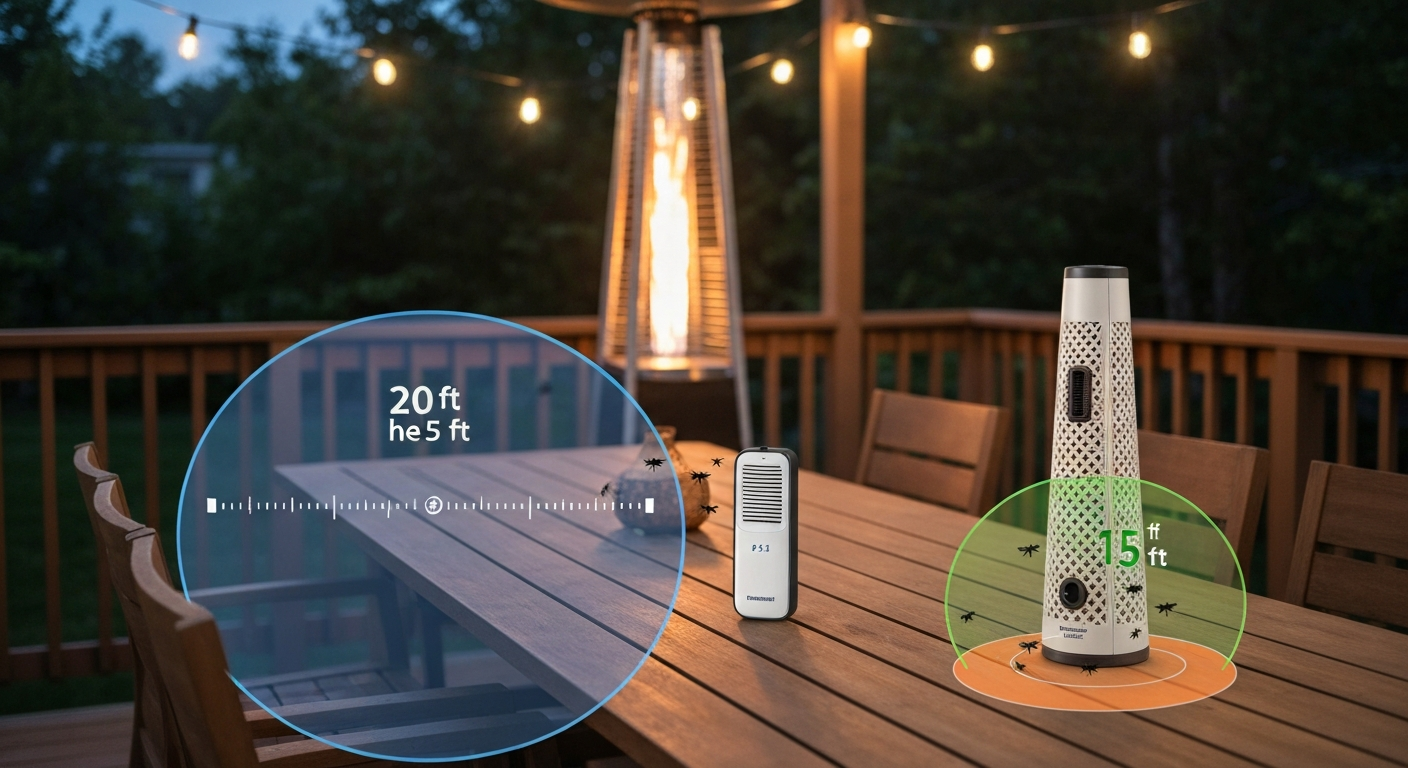
If you need mosquito protection for a large, open patio, the Thermacell E55 wins on coverage with its 20-foot zone, and it runs silently on a rechargeable battery with no open flame, making it the safer choice near patio heaters. If you have a smaller setup of around 15 feet, grab the Patio Shield instead: it costs less upfront, runs indefinitely as long as you have butane cartridges, and doesn't need charging. Neither unit heats your patio, but both make it dramatically more comfortable by keeping mosquitoes out of your space, which is exactly why I treat them as essential companions to any patio heating setup.
Thermacell E55 vs Patio: Best Mosquito Protection for Patio

Willa Brennan
13 Jul 2026
What This Comparison Covers and Who It's For
This head-to-head is aimed at homeowners and outdoor hosts who are already thinking about patio comfort in a complete way: heaters for warmth, lighting for ambiance, and mosquito protection so guests aren't constantly swatting. If you've landed here searching 'Thermacell E55 vs Patio,' you're probably trying to figure out which Thermacell model fits your specific outdoor space. I'll walk you through both units side by side, covering coverage area, runtime, fuel type, portability, ongoing costs, and real-world performance in calm versus windy conditions. I'll also flag where each device sits safely alongside patio heaters, because placement matters more than most people realize.
Quick Verdicts by Buyer Type
- Homeowners with a large open patio (over 200 sq ft): Go with the E55. Its 20-foot protection zone is bigger, it produces no open flame, and it runs without any butane cartridges to manage.
- Hosts who entertain for long evenings: The Patio Shield has unlimited runtime as long as you stock cartridges, so there's no anxiety about the battery dying mid-party. Keep a spare cartridge on hand and you're set.
- Campers or hikers: Neither unit is designed for this, but the Patio Shield's handheld siblings (MR300, MR450) are the better trail companions. The E55 needs USB charging and isn't officially rated for tent use.
- Budget-conscious buyers: The Patio Shield is typically cheaper upfront. Long-term consumable costs are comparable, but butane cartridges are easier to find at hardware stores and big-box retailers.
- Safety-first patio owners running propane or electric heaters nearby: The E55 has no open flame and no fuel cartridge, which makes it the cleaner option to place near a heater.
How Thermacell Mosquito Protection Actually Works
Both the E55 and the Patio Shield use the same core principle: heat a small repellent pad or liquid refill until the active ingredient vaporizes into the air around you, creating an invisible zone that mosquitoes avoid. The key difference is the heat source. Fuel-platform devices like the Patio Shield burn butane to generate that heat. The rechargeable E55 uses a battery-powered heating element instead. In both cases, the repellent disperses slowly outward and upward, forming a rough dome of protection that mosquitoes find uncomfortable and steer clear of. It takes about 10 to 15 minutes after you switch on either device for the zone to fully establish, so turn them on before guests arrive, not when people are already getting bitten.
The active ingredient varies by platform. The Patio Shield's fuel-mat system uses d-cis/trans allethrin at approximately 21.97%, a synthetic pyrethroid that's been EPA-reviewed and registered. The E55's liquid refills use a different active ingredient formulation suited for the rechargeable heating element. Both are spatial repellents, meaning they don't kill mosquitoes on contact like a spray would; they push mosquitoes out of the zone rather than poison them. Field evaluations, including USDA ARS testing, have confirmed measurable spatial repellency for the allethrin-based fuel platform under realistic outdoor conditions, though wind speed and local mosquito species do affect results. USDA ARS technical report 'Field evaluation of four spatial repellent devices against Arkansas rice‑land mosquitoes, USDA ARS (publication listing)' lists ThermaCELL (d‑cis/trans allethrin) among the four spatial‑repellent devices evaluated and provides comparative performance data indicating wind speed and mosquito species affect results Field evaluation of four spatial repellent devices against Arkansas rice‑land mosquitoes — USDA ARS (publication listing).
Thermacell E55: What It Is and Who It's Built For
Thermacell calls the E55 the E-ZoneGuard Patio 5.5Hr. It's a compact, rechargeable unit designed to sit on a patio table or deck surface and create a 20-foot protection zone (that's roughly a 20-foot diameter circle, or about 314 sq ft). The E‑ZoneGuard Patio 5.5Hr Rechargeable Mosquito Repeller (E55), Thermacell product page describes the E55 as a rechargeable lithium‑ion unit that produces a 20‑foot zone of protection, runs up to 5.5 hours per charge, and ships with a 12‑hour liquid repellent refill E‑ZoneGuard Patio 5.5Hr Rechargeable Mosquito Repeller (E55) — Thermacell product page. The device heats a liquid repellent refill rather than a mat, charges via USB, and runs for 5.5 hours on a full charge. The kit ships with one 12-hour liquid repellent refill and a USB cable. Physically, it's quiet, has no open flame, and carries no pressurized fuel cartridge, which makes it inherently lower-risk around outdoor furniture and patio heaters.
In terms of design, the E55 needs to be placed with the vent facing up. Thermacell recommends centering it in the zone you want protected, which on most standard patios means somewhere near the middle of the table or deck. The battery lasts about 5.5 hours of continuous use per charge, so for a typical evening gathering from 6 PM to 11 PM, you'd be right at the limit. Wirecutter's independent testing found the E-series devices performed close to the claimed 20-foot zone in still conditions and noted that the E90 (the larger sibling with about 9 hours of runtime) is the better pick when you need to go longer. The E55 is the right choice when 5.5 hours is enough and you want a compact, cord-free unit.
- Coverage zone: 20-foot diameter (approximately 314 sq ft)
- Runtime: 5.5 hours per charge
- Power source: Rechargeable lithium-ion battery via USB
- Included in box: One 12-hour liquid repellent refill and USB cable
- No open flame, no butane cartridge
- Quiet operation: no combustion sound
- Needs 10 to 15 minutes to establish full protection zone
- Do not expose to temperatures above 140°F — relevant near patio heaters
- Store with at least partial charge; recharge at least once every three months
Thermacell Patio Shield: What It Is and Who It's Built For
The Thermacell Patio Shield (model MRPSB) is a fuel-powered repeller designed specifically for stationary patio use. For more on real-world performance and user impressions, check Thermacell Patio Shield reviews covering durability, ease of use, and long-term consumable costs. It creates a 15-foot protection zone using heat from a butane cartridge to activate allethrin-impregnated repellent mats. The unit ships with one 12-hour fuel cartridge and three 4-hour repellent mats, giving you 12 hours of total use right out of the box. Its dimensions are 4 x 4.3 x 9.3 inches and it weighs just 9.6 ounces, making it easy to move and reposition. The Patio Shield is designed to stand on a flat surface, fits on a patio table or deck ledge, and has a slightly more decorative casing than the handheld MR300 or MR450 models.
The biggest practical advantage of the Patio Shield is unlimited runtime: as long as you have spare butane cartridges and repellent mats, it keeps running. There's no battery to charge, no waiting for a USB connection. For hosts who want to set it up at the start of summer and forget about charging logistics, that's genuinely convenient. The trade-off is the open flame from butane combustion, which matters if you're placing it near flammable materials or a propane patio heater. Thermacell recommends swapping mats when they turn completely white and replacing cartridges when empty. The device is also less effective in windy conditions, since the allethrin vapor disperses faster when air is moving.
- Coverage zone: 15-foot protection zone (225 sq ft effective area)
- Runtime: unlimited with replacement cartridges and mats
- Power source: Butane fuel cartridges (12-hour cartridge included)
- Included in box: One 12-hour fuel cartridge and three 4-hour repellent mats
- Dimensions: 4 x 4.3 x 9.3 inches; weight: 9.6 oz
- Uses open-flame butane combustion to heat mats
- Active ingredient: d-cis/trans allethrin (~21.97%)
- Replace mat when it turns completely white; wipe vents regularly
- Less wind-resistant than rechargeable models due to combustion-based heating
Head-to-Head: E55 vs Patio Shield on Every Spec That Matters
Coverage Area
This is the clearest win for the E55. A 20-foot zone covers roughly 314 square feet, compared to the Patio Shield's 225 square feet from its 15-foot zone. In real-world terms, that difference shows up on mid-to-large patios. On a 12x20-foot deck with a table, the E55 centered on the table keeps the entire space in the zone. The Patio Shield, placed in the same center spot, leaves the edges outside effective coverage. If your patio is under about 200 square feet, the difference is less meaningful, but for anything larger, the E55 earns its keep.
Runtime and Power
The Patio Shield wins on runtime flexibility. A single 12-hour cartridge gives you two full evenings of use, and you can swap to a fresh one in seconds. The E55's 5.5-hour battery life is enough for most single evenings, but it requires a USB recharge between uses, which takes a few hours. If you're running back-to-back evenings or want to leave a unit running all day during an outdoor party, the Patio Shield is more forgiving. That said, if you have access to an outdoor outlet or a USB power bank, you can top off the E55 during a midday break.
Portability and Weight
Both devices are light enough to carry in one hand. The Patio Shield weighs 9.6 oz and the E55 is similarly compact. The practical portability difference is the fuel cartridge: the Patio Shield with a cartridge installed is slightly bulkier and requires you to carry spare cartridges. The E55 just needs its USB cable for recharging. Neither is designed for backpacking, but both move easily between a front porch, back deck, and side yard.
Noise
The E55 runs silently. There's no combustion, no clicking igniter, and no low hiss from burning butane. The Patio Shield produces a faint combustion sound (a quiet hiss or soft burn) that most people don't find objectionable but that is audible in a quiet outdoor setting. Neither unit is loud enough to disrupt conversation, but if you're in a very quiet backyard or using one near an outdoor speaker system, the E55 is the cleaner choice acoustically.
Consumable Costs
Over a full season, costs are broadly similar but structured differently. The Patio Shield's RB-4 refill pack (12 mats plus 4 cartridges, covering 48 hours of use) retails around $24.99 at major retailers. At roughly $0.52 per hour of use, that's a manageable ongoing cost. Thermacell rechargeable refills for the E55 (40-hour refill packs) are available at a range of prices depending on retailer and format, with eBay and marketplace listings showing roughly $9 to $30 depending on the pack size and seller. Budget for both; neither is a one-time expense.
Maintenance
The Patio Shield needs mat replacement (when mats turn fully white), cartridge swaps, and occasional vent wiping to clear debris. The E55 needs USB charging, refill replacement, and the same vent-cleaning routine. Thermacell also instructs E55 owners to store the battery with at least a partial charge and to recharge it at least once every three months during the off-season to preserve battery health. The Patio Shield has no off-season battery management requirement; just store it in a cool, dry place.
Specs Comparison: Thermacell E55 vs Patio Shield
| Feature | Thermacell E55 | Thermacell Patio Shield (MRPSB) |
|---|---|---|
| Protection zone | 20-foot zone (~314 sq ft) | 15-foot zone (~225 sq ft) |
| Power/fuel type | Rechargeable lithium-ion battery (USB) | Butane fuel cartridge |
| Runtime per charge/cartridge | 5.5 hours per charge | 12 hours per cartridge (unlimited with extras) |
| Included in box | 1x 12-hr liquid refill + USB cable | 1x 12-hr cartridge + 3x 4-hr mats |
| Active ingredient | Proprietary rechargeable refill formula | d-cis/trans allethrin (~21.97%) |
| Open flame | No | Yes (butane combustion) |
| Weight | Compact (similar to ~9–10 oz class) | 9.6 oz |
| Dimensions | Compact tabletop form | 4 x 4.3 x 9.3 inches |
| Noise | Silent | Faint combustion hiss |
| Wind resistance | Moderate (electric heat maintains temp) | Lower (combustion flame affected by wind) |
| Approx. consumable cost per hour | Variable (~$0.22–$0.75/hr depending on refill pack) | ~$0.52/hr (RB-4 pack at ~$24.99/48 hrs) |
| Off-season battery care needed | Yes (charge every 3 months) | No |
| Safe near patio heaters | Better (no open flame, no pressurized fuel) | Use with caution (pressurized cartridge, open flame) |
| Best for | Large patios, extended gatherings, safety-conscious setups | Smaller patios, long-season use, no-charge convenience |
Real-World Scenarios: Which One to Use and Where to Put It
Small Patio (Under 150 sq ft)
On a small patio under 150 square feet, either unit works well. The Patio Shield's 225-square-foot zone covers the entire space with room to spare, and its lower upfront cost makes it the practical pick here. Place it at the center of the table or on a corner ledge, vent up, and turn it on 15 minutes before you sit down. At this patio size, you don't need the E55's larger zone, and the Patio Shield's unlimited runtime is a bonus for smaller gatherings that run long.
Medium to Large Patio (150 to 350 sq ft)
This is where the E55 earns its price premium. A 20-foot zone centered on a 15x20-foot deck keeps the full deck inside the effective area. With the Patio Shield, guests sitting at the edges of a larger patio may notice less protection. If you have a patio in this size range, put the E55 roughly in the center of the seating area, not pushed to one side. For extra coverage on a very large deck, Thermacell themselves suggest using multiple devices spaced appropriately rather than relying on one unit.
Covered Patio or Screened Porch
Covered patios with minimal airflow actually work in the E55's favor. The electric heating element maintains consistent temperature regardless of drafts, and the vapor accumulates more reliably under a roof. The Patio Shield works well here too, but the combustion flame is slightly more sensitive to the kind of cross-breeze you get in a partially open covered space. One placement note for covered patios: keep the Patio Shield at least a few feet from any curtains, fabric furniture, or other combustibles, and keep both units well clear of the heat output zone of any propane or infrared patio heater you're running.
Windy Conditions
Wind is the enemy of both devices, but it hurts the Patio Shield more. Wind disrupts the butane flame and disperses the allethrin vapor before it can form a stable zone. USDA ARS field evaluations specifically noted that wind speed affects results for allethrin-based spatial repellents. The E55's electric heater isn't affected by wind the same way, but the repellent vapor it emits still disperses in a strong breeze. If your outdoor space is regularly exposed to wind above about 5 mph, place whichever device you choose on the upwind side of the seating area so the vapor blows through the zone rather than away from it. On very windy nights, accept that performance will drop and move the gathering to a more sheltered spot.
Camping or Away-from-Home Use
Be direct here: neither the E55 nor the Patio Shield is the right tool for camping. The E55 is specifically a patio unit, and Thermacell's own Radius manual warns against use in enclosed spaces or tents. The handheld MR300 and MR450 are the fuel-platform units built for portability and field use, and the Radius is the rechargeable option for more casual outdoor use beyond the backyard. If you're shopping for a camping repeller specifically, those models are worth looking at separately. The Patio Shield and E55 are both designed for stationary, outdoor patio use.
Safety Placement Near Patio Heaters
This is a consideration that often gets overlooked on patio-heater-focused sites, so it's worth being specific. The E55's manual states not to expose it to temperatures above 140°F. Most propane patio heaters radiate significant heat within a 2 to 3-foot radius of the burner head, so keep the E55 on the table at least 4 to 5 feet from the heater's heat output zone. The Patio Shield carries an additional risk: its butane cartridge is pressurized. Keep it well away from any propane or electric heater heat source, not just for the cartridge's sake but because the open flame from the butane combustion creates a secondary ignition risk near propane lines or flammable deck sealers. The E55 is the unambiguously safer choice when running both a patio heater and a mosquito repeller simultaneously.
How the E55 and Patio Shield Compare to Other Thermacell Models
It helps to know where these two sit in the broader Thermacell lineup. For a focused look at how the Patio Shield stacks up against the handheld MR300, see our Thermacell Patio Shield vs MR300 comparison for differences in form factor, runtime, and best-use scenarios. The MR300 and MR450 are both fuel-platform portables in the same family as the Patio Shield: they use butane cartridges and allethrin mats, create the same 15-foot zone, and weigh in at around 6 to 6.4 ounces. The main difference between the Patio Shield and those handhelds is form factor: the Patio Shield has a more stable, decorative base designed to stand on a flat surface, while the MR300 and MR450 are handheld and designed for field use. The Radius sits closer to the E55's rechargeable category but creates only a 10-foot zone (Thermacell specs it at roughly 3 meters) and uses metofluthrin as its active ingredient. If you want a thorough breakdown of how the Patio Shield performs against those handheld models, or how the Radius stacks up against the rechargeable E-series, those comparisons go deeper into the trade-offs within each fuel platform. See Thermacell Patio Shield vs Radius for a focused comparison of the Patio Shield and the Radius.
The Bottom Line: Which One Should You Buy
Buy the E55 if you have a medium-to-large patio (roughly 150 to 350 square feet), run a patio heater nearby and want to avoid any flame-on-flame risk, or simply prefer not managing butane cartridge inventory. Its 20-foot zone is genuinely larger, it's silent, and it's the safer choice around other heat sources. The 5.5-hour battery is the main constraint; plan to charge it during the day for evening use.
Buy the Patio Shield if your patio is on the smaller side (under 200 sq ft), you want unlimited runtime without charging logistics, or you want the lower upfront cost and the convenience of a device that runs as long as you keep cartridges on hand. It's a proven platform with widely available refills and a track record backed by field testing. Just keep it well clear of patio heaters and replace the mats on schedule. Either way, you're getting a meaningful upgrade to your outdoor comfort setup.
FAQ
At a glance, what are the main differences between the Thermacell E55 and the Thermacell Patio Shield?
E55 (E‑Series rechargeable): rechargeable lithium‑ion battery, advertised ~20‑foot zone of protection, ~5.5 hours runtime per charge (kit includes one 12‑hr repellent refill and USB cable). Best for portable, cordless use and small to medium outdoor zones. Patio Shield (fuel‑powered): butane/fuel cartridge platform with heat‑activated mats; Thermacell lists an effective protection area up to ~15 ft × 15 ft (≈225 sq ft) with ~12‑hour fuel cartridge life and included mats. Best for continuous, longer single‑session use without recharging; requires consumable fuel cartridges and repellent mats.
How do Thermacell mosquito‑protection systems work across these models?
Both platforms use a small heater to volatilize a pyrethroid spatial‑repellent (commonly allethrin or related actives) from a mat or liquid refill, creating a low‑concentration repellent zone that reduces mosquito landings. Rechargeable E‑series heats a liquid refill; fuel platforms heat repellent mats and run from a butane/fuel cartridge. Devices need ~10–15 minutes to establish a protection zone and perform best in still air; wind reduces effective coverage.
Can you give a side‑by‑side specs comparison I can scan quickly?
Quick specs summary (manufacturer specs / manuals): - Coverage area: E55 ~20‑ft diameter zone (≈314 sq ft if circular); Patio Shield ~15 ft × 15 ft (≈225 sq ft). - Runtime per charge/fuel: E55 ≈5.5 hours per full charge (kit includes one 12‑hr refill); Patio Shield ≈12 hours per fuel cartridge (includes one 12‑hr cartridge + mats). - Power/fuel type: E55 rechargeable lithium‑ion (USB); Patio Shield butane/fuel cartridge + disposable repellent mats. - Weight & size: E55 is a compact rechargeable unit (light, handheld); Patio Shield listed dims ≈4 × 4.3 × 9.3 in, weight ≈9.6 oz. - Noise: Both are essentially silent aside from mild heating electronics; no fan noise. - Maintenance: E55—keep vents clear, recharge battery, replace liquid refills as directed; Patio Shield—replace fuel cartridges and mats, clear vents, store dry. - Consumable costs: Rechargeable refills (multi‑hour liquid cartridges/packs) and mats/fuel packs vary by retailer; generally fuel‑platform mats + cartridges are sold in multi‑packs and cost depends on pack size (expect regular replacement costs for both platforms). Note: Real‑world coverage depends on wind, placement, and species; Thermacell recommends central placement and multiple units for larger areas.
Which model is better for a small covered patio (e.g., 10'×10')?
Either model will work for a 10'×10' covered patio. If you want cordless convenience and lower recurring butane use, the E55 is a good fit — it produces a roughly 20‑ft zone, is rechargeable, and sits safely on a table. For longer single‑session use (evenings without recharging), Patio Shield runs ~12 hours per cartridge and may be preferable. Ensure adequate ventilation and follow the device manual: do not use inside fully enclosed spaces; covered patios that are open to air are acceptable if manufacturer placement rules (vent up, not covered) are followed.
Which model is better for a large patio or open‑air deck (e.g., 20'×20')?
For larger patios (≈400 sq ft), neither single unit will reliably protect the whole area alone. Options: use multiple units spaced per manufacturer guidance (E‑series: place units to overlap ~10–20 ft zones; fuel units: multiple Patio Shields about 15 ft apart), or combine a primary device with other controls (screens, fans, timed heater placement). For long unattended periods prefer Patio Shield fuel cartridges if you don’t want to recharge mid‑evening; for portability and flexible placement use multiple E55 units.
How does wind and open‑air use affect performance?
Wind degrades spatial‑repellent performance for both platforms. In breezy or windy conditions the chemical plume dissipates and protection shrinks; devices are most effective in still to light‑breeze conditions and in semi‑sheltered areas. For windy patios place devices in the center of the seating area and consider windbreaks (furniture, screens) or multiple units to maintain coverage.