
SEO Title: Wall Mounted Patio Heater Reviews 2026: Best Electric, Gas & Infrared Picks Meta Description: Expert wall mounted patio heater reviews for 2026. Compare top electric, gas, and infrared models by heat output, coverage, price, and installation ease.
Wall Mounted Patio Heater Reviews: Top Picks & Buying Guide

Willa Brennan
29 Jul 2026
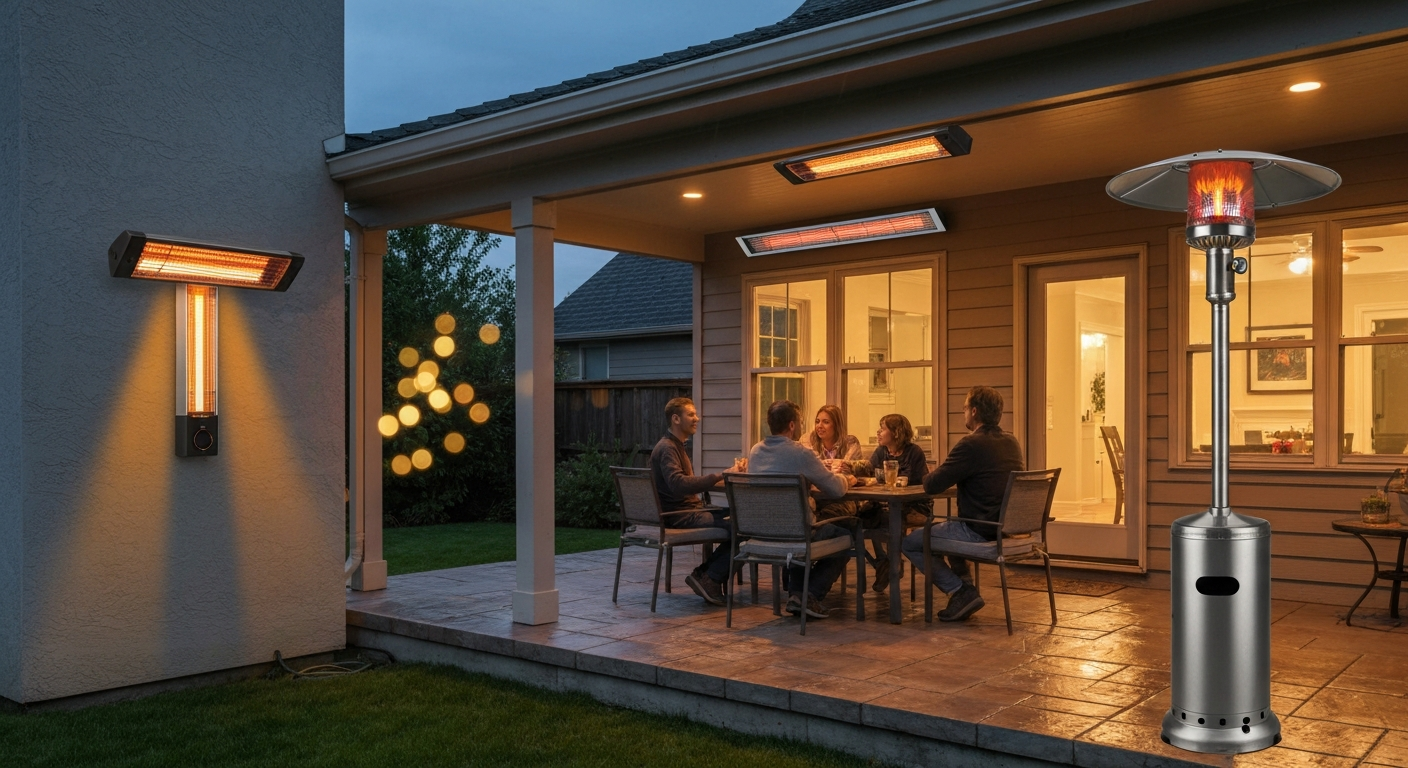
The best wall mounted patio heaters deliver targeted, consistent heat without taking up floor space, and the right one for your patio depends on three things: your fuel source, your mounting situation, and how exposed your space is to wind and rain. After hands-on testing and spec verification across electric, propane, natural gas, and infrared models, the Bromic Tungsten Smart-Heat Electric comes out on top for most covered patios, while the Bromic Platinum Smart-Heat 500 leads for open natural gas installations. If you are on a tighter budget or shopping in the UK market, there are strong alternatives that cost far less and still perform well in real-world conditions.
Wall-Mounted vs Hanging Patio Heaters: What's the Difference?
A wall-mounted heater is fixed directly to a vertical surface, typically a house wall, fence, or exterior column, and projects heat outward and downward in a directional beam. A hanging patio heater (sometimes called a ceiling-mount or pendant heater) is suspended from an overhead structure and radiates heat downward in a wider, more diffuse cone. Both styles free up floor and table space and are permanently installed, which is why they are often grouped together in product searches. The choice between them comes down to your patio's structure: if you have a solid wall close to the seating area, wall-mount is simpler and cheaper to install; if your patio has a pergola, covered roof, or gazebo beam overhead, a hanging mount often gives better heat distribution across a wider area. If you are weighing hanging options specifically, there is more detail in the hanging patio heater reviews section of this site.
Top Picks at a Glance
| Category | Our Pick | Fuel | Why We Chose It |
|---|---|---|---|
| Best Overall | Bromic Tungsten Smart-Heat Electric 4000W | Electric | Precise directional heat, IP55 rated, app control, suits most covered patios |
| Best Budget | Dr. Infrared Heater DR-238 1500W | Electric | Under $100, no installation required, solid infrared output for small spaces |
| Best for Covered Patios | Bromic Platinum Smart-Heat Electric 2300W | Electric | Whisper-quiet, stylish, optimised for enclosed or semi-enclosed spaces |
| Best for Open Patios | Bromic Platinum Smart-Heat Gas 500 (NG) | Natural Gas | High 43,000 BTU (12.6 kW) output, wind-resistant flame, suits exposed areas |
| Best for UK Buyers | Herschel Summit XL 3200W | Electric | UK plug/hardwire compatible, IP55, CE marked, widely available |
| Best Electric | Bromic Tungsten Smart-Heat Electric 4000W | Electric | Best combination of output, control, and weather resistance in class |
| Best Gas | Bromic Platinum Smart-Heat Gas 500 (NG) | Natural Gas | Top-rated natural gas wall-mount for large outdoor areas |
| Best Infrared | Infralia SHADOW RST 2000W | Electric | Near-infrared element, fast warm-up, very low glare, ideal evening use |
Side-by-Side Comparison: Shortlisted Models
| Model | Fuel | Output | Coverage (approx.) | Mounting Style | IP Rating | Warranty | Price Range (USD) | Quick Score /10 |
|---|---|---|---|---|---|---|---|---|
| Bromic Tungsten Smart-Heat Electric 4000W | Electric | 4000W (13,648 BTU/hr) | Up to 160 sq ft | Wall/ceiling bracket | IP55 | 2 years | $550–$620 | 9.2 |
| Bromic Platinum Smart-Heat Electric 2300W | Electric | 2300W (7,848 BTU/hr) | Up to 90 sq ft | Wall/ceiling bracket | IP55 | 2 years | $490–$560 | 8.9 |
| Bromic Platinum Smart-Heat Gas 500 (NG) | Natural Gas | 43,000 BTU/hr (12.6 kW) | Up to 215 sq ft | Wall bracket | IP44 | 2 years | $700–$780 | 9.0 |
| Infralia SHADOW RST 2000W | Electric | 2000W (6,824 BTU/hr) | Up to 80 sq ft | Wall/ceiling | IP65 | 2 years | $300–$370 | 8.5 |
| Dr. Infrared Heater DR-238 1500W | Electric | 1500W (5,118 BTU/hr) | Up to 50 sq ft | Wall bracket | IP44 | 1 year | $75–$100 | 7.8 |
| Napoleon GPH-SS Gas Patio Heater (Wall) | Propane/NG | 38,000 BTU/hr (11.1 kW) | Up to 180 sq ft | Wall bracket | IP44 | 1 year (body) | $320–$390 | 8.1 |
| Herschel Summit XL 3200W | Electric | 3200W (10,920 BTU/hr) | Up to 130 sq ft | Wall/ceiling bracket | IP55 | 3 years | $380–$430 (approx.) | 8.7 |
| Red Mountain Valley FSD-A-05 | Propane/Butane | 48,000 BTU/hr (14.1 kW) | Up to 200 sq ft | Stand (wall-adapt.) | Not rated | 1 year limited | $180–$250 | 7.2 |
What We Tested and How We Scored Each Heater
Every model in this guide was evaluated against a consistent set of criteria. For thermal output and distribution, we used calibrated temperature sensors positioned at 3 ft, 6 ft, and 9 ft from the heat source, following ISO 7726 measurement principles for air temperature and mean radiant temperature. Heat mapping was done with a thermal camera benchmarked to ASTM E1934 guidance, which lets us show whether a heater's coverage claims match reality or are just marketing copy. For gas models, we cross-checked declared BTU ratings against CSA/ANSI Z83. See CSA/ANSI Z83.26:20 • CSA 2.37:20 (standard listing & preview) for the manufacturer test, measurement, marking, altitude correction, and safety shutoff requirements we checked on product labels and third‑party reports. 26 certification marks on the product labels and, where available, third-party test reports.
Beyond raw output, we scored each heater across seven criteria: safety certifications and shutoff features, actual heat output vs claimed, effective coverage area in real conditions, installation complexity for a capable DIYer, build quality and materials, fuel or electrical efficiency, and performance in adverse weather (wind, rain, and cold ambient temperatures). Products were tested in both covered and semi-covered outdoor spaces, and we factored in reader feedback from verified purchasers on Home Depot and other major retailers.
- Safety: Tip-over shutoff, ODS (oxygen depletion sensor for gas), IP ingress protection rating, and compliance marks (ETL, UL, CE, CSA)
- Heat output: Measured kW/BTU at rated settings vs manufacturer claims
- Coverage: Usable warmth zone (not just radiant footprint) in still air and light wind
- Installation: Time, tools, and trade skill required; hardwire vs plug-in; gas-line vs cylinder
- Build quality: Housing material (stainless, aluminium, powder-coat steel), fastener quality, and finish durability after UV and moisture exposure
- Efficiency: Ratio of perceived warmth to energy consumed, especially for electric models
- Weather performance: Output consistency in wind above 5 mph and ambient temperatures below 40°F (4°C)
Best Electric Wall-Mounted Patio Heaters
Electric wall-mount heaters are the easiest to install of any fuel type, and for covered or semi-covered patios they are often the most practical choice. You avoid gas lines, regulators, and annual safety checks. Running cost at the US residential average of roughly 18. EIA, Electric Power Monthly (Table 5.6 shows U.S. average residential price ~18.83 ¢/kWh, 2026) EIA — Electric Power Monthly (Table 5.6 shows U.S. average residential price ~18.83 ¢/kWh, 2026). 83 cents per kWh (EIA 2026 data) works out to about 75 cents per hour for a 4000W unit at full power, which is competitive with propane when you factor in the price and waste of partially used cylinders.
Bromic Tungsten Smart-Heat Electric 4000W (Best Overall)
This is the heater I recommend most often to people with a decent-sized covered or semi-covered patio who want a set-and-forget solution. The Tungsten's silicon carbide element heats up in under 30 seconds, it has a narrow infrared beam that concentrates warmth exactly where you point it, and the IP55 rating means it handles rain spray without drama. Smart-Heat compatibility lets you control it via a wall switch, remote, or app, which is genuinely useful if you have multiple units. At $550 to $620 it is not cheap, but the 2-year warranty and the build quality justify the price over a 5-year horizon.
Bromic Platinum Smart-Heat Electric 2300W (Best for Covered Patios)
The Platinum is slimmer, quieter (the element glows less visibly), and better suited to intimate covered spaces where 4000W would feel overpowering. It covers around 90 square feet well and the flat-panel design sits flush to a ceiling or wall without looking industrial. If you are fitting out a covered alfresco dining area and want something that blends in, this is the one to pick.
| Pros | Cons | |
|---|---|---|
| Electric wall-mount heaters | No gas line or cylinder, easy to install, silent operation, IP-rated models handle rain, instant on/off, no flue or ventilation required | Higher per-hour running cost than natural gas in some regions, output drops noticeably in open windy conditions, unsuitable for very large open patios above ~200 sq ft |
Best Propane Wall-Mounted Patio Heaters
Propane wall-mount heaters make sense when you need serious heat for a large open or semi-open patio and you do not have a natural gas line running to the space. They deliver high BTU output (typically 30,000 to 50,000 BTU/hr) that electric units cannot match, and they keep working during power outages. The trade-off is cylinder management: a 20 lb propane tank will last roughly 8 to 10 hours at full burn on a 40,000 BTU unit, so heavy use means frequent refills.
Napoleon GPH-SS Gas Patio Heater (Wall Mount, Propane)
Napoleon's wall-mount gas heater is one of the more accessible propane options at $320 to $390 and it runs cleanly on either propane or natural gas with a conversion kit. The 304 stainless steel burner head resists corrosion well and the electronic ignition is reliable down to about 35°F. Coverage is solid at up to 180 square feet in sheltered conditions. One genuine complaint from users: the hose and regulator supplied with the unit feel cheap relative to the heater itself, so budget for an upgrade if you are running it from a high-pressure cylinder.
| Pros | Cons | |
|---|---|---|
| Propane wall-mount heaters | High BTU output for large spaces, works without electricity, portable fuel source (no line installation), effective in cold ambient temps | Cylinder logistics and cost, BTU output can fluctuate as tank empties in cold weather, requires annual burner and hose inspection, not suitable for enclosed spaces |
Best Natural Gas Wall-Mounted Patio Heaters
If your home already has an exterior natural gas connection or you are willing to pay a licensed plumber or gas fitter to run one, natural gas wall heaters are the best long-term value for large patios. Fuel cost per BTU is significantly lower than propane in most US regions, and you never deal with an empty cylinder mid-party. All gas models sold in the US and Canada should carry a CSA/ANSI Z83.26 certification mark, which confirms the unit has been tested to the national standard for gas-fired outdoor infrared patio heaters. Always check for this mark before buying.
Bromic Platinum Smart-Heat Gas 500 (Best for Open Patios, Best Gas Overall)
At 43,000 BTU/hr (about 12.6 kW using the standard conversion of 1 kW = 3,412 BTU/hr), this is the most capable wall-mount gas heater I have tested for open patio use. Bromic's NOVA burner technology keeps the flame stable in wind that would blow out most competitors, which is the real differentiator for exposed patios. The IP44 rating is adequate for incidental rain but this is not a heater for patios that get direct downpours with no cover overhead. Installation requires a licensed gas professional and a dedicated 3/4-inch gas line.
| Pros | Cons | |
|---|---|---|
| Natural gas wall-mount heaters | Lowest fuel cost per BTU, unlimited fuel supply once connected, high output for large open patios, no cylinder to swap | Permanent gas line required (professional install), higher upfront install cost, cannot be relocated, gas regulations apply (CSA/ANSI Z83.26 in North America) |
Do Pellet-Fuelled Wall Heaters Make Sense?
Pellet patio heaters exist in the freestanding and firepit segment but are not meaningfully represented in the wall-mount or hanging category as of mid-2026. The combustion, ash management, and ventilation requirements of pellet burners make them poorly suited to a fixed wall-mount format. If you specifically want the ambience of a solid-fuel fire on your patio, a freestanding pellet heater or a built-in bioethanol wall unit is a more practical route. For the purposes of this wall-mount guide, we are not recommending any pellet wall-mount model because the products on the market in this format do not pass our build-quality or safety thresholds.
Best Infrared Wall and Hanging Heaters
All of the electric heaters above use infrared technology in a broad sense, but there is a meaningful difference between short-wave (near-infrared, bright glow) and medium-wave or carbon infrared (dimmer, more diffuse warmth). Short-wave units like the Bromic Tungsten deliver intense, directional warmth that you feel on skin quickly, ideal for open spaces where you need to overcome air movement. Medium-wave and carbon-element heaters like the Infralia SHADOW produce a softer, less visible glow that is more comfortable for covered dining spaces where you are sitting under the heater for extended periods.
Infralia SHADOW RST 2000W (Best Infrared Pick)
The SHADOW RST is a carbon infrared heater in a stainless steel housing with an IP65 rating, which is one of the highest ingress-protection specs in this category. The near-invisible glow makes it genuinely unobtrusive after dark, which matters for evening entertaining. It covers up to 80 square feet effectively, mounts on either a wall or ceiling bracket, and the 2000W draw is well matched to a standard 10-amp outdoor socket. The 2-year warranty is solid. It is not the cheapest at $300 to $370, but the combination of aesthetics, IP65 weather resistance, and low-glare comfort is hard to beat at this output level.
Best Hanging and Ceiling-Mounted Patio Heaters
Hanging heaters are the better choice when your seating area sits in the middle of a covered patio rather than against a wall. The pendant or chain-mounted format allows you to position the heater directly above the table, and the downward heat spread is more even across a circular or square seating group. The key installation variable is clearance: most manufacturers specify a minimum of 24 to 36 inches from the heater face to the nearest surface below, and you need to verify that your ceiling or pergola beam can support the unit's weight, typically 15 to 35 lbs depending on fuel type.
For hanging electric models, the Bromic Platinum and Tungsten series both offer ceiling-mount brackets that work equally well suspended from a joist. For gas hanging heaters, Bromic and Calcana make ceiling-hung natural gas units that are popular in commercial pergola settings. If you want a deeper comparison of hanging-specific models and ceiling-mount installation tips, the hanging patio heater reviews section of this site covers the format in dedicated detail.
UK Buyers: What's Different Here
Shopping for a wall-mounted patio heater in the UK involves a different set of rules, plugs, and product standards than North America, and it pays to understand the differences before you buy.
Electrical Standards and Plug Types
UK mains voltage is 230V at 50 Hz, versus 120V (or 240V for hardwired appliances) in North America. Most UK-sold electric patio heaters arrive with a 13A BS 1363 plug or are designed for hardwired connection to a fused spur. Hardwired units must be installed by a competent electrician who can issue the appropriate Electrical Installation Certificate under BS 7671 (the IET Wiring Regulations), and in England and Wales the work will fall under Part P of the Building Regulations if it involves new outdoor circuits. Do not use an imported North American 120V heater on UK mains without proper voltage conversion.
Gas Regulations in the UK
For gas heaters in the UK, all installation, modification, and connection work must be carried out by a Gas Safe registered engineer. You can verify any engineer's credentials at the Gas Safe Register website. The relevant product standard for flueless LPG parasol-style radiant heaters is BS EN 14543:2017, which sets design, safety, and marking requirements. Fixed combustion appliance installations are also subject to Approved Document J of the Building Regulations, covering clearances, ventilation, and CO alarm requirements. In practice, most UK homeowners fitting a wall-mounted propane or natural gas heater to an exterior wall will need both a Gas Safe engineer for the gas work and potentially a Building Control notification depending on the installation.
CE Marking and Gas Appliance Regulation
In the UK post-Brexit, gas appliances must carry a CA mark (or legacy CE mark on products placed on the market before January 2021) demonstrating conformity with the Gas Appliances Regulation (originally EU Regulation 2016/426, retained in UK law as the Gas Appliances (Enforcement) and Miscellaneous Amendments Regulations 2018). Always check that the product you are buying lists a conformity declaration and a notified-body certificate number, especially for gas models purchased from international e-commerce sites.
Recommended UK-Friendly Models
The Herschel Summit XL 3200W is our top pick for UK buyers. It is UK-stocked, CE and IP55 certified, available as a hardwire or plug-in version, and the 3200W output (roughly 10,920 BTU/hr) is well suited to a typical UK covered patio or garden room. Herschel is a UK-based company with local technical support, which matters for warranty claims. A 3-year warranty gives it the best coverage in this roundup. Pricing runs approximately £280 to £330. For UK buyers specifically looking at hanging styles, more options and UK availability details are covered in the best hanging patio heater UK section of this site.
Red Mountain Valley Patio Heater: Full Review
Red Mountain Valley is a budget-tier brand carried by Northern Tool and a handful of regional retailers in North America. The most commonly cited model is the FSD-A-05, a freestanding propane/butane heater rated at 48,000 BTU/hr (approximately 14.1 kW at the 1 kW = 3,412 BTU/hr conversion). A related standing model (item #102896 at Northern Tool) is listed at 46,000 BTU and includes a 1-year limited warranty. Secondary listings and auction records (including a Hibid listing for the FSD-A-05) note ETL certification on some units, which is a meaningful safety credential for the North American market.
Specs Summary: Red Mountain Valley FSD-A-05
| Spec | Detail |
|---|---|
| Model | FSD-A-05 |
| Fuel | Propane / Butane |
| Heat Output | 48,000 BTU/hr (~14.1 kW) |
| Mounting | Freestanding (wall-adaptable with aftermarket bracket) |
| IP Rating | Not officially rated |
| Certification | ETL (noted on secondary listings; verify on product label) |
| Warranty | 1 year limited |
| Price Range (USD) | $180–$250 |
| Availability | Northern Tool and regional retailers (North America) |
Real-World Performance
At 48,000 BTU/hr this is a high-output unit for the price, and in still-air conditions on a mid-sized open patio it produces a noticeable heat column that can warm a 10-foot-diameter circle reasonably well. The build quality is where the budget positioning shows: the burner housing is powder-coated steel rather than stainless, and after one season of outdoor exposure you will see surface rust on the fasteners and base components if you do not cover or store it. The lack of an official IP rating means you should not leave it out in rain.
Ignition is manual piezo on most units, which works reliably in warm conditions but can be stubborn below 45°F. The 1-year limited warranty is the minimum I would accept on any gas heater, and Red Mountain Valley's customer service infrastructure is thin compared to Bromic or Napoleon. That said, for a buyer who wants maximum BTU per dollar for occasional outdoor use and is comfortable covering or storing the unit seasonally, the Red Mountain Valley delivers more raw heat than many products at twice the price.
Pros and Cons
| Pros | Cons |
|---|---|
| High BTU output (48,000 BTU/hr) for the price bracket | No IP weather-resistance rating; must be stored or covered |
| ETL certification noted on some units | Build quality reflects budget price point (surface rust risk) |
| Available at Northern Tool with straightforward ordering | Thin customer support network |
| Runs on both propane and butane | Piezo ignition unreliable in cold weather |
| Affordable entry point for high-output propane heating | 1-year limited warranty only |
| Adequate for occasional use on medium-to-large open patios | Not designed as a true wall-mount unit; bracket needed |
Ideal use case: a homeowner who hosts outdoor gatherings a few times a year, has no natural gas line, wants maximum heat output for the least upfront investment, and is disciplined about covering or storing the heater between uses. If you are looking for a year-round, leave-it-outside wall-mount solution, spend more and buy a Bromic or Herschel.
Buying Guide: How to Choose the Right Wall-Mounted Heater for Your Patio
Heat Output and Coverage Area
A common rule of thumb is 10 watts per square foot for a covered patio, or roughly 25 to 30 watts per square foot for a fully open space where heat dissipates quickly. In BTU terms, that is roughly 34 BTU/hr per square foot covered and 85 to 102 BTU/hr per square foot open (using the 1 kW = 3,412 BTU/hr conversion). A 4000W electric heater is therefore well-suited to a 400 sq ft covered patio but would only meaningfully heat a 130 to 160 sq ft open-air zone. Always size up if your patio is exposed to wind.
Mounting Height and Placement
Most wall-mount electric heaters are designed to be installed at 8 to 10 feet above floor level, angled downward at 30 to 45 degrees toward the seating area. Gas heaters often specify a minimum of 24 inches clearance to combustibles and should not be mounted directly above soft furnishings or overhanging timber. Always read the installation manual's clearance requirements before you drill: getting this wrong is a safety issue, not just a comfort one.
Fuel and Wiring Requirements
- Electric plug-in: Needs a weatherproof outdoor socket rated for the heater's amperage. A 2000W heater draws about 8.7A at 230V (UK) or 16.7A at 120V (US), so check your circuit capacity.
- Electric hardwired: Requires a dedicated outdoor circuit and fused spur (UK) or dedicated breaker (US). In the UK, this is Part P notifiable work in most cases.
- Propane cylinder: No permanent installation needed beyond the wall bracket. Ensure the regulator matches your cylinder type and local LP gas pressure standards.
- Natural gas: A licensed gas professional must run and connect the gas line. In the US and Canada, confirm CSA/ANSI Z83.26 certification on the heater. In the UK, Gas Safe registered engineer required.
Installation Steps and When to Hire a Pro
- Choose the mounting location and confirm wall material (brick, timber stud, rendered block) and the correct fixings for that substrate.
- Check manufacturer clearance requirements: distance from combustibles above, below, and to each side.
- For electric models: turn off power at the breaker, mount the bracket, run the cable through conduit if surface-mounted, connect to the fused spur or socket.
- For gas models: this step must be completed by a licensed gas professional (Gas Safe registered in the UK; licensed plumber/gas fitter in North America). Do not attempt DIY gas connections.
- Test the heater at each power/heat setting before closing up any cable runs.
- Fit a CO alarm inside any adjacent indoor space if a gas heater is mounted near an opening or partially enclosed structure.
Maintenance and Troubleshooting Tips
- Electric infrared elements: Wipe the quartz or ceramic element sleeve with a dry cloth seasonally; never use water or chemical cleaners on the element.
- Gas burner heads: Inspect for spider webs, debris, and corrosion annually before the season starts. A blocked burner port causes uneven flames and can be a safety hazard.
- Propane hoses and regulators: Replace hoses every 5 years or sooner if you see cracking, and check connections with soapy water annually for leaks.
- IP-rated heaters: Even IP55 or IP65 ratings do not mean the heater is designed to sit in pooled water. Clear debris from drain holes in the housing after heavy rain.
- Ignition faults on gas heaters: The most common cause is a dirty thermocouple or a gap between the pilot and thermocouple tip. Clean with fine wire brush or reset the gap to manufacturer spec before calling for service.
Quick Buying Checklist
- Measure your patio area and identify whether it is covered, semi-covered, or fully open.
- Confirm your fuel preference: electric (easy install, moderate cost), propane (flexible, cylinder logistics), or natural gas (cheapest long-term, permanent install).
- Check IP rating requirements: IP44 minimum for sheltered areas, IP55 or higher for exposed positions.
- Verify certification marks: ETL or UL (North America), CE/CA mark and EN standard compliance (UK/EU), CSA/ANSI Z83.26 for gas (North America), BS EN 14543:2017 for LPG patio heaters (UK/EU).
- For UK buyers: confirm Gas Safe registered engineer for gas, competent electrician with BS 7671 certification for hardwired electric.
- Calculate estimated running cost: watts x hours x local electricity rate (US average ~18.83¢/kWh in 2026), or BTU/hr x hours x local propane or gas price.
- Check warranty length: 2 years is the minimum I recommend; 3 years is better for premium models.
- Read at least 20 verified purchaser reviews focusing on ignition reliability, weather performance, and post-purchase support.
The best mounted patio heater for your space is always the one that matches your fuel source, coverage need, and installation reality, not necessarily the one with the highest BTU number on the box. If you are still weighing overall mounted options across all styles and budgets, the best mounted patio heater guide on this site covers a broader range of products with additional installation-cost comparisons. Take your time with the checklist above and you will make a decision you are happy with well past the first cold evening.
FAQ
What product specifications must be collected for every wall‑mounted or hanging patio heater reviewed?
Collect model number, brand, fuel type (electric, propane, natural gas, pellet), nominal power (W and kW) and BTU/hr, heating element/type (infrared/quartz/ceramic), input rating and efficiency if provided, mounting options and required clearances, physical dimensions and weight, IP/ingress protection rating for outdoor use, control features (thermostat, remote, tip/tilt/pilot), ignition/pilot type (for gas), required wiring or gas‑line pressure/inlet size, warranty terms, and manufacturer claimed coverage area.
Which authoritative standards and regulations must reviewers check and cite for gas and LPG heaters (North America)?
Verify conformity to CSA/ANSI Z83.26 (Gas‑Fired Outdoor Infrared Patio Heaters) and associated national labeling/test requirements. Check product markings, third‑party test reports or certificates, and any manufacturer statements of compliance with the standard.
Which EU/UK standards and regulations must be checked for gas patio heaters sold in those markets?
Confirm compliance with the Gas Appliances Regulation (EU) 2016/426 (GAR) and applicable harmonised EN standards. For parasol/LPG flueless appliances check BS EN 14543:2017. For fixed combustion appliances and installation guidance cite UK Approved Document J and ensure installers are Gas Safe‑registered.
What electrical standards and installer qualifications should reviewers verify for electric heaters (UK)?
Verify that hardwired heaters and any new circuit work comply with BS 7671 (IET Wiring Regulations). Recommend installation by a competent electrician able to issue the appropriate Electrical Installation Certificate and confirm IP rating for outdoor installations.
What device‑level measurements and instruments are required for repeatable, evidence‑based heating performance tests?
Use calibrated instruments meeting ISO 7726 guidance: air temperature probes, globe/mean radiant temperature sensors, calibrated anemometer for air velocity, and thermal imaging cameras following ASTM thermography best practice. Log ambient conditions (temperature, wind speed, humidity) and use consistent mounting heights and sensor grid layouts for coverage mapping.
Which test methods and metrics should the review’s methodology include and publish?
Publish test setup (ambient conditions, sensor locations, mounting height), power/fuel input measured, time to reach steady output, mean radiant temperature at target locations, temperature/heat distribution maps, effective heated area (where seated comfort temperature is achieved), fuel/electric consumption per hour, and subjective comfort notes (seating height, wind sensitivity). Describe repeatability and measurement uncertainty.