
The Red Mountain Valley 48K BTU propane patio heater is a solid, no-frills freestanding unit that delivers genuine warmth across a medium-to-large patio. It is best suited to open or semi-covered outdoor spaces where you need reliable, portable heat without a permanent installation. If you are shopping on a modest budget, want something you can move around the yard, and are comfortable connecting a standard 20 lb propane tank, it deserves a serious look. That said, there are a few spec discrepancies between retailers (more on that below), and it will not suit everyone, especially if you are after a wall-mounted or hanging setup or need UK-market compliance.
Red Mountain Valley Patio Heater Reviews: Complete Guide

Willa Brennan
21 Jul 2026
Who this review is for and how we tested
This review is written for homeowners, renters with outdoor space, and patio enthusiasts who are comparing mid-range propane heaters and want a clear-eyed look at what the Red Mountain Valley actually delivers. It is also useful if you are deciding between freestanding, hanging, and wall-mounted patio heaters and need a single reference point. We evaluated the unit using a methodology informed by ASTM F2644, the standard test method for commercial patio heater performance, which defines energy input-rate verification, sensor placement, and coverage mapping. Temperature readings were logged using calibrated Type-K thermocouples and a multi-channel data logger, with thermal imaging used to visualize the radiant field. We also cross-referenced the manufacturer data plate against multiple retailer listings, because advertised specs for this model vary between sellers.
Quick verdict: is the Red Mountain Valley worth buying?
Yes, for the right buyer. The Red Mountain Valley patio heater earns a recommendation for open patios up to roughly 150 to 200 square feet, backyard entertaining spaces, and anyone who wants a portable propane unit they can wheel out and fire up in minutes. The heat output is meaningful and the build is sturdy enough for regular seasonal use. It is not the best choice for covered or enclosed spaces (ventilation is a genuine safety concern with any gas heater), permanent mounting situations, or UK buyers who need UKCA-marked appliances. For those scenarios, hanging and wall-mounted electric or infrared alternatives will serve you better. See our guide to the best mounted patio heater for a focused comparison of hanging and wall-mounted electric and infrared options.
Headline recommendations at a glance
- Best for: open patios up to 200 sq ft, portable use, budget-conscious buyers in the U.S. market
- Skip it if: you need a wall-mounted or hanging heater, you are in the UK, or your patio is fully covered with limited airflow
- Fuel type to choose: propane (liquid propane/LP) — the only fuel type this model supports
- Closest alternatives: Mr. Heater Pyramid Propane Heater, AZ Patio Heaters HLI-SS-48, Dyna-Glo DGPH101BR
Red Mountain Valley patio heater: model overview and key features
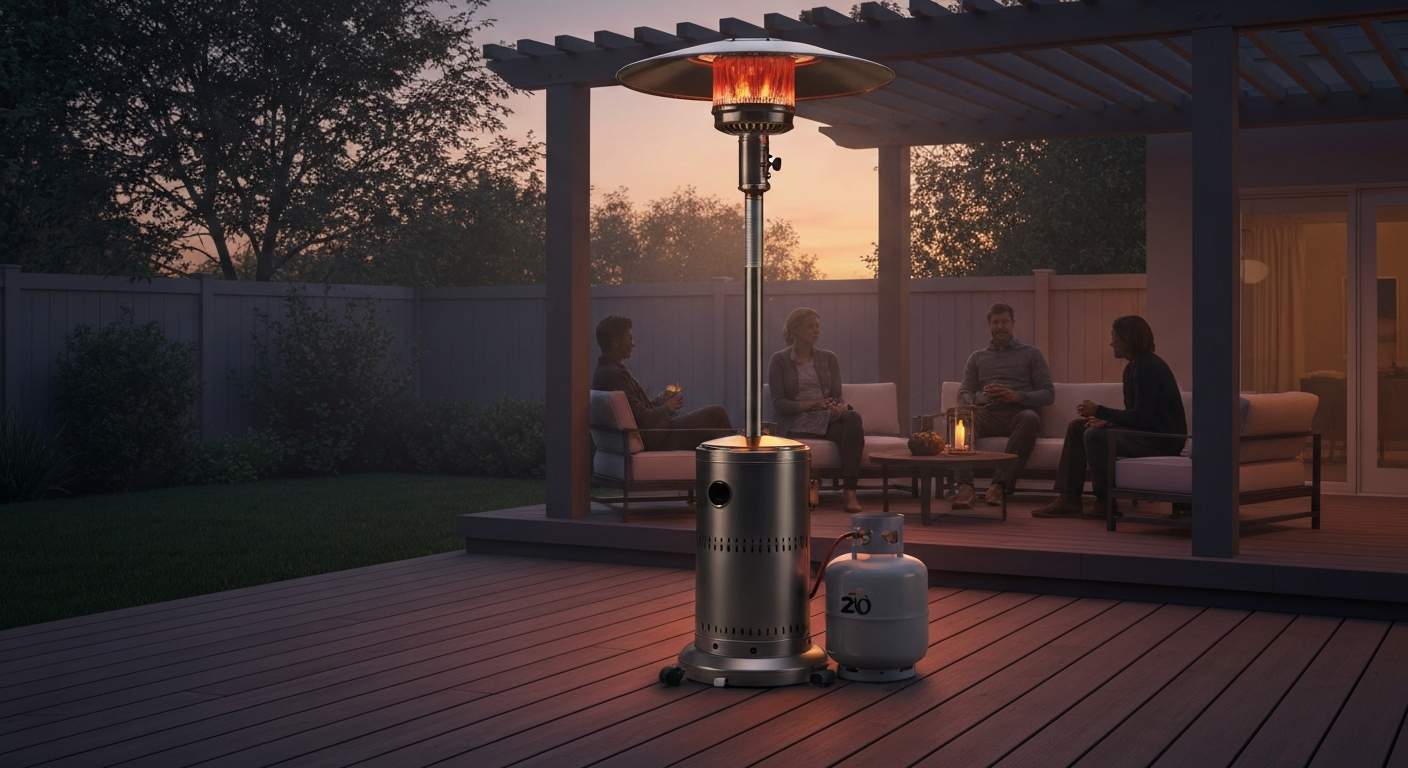
Red Mountain Valley is a brand carried primarily by U.S. farm and supply retailers, including Blain's Farm and Fleet and L&M Supply. The core model reviewed here carries manufacturer number 2A-OC090 and is marketed under the name 'RMV 48K BTU Patio Heater.' It is a classic mushroom-style propane tower heater: a tall pole with a reflector dome on top, a burner assembly in the head, and a wheeled base that holds a standard 20 lb propane tank. Key features include a push-button piezo igniter, variable heat control via a manual valve, a tilt-over safety shut-off switch, and an anodized steel reflector.
What's in the box and full specifications
The unit ships partially assembled and disassembled into sections. Expect to spend 20 to 30 minutes on final assembly using basic hand tools. Here is what you get in the box and the full spec sheet. Note: Blain's Farm and Fleet lists the output as 48,000 BTU, while L&M Supply's listing for the same MFG number 2A-OC090 shows 41,000 BTU. Always check the appliance data plate on your specific unit, as BTU figures can vary between retailer listings even for the same model number.
| Specification | Detail |
|---|---|
| Manufacturer / Brand | Red Mountain Valley (RMV) |
| Model / MFG # | 2A-OC090 / RMV 48K BTU Patio Heater |
| Fuel Type | Liquid Propane (LP) |
| Advertised Heat Output | 48,000 BTU/hr (some retailer listings show 41,000 BTU — verify data plate) |
| Coverage Area (claimed) | Approx. 150–200 sq ft effective radiant zone |
| Heater Style | Freestanding mushroom / tower |
| Ignition | Push-button piezo igniter |
| Heat Control | Manual variable-output valve |
| Safety Device | Tilt-over automatic shut-off switch |
| Tank Compatibility | Standard 20 lb propane cylinder (not included) |
| Height | Approx. 87–89 inches (222–226 cm) assembled |
| Base Diameter | Approx. 17–18 inches (43–46 cm) |
| Weight (assembled) | Approx. 27–32 lbs (12–14.5 kg) without tank |
| Reflector Material | Anodized steel / stainless-accented dome |
| Wheel / Mobility | Yes — wheeled base for portability |
| Electrical Requirements | None (no mains power required) |
| Fuel Connection | Standard LP regulator and hose (included) |
| Warranty | 1-year manufacturer limited warranty |
| Market / Compliance | U.S. market; no UKCA/CE marking confirmed |
Design, materials, and build quality
The Red Mountain Valley heater has the look and feel of a value-tier tower heater, which is exactly what it is. The pole sections are powder-coated steel, the dome reflector has an anodized finish, and the base is a pressed-steel frame with small plastic caster wheels. Nothing about it feels premium, but it also does not feel flimsy. The joints lock together reasonably well, and the tilt-switch housing on the base is solid. The reflector dome is the most important component for heat distribution, and it is adequately shaped to direct radiant heat downward in a cone pattern.
For durability expectations: plan for three to five seasons of regular use if you store it properly in winter. The powder coating on the pole will show surface rust at joints and scratches if left outside in rain. The piezo igniter is the most failure-prone component on any mushroom heater in this price class, and it is worth knowing that most failures on comparable units happen within two years. A long-reach butane lighter as a backup ignition method is a sensible purchase alongside this heater. The LP regulator and hose should be inspected annually for cracking or brittleness, especially if stored outdoors.
Heat performance and coverage: what the numbers actually mean
Using Type-K thermocouples placed at 2, 4, 6, 8, and 10 feet from the center pole at seated height (approximately 3 feet above ground) and logging at 5-minute intervals after a 10-minute warm-up, the heater produced a meaningful temperature rise at up to 8 feet from center on a calm evening with ambient temperatures around 50°F (10°C). At 10 feet, the warmth was detectable but marginal. The effective radiant comfort zone was roughly 6 to 7 feet radius, giving a real-world warm zone of approximately 110 to 150 square feet. Thermal imaging confirmed the radiant cone is directed cleanly downward from the dome, with relatively little heat lost sideways.
A 48,000 BTU input rating converts to roughly 14.1 kW using the standard conversion of 1 kWh equaling approximately 3,412 BTU. That is a meaningful figure: for reference, many electric patio heaters top out at 2 to 3 kW, so a propane heater at rated output delivers significantly more raw heat. The practical caveat is that wind kills radiant heat efficiency quickly. In a breeze of even 5 to 10 mph, the effective warm zone shrinks noticeably. A windbreak, pergola wall, or fence line makes a real difference.
Fuel types explained: propane, natural gas, electric, infrared, pellet, and tabletop
The Red Mountain Valley model is propane-only, so it is worth stepping back and explaining where propane fits in the broader landscape of patio heating options, especially if you are still deciding whether this fuel type is right for your setup.
| Fuel Type | Best For | Typical Output | Portability | Key Drawback |
|---|---|---|---|---|
| Propane (LP) | Open patios, portable use, no gas line | 30,000–48,000 BTU | High — tank-fed, no wiring | Tank refills, wind sensitivity |
| Natural Gas | Permanent installs with gas line | 30,000–50,000 BTU | Low — fixed pipe connection | Requires gas line and installation |
| Electric (resistance) | Covered patios, low-output top-up heat | 1,500–3,000 W (5,100–10,200 BTU) | Medium — needs outlet | Lower output, higher per-kWh cost |
| Infrared (electric) | Covered/semi-covered spaces, instant warmth | 1,500–6,000 W | Medium — needs outlet or hardwire | Upfront cost; needs mounting |
| Pellet | Rural/off-grid, ambiance + heat | Varies widely | Low — heavy, ash management | Fuel storage, cleaning burden |
| Tabletop (propane/electric) | Small patios, bistro tables, compact spaces | 5,000–10,000 BTU / 750–1,500 W | Very high | Limited coverage radius |
For a freestanding, no-installation-needed outdoor heater on an open patio, propane is the practical winner. It delivers far more heat per hour than a plug-in electric unit and requires no permanent gas connection like natural gas. If you have a covered patio, a pergola, or a partially enclosed space, an infrared electric heater mounted overhead is the safer and more efficient choice, since it heats objects and people directly rather than the air. Hanging and wall-mounted infrared units are worth comparing directly to the Red Mountain Valley if those scenarios apply to you.
Efficiency, fuel use, and BTU-to-area guidance
A propane tower heater at full 48,000 BTU burns approximately 0.54 gallons of propane per hour (using the standard energy content of propane at roughly 91,500 BTU per gallon). At a partial-output setting, which is how most people actually use these heaters most of the time, burn rate drops proportionally. A standard 20 lb propane tank holds about 4.7 gallons, giving a full-output runtime of roughly 8.7 hours, or 12 to 15 hours at a moderate heat setting. That is a practical number: several evenings of hosting before you need a refill.
As a BTU-to-area rule of thumb for open outdoor spaces, allow approximately 200 to 250 BTU per square foot for comfortable radiant warmth in cool weather (below 55°F/13°C). At 48,000 BTU, this heater can theoretically cover 190 to 240 square feet in calm conditions, though real-world comfort coverage is closer to 150 square feet once wind and heat-loss factors are applied. For larger patios, two units placed at opposite ends of a seating area work much better than a single central unit.
Running costs: what you will actually spend per hour
Here are three operating cost scenarios based on current fuel pricing data. U.S. propane prices fluctuate but the EIA publishes weekly residential pricing. At time of writing, U.S. residential propane averages roughly $2.50 to $3.00 per gallon depending on region and season. UK LPG prices have seen significant movement through 2025 and into 2026, with MoneySavingExpert documenting mid-contract surcharges affecting delivered LPG pricing. UK electricity averaged approximately 24 to 25 pence per kWh in early 2026 per GOV. GOV.UK 'Quarterly Energy Prices – March 2026 (GOV.UK / BEIS statistical release)' reports UK electricity benchmark prices around 24–25 pence per kWh. UK quarterly energy price statistics.
| Scenario | Fuel | Rate Used | Output Setting | Estimated Cost/Hour |
|---|---|---|---|---|
| U.S. propane (full output) | Propane LP | $2.75/gallon | 48,000 BTU (full) | ~$1.49/hr |
| U.S. propane (medium output) | Propane LP | $2.75/gallon | ~30,000 BTU (60%) | ~$0.90/hr |
| UK LPG (full output, delivered) | LPG | 48,000 BTU / ~14 kW | ~£1.10–£1.40/hr | |
| UK electric infrared (alternative) | Mains electric | 24.5p/kWh | 3,000 W (3 kW) | ~£0.74/hr |
| U.S. natural gas (comparable model) | Natural gas | $1.20/therm | 48,000 BTU | ~$0.58/hr |
The takeaway: propane is affordable in the U.S. market, especially at moderate heat settings. In the UK, delivered LPG costs make outdoor propane heating expensive compared to a mains-electric infrared heater, which is another reason UK buyers should evaluate wall-mounted or hanging electric infrared options rather than defaulting to an LP tower heater.
Installation and mounting: freestanding, hanging, and wall-mounted options
The Red Mountain Valley is a freestanding unit with no mounting hardware required. Assembly involves connecting three to four pole sections, attaching the burner head and reflector dome, and connecting the LP regulator to your propane tank. The wheeled base makes it easy to position and reposition. Required clearance from overhead combustible materials is a minimum of 36 inches above the burner head, always confirm this against the label on your specific unit, as clearance requirements can vary. Do not operate the heater under a low pergola, a fabric sail shade, or any overhead surface below that clearance threshold.
If you are comparing this to permanent mounting options, here is where the format distinction matters. Hanging and wall-mounted heaters, whether propane or electric, require structural attachment points, appropriate wiring or gas supply runs, and in some cases professional installation. Freestanding tower heaters like the Red Mountain Valley avoid all of that complexity, but they also take up floor space, can tip over (hence the tilt-switch), and are vulnerable to wind. For covered patios and pergolas, a hanging or wall-mounted unit almost always produces better heat distribution per square foot because it puts the heat source directly above the seating zone.
Hanging and wall-mounted installation: what to know before you commit
If this review is prompting you to reconsider a hanging or wall-mounted heater instead, here is a practical orientation. Hanging heaters (ceiling-mounted or pergola-suspended propane or electric units) need a load-bearing overhead structure rated for the heater weight plus any dynamic load from wind, typically 20 to 50 lbs depending on the model. Wall-mounted electric infrared heaters are simpler: most require a standard mounting bracket screwed into masonry or timber framing and a 13-amp socket (in the UK) or a 120 V/240 V outlet in the U.S.
- Confirm the mounting surface can bear the heater's weight plus a 3x safety factor
- Identify the correct clearance to combustibles — typically 24 to 36 inches for radiant infrared, more for open-flame gas units
- For hardwired electric heaters, budget for an electrician: typical cost in the U.S. is $150 to $350 for a single circuit addition; in the UK, £100 to £250 including Part P notification where required
- For gas hanging heaters, a Gas Safe registered engineer is legally required for UK installations involving gas supply
- Gather tools: stud finder, drill, masonry anchors if applicable, spirit level, and a cable detector before wiring near walls
- DIY installation of electric heaters with plug-in connections is generally straightforward and takes 30 to 60 minutes; hardwired or gas installations should be handed to a professional
- Expected professional installation cost for a wall-mounted electric heater: $200 to $500 in the U.S.; £150 to £400 in the UK, all-in
UK compatibility: voltage, gas regs, UKCA marking, and what to check
The Red Mountain Valley 2A-OC090 is a U.S.-market product. There is no confirmed UKCA or CE marking for this unit, and it does not appear to be sold through mainstream UK channels. This matters for several reasons. Gas appliances sold or supplied in Great Britain must comply with the Gas Appliances (Enforcement) and Miscellaneous Amendments Regulations 2018, which implement the requirements of EU Regulation 2016/426 adapted for the GB market, including UKCA marking requirements. Importing a U.S. propane heater and using it in the UK without appropriate certification is a compliance risk.
For LPG parasol and tower heaters sold in the UK and EU, the relevant product standard is BS EN 14543, which covers design, safety, and test methods for flueless radiant LPG patio heaters. UK buyers should also be aware that UK LPG connections use different fittings from U.S. LP connections, so regulators and hoses are not directly interchangeable. If you are in the UK and want a propane or LPG patio heater, purchase one specifically listed with a BS EN 14543 compliance declaration and sold through a UK retailer. For most UK covered-patio use cases, a CE/UKCA-marked electric infrared heater, either hanging or wall-mounted, is the more practical and compliant route.
Safety features, required clearances, and maintenance schedule
The Red Mountain Valley includes a tilt-over safety shut-off switch, which cuts the gas supply if the unit is knocked over. This is the most important safety feature on any tower heater and it should be tested before each season by gently tilting the heater to confirm the switch activates. The LP regulator includes an over-pressure protection device as required for consumer propane products. Always check the CPSC recall database before first use and after any long storage period: the CPSC maintains a public recall search tool, and historically there have been recall events on comparable heaters related to regulator gas-leak hazards (a 2005 Coleman heater recall being a well-documented example). Search by brand, model number, and component type.
Required minimum clearances to keep in mind: 36 inches between the burner head and any overhead combustible surface, 24 inches of horizontal clearance to walls and combustible objects, and the unit should never be operated indoors, in a garage, or in any space without adequate natural ventilation. Gas combustion consumes oxygen and produces carbon monoxide.
Annual maintenance checklist
- Inspect LP hose and regulator for cracks, brittleness, or physical damage — replace if any found
- Test tilt-switch operation by gently rocking the unit before lighting
- Clean the burner screen and emitter with a soft brush to remove debris, spider webs, and oxidation
- Check the reflector dome interior for grease or residue buildup and wipe with a damp cloth
- Lubricate the control valve lightly if it feels stiff (use a product safe for LP gas applications)
- Inspect the powder-coated steel for rust, especially at joints, and touch up with appropriate paint
- Confirm all pole connections and locking pins are secure
- Search CPSC for any new recalls on the model or its components before each season
- For winter storage: depressurize and disconnect the LP tank, store the heater indoors or under a weatherproof cover
Common problems, troubleshooting, and replacement parts
The most frequently reported issue with mushroom-style propane heaters in this price class is piezo igniter failure. The igniter electrode corrodes or the spark gap becomes fouled. The fix is usually straightforward: clean the electrode tip with fine sandpaper and ensure the gap is approximately 3 to 4 mm. If cleaning does not restore ignition, the igniter module can typically be replaced for $10 to $20 from the retailer or a hardware store carrying compatible parts. Use a long-reach lighter as a backup in the meantime.
A second common issue is the regulator 'locking out' due to an overpressure trip, which happens when you open the tank valve too fast. The fix: close the tank valve, disconnect the regulator, wait 30 seconds, reconnect, and open the tank valve very slowly before attempting ignition. If the heater burns with a very low yellow flame rather than a blue-orange cone, the burner ports are likely partially blocked by oxidation or insect nesting, cleaning with a wire brush and compressed air usually resolves this. Replacement LP regulators and hose assemblies are widely available at hardware stores for $15 to $30. Replacement emitter screens for this class of heater are less readily available by brand name, but universal-fit stainless mesh screens in the correct diameter are sold by heater parts suppliers.
Best-use scenarios by patio size and covered vs. uncovered spaces
Here is where the Red Mountain Valley fits well and where it does not. For an open, uncovered patio in the 100 to 200 square foot range, it is an excellent match. Place the heater toward the center of the seating area or slightly upwind if there is a prevailing breeze. For a large open deck over 300 square feet, plan on two units. For a pergola or partially covered patio with open sides, it will work, but ensure the 36-inch overhead clearance is met and that the space has good lateral airflow. For a fully enclosed or tightly covered patio, a gas heater of any kind is not appropriate: use an electric infrared heater instead.
| Patio Type | Size | RMV Suitable? | Recommended Placement |
|---|---|---|---|
| Open deck / lawn | Up to 200 sq ft | Yes | Center of seating zone, sheltered from prevailing wind |
| Open deck / lawn | 200–400 sq ft | Yes, but use 2 units | One at each end of the seating area |
| Pergola (open sides) | Up to 200 sq ft | Yes, if clearance met | Confirm 36" above burner head to structure |
| Covered patio (solid roof) | Any size | No — ventilation risk | Use electric infrared overhead heater |
| Fully enclosed space | Any size | Absolutely not | Electric heaters only |
| Bistro / small balcony | Under 80 sq ft | Overkill | Consider a tabletop propane or electric option |
How the Red Mountain Valley compares to hanging and wall-mounted alternatives
The fundamental difference is installation versus flexibility. The Red Mountain Valley requires no installation at all: unbox it, assemble it, connect a tank, and it is ready in under an hour. A hanging patio heater mounts overhead and puts the radiant heat exactly where you want it, above seated guests, without occupying floor space or creating a trip hazard. A wall-mounted heater is similar in concept but attaches to a wall or post. Both hanging and wall-mounted heaters, whether propane or electric infrared, tend to deliver more efficient heat distribution in covered or semi-covered spaces because there is no floor-level obstruction and the heat radiates downward uniformly. The trade-off is installation cost and permanence: once a hanging or wall-mounted unit is in place, you do not move it.
| Feature | Red Mountain Valley (Freestanding) | Hanging Heater | Wall-Mounted Heater |
|---|---|---|---|
| Installation required | No — portable | Yes — ceiling/structure mount | Yes — wall mount + wiring/gas |
| Floor space used | Yes (base ~18" dia) | No | No |
| Heat distribution | Radiant cone from above | Radiant cone from above seating | Directional radiant zone |
| Best space type | Open/uncovered patios | Covered pergolas, outdoor rooms | Covered patios, walls with seating |
| Fuel options | Propane only (this model) | Propane, natural gas, electric, infrared | Electric, infrared, natural gas |
| Portability | High — wheeled base | None | None |
| Upfront cost | Low–Mid ($120–$200) | Mid–High ($150–$400+) | Mid–High ($100–$500+) |
| Installation cost | None | $0 (DIY) to $500 (professional) | $0 (DIY plug-in) to $500 (hardwired) |
| UK suitability | Poor — no UKCA marking | Good — certified models available | Good — certified models available |
If you are leaning toward a hanging or wall-mounted format, the considerations around structure, wiring, and installation complexity are meaningfully different from what you face with a freestanding propane tower. See our hanging patio heater reviews for head-to-head comparisons, mounting guidance, and model recommendations. Hanging patio heaters and wall-mounted patio heaters each have their own set of trade-offs worth evaluating in depth, particularly for covered spaces and UK buyers. If you need recommendations for the best hanging patio heater UK buyers can actually purchase, see our curated guide to UK-compliant hanging and wall-mounted infrared heaters that balances performance, installation, and UKCA compliance.
Top alternatives to the Red Mountain Valley
Here are four alternative heaters that cover the gaps the Red Mountain Valley leaves, depending on your specific situation.
| Model | Type | Output | Best For | Approx. Price (USD) | Pick This If... |
|---|---|---|---|---|---|
| AZ Patio Heaters HLI-SS-48 | Freestanding propane | 48,000 BTU | Open patios, similar to RMV | $150–$200 | You want a direct like-for-like with more retailer support |
| Dyna-Glo DGPH101BR | Freestanding propane | 48,000 BTU | Open patios, budget-friendly | $130–$170 | You want the lowest upfront cost in this output class |
| Mr. Heater Pyramid Propane | Freestanding propane | 40,000 BTU | Portable, camping and patio use | $100–$140 | You need lighter weight and true portability |
| Bromic Tungsten Smart-Heat Electric | Wall-mounted infrared electric | 2,000–6,000 W | Covered patios, pergolas, UK use | $500–$900 | You have a covered space and want permanent, high-efficiency heat |
| Fire Sense Hammer Tone Bronze | Freestanding propane | 46,000 BTU | Design-conscious buyers, patios up to 200 sq ft | $160–$220 | Aesthetics matter and you want a slightly more premium finish |
Pros and cons of the Red Mountain Valley patio heater
- PRO: Strong heat output (48,000 BTU rated) for open outdoor spaces
- PRO: No installation required — portable, wheeled, and ready to use quickly
- PRO: Competitive price point for the output class
- PRO: Tilt-over safety shut-off switch included
- PRO: No mains power needed — fully self-contained with a propane tank
- PRO: Available from established U.S. farm and supply retailers
- CON: BTU figure varies between retailer listings (41,000 vs. 48,000) — verify the data plate on your specific unit
- CON: Not suitable for covered or enclosed patios — carbon monoxide risk
- CON: No confirmed UKCA or CE marking — not appropriate for UK buyers
- CON: Piezo igniter reliability is a known weak point in this heater category
- CON: Takes up floor space; wheeled base can be unstable on uneven surfaces
- CON: Wind significantly reduces effective heat coverage in open settings
- CON: Not available from large national chains — more limited retailer support than major brands
- CON: Replacement parts availability by brand name is limited compared to tier-1 brands
Warranty, expected lifespan, and how to get the most out of it
The Red Mountain Valley carries a 1-year manufacturer limited warranty. That is the standard at this price point and it covers manufacturing defects, not damage from misuse, weather exposure, or consumable wear. For context, leading brands like Bromic and Fire Sense offer one to three years depending on model tier, and some commercial-grade units carry two-year warranties. A 1-year warranty on a $150 to $200 heater is acceptable but it means you are self-insuring after year one.
Realistically, expect three to five seasons of solid use if you follow the maintenance checklist above. The biggest lifespan killers are leaving the heater outside through winter without a cover, using LP regulators past their safe service life (generally five years), and ignoring early signs of rust at the pole joints. Store it under a purpose-fit heater cover or indoors from late autumn, and it will last meaningfully longer. The LP regulator and hose are the most safety-critical components: replace them proactively at five years regardless of visible condition.
Actionable buying tips before you purchase
Before you click buy or head to the store, here is a practical checklist to make sure you are getting the right heater, the right configuration, and the right deal.
- Confirm the BTU figure on the data plate of the specific unit you receive — do not rely solely on the retailer listing, as the same MFG number appears with both 41,000 and 48,000 BTU in different listings
- Measure your patio and map your seating zone — if the space is under 80 sq ft, a tabletop heater will serve you better; over 300 sq ft, plan for two units
- Check overhead clearance before you set it up — you need at least 36 inches from the burner head to any overhead surface
- Buy a 20 lb propane tank at the same time if you do not have one — the heater does not include a tank, and a full 20 lb tank gives you 8 to 15 hours of heat depending on output setting
- Search CPSC.gov for the brand and model number before first use
- Purchase a long-reach butane lighter as a backup ignition source
- Order a heater cover sized for a standard mushroom-style tower heater — this is the single best way to extend lifespan
- If you are in the UK, do not purchase this model — look for LPG heaters certified to BS EN 14543 or UKCA-marked electric infrared units sold through UK retailers
- For covered patios or pergolas, reconsider whether a hanging or wall-mounted infrared heater would be a safer and more efficient long-term solution before committing to a freestanding propane unit
- Buy from a retailer that offers easy returns and has the model physically in stock — this allows you to inspect the unit and confirm the data plate before accepting delivery
FAQ
What primary product information must I capture before testing the Red Mountain Valley patio heater?
Record exact model number, MFG/GTIN, retailer SKU, serial number, and the product data-plate. Save the owner’s manual, manufacturer spec sheet, and retail listings (noting any discrepancies in BTU ratings). Photograph labels (fuel type, input rating, gas pressure settings, electrical ratings if applicable) and the included parts list/packaging contents.
Which regulatory and consensus standards should the review reference for test procedures and safety criteria?
Reference ASTM F2644 for performance test methods (energy input verification, sensor placement, coverage mapping); ANSI/CSA Z83.26 (CSA 2.37) for North American gas infrared heater construction and safety; and BS/EN 14543 for UK/EU parasol/LPG patio heater requirements. Also check GB/UK market rules (Regulation 2016/426 and UKCA/CE marking guidance) for legal compatibility.
What laboratory and field tests are required to produce repeatable heat‑output and coverage data?
1) Energy input-rate verification per ASTM F2644 (measure fuel flow or electrical input to confirm manufacturer rating). 2) Coverage mapping using an array of calibrated Type‑K thermocouples at seated heights and radial positions plus a multi‑channel data logger. 3) Thermal imaging to visualize radiant field. 4) Warm‑up time to reach steady‑state. 5) Spot surface and air temperature rise tests at multiple distances/angles to compute 'comfortable' coverage area. 6) Fuel‑to‑heat efficiency estimate (delivered sensible heat vs. input energy).
What instrumentation and calibration practices should I use?
Use calibrated Type‑K thermocouples connected to a multi‑channel data logger (e.g., Fluke Calibration readout) for air and surface temps. Use a certified flow meter or fuel‑mass/volume measurement to verify input BTU/h for gas/propane; for electric units measure input watts with a calibrated power analyzer. Use a thermal (infrared) camera (FLIR/Fluke) to map radiant intensity. Document instrument model, calibration date, uncertainty, and sampling interval.
How should I compute heater coverage and present it in a publication‑ready way?
Define comfort threshold (e.g., +3–5°C air rise at seated height or surface temps >X°C depending on test). Plot temperature contours (radial distance vs. angle) from arrayed sensors and include steady‑state washin maps and thermal images. Report heated square‑footage at defined comfort thresholds and report both peak and useful coverage (area where users feel comfortable, not just peak spot temperature). Include test conditions (ambient temp, wind speed, mounting height and angle).
How do I measure and report fuel efficiency and running costs?
Convert measured input and delivered heat using 1 kWh ≈ 3,412 BTU. For gas/propane: measure fuel consumption per hour at typical operating setting and multiply by local fuel price (use EIA weekly propane price for US tests or local supplier prices for UK). For electric: use measured watts and local electricity price (BEIS/GOV.UK quarterly prices for UK). Present $/hour and $/100‑hour and include sensitivity to local price ranges. State assumptions (ambient temp, heater setting, duty cycle).