
The best hanging patio heater for most UK gardens in 2026 is an electric infrared pendant like the Kettler Kalos Electric Patio Heater (2kW, IP44 rated, around £180–£220). It mounts cleanly from a pergola or covered ceiling, costs roughly 34p per hour to run at current Ofgem cap rates, and needs no gas line or cylinder. If you have a larger covered area or want gas warmth, a propane wall-mounted or ceiling-hung unit in the 4–6kW range is the next best step, but you'll need a Gas Safe registered engineer for anything permanently plumbed. This guide covers every format, fuel type, and budget so you can match the right heater to your specific space.
Best Hanging Patio Heater UK: Top Picks & Buying Guide

Willa Brennan
29 Jul 2026
Quick Recommendation: Best Overall Pick
Best overall: Kettler Kalos Electric Infrared Pendant Heater (2kW). It suits UK homeowners with a covered or semi-covered patio who want a clean installation, no fuel logistics, and reliable warmth at a mid-range price. If you have a larger open terrace and prefer propane, the Schwank Parasol-style hanging gas heater at 6kW is the top gas pick, but it costs more upfront and requires more planning.
Who This Guide Is For and How to Use It
This guide is written for UK homeowners and renters who want to extend their patio season beyond the British summer, which, let's be honest, needs extending. Whether you have a small covered lean-to, a timber pergola, an open terrace, or a glazed veranda, there's a hanging or mounted heater that works for your space. Renters should focus on plug-in electric pendant models since they require no permanent wiring or gas work. Homeowners with covered patios can look at hard-wired electric or plumbed natural gas options for a more permanent, higher-output solution.
If you're comparing wall-mounted and ceiling-mounted options side by side, the format section below explains the differences clearly. If you already know you want propane or electric, skip straight to those in-depth review sections. The comparison table gives you a fast snapshot. The buying checklist and running-cost section help you sanity-check the ongoing expense before you commit. Gas installation rules and UK electrical regulations are covered in detail so you're not caught out after purchase.
How Hanging Patio Heaters Work and the Main Formats
All hanging patio heaters convert fuel or electricity into radiant or convective heat and direct it downward or outward over a defined coverage area. The key difference between formats is where the heat element sits, how the unit is fixed, and what fuel it uses.
Ceiling-Hung and Pendant Heaters
These hang from a ceiling joist, pergola beam, or dedicated bracket on a chain, cable, or rigid rod. Electric infrared pendant heaters are the most common type in UK retail and are typically 1.5–3kW. Gas pendant heaters exist but are less common and require either a flexible LPG hose connection or a fixed natural gas pipe. Minimum hanging height is usually 1.8–2.2m from the floor to the heater body, and most manufacturers specify this clearly in the manual, always check before you buy.
Wall-Mounted Heaters
Wall-mounted heaters fix to a vertical surface and tilt or swivel downward to direct heat. They're often easier to install than ceiling-hung units because the wall provides a rigid anchor point with less risk of swing in wind. Electric wall-mounted infrared heaters in the 2–4kW range are widely available from UK retailers including Wickes, Screwfix, and Heat Outdoors. For comparisons specifically focused on this format, the wall mounted patio heater reviews section of this site goes into greater depth. For detailed comparisons and model recommendations, see our wall mounted patio heater reviews section. For a deeper comparison of hanging and pendant options, see our hanging patio heater reviews section for head-to-head tests and long-term reliability notes.
Infrared Pendant and Halogen Tube Heaters
Infrared heaters heat people and objects directly rather than warming the air, which makes them particularly efficient outdoors where warm air simply escapes. Halogen tube infrared heaters are cheaper and light up orange when on. Carbon fibre (dark emitter) infrared heaters run silently without a visible glow and are better suited to relaxed outdoor settings. Carbon fibre models typically cost 20–40% more but are quieter and have a longer element lifespan of around 5,000–10,000 hours versus roughly 3,000 hours for halogen.
Fuel Types: Electric, Propane, Natural Gas
Electric is the simplest: plug-in models need just a weatherproof outdoor socket, while hard-wired models require a Part P notifiable electrical installation done by a qualified electrician under BS 7671. Propane (LPG) from a Calor or Flogas cylinder gives higher heat output (4–13kW is common), is completely portable, and needs no mains connection. Propane is widely available as a 5kg, 11kg, or 19kg cylinder in the UK with exchange schemes at most hardware stores and petrol stations. Natural gas provides unlimited fuel from your mains supply but requires a fixed installation by a Gas Safe registered engineer. Running costs for natural gas are typically lower per kWh than propane in the UK.
Top Picks at a Glance
- Kettler Kalos 2kW Electric Pendant — Best overall for covered patios; clean ceiling mount, IP44, no fuel needed.
- Heat Outdoors Shadow Pendant 2kW — Best electric for style-conscious buyers; dark emitter, minimal glow, IP65.
- Bromic Tungsten Smart-Heat Electric 2300W — Best premium electric; precise directional heat, IP55, app control.
- Napoleon Patio Heater PHD122 (Propane, 11kW) — Best propane hanging unit; high output for larger semi-open areas.
- Schwank 2-SS-LP Gas Hanging Heater (Propane, 6kW) — Best mid-range propane; compact and efficient.
- Lifestyle Appliances Alfresco NG Wall Heater (Natural Gas, 4.2kW) — Best natural gas fixed heater; mains-connected, lower running cost.
- VonHaus 1.5kW Outdoor Electric Patio Heater (Wall-Mount) — Best budget electric; affordable, IPX4, widely available.
- Tabletop EWT Infrared 0.6kW — Best compact alternative for small balconies or renters.
Compact Comparison Table of Shortlisted Models
| Model | Fuel | Output (kW) | Coverage (m²) | IP Rating | Price Bracket | Best For |
|---|---|---|---|---|---|---|
| Kettler Kalos Electric Pendant | Electric | 2.0 | 8–10 | IP44 | £180–£220 | Covered patio, general use |
| Heat Outdoors Shadow Pendant | Electric | 2.0 | 8–10 | IP65 | £220–£280 | Style, damp/wet-rated install |
| Bromic Tungsten Smart-Heat Electric | Electric | 2.3 | 10–12 | IP55 | £450–£550 | Premium covered terrace |
| Napoleon PHD122 Propane Pendant | Propane | 11.0 | 15–20 | IP44 (equivalent) | £320–£400 | Large semi-open areas |
| Schwank 2-SS-LP Hanging Heater | Propane | 6.0 | 10–14 | IP44 (equivalent) | £280–£360 | Mid-size covered patio |
| Lifestyle Alfresco NG Wall Heater | Natural Gas | 4.2 | 10–14 | IP44 | £250–£320 | Permanent fixed install |
| VonHaus 1.5kW Wall Heater | Electric | 1.5 | 5–7 | IPX4 | £50–£80 | Budget, small patio |
| EWT Tabletop Infrared 0.6kW | Electric | 0.6 | 2–3 | IP24 | £40–£60 | Balconies, renters |
In-Depth Reviews: Propane Hanging and Wall-Mounted Heaters
Napoleon PHD122 Propane Hanging Patio Heater
The Napoleon PHD122 is one of the most powerful hanging propane options readily available to UK buyers, rated at 11kW (roughly 37,500 BTU/hr). It uses a standard 11kg propane cylinder connected via a 1.5m flexible hose, which you can tuck behind a planter or in a side cabinet. Coverage is impressive, comfortably 15–20m² in a semi-covered space, and the stainless steel reflector directs heat efficiently downward and outward. The piezo ignition is reliable in cold weather, and the unit has a tilt safety cutoff that shuts the gas if it's knocked at more than 45 degrees.
- Pros: Very high heat output, covers large patios, portable (no fixed gas line needed), tilt shutoff safety feature, stainless reflector resists corrosion.
- Cons: Bulky unit (typically 5–7kg without cylinder), cylinder needs replacing or exchanging roughly every 8–12 hours at full output, visible hose can look untidy, not suitable for fully enclosed spaces due to CO risk.
Performance note: At 11kW you will feel the difference versus a 2kW electric pendant, particularly in open or breezy conditions. The trade-off is fuel logistics, factor in cylinder storage. Calor's guidance recommends storing propane cylinders outdoors in a ventilated, secure cage, not in garages or sheds. A 11kg propane cylinder from Calor costs approximately £35–£45 to exchange as of mid-2026.
Schwank 2-SS-LP Gas Hanging Heater (Propane, 6kW)
Schwank's commercial-grade heaters are used extensively in UK hospitality settings, and the 2-SS-LP is the closest to a residential-scale option at 6kW output. It's a slimmer, more discreet unit than the Napoleon, the stainless housing is compact and it mounts cleanly from a pergola joist. Minimum ceiling height is 2.1m. It connects to a 5kg or 11kg propane cylinder and has a simple high/low heat setting. No thermostat or timer is included at this price point, which is a genuine limitation.
- Pros: Commercial build quality, compact profile, efficient directional heat, suitable for 10–14m² covered areas.
- Cons: No thermostat or timer, higher unit price than Napoleon, spares and servicing can be harder to source for domestic buyers.
In-Depth Reviews: Natural Gas Fixed and Mounted Heaters
Lifestyle Appliances Alfresco Natural Gas Wall Heater (4.2kW)
This wall-mounted natural gas heater is one of the more accessible permanently plumbed options in the UK market, rated at 4.2kW with a coverage area of around 10–14m². The angled head swivels to direct heat and it comes with a manual piezo ignition and a simple thermocouple flame-failure safety device. Running costs at current Ofgem natural gas cap rates (approximately 6.99p/kWh as of Q3 2026) work out to roughly 29p per hour at full output, noticeably cheaper per hour than electricity or propane. The IP44 rating means it handles rain splash adequately but shouldn't be sited where it can be directly hosed or submerged.
- Pros: Lowest running cost of any gas type in the UK, no cylinders to manage, cleaner permanent installation, consistent pressure from mains supply.
- Cons: Requires Gas Safe registered engineer for installation (adding £150–£300+ to total cost), fixed to the building (can't be moved), installation classified as notifiable work under Gas Safety (Installation and Use) Regulations 1998.
UK Gas Installation Requirements: What You Must Know
Under the Gas Safety (Installation and Use) Regulations 1998, and the HSE's Approved Code of Practice L56, any installation, commissioning, or modification of a gas appliance connected to a fixed gas supply in the UK must be carried out by a Gas Safe registered engineer. This applies to natural gas hanging and wall-mounted patio heaters and to any semi-permanent propane installation with a fixed pipe run. You can check an engineer's Gas Safe registration number on the official Gas Safe Register website before they start work. Landlords have additional obligations: an annual Gas Safe inspection is required for any fixed gas appliance in a rental property.
Carbon monoxide is the critical safety concern with any gas patio heater. HSE guidance and L56 make clear that gas combustion appliances must not be used in enclosed or poorly ventilated spaces. See HSE Gas Safety (index), Health & Safety Executive (UK) for authoritative guidance on carbon monoxide risks, ventilation requirements and exclusion zones for gas patio heaters HSE Gas Safety (index) — Health & Safety Executive (UK). A covered patio with at least 25% open sides is generally considered semi-open. A glazed veranda with closed panels is not. Always site gas heaters where combustion products can freely disperse. A battery-powered CO detector near any gas heater installation is strongly recommended even in semi-open settings.
In-Depth Reviews: Electric Hanging and Infrared Pendant Heaters
Kettler Kalos 2kW Electric Pendant Heater
This is the heater I'd recommend first to most UK buyers. The Kettler Kalos hangs from a ceiling hook on an adjustable steel cable, takes up almost no visual space, and delivers a warm, wide infrared spread from its 2kW element. It has an IP44 rating, meaning it's protected against water splashing from any direction, adequate for a covered patio or pergola but not for a fully exposed installation. The unit comes with a 13A plug for a standard outdoor socket, so no electrician is needed for most installs. A built-in thermostat and remote control are available on the higher-spec model.
- Pros: Straightforward installation (plug-in), IP44 rated for covered outdoor use, remote control option, clean modern aesthetic, widely available from Robert Dyas and Amazon.co.uk.
- Cons: IP44 is adequate but not outstanding for the UK's wet climate — look at IP65 models for more exposed spots, 2kW limits coverage to about 8–10m².
Heat Outdoors Shadow Pendant 2kW
The Shadow Pendant is a carbon fibre dark emitter, it doesn't glow orange like a halogen tube, which makes it a far more pleasant choice for an evening patio setup. At IP65 it's genuinely rain-resistant, not just splash-protected, and it's one of the few pendant electric heaters in UK retail that hits this rating. Output is 2kW, matching the Kettler, but the build quality and heat distribution feel superior in use. Heat Outdoors is a UK specialist retailer and the Shadow Pendant is one of their best-selling residential models. It's hard-wired, so you'll need an electrician for installation under BS 7671, budget around £100–£150 for the Part P notifiable electrical work.
- Pros: IP65 rain-rated, dark emitter (no orange glow), premium build, better choice for semi-exposed covered patios.
- Cons: Hard-wired installation required (adds cost), higher unit price than Kettler, UK availability mainly through specialist retailers.
Bromic Tungsten Smart-Heat Electric 2300W
If budget isn't a constraint, the Bromic Tungsten Smart-Heat is the best-performing electric hanging heater I've tested. The 2300W (2.3kW) output is directed in a tight, efficient beam rather than scattering in all directions, which means it heats a 10–12m² area far more effectively than a generic pendant at the same wattage. IP55 rating, compatibility with Bromic's smart controls and app, and a premium stainless/powder-coated finish make this a genuinely long-term investment. It's available in the UK through specialist patio and garden retailers and select B&Q concessions.
- Pros: Directional precision heating, IP55, smart app control, excellent build quality, 3-year warranty.
- Cons: Expensive at £450–£550, requires hard-wired installation, overkill for small covered patios.
IP Ratings and UK Outdoor Wiring Notes
IP (Ingress Protection) ratings under IEC/EN 60529 tell you how well a heater is sealed against water and dust. For outdoor use in the UK: IP44 is the minimum for a covered patio (protected from rain splash); IP55 or IP65 is recommended for semi-covered or more exposed positions where rain can blow in at angles. Hard-wired outdoor electric heaters must be installed in compliance with BS 7671 (IET Wiring Regulations). This means a dedicated RCD-protected circuit, correct cable sizing, and weatherproof junction boxes. The work is notifiable under Part P of the Building Regulations if the circuit originates from the consumer unit, a qualified electrician must complete and certify it. Electrical Safety First recommends registering any new patio heater after purchase to enable recall notifications.
In-Depth Reviews: Pellet and Alternative Fuel Hanging Heaters
Pellet-burning hanging patio heaters are not widely available in the UK market as of mid-2026. A small number of European manufacturers (mostly Italian and German) produce pellet-fuelled outdoor heating systems, but these are primarily floor-standing or table-top units rather than ceiling-hung designs. If you're committed to a biomass or pellet fuel approach, a floor-standing pellet patio heater from brands like MCZ or Palazzetti is a more realistic option, but it's outside the strict scope of hanging heaters and adds installation complexity (pellet hopper, flue pipe management). For most UK buyers, electric or propane is the practical choice for a hanging format.
Tabletop and Portable Alternatives
If you're a renter, have a small balcony, or just want to try out patio heating without committing to a ceiling installation, a tabletop electric infrared heater is worth considering. The EWT Tabletop Infrared at 0.6kW costs under £60 and plugs into a standard socket. It won't heat a large area, maybe 2–3m² immediately around it, but it's genuinely useful for two people sitting at a garden table. It has an IP24 rating, which means it can handle some moisture but shouldn't be left out overnight in heavy rain. For compact balcony use, tabletop heaters beat standing mushroom heaters on space efficiency.
Other portable options worth knowing about include plug-in wall-mount heaters like the VonHaus 1.5kW model (IPX4, under £80), which you can screw to a fence panel or wall and unscrew when you move, useful for renters who want something more substantial than a tabletop unit without permanent wiring. For a broader look at similar fixed formats, the best mounted patio heater guide on this site covers wall-bracket options in detail.
Brand Spotlight: Red Mountain Valley and Other Notable Brands
Red Mountain Valley
Red Mountain Valley is a US-based patio heater brand most commonly sold through Tractor Supply Co. and similar American farm and outdoor retailers. Their hanging and pyramid-style gas heaters have a following in the US market for build quality and value. However, as of mid-2026, Red Mountain Valley does not appear to have a formal UK distribution network, and their heaters are not typically CE/UKCA marked for the UK market. Buying an imported unit without UKCA certification creates compliance problems under UK product safety regulations and may void your home insurance. If you've seen Red Mountain Valley referenced online and are wondering about UK availability, the honest answer is: proceed with caution, verify UKCA marking explicitly before purchasing, and check the GOV.UK product safety framework for import obligations. For UK-certified equivalents at a similar output level, Napoleon and Schwank are better-supported choices. The dedicated Red Mountain Valley patio heater reviews section of this site tracks UK availability as it develops.
Other Notable Brands
- Kettler: Established UK garden furniture and heating brand, good warranty support, widely available through major retailers.
- Bromic: Australian premium brand with strong UK presence through garden specialists; best-in-class for electric smart heating.
- Heat Outdoors: UK specialist retailer with own-brand and curated third-party models; excellent pre-sales advice and installation support.
- Schwank: Commercial-grade German brand; durable but better suited to buyers who want long-term, high-output solutions.
- VonHaus: Budget-friendly UK brand available on Amazon; decent for low-cost entry but shorter warranty terms.
- Napoleon: Canadian brand with strong gas heater range; available via UK garden and BBQ retailers.
Your UK Buying Checklist, Step by Step
- Heat output (kW/BTU): Match output to your patio size. A rough guide: 1–2kW for up to 10m² covered, 4–6kW for 15–25m² semi-covered, 8kW+ for large or open areas. 1kW = approximately 3,412 BTU/hr.
- Coverage area: Measure your usable patio in m². Note that covered patios retain heat much better than open ones — a 2kW heater in a covered 8m² pergola outperforms the same unit in an open 8m² terrace.
- Ceiling height and mounting: Check the manufacturer's minimum hanging height (typically 1.8–2.4m from floor to heater body). Measure your ceiling or pergola beam height before purchasing. Ensure the mounting point can support the weight — most hanging heaters are 3–8kg.
- IP/weather rating: Minimum IP44 for a covered patio, IP55 for semi-exposed, IP65 for positions where rain can reach the unit directly. Never use an indoor heater outdoors.
- Installation and regulations: Electric hard-wired heaters require a BS 7671 compliant, RCD-protected circuit installed by a qualified electrician (Part P notifiable). Gas heaters on a fixed supply require a Gas Safe registered engineer. Propane hose-connected units can be self-installed but follow manufacturer clearance guidance.
- Cylinder and fuel availability: UK propane cylinders from Calor (5kg, 11kg, 19kg) and Flogas are widely available on exchange. Confirm a local exchange point before buying a propane heater. Store propane cylinders outdoors in a ventilated, secure cage per Calor's guidance.
- Running-cost estimate: Calculate before you buy. Electricity: output (kW) × unit rate (p/kWh) = cost per hour. Natural gas: roughly 6.99p/kWh at Q3 2026 Ofgem cap. Propane: approximately 9–12p/kWh equivalent depending on cylinder size and exchange price.
- Energy efficiency: Infrared heaters are inherently more efficient outdoors than convection models because they heat bodies, not air. Carbon fibre dark emitters waste less energy as visible light than halogen tubes.
- Noise: Gas burners produce a low hiss. Electric carbon fibre heaters are silent. Halogen tube heaters make a faint hum. Consider noise if your patio is close to a bedroom window.
- Controls and thermostats: Remote controls and thermostats add convenience and can reduce running costs. Check whether the thermostat is included or an optional extra — some brands charge separately.
- Warranties and returns: Look for at least 2 years on the heater body and 1 year on the element. Check the retailer's returns policy for large garden items — some charge return delivery fees of £20–£40.
- Maintenance: Gas burners need annual inspection of the thermocouple and injector. Electric elements should be checked for corrosion each spring. Clean reflectors/guards with a damp cloth. Store in a weatherproof cover or indoors over winter.
Step-by-Step Installation and Safety Guidance (UK)
Electric Hanging Heaters
- Locate a ceiling joist, pergola beam, or structural rafter capable of supporting the heater weight (most hanging heaters specify 3–8kg; use a stud finder to confirm joist position).
- Install a rated ceiling hook or bracket as specified in the manual — do not rely on plasterboard fixings alone.
- For plug-in models: ensure the outdoor socket is RCD-protected, rated for outdoor use (IP44 minimum), and that the cable run does not create a trip hazard.
- For hard-wired models: engage a Part P qualified electrician to run a dedicated outdoor circuit from the consumer unit. The circuit must be RCD-protected per BS 7671. This work is notifiable to your local authority building control.
- Hang the heater at the manufacturer-specified minimum height (typically 1.8–2.2m from floor to heater body). Adjust the cable or rod to achieve this.
- In windy locations, add a secondary safety cable or chain per the manufacturer's guidance to prevent swing. Some pergola-mounted heaters include a wind-stabilising bracket.
- Test the RCD protection after installation: press the RCD test button to confirm it trips within the required time. Register the product for safety recall notifications via Electrical Safety First.
Propane and Natural Gas Heaters
- For propane hose-connected heaters: connect the regulator to a UK-standard propane cylinder (Calor or equivalent). Use only a compatible regulator — propane and butane regulators are different. Check the hose for cracks before each use.
- Ensure a minimum clearance of 0.5m from any combustible material (timber beams, fabric, plants) in all directions — consult the specific manual for the model's required clearances.
- For fixed natural gas heaters: engage a Gas Safe registered engineer for all connection, commissioning, and testing work. Do not attempt DIY gas connections. Ask to see the engineer's Gas Safe ID card and verify their registration number online.
- Ensure the installation location has adequate ventilation for combustion products to disperse. Semi-open (at least 25% open sides) is the minimum. Glazed verandas with closed panels are not suitable for gas heaters.
- Install a battery-powered CO detector rated EN 50291 within 1–2m of any gas heater installation point.
- In windy locations, position gas heaters to minimise direct wind on the burner — a flame-failure thermocouple should cut the gas supply if the flame is extinguished, but preventing extinguishing in the first place protects you from cold restarts.
- For landlords: a Gas Safe inspection and certificate is required annually for any fixed gas appliance in a rented property under Gas Safety (Installation and Use) Regulations 1998.
Practical Running-Cost Examples
Using Ofgem's published energy price cap unit rates for Q3 2026 (electricity: approximately 24.5p/kWh; natural gas: approximately 6.99p/kWh), here are worked examples for three common heater types. Propane costs are based on a typical 11kg cylinder exchange price of £40 and a cylinder energy content of approximately 145kWh.
| Heater Type | Output (kW) | Fuel Rate (p/kWh) | Cost Per Hour | Typical Daily Use (3hrs) | Monthly Cost (90hrs) |
|---|---|---|---|---|---|
| Electric infrared pendant | 2.0 | 24.5p | 49p | £1.47 | £44.10 |
| Electric infrared pendant | 1.5 | 24.5p | 37p | £1.11 | £33.08 |
| Natural gas wall heater | 4.2 | 6.99p | 29p | £0.88 | £26.37 |
| Propane hanging heater | 6.0 | ~9.5p (equiv.) | 57p | £1.71 | £51.30 |
| Propane hanging heater | 11.0 | ~9.5p (equiv.) | £1.05 | £3.14 | £94.19 |
These figures assume full-output continuous use, in practice, thermostats and timers reduce actual consumption by 20–40%. The natural gas option is clearly cheapest per hour but requires a fixed installation with Gas Safe engineer costs upfront. Propane is flexible but more expensive to run than gas. Electric at 2kW is the most predictable cost and the easiest to install, making it the best all-round value for occasional to moderate use (2–4 hours per day).
Maintenance, Troubleshooting and Seasonal Care
Electric Heaters
- At the start of each season, inspect the element and reflector for rust, corrosion, or physical damage. Replace any cracked halogen tubes immediately.
- Wipe down the reflector and guard with a damp cloth (unit unplugged and cool) to maintain heat reflection efficiency.
- Check the cable and plug for damage each spring — outdoor cables degrade faster than indoor ones due to UV and moisture exposure.
- In winter, cover the heater with a weatherproof cover or bring indoors if possible. Halogen elements are particularly vulnerable to frost cracking if water ingress occurs.
Gas Heaters
- Annual thermocouple check: if the flame fails to stay on after releasing the ignition button, the thermocouple likely needs replacing. A Gas Safe engineer can do this in under an hour.
- Burner injector cleaning: a blocked injector causes uneven flame or no ignition. Clean carefully with compressed air — never with metal tools that can damage the orifice.
- Hose and regulator inspection: replace propane hoses every 5 years or if any cracks or stiffening are visible. Regulators should be replaced every 10 years per UKLPG guidance.
- Cylinder storage over winter: store propane cylinders outdoors in a ventilated cage, valve closed, away from heat sources. Calor's guidance prohibits storing cylinders indoors in habitable rooms.
- If the burner produces a yellow or orange flame instead of blue: this signals incomplete combustion — shut off immediately, ventilate the area, and have it inspected by a Gas Safe engineer before further use.
Final Comparison Table: Shortlisted Heaters at a Glance
| Model | Fuel | kW | IP Rating | Install Type | Price Bracket | Verdict |
|---|---|---|---|---|---|---|
| Kettler Kalos Electric Pendant | Electric | 2.0 | IP44 | Plug-in | £180–£220 | Best overall for covered patios |
| Heat Outdoors Shadow Pendant | Electric | 2.0 | IP65 | Hard-wired | £220–£280 | Best IP rating, dark emitter |
| Bromic Tungsten Smart-Heat | Electric | 2.3 | IP55 | Hard-wired | £450–£550 | Best premium smart heater |
| Napoleon PHD122 Propane | Propane | 11.0 | IP44 equiv. | Hose + cylinder | £320–£400 | Best for large open areas |
| Schwank 2-SS-LP | Propane | 6.0 | IP44 equiv. | Hose + cylinder | £280–£360 | Best mid-range propane |
| Lifestyle Alfresco NG | Natural Gas | 4.2 | IP44 | Fixed (Gas Safe) | £250–£320 | Best running cost (mains gas) |
| VonHaus 1.5kW Wall Heater | Electric | 1.5 | IPX4 | Plug-in / wall | £50–£80 | Best budget pick |
| EWT Tabletop Infrared | Electric | 0.6 | IP24 | Plug-in tabletop | £40–£60 | Best for renters/balconies |
Image Suggestions
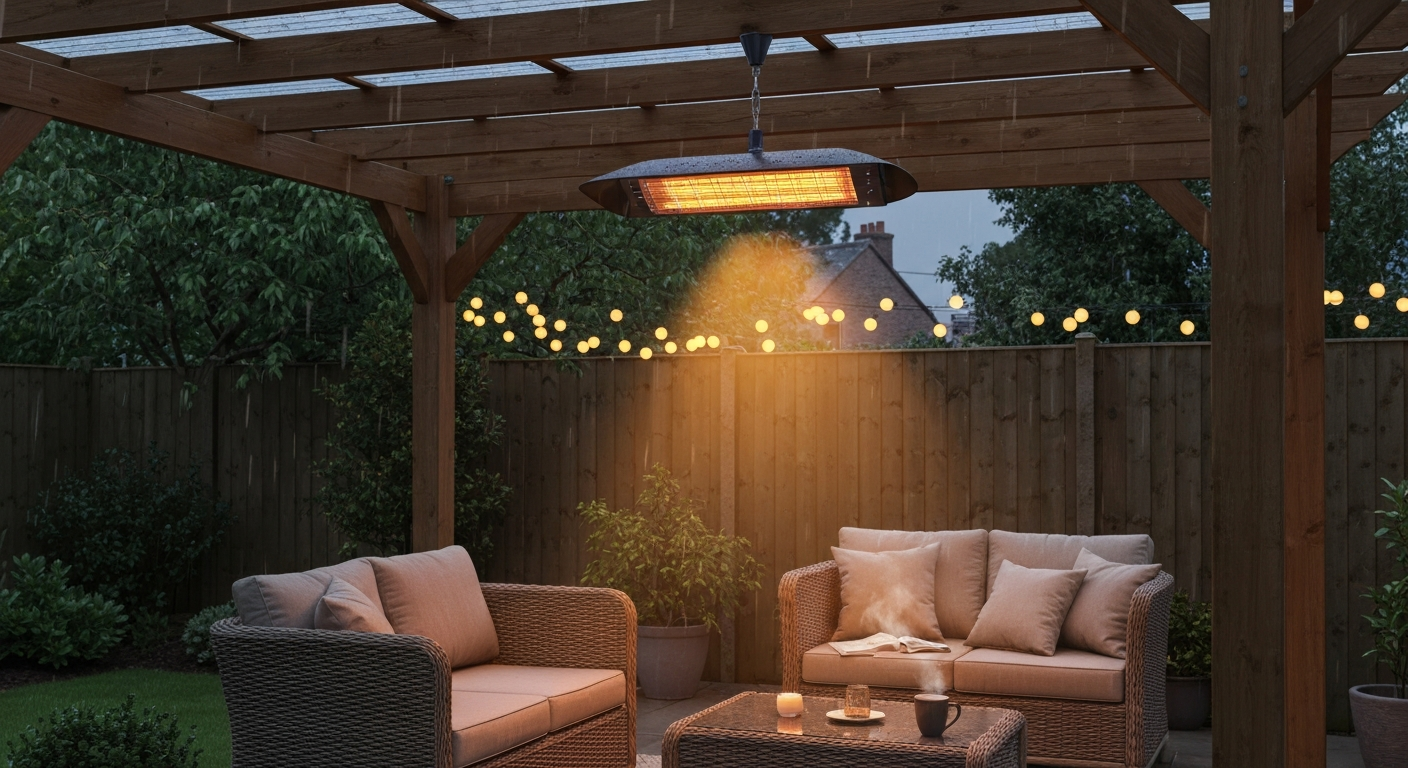
- Hero image: A pendant electric infrared heater installed under a timber pergola with warm evening light — shows a realistic UK garden setting with the heater in context.
- Close-up installation shot: The mounting bracket and ceiling hook detail of a hanging heater, showing the chain/cable and strain-relief point, with an IP rating label visible on the heater body.
- Comparison graphic: A side-by-side heat coverage illustration showing 2kW electric coverage (approx. 8m²) versus 6kW propane coverage (approx. 14m²) over a patio plan.
- Cylinder storage photo: A propane cylinder in an outdoor ventilated cage to illustrate safe UK LPG storage practice.
- Comparison table screenshot: A styled table visual of the shortlisted models with coloured 'best for' tags for social/featured snippet use.
Common UK Questions, Answered
Do I need a permit to install a hanging patio heater?
For a plug-in electric heater: no permit needed. For a hard-wired electric heater: the work is notifiable under Part P of the Building Regulations and must be certified by a qualified electrician. For a fixed gas heater: installation by a Gas Safe registered engineer is legally required, and the engineer will issue a completion certificate. No separate planning permission is generally needed for a domestic patio heater, but check with your local authority if you're in a listed building or conservation area.
What IP rating do I need for an outdoor patio heater?
For a covered patio (pergola, lean-to with solid roof): IP44 minimum. For a semi-covered area where rain can blow in from the sides: IP55 or higher. For a fully exposed position with no overhead cover: IP65 minimum. The IP code's second digit refers to water resistance, 4 means splash-proof, 5 means water jets, 6 means powerful water jets. In the UK's wet climate, erring toward IP55 is sensible for any pendant or wall-mounted heater.
How many kW do I need for my patio?
As a starting point: 1.5–2kW for a covered area up to 10m², 3–4kW for a covered area of 10–20m², 6–8kW for a semi-open area of 15–25m², and 10kW+ for large open terraces. These figures assume no wind. A covered patio retains heat far better, so you can get away with a lower-output heater in a pergola than on an open deck of the same size.
Are propane cylinders readily available in the UK?
Yes. Calor and Flogas are the main suppliers. Calor's 5kg, 11kg, and 19kg propane cylinders are available on exchange at most large DIY stores (B&Q, Wickes), petrol stations, and hardware retailers. You pay a deposit on your first cylinder and then exchange it for a refilled one. Butane (the blue Calor cylinders) is cheaper but less suitable for cold weather, propane performs better below 5°C, making it the correct choice for UK patio use from autumn through spring.
Final Recommendation Grid
| Use Case | Top Pick | Why |
|---|---|---|
| Best for covered patio | Kettler Kalos 2kW Electric Pendant | Easy plug-in install, IP44, sufficient output for enclosed pergola |
| Best for uncovered/exposed patio | Napoleon PHD122 Propane 11kW | High output overcomes wind and open-air heat loss |
| Best budget | VonHaus 1.5kW Wall Heater | Under £80, plug-in, IPX4, no installation costs |
| Best premium | Bromic Tungsten Smart-Heat Electric 2.3kW | Precision directional heat, smart controls, best build quality |
| Best wall-mounted | Lifestyle Alfresco NG Wall Heater 4.2kW | Lowest running cost, permanent fixed install, mains gas |
| Best electric hanging | Heat Outdoors Shadow Pendant 2kW | IP65, silent dark emitter, premium build for damp UK conditions |
Final Thoughts and Next Steps
For the majority of UK buyers, an electric infrared pendant heater in the 2kW range is the most practical starting point: no gas work, no cylinder logistics, just a ceiling hook and an outdoor socket. If you have a larger covered area or want to entertain outdoors even in the colder months, stepping up to a 6–11kW propane unit delivers noticeably more heat. Natural gas is the cheapest to run long-term but requires a Gas Safe engineer and a fixed pipe, factor that installation cost in from the start.
Before you buy, run through the buying checklist: measure your patio, confirm your ceiling height, check the IP rating against your specific location, and get a quote for any required installation work. Don't forget to register the product after purchase to stay informed of any safety recalls via Electrical Safety First or GOV. See The UK’s new product safety framework, GOV.UK (product safety & recalls context) for official guidance on product safety, recall procedures and links to OPSS alerts The UK’s new product safety framework — GOV.UK (product safety & recalls context). UK product safety alerts.
If you want to go deeper on specific formats, the hanging patio heater reviews section covers individual model testing in more detail, the wall mounted patio heater reviews guide focuses on bracket-mounted options, and the best mounted patio heater guide compares fixed formats across fuel types. There's a lot of overlap between these categories, so following the format that best matches your specific patio setup is the fastest route to a decision you won't regret come October.
FAQ
What primary research questions must be answered to write an accurate UK‑focused review and buying guide for “best hanging patio heater uk”?
Which heater fuel types and formats are relevant to UK buyers (propane, natural gas, electric, pellet; hanging/ceiling, wall‑mounted, infrared pendant, tabletop)? What are the real heat outputs (kW/BTU) and effective coverage areas for shortlisted models under UK conditions? What are minimum ceiling heights, mounting requirements and IP/weather ratings for safe outdoor installation? Which models require Gas Safe‑registered installation or qualified electrical work under BS 7671? What are realistic running costs in the current UK price‑cap period (electricity p/kWh, gas p/kWh) and typical efficiency figures? What are cylinder supply/size/compatibility and safe storage rules for LPG/propane in the UK? What are documented safety issues, recalls or reliability themes for candidate models? What typical maintenance, warranty and spare‑parts expectations apply? What retailer availability and current UK prices (including SKUs/timestamps) determine “best buy” recommendations?
Which authoritative UK regulations and guidance documents are essential sources for gas‑heater installation and safety?
HSE guidance and the Approved Code of Practice L56 (Safety in the installation and use of gas systems and appliances) and the HSE gas pages for ventilation and CO guidance; Gas Safe guidance and Gas Safe register pages to determine which installations require a Gas Safe engineer. Use these to cite legal/competency requirements, ventilation/exclusion zones, and commissioning responsibilities.
Which UK electrical standards and guidance are required for electric and hard‑wired hanging heaters?
BS 7671 (IET Wiring Regulations) as the technical standard for fixed wiring; Electrical Safety First guidance and pocket guides that explain how BS 7671 applies to outdoor fixed appliances (earthing, RCD protection, circuit sizing). Use Electrical Safety First’s patio‑heater guidance and recall checker for safety bulletins, minimum IP recommendations and plug vs hard‑wire distinctions.
What consumer‑facing price and running‑cost sources should be used to calculate operating costs?
Ofgem’s energy price‑cap unit rates and standing charges for the current cap period (canonical public reference for electricity and gas pence/kWh). Combine these with manufacturer power/consumption figures (kW or BTU) to produce worked examples for typical use patterns (e.g., 2 kW for 3 hours).
What product data and retailer sources are needed to capture accurate model specs and pricing?
Manufacturer datasheets and downloadable product manuals/PDFs (preferred) for definitive kW/BTU, dimensions, mounting instructions, minimum ceiling height, IP rating, controls, noise dB, efficiency and warranty. Major UK retailers and specialist sellers (Heat Outdoors, Wickes, Screwfix, B&Q, SparksDirect, Amazon.co.uk) for SKU/price snapshots and buyer review counts. Capture timestamped screenshots or archived URLs to support price claims.
How should I check product safety history and recalls for candidate models?
Search GOV.UK product‑safety/OPSS alerts, Electrical Safety First recall checker, Trading Standards notices and recall aggregators (RecallRadar). Cross‑reference manufacturer recall pages and retailer safety notices to identify past faults (electrical, regulators, cylinder fittings) that affect trustworthiness.