
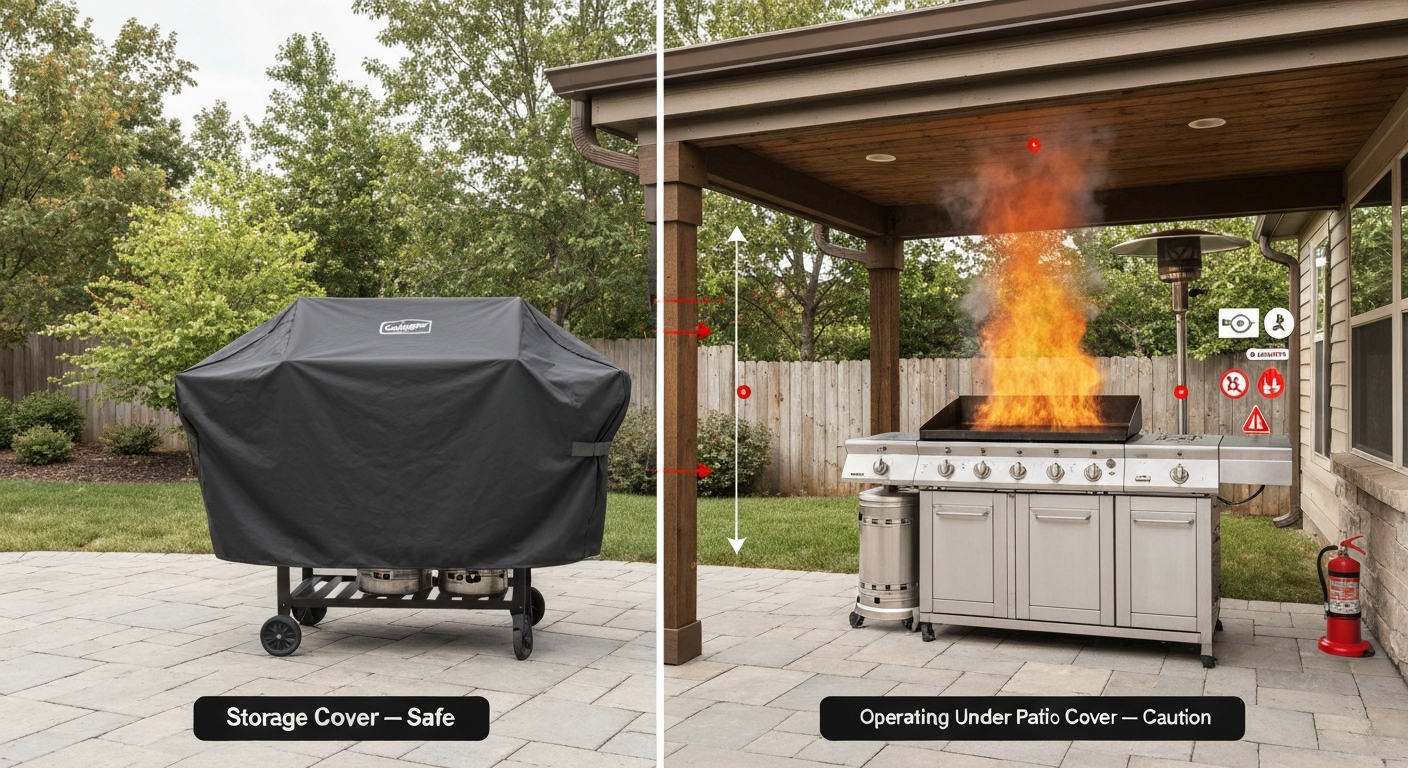
When people search 'Camp Chef flat top grill patio cover,' they almost always mean one of two completely different things: either they want a weather-protection cover to store their griddle safely between cooking sessions, or they want to know if it is safe to run their Camp Chef flat top under an overhead patio cover (a roof, pergola, or awning) while they cook. Both questions matter, and the answers are very different. A protective storage cover is something you absolutely should use once the grill cools down. Running a propane or natural-gas flat top underneath a closed patio roof is something you should approach with extreme caution, clear-headed safety planning, and local code awareness before you light a single burner.
Camp Chef Flat Top Grill Patio Cover: Safety, Covers & Setup.

Willa Brennan
6 Aug 2026
The Two Things People Mean by 'Patio Cover'
It is worth spelling this out plainly because mixing up the two concepts can lead to real danger. A storage cover or grill cover is a fitted vinyl or polyester shroud you drape over your Camp Chef flat top after cooking is done and the unit has cooled completely. It protects the steel cooking surface, burners, and control knobs from rain, UV rays, bird droppings, and general seasonal abuse. A patio cover, on the other hand, is a permanent or semi-permanent overhead structure attached to or positioned near your home: a roof extension, a wood-framed pergola with a solid or lattice ceiling, a retractable awning, a screened-in porch ceiling, or a gazebo roof. Operating a fuel-burning grill underneath that overhead structure is the safety question, and it carries fire, carbon monoxide, and insurance implications that the storage-cover question does not.
How Camp Chef Flat Top Grills Actually Work
Camp Chef's flat-top griddle lineup runs on rolled-steel cooking surfaces heated by open burners underneath. The flame heats the steel plate directly rather than cooking over open grates, which means the entire surface becomes a uniform radiant cooktop. The most popular models right now are the Gridiron 36 (FTG36, a four-burner propane unit), the Flat Top 600 / FTG600 series (four burners, roughly 604 sq. in. of cooking surface, assembled dimensions around 64 inches wide by 24.5 inches deep by 42 inches tall with the cart), and the smaller portable VersaTop, FTG250, and FTG275 variants designed for tailgating or tighter spaces. Nearly all consumer-facing Camp Chef flat tops run on liquid propane (LP) out of the box, and some can be converted to natural gas with appropriate conversion kits or purchased in hard-piped NG versions.
In terms of BTU output, the four-burner 600-series models are typically rated in the range of 48,000 to 55,000 BTU total across all burners, depending on the specific SKU. That is not a small amount of heat. Pellet-driven flat tops exist in the broader Camp Chef ecosystem (Camp Chef also makes pellet smokers, some of which include griddle accessories), and electric options appear at the portable end of the market. Each fuel type behaves differently under a covered structure, and that difference drives most of the safety guidance below.
| Model | Fuel | Burners | Cooking Area (approx.) | Key Use Case |
|---|---|---|---|---|
| Gridiron 36 / FTG36 | Liquid Propane | 4 | 604 sq. in. | Backyard cart-style griddle |
| Flat Top 600 / FTG600 series | LP (NG conversion available) | 4 | ~604 sq. in. | High-output family/crowd cooking |
| FTG250 / FTG275 VersaTop | Liquid Propane | 2 | ~285–330 sq. in. | Portable, camping, tailgate |
| Pellet griddle attachment models | Wood pellets | N/A (convection heat) | Varies by smoker base | Low-and-slow with griddle surface |
| Portable electric flat top | Electric (120V) | Electric coils | Varies | Small covered spaces, low-heat tasks |
Picking the Right Protective (Storage) Cover for Your Camp Chef Flat Top
This is the simpler of the two topics, but there are still a handful of details that trip people up. The most important one is sizing. Marketplace listings for 'Camp Chef Gridiron 36 cover' or 'Camp Chef FTG600 cover' often reference only the cooking surface width, not the full assembled dimensions of the grill with its cart, side shelves, and control panel housing. Before you buy a cover, measure your specific unit's assembled width (including side shelves), depth (including the front control area and any rear propane tank clearance), and overall height to the top of the lid or handle. For the FTG600, that can push close to 64 inches wide, and a cover sized for a 36-inch cooking surface will not fit the cart.
Cover Materials: What to Look For
Most third-party covers marketed for Camp Chef flat tops use 600D polyester with a PVC (polyvinyl chloride) backing, and that is generally the right choice for outdoor weather protection. 600D refers to the thread density (denier), and the PVC laminate on the interior face is what delivers waterproofing. You may also see 420D or 300D options, which are lighter-weight and fine for mild climates but less durable in heavy rain or sun-heavy environments. Look for welded or taped seams rather than just sewn seams, because stitching holes are the most common moisture infiltration point in cheaper covers. Drawcord closures or adjustable straps at the bottom hem keep the cover from blowing off in wind.
- 600D polyester with PVC coating: best all-around durability for outdoor storage
- Welded or heat-taped seams: waterproof at stress points; stitched-only seams let moisture in
- Drawcord or strap closure: prevents wind lift; look for side buckles on larger cart covers
- Vents or air pockets: allow airflow to prevent mold and mildew buildup under the cover
- UV inhibitor treatment: slows fading and material degradation in direct sun
- Soft interior lining: protects the griddle surface and control knobs from scratching
One thing to verify: Camp Chef does not always include a protective cover in the box with its flat-top units. Retail product pages at major chains like Home Depot and Costco confirm this for many SKUs. If you bought a Camp Chef flat top and found no cover inside, that is normal. Check Camp Chef's own accessories page for OEM part numbers first, because third-party 'fits FTG36' or 'fits FTG600' labels on marketplace listings are based on approximate measurements and not always verified against the manufacturer's assembly dimensions. When in doubt, call Camp Chef's customer support line with your model number and ask for the recommended cover SKU.
Weather Ratings and What They Actually Mean
Cover manufacturers use terms like 'waterproof,' 'water-resistant,' and 'UV-rated' somewhat loosely. A PVC-coated 600D cover is genuinely waterproof during normal rain if the seams are sealed. 'Water-resistant' typically means the material resists light rain but will eventually saturate under sustained downpour. UV ratings are rarely published as a specific measurement in grill-cover marketing; 'UV-resistant' simply means the fabric has some UV stabilizer mixed in or applied, which slows degradation. For most backyards, a 600D PVC cover stored in a covered patio area (ironically) when not in use will outlast one that sits in direct sun all day every day. If your grill lives in full sun year-round, prioritize UV-stabilized fabric and expect to replace the cover every two to three seasons regardless.
Keeping Your Cover in Good Shape: Care and Seasonal Storage
The single rule that both Camp Chef materials and virtually every grill manufacturer manual repeats is this: never put a cover on a hot grill. Some manuals phrase it as 'NEVER COVER GRILL WHEN HOT.' The reason is simple: trapped heat and residual combustion gases can degrade or melt the cover's PVC lining, create a fire risk, and in some manufacturer warranty language, void coverage for heat-related cover damage. Wait until the griddle surface has cooled to ambient air temperature, which on a 55,000 BTU unit can take 30 to 60 minutes after the last burner shuts off. If you are rushing, use an infrared thermometer to spot-check the surface; aim for under 100°F before covering.
- Always allow the flat top and cart to cool fully to ambient temperature before covering (typically 30–60 minutes after shutdown)
- Wipe the griddle surface dry before covering to prevent moisture trapping and rust
- Remove the cover periodically on dry days to let residual moisture under the cover evaporate
- Inspect the cover every few weeks for tears, mold spots, or failed seams — catch small issues before they become big ones
- Clean the cover with mild soap and water, rinse thoroughly, and air-dry completely before refolding or storing
- For seasonal storage, remove the cover from the grill, fold it loosely, and store flat or rolled in a dry indoor space — do not compress PVC-coated covers tightly for long periods because the coating can crack at fold lines
- At the start of each season, reinstall and check that the cover's vents are unobstructed and drawcords are intact
Can You Actually Use a Camp Chef Flat Top Under a Patio Cover? Safety and Code Reality
This is where the conversation gets serious. Most major grill manufacturer manuals, including language consistent with Camp Chef's own operator documentation, include an explicit warning that the appliance is for outdoor use only and should not be operated under roof overhangs, carports, awnings, or any overhead construction. Turbo and Napoleon owner manuals similarly warn that outdoor gas or charcoal grills are for outdoor use only and must not be used under roof overhangs, carports, awnings, or any overhead construction Turbo and Napoleon owner manuals similarly warn that outdoor gas or charcoal grills are for outdoor use only and must not be used under roof overhangs, carports, awnings, or any overhead construction.. This is not a suggestion. The combination of open-flame combustion, heat accumulation beneath a low ceiling, and restricted airflow creates both fire and carbon monoxide (CO) hazards. NFPA data has historically reported around 8,900 home grill fires per year in the U.S., with a significant portion involving structures, decks, or overhangs. The CPSC and CDC both emphasize that fuel-burning appliances in confined or semi-enclosed spaces can build up lethal CO concentrations before anyone in the area notices symptoms.
From a code standpoint, the International Fire Code (IFC) section addressing open-flame cooking devices prohibits operating charcoal burners and other open-flame cooking devices within 10 feet of combustible construction. The International Fire Code (IFC) §308.1.4 prohibits operating charcoal burners and other open‑flame cooking devices on combustible balconies or within 10 feet (3048 mm) of combustible construction IFC §308.1.4. Many local jurisdictions adopt this baseline or add stricter amendments. Some fire marshal offices explicitly prohibit use under roofed porches or within specified horizontal and vertical clearances of any combustible material. Insurance policies are another layer: a fire that starts while a grill is being operated under a wood pergola or attached roof overhang may trigger a coverage exclusion if the insurer can show the grill was operating against manufacturer guidelines or local fire code. Check with your homeowner's insurance carrier and local fire marshal before you make covered-patio grilling a regular practice.
Clearance and Risk by Fuel Type
| Fuel Type | CO Risk | Fire/Flame Risk | Covered Patio Suitability | Key Clearance Consideration |
|---|---|---|---|---|
| Liquid Propane (LP) | High — open flame, incomplete combustion possible | High — open burners, grease fire risk | Not recommended without significant open-air ventilation and clearance | 10 ft from combustible construction (IFC baseline); check ceiling height minimum |
| Natural Gas (hard-piped) | High — same combustion chemistry as LP | High — same flame/grease risk, no tank to move | Same restrictions as LP; harder to relocate if setup is wrong | Same IFC setbacks apply; permanent piping adds complexity |
| Pellet (wood pellets) | Moderate-High — smoldering combustion, smoke and CO | Moderate — smolder and spark risk, but lower open flame than LP | Generally not suitable under a closed or low-clearance overhead cover | Smoke and particulate accumulation under cover is an additional problem |
| Electric flat top | Very Low — no combustion, no CO production | Low — grease fire remains possible but no open flame | Most suitable for covered patios; check grease-fire clearance and GFCI requirements | Grease fire risk remains; maintain ceiling clearance from hot surface |
The electric flat top is genuinely the safest option for a fully covered patio. No combustion means no carbon monoxide, and no open flame dramatically reduces the ignition risk. Grease fires remain possible on any flat top regardless of fuel, so ceiling height and non-combustible surface requirements still apply, but the CO argument goes away entirely. If you have a covered patio and want to cook on a flat-top surface regularly, an electric griddle is worth serious consideration as a dedicated covered-space appliance. For options and comparisons suited to covered patios, check recent electric patio grill reviews to compare features, safety, and performance. That said, most Camp Chef flat tops in consumer hands are LP-fueled, so the rest of this article focuses on making LP use as safe as possible when you are near or under a patio structure.
Ventilation, Heat Shielding, and Surface Choices for Covered Patios
If you have done the code and insurance homework and you are still planning to use your LP or natural-gas Camp Chef flat top under or very near a patio cover, there are specific structural and accessory considerations that reduce (though never eliminate) the risk. Start with vertical clearance. Most fire safety references point to a minimum of 9 to 10 feet of vertical clearance between the cooking surface and any overhead combustible material, and some authorities cite higher figures for appliances with high BTU output. A four-burner Camp Chef at 48,000-plus BTU generates a substantial heat plume. Measure from the top of the griddle surface (or lid if equipped) to the lowest point of the patio ceiling or overhang.
Horizontal clearance matters as much as vertical. Keep the grill at least 10 feet from combustible vertical surfaces like wood siding, fencing, lattice, or the home exterior wall. Non-combustible patio flooring under and around the grill is strongly preferred. If your patio surface is wood decking, composite decking, or any combustible material, place a non-combustible grill mat or steel/cement paver directly under the unit. Many grill mats marketed for outdoor use are fiberglass or flame-retardant fabrics; for a high-output flat top, a porcelain-coated steel mat or a cement paver is a more reliable non-combustible barrier than fabric-based mats.
Vent Hoods and Heat Deflectors
If you have a covered patio kitchen setup with a permanent overhead structure, a professionally installed commercial-style vent hood rated for outdoor use can channel heat, smoke, and grease vapor up and away from the ceiling. These are not cheap or easy DIY projects, but they are the correct solution for a permanent outdoor kitchen with a covered ceiling. Heat deflectors (angled metal shields that redirect heat horizontally before it rises to the ceiling) are a supplementary option, not a substitute for vertical clearance and open-air ventilation. An open-sided pergola with a lattice or slatted roof provides far more ventilation than a solid covered patio roof and significantly reduces heat and CO accumulation risk, but the IFC setback from combustible construction materials in the pergola frame still applies.
Flooring and Ceiling Material Considerations
Concrete, tile, stone pavers, and brick are all non-combustible and appropriate under and around a flat-top grill. Wood decking, composite decking, and vinyl flooring are combustible and should be separated from the grill by a non-combustible pad of sufficient size to catch any grease drips or spark. For the ceiling, unpainted concrete or metal roofing is non-combustible; painted or treated wood beams, vinyl panels, and polyester shade sails are all combustible and should be outside the heat plume zone. Patio string lights and plastic fixtures within a few feet of the heat column are also a practical fire concern worth relocating.
Accessories and Setup Advice for a Safer, Better Outdoor Kitchen
CO Detectors and Fire Extinguishers
If you are using any fuel-burning grill near your home, a battery-operated CO detector placed near the cooking area (not inside the home only) adds a meaningful safety layer. For related outdoor heating options and user feedback, see Master Forge patio heater reviews for independent evaluations and user experiences. CO is colorless and odorless, and symptoms of mild exposure (headache, dizziness) can be mistaken for heat fatigue. CPSC guidance recommends CO alarms in the home; outdoor-rated CO detectors are worth the investment for any semi-enclosed cooking area. A Class K or ABC dry-chemical fire extinguisher rated for grease fires should be within arm's reach of any high-output griddle, covered or not. Check and recharge annually. If you also want to extend outdoor comfort on cool evenings, see nexgrill patio heater reviews for options and performance notes.
Grill Mats and Wind Guards
A grill mat under the flat top catches grease drips and protects your patio surface. As mentioned above, favor porcelain-coated steel or heavy cement-board products over fabric mats for a high-BTU propane unit. Wind guards designed for Camp Chef flat tops attach to the perimeter of the cooking surface and help maintain consistent griddle temperatures in breezy conditions. Under a partially open patio cover, wind patterns can be unpredictable as air channels between openings, so a wind guard can genuinely improve cooking performance and reduce flare-up risk from wind-driven flame disruption.
Regulators, Hoses, and Natural Gas Connections
LP flat tops ship with a regulator and hose designed for standard 20-lb propane cylinders. If you are connecting to a larger bulk tank or converting to natural gas, use only Camp Chef-approved conversion kits and regulators rated for the specific model's BTU output and inlet pressure. Never use a regulator or hose that is cracked, kinked, or showing signs of UV damage (visible chalking or brittleness). A leak-detection solution (soapy water or a commercial leak-check spray) should be part of every seasonal setup check. For natural-gas connections, have a licensed plumber install and pressure-test the line; this is not a DIY hose-and-fitting job.
Anchoring and Leveling
Camp Chef flat-top carts have wheels, which is convenient for moving the grill but creates a tip risk on sloped patios or in wind. Lock the wheels before each cooking session and, on paved surfaces with any slope, use wheel chocks. On a covered patio where the floor may be a more consistent grade, leveling is still important because an unleveled flat-top surface causes pooling oil and uneven heat distribution. Most Camp Chef carts have leveling feet or can be shimmed; a small torpedo level placed on the cooking surface before lighting identifies any issues quickly.
How Camp Chef Flat Tops Compare to Other Grill Types for Covered Patios
Flat-top propane griddles occupy a specific safety niche compared to other outdoor cooking options. Open-grate propane and gas grills carry similar combustion and clearance requirements but add the variable of direct flame contact with food drippings, which increases flare-up risk. Charcoal grills are generally considered the most problematic for any covered or semi-enclosed space: they produce higher CO output per cooking session, generate sparks and airborne embers, and have no quick shutoff. If you have explored charcoal options like the Char-Griller Patio Pro series, you will find that those units face the same or stricter covered-space restrictions as LP flat tops, with the added ember and spark concern. For hands-on comparisons and user feedback on patio-style grills, see flips patio grill reviews. Electric flat tops and electric grills broadly represent the most covered-patio-compatible option in the grill category, though they sacrifice the high heat output and fuel flexibility that make Camp Chef LP flat tops popular for high-volume cooking. For model comparisons and buyer guidance, see our patio gas grill reviews to help choose the right covered-patio option. For a direct comparison with similar propane models, see our Char Griller Patio Pro review.
Decision Checklist: Can You Use Your Camp Chef Flat Top Under Your Patio Cover?
Work through this checklist honestly before setting up for a cook under your overhead structure. If you cannot check all the boxes that apply to your fuel type, consider relocating the grill or switching to an electric alternative for covered-space cooking.
- Read your Camp Chef model's owner manual safety section and confirm it does not prohibit use under overhead construction (most do prohibit it or set explicit clearance requirements)
- Check your local jurisdiction's adoption of IFC or applicable fire code for open-flame cooking device setbacks (typically 10 ft from combustible construction)
- Measure vertical clearance from the griddle surface or lid to the lowest point of the overhead cover — compare against manufacturer guidance and local code minimums
- Measure horizontal clearance from all sides of the grill to combustible walls, fences, and siding (10 ft IFC baseline)
- Confirm the patio floor under and around the grill is non-combustible, or place a verified non-combustible pad beneath the unit
- Assess overhead ventilation: is the cover open on at least two or three sides (pergola-style), or is it a solid roof with limited air movement? Solid roofs with limited openings are not safe for LP combustion appliances
- Confirm ceiling and overhead structural materials: are beams, panels, or shade structures combustible? If yes, the 10-ft clearance rule applies vertically and horizontally
- Verify your homeowner's insurance policy does not exclude structure-related fire claims when a grill is operated within the prohibited zone
- Install a CO detector in or immediately adjacent to the covered area if using any fuel-burning appliance nearby
- Have a Class K or ABC fire extinguisher accessible within arm's reach
- If converting to or using natural gas, confirm a licensed plumber installed and pressure-tested the line
- If any of the above checks fail, strongly consider an electric flat-top griddle as your covered-patio cooking solution
Choosing a Protective Cover: Quick Model-to-Cover Reference
Because cover sizing errors are so common with Camp Chef flat tops, here is a practical reference. Always confirm against the actual assembled dimensions listed on your specific model's product page or owner manual, as Camp Chef updates configurations and accessories periodically.
| Camp Chef Model | Approx. Assembled Width (with cart/shelves) | Cover Type to Seek | Key Fit Notes |
|---|---|---|---|
| FTG36 / Gridiron 36 | ~52–54 in. (confirm with manual) | Heavy-duty cart cover, 600D PVC, drawcord | Cooking surface is 36 in.; cart and shelves are wider — size cover to full assembled width |
| FTG600 / Flat Top 600 series | ~64 in. | Large cart cover, 600D PVC with straps and vents | Four-burner cart is one of Camp Chef's widest; confirm cover fits full depth including front controls |
| FTG250 / FTG275 VersaTop portable | ~30–34 in. (folded with legs) | Portable grill cover or carry bag, 420–600D | These fold for transport; a fitted carry bag may be more useful than a drape cover |
| Pellet griddle add-on (smoker base) | Matches pellet smoker model dimensions | Cover for the base pellet smoker model | Use the cover sized for the specific pellet smoker SKU; griddle attachment does not change overall footprint significantly |
If you want an OEM-exact fit, visit Camp Chef's accessories section and search by your model number. Third-party covers from major retailers labeled 'fits FTG36' or 'fits FTG600' are widely available in 600D PVC polyester with wind straps and vents, and most work well at a lower price point, but the sizing disclaimer above applies. Read the listed cover dimensions in inches, not just the model-fit label, and compare them to your measured grill dimensions before clicking buy.
Putting It All Together
If your goal is protecting your Camp Chef flat top from the weather, the path is straightforward: measure your assembled grill dimensions carefully, buy a 600D PVC-coated cover with vented hems and a secure drawcord or strap system, let the grill cool completely before covering it, and follow basic seasonal storage and inspection habits. That part of the 'patio cover' question is genuinely simple and makes a real difference in how long your griddle surface, burners, and finish hold up.
If your goal is cooking under an overhead patio structure, treat it as a serious safety and code question rather than a convenience one. LP and natural-gas Camp Chef flat tops are outdoor appliances designed for open-air environments. They produce carbon monoxide, generate substantial heat plumes, and can ignite combustible overhead materials. The IFC's 10-foot setback from combustible construction, manufacturer warnings against overhead use, and your insurance carrier's stance all point in the same direction. Use a covered patio as a serving and prep area, keep the grill out in the open air, and relocate or switch to an electric flat top if covered-space cooking is truly your priority. That combination of a properly covered, well-protected grill and a thoughtfully chosen cooking location is what makes outdoor flat-top cooking consistently safe and enjoyable for the long run.
FAQ
What does the search intent 'Camp Chef flat top grill patio cover' usually mean?
Users generally mean one of two things: (A) they want a protective weather/storage cover sized and rated for a Camp Chef flat top (griddle) to protect it from rain, sun and dust when not in use; or (B) they want guidance about operating a Camp Chef flat top/griddle under a patio roof or covered patio—clearances, ventilation, safety, and any code or insurance consequences.
Can I legally and safely operate a Camp Chef flat top (propane or natural gas) under a patio cover/roof?
Most manufacturer manuals and model building/fire codes say these fuel‑burning grills are for outdoor use only and should not be used in enclosed or partially enclosed spaces where combustion products or heat can accumulate. Many jurisdictions adopt the International Fire Code (IFC) language that effectively prohibits open‑flame cooking under combustible overhangs, and fire departments/NFPA/CPSC guidance advise keeping grills away from structures and overhangs. Check your local code/fire marshal and your insurance for specific prohibitions or restrictions; when in doubt do not operate under a patio roof.
If I still want to use a Camp Chef flat top on a covered patio, what minimum clearances and conditions should I follow?
If local rules allow it (rare), ensure: a) a vertical clearance to any combustible ceiling/overhang of at least 10 ft where IFC/authority requires (some authorities require 10 ft horizontally/vertically or outright prohibit); b) the grill sits on a noncombustible surface (concrete, pavers, or protected decking) and not directly on combustible decking unless a code‑approved thermal barrier is used; c) adequate cross‑ventilation so combustion gases cannot accumulate and a clear path for heat to dissipate; d) screens/walls that reduce ventilation are kept well away; and e) a working carbon‑monoxide alarm is installed in the adjacent indoor spaces. Always verify local numeric clearances with your fire marshal because jurisdictions vary.
Are there recommended ventilation or heat‑shield measures for covered patios?
Yes—recommended measures include: maximize natural ventilation (open sides, louvers); avoid wind‑blocking enclosures; install a vented hood or dedicated exhaust if the patio is semi‑enclosed and local code permits such installations (this usually requires professional design and permits); use noncombustible heat shields or rockwool‑backed panels where heat impingement on structure is possible (installed to manufacturer and code specs); and maintain clearance around the grill for air flow. Passive shielding must not trap heat—do not enclose the grill.
Does using a heat‑shield or noncombustible surface change code or insurance requirements?
Not automatically. Heat shields and noncombustible surfaces can reduce radiant heat transfer but do not eliminate hazards from combustion or CO accumulation. Many codes still prohibit open‑flame appliances under combustible roofs regardless of shields. Insurance companies may require adherence to local code and manufacturer instructions; altering the installation without permits or conflicting with codes can affect coverage. Consult the local building/fire authority and your insurer before relying on shields to justify operation under an overhang.
What should I know when choosing a weather/storage cover for a Camp Chef flat top?
Measure the assembled unit (including side shelves, front controls and rear tank clearance) before buying—retail '36-inch' or '600' labels often refer to cooking surface width only. Choose a cover made of durable outdoor material (commonly 600D PVC‑coated polyester or 420D/300D polyester with welded/taped seams), with vents to reduce trapped moisture, secure straps/drawcords to prevent wind removal, and UV‑resistant treatment. Prefer model‑specific OEM covers or well‑reviewed third‑party covers that list assembled dimensions; verify seller measurements and return policy.