
Master Forge patio heaters are a solid, budget-friendly choice for most homeowners who want reliable propane heat on a standard patio. The flagship 48,000-BTU floorstanding propane model (FHTS80001D) earns a 4.3 out of 5 from over 1,200 Lowe's customers, delivers genuine warmth across up to 200 square feet, and regularly goes on sale for under $100. The trade-off is build quality over the long haul: a meaningful minority of owners report corrosion and component wear after one to three seasons, and the pellet stove line has a notably weaker track record. If you want strong first-season performance at a low sticker price and are comfortable doing some basic maintenance, Master Forge delivers real value. If you need commercial durability or a heater for an enclosed, high-humidity space, you should look at premium alternatives.
Master Forge Patio Heater Reviews: Top Picks & Buyer Guide

Quick overview and TL;DR verdicts
Master Forge is a Lowe's house brand with a focused outdoor-heating lineup: freestanding propane heaters, vent-free natural gas wall heaters, and pellet stoves. The propane patio heaters are the strongest performers in the range, backed by recognizable safety certifications (ANSI Z83.26-2020 and CSA 2.37-2020), pulse ignition, thermocouple shutoff, tip-over protection, and a 1-year parts warranty. The pellet stoves and wall heaters are more of a mixed bag based on real customer data.
| Model / Type | BTU Output | Lowe's Rating | Best For | TL;DR Verdict |
|---|---|---|---|---|
| FHTS80001D (48k propane floorstanding) | 48,000 BTU | 4.3/5 (1,263 reviews) | Medium patios, general use | Best overall — strong heat, fair price, decent build |
| Master Forge vent-free natural gas wall heater (IR12DMF/IR18DMF/IR30DMF series) | Up to ~30,000 BTU | Limited public data | Covered patios, garages | Good option if you have gas lines; requires ventilation check |
| Master Forge pellet stove (2,500 sq ft model) | High-output stove | ~2.9/5 | Supplemental indoor/covered use | Avoid unless you're prepared for part-failure risk |
| Tabletop propane (smaller Master Forge units) | Varies (~10,000 BTU est.) | Varies | Small tables, balconies | Convenient but limited coverage |
| Infrared wall-mount variants | Varies by model | Limited public data | Directional, covered spaces | Niche pick; limited availability vs. competitors |
Who Master Forge heaters are best for
Not every buyer needs the same heater, and Master Forge is not the right answer for everyone. Here is a plain-language breakdown of who gets the most value out of this brand.
- Budget-conscious homeowners: If your ceiling is under $200 and you want a full-size freestanding propane heater, the Master Forge 48k is consistently one of the cheapest options in that category at major retailers, especially during seasonal sales.
- Lowe's regulars: Because Master Forge is a Lowe's exclusive brand, buyers who already shop there can easily handle returns, parts requests, and in-store assembly help. That ecosystem matters when something breaks.
- Occasional users: If you fire up your heater for fall evenings a few times a week rather than running it daily through a long season, you are less likely to hit the durability ceiling before the warranty period ends.
- Medium patio owners (150–200 sq ft): The 48k BTU unit is sized well for a typical mid-size deck or backyard patio. It covers up to 200 square feet without being overkill or underpowered.
- DIY-comfortable buyers: Assembly takes time and some reviewers find the instructions unclear. If you are comfortable with basic mechanical assembly and occasional maintenance, that friction is manageable.
- Renters or seasonal residents: The wheeled base makes the unit easy to move and store. For someone who does not want to hard-pipe a natural gas connection or invest in a permanent installation, a wheeled propane unit is a practical fit.
Master Forge is a harder sell for restaurant and commercial operators who run heaters for eight-plus hours a night, owners in coastal or high-humidity environments where corrosion accelerates, and buyers who want the absolute quietest, most polished-looking heater for a premium outdoor living space. Those buyers will get more mileage from commercial infrared brands like Bromic or a stainless-steel commercial unit with a longer warranty.
Top Master Forge picks by category
Best overall: Master Forge FHTS80001D 48,000-BTU propane floorstanding heater
This is the one to buy if you want a single Master Forge recommendation. It is the most reviewed, most tested, and best-documented model in the lineup. At a regular price around $169 and frequently on sale in the $84–$120 range, it delivers genuine 48,000 BTU output, covers up to 200 square feet, and runs approximately nine hours on a standard 20-pound propane tank. The stainless-steel finish holds up reasonably well for two to three seasons with basic care.
Best budget pick: FHTS80001D on sale
The same flagship model doubles as the budget pick when caught on a Lowe's seasonal sale. Prices as low as $84.50 have been observed at Lowe's promotions, which is an exceptional price for a 48k-BTU unit with electric ignition and tip-over protection. Timing your purchase around Memorial Day, Labor Day, or end-of-season clearance events is the easiest way to get strong value from this brand.
Best tabletop option: smaller Master Forge propane tabletop units
Master Forge's tabletop propane models are best suited to balconies, small bistro setups, or as a supplemental heat source alongside a full-size unit. Coverage is more limited than a floorstanding model, but the compact footprint and lower price make them practical for tight spaces. Specs vary by model year and availability, so confirm output and tank compatibility before purchasing.
Best for covered patios: vent-free natural gas wall heater (IR18DMF / IR30DMF series)
If you have a covered patio or screened porch with an existing natural gas line, the Master Forge wall-mount vent-free series is worth considering. These units mount out of the way, eliminate propane tank refills, and deliver consistent output. The key caveat: vent-free heaters are only appropriate in spaces with adequate airflow. Always verify local code compliance before installing one in a semi-enclosed area.
Best infrared option: IR-series wall heaters
Master Forge's IR-series models provide directional radiant heat that warms people and surfaces rather than the surrounding air. This makes them more wind-resistant than convective floorstanding heaters. Public consumer data on these specific models is more limited than on the flagship propane unit, so treat this as a situational pick rather than a confident primary recommendation for most shoppers.
Commercial use: not a primary recommendation
For restaurant patios, event venues, or any setting where heaters run multiple hours daily, Master Forge is not the best fit. The 1-year warranty, variable long-term durability reports, and limited commercial parts support make competing brands a safer investment. Bromic Tungsten electric models, for example, carry a 2-year heater warranty and a 7-year element warranty, and are explicitly designed for continuous commercial use.
Full model-by-model reviews and ratings
Master Forge FHTS80001D, 48,000-BTU stainless steel propane floorstanding heater
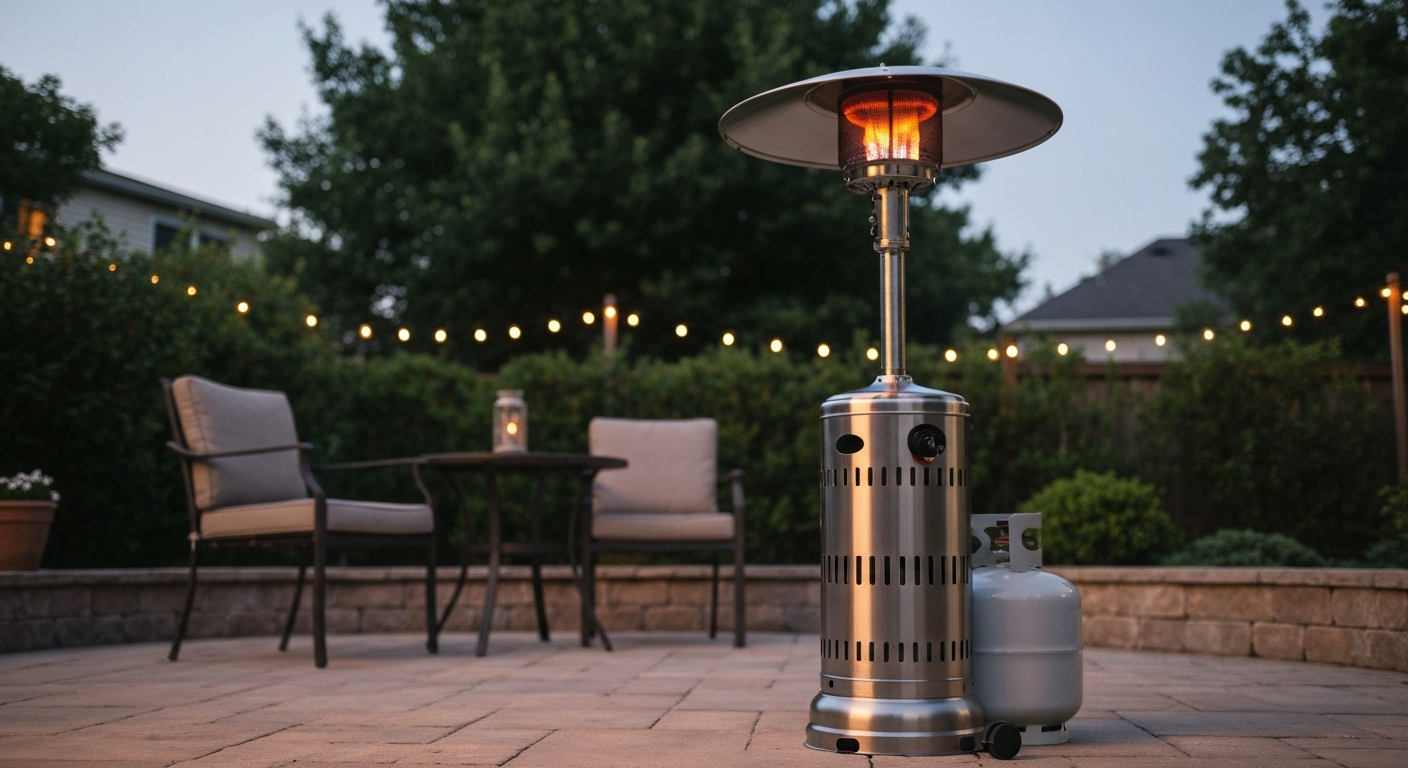
This is Master Forge's primary patio heater offering and the model with the most real-world consumer data available. It is a classic mushroom-top design in stainless steel, certified to ANSI Z83.26-2020 and CSA 2.37-2020, and sold exclusively through Lowe's. The pulse-electric ignition runs on a standard battery, which keeps lighting simple and eliminates the need for a manual piezo strike. The thermocouple safety shutoff cuts gas flow if the flame goes out unexpectedly, and the tilt-switch tip-over protection shuts the unit down if it falls. These are standard features on most quality patio heaters, but it is reassuring to see them all present on a budget model.
Heat output is legitimate. A 48,000-BTU propane heater running on a 20-pound tank will deliver roughly 0.525 gallons of propane per hour, which aligns with the manufacturer's 'up to 9 hours' burn-time claim. In calm or light-wind conditions, the heat radius is comfortable at distances of up to about eight to nine feet from the pole. In windier environments, performance drops noticeably, which is a universal limitation of convective mushroom-top designs rather than a flaw unique to Master Forge.
Assembly is the most common friction point in consumer reviews. Multiple buyers note that instructions are not always clear, parts occasionally arrive damaged or missing, and the full setup can take one to two hours. Once assembled and running, the majority of buyers are satisfied. The 4.3 out of 5 rating from over 1,200 reviews is meaningfully above average for a budget category heater and reflects genuine satisfaction with the heat output and value for money.
The durability picture is more nuanced. Most owners get a solid first and second season without issues. In the third year and beyond, a subset of owners report corrosion on the burner housing, weakening ignition performance, and wear on the thermocouple. These are common failure modes across budget propane patio heaters, not exclusive to Master Forge, but worth noting for anyone expecting five-plus years of hands-off performance.
| Category | Rating (out of 5) | Notes |
|---|---|---|
| Heat Output | 4.5 | Legitimate 48k BTU; strong warmth up to ~200 sq ft in calm conditions |
| Ignition Reliability | 3.8 | Pulse ignition works well when new; battery and electrode issues emerge over time |
| Build Quality | 3.5 | Acceptable for the price; corrosion risk after 2–3 seasons |
| Assembly Experience | 3.2 | Time-consuming; instructions could be clearer; occasional missing parts |
| Value for Money | 4.6 | Exceptional at sale price; strong at regular price |
| Safety Features | 4.5 | Thermocouple, tip-over switch, ODS — full set present |
| Overall | 4.3 | Matches the Lowe's aggregated customer rating (1,263 reviews) |
Master Forge natural gas vent-free wall heaters (IR12DMF / IR18DMF / IR30DMF series)
This family of wall-mount vent-free heaters covers output levels from roughly 12,000 to 30,000 BTU and is designed for covered patios, garages, and supplemental space heating. They connect to a natural gas supply line, so there is no tank to manage. Vent-free operation means all combustion byproducts stay in the space, which is why these are only appropriate where there is adequate ventilation and where local codes permit vent-free appliances. Public consumer review data on these models is thinner than on the flagship propane unit, so confidence in aggregated ratings is lower. Installation requires a licensed plumber or gas technician in most jurisdictions.
Master Forge pellet stoves (H-series and 2,500-sq-ft model)
This is where the Master Forge brand has its weakest record. The 2,500-square-foot pellet stove model on Lowe's carries an average rating of approximately 2.9 out of 5, and the review thread includes multiple one-star entries reporting part failures, repeated service calls, and difficulty getting warranty support. Pellet stoves are mechanically complex appliances with augers, igniter rods, control boards, and exhaust systems. In this product category, brand reliability and parts availability are critical, and Master Forge does not have the same track record as dedicated pellet stove manufacturers like Harman, Quadra-Fire, or Englander. Unless you find an exceptional deal and are comfortable with the service risk, the pellet stove line is not a confident recommendation.
Fuel-type comparison: propane vs. electric vs. natural gas vs. pellet vs. infrared vs. tabletop
Master Forge spans several fuel types, but no single fuel is the right answer for every situation. Here is an honest look at what each type does well and where it falls short, with context on how Master Forge's lineup fits into each category. For another relevant comparison, see patio gas grill reviews. For another relevant comparison, see masterbuilt electric patio grill reviews. For another relevant comparison, see electric patio grill reviews.
| Fuel Type | Master Forge Availability | Pros | Cons | Best Situation |
|---|---|---|---|---|
| Propane (freestanding) | Yes — flagship FHTS80001D | Portable, no permanent install, high BTU, fast heat | Tank refills needed, wind sensitivity, corrosion over time | Open or semi-open patios, renters, portability needed |
| Natural gas (vent-free wall) | Yes — IR series | No tank, consistent fuel cost, wall-mounted saves space | Requires gas line, code restrictions on vent-free, pro install | Covered patios with existing gas supply |
| Electric | Not a primary Master Forge category | No fuel, no emissions, precise control | High operating cost, requires outlet access | Small covered spaces, low-BTU supplement |
| Pellet | Yes — H-series/2500 model (weak reviews) | Renewable fuel, high heat output for indoor/semi-indoor use | Mechanical complexity, poor Master Forge reliability data | Not recommended in Master Forge brand |
| Infrared (gas) | Yes — IR-series wall heaters | Directional heat, wind-resistant, warms people not air | Higher upfront cost, limited availability in Master Forge | Covered patios, wind-exposed areas |
| Tabletop propane | Yes — smaller models | Compact, affordable, easy to move | Limited coverage, small tank, not for large spaces | Balconies, bistro tables, supplemental heat |
For most outdoor patio heating needs, propane freestanding and natural gas wall-mount options cover the widest range of use cases. Electric heaters are excellent for covered, low-wind spaces but are not a Master Forge strength. Pellet stoves from Master Forge carry too much reliability risk to recommend confidently. If you want a great electric patio heater or a premium infrared solution, you are better served by brands that specialize in those categories.
Key performance metrics explained
BTU and heat output
BTU (British Thermal Units) measures how much heat a burner produces per hour. For outdoor heaters, 40,000–50,000 BTU is the standard output range for full-size freestanding propane models. Master Forge's flagship hits 48,000 BTU, which is competitive in that range. Higher BTU does not automatically mean better warmth in practice, because outdoor heat dissipates quickly. Wind conditions, the design of the heat reflector, and whether the heat is radiant (directional) or convective (ambient) all matter as much as the BTU number.
Coverage area
Lowe's lists the Master Forge 48k unit as covering 'up to 200 square feet.' That claim assumes calm wind conditions and an open outdoor space. In real use, the effective warm zone is roughly a 9-foot radius circle around the heater (about 250 sq ft geometrically, but with heat concentration closer in). Do not expect even warmth at the edges of that zone in any breeze above about 5–10 mph. Brands like Bromic publish detailed 'heat bloom' maps for their models because simple BTU-per-square-foot math does not work reliably outdoors.
Runtime
Propane fuel math is straightforward. Liquid propane contains roughly 91,500 BTU per gallon. A 20-pound tank holds about 4.7 usable gallons, which equals approximately 430,000 BTU total. Running a 48,000-BTU heater continuously, you burn through roughly 0.525 gallons per hour, giving you approximately 8.8 to 9 hours of continuous runtime per tank. This matches the manufacturer's 'up to 9 hours' claim and is a reliable planning figure.
Build quality
The FHTS80001D uses a stainless-steel housing, which is appropriate for outdoor use. However, 'stainless steel' covers a wide range of grades and thicknesses. Budget heaters like this one typically use thinner gauge material than commercial units, which is why corrosion and denting show up in multi-year ownership reports. Covering the heater during off-season storage and wiping down the reflector and burner housing after use significantly extends the usable life.
Ignition reliability
The pulse-electric ignition uses a battery-powered spark to light the pilot. This is easier to use than a manual piezo striker. The most common ignition failures over time are a dead or corroded battery, a fouled electrode gap, or a weak thermocouple that does not hold the gas valve open. All of these are diagnosable and fixable with basic tools and inexpensive replacement parts.
Portability
The FHTS80001D includes a wheel kit, which makes moving the heater across a deck or patio easy enough for one person. It is not a carry-anywhere unit, but storing it in a garage or shed at the end of the season is practical. At roughly 35–40 pounds without the propane tank, it is manageable without assistance.
Assembly
Consumer feedback consistently flags assembly as the most frustrating part of owning a Master Forge heater. Plan for one to two hours and have a second person help align the pole sections and attach the reflector housing. Read the full manual before starting rather than following parts-by-parts. A Phillips-head screwdriver and an adjustable wrench are the main tools needed.
Warranty
The manufacturer's manual includes a 1-year parts warranty. This is standard for budget patio heaters but well below the 2-year (heater) and 7-year (elements) commercial warranty offered by brands like Bromic. For the price point, a 1-year warranty is acceptable, but it does mean that component failures in year two and beyond come out of your pocket.
Side-by-side spec and performance table
| Spec | Master Forge FHTS80001D | Fire Sense 46,000-BTU Propane | Dyna-Glo 48,000-BTU Propane | Bromic Tungsten Electric 4kW |
|---|---|---|---|---|
| BTU / Output | 48,000 BTU | 46,000 BTU | 48,000 BTU | ~13,650 BTU (4kW electric) |
| Coverage Area | Up to 200 sq ft | ~150–200 sq ft | ~150–200 sq ft | ~130 sq ft (directional) |
| Runtime per tank/fill | ~9 hrs (20-lb tank) | ~9 hrs (20-lb tank) | ~9 hrs (20-lb tank) | Continuous (electric) |
| Ignition | Pulse electric (battery) | Pulse electric | Pulse electric | Electronic switch |
| Fuel Type | Liquid propane | Liquid propane | Liquid propane | Electric (240V) |
| Weight (approx.) | ~35–40 lbs | ~35 lbs | ~38 lbs | ~22 lbs (wall mount) |
| Warranty | 1 year (parts) | 1 year | 1 year | 2 yr heater / 7 yr elements |
| Regular Price (July 2026) | ~$169 (sale ~$84) | ~$150–$200 | ~$180–$250 | ~$775–$1,210 |
| Safety Certifications | ANSI Z83.26 / CSA 2.37 | CSA certified | CSA certified | ETL / cETL |
| Customer Rating | 4.3/5 (1,263 reviews) | Varies by retailer | Varies by retailer | Commercial — limited public reviews |
Real-world performance notes and aggregated consumer feedback
What owners consistently praise
- Heat output: The 48,000-BTU output gets consistent praise for generating strong, immediate warmth. Most owners say it exceeded their expectations for the price.
- Value at sale prices: Buyers who purchased during promotions (below $120) overwhelmingly rate the unit highly and say they would buy again.
- Ease of use once assembled: The push-button ignition and simple knob controls get positive marks from owners who are not mechanically inclined.
- Tip-over protection and thermocouple: Several reviewers mention peace of mind from knowing the safety shutoffs work correctly — some tested them intentionally.
Recurring complaints
- Assembly frustration: Unclear instructions, heavy packaging, and occasional missing or pre-damaged parts are the most cited complaints in Lowe's Q&A and review sections.
- Corrosion after one to three years: Multiple owners report rust or surface degradation on the burner housing and reflector, particularly in humid climates or when the unit is left outdoors uncovered.
- Ignition problems over time: Battery-powered pulse igniters lose effectiveness as the electrode corrodes or misaligns. Many owners resort to lighting manually with a long grill lighter after the first season.
- Wind sensitivity: Like all mushroom-top convective heaters, the Master Forge 48k struggles in winds above around 10 mph. The flame can flicker or extinguish, and the ODS safety shutoff may trip.
Durability and noise
The unit operates quietly, there is a low burner roar at full output, similar to any propane appliance, but no fan noise. Durability is the real variable. Owners who store the heater indoors or under a cover during the off-season and who wipe down the reflector regularly report much better longevity than those who leave it outdoors year-round. Salt-air environments (within a mile of the coast) accelerate corrosion substantially and shorten the realistic service life.
Price and value analysis
The Master Forge 48k propane heater lists at approximately $169 at Lowe's and has been observed on sale for as low as $84.50. That puts it at the budget end of the full-size freestanding propane category, where competitors like Fire Sense and Dyna-Glo typically run $150 to $250 at regular price. Premium commercial infrared systems like the Bromic Tungsten Electric start at roughly $775 and can exceed $1,200, targeting a completely different budget bracket.
On operating costs, propane is the main ongoing expense. At current propane retail prices (roughly $3.50–$5.00 per gallon depending on location and supplier), a full 9-hour burn on a 20-pound tank costs approximately $18–$25 in fuel. That works out to $2–$3 per hour of heat, which is reasonable for occasional use but adds up if you run the heater every evening through a long autumn. Natural gas wall heaters have lower fuel costs per BTU, and electric heaters avoid fuel logistics entirely but carry higher per-hour electricity costs depending on your utility rate.
Long-term value depends heavily on how you treat the unit and where you live. A well-maintained Master Forge propane heater in a mild, low-humidity climate can last three to five seasons without major issues, making the effective cost per season very competitive. In a coastal or high-humidity environment with no covered storage, you might be replacing it after two seasons, which erodes the value advantage. At that point, spending more upfront on a heavier-gauge commercial unit may be the smarter economic decision.
Recommendations by space and use case
Small balcony (under 80 sq ft)
A full-size 48k-BTU floorstanding heater is overkill for a small balcony and likely creates clearance issues with railings and overhead ceilings. A Master Forge tabletop propane model or a compact electric infrared heater is a much better fit. Check local apartment or HOA rules on propane use before purchasing any gas heater for a balcony.
Medium open patio (80–200 sq ft)
This is the sweet spot for the Master Forge FHTS80001D. A single unit positioned centrally covers the space well in calm to light-wind conditions. Budget-conscious buyers in this situation will get strong value from the Master Forge flagship, especially if they can catch a sale.
Large uncovered patio (200+ sq ft)
For a larger open patio, you are looking at two units or a higher-output alternative. Two Master Forge 48k heaters positioned at opposite ends of the space is a cost-effective solution for intermittent entertaining. For everyday large-space heating, consider a higher-output commercial propane heater or multiple natural gas wall mounts if a gas line is accessible.
Covered or semi-enclosed patio
A covered patio is where radiant and natural gas options shine. The Master Forge vent-free natural gas wall heater is worth considering here, provided local codes allow vent-free appliances in your space and you have adequate airflow. A wall-mount infrared heater is also highly effective in covered spaces because it heats people and surfaces directly rather than warming air that escapes through the open sides. Never use an LP or natural gas heater in a fully enclosed space.
Commercial or restaurant patio
Skip Master Forge for commercial applications. The 1-year warranty, budget-grade construction, and variable durability record are not appropriate for heaters that run daily for months. Bromic, Infratech, or Patio Comfort commercial units are better investments for restaurant and event-venue use, even at a significantly higher upfront cost.
Safety, installation, and local code considerations
The Master Forge FHTS80001D is certified to ANSI Z83.26-2020 and CSA 2.37-2020, the current North American standards for outdoor gas patio heaters. The manual specifies the unit is for outdoor use only and requires specific clearances from combustible materials. The U.S. Consumer Product Safety Commission previously recalled Master Forge gas grills in 2012 for hose failures and fire/burn hazards, demonstrating a documented recall history for related Master Forge gas products (blank" rel="noopener noreferrer">CPSC Recall: Master Forge Gas Grills Sold at Lowe's Recalled Due to Fire and Burn Hazards (2012)). The blank" rel="noopener noreferrer">Master Forge FHTS80001D User Manual (standards cited: ANSI Z83.26-2020 and CSA 2.37-2020) explicitly states the unit is for outdoor use only and lists the required clearances from combustible materials and overhead structures. Follow the clearance requirements printed in the manual precisely: these typically mean keeping the heater away from overhead structures, walls, and furniture by several feet.
- Clearances: Maintain the minimum clearances from combustible overhead structures, walls, and furniture as specified in the product manual. The exact dimensions are printed on the unit's data plate and in the installation section of the manual.
- Ventilation: All LP and natural gas outdoor heaters must be used in well-ventilated outdoor or semi-outdoor spaces. Do not use inside garages, tents, screened rooms, or any fully enclosed area.
- Fuel storage: Store spare propane cylinders upright in a well-ventilated outdoor location away from heat sources and direct sunlight. Never store propane indoors.
- Natural gas hard-piping: The vent-free wall heater series requires a rigid or flexible gas supply line installed by a licensed plumber or gas fitter. Do not attempt DIY gas-line work unless you are a licensed tradesperson.
- Local codes: Some municipalities restrict vent-free gas appliances or require permits for outdoor heater installations. Check with your local building department before installing any natural gas or LP heater on a covered structure.
- CPSC recall awareness: Master Forge had a documented gas grill recall in 2012 related to hose fire hazards. For patio heaters, always inspect the regulator hose before each season and replace it if cracked, kinked, or worn. This is good practice for any brand.
Assembly, portability, storage, and seasonal care
Assembly of the FHTS80001D typically takes 60 to 90 minutes for a first-time assembler. Lay all parts out before starting, confirm nothing is missing or damaged (document any damage with photos for return or warranty purposes), and read the full instruction sheet before turning a single bolt. The most common assembly errors are misaligning the pole sections, over-tightening the reflector mounting hardware, and incorrectly connecting the gas hose to the tank regulator.
- Unbox carefully and lay out all parts. Check against the parts list in the manual before starting.
- Assemble the base first and attach the wheel kit before standing the unit upright.
- Thread the pole sections together firmly but without stripping the threads.
- Mount the burner head and reflector assembly per the diagram — a second set of hands helps here.
- Connect the regulator hose to the propane tank, confirm it is hand-tight plus a quarter turn, then test for leaks with soapy water before lighting.
- Test the ignition with the tank valve cracked open slowly. If ignition fails three times, wait five minutes before retrying to allow any accumulated gas to disperse.
At the end of each season, turn off the propane tank valve, let the burner run until it extinguishes naturally (burning off residual gas in the line), then disconnect the tank. Wipe down the reflector and housing with a dry cloth. Cover the unit with a weather-resistant patio heater cover and store in a garage, shed, or covered area. If you must leave it outdoors, a quality cover is essential to slow corrosion. Bring it inside or under cover during hard freezes to protect the regulator hose from cracking.
Maintenance and troubleshooting checklist
The most common issues with Master Forge and similar budget propane heaters follow predictable patterns. Most are fixable without professional help.
| Problem | Likely Cause | Fix |
|---|---|---|
| Igniter clicks but no flame | Dead or corroded battery; fouled electrode | Replace battery (check polarity); clean electrode tip with fine sandpaper; check electrode gap (should be ~3–4mm) |
| Pilot lights but main burner won't stay on | Weak or failed thermocouple | Replace thermocouple — inexpensive part, widely available from third-party suppliers |
| Heater shuts off by itself | Tilt/ODS switch triggered; wind extinguishing pilot | Ensure unit is on level ground; check tilt switch for debris; use in more sheltered location |
| Low flame at full output | Regulator fault; low tank pressure; partially blocked orifice | Let tank warm up (cold temps reduce pressure); clean burner orifice with compressed air; replace regulator if faulty |
| Flame won't hold in wind | Normal convective heater limitation | Reposition heater to sheltered area; use a wind guard if available; consider an infrared model for windy spaces |
| Surface corrosion on housing | Moisture exposure; inadequate cover/storage | Clean with stainless steel cleaner; apply protective spray; improve storage/cover routine |
| Gas smell near regulator | Loose connection or cracked hose | Immediately shut off tank; inspect hose for cracks; replace hose and regulator if any damage found; do not operate until resolved |
Replacement parts for Master Forge and compatible budget patio heaters (thermocouples, igniter packs, tilt switches, regulator hoses) are available from third-party parts suppliers and on general marketplaces. The Master Forge manual includes a complete parts list with part numbers to aid in ordering. Most repairs cost under $20 in parts if you are comfortable doing them yourself.
Warranty, replacement parts, and customer support
The FHTS80001D carries a 1-year limited warranty on parts, as specified in the product manual. Because Master Forge is a Lowe's house brand with OEM manufacturing roots tied to larger industry suppliers (including connections to Enerco Group per compliance test records), the warranty service path runs through Lowe's customer service rather than a standalone manufacturer support line. This has practical implications: warranty claims are generally processed through the store, and Lowe's return and exchange policies can be a faster path to resolution than waiting on a parts claim for minor failures.
For parts outside the warranty window, the manual's parts list is your best starting point. Third-party suppliers stock compatible thermocouples, igniters, and regulator assemblies for mushroom-top propane heaters broadly. Search by part description rather than Master Forge model number for the widest selection. Lowe's store associates can sometimes special-order parts for current models, but availability varies by location and model year.
Alternative brands and vetted substitutes by fuel type
If Master Forge is not the right fit, here are the strongest alternatives by fuel type, based on specifications, consumer data, and editorial coverage.
| Fuel Type | Alternative Brand / Model | Why Consider It | Price Range |
|---|---|---|---|
| Propane freestanding | Fire Sense 46,000-BTU Stainless | Similar BTU, slightly heavier gauge, widely reviewed | $150–$200 |
| Propane freestanding | Dyna-Glo 48,000-BTU | Comparable output, available at multiple retailers | $180–$250 |
| Electric infrared | Bromic Tungsten Smart-Heat Electric (2kW–6kW) | Premium directional heat, 7-yr element warranty, commercial-grade | $775–$1,210 |
| Electric infrared | Infratech C-Series | Residential-commercial crossover, multiple wattages | $400–$700 |
| Natural gas wall mount | Mr. Heater Big Maxx NG | Strong BTU, good reliability record for garages/covered spaces | $200–$350 |
| Tabletop propane | AmazonBasics tabletop heater | Low cost, widely available, decent reviews for compact use | $50–$100 |
| Commercial propane | Patio Comfort PC01SS | Commercial-grade, 40,000–46,000 BTU, strong build quality | $350–$500 |
Nexgrill also makes a well-regarded freestanding propane patio heater that competes directly with the Master Forge 48k in the budget-to-mid-range bracket. If you want to compare that option head-to-head, it is worth reading through dedicated Nexgrill patio heater reviews for a full picture of how the two brands stack up on real-world performance and build quality.
Buying checklist and quick decision flow
Before you pull the trigger on any patio heater, answer these questions. They will tell you whether Master Forge is the right choice or whether you should look elsewhere.
- What is your budget? Under $200 for a full-size heater: Master Forge is competitive. Over $300: explore mid-range and premium alternatives.
- What is your patio size? Under 80 sq ft: consider tabletop or compact models. 80–200 sq ft: the Master Forge 48k is well-matched. Over 200 sq ft: plan for two units or a higher-output alternative.
- Is your space open or covered? Open/uncovered: propane freestanding works well. Covered/semi-enclosed: consider natural gas wall-mount or infrared wall heater.
- How often will you use it? Occasional (weekend use): Master Forge's budget build quality is acceptable. Daily/commercial use: invest in a heavier-gauge commercial unit.
- Do you have a natural gas line available? If yes and the patio is covered: the vent-free wall heater series offers convenience over tank management.
- What climate do you live in? Coastal or high humidity: budget for a cover and plan for accelerated corrosion, or spend more on a corrosion-resistant unit.
- How important is portability? Need to move the heater regularly: the wheeled propane unit works. Fixed location: wall-mount infrared or natural gas is cleaner.
- Are you comfortable with assembly and basic maintenance? If no: budget for professional assembly or choose a simpler electric plug-in heater.
- What is your local code situation? Check with your municipality before purchasing any gas heater for a covered structure.
How to measure your coverage area and place your heater
Getting placement right is as important as choosing the right heater. A well-placed 48k-BTU unit will outperform a poorly placed 50k-BTU unit every time.
- Measure your patio: Use a tape measure to get the length and width in feet. Multiply them for total square footage. An irregular space? Break it into rectangular sections and add them up.
- Identify your seating zone: You do not need to heat the whole patio — just the area where people will be sitting. Mark that zone on a rough sketch.
- Position the heater centrally: For a freestanding mushroom-top heater, center it in or just upwind of the seating zone. The effective warm radius is approximately 8–9 feet from the pole at full output in calm conditions.
- Check overhead clearances: Measure the height from the burner head to any overhead structure (pergola, umbrella, awning). The heater requires the clearances specified in the manual — typically several feet of clearance above the reflector.
- Account for prevailing wind: If your yard has a consistent wind direction, position the heater on the upwind side of the seating area so the heat blows toward rather than away from your guests.
- For two-heater setups on larger patios: Space the units at opposite ends of the seating area rather than side by side to maximize coverage overlap.
- Wall-mount heaters: Mount at the height specified in the manual, angled slightly downward toward the seating zone. Infrared heaters are most effective at a mounting height of 8–10 feet for a typical residential patio.
Where to buy, pricing tips, and best times to shop
Master Forge patio heaters are sold exclusively through Lowe's (in-store and online) because Master Forge is a Lowe's house brand. This means you will not find them on Amazon, Home Depot, or other major outdoor retailers. The upside is that Lowe's return and exchange process is your primary recourse for problems, which is generally straightforward.
- Best sale windows: End-of-season clearance (September–October) and early spring restocks (February–March) typically offer the steepest discounts. Memorial Day and Labor Day weekend sales at Lowe's are also reliable opportunities.
- Price matching: Lowe's has a price-match policy. If a competitor lists a similar heater at a lower price, it is worth asking at the service desk.
- Online vs. in-store: Online orders for large items like patio heaters can qualify for free delivery, but inspect the box carefully upon arrival and document any shipping damage before signing.
- Used market cautions: Master Forge heaters do appear on Facebook Marketplace and Craigslist. Before buying used, insist on seeing the unit operate (lit burner, functioning ignition). Inspect the regulator hose for cracks and the burner orifice for blockage. Avoid units with visible rust on the burner head or corroded thermocouple connections.
- Bundle opportunities: Lowe's occasionally bundles propane heaters with a first propane tank fill or a heater cover. These bundles can represent meaningful savings on accessories you will need anyway.
- Model-year transitions: New model years often arrive in late February or March. Prior-year models may be heavily discounted to clear inventory — a good opportunity if the specs meet your needs.
Related buying guides worth reading next
If you are still comparing options or want to explore adjacent categories, there are several related guides that cover the territory in more depth. If you’re also shopping budget grills, see our Char-Griller Patio Pro charcoal grill reviews for a hands-on look at a popular compact charcoal option. A dedicated comparison of Nexgrill patio heaters covers how that brand's freestanding propane lineup competes with Master Forge on build quality and pricing. For a direct comparison to similarly priced freestanding propane heaters, see our Char Griller Patio Pro review. If you are considering an outdoor cooking setup alongside your heating solution, electric patio grill reviews and Masterbuilt electric patio grill reviews walk through grilling options that complement a propane heater setup on the same deck or patio. If you own a flat-top grill, consider a Camp Chef flat top grill patio cover to protect it during outdoor storage. Also see our flips patio grill reviews for additional comparisons of patio grills that pair well with outdoor heaters. For buyers who want a versatile outdoor cooking and heating combination, the patio gas grill reviews guide covers the full range of gas-fueled outdoor appliances worth considering in the same budget bracket.
FAQ
Are Master Forge patio heaters a good fit for homeowners and outdoor enthusiasts?
Yes—for buyers seeking strong initial heat at a low price, Master Forge big‑box propane freestanding heaters (notably the 48,000 BTU floorstanding model) are a solid budget choice. Retail and manual data show high heat output, pulse ignition, tip‑over protection and typical runtimes up to ~9 hours on a 20‑lb LP tank. However, aggregated consumer feedback and product listings indicate variable long‑term durability across model families (good short‑term value, mixed multi‑year reliability), so they’re best when you prioritize upfront value and replaceable parts rather than premium commercial longevity.
Which Master Forge models should I consider first?
Top entry model: 48,000 BTU stainless‑steel floorstanding propane heater (Model FHTS80001D) — most widely sold, electric/pulse ignition, wheel kit, tip‑over protection, ~200 sq.ft. claimed coverage, up to ~9 hours on a 20‑lb tank. Other Master Forge offerings include wall/vent‑free natural‑gas units and pellet/wood stoves; these exist but show more variable customer reliability and are less standardized than the 48k propane family. Check the manual for model‑specific standards and warranty details before buying.
How do Master Forge fuel types compare (propane, natural gas, electric, pellet, infrared, tabletop)?
- Propane (48k freestanding): highest instantaneous heat output and portability; low price; common ~9‑hour runtime on 20‑lb tank but affected by BTU draw. - Natural gas (vent‑free/wall): good for permanent installs with unlimited runtime; requires gas hookup and professional install. - Electric/infrared (premium brands outperform Master Forge): quieter, directional radiant heat, better for covered or semi‑enclosed spaces; higher upfront cost for commercial‑grade electric infrared (e.g., Bromic). - Pellet/wood: aesthetic and steady heat but customer reviews show mixed reliability for Master Forge pellet stoves. - Tabletop: limited range, mainly ambience. Choose propane for portability/value, electric/infrared for premium directional heating and longevity, natural gas for permanent fixtures.
How much area will a 48,000 BTU Master Forge heater actually heat?
Manufacturers and retailers commonly quote coverage up to ~150–300 sq.ft. for 46–48k BTU freestanding units; Lowe’s lists ~200 sq.ft. for the Master Forge 48k. Real‑world effective warming radius depends on wind, layout, radiant vs. convective use and how many people you want comfortable—expect localized warmth under/near the heater rather than even whole‑patio heating. For directional/commercial needs consider premium infrared units with published heat‑area maps.
What are the common performance and reliability themes from consumer feedback?
Aggregated retailer reviews show: generally strong satisfaction with immediate heat and value on purchase; frequent complaints about cumbersome packaging and time‑consuming assembly; a measurable minority reporting missing/damaged parts, corrosion or component failures after 1–3 years—especially in non‑stainless components or pellet/stove product lines. These patterns suggest good short‑term performance but variable long‑term durability across model types.
How reliable is the ignition and safety equipment, and what common failures should I expect?
Master Forge 48k units use electric/pulse igniters (battery) with thermocouple safety shutoff and tip‑over protection per manual specs. Common failures for similar big‑box heaters are dead batteries, fouled/misaligned electrode, blocked pilot orifice, weak thermocouple, or tilt switch faults. Troubleshooting typically starts with cleaning, replacing the battery, checking pilot and regulator, then swapping thermocouple/igniter/tilt switch assemblies as needed; replacement parts are widely available from third‑party suppliers.