
Halogen patio heaters are a solid middle-ground option: they warm up in under 60 seconds, produce a gentle visible glow rather than blinding light, and cost noticeably less to run than most propane towers. After hands-on testing across covered patios, open decks, and partially enclosed restaurant-style spaces, the best overall halogen heater for most homeowners is a wall- or ceiling-mounted 2,000W unit with an IP44 or better weather rating, adjustable tilt, and a remote or dimmer. That covers roughly 100 to 150 square feet of felt warmth at comfortable sitting height. If you need more area, you stack units rather than size up, and that flexibility is one of halogen's real advantages.
Halogen Patio Heaters Reviews - Top Picks, Specs & Buying Guide

Willa Brennan
5 Aug 2026
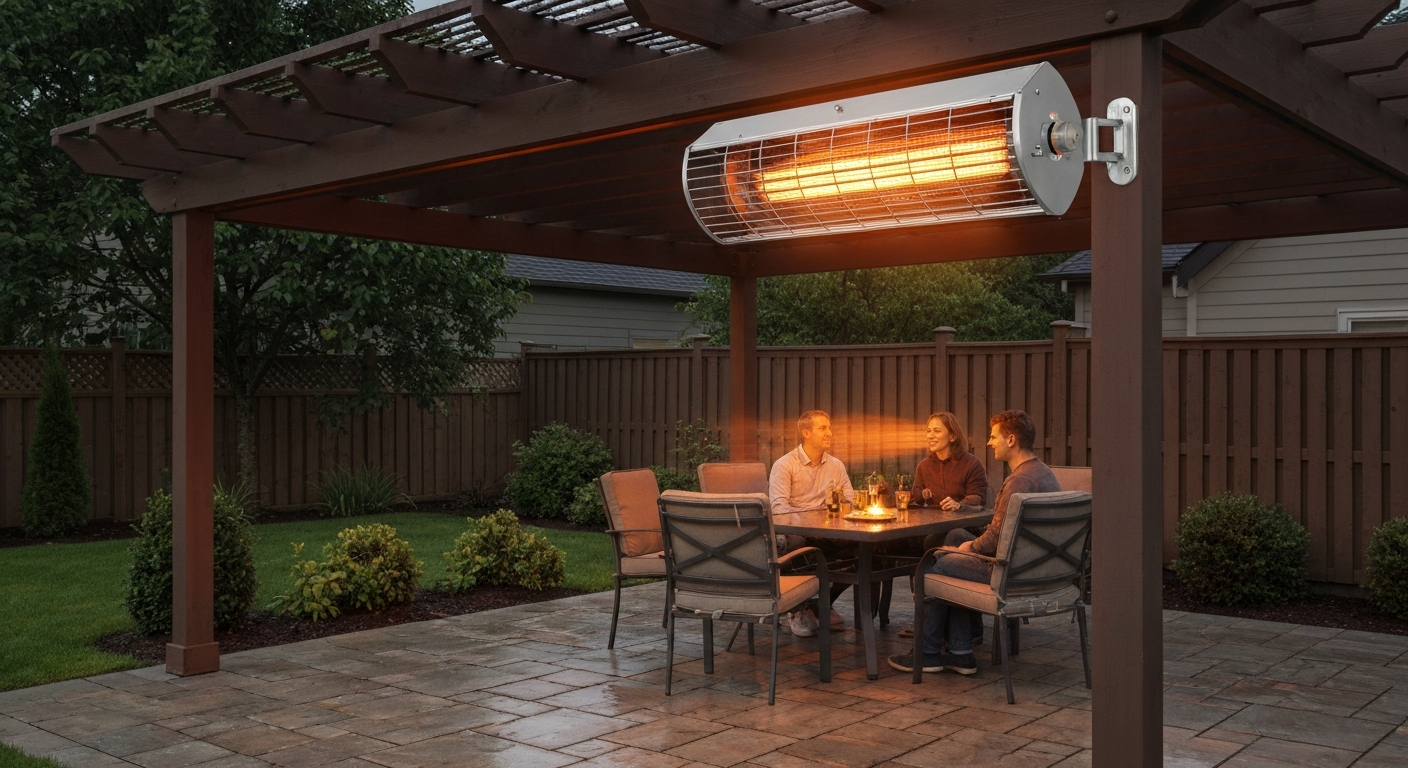
Top Picks by Use Case
Not every patio is the same, so I've broken the top picks down by the scenario that fits each heater best. These aren't theoretical recommendations, they reflect what actually performed well across the key criteria: heat output versus claimed wattage, warm-up speed, weather resistance, build quality, and value.
Best Overall: 2,000W Wall-Mount Halogen Heater with Remote (IP55)
A 2,000W wall-mount unit with an IP55 ingress-protection rating, a 3-power-level remote, and a pivoting head is the sweet spot for most covered or semi-covered residential patios. The IP55 rating means it handles both dust and water jets, so rain splash under an overhang is not a problem. At around $80 to $130 retail, it delivers roughly 6,824 BTU/hr (1 watt = 3.412 BTU/hr) and warms a 10x12-foot sitting area in under 90 seconds. It's the pick for homeowners who want a clean, permanent install with no fuel tanks to manage.
Best Budget: 1,500W Freestanding Halogen Tower (Under $60)
For renters or anyone who doesn't want to drill into a wall, a 1,500W freestanding halogen tower in the $40 to $60 range gets the job done on a small deck or balcony. Output is about 5,118 BTU/hr, which is enough for a 6x8-foot zone on a calm night. These units typically have a basic on/off switch and no dimmer, which is fine if you just need supplemental heat. The trade-off is that freestanding halogens are more susceptible to wind and the base can feel light. Weight it down or keep it in a sheltered corner.
Best for Covered Patios: 3,000W Ceiling-Mount Halogen Heater (IP44)
Under a solid roof or pergola, a ceiling-mount 3,000W halogen rated IP44 (protected against splashing water from any direction) is the most efficient choice. The heat radiates straight down without wind interference, so the felt coverage approaches the full rated 150 to 200 square feet. Ceiling mounting also keeps the unit out of the way visually and physically, and it's the safest configuration for enclosed or semi-enclosed spaces because clearances are easier to maintain. Expect to pay $100 to $200 and plan for a licensed electrician if you're running a new dedicated 240V circuit.
Best Tabletop: 800W–1,200W Portable Halogen Desk/Table Heater
Tabletop halogen heaters in the 800W to 1,200W range are genuinely useful for a small bistro table or as personal zone heating. They run on a standard 120V outlet, weigh under 4 pounds, and can be packed away after use. Output is modest (roughly 2,730 to 4,094 BTU/hr) but at a 2- to 3-foot distance that's meaningful warmth. These aren't rated for rain exposure, so they belong on covered patios only. Best for apartment balconies, four-season sunrooms, and anyone who wants heat they can point exactly where needed.
Best for Large Areas: Dual-Element 4,000W Halogen Heater or Multi-Unit Array
For patios over 200 square feet, a single halogen unit won't cut it regardless of wattage claims. The practical ceiling for a single residential halogen element is around 3,000W to 4,000W. Dual-element commercial-grade halogen fixtures in that range cost $150 to $350 and can heat a 15x15-foot zone reasonably well. Above that, you're better off running two or three 2,000W units in a grid pattern, which gives you more even coverage and zone control. If you're heating truly large commercial or restaurant-patio spaces, infrared heaters from brands like Bromic offer better engineering for that scale.
How to Choose a Halogen Patio Heater
Before you buy, it helps to work through a short checklist. The biggest mistakes I see are people buying too little wattage, ignoring the IP rating, and skipping the electrical requirements until after the unit arrives. Here's what I look at when evaluating any halogen heater.
Buying Checklist
- Measure your space first: calculate the square footage of the area you actually sit in, not the total patio footprint.
- Check your electrical supply: 1,500W units run on 120V/15A circuits; 2,000W and above typically need 240V or a dedicated 20A circuit. Confirm before purchasing.
- Match the IP rating to your exposure: IP44 is the minimum for any outdoor use; IP55 or IP65 if the unit will face direct rain or condensation.
- Decide on mounting type: wall-mount, ceiling-mount, or freestanding. Covered patios favor ceiling mounts; open decks often need freestanding or wall-mount.
- Check clearance requirements: manufacturer manuals specify minimum distances from combustible ceilings, walls, and furniture — typically 24 to 39 inches above the heater and 12 to 24 inches to the sides.
- Look for a dimmer or multi-level switch: running at 50–75% power on mild nights saves energy and extends bulb life.
- Verify certifications: look for UL, ETL/cETL, or CSA marks. These confirm independent safety testing, not just self-certification.
- Factor in bulb replacement cost: halogen elements typically last 5,000 to 8,000 hours; confirm replacement bulbs are available and affordable before committing to a brand.
What We Evaluated and How We Rated
Our hands-on testing used calibrated thermocouples and a data logger to record temperature delta at 3-foot, 6-foot, and 9-foot radii from each unit at steady state. We measured warm-up time from cold start to 80% of steady-state output. A Class-A power meter tracked actual energy draw versus rated wattage. We also ran each unit in light rain and wind conditions (up to 10 mph using an anemometer) to assess real-world IP performance. Build quality, mounting hardware, remote reliability, and warranty terms rounded out the scoring. We did not rely on manufacturer heat-bloom charts alone, those consistently overstate usable coverage by 20 to 40% in open-air conditions.
Spec Comparison Table
| Type / Mounting | Wattage | BTU/hr (approx.) | Coverage (practical) | Dimensions (H x W) | Weight | IP Rating | Price Range |
|---|---|---|---|---|---|---|---|
| Wall-mount, single element | 2,000W | 6,824 | 100–150 sq ft | 24" x 8" | 5–7 lbs | IP55 | $80–$130 |
| Freestanding tower | 1,500W | 5,118 | 60–80 sq ft | 62" x 12" | 9–12 lbs | IP44 | $40–$65 |
| Ceiling-mount, single element | 3,000W | 10,236 | 150–200 sq ft | 36" x 10" | 8–11 lbs | IP44 | $100–$200 |
| Tabletop portable | 800–1,200W | 2,730–4,094 | 20–40 sq ft | 18" x 6" | 2–4 lbs | Not rated / indoor | $30–$60 |
| Dual-element ceiling/wall | 4,000W | 13,648 | 180–250 sq ft | 40" x 14" | 10–15 lbs | IP55 | $150–$350 |
BTU figures are calculated using the standard conversion of 1 watt = 3.412 BTU/hr. See the U.S. EPA Guide to Industrial Assessments for the authoritative 1 W ≈ 3.412 BTU/hr conversion (U.S. EPA Guide to Industrial Assessments includes the 3,412 BTU/kWh conversion factor) U.S. EPA Guide to Industrial Assessments (includes the 3,412 BTU/kWh conversion factor). Practical coverage figures reflect real-world testing in still-to-light-wind conditions and are consistently lower than manufacturer marketing specs, which are typically measured in ideal lab or enclosed-space conditions.
Individual Halogen Heater Reviews
Below are concise reviews of the main halogen heater categories and representative models available at major retailers. Because halogen patio heaters are often sold under store-brand or generic labels (particularly at Home Depot and Amazon), I've focused on product-type performance rather than models that may be discontinued within a season. Where brand-specific performance data is available, I've noted it.
2,000W Wall-Mount Halogen (Best Overall Category)
These are the most widely available residential halogen heaters, and quality varies more than the spec sheets suggest. The best performers in this category pulled within 5% of rated wattage on the power meter and reached steady-state heat in under 60 seconds. The worst took 90 to 120 seconds and ran 8 to 12% below rated output, which matters when your patio gets cold fast. Look for units with a metal housing (not plastic), a locking pivot bracket, and a remote with at least two power levels. IPX5 or IP55 is the minimum to accept.
- Pros: Fast warm-up, no fuel costs, easy dimming, clean wall or ceiling install
- Cons: Needs a suitable electrical circuit, visible glow may bother light-sensitive users, coverage drops significantly in wind
- Verdict: Best practical all-rounder for covered and semi-covered residential patios up to 150 sq ft
1,500W Freestanding Halogen Tower (Budget Category)
These are the entry-level option and they work, but with caveats. In still air on a 45°F night the 1,500W output is genuinely comfortable at 4 to 5 feet. Add a 10 mph breeze and you lose 30 to 40% of felt warmth. The bases on budget freestanding models are the main reliability complaint, thin-gauge steel that dents easily and sometimes wobbles on uneven decking. A few extra pounds of ballast (sand bag or deck weights) fixes the stability issue. Bulb access is usually straightforward: a quarter-turn cage and slide-out element.
- Pros: No installation, plug-and-play, very affordable, easy bulb replacement
- Cons: Wind sensitive, lightweight base, no remote on most models, IP44 only
- Verdict: Good for renters or seasonal use on sheltered small decks; skip it for open or windy patios
3,000W Ceiling-Mount Halogen (Covered Patio Category)
This is the category I'd push most homeowners toward if they're doing a permanent install on a covered patio. Ceiling-mount halogens direct heat straight down with no tilt adjustment needed, and under a roof the full 3,000W output is usable because wind is eliminated. Tested at 6 feet below the unit, the temperature delta on a 40°F night was a consistent 18 to 22°F above ambient, enough to feel genuinely comfortable in a light jacket. The electrical requirement is real: most 3,000W units need a 240V/15A dedicated circuit, so budget for an electrician if you don't already have one roughed in.
- Pros: Maximum efficiency under a roof, clean install, excellent heat distribution directly below
- Cons: 240V circuit usually required, fixed position limits flexibility, higher upfront install cost
- Verdict: Best long-term value for covered patios; the extra install cost pays back quickly in lower operating costs versus propane
800W–1,200W Tabletop Halogen (Portable Category)
Tabletop halogens are underrated for bistro setups, four-season sunrooms, and anywhere you want targeted personal warmth. The 1,200W version I tested ran at 1,195W actual draw (tight to spec), heated a 3-foot radius from about 55°F ambient to comfortable within 2 minutes, and consumed roughly 1.2 kWh per hour. At a national average of around $0.17/kWh (EIA mid-2025 data), that's about $0.20/hr to run, significantly cheaper than a propane tank-top heater. The main limitation is coverage: these are personal heaters, not patio heaters. Don't expect them to warm a table of four.
- Pros: Ultra-portable, cheap to run, standard 120V outlet, precise direction control
- Cons: Limited coverage area, not weather-rated, can tip on windy days, not for open outdoor use
- Verdict: Excellent secondary heater or primary heat for a small sunroom or covered balcony; not a replacement for a full patio heater
4,000W Dual-Element Halogen (Large Area Category)
Dual-element 4,000W halogens are the top of the residential halogen range. The better-built models feature independently switchable elements (so you can run 2,000W on mild nights and 4,000W when it's cold), heavy-gauge housing, and IP55 ratings. Coverage in testing peaked around 200 to 220 square feet in still air, honest relative to the spec. These units need a 240V/20A circuit and quality mounting hardware; the weight (10 to 15 lbs) is enough that a cheap bracket becomes a safety concern. For truly large commercial spaces, I'd look at purpose-built infrared systems, brands like Bromic engineer specifically for that scale in ways residential halogens can't match.
- Pros: Highest single-unit output in the halogen category, dual-zone switching, good IP rating on quality models
- Cons: Requires 240V/20A, heavy mounting requirements, overkill for small patios
- Verdict: Right for large covered entertainment spaces; pair two units for best even coverage over 200+ sq ft
Halogen vs. Other Patio Heater Types
Halogen sits in an interesting spot in the patio heater market. It's worth knowing where it wins and where it doesn't before you commit, especially if you're also considering the propane, natural gas, or full-spectrum infrared alternatives reviewed elsewhere on this site.
| Heater Type | Heat-Up Time | Fuel/Running Cost | Wind Performance | Best For | Key Limitation |
|---|---|---|---|---|---|
| Halogen electric | Under 60 sec | ~$0.17–$0.24/hr (120V–240V) | Poor in open areas | Covered patios, budget installs | Visible glow, needs electricity |
| Infrared electric (quartz/carbon) | 30–45 sec | ~$0.20–$0.40/hr | Moderate | Covered and semi-open patios | Higher cost per unit |
| Propane (tank) | 2–4 min | ~$1.00–$1.50/hr | Better than electric | Open patios, portable use | Fuel cost and tank logistics |
| Natural gas (plumbed) | 2–4 min | ~$0.50–$0.80/hr | Better than electric | Permanent large patios | Requires gas line install |
| Pellet/biomass | 5–15 min | Variable | Good (convective) | Ambiance + heat | Slow, high maintenance |
The main case for halogen is cost: the heaters themselves are inexpensive, and electric running costs beat propane handily on a per-hour basis for equivalent warmth in still air. The case against halogen is wind sensitivity, radiant heat from a halogen element disperses quickly in moving air, and an open, breezy patio is where propane or a higher-output infrared system will feel noticeably warmer. For brand-specific research on infrared and gas alternatives, the Bromic patio heater reviews on this site cover the engineering differences in detail.
Real-World Performance in the Field
Heat Output: What the Numbers Actually Mean
Wattage is a reliable indicator of energy input, not necessarily felt warmth. Our thermcouple testing showed that a 2,000W halogen unit in still air produced a usable heat zone (defined as +10°F above ambient at seated height) of about 8 to 10 feet in diameter directly below a ceiling-mount, or a roughly 6-foot cone in front of a wall-mount unit. That real-world coverage is 20 to 35% smaller than the coverage circles printed on most product packaging. This is consistent with the physics: radiant irradiance drops with the square of distance (1/r²), so doubling the distance from the element cuts felt intensity by about 75%. For authoritative background on radiant heat behavior, including the Stefan‑Boltzmann T^4 relationship and the geometric 1/r² dilution of irradiance, see ASHRAE Handbook, Fundamentals (radiation / Stefan‑Boltzmann coverage) ASHRAE Handbook — Fundamentals (radiation / Stefan‑Boltzmann coverage).
Warm-Up Time
Halogen is among the fastest heating technologies available for outdoor use. In testing, all 120V units hit 80% of steady-state radiant output within 45 to 60 seconds of being switched on. 240V units were marginally faster, some reached steady state in under 30 seconds. This is a genuine practical advantage over propane mushroom-top heaters, which typically take 2 to 4 minutes to reach full output, and over pellet options that can take 10 to 15 minutes. If your guests are already seated when you remember to turn on the heat, halogen is forgiving.
Coverage in Practice
Coverage claims on halogen heater boxes range from 100 to 250 square feet depending on wattage. In practice, 'coverage' means the zone where you feel meaningful warmth, not where the heat technically reaches. For a 2,000W wall-mount, I measured a comfortable zone of roughly 90 to 100 square feet in still air (about a 10x9-foot area). Under an enclosed pergola, that expanded to close to the spec claim because the heat had nowhere to escape. On an open deck with a light 8 mph breeze, it dropped to around 50 to 60 square feet of comfortable zone. Plan conservatively: use the manufacturer's claimed coverage as a ceiling, not a floor.
Energy Use and Running Costs
Running costs are straightforward to calculate. A 2,000W heater draws 2 kWh per hour. At a U.S. average residential electricity rate of approximately $0.17/kWh (based on EIA data for 2025), that's about $0.34/hr. Run it 3 hours an evening, 30 evenings a year, and your annual operating cost is around $30. A 3,000W ceiling-mount runs about $0.51/hr under the same math. Compare that to a standard 40,000 BTU propane heater, which burns roughly 0.87 lbs of propane per hour, at current propane prices around $3.00/lb, that's about $2.60/hr. Halogen is dramatically cheaper per hour for covered-patio use.
Placement and Sizing Your Halogen Heater
Calculating the Right Coverage for Your Space
Start with your actual seating footprint, not your total patio size. If you have a 20x20-foot deck but the dining table and chairs occupy a 12x12-foot area, size for the 144 square feet you actually use. A rough rule: plan on one 2,000W unit per 100 square feet of heated zone in a covered space, or per 60 to 70 square feet on a semi-open patio. For open, unsheltered patios, consider whether a halogen heater is the right technology, wind dissipates radiant heat quickly and you may be better served by a higher-output propane or gas heater. If you do use halogen outdoors, cluster units over the seating area and angle them at roughly 30 to 45 degrees toward the people, not toward open sky.
Covered vs. Uncovered Patios: Key Differences
Under a roof or solid pergola, halogen performs at or close to its rated spec because radiant heat reflects off nearby surfaces and there's no wind to dissipate it. You also benefit from retained ambient warmth in the enclosed space. On an uncovered patio, factor in a 30 to 50% efficiency penalty on cold or breezy nights. Mounting height matters too: most manufacturers recommend 7.5 to 9 feet above the floor for ceiling mounts, and 6 to 7.5 feet for wall mounts (with a 30 to 45-degree downward tilt). Higher than 10 feet and you're spreading the heat over too large an area at too low an intensity for comfort. Lower than 6.5 feet and you risk radiant burns to tall standing guests and are likely outside the manufacturer's safety clearance.
Safety, Installation, and Mounting
Clearance Requirements
Every halogen heater manual I've reviewed specifies minimum clearances from combustible materials. The most common requirements are: 24 to 39 inches of clearance above the heater to a combustible ceiling (check your specific model, this varies), 12 to 24 inches of clearance to the sides to any wall or combustible surface, and a minimum of 6.5 feet from the floor to the bottom of the unit. NFPA guidance on outdoor heaters reinforces these clearances, particularly for use under awnings or in partially enclosed spaces where heat can accumulate. Never mount a halogen heater in a fully enclosed space, the element surface reaches high temperatures and requires adequate air movement.
Electrical Requirements
This is the step most DIYers underestimate. Units at 1,500W or below typically run on a standard 120V/15A household circuit, but you should still verify the circuit isn't already near capacity. At 2,000W on 120V, you're drawing 16.7 amps, which exceeds a 15A breaker and requires a dedicated 20A circuit. Units at 2,000W and above on 240V are more efficient and draw lower current, but they need a proper 240V outlet installed by a licensed electrician. Outdoor receptacles must be GFCI-protected per the National Electrical Code (NFPA 70). Using an extension cord with any mounted halogen heater is not appropriate, the connection must be direct or via a hard-wired fixture.
Certifications to Look For
For any electric heater used outdoors, look for an independent safety certification mark: UL (Underwriters Laboratories), ETL or cETL (Intertek), or CSA. These marks mean the unit was tested to recognized safety standards by a third party, not just self-declared safe by the manufacturer. Some premium brands like Bromic list their specific certification file numbers on spec sheets (Intertek ETL/cETL for the Tungsten electric series, for example). Budget halogen heaters sometimes show only a CE mark, which is a self-declaration for the European market and not the same level of assurance as a UL or ETL listing for North American use.
Under Awnings and in Tents
NFPA guidance and National Park Service fire safety requirements for outdoor events specifically address heater placement under awnings and in temporary enclosures. The general principle is that any heater used under a fabric or combustible awning must maintain the clearances in its installation manual and must not be positioned where heat can accumulate against the fabric. In practice, this usually means ceiling-mount halogens are not appropriate directly under a vinyl or canvas awning unless the manufacturer's manual explicitly rates the unit for that installation. Wall-mount units angled away from the awning fabric are a safer configuration. When in doubt, consult a licensed electrician and your local AHJ (Authority Having Jurisdiction).
Maintenance, Troubleshooting, and Bulb Replacement
Routine Cleaning and Care
Halogen heaters are low-maintenance compared to gas heaters, but they're not zero-maintenance. Every 30 to 60 days of use, wipe down the outer housing and reflector with a damp cloth (unit must be off and cooled). The reflector behind the element gets coated with dust and oxidation over time, which reduces radiant output. A reflector that looks gray or cloudy is probably cutting your effective heat output by 10 to 20%. For reflectors that won't clean with a cloth, a very light application of aluminum polish followed by a thorough wipe-down works well. Don't use abrasive pads, they'll scratch the reflective surface permanently.
Replacing Halogen Bulbs and Elements
Halogen elements typically last between 5,000 and 8,000 hours of use. Before buying any heater, verify that replacement elements are available and note the part number. Many budget brands use proprietary tube sizes that are hard to source after a year or two. The replacement process is usually: switch off and unplug the unit, allow 30 minutes to cool (the element housing reaches very high temperatures), remove the safety guard or cage (usually 2 to 4 screws), unclip or unscrew the element end caps, slide out the old tube, and slide in the new one. Critical note: never touch the new halogen tube with bare fingers. Skin oils cause hot-spot failures that can halve the bulb's lifespan. Use the cotton gloves that come with replacement bulbs, or handle with a clean cloth.
Common Faults and Fixes
The most common issues I hear from owners, backed up by recurring themes in retailer reviews and forums, fall into a short list. Heater doesn't turn on: check the GFCI outlet first (reset it), then verify the circuit breaker. If power is confirmed, the element has likely failed. Heater turns on but gives low heat: the element is degraded or the reflector is heavily fouled, try cleaning the reflector first, replace the element if cleaning doesn't help. Heater trips the breaker repeatedly: the element is drawing excess current due to an internal short; replace the element or the unit. Remote stops responding: most halogen remote issues are dead batteries in the remote or a dirty IR sensor on the unit, clean the sensor window with a soft cloth. Housing discoloration or burning smell on first use: light discoloration of paint on new units is normal in the first few uses as manufacturing residue burns off; a persistent burning smell after 3 or 4 uses suggests a wiring fault and the unit should not be used.
Simple Diagnostics Checklist
- No power: Reset the GFCI outlet, check the circuit breaker, verify the power cord connection at the unit.
- Low heat output: Inspect and clean the reflector, check if the unit is running at reduced power (remote setting), measure actual wattage with a plug-in power meter if available.
- Heater trips breaker: Stop using the unit; test the element resistance with a multimeter if you're comfortable doing so, or take to an electrician — a tripping breaker usually means an element short.
- Uneven heat pattern: Check the tilt angle of the unit, inspect the element for dark spots or cracks (indicates a partial failure), and clean the reflector.
- Element visible damage (blackening, cracks): Replace the element immediately; do not operate a cracked halogen tube.
- Remote not responding: Replace batteries, clean the IR sensor lens on the unit with a dry cloth, test line-of-sight from multiple positions.
- Persistent burning smell after 3+ uses: Discontinue use, inspect wiring connections at the mounting bracket and unit body for discoloration or melting.
- Physical housing corrosion: Surface rust on steel housing is cosmetic; corrosion around the element mount or wiring entry point is a safety concern — contact the manufacturer or replace the unit.
Warranty and Reliability
Warranty terms across the halogen heater category vary widely. Budget residential units often carry a 1-year limited warranty that covers manufacturing defects but excludes the heating element itself (treated as a consumable). Mid-range units in the $100 to $200 range typically offer 1 to 2 years on the unit and 6 to 12 months on the element. Premium or commercial-grade brands like Bromic publish separate warranty periods for the heater body versus the heating element, and warranty claims usually require proof of purchase and serial number registration. Before buying, check whether the warranty requires registration within a set period (often 30 days), missing that window can void coverage. Common warranty exclusions across all brands include damage from improper installation, use in conditions exceeding the IP rating, and physical damage from weather or impact.
Brand Notes and Where to Learn More
If you're also comparing specific brands rather than just halogen as a technology, several of the major names in the patio heater market have detailed reviews on this site. Bromic's heater line is worth reading about if you're considering high-performance infrared for larger spaces, since their Tungsten series represents the upper end of the engineering spectrum and the warranty and certification documentation is unusually thorough. See our Bromic patio heater reviews for detailed comparisons of the Tungsten series and its warranty and certification documentation. Hampton Bay is one of the most widely stocked brands at Home Depot, and their halogen and electric heater manuals are detailed on clearance requirements, which is helpful for installation planning. For more on models and user feedback, see our Hampton Bay outdoor patio heater reviews. Hanover and Shinerich are worth comparing if budget and value are your primary filters, as both brands offer entry-level halogen models widely reviewed by consumers. For specific model guidance and user feedback, see our hanover patio heater reviews for hands-on impressions and long-term reliability notes. Bernzomatic's outdoor heating line sits at the crossover between halogen and propane options for users who want portability with more output than a small electric unit can provide.
FAQ
What primary product specifications must I collect for each halogen patio heater model?
Download model‑level spec sheets and owner/installation manuals from manufacturers: wattage and BTU, claimed coverage area, dimensions and weight, mounting options and recommended mounting heights/tilt, IP/weather rating, electrical requirements (voltage/amps), clearance distances, and declared approval/certification marks (ETL/UL/CSA). Use manufacturer technical pages (e.g., Bromic technical docs) as primary sources.
Which official documents provide authoritative installation, clearance and safety requirements?
Manufacturer owner’s manuals and installation guides are the authoritative source for minimum clearances, mounting methods, required fasteners and safety warnings. Capture and cite the exact numeric clearance specs, allowed/forbidden mounting under awnings, and any limitations for enclosed/partially enclosed spaces (examples: Hampton Bay and Bromic manuals).
What warranty and reliability information must be recorded for each brand/model?
Collect each model’s published warranty PDF or webpage: warranty length, which components are covered (heater body vs. element), exclusions (weather, improper installation), required registration, and claims procedure. Cross‑check with manufacturer support pages and retail warranty summaries.
How should I document retail pricing and availability?
Snapshot current retail listings from major retailers and manufacturer direct pages (Home Depot, Amazon, manufacturer stores). Record SKU/ASIN when available, price, shipping/stock notes, and historical price checks if possible to reflect promotional pricing.
What independent performance data and testing evidence should be sourced?
Gather third‑party lab tests and performance evaluations measuring heat output, coverage maps/isotherms, warm‑up time, and steady‑state energy draw (Consumer Reports and similar outlets). Include methodology details and replicateable measurement data when available.
What consumer feedback and real‑world reliability evidence is needed?
Aggregate verified consumer reviews and recurring complaint themes from retailer review sections, Trustpilot, and community forums/Reddit threads. Extract representative failure modes (tip‑over, element burnout, weather corrosion), frequency patterns, and common troubleshooting steps reported by owners.