
When you search 'hearth and patio reviews,' you're usually trying to answer one of two questions: Can I trust this specific company with my money, or is this installer going to leave me with a poorly vented fireplace and a voided warranty? The three names that come up most are AES Hearth and Patio, Family Hearth and Patio, and Hearthside Fireplace and Patio. They are three completely separate businesses operating in different states, and their reputations, service scopes, and red flags are different enough that you really need to look at each one on its own terms before making any decisions.
Hearth and Patio Reviews: AES, Family, and Hearthside Compared

Willa Brennan
11 May 2026
Why people search 'hearth and patio reviews' and what they actually find
Most people searching this phrase are not just browsing. They've already found a company, gotten a quote, or seen a product they like, and now they want to make sure they're not about to get burned (pun intended). The challenge is that 'hearth and patio' is a generic phrase used by dozens of regional retailers and installers across the country, so search results often bundle totally unrelated companies together. You might read a glowing review for Hearthside Fireplace and Patio in Warwick, RI and think it applies to a company in Pennsylvania. It doesn't.
What you'll encounter in those search results is a mix of third-party aggregators (Angi, HomeAdvisor, Birdeye, BBB), Google reviews, and the companies' own testimonial pages. Each source has different biases. Company websites cherry-pick their best reviews. Birdeye aggregates across platforms and can produce a high star count simply because of volume. BBB accreditation status matters but isn't the whole story. The most useful signal is pattern recognition across multiple platforms: what do people consistently praise, what do they consistently complain about, and how does the company respond when something goes wrong?
Company-by-company reputation breakdown
AES Hearth and Patio (Pennsylvania)
AES Hearth and Patio operates out of Newville and Camp Hill, PA, and positions itself as a full-service shop: design, installation, chimney repair, fireplace service, chimney relining, and waterproofing. On the Chamber of Commerce platform, they hold a 4.7-star rating across 43 reviews, with testimonials that highlight communication and scheduling responsiveness, specifically things like prompt voicemail callbacks. Their own website leans heavily on technician professionalism and post-install guidance, including weekly and monthly care instructions.
The Birdeye profile aggregates 389 reviews and the rating is high, but that's also where you'll find the most detailed negative experiences. The most serious complaint pattern involves installation quality: specifically, allegations of chimney pipe cut too short with insufficient overlap, which creates real smoke and carbon monoxide risks. That's not a minor complaint, and it's worth reading in full if you're considering them for an installation project.
If you want to compare options beyond AES, look for an alternative energy hearth and patio shoppe llc that also provides clear installation documentation and expectations AES Hearth and Patio. On the employee side, Indeed reviews flag inconsistent internal policies and note that the service and installation division tends to drive operations, which can translate to variable customer experiences depending on which crew you get.
One concrete thing to know before you buy: AES has a strict return policy stating that all non-stock and special-order products are not accepted for return or refund. If a salesperson steers you toward a special-order item, you need to be completely certain before you pay. Get the product specs, the model number, and the delivery timeline in writing before you commit.
Family Hearth and Patio (Connecticut)
Family Hearth and Patio LLC is based in New London, CT. On HomeAdvisor, they have a 4.3-star rating across 11 reviews, which is a smaller sample but still useful for spotting patterns. The praise centers on craftsmanship and crew professionalism. The most notable complaint is a product mismatch allegation: a customer claims a different decking product was installed than what they were sold. Whether that's a miscommunication or something worse, it's a pattern that shows up in hearth and patio retail generally, and it's exactly why you need written specs before any work begins.
Family Hearth and Patio also explicitly offers ongoing maintenance and cleaning services, which is a real positive if you want a single provider for both installation and long-term upkeep. They hold a Connecticut Home Improvement Contractor license, number HIC.0646606, which was active as of the most recent check in BuildZoom's database. Connecticut also has specific state-level rules about who can perform 'hearth product work,' limiting it to licensed contractors doing propane or natural gas fireplace venting and piping. So the license check here is especially important.
Hearthside Fireplace and Patio (Rhode Island and Massachusetts)
Hearthside Fireplace and Patio is the largest and most reviewed of the three. They operate four locations: Warwick, RI (790 Bald Hill Rd), Holliston, MA (1470 Washington St), Westport, MA (1030 State Rd), and a subcontractor-only location in Whitinsville, MA with no public showroom. Their Birdeye profile shows 4.8 stars across 291 reviews, which is a genuinely strong signal when you have that kind of volume. Angi reviews specifically mention permit handling and installation process quality, which is a good sign because permits are often where smaller installers cut corners.
On the BBB side, blank" rel="noopener noreferrer">Hearthside is listed but is NOT BBB accredited. Their file has been open since 1977 (the incorporation date listed is also 1977), so they've been around a long time, which matters. The lack of BBB accreditation doesn't automatically mean anything negative, but it does mean there's no BBB-mediated dispute resolution if something goes wrong. One genuinely useful thing Hearthside provides is blank" rel="noopener noreferrer">a customer expectations checklist PDF. This document outlines who's responsible for gas-run work, insulation requirements, and installation prerequisites. If the company you're considering doesn't offer something like this, ask for it in writing yourself.
How to verify legitimacy and shop safely
Before you spend a dollar, run these checks on any hearth and patio company, not just the three above. To become NFI Certified, a person studies from NFI reference manuals and passes the NFI exam.
- Look up their contractor license in your state's official database. For Connecticut, that's the Department of Consumer Protection. For Pennsylvania and Rhode Island, similar state licensing boards exist. Ask the company for their license number directly and verify it yourself.
- Confirm they carry general liability insurance and, if they're sending workers to your home, workers' compensation coverage. Ask for a certificate of insurance and verify the policy is current.
- Check for NFI (National Fireplace Institute) certification. NFI certifies installers by fuel type and product category through a formal examination process. An NFI-certified specialist on staff is a strong signal of real technical competence beyond a generic contractor license.
- Check BBB for complaint history, not just the rating. Look at how the company responded to complaints, not just whether any exist.
- Search Angi, HomeAdvisor, Birdeye, and Google separately. Compare the patterns across all of them rather than relying on a single platform's aggregate score.
- Confirm their physical address matches what they claim. For Hearthside specifically, the three public showroom addresses are publicly listed and verifiable.
What to ask before you buy or commit to an installation
The questions you ask upfront are what separate a smooth project from a nightmare. Don't be shy about this. Any reputable company expects these questions.
- Can you provide a written, itemized quote that includes product model numbers, installation scope, permit fees, and any exclusions?
- What is your return and cancellation policy, specifically for special-order or non-stock items?
- Who handles permits, and is that included in the quote or billed separately?
- What is the realistic installation timeline from deposit to completion?
- Does your installation crew include or subcontract NFI-certified technicians?
- What warranty comes with the product, and what warranty do you provide on the installation labor itself?
- What maintenance schedule do you recommend after installation, and do you offer a service contract?
- Who do I call if there's a problem six months from now, and what's your average response time for service calls?
- For gas appliances: who is responsible for running the gas line, and is that in scope or a separate contractor?
That last question about gas line responsibility is specifically where disputes happen. Hearthside's customer expectations checklist addresses this directly. If your installer doesn't bring it up, you bring it up.
How to read reviews the right way
Star ratings are a starting point, not an answer. Here's how to actually extract useful information from review pages.
Look for pricing transparency in the reviews. Customers who felt surprised by final costs after a quote are telling you something about how the company communicates scope. Praise around 'the price matched the quote exactly' is a strong positive signal.
Pay close attention to workmanship complaints, especially anything involving ventilation, gas connections, or structural work. A chimney pipe with insufficient overlap isn't a cosmetic issue, it's a safety issue. One detailed negative review about a serious installation error should weigh more heavily than ten short positive reviews that just say 'great experience.'
Communication patterns matter across the whole project. Reviews that mention things like 'they never called back after install' or 'impossible to reach for warranty work' are warning signs. Family Hearth and Patio reviews mention timeline communication specifically, so look for that in whatever company you're evaluating.
Returns and post-sale service are where companies show their real character. AES's strict no-return policy on special-order products means that reviews about product mismatches or wrong deliveries are especially relevant there. If a reviewer says they received the wrong product and got no resolution, that's a pattern you need to weight seriously.
Finally, consider employee reviews on Indeed or Glassdoor as supplementary data. They're not customer experiences, but they can reveal operational dysfunction that eventually surfaces as customer problems. Inconsistent internal policies, as flagged in AES's employee reviews, often translate to inconsistent customer service.
Choosing the right patio heating or hearth solution for your space
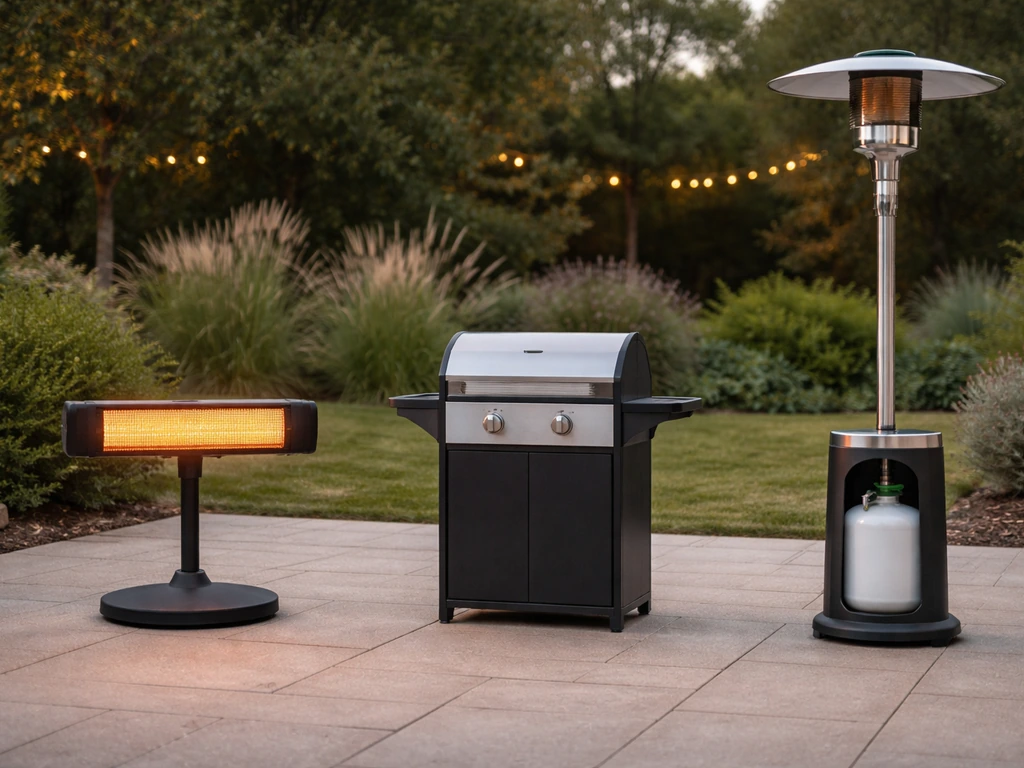
Once you've found a company you trust, the next question is what to actually buy. The fuel type, heater style, and installation requirements all depend on your specific space. Here's a straightforward breakdown.
| Heater Type | Best For | Key Advantage | Main Trade-off |
|---|---|---|---|
| Propane | Uncovered or open patios, no gas line | Portable, no installation required | Ongoing fuel cost, tank refills needed |
| Natural Gas | Permanent outdoor or indoor fireplace setups with gas access | Lowest ongoing fuel cost, always on | Requires gas line installation, fixed location |
| Electric (infrared) | Covered patios, smaller spaces, rentals | No fuel, instant heat, safe indoors | Limited range, needs outlet access |
| Pellet stove/heater | Larger covered spaces, aesthetic appeal | Efficient, ambiance, renewable fuel | Requires pellet storage, more maintenance |
| Tabletop heater | Small patios, balconies, occasional use | Ultra-portable, affordable | Low BTU output, not for large spaces |
Covered vs. uncovered spaces
Covered patios give you the most options. Electric infrared heaters work particularly well here because they heat objects and people directly rather than the air, which means wind doesn't strip the warmth away. They're also safe to mount overhead in covered structures. Open, uncovered patios need higher BTU output to compensate for heat loss. A propane standing heater in the 40,000 to 46,000 BTU range handles a roughly 20-foot diameter area, which works for most patio dining setups. For a large open deck, you'll want multiple units or a natural gas permanent installation.
Matching heater size to your patio
A rough rule: plan on about 10 watts per square foot for electric infrared, or about 1,000 BTU per 10 square feet for gas heaters in mild climates. Cold climates need more. A 200-square-foot covered patio in a region with cold winters needs at least a 20,000 BTU heater to stay comfortable, and 30,000 to 40,000 BTU is more realistic for actual warmth rather than just taking the edge off.
Budget considerations
Tabletop propane heaters start around $50 to $100. Freestanding propane tower heaters run $150 to $400. Electric infrared wall or ceiling mounts range from $100 to $600 depending on wattage. A natural gas permanent installation, including the appliance and labor, can run $2,000 to $6,000 or more depending on gas line distance and local permit costs.
Pellet stoves for indoor or semi-enclosed outdoor spaces typically start at $1,500 and go up from there. When comparing quotes from companies like AES, Family Hearth, or Hearthside, make sure the installation labor, permit fees, and any gas line work are all itemized separately so you're comparing apples to apples. When you compare companies like Better Homes Hearth & Patio Inc, also insist that the quote clearly lists installation labor, permit fees, and any gas line work.
When you compare the best fire hearth & patio options, ask for itemized quotes so you can separate appliance cost from installation, permits, and any venting or gas line work.
It's also worth mentioning that some companies covered here, including those comparable to Best Fire Hearth and Patio and similar regional specialists, may offer certified installation services as part of a package. Always ask whether the quote includes a site evaluation and chimney or venting inspection before any new appliance goes in.
Your next steps checklist: how to decide and what to do today
If you've read this far, you're ready to move. Here's exactly what to do in order.
- Identify which company you're actually considering and confirm their physical location and state of operation. Don't assume 'Hearth and Patio' reviews from one region apply to a company in another.
- Verify their contractor license number in your state's official database. For Family Hearth and Patio in CT, the number is HIC.0646606. For others, ask directly and look it up.
- Request a certificate of insurance showing current general liability and workers' comp coverage before anyone sets foot on your property.
- Ask about NFI certification for any installer who will be working on a gas, pellet, or fireplace installation.
- Get a written, itemized quote with product model numbers, installation scope, permit responsibility, and timeline.
- Check BBB, Angi, HomeAdvisor, and Birdeye separately and read the negative reviews in full, not just the star count.
- Clarify the return policy before ordering, especially for any non-stock or special-order items.
- Decide on your heater type based on your space: covered or uncovered, square footage, climate, and whether you have or want a permanent gas line.
- Request a customer expectations checklist or written scope document that details who handles each step of the install, including gas line, permits, and post-install inspection.
- Get at least two quotes for any installation over $1,000 and compare line by line, not just the bottom number.
That's really all it takes. The companies that hold up under this checklist are the ones worth your business. The ones that get vague, pressure you to skip steps, or won't provide written documentation are showing you exactly who they are before you've spent a cent.
FAQ
When comparing hearth and patio quotes, what should I insist is itemized?
Ask for a written itemization that separates appliance price, installation labor, permit fees, venting/chimney components, and any gas line work (including distance from the run to the appliance). If the company quotes a single lump sum, request a break-out before signing, because reviews often flag “surprise costs” when scope is added after approval.
How can I avoid getting stuck with the wrong special-order product?
Before you place an order for a special-order or non-stock item, request the exact product model number, finish/color code, and the return or cancellation terms in writing. If the company cannot provide a written document that guarantees they will accept the item back or cancel it without a penalty, treat that as a buying risk.
Who should handle permits and inspections for a fireplace or gas patio installation?
Clarify whether the installer will perform (or subcontract) the permit application and inspection scheduling, and who attends the inspection. Reviews that mention permit handling as a strength often correlate with fewer delays and fewer “failed inspection” redo costs.
Why do some hearth and patio reviews mention inconsistent experiences, and how do I plan around that?
Ask what crew will do your job and how scheduling is handled (for example, initial site visit crew versus install crew). If reviews mention variable experiences depending on crew, you should request the crew role assignments in advance and confirm the installer of record on the work order.
What ventilation or gas-connection details should I verify before installation?
Request a written ventilation or venting plan that states the specific chimney or vent system components, routing, clearance requirements, and how joints are sealed. If the company cannot clearly explain overlap, connection method, and safety checks, do not treat that as a normal “detail,” those are safety-critical items.
In a gas line dispute, how do I make sure I have documentation on responsibility?
For gas work, ask who is responsible for gas line sizing and pressure verification, and request documentation of the test results after installation. If the checklist or expectations document is not provided, ask for an equivalent written scope summary that assigns responsibility before work begins.
When a company offers maintenance, what specifics should I ask for so it’s actually useful?
If you’re getting ongoing maintenance, ask for the service cadence (for example, seasonal cleaning frequency), what is included (inspection, lubrication, component checks), and the callout process for emergencies. “Maintenance offered” is broad, the valuable detail is what tasks are included each visit and how response times are handled.
How do I verify warranty coverage and avoid denial based on maintenance or paperwork?
Check whether the warranty coverage is tied to using the company for maintenance, using certified parts, or scheduling inspections within specific time windows. Reviews sometimes complain about denied warranty work, so ask for warranty terms and any conditions that must be met to keep coverage active.
How do I read hearth and patio reviews to find signal, not noise?
Use reviews that include specifics (date of install, type of fuel, problem description, what was corrected). Be cautious of reviews that are only general praise or only general complaints, and weigh serious workmanship or safety issues more heavily than unrelated friendliness comments.
Why does location matter when reviewing Hearthside-style multi-location hearth and patio services?
If the company operates multiple locations or has a showroom versus subcontractor-only work, ask which location your project is tied to and who manages your contract. Reviews can blend experiences across regions, so you want the person accountable for your address and scope.