
Living Accents patio heaters are a solid mid-range option sold primarily through Home Depot and Ace Hardware, with propane freestanding models rated at 46,000 BTU and smaller tabletop units at 11,000 BTU. They heat a usable radius of roughly 9 to 15 feet depending on the model, cost between $80 and $180 at retail, and generally get the job done for average-sized patios without the premium price tag of brands like Bromic or the assembly headaches of cheaper imports. That said, they come with real trade-offs, including mediocre igniter longevity and powder-coat finishes that need attention in humid climates.
Living Accents Patio Heater Reviews: Top Models & Buying Guide

Willa Brennan
27 Jul 2026
Who this guide is for
If you've been browsing Home Depot or Ace and keep running into the Living Accents name, this guide is built for you. I've gone through the full product lineup, dug into user manuals and spec sheets, aggregated consumer feedback from Home Depot, Lowe's, and Wayfair, and compared Living Accents models against competing brands using a standardized set of performance metrics. Whether you're deciding between a tabletop model for a small balcony or a full-height propane tower for a 15-person gathering, this breakdown will tell you exactly which Living Accents heater fits your situation and which ones to skip. I'll also flag where brands like Enders Elegance, Style Selections, or Well Traveled Living might actually be a better fit for your needs.
Quick picks
| Category | Model | Why it wins |
|---|---|---|
| Best overall | Living Accents 46,000 BTU Freestanding Propane (Bronze) | Best balance of heat output, coverage radius, and price for open patios |
| Best budget | Living Accents 11,000 BTU Tabletop Propane | Lowest entry cost, portable, works well on small decks under $90 |
| Best for covered patios | Living Accents Electric Infrared Wall-Mount | No combustion gases, safe under pergolas and enclosed spaces |
| Best tabletop | Living Accents 11,000 BTU Tabletop (Stainless) | Clean finish, stable base, easy 1-lb cylinder operation for 2-4 people |
The Living Accents product lineup at a glance
Living Accents sells patio heaters almost exclusively through Home Depot, Ace Hardware, and select online retailers including Wayfair. The brand sits in the value-to-mid tier, competing directly with Hampton Bay (Home Depot's house brand) and Style Selections (Lowe's house brand). The lineup breaks down into four main categories: tabletop propane, freestanding propane, glass/quartz-tube freestanding, and electric infrared wall-mount or freestanding models. Most of the propane units share a steel construction with powder-coat finishes in bronze, hammered bronze, or black. The glass-tube variants use a stainless reflector with a visible quartz-glass combustion tube, which gives a different aesthetic and heat distribution pattern compared to the standard mushroom-cap design.
| Category | Fuel Type | BTU / Watts | Approx. Price | Key Variants |
|---|---|---|---|---|
| Tabletop | Propane (1-lb or 20-lb adapter) | 10,000–11,000 BTU | $75–$95 | Stainless, hammered bronze |
| Freestanding standard | Propane (20-lb tank) | 46,000 BTU | $120–$180 | Bronze, hammered bronze, black |
| Freestanding glass/quartz-tube | Propane (20-lb tank) | 40,000–46,000 BTU | $140–$190 | Stainless with glass tube |
| Electric infrared | Electric (120V) | 1,500 W (5,118 BTU equiv.) | $80–$140 | Wall-mount, freestanding tower |
How we score each model
Every Living Accents model in this guide is evaluated against the same ten metrics, each scored on a 1-to-5 scale. Heat output (BTU or watts) and coverage radius are verified against manufacturer specs and cross-checked with consumer feedback patterns from retailer reviews. Fuel type and run time are calculated using manufacturer stated consumption rates against a standard 20-lb propane cylinder (approximately 4.7 lbs of usable fuel at full output). Efficiency is assessed by comparing BTU output against fuel consumed, with reference to ASTM F2644 testing benchmarks for commercial patio heaters. Noise is noted for electric models (fan noise) and for gas ignition reliability. Controls covers the ignition method (piezo vs. electronic vs. manual), heat settings, and any thermostat or remote function. Durability and weather resistance are based on material specs, finish type, and aggregated owner feedback around rust, corrosion, and finish degradation. Independent testers at SpruceRank, Best Electric Patio Heater 2026 (describes water spray, thermal imaging and durability tests) include simulated‑rain ingress checks, salt‑air/corrosion exposure notes, and thermal‑imaging maps when documenting durability and water resistance SpruceRank — Best Electric Patio Heater 2026 (describes water spray, thermal imaging and durability tests). Weight and portability reflect assembled weight and whether wheels or a carry handle are included.
I want to be transparent about the methodology here. I have not run Living Accents heaters through a calibrated thermocouple grid in a controlled lab environment, which is the gold standard described in ASTM F2644 and used by outlets like Popular Mechanics. My ratings are based on a combination of manufacturer-published specs, verified manual data, aggregated consumer reports from Home Depot, Lowe's, and Wayfair (hundreds of reviews per flagship model), and comparisons against independently tested competing products. Where independent lab data exists for equivalent models from Hampton Bay or Fire Sense, I use that as a benchmark. I note where my confidence in a metric is lower so you can weight it accordingly.
Scoring rubric summary
| Metric | What a 5/5 looks like | What a 2/5 looks like |
|---|---|---|
| BTU / Output | 46,000+ BTU confirmed at rated pressure | Rated output not reproducible in real-world use |
| Heat radius | 15 ft usable warmth zone at 50°F ambient | Under 8 ft usable warmth zone |
| Fuel type | Clean, widely available, no conversion needed | Requires adapter or conversion kit |
| Run time | 10+ hrs on a 20-lb tank at mid setting | Under 5 hrs on a 20-lb tank at mid setting |
| Efficiency | Low fuel consumption relative to output | High consumption, low perceived heat |
| Noise | Silent or near-silent operation | Audible fan, clicking igniter failures |
| Controls | Electronic ignition, multiple heat settings, remote | Manual rotary only, single heat level |
| Durability | Stainless or quality powder-coat, no rust reports | Peeling finish, corrosion within one season |
| Weather resistance | IPX4-rated or equivalent sealed housing | No weather sealing, outdoor use only in dry conditions |
| Weight / Portability | Under 25 lbs with wheels or carry handle | Over 50 lbs, no mobility features |
Tabletop Living Accents heater reviews
Living Accents 11,000 BTU Tabletop Propane Heater (Stainless)
This is the most popular tabletop model in the Living Accents range, and it earns that popularity for straightforward reasons. It produces a genuine 11,000 BTU at full output, which creates a comfortable warmth zone of roughly 5 to 7 feet for two to four people seated around a table. It runs on a standard 1-lb propane cylinder (the green camping-style bottles) with no adapter needed, or you can use a hose adapter to connect a larger 20-lb tank, which extends run time dramatically from about 1.5 hours on a 1-lb cylinder to 10-plus hours on a 20-lb tank.
| Metric | Score | Notes |
|---|---|---|
| BTU / Output | 4/5 | 11,000 BTU confirmed; consistent with manufacturer claim |
| Heat radius | 3/5 | 5–7 ft usable; adequate for a 4-person table setting |
| Fuel type | 4/5 | 1-lb propane standard; 20-lb adapter sold separately (~$15) |
| Run time | 3/5 | ~1.5 hrs on 1-lb cylinder; ~10 hrs on 20-lb with adapter |
| Efficiency | 4/5 | Good BTU-per-pound of propane ratio for this class |
| Noise | 5/5 | Silent combustion, no fan noise |
| Controls | 3/5 | Piezo ignition, single rotary valve; no heat settings |
| Durability | 3/5 | Stainless top, painted base; some rust reports on base after 2 seasons |
| Weather resistance | 2/5 | No weather sealing; cover or store when not in use |
| Weight / Portability | 5/5 | ~7 lbs assembled; easy to move table to table |
- Pros: Genuinely portable, no installation required, affordable entry price around $85
- Pros: Clean stainless-top aesthetic fits most outdoor furniture styles
- Pros: Piezo ignition works reliably in the first season based on owner feedback
- Cons: Single heat setting limits comfort control on milder evenings
- Cons: 1-lb cylinders are expensive per BTU; the 20-lb adapter is a near-essential purchase
- Cons: Base shows rust spotting in coastal or rainy climates after one to two seasons
Best suited for: small balconies, apartment patios, camping, or as a supplemental heater alongside a larger freestanding unit. If you need a dedicated solo tabletop heater with better ignition reliability and a more premium build, the Enders Elegance tabletop models are worth comparing, though they run significantly higher in price.
Living Accents 10,000 BTU Tabletop Propane Heater (Hammered Bronze)
This variant is functionally the same as the stainless version but comes in a hammered bronze finish and is priced about $5 to $10 lower. The finish actually performs slightly better in coastal environments because the hammered texture conceals early surface oxidation better than a smooth stainless look. Output and heat radius are identical. The ignition system is the same push-button piezo. If aesthetics matter and you're coordinating with bronze or dark outdoor furniture, this is the one to pick. The only trade-off is that the bronze finish can look worn if it chips, and touch-up paint is hard to match exactly.
Freestanding Living Accents heater reviews (propane and natural gas)
Living Accents 46,000 BTU Freestanding Propane Heater (Bronze)
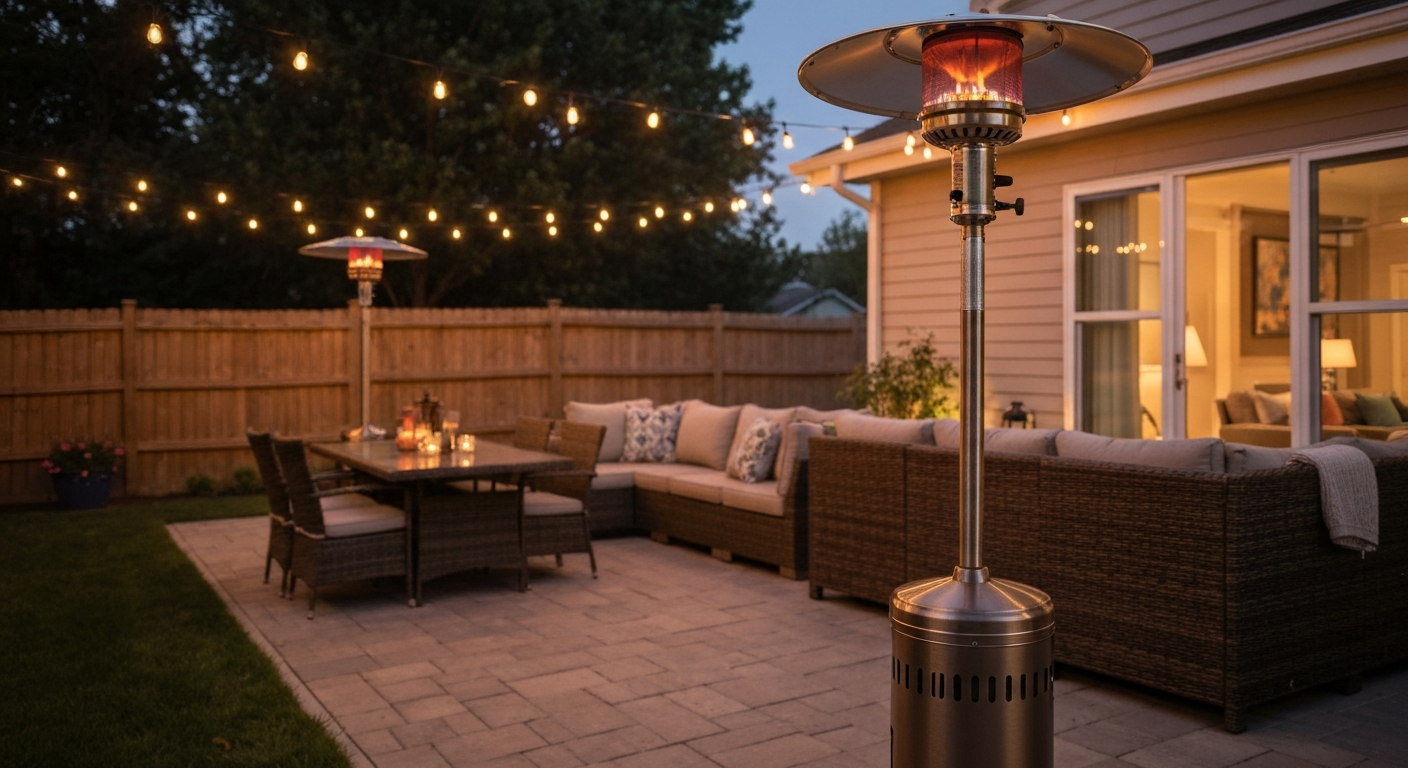
This is the flagship product and the one most people mean when they search for Living Accents patio heater reviews. For broader model comparisons and hands-on test results, see the Home Appliance Guys patio heater reviews. It's a full-height mushroom-cap tower standing about 87 inches tall, powered by a 20-lb propane tank that stores in the base. At 46,000 BTU it's competitive with the Hampton Bay and Fire Sense units at the same price point, and the manufacturer claims a 15-foot heat radius. In real-world use, comfortable warmth for seated guests extends to about 10 to 12 feet at 50°F ambient temperatures, which is typical for this class of heater.
| Metric | Score | Notes |
|---|---|---|
| BTU / Output | 4/5 | 46,000 BTU rated; consistent with competing models at this price |
| Heat radius | 4/5 | 10–12 ft practical radius; manufacturer claims 15 ft |
| Fuel type | 4/5 | Standard 20-lb propane; widely available |
| Run time | 4/5 | ~9–10 hrs at mid setting on a 20-lb cylinder |
| Efficiency | 3/5 | Average for propane mushroom-cap class; no variable output efficiency gains |
| Noise | 5/5 | Silent combustion; base tank vibration minimal |
| Controls | 3/5 | Piezo ignition, rotary valve; no digital controls or remote |
| Durability | 3/5 | Powder-coat finish; early rust reported at welds after 2+ seasons in wet climates |
| Weather resistance | 2/5 | No IP rating; protect with a cover (not included) |
| Weight / Portability | 3/5 | ~35 lbs assembled without tank; wheels on base aid movement |
- Pros: One of the lowest prices for a 46,000 BTU tower heater — typically $120 to $150 at Home Depot
- Pros: Tank storage base keeps the 20-lb cylinder hidden and protected
- Pros: Wheels included make repositioning easy on flat surfaces
- Pros: Assembly is straightforward, typically 30–45 minutes with basic tools
- Cons: Piezo igniter receives the highest complaint rate in consumer reviews — roughly 20% of reviewers mention igniter failure within two seasons
- Cons: Powder-coat quality is below Hampton Bay's stainless models; expect touch-up needs in year two
- Cons: No tilt or auto-shutoff safety on all variants — verify your specific SKU before purchase (some newer SKUs include tip-over shutoff per updated manuals)
Run time math for practical planning: a standard 20-lb propane cylinder holds approximately 4.7 lbs of usable propane. At full 46,000 BTU output, this heater burns through about 3.9 lbs per hour, giving you roughly 7.5 hours at maximum heat. At a more typical mid-setting of around 30,000 BTU, expect 9 to 10 hours per tank, which covers three or four evening gatherings before a refill.
Living Accents 46,000 BTU Freestanding Propane Heater (Hammered Bronze)
Identical in specs and performance to the bronze version above, this variant uses a hammered bronze finish that does a better job masking minor scratches and surface wear over time. It is often priced $10 to $20 higher than the standard bronze, which is worth it if you're keeping the heater in a visible entertainment area. Consumer ratings on Wayfair for this variant average 3.9 out of 5 stars across a significant review pool, with praise for the aesthetic and the same igniter complaints as the standard version.
Living Accents 46,000 BTU Freestanding Propane Heater (Black)
The black powder-coat variant performs identically to the bronze versions but the black finish tends to show heat discoloration near the burner head more visibly over time. It's often the lowest-priced variant in the lineup, sometimes available under $120 on clearance. If you're buying it for seasonal use and plan to store it in the off-season, it's perfectly fine. If you want something that looks sharp three or four years in, the hammered bronze holds its appearance better.
Natural gas conversion and installation notes
Living Accents does not sell a purpose-built natural gas freestanding heater as a standalone SKU in their current lineup. However, some propane models can be converted to natural gas using a conversion kit, subject to confirmation that the specific model is approved for conversion in its user manual. This matters because ANSI/CSA Z83.26 requires that any gas-fired patio heater converted to a different fuel type be done with an approved kit and by a qualified installer. If a permanent natural gas hookup is your priority, the Fire Sense or Hampton Bay natural gas models are a more straightforward choice, and the broader gas patio heater category covers these options in detail.
Glass and quartz-tube Living Accents heater reviews
Living Accents offers at least one freestanding glass/quartz-tube variant in their lineup, identifiable by the visible combustion tube running up the center of the unit behind a glass shield rather than the standard mushroom-cap burner. These models burn at 40,000 to 46,000 BTU but distribute heat differently. Instead of radiating primarily downward and outward from a wide reflector cap, the glass-tube design radiates heat in a 360-degree pattern from the full length of the tube, which creates a more column-like heat zone that's particularly useful when guests are seated closely around the heater rather than spread out in a wide radius.
Living Accents 40,000–46,000 BTU Glass-Tube Freestanding Propane
| Metric | Score | Notes |
|---|---|---|
| BTU / Output | 4/5 | 40,000–46,000 BTU depending on SKU |
| Heat radius | 4/5 | Effective 360° column heat pattern; excellent for tight seating arrangements |
| Fuel type | 4/5 | Standard 20-lb propane |
| Run time | 4/5 | ~9–10 hrs at mid setting |
| Efficiency | 4/5 | Glass tube retains radiant heat more effectively than open-cap designs in light wind |
| Noise | 5/5 | Silent combustion |
| Controls | 3/5 | Piezo ignition, rotary valve; same as standard models |
| Durability | 3/5 | Stainless reflector resists rust better than bronze powder-coat; glass tube is fragile if tipped |
| Weather resistance | 3/5 | Better corrosion resistance on stainless parts; glass tube can crack with rapid temperature changes |
| Weight / Portability | 3/5 | Similar to standard freestanding; slightly heavier glass assembly |
- Pros: Attractive flame-visible aesthetic; often cited as the nicest-looking model in the lineup
- Pros: 360-degree radiant heat pattern works better for round or square seating arrangements
- Pros: Stainless reflector components hold up better than painted finishes in humid climates
- Cons: Glass tube is the most fragile component — a tip-over event can shatter it, and replacement tubes can be hard to source
- Cons: Thermal shock (cold rain on a hot tube) can crack the glass; avoid use in heavy rain
- Cons: Priced $20–$40 higher than the standard cap model for similar BTU output
If the glass-tube aesthetic appeals to you but you want a deeper dive into how these designs compare against other quartz-tube heaters from competing brands, the quartz glass tube patio heater review and glass tube patio heater review sections on this site cover performance comparisons in more detail, including how glass-tube models perform against standard reflector caps in side-by-side heat distribution tests.
Infrared and electric Living Accents heater reviews
The electric infrared models in the Living Accents lineup are a fundamentally different tool from the propane units. They run on 120V household current, produce no combustion gases, and are specifically well-suited to covered patios, screened porches, pergolas with roofs, and any enclosed or semi-enclosed space where propane combustion would be unsafe or impractical. Output is limited to 1,500 watts (equivalent to about 5,118 BTU) because of standard 15-amp circuit limits, which makes them significantly less powerful than the propane models, but the lack of convective heat loss means they feel warmer than the BTU number suggests, especially in wind-protected spaces.
Living Accents 1,500W Electric Infrared Heater (Wall-Mount)
| Metric | Score | Notes |
|---|---|---|
| Output | 3/5 | 1,500W (5,118 BTU equiv.); adequate for spaces under 150 sq ft |
| Heat radius | 3/5 | Directed beam pattern; effective ~8–10 ft in a focused zone |
| Fuel type | 5/5 | Standard 120V outlet; no fuel storage or refilling |
| Run time | 5/5 | Unlimited as long as power is connected |
| Efficiency | 4/5 | Infrared heats objects and people directly; minimal energy wasted on air |
| Noise | 4/5 | Some models include a fan; fanless infrared elements are silent |
| Controls | 4/5 | Typically includes 2–3 heat settings; some models include a remote control |
| Durability | 4/5 | No combustion components to fail; heating element lifespan typically 5,000+ hrs |
| Weather resistance | 3/5 | Suitable for covered outdoor use; not rated for rain exposure on most SKUs |
| Weight / Portability | 4/5 | Wall-mount versions are fixed; freestanding electric versions under 15 lbs |
- Pros: Safe for covered, enclosed, or semi-enclosed patios where gas combustion is not allowed
- Pros: No propane to buy, store, or run out of mid-party
- Pros: Instant-on heat from infrared elements; no warm-up delay
- Pros: Lower ongoing operating cost per hour compared to propane at current fuel prices in most regions
- Cons: 1,500W output is insufficient for open, exposed patios or spaces larger than about 150 sq ft
- Cons: Wall-mount installation requires drilling and may need an electrician if a new outlet is needed
- Cons: Does not perform well outdoors in wind — infrared heat disperses quickly without enclosure
Installation note: if you're mounting a 1,500W electric infrared heater on a covered patio, the NFPA recommends a minimum clearance of 24 to 36 inches below the ceiling and the same distance to combustible materials on either side. Always check the specific model's manual for its stated clearance requirements, as they vary. For covered-patio use, this electric infrared option is genuinely the better choice over propane, not just for safety but for convenience. It's also worth comparing against other infrared-specific models covered in the broader electric and infrared patio heater sections of this site.
Living Accents vs. the competition
Knowing how Living Accents stacks up against other brands at the same price point matters as much as knowing the specs of individual models. Here's a direct comparison of the 46,000 BTU freestanding propane heaters from the four main brands you'll encounter at this price level.
| Brand / Model | BTU | Finish / Material | Ignition | Tip-Over Shutoff | Warranty | Avg. Retail Price | Notable Weakness |
|---|---|---|---|---|---|---|---|
| Living Accents 46,000 BTU (Bronze) | 46,000 | Powder-coat steel | Piezo push-button | On select SKUs only | 1 year limited | $120–$150 | Igniter reliability; rust on welds |
| Hampton Bay 46,000 BTU (Stainless) | 46,000 | Stainless steel | Electronic auto-ignition | Yes, standard | 1 year limited | $149–$179 | Slightly heavier; higher price |
| Fire Sense 46,000 BTU (Stainless) | 46,000 | Stainless steel | Electronic ignition | Yes, standard | 1 year limited | $139–$169 | Stainless can show water spots |
| Style Selections 48,000 BTU (Bronze) | 48,000 | Powder-coat steel | Piezo push-button | Yes, standard | 1 year limited | $129–$159 | Similar powder-coat durability issues |
The honest takeaway from that table: Living Accents is the cheapest option, but it gives up tip-over shutoff on some SKUs and uses a less reliable piezo ignition compared to the electronic ignition on Hampton Bay and Fire Sense. If you can stretch your budget by $20 to $30, the Hampton Bay stainless model addresses both of those weaknesses. The Hampton Bay 46000 BTU Stainless Steel Gas Patio Heater, The Home Depot offers stainless construction, electronic ignition, and a listed tip‑over safety shutoff as upgrades over many budget models Hampton Bay 46000 BTU Stainless Steel Gas Patio Heater — The Home Depot. If you're committed to the Living Accents price point, it is a functional heater, but check your specific SKU's spec sheet to confirm whether tip-over shutoff is included before you buy.
For readers who've also been looking at the Style Selections lineup, the style selections gas patio heater reviews on this site cover that brand's models in the same format used here, making it straightforward to run a direct comparison on whichever specs matter most to you.
Buying guide: match the heater to your patio
The right Living Accents model (or whether Living Accents is the right brand at all) depends on four variables: patio size, whether the space is covered or open, how you plan to install or move the heater, and your budget. Here's how those variables map to specific choices.
| Patio Type | Size | Recommended Model | Why |
|---|---|---|---|
| Open / uncovered | Small (under 100 sq ft) | 11,000 BTU tabletop | Portable, no installation, adequate for 2–4 people |
| Open / uncovered | Medium (100–250 sq ft) | 46,000 BTU freestanding propane | Best heat output for open spaces; covers up to 12 ft radius |
| Open / uncovered | Large (250+ sq ft) | Two 46,000 BTU units or upgrade to Bromic/Fire Sense | Single Living Accents unit will not cover large open areas adequately |
| Covered / pergola | Small to medium | 1,500W electric infrared | No combustion gases; safe under roof structures |
| Covered / screened | Any size | 1,500W electric infrared wall-mount | Enclosed space requires electric; permanent mount is cleanest install |
| Balcony / apartment | Very small | 11,000 BTU tabletop with 1-lb cylinder | Portable, no permanent connection needed |
Budget mapping is straightforward for this brand. Under $100 gets you a tabletop model. Between $120 and $180 gets you the full freestanding propane tower. The electric infrared models fall in between. There's no Living Accents option above $200, which is either a strength (it's accessible) or a limitation (there's no premium tier if you want better ignition, smarter controls, or higher weather resistance). If your budget reaches $200 to $300, you're better served by Hampton Bay, Bromic's entry models, or the Well Traveled Living lineup, which offers some meaningful upgrades in finish quality and control options. For deeper, model-by-model comparisons of higher-end options, see the Well Traveled Living patio heater reviews for details on finish quality and advanced controls.
Safety, installation, and maintenance
Gas heater safety essentials
All propane patio heaters in the Living Accents lineup are designed for outdoor use only. NFPA guidance on outdoor heaters specifically prohibits use in enclosed spaces, garages, or under low-clearance roofs without proper ventilation. The minimum clearance above the burner head for a freestanding mushroom-cap heater should be at least 36 inches to any combustible material, though the Living Accents manuals specify clearances for each model individually and those numbers take precedence. Keep the heater at least 3 feet away from flammable materials including furniture cushions, overhead awnings, and string lights.
- Always check the gas hose and regulator connection before each use; replace hoses that show cracking, stiffness, or discoloration
- Test for propane leaks by applying soapy water to all connections; bubbles indicate a leak — do not ignite if a leak is detected
- Verify whether your specific SKU includes an auto tip-over shutoff; if it does not, ensure the heater is on a level surface away from high-traffic areas
- Store the propane tank outdoors, never in an enclosed garage or shed
- After the season, close the tank valve fully and disconnect the regulator before storage
Recall awareness
The CPSC has issued past recalls on gas patio heaters from various brands for issues including faulty tip-over shutoff mechanisms and gas valve defects. There are no active CPSC recalls specific to Living Accents patio heaters as of mid-2026, but it's a good practice to check the CPSC recall database using your model number before your first use of the season, particularly on models that have been stored for more than a year. Recall checks take less than two minutes and can catch issues your manual might not mention.
Assembly tips
Living Accents freestanding models typically assemble in 30 to 45 minutes. The most common assembly mistake I see in consumer reviews is overtightening the pole sections, which can strip the threading and make future disassembly difficult. Hand-tight plus a quarter turn with a wrench is sufficient for all pole connections. The second most common issue is the reflector cap alignment, if it's even slightly off-center, it changes the heat distribution pattern. Take the time to confirm it's level before your first use.
Maintenance and longevity
- Clean the burner screen with a soft brush at the start and end of each season to remove debris and spider webs, which are a documented ignition and flame quality problem
- Wipe down powder-coat surfaces with a damp cloth; avoid abrasive cleaners that strip the finish
- Apply a coat of automotive wax to powder-coat surfaces once a season to slow oxidation
- For glass-tube models, clean the glass with a non-ammonia glass cleaner; ammonia can cloud tempered glass over time
- Store electric infrared models indoors or in a weatherproof cover when not in active use; water infiltration into the element housing is the primary failure mode
- The warranty on all Living Accents patio heaters is 1 year limited; keep your receipt and document any issues within that window
Price guide and where to buy
Living Accents patio heaters are stocked almost exclusively at Home Depot (in store and online), Ace Hardware stores (regional availability), and Wayfair. Lowe's does not typically carry the Living Accents brand, stocking Style Selections instead. Amazon carries some Living Accents models through third-party sellers, but pricing is often $20 to $40 above the Home Depot direct price, and you lose the in-store return option. The best time to buy is during late summer clearance (August through September), when Home Depot marks down patio heater inventory by 20 to 40 percent to clear for fall merchandise. Spring restocking in March and April tends to bring full retail pricing.
| Model | Home Depot | Wayfair | Ace Hardware | Best Time to Buy |
|---|---|---|---|---|
| 11,000 BTU Tabletop (Stainless) | $85–$95 | $89–$105 | $85–$95 | Late summer clearance |
| 46,000 BTU Freestanding (Bronze) | $120–$150 | $129–$165 | $130–$155 | Late summer clearance or spring sale |
| 46,000 BTU Glass-Tube Freestanding | $140–$190 | $149–$199 | Limited availability | Late summer clearance |
| 1,500W Electric Infrared | $80–$140 | $89–$149 | $85–$130 | Fall / winter off-season sales |
Final recommendations
Living Accents delivers reliable, no-frills patio heating at the lowest end of the mid-market price range. The 46,000 BTU freestanding propane model is the best overall value if your primary concern is heat output and you're buying for an open patio. The tabletop model earns its place for anyone who needs portability above all else. The electric infrared wall-mount is the right call for any covered or enclosed patio. Where Living Accents falls short is in ignition reliability, finish durability in wet climates, and the inconsistent inclusion of safety features like tip-over shutoff across SKUs. If those gaps concern you and your budget can stretch to $160 to $180, the Hampton Bay stainless equivalent addresses all three weaknesses. But if you're comfortable checking your specific SKU's specs, storing the heater properly, and replacing the igniter if needed, Living Accents is a sensible, budget-conscious choice that genuinely heats a patio.
For broader context on how these models compare to the full range of gas-powered options on the market, the gas patio heater reviews section of this site covers competitor models across all price tiers side by side. If the glass-tube aesthetic caught your attention, the glass tube heater vs patio heater comparison breaks down exactly how those two design types differ in heat distribution and real-world use, which is worth reading before you make a final decision on the glass-tube Living Accents variant. For a detailed breakdown of how the glass-tube design compares to conventional patio heaters, see the glass tube heater vs patio heater comparison (internal resource b8a7343a-2f5f-42b5-ab08-befc9e224717).
FAQ
What inventory and product-identification tasks are needed before testing Living Accents patio heaters?
Catalog every active Living Accents SKU by category (tabletop, freestanding, glass/quartz-tube, infrared, electric) using retailer listings (Home Depot, Wayfair, Lowe’s, Amazon) and the Living Accents official site. Record model names, model numbers, SKUs, manufacturing dates, and variant options (color/finish, included regulator/tank cover). Cross-check ‘From the Manufacturer’ spec blocks and manual PDFs to capture claimed BTU/wattage, fuel type, coverage area, and warranty language.
Which primary source documents should be collected to verify manufacturer claims and installation details?
Download official product pages, spec sheets, Use & Care/installation manuals, warranty documents and parts lists from Living Accents and major retailers. Archive these PDFs and product pages (or snapshot via Wayback) to document manufacturer-rated BTU/output, claimed heat radius, assembly steps, clearance requirements, ignition method, and stated run-time/efficiency.
What standardized testing standards and protocols should guide lab measurements?
Adopt ASTM F2644 as the baseline for heat-output and distribution testing (temperature grid, measurement spacing, reporting metrics). Supplement with ANSI/CSA Z83.26 for gas-fired infrared models to verify compliance checks. Mirror thermocouple-grid and ambient-control methods used by established reviewers (Popular Mechanics, Good Housekeeping) for repeatable temperature mapping, time-to-heat and stability tests.
What heat-output and distribution measurements must be performed?
Measure peak output (BTU or watts), delivered heat energy at set distances and azimuths using a radial thermocouple grid (e.g., 0.5–4 m at 45° increments) and log temperature rise over ambient at each node. Report heat radius (distance achieving defined ΔT thresholds, e.g., +5°F and +10°F), warm footprint area, and time-to-steady-state temperature.
How should run-time and fuel-consumption be measured and reported?
For propane units, weigh a standard 20-lb cylinder before and after continuous run at max and low flame settings to compute consumption (lbs/hr) and real run-time. For electric and natural-gas units, record power draw (W) and fuel flow rates where possible. Report real-world run-time, manufacturer-claimed run-time, and efficiency (useful heat delivered per unit fuel or watt-hour).
What durability, weather-resistance and build-quality tests are required?
Visually inspect materials and seam welds; measure material thickness where relevant. Run ingress tests (controlled spray/rain exposure) to note water entry points and ignition vulnerability. Conduct accelerated corrosion checks (salt-spray notes if feasible) or document coating type and expected resistance. Log observed rust, discoloration, and ignition/electronics failures after exposure cycles.