
Napoleon makes solid outdoor heating equipment, but if you're specifically shopping for a Napoleon tabletop patio heater, you need to know something upfront: as of mid-2026, Napoleon's active U.S. product catalog does not list a dedicated tabletop propane heater. There is a well-documented Napoleon-branded stainless steel tabletop propane unit (11,000 BTU, 304 stainless, push-button ignition, 7-foot heating diameter) that circulated through Canadian Tire and other Canadian retailers, but it has been discontinued in most channels. On the electric side, Napoleon's current outdoor heater lineup centers on the Phantom freestanding infrared series (like the NEOFV80IH at 1,500 W / ~5,100 BTU equivalent, MSRP $859). This guide covers what you actually get from Napoleon's tabletop and small-format heater range, how the discontinued tabletop propane model stacks up, and whether a Napoleon electric infrared unit makes sense as a compact-patio alternative, plus honest comparisons with tabletop options from Nedis, Pamapic, Sahara, and Sunpak so you can pick the right heater for your specific setup. For full details and model comparisons, see our napoleon patio heater review.
Napoleon Tabletop Patio Heater Reviews: Top Picks & Guide

Who this guide is for
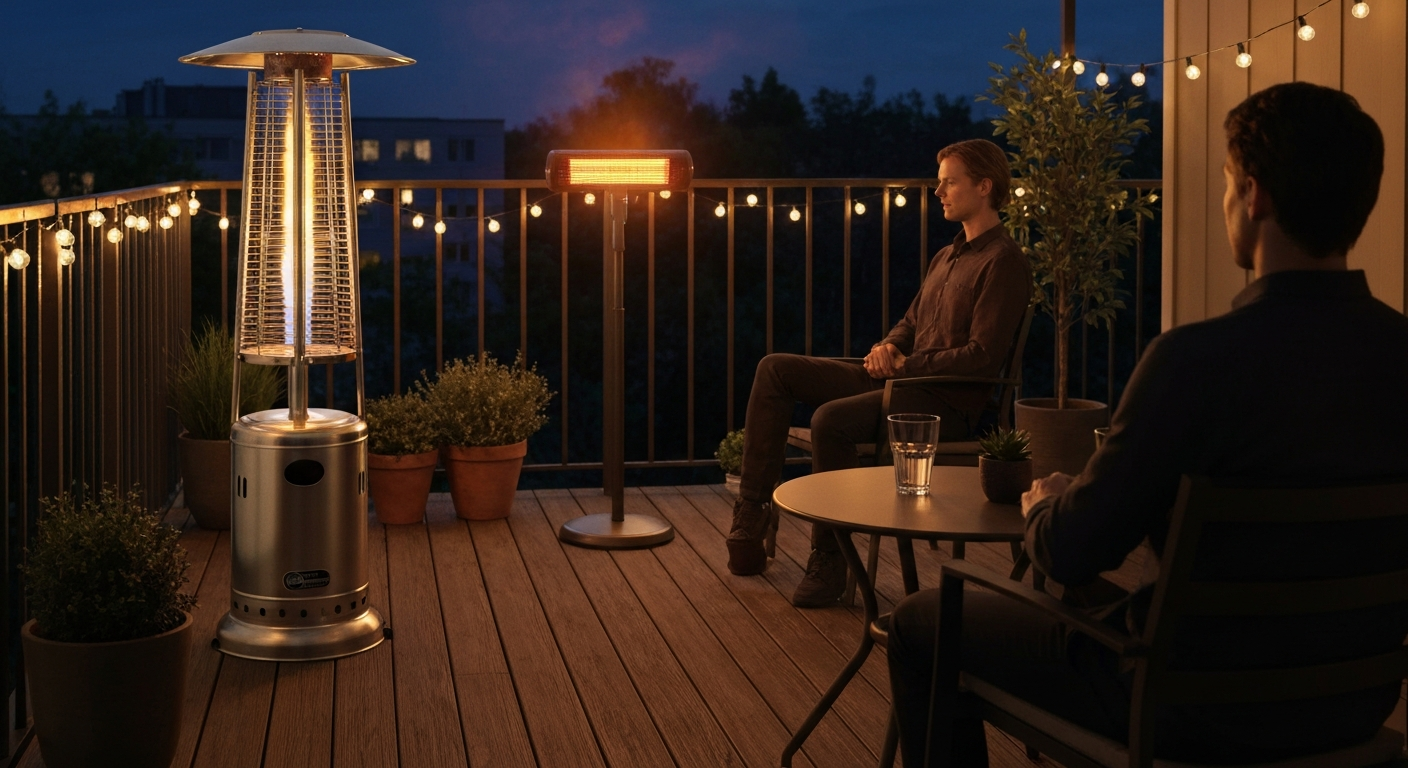
This review is written for homeowners and renters who want a compact, portable heat source for smaller outdoor spaces: a bistro-style patio table, a balcony, a small deck, or a covered pergola. If you've been drawn to Napoleon because you already own their grills or fireplaces and trust the brand, that's a fair reason to look here first. But tabletop heating is a niche Napoleon hasn't consistently invested in for the U.S. market, so part of what I'll do is be straight with you about where the brand actually delivers and where a competitor gives you better value in a small-format heater.
Top picks at a glance
Not everyone wants to read a 3,000-word review before making a decision. Here's where I'd point different buyers right now, based on use case.
| Use Case | Recommended Option | Why |
|---|---|---|
| Small uncovered patio or balcony, propane preferred | Napoleon tabletop propane (if found secondhand/clearance) or Pamapic tabletop propane | 11,000 BTU / 7 ft diameter is solid for 2–4 people; Napoleon's 304 stainless is a build quality edge |
| Covered patio or screened porch, electric preferred | Napoleon NEOFV80IH Phantom (freestanding, not tabletop) | 1,500 W infrared is safe indoors/covered; directional heat is efficient in enclosed spaces |
| Apartment balcony, low profile needed | Nedis or Pamapic tabletop electric infrared | Compact form, no fuel tank, lower cost entry point |
| Budget-first, portability a priority | Pamapic or Sahara tabletop propane | CSA-certified options under $100; good for occasional use |
| High-output tabletop for entertaining | Sunpak tabletop or Pamapic pyramid portable | Higher BTU output options with broad coverage for 4–6 people |
How we evaluated these heaters
I assess tabletop patio heaters across six core dimensions: heat output and coverage (measured in BTU for propane and watts for electric, with real-world warmth radius tested at ambient temperatures between 45°F and 55°F), build quality (materials, finish durability, stability on a surface), safety features (tip-over shutoff, thermocouple/flame failure device, certification marks), ignition and ease of use, fuel runtime or run cost, and overall value. For Napoleon specifically, I cross-referenced official Napoleon product pages and the 2025/2026 Napoleon digital price book, Canadian Tire retail listings for the tabletop propane model, third-party manual indexes including Manuals. The Hiland HLDS032‑BB 11,000 BTU Table Top Patio Heater, User Manual index provides a public user manual showing an 11,000 BTU/hr rating, recommended clearances, anti‑tilt and flame failure devices, and replacement parts lists, which are representative of small‑format propane tabletop heater specifications blank" rel="noopener noreferrer">Hiland HLDS032‑BB 11,000 BTU Table Top Patio Heater — User Manual index. Manufacturer/third‑party manual indexers host Napoleon heater user manuals and list the NEOFV80IH Phantom Freestanding outdoor electric infrared patio heater user manual and warranty information on Napoleon Manuals & User Guides, Manuals.plus (manual aggregator) blank" rel="noopener noreferrer">Napoleon Manuals & User Guides — Manuals.plus (manual aggregator). plus for owner's manuals and safety specs, and aggregated consumer feedback from Home Depot, Amazon, and Canadian Tire product pages. For safety compliance, I checked each model against CSA/ANSI Z83.26 (the governing North American standard for gas-fired outdoor infrared patio heaters, third edition 2020/R2025) and looked up CPSC recall records for Napoleon/Wolf Steel products. No active recalls for Napoleon tabletop heaters were found in that search.
Key specs explained before you buy
BTU vs. Watts: what the numbers actually mean
BTU (British Thermal Units) is the standard heat output measurement for propane and gas heaters. One BTU raises one pound of water by one degree Fahrenheit. For a tabletop propane heater, 11,000 BTU/hr is the most common rating in this class, it's enough to keep 2–4 people comfortable at a small table in 40–55°F weather with no wind. Electric heaters are rated in watts; 1,500 W is roughly equivalent to about 5,100 BTU/hr. Electric infrared is more efficient at delivering warmth to people directly (it heats objects, not air), so a 1,500 W infrared unit often feels warmer than its BTU equivalent suggests, especially in a covered space.
Heat pattern and coverage area
Tabletop propane heaters typically radiate heat in a roughly circular pattern upward and outward from a central burner head. The Napoleon tabletop propane unit claims a 7-foot heating diameter, which is realistic for mild ambient temperatures. Freestanding and wall-mounted infrared heaters like the Napoleon Phantom project a directional beam, excellent for targeting seated guests but less useful if you need 360-degree coverage. Keep in mind that wind is the enemy of any tabletop propane heater: even a light breeze will push the convective heat away from your guests and can cut effective coverage roughly in half.
Run time on a 1 lb propane cylinder
Most tabletop propane heaters connect to a standard 1 lb disposable propane cylinder. At 11,000 BTU/hr maximum output, a 1 lb cylinder (containing about 21,500 BTU of usable energy) gives you roughly 1.5 to 2 hours of runtime at full blast. Turn the heat down to medium (around 6,000–7,000 BTU) and you can stretch that to 3 hours or more. If you use a 20 lb tank with an adapter hose, the math scales accordingly, one 20 lb tank holds approximately 430,000 BTU, meaning many evenings of use before a refill.
Ignition and safety systems
Push-button electronic ignition (also called piezo ignition) is the standard on quality tabletop propane heaters and is what the Napoleon tabletop propane unit uses. The two safety features that matter most are the thermocouple (a sensor that cuts gas flow if the flame goes out, preventing unburned propane from accumulating) and the anti-tilt shutoff (cuts gas if the unit tips over). CSA/ANSI Z83.26 requires both for certified tabletop gas heaters. Always verify these are present before buying any tabletop propane heater.
Napoleon's outdoor heater lineup: what the brand actually offers
Napoleon is a Canadian brand (Wolf Steel Ltd., headquartered in Barrie, Ontario) best known for grills and fireplaces. Their outdoor heating lineup as of 2026 is anchored by two product families: the Patioflame fire table series and the Phantom electric infrared heater series. The Phantom NEOFV80IH is their flagship portable electric outdoor heater, it's freestanding, not a tabletop unit, but it's compact enough (designed for small patios and balconies) that it belongs in this conversation. At 1,500 W and MSRP $859, it's a premium buy. The Patioflame fire tables are aesthetic products (beautiful, but not primarily heaters). The discontinued tabletop propane model, which showed up in Canadian Tire as SKU 085-4054-6, was built from 304 stainless steel and produced 11,000 BTU with a push-button ignition, a well-specified unit for its time, but it's no longer in regular production or distribution as of our July 2026 research.
The key thing to understand about Napoleon's approach to outdoor heating is that the brand positions itself at a premium tier. Their products tend to be made from better materials than the budget competitors, come with stronger warranty backing (Napoleon's support portal at warranty.napoleon.com handles claims and parts searches), and carry a corresponding price premium. When you find a Napoleon tabletop heater, you're generally paying for that build quality, but you should compare carefully with what the current market offers.
Napoleon tabletop and small-format heater models side by side
| Model | Type | Output | Fuel | Ignition | Key Safety Features | Certification | MSRP / Street Price | Availability |
|---|---|---|---|---|---|---|---|---|
| Napoleon Tabletop Propane (SKU 085-4054-6) | Tabletop propane | 11,000 BTU/hr | Propane (1 lb or 20 lb w/ adapter) | Push-button electronic | Thermocouple, anti-tilt shutoff | CSA (per retail listing) | ~$100–$130 CAD (when available) | Discontinued / clearance only |
| Napoleon Phantom NEOFV80IH | Freestanding electric infrared | 1,500 W (~5,100 BTU equiv.) | 120V electric | Switch/remote | Overheat protection, tip-over shutoff | ETL/CSA (per price book) | $859 USD MSRP | Active — current model |
Detailed Napoleon model reviews
Napoleon tabletop propane heater (discontinued model)
If you find this one at a clearance outlet, a garage sale, or a Canadian retailer still working through old stock, it's worth picking up, with a few caveats. The 304 stainless steel construction is a genuine differentiator. Budget tabletop heaters often use painted steel or lower-grade alloys that rust at the burner area after a season or two in wet conditions. The 304 stainless on the Napoleon unit handles humidity and repeated heat cycles much better. The push-button electronic ignition works reliably when the burner and igniter tip are clean and dry. At 11,000 BTU and a 7-foot heating diameter, it covers a standard patio bistro table for 2–4 people comfortably in 45–55°F weather.
On safety, the thermocouple flame failure device and anti-tilt mechanism are both present, consistent with CSA/ANSI Z83.26 requirements for tabletop gas heaters. Consumer reviews from Canadian Tire and Home Depot noted that the unit is stable on flat surfaces but can feel tippy on uneven deck boards, a concern worth noting if your patio surface isn't level. The main practical downside today is availability: parts sourcing can be difficult for a discontinued model. Napoleon's warranty portal (warranty.napoleon.com) is worth checking for parts availability, but don't expect replacement burner heads to be in stock indefinitely.
- Pros: 304 stainless steel resists rust and corrosion better than painted competitors; 11,000 BTU is adequate for small table-side use; push-button ignition; thermocouple and tilt-shutoff safety features included
- Cons: Discontinued in most channels, so finding one new is difficult; parts availability will decline over time; ~$100–$130 CAD is slightly above budget-brand pricing for equivalent BTU output; no 1 lb cylinder included
- Best for: Buyers who find it at clearance pricing and want a well-built compact propane heater for a small patio table
Napoleon Phantom NEOFV80IH: premium electric infrared for small patios
The Phantom is not a tabletop heater, it's a freestanding pedestal-style unit. But I'm including it here because it's Napoleon's closest current answer to the 'compact patio heater' need, and it's the product Napoleon actively sells and supports. At 1,500 W, it outputs the equivalent of roughly 5,100 BTU in radiant infrared energy. The practical difference from a propane tabletop unit is significant: infrared heaters warm people and surfaces directly rather than heating the air, which means they're far more effective in a covered patio or a breezy outdoor space where convective heat dissipates quickly.
The $859 MSRP is genuinely steep compared to tabletop propane competitors. You're paying for build quality, the Napoleon support ecosystem (warranty portal, parts search, official manuals through Manuals.plus and Napoleon's own support pages), and the infrared technology itself. For a homeowner with a covered deck who wants a set-it-and-forget-it electric heater they'll use for years, the math can work out. For a renter who wants occasional warmth on a small balcony and doesn't want to spend close to $900, it doesn't.
- Pros: Infrared heat works well in covered and partially enclosed spaces; no fuel to buy or store; Napoleon's warranty/parts support is active and accessible; premium build quality
- Cons: $859 MSRP is among the highest in the residential patio heater category; not a true tabletop unit (freestanding, takes floor space); 1,500 W / 120V requires an outdoor-rated outlet; less portable than propane tabletop units
- Best for: Covered patios, screened porches, or permanent small-deck setups where convenience and longevity justify the higher upfront cost
Napoleon vs. Nedis, Pamapic, Sahara, and Sunpak: honest brand comparisons
Napoleon doesn't really compete head-to-head in the active tabletop propane market right now because they've stepped back from that product category in the U.S./international channel. That said, buyers comparing Napoleon with these brands deserve a direct breakdown of where each one sits.
| Brand | Format Focus | Typical Output | Certification | Build Quality | Price Range | Best Use Case |
|---|---|---|---|---|---|---|
| Napoleon (tabletop propane, discontinued) | Tabletop propane | 11,000 BTU | CSA | High (304 stainless) | $100–$130 CAD clearance | Small patio table, 2–4 people, quality-first buyer |
| Napoleon (Phantom electric infrared) | Freestanding electric | 1,500 W | ETL/CSA | Premium | $859 USD | Covered patio, permanent install, long-term use |
| Nedis | Tabletop/wall electric infrared | 1,000–2,000 W | CE (EU-focused) | Good | $80–$200 | Balcony or covered porch, electric preferred |
| Pamapic | Tabletop and pyramid propane | 11,000–46,000 BTU | CSA | Good (stainless + painted steel) | $60–$180 | Budget-friendly propane, occasional to regular use |
| Sahara | Tabletop and freestanding propane/electric | 9,000–46,000 BTU | CSA/CE varies | Good | $70–$200 | Mixed use, good value for covered and open patios |
| Sunpak | Freestanding and tabletop | 25,000–34,000 BTU (large format) | ETL/CSA | Premium (commercial-grade options) | $200–$500+ | High-output entertaining, larger tables, semi-permanent setups |
Napoleon vs. Pamapic: build quality vs. budget value
Pamapic is the closest direct competitor to Napoleon's tabletop propane unit in format and output. Both land at roughly 11,000 BTU, both offer CSA certification, and both include thermocouple and tilt-shutoff safety features. The real difference is material quality and price. Napoleon's 304 stainless holds up better in high-humidity environments and over multiple seasons. Pamapic uses a mix of stainless and painted steel on most tabletop models, which can show surface rust at joints after a year or two in wet climates. Pamapic costs noticeably less, though, and its owner's manual (publicly available via Manuals.plus) is thorough, detailed parts diagrams, clear safety warnings, CSA certification icons, and a 1-year limited warranty. For a buyer who wants decent quality at a lower price point and doesn't mind replacing the unit in 3–4 years, Pamapic is a sensible pick.
Napoleon vs. Sunpak: different leagues
Sunpak skews toward higher BTU output (25,000–34,000 BTU in their larger models) and commercial-grade build quality. If you're heating a larger covered patio and want a unit you'd mount overhead or use as a dedicated freestanding heater for a 6–8 person table, Sunpak is worth serious consideration. For detailed comparisons, see Sunpak patio heater reviews for model specs and real-world performance. For genuine tabletop use around a small bistro table, Sunpak's larger format models are overkill and impractical. Where their smaller tabletop offerings exist, they're competitive with Napoleon on quality but come at a higher cost.
Napoleon vs. Nedis: propane vs. electric, different use cases
Nedis focuses on electric infrared heaters (wall-mount and tabletop electric formats are their strength), making them a natural comparison point for Napoleon's Phantom electric line rather than the tabletop propane unit. Nedis products are CE-certified and more commonly available in European markets. If you're in North America and want a compact electric tabletop infrared heater, Nedis is a viable option, typically priced between $80–$200, though you'll want to verify North American electrical compliance (120V, ETL or UL listing) before buying.
Napoleon vs. Sahara: range vs. focus
Sahara offers a broader product range spanning both propane and electric formats, with pricing that's competitive with Pamapic. Like Pamapic, they represent the accessible mid-market segment. Build quality is reasonable but not at Napoleon's level. For detailed model comparisons and user feedback, see our Sahara patio heater reviews. For buyers who want flexibility in fuel type and a straightforward warranty process, Sahara is a solid consideration, particularly for occasional use scenarios where premium construction isn't a priority.
Infrared vs. convective heat: the real tradeoff for tabletop buyers
Propane tabletop heaters like the Napoleon discontinued unit and Pamapic models heat primarily by convection, they warm the surrounding air. Infrared heaters like the Napoleon Phantom heat objects and people directly without warming the air in between. For open, uncovered patios, convective heating loses a lot of efficiency to wind and air movement. Infrared units are dramatically more effective in those conditions. But infrared freestanding units cost more and require a power outlet, which isn't always convenient for a portable table-side setup. If your patio is covered or semi-enclosed, go infrared if the budget allows. If you're heating an open deck or want to bring a heater to a tailgate or camping setup, a propane tabletop unit is far more practical.
Setup, safety, and maintenance tips
Setting up a tabletop propane heater safely
- Always place the heater on a stable, level, non-combustible surface — unstable positioning is the most common cause of tip-over incidents with tabletop heaters
- Keep a minimum 3-foot clearance from overhead structures, curtains, umbrellas, and flammable materials (CSA/ANSI Z83.26 requires specific minimum clearances; always check your model's manual for exact distances)
- Connect the propane cylinder securely and perform a leak check using soapy water on the regulator connection before the first use of each season
- Never use a tabletop propane heater in an enclosed indoor space — propane combustion consumes oxygen and produces carbon monoxide
- Store propane cylinders upright and away from heat sources when not in use; never store a cylinder indoors
Common troubleshooting for propane tabletop heaters
- Heater won't ignite: Check that the cylinder is not empty, the valve is fully open, and the igniter tip is clean and positioned correctly near the burner orifice. Piezo igniters can fail after extended use — a long-reach lighter is a valid backup.
- Flame goes out shortly after lighting: This is usually the thermocouple. The thermocouple tip needs to be in the flame path; if it's been bent away during cleaning or assembly, reposition it. A dirty or corroded thermocouple may need replacement.
- Low flame output despite full cylinder: Cold weather reduces propane vapor pressure in the cylinder. Warming the cylinder slightly (not with direct heat — try bringing it indoors for 20 minutes before use) can restore pressure. Also check the regulator for blockage.
- Yellow/orange flame instead of blue: Indicates incomplete combustion, often from a clogged burner orifice. Turn off the heater, disconnect the fuel, and clean the orifice with a soft brush or compressed air.
Maintenance to extend heater life
At the end of each season, disconnect the propane cylinder and store it outside. Wipe down the stainless steel components with a mild detergent and dry thoroughly. Inspect the burner screen for spider webs or insect nests, these are surprisingly common and can cause ignition problems and dangerous pressure buildup. Cover the heater when not in use if it's stored outdoors. For electric infrared units like the Napoleon Phantom, keep the heating element free of debris and periodically check that the power cord and connections show no signs of weathering or cracking.
Warranty and parts: what Napoleon actually covers
Napoleon's warranty support runs through warranty.napoleon.com, where you can submit claims, search for parts, and access product manuals. For the Patioflame fire table series, Napoleon publishes a 3-year limited warranty on product pages. The active Phantom electric heater would fall under Napoleon's standard residential product warranty terms, check warranty.napoleon.com directly for current coverage periods, as these can vary by product and region. For the discontinued tabletop propane unit, warranty coverage has likely expired for most units in circulation, and parts availability through official channels is uncertain. This is an important practical consideration: buying a discontinued heater at clearance saves money today but may create a parts headache in 18 months.
Decision checklist: picking the right tabletop heater for your space
Use these questions to narrow your choice before buying.
- Is your patio covered or enclosed? If yes, a 1,500 W electric infrared unit (Napoleon Phantom or a comparable Nedis electric model) will outperform any convective propane heater at equivalent wattage.
- Do you have access to an outdoor power outlet? If no, a propane tabletop heater is your only practical option.
- How many people are you heating? For 2–4 people at a bistro-style table, 11,000 BTU propane or 1,500 W electric is sufficient. For 4–6 people, consider a freestanding unit with higher output.
- How often will you use it? For regular, multi-season use, invest in better materials (Napoleon stainless, Napoleon Phantom, or Sunpak). For occasional use, Pamapic or Sahara at a lower price point is reasonable.
- Is portability important? Tabletop propane units win here — no cord, compact, light, work anywhere.
- What is your budget? Under $100: Pamapic or Sahara tabletop propane. $100–$200: Napoleon tabletop propane (if found), Pamapic, Sahara, Nedis electric. $500+: Napoleon Phantom electric infrared or Sunpak freestanding.
- Do you care about long-term parts and support? Napoleon's active warranty portal and Sunpak's commercial-grade ecosystem offer the best long-term support. Budget brands may not stock replacement thermocouples or regulators after 2–3 years.
The bottom line on Napoleon tabletop patio heaters
Napoleon built a genuinely good tabletop propane heater, the 304 stainless construction, CSA certification, thermocouple, and push-button ignition were all done right. The problem is that it's no longer in active production, which means finding one new requires luck, and planning around long-term parts support is a real concern. For buyers who want Napoleon quality in a current, supported product, the Phantom NEOFV80IH is the answer, but at nearly $900 it's a freestanding electric unit aimed at buyers with a permanent covered-patio setup and the budget to match. If you need a compact propane tabletop heater right now, Pamapic offers the closest equivalent to the Napoleon's spec at a lower price with active availability. If high output and premium build quality matter more than budget, Sunpak's lineup is worth a look. And if electric infrared is your direction, Napoleon's own Phantom or a Nedis compact electric unit both deserve consideration depending on how much you want to spend.
FAQ
What primary product documentation and manufacturer sources must be collected for each Napoleon and competitor tabletop model?
Owner’s manuals (assembly, specs, clearances, parts), official spec sheets (BTU/W, dimensions, weight), warranty statements and parts/repair portals, product pages (Napoleon Outdoor Heating, Patioflame), digital price books/catalogs, certification listings (ETL/UL/CSA statements), and manufacturer support/contact records. If manuals are absent on the vendor site, use manual aggregators and the manufacturer’s warranty/parts portal to retrieve them.
Which safety, performance and installation standards should reviews reference and verify compliance with?
CSA/ANSI Z83.26 • CSA 2.37 (gas‑fired outdoor/ tabletop patio heaters) for propane/gas units, ANSI Z223.1 / NFPA 54 (National Fuel Gas Code) for installation, and applicable electrical standards for electric/infrared units (UL/ETL listings to relevant UL/CSA standards). Also check regional equivalents (CSA for Canada, local building codes).
What independent certification and regulatory checks are required?
Verify ETL/UL/CSA certification reports or listing numbers, query recall databases (U.S. CPSC, Health Canada recalls), and check for any manufacturer safety notices or product recalls. Record certification scope (which standard and model numbers covered) and dates.
What objective lab tests should be performed to evaluate heating performance and efficiency?
Measure radiant surface temperature and emitted flux using calibrated thermal cameras and radiometers, quantify delivered heat in Watts/BTU at standard distances and orientations, map heat pattern/coverage (isotherm maps) at common seating heights, measure warm‑up time to target temperature, and measure fuel consumption (g/hr or BTU/hr) and run time using a standardized cylinder or power draw for electric units. All instruments must be calibrated and results reported with test conditions (ambient temp, wind speed, humidity).
How should real‑world field tests be structured (conditions and protocols)?
Test in controlled outdoor settings across representative scenarios: small balcony (covered/uncovered), 6–12 ft2 table area, and open deck. Run each unit for set intervals at maximum and mid settings. Record felt warmth (subjective) from seating positions, air temperature delta at 1m and 2m, wind sensitivity (tests at 0, 5, 10 mph or equivalent sheltering), ignition reliability, and run time. Repeat each test 3+ times to assess repeatability.
Which mechanical and durability assessments are necessary?
Inspect build materials (stainless grade, coatings), weld/fastener quality, finish uniformity, and weight/packaging. Conduct accelerated corrosion exposure (salt spray or wet/dry cycles) where possible, test tilt/anti‑tip mechanism and stability on uneven surfaces, cycle ignition and control knobs 500+ times to evaluate wear, and assess portability (weight, carry handles, propane cylinder fit, breakdown time).