
A tabletop patio heater sits directly on your outdoor table or a nearby surface and throws heat across a small radius, typically 5 to 10 feet, making it the right tool for a compact balcony, a tight bistro setup, or any situation where a full standing heater would be overkill or just won't fit. If you're shopping today and need the quick answer: a propane tabletop heater in the 10,000 to 12,000 BTU range is the most versatile pick for most people, but your best choice really comes down to whether you have access to a power outlet, how much wind your space sees, and whether you want the convenience of gas or the simplicity of electric.
Outdoor Patio Heater Table Top Buying Guide by Fuel Type

Willa Brennan
28 Apr 2026
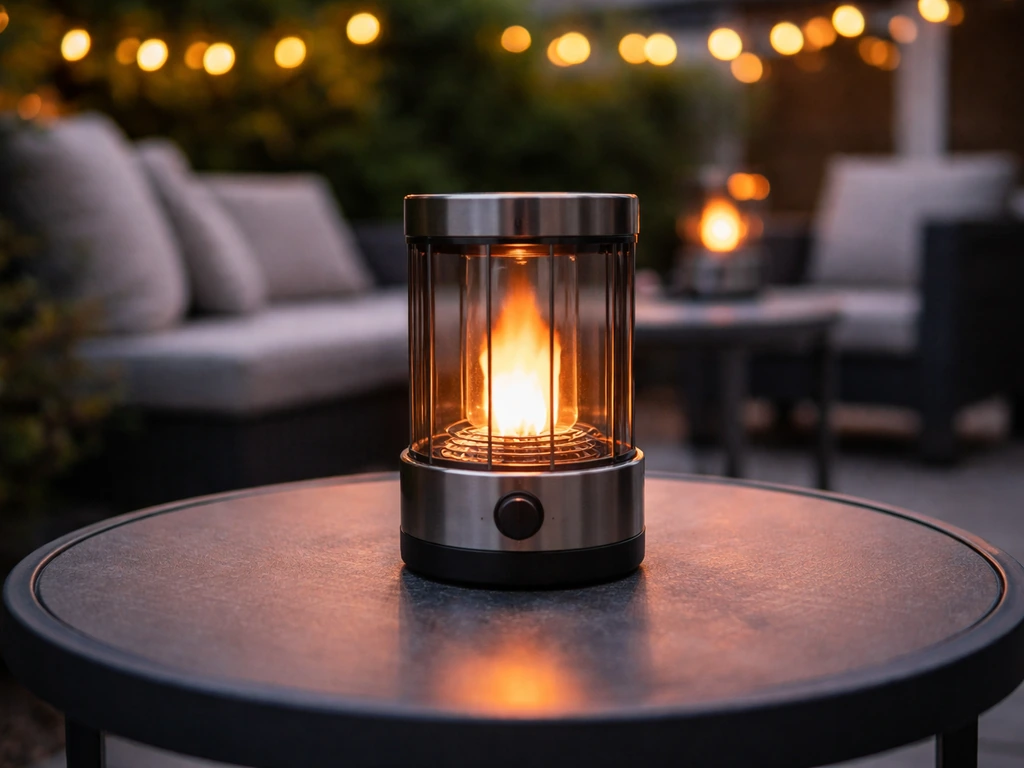
What a tabletop patio heater actually is (and where it shines)
Tabletop patio heaters are compact, freestanding units designed to sit on a flat surface rather than stand on the ground like a traditional mushroom-style tower heater. They usually run between 8 and 12 inches in diameter at the base and stand anywhere from 18 to 30 inches tall. Some use a small 1 lb propane canister that threads directly into the base; others connect to a standard 20 lb tank via a hose. Electric versions simply plug into an outdoor outlet.
They work best in specific situations: a small apartment balcony where a floor heater simply won't fit, a bistro table on a deck where you want warmth close to where people are sitting, a covered patio where ceiling clearance rules out a tall heater, or a situation where you're renting and can't do any permanent installation. They're also genuinely useful as a supplemental heat source at a larger table when you want warmth directed at a specific spot rather than heating an entire patio. Because they sit lower and have a smaller footprint, tabletop models also tend to be more stable in moderate wind than tall tower heaters, which makes them a solid choice for exposed outdoor spaces.
Where they don't work well: large open patios where you need to heat a 10- to 20-foot radius, uncovered decks in consistently high winds (even compact units lose efficiency fast in wind), and situations where the table surface itself is too small or unstable to safely support the heater's base. Always check the manufacturer's minimum table size recommendation before buying.
Gas vs. electric vs. other fuel types: picking the right one for your setup
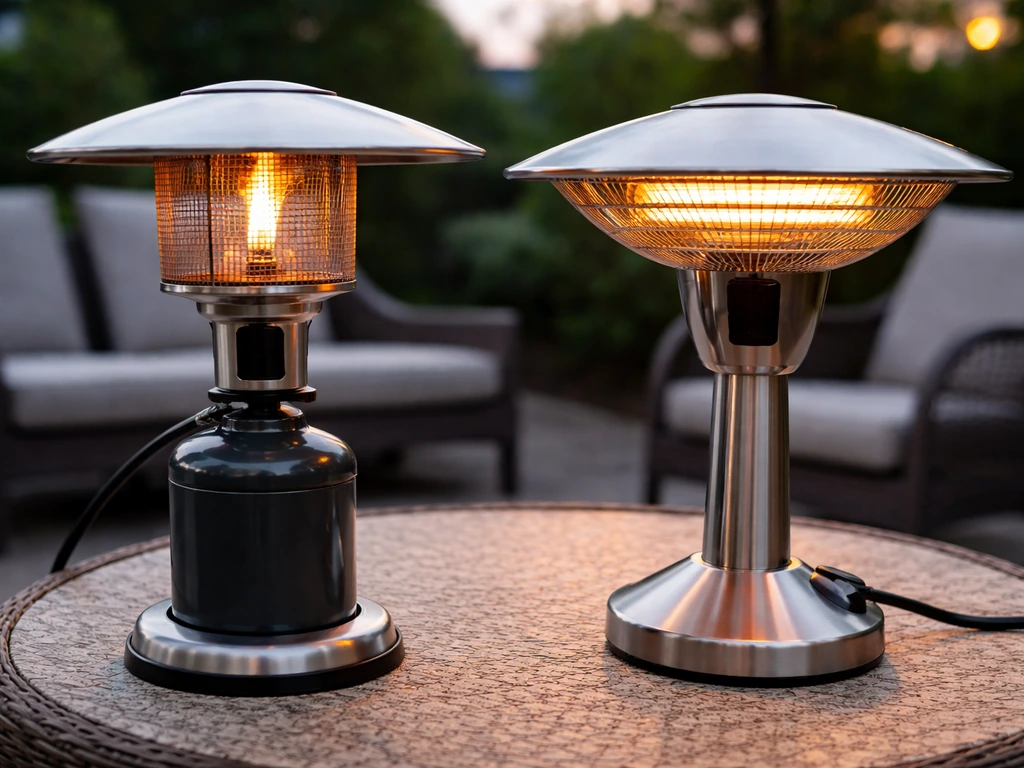
This is the first real decision you need to make, and it matters more than brand or BTU count. Each fuel type has genuine trade-offs, not just marketing spin.
Propane tabletop heaters
Propane is the most popular choice for tabletop heaters, and for good reason. You don't need an outlet, you can move the heater anywhere, and the heat output is strong enough to feel meaningful even outdoors. Most models run on a 1 lb disposable canister (good for roughly 1 to 2 hours of heat at full output) or connect via a hose adapter to a standard 20 lb tank for much longer run times. If you plan to use your heater regularly, the hose-and-tank setup is far more economical. The Fire Sense 60262 is a well-known example in this category, offering an auto-shutoff tilt valve and an oxygen depletion sensor (ODS) as standard safety features.
Natural gas tabletop heaters
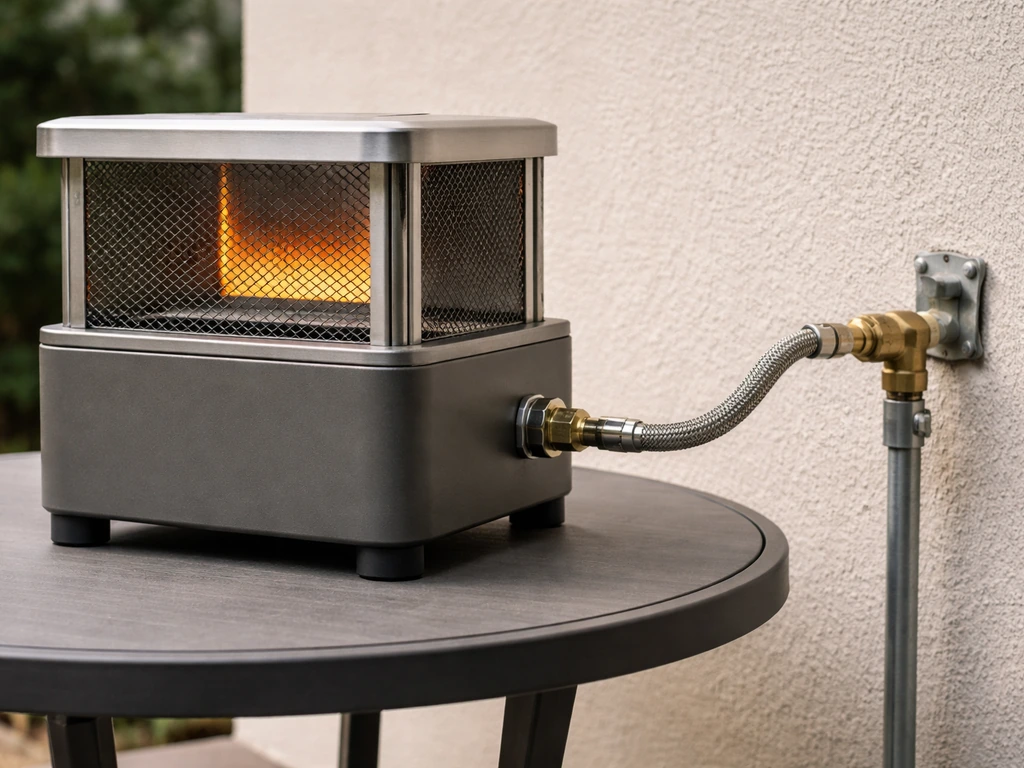
Natural gas tabletop heaters exist, but they're far less common because they require a fixed gas line connection. For a truly portable tabletop unit, natural gas is rarely practical unless you have a dedicated outdoor gas hookup right where the heater will live permanently. If you do have that setup, natural gas is cheaper per BTU than propane and you never run out of fuel, but the flexibility that makes tabletop heaters appealing largely disappears. Most people searching for a natural gas tabletop heater would actually be better served by a natural gas floor-standing model or a built-in table heater combo.
Electric tabletop heaters
Electric tabletop patio heaters, including infrared models like those from La Hacienda, are the easiest to use: plug in and go, no fuel to manage, no regulator to check. They're quiet, produce no combustion byproducts, and work well in covered or semi-enclosed spaces. The downside is the cord, which limits placement, and the heat output, which typically tops out around 1,500 to 2,000 watts (roughly 5,100 to 6,800 BTU equivalent). That's noticeably less punch than a gas model at the same size. Electric works well for mild evenings, covered patios, and situations where you already have a weatherproof outlet nearby.
Other options: pellet and bio-ethanol
Pellet and bio-ethanol tabletop fire bowls exist and create a nice ambiance, but they're more mood piece than serious heat source. If warmth is your primary goal, stick with propane or electric.
| Fuel Type | Heat Output | Portability | Running Cost | Best For |
|---|---|---|---|---|
| Propane (canister) | 10,000–12,000 BTU | Fully portable | Moderate (1 lb cans are pricey) | Occasional use, no outlet available |
| Propane (hose + 20 lb tank) | 10,000–12,000 BTU | Portable with tank | Low–moderate | Regular use, best all-around pick |
| Natural gas | 10,000–12,000 BTU | Fixed location only | Low | Permanent outdoor gas hookup setups |
| Electric (infrared) | 5,100–6,800 BTU equiv. | Cord-limited | Low (per session) | Covered patios, mild climates, easy setup |
| Bio-ethanol / pellet | Low | Portable | Moderate–high | Ambiance, not primary heating |
Heat output and coverage: how much BTU do you actually need?
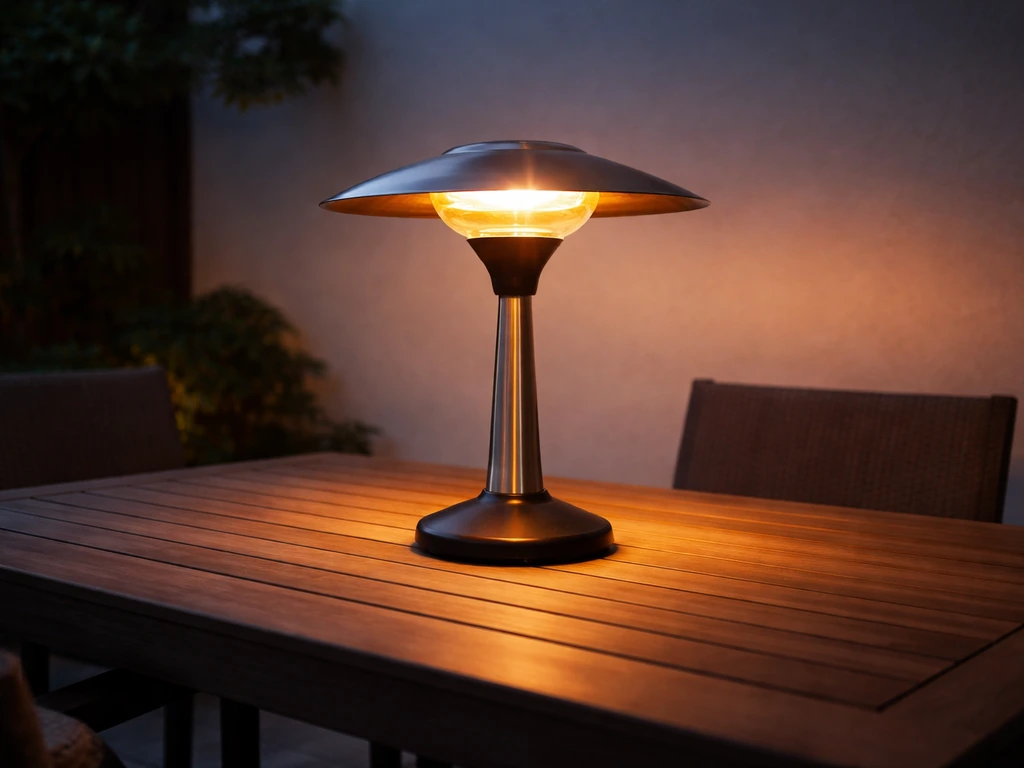
BTU (British Thermal Unit) is the standard measure of heat output, and for tabletop heaters you'll typically see ratings between 8,000 and 12,000 BTU for gas models. To put that in perspective: a standard full-size standing patio heater runs 40,000 to 46,000 BTU and covers roughly a 20-foot diameter. A tabletop unit at 10,000 BTU covers a much smaller circle, realistically about 5 to 8 feet across under calm conditions. That's enough to keep two to four people comfortable at a small bistro table on a cool evening.
Wind changes everything. The more exposed your space, the more BTU gets carried away before it reaches the people sitting there. A 10,000 BTU heater in a sheltered courtyard will feel noticeably warmer than the same unit on a breezy open deck. If your patio gets real wind, either position the heater in the most sheltered corner you can find, or size up toward the 12,000 BTU end of the range. Some tabletop models offer adjustable output so you can dial back on calm nights and push higher when it's breezy.
For table sizing: most tabletop heaters need at least a 24-inch square or 30-inch round table to sit safely. The heater should be centered and never placed near the table edge. If your table is small or lightweight, consider a floor-standing model placed beside the table rather than on it.
The specs that actually matter when you're comparing models
There's a lot of marketing language on product pages, so here are the specs worth focusing on and what they actually mean for everyday use.
- BTU rating: For tabletop propane heaters, 10,000 to 12,000 BTU is the sweet spot. Below 8,000 BTU feels weak on anything but the mildest nights. Higher is better for windy or cooler conditions.
- Tip-over protection: Essential for any tabletop heater. Gas models should have an automatic shutoff valve that kills the gas flow the moment the unit tips past a safe angle. Electric models should have a UL-listed tip-over switch that cuts power instantly. Do not buy a tabletop heater without this feature.
- Oxygen depletion sensor (ODS): Gas models only. This sensor shuts the heater off automatically if oxygen levels drop too low, which matters most in semi-enclosed spaces like covered patios or pergolas. The Fire Sense 60262 is a good example of a propane tabletop model that includes both an ODS and an auto-shutoff tilt valve.
- Ignition type: Push-button piezo ignition is standard and convenient. Some budget models use a matchstick ignition, which is less safe and more annoying. Confirm ignition type before buying.
- Base stability: Look for a wide, weighted base. Some models include a weighted base ring or a sand/water fill option for extra stability. This matters more on uneven table surfaces.
- Wind performance: Enclosed burner designs and reflector shields help retain heat in wind. Models with an open flame design lose efficiency fast when wind picks up.
- Weather and IP rating: For electric models especially, look for an IPX4 or higher weather resistance rating if the heater will be left outdoors. For gas models, check if the igniter and regulator components are sealed against moisture.
- Fuel connection: For propane models, confirm whether the unit uses a 1 lb canister directly or requires a hose and regulator for a larger tank. Hose-compatible models offer more flexibility and lower running costs.
- Regulator included: For natural gas models, confirm the regulator is rated and approved for natural gas, not just propane. They are not interchangeable.
Natural gas vs. propane tabletop heaters: setup, hookups, and what you'll actually spend
If you're genuinely choosing between natural gas and propane for a tabletop heater, here's the honest breakdown. Natural gas is cheaper per BTU, typically running about one-third to one-half the cost of propane on a per-unit-of-heat basis. But natural gas requires a permanent gas line connection, usually installed by a licensed plumber or gas fitter, which adds upfront cost and permanently fixes the heater's location. For a tabletop unit that you may want to move around or store indoors in winter, natural gas is often the wrong call.
Propane gives you full portability. A 20 lb propane tank costs around $15 to $20 to fill and will power a 10,000 BTU tabletop heater for roughly 20 to 30 hours of use at medium output. That's a reasonable cost for occasional weekend use. If you're heating every evening through a full fall and winter season, the costs add up and natural gas starts to make more economic sense, assuming the infrastructure is already in place or you're willing to invest in the hookup.
One important note: propane and natural gas regulators and orifices are not interchangeable. A heater sold as a propane unit cannot simply be connected to a natural gas line. Some manufacturers sell conversion kits, but this should only be done by someone who knows what they're doing and with a kit explicitly approved for the model. Using the wrong regulator or orifice is a serious safety hazard.
| Factor | Propane Tabletop | Natural Gas Tabletop |
|---|---|---|
| Setup complexity | Plug and play (canister or hose + tank) | Requires permanent gas line hookup |
| Portability | Fully portable | Fixed location |
| Fuel cost | Moderate ($15–$20 per 20 lb fill) | Low (utility rate, roughly 1/3 of propane) |
| Run time (20 lb tank) | ~20–30 hours at medium output | Unlimited (connected to line) |
| Safety features needed | ODS, tilt valve, tip-over switch | Same, plus proper regulator and line pressure |
| Best for | Most tabletop users, portability a priority | Permanent outdoor kitchen setups with gas access |
Best tabletop patio heaters right now: what to look for across budget levels
Rather than picking a single winner, here's how to think about the best options across different needs and price points, since what's 'best' genuinely depends on your setup.
Best all-around propane tabletop heater
Look for a model in the 10,000 to 11,000 BTU range with a stainless steel burner, push-button ignition, ODS, auto-shutoff tilt valve, and compatibility with both 1 lb canisters and a hose adapter for larger tanks. The Fire Sense 60262 is one of the most frequently recommended models in this category and checks all those boxes at a mid-range price.
For something with a bit more style and a rattan housing, rattan tabletop patio heaters are worth a look for covered patio setups where aesthetics matter. The Endless Summer lineup is another popular choice, available at most big-box retailers, with solid heat output and broad parts availability. If you are considering an Endless Summer tabletop option for your setup, compare the heat output, safety features, and fuel type before you buy Endless Summer lineup.
Best budget pick
If you're looking for a cheaper option or just need something functional for a single season, prioritize tip-over protection and ODS above everything else. UL guidance for portable electric heaters notes that tip-over protection should shut the heater off when tipped forward or backward, disconnecting power via the blank" rel="noopener noreferrer">tip-over switch. Don't skip those safety features to save $20. Garden Sun tabletop patio heaters and entry-level models from brands like Gasmate regularly appear in the under-$60 range and perform adequately for light use. The Member's Mark patio heater with LED table is worth noting as a combination product that integrates a heater into a side table, which can be a smart space-saving move for smaller patios.
Best electric tabletop option
If you have a covered patio and an outdoor outlet, an infrared electric tabletop heater is the most hassle-free setup you can buy. The La Hacienda tabletop electric patio heater is a well-regarded option in this category, with a clean design and decent heat throw for its wattage. Look for at least 1,500 watts, an IPX4 or better weather rating, and a tip-over switch.
Under-table patio heater options
Under-table patio heaters are a slightly different beast. These are typically electric infrared panels or small propane units designed to mount under a table top or hang from the underside of a patio umbrella, directing heat downward toward seated guests. They're genuinely useful when you don't want anything sitting on the table surface itself. For the best under-table setups, look for flat panel infrared electric models in the 1,500 to 2,000 watt range with a clamp or bracket mount. Make sure the mounting hardware is rated for outdoor use and the clearance between the heater and the table surface meets the manufacturer's minimum (usually 12 to 18 inches).
Shopping for tabletop heaters on sale or buying used: what to watch out for
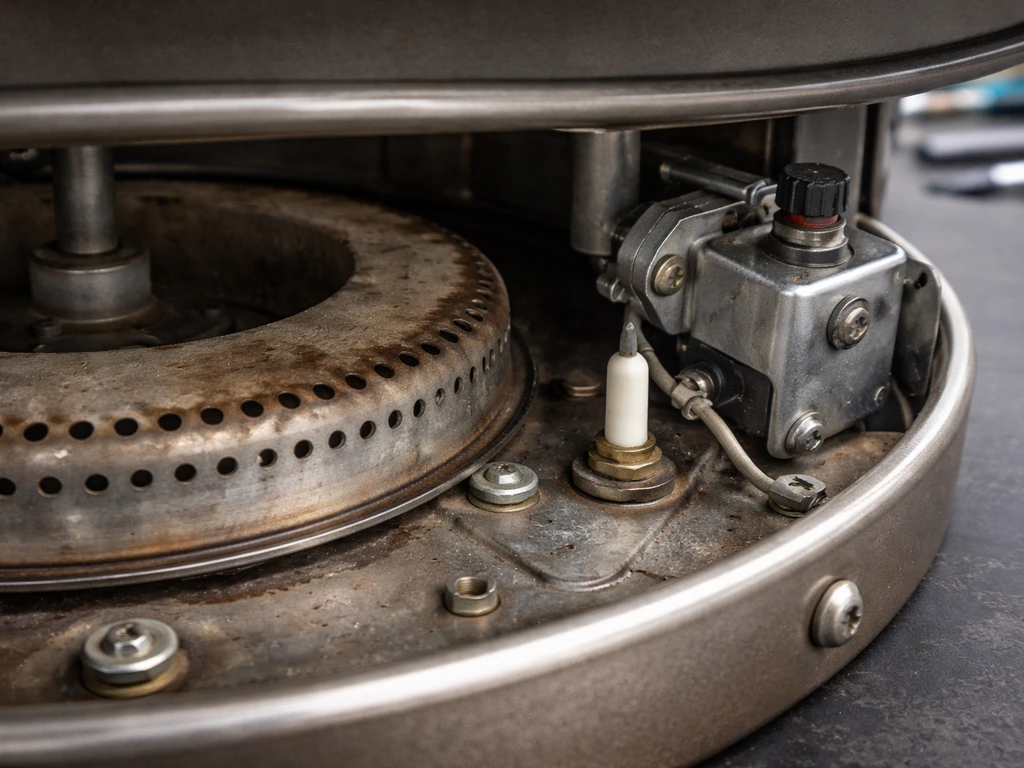
Tabletop patio heaters go on sale fairly predictably: end of summer (August through September), post-Labor Day, and again in late October and November as retailers clear stock. If you're specifically looking for an endless summer table top patio heater, those end-of-summer sale windows are usually the best time to hunt for one. If you can wait, you'll often find models at 30 to 50 percent off during these windows. Big-box retailers like Home Depot, Lowe's, and Walmart tend to have the deepest clearance discounts. Amazon's pricing fluctuates year-round but is worth checking alongside the brick-and-mortar options.
Used tabletop heaters can be a legitimate bargain, but there are real risks with gas models in particular. Here's exactly what to check before buying a used propane or natural gas tabletop heater:
- Inspect the burner for corrosion, rust, or physical damage. Surface rust on the housing is cosmetic; rust on the burner head or inside the fuel line is a deal-breaker.
- Test the tip-over switch and ODS before buying, or at minimum confirm they haven't been bypassed or disabled. Ask the seller to demonstrate them if possible.
- Check the regulator and hose for cracks, brittleness, or damage. Gas hoses degrade over time and should be replaced every 5 years regardless. Factor in the cost of a new regulator/hose if the unit is more than a few years old.
- Confirm the igniter works. A faulty igniter on a gas heater means relying on a match or lighter near an open gas valve, which is not ideal.
- Look up the model number and check whether it was ever subject to a recall. The CPSC recall database (cpsc.gov) is the authoritative source. Several older tabletop propane heaters were recalled for ODS failures.
- For electric models, inspect the cord and plug for damage, fraying, or signs of water ingress. An outdoor electric heater with a compromised cord is a shock and fire hazard.
- Verify the model has UL, CSA, or ETL certification. If the original certification label has been removed or is illegible, pass on it.
A used tabletop heater in good condition from a reputable brand like East Oak, Fire Sense, or Endless Summer can absolutely be worth it. If you want to narrow down options faster, East Oak patio heater reviews can help you compare real-world heat throw, safety features, and value. Just don't buy one where you can't verify the safety features are functional. The small amount you save isn't worth the risk of a gas leak or a fire.
Making the final call: a quick decision framework
If you're still not sure which direction to go, work through these four questions and your answer will become pretty clear:
- Do you have a weatherproof outdoor outlet within cord reach of the table? If yes, an electric tabletop heater is the easiest, lowest-maintenance option, especially for covered patios.
- Do you need full portability or do you heat a fixed spot regularly? If portability matters, propane with a 20 lb tank connection is the best all-around pick. If you have a permanent gas hookup, natural gas makes long-term economic sense.
- How windy is your space? If it's consistently breezy, prioritize a model with an enclosed burner design and a wide, heavy base. Place it in the most sheltered corner of the table and consider supplementing with a windbreak.
- What's your honest budget? Under $50: look for a reputable budget propane model with ODS and tip-over protection. $50 to $120: you're in the sweet spot for quality mid-range propane or electric models. Over $120: you can get heaters with better build quality, adjustable output, and nicer finishes, including combination heater-table models that save surface space entirely.
Tabletop patio heaters are one of the most practical outdoor heating options when they match the space. They're not trying to heat a whole patio, and they shouldn't be expected to. Get the right size, confirm the safety features are real and functional, and you'll have a heater that actually earns its spot on the table.
FAQ
How do I figure out the minimum table size for an outdoor patio heater table top model?
Start with the manufacturer’s minimum requirement, then add margin for safety. Even if the base looks small, aim for a stable 30-inch round or 24-inch square tabletop, and keep the heater centered with adequate clearance from the edge (especially on slatted or lightweight wood tables).
Can I place a tabletop propane heater on a glass or metal tabletop?
Often yes if the surface is flat and rated for the heater’s base, but avoid tempered glass or fragile laminates unless the heater explicitly allows it. Metal tables can get hot to the touch, so use heat-safe placement, keep people from brushing the base, and never set it on a table with gaps that prevent stable full contact.
What is the safest way to position a tabletop heater so it does not tip?
Use it only on a level surface, center it, and do not rely on “weight alone” if the table is lightweight. If the unit has an auto-shutoff tilt valve, treat it as a backup safety feature, not your placement plan, and keep it away from table edges, windy openings, and foot traffic.
How much wind is too much for a tabletop outdoor patio heater table top?
If you can feel steady gusts at seated height, plan on reduced comfort and higher fuel use. The practical fix is relocating to the most sheltered corner, closing nearby openings if possible, and selecting an adjustable-output model or stepping up toward the higher end of the BTU range.
Do tabletop heaters need a clear area around them, or is it okay to sit close to walls and railings?
You need clearance around the heater for stable operation and to prevent surfaces from overheating. Keep it away from umbrellas, curtains, railings, and low eaves, and follow the specified clearance distances for your exact model rather than using general spacing rules.
How long will a 1 lb propane canister last compared with a 20 lb tank setup?
A 1 lb canister is typically good for about 1 to 2 hours at full output, so real-world use can be shorter or longer depending on wind and whether you use lower settings. A hose-and-20 lb tank setup provides much longer runtime, which matters if you plan to heat nightly through a season.
Can I switch a propane tabletop heater to natural gas with a generic conversion kit?
No. Propane and natural gas parts (regulator and orifice) are not interchangeable. Only use a kit explicitly approved for your exact model, and have it handled by a qualified person if you are not already trained for gas conversions.
What should I check for before using a used propane or natural gas tabletop heater?
Verify safety features are functional, inspect hoses and fittings for cracks or brittleness, confirm the condition of the regulator components, and do not buy if you cannot confirm that the correct parts are present. If you smell gas or see any inconsistent ignition behavior, stop and do not test further.
How do I choose between electric infrared and gas for an outdoor tabletop setup?
Pick electric if you have a weatherproof outlet nearby and you mainly need mild warmth, infrared models, typically up to around 1,500 to 2,000 watts, do best in covered or semi-enclosed areas. Choose gas if you need stronger heat without being limited by a cord and you expect more exposed conditions.
What weather rating should I look for in an electric outdoor patio heater table top?
Look for at least an IPX4 rating or better, and confirm it includes tip-over shutoff. Also check that the unit is designed for outdoor use and that your outlet is GFCI-protected.
Can I use an outdoor patio heater table top on a balcony or in a semi-enclosed area?
Yes, but combustion units require extra attention to ventilation. For propane, avoid use in tightly enclosed spaces, keep it away from doorways and drafts that blow exhaust toward you, and ensure you follow the manufacturer’s guidance for indoor or covered use.
Is it safe to leave a tabletop heater outside overnight?
For propane and electric, it is better not to. Store propane units indoors when not in use, protect the electric unit from weather per the recommended storage guidance, and never leave tanks or power-connected components exposed to heavy rain, snow buildup, or freezing conditions.
What common mistake causes most tabletop heater problems?
Placing the heater on an unsuitable or unstable tabletop, ignoring the minimum table size and clearance rules, and using the wrong fuel system parts (especially regulators/orifices) when conversions are attempted. Start with surface suitability and correct fuel compatibility before comparing BTU or price.