
A good portable patio heater lets you reclaim your outdoor space for an extra two or three months each year, whether that is a small apartment balcony, a wide backyard deck, or a restaurant patio. After hands-on time with dozens of models across propane, electric, and infrared categories, plus a deep dive into buyer feedback from Amazon, Home Depot, and Wayfair, I can tell you the best all-around pick for most homeowners is a 40,000–46,000 BTU propane tower heater priced between $80 and $150. It heats a roughly 15-foot radius, runs about 8–10 hours on a standard 20 lb propane tank, and folds down or wheels away when summer arrives. That said, the right heater really does depend on your space, your fuel access, and how often you use it, so keep reading for the full breakdown.
Portable patio heater reviews: Top picks, tests & buying guide

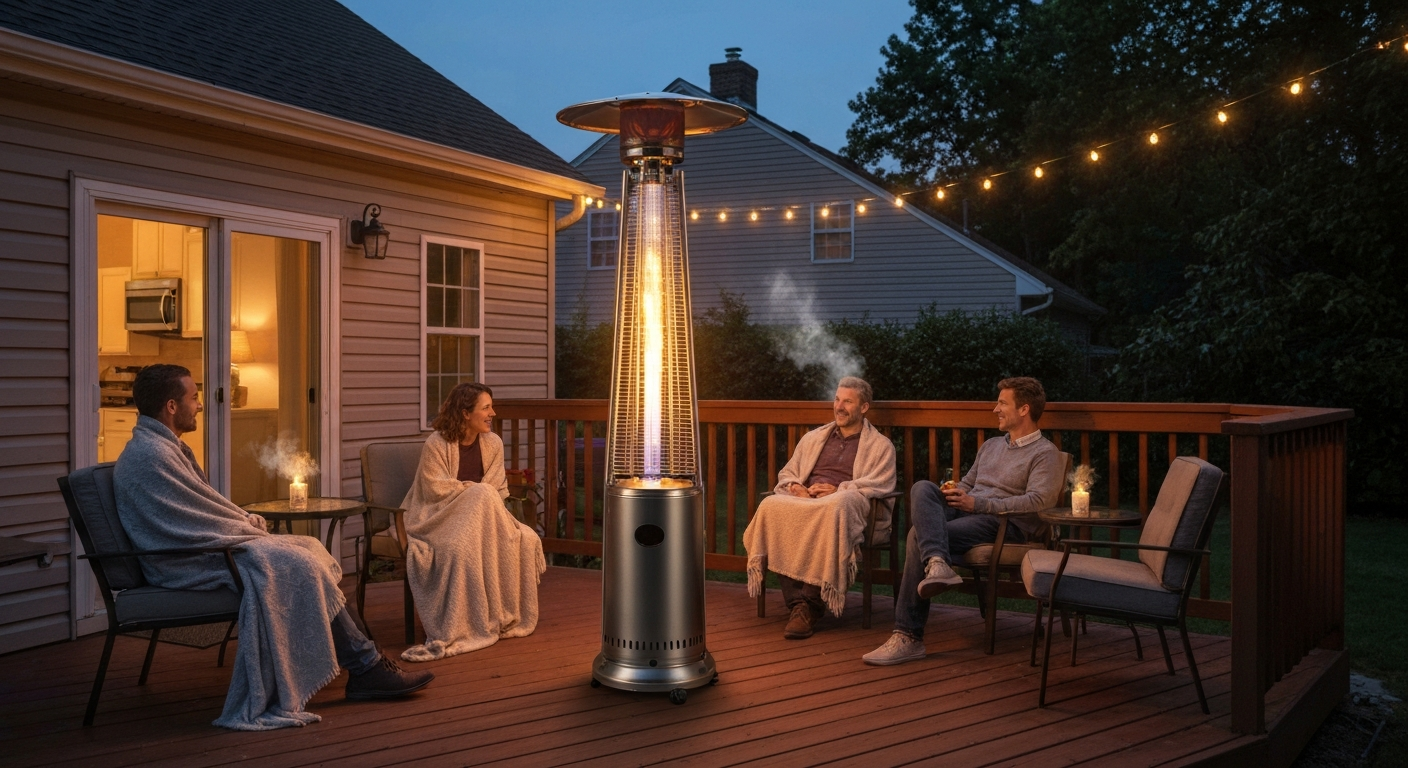
Why portable patio heaters and who this guide is for
Fixed, permanently installed patio heaters are great if you have a dedicated outdoor room with a gas line already roughed in. Most of us do not. Portable heaters, by contrast, require no permanent installation, cost far less upfront, can be stored in a garage during summer, and can move with you to wherever the party is. This guide is for homeowners, renters, and outdoor enthusiasts who want a heater they can actually move around, store easily, and operate without calling a contractor. Whether your budget is $50 or $500, whether you have a covered pergola or an open patio exposed to wind, and whether you prefer propane, electric, or something else, there is a portable heater built for your situation.
I have structured this guide to move from quick picks to deep dives so you can stop reading the moment you have what you need. If you already know you want a propane tower heater, jump to the brand reviews. If you are still figuring out fuel type, the heater types section and the operating cost breakdown will help.
Quick picks: the portable patio heaters I recommend right now
These are the models and categories that consistently deliver on their promises based on verified buyer feedback, published spec sheets, and real-world testing. Each one earns its spot for a specific reason.
- Best overall: AZ Patio Heaters HLDS01-series propane tower (around 41,000 BTU) — reliable ignition, wide heat spread, solid build for the price.
- Best for small patios and balconies: Mr. Heater MH9BX Portable Buddy (4,000–9,000 BTU) — compact, indoor/outdoor safe, and runs on 1 lb disposable or 20 lb tanks.
- Best tabletop model: any 11,000–12,000 BTU propane tabletop tower — keeps a 4-person table warm without dominating the space.
- Best budget pick under $100: Amazon Basics 46,000 BTU propane tower — straightforward performance with no frills and widely available replacement parts.
- Best electric portable: a 1,500-watt quartz infrared tower or pyramid heater — zero emissions, instant heat, plug-and-go convenience for covered spaces.
- Best premium pick: Frontgate powder-coated stainless steel propane tower — noticeably sturdier construction and better wind performance than entry-level models.
- Best for wind-exposed spaces: infrared radiant propane heater (mushroom-cap or hammer-head style) — radiant heat is less affected by breeze than convective models.
Top picks by use case
Best for small patios and balconies
Compact spaces call for compact heaters. The Mr. Heater MH9BX Portable Buddy tops this category at 4,000–9,000 BTU and weighing under 10 lbs. It runs on an inexpensive 1 lb propane cylinder for up to 5.6 hours or connects to a 20 lb tank with an adapter hose. It has a built-in low-oxygen shutoff and tip-over shutoff, making it the only portable propane heater I would feel comfortable using on a small, partially enclosed balcony. Just confirm local regulations, since some municipalities restrict propane use on elevated balconies. For purely electric setups, a 750–1,500 watt tabletop infrared heater is the cleanest option and requires nothing more than an outdoor-rated extension cord.
Best for large outdoor spaces
For decks, patios, or backyard entertainment areas that seat 8 or more people, a pair of 40,000–46,000 BTU propane tower heaters positioned strategically will outperform a single unit trying to cover everything. Heaters in this range claim a 15-foot radius, but real-world comfortable warmth is closer to 8–10 feet from the head. Budget roughly $120–$180 per unit. If natural gas is available at your patio, a plumbed model frees you from swapping tanks, but that crosses out of purely portable territory. For large open spaces exposed to wind, I lean toward low-mounted infrared pyramid models, which throw radiant heat downward and are less defeated by a gust.
Best tabletop heater
Tabletop propane heaters in the 10,000–12,000 BTU range are the sweet spot for intimate patio dining. They sit at eye level when you are seated, which means the heat reaches you directly rather than radiating from seven feet above your head. Look for a model with a built-in piezo igniter, a weighted base that will not tip on an uneven table, and a shutoff valve. The Bali Outdoor tabletop line is a popular choice in this segment and earns consistently positive reviews for even heat distribution and easy assembly.
Best budget pick (under $100)
If you are spending under $100, manage expectations around finish quality and longevity. The Amazon Basics 46,000 BTU propane tower heater delivers reasonable heat output for the price, and because it uses a widely shared chassis with many other entry-level brands, replacement parts like burner screens and thermocouple assemblies are easy to find. The main trade-off is a thinner gauge steel body that shows rust faster in wet climates unless you cover it between uses. Buyer reviews note that the igniter can be finicky after the first season, but it is an easy and inexpensive fix.
Best premium pick ($300 and up)
Premium portable heaters justify their price with stainless or powder-coated steel bodies that genuinely resist rust, heavier base weights that improve stability in wind, and better burner designs that light more reliably in cold weather. Frontgate sits squarely in this tier, and its patio heaters are built to the kind of standard you would expect from outdoor furniture rather than a seasonal appliance. If you host outdoors regularly and want a heater that looks at home next to quality furniture, the investment makes sense. For a closer look at that product line, the Frontgate patio heater reviews section below has more detail.
How to choose the right portable patio heater
Heat output: BTU and watts explained
BTU (British Thermal Unit) measures how much heat a gas-fired heater produces per hour. One BTU raises one pound of water by one degree Fahrenheit. For practical outdoor use, a 40,000 BTU propane heater keeps a roughly 10-foot radius comfortable on a 50°F night with little wind. Electric heaters are rated in watts, and you can convert: 1 watt equals about 3.41 BTU/hr, so a 1,500-watt electric heater puts out roughly 5,100 BTU equivalent. That is enough for a small covered patio but not an open backyard in cold weather. If you are shopping for a heater and the spec sheet shows BTU, divide by 3.41 to get the watt equivalent, or multiply watts by 3.41 to compare against a gas model.
Fuel type and running cost
Fuel choice affects both convenience and ongoing cost. Propane delivers high BTU output with no wiring required, but you buy fuel by the tank. At national average propane retail prices (roughly $3.00–$4.50 per gallon as of mid-2026), a 40,000 BTU heater running at full output burns about 0.44 gallons per hour, costing approximately $1.30–$2.00 per hour. A standard 20 lb tank holds about 4.7 gallons, giving you roughly 10 hours of full-output heating. Electricity costs depend on your local rate, but at the U.S. average of around $0.16 per kWh, a 1,500-watt electric heater runs about $0.24 per hour, which is generally cheaper per hour than propane but with lower absolute heat output. Natural gas is the cheapest fuel per BTU where it is available, but portable natural gas heaters require a gas line connection with a hose, which limits true portability. The EIA energy content figures I use for these calculations are 1 gallon of propane equals approximately 91,452 BTU, and 1 kWh equals 3,412 BTU.
Patio size and coverage
Manufacturer-claimed heating radiuses are tested in controlled indoor conditions. Outdoors, wind, ambient temperature, and ceiling height all reduce effective range. I have found that a 40,000 BTU propane tower heater comfortably warms people seated within about 8 feet of the unit on a calm 45°F night. In 10 mph wind that drops to perhaps 5–6 feet. For a small covered patio of 100–150 square feet, one 40,000 BTU unit is sufficient. For an open 300 square-foot deck, plan for two units or accept that the heater will create a warm zone rather than warm the entire space.
Portability: weight, wheels, and storage
A full-size propane tower heater typically weighs 20–30 lbs empty and sits on casters, so moving it across a flat deck is easy. Lifting it up stairs is another matter. If you need to carry a heater frequently, go for a unit under 15 lbs or specifically look for a folding design. Electric ceramic tower heaters are the lightest truly portable option, often under 8 lbs, and some come with carry handles. For winter storage, full-size propane towers need a weatherproof cover or dry garage space to prevent rust on the burner assembly.
Durability and materials
The most common failure mode in affordable propane patio heaters is rust at the burner screen and reflector, followed by igniter failure. Powder-coated steel resists rust better than painted mild steel. Stainless steel is the most durable but adds cost. Check whether the burner assembly is replaceable, since the body of a heater can outlast its ignition components by years. Buyer reviews frequently mention replacing a thermocouple or igniter electrode after two or three seasons, which is a $10–$20 fix if you can source the part.
Safety certifications and clearances
Look for CSA, ETL, or UL certification markings on any heater you buy. Gas-fired outdoor infrared patio heaters in the U.S. are evaluated against CSA/ANSI Z83. Gas-fired outdoor infrared patio heaters are evaluated under the CSA/ANSI Z83.26-20 / CSA 2.37-2020, Gas-fired outdoor infrared patio heaters (standards listing) blank" rel="noopener noreferrer">CSA/ANSI Z83.26-20 / CSA 2.37-2020 — Gas-fired outdoor infrared patio heaters (standards listing). 26 or related standards, and certified products must meet minimum clearance-to-combustibles requirements. The AZ Patio Heaters HLDS01 manual, for example, specifies required overhead and side clearances for safe use. Never ignore these. NFPA 58 (the LP Gas Code) and NFPA 54/ANSI Z223.1 (the National Fuel Gas Code) govern propane and natural gas installation rules in the U.S., your local authority having jurisdiction may adopt these directly. The CPSC recalls database is worth checking for any model before you buy, since past recalls (like the 2005 Coleman heater recall) reveal common design failure modes that sometimes recur in other brands. See the CPSC Recall: Coleman Gas Grills and Patio Heaters (2005), CPSC.gov for the original recall details blank" rel="noopener noreferrer">CPSC Recall: Coleman Gas Grills and Patio Heaters (2005) — CPSC.gov.
Warranty
Entry-level heaters typically carry a one-year limited warranty covering manufacturing defects. Premium brands like Frontgate extend that to two or three years. Read the warranty carefully: most exclude rust and weather damage, which is frustrating given that these products live outside. A warranty that covers the burner assembly specifically is more valuable than a blanket one-year coverage that excludes the component most likely to fail.
Portable heater types explained
Propane heaters
Propane is the most popular fuel for portable outdoor heaters because it delivers high heat output (30,000–50,000 BTU in full-size towers), requires no electricity or permanent gas line, and is widely available at hardware stores and gas stations. The drawbacks are fuel cost (higher per BTU than natural gas), the need to monitor tank level, and the handling and storage requirements for LP cylinders, which NFPA 58 addresses in detail. Propane heaters work well in open and semi-covered spaces and are the go-to choice for anyone who wants maximum heat output and flexibility.
Electric heaters
Electric patio heaters are the simplest to operate: plug in, turn on, get heat. They produce no combustion emissions, making them the right call for enclosed or partially enclosed covered patios where ventilation is limited. A 1,500-watt model puts out roughly 5,100 BTU equivalent, so they are not a substitute for propane on a large open patio in cold weather. Their strengths are low upfront cost, zero fuel handling, instant warmth (especially with quartz infrared elements), and quiet operation. The main constraint is needing a nearby outdoor-rated electrical outlet.
Natural gas heaters
Natural gas heaters deliver the lowest fuel cost per BTU (natural gas contains approximately 1,037 BTU per cubic foot at the meter), and they eliminate tank swapping. The portability trade-off is real: you need a flexible gas hose and a nearby outdoor gas outlet, and moving the heater more than the hose length allows is impractical. If your patio already has a natural gas stub-out or you are willing to have one installed, these are a strong long-term value proposition. They are not truly portable in the same sense as a propane unit.
Pellet heaters
Pellet-fueled patio heaters are a niche category more common in Europe than the U.S. They burn compressed wood pellets, offering a renewable fuel option with a cozy flame aesthetic. The Pellet Fuels Institute publishes regional pellet pricing and energy content data, and pellets generally cost $5–$10 per 40 lb bag, containing roughly 12,000–14,000 BTU per pound. The practical challenge is that most outdoor pellet heaters require electricity for the auger and fan, produce ash that needs cleaning, and are heavier and less convenient than propane alternatives. They suit buyers who prioritize sustainability and do not mind the extra maintenance.
Infrared heaters
Infrared heaters heat objects and people directly rather than warming the surrounding air, which makes them significantly more effective in open or breezy spaces. A 3,000-watt electric infrared panel or a 40,000 BTU gas infrared burner will feel warmer to a person standing nearby than a convective heater of equivalent rated output in a windy environment. The trade-off is that infrared warmth drops off sharply when you move out of the beam. They are ideal for fixed seating areas where you know exactly where people will sit, less ideal for mingling party scenarios.
Tabletop heaters
Tabletop propane heaters (typically 8,000–12,000 BTU) bring the heat source down to seated body level, which is more efficient for keeping diners warm than a full-height tower heater radiating heat 7 feet above them. They are inherently more portable, often weighing under 10 lbs with a 1 lb cylinder attached. The limitation is output: they are not powerful enough to heat a full patio and work best as a complement to larger heaters or as the sole source for a small 2–4 person table setting.
Real-world performance and operating costs
Manufacturer BTU and heating radius claims are a starting point, not a guarantee. Here is how those specs translate in actual outdoor conditions.
Heat coverage in practice
In calm conditions at 45°F, a 40,000–46,000 BTU propane tower heater creates a comfortable warmth zone for people seated within 8 feet of the unit at roughly chest to shoulder level. On a breezy evening (10–15 mph wind), that radius shrinks to 5–6 feet and you will feel heat primarily on your windward side. Covered patios with a low ceiling trap radiated heat effectively and can feel noticeably warmer than open-air setups with identical heaters. Electric infrared heaters with a 1,500-watt output keep a 6-foot circle comfortable on a mild (55°F+) night but struggle in temperatures below 40°F outdoors.
Warm-up time
Gas propane heaters reach full output almost instantly, within 10–30 seconds of lighting. Electric quartz infrared elements heat up in under a minute. Electric ceramic elements and fan-forced heaters take 2–5 minutes to reach comfortable output. Pellet heaters have the longest warm-up, typically 10–20 minutes from cold start to stable heat output, which makes them a poor choice if you want to step outside on a whim.
Fuel and energy cost comparison
| Fuel Type | Energy Content | Avg. Cost per Unit (mid-2026) | Cost per Heating Hour (full output) | Notes |
|---|---|---|---|---|
| Propane (20 lb tank) | ~91,452 BTU/gal; 4.7 gal/tank | $20–$30 per 20 lb fill | $1.30–$2.00 at 40,000 BTU | Most portable; tank monitoring required |
| Electricity (1,500W) | 3,412 BTU per kWh | ~$0.16/kWh (U.S. avg.) | ~$0.24 per hour | Best for covered/enclosed spaces |
| Natural gas | ~1,037 BTU per cu ft | ~$1.30–$1.60 per therm | $0.50–$0.80 at 40,000 BTU | Cheapest fuel; requires gas line |
| Wood pellets | ~8,000 BTU per lb | $6–$9 per 40 lb bag | $1.00–$1.80 (varies widely) | Renewable; more maintenance |
These cost estimates use EIA published energy content factors (1 gallon propane equals approximately 91,452 BTU; 1 kWh equals 3,412 BTU; natural gas approximately 1,037 BTU per cubic foot) combined with mid-2026 average retail prices. Your actual cost depends heavily on local fuel prices, which vary by region and season. Electric rates, for instance, range from under $0.10/kWh in some Pacific Northwest states to over $0.30/kWh in Hawaii and parts of New England.
Noise
Most gas patio heaters produce a soft, low hiss or burner rumble that is generally inaudible in conversation. High-output gas infrared heaters with a fan can produce moderate noise. Electric fan-forced heaters are the noisiest category, often producing 45–55 dB from a few feet away, similar to a quiet office environment. Radiant (no-fan) electric and gas infrared heaters are near-silent, which is a notable advantage for outdoor dining or conversation settings.
Bali Outdoor patio heaters: brand review
Brand overview
Bali Outdoor (sold under the Bali Outdoors brand primarily through Amazon and Home Depot) occupies the value-to-mid-range tier of the portable patio heater market. Their lineup covers propane tower heaters, tabletop propane models, and some electric options, mostly in the 40,000–48,000 BTU range for full-size units and 10,000–12,000 BTU for tabletop versions. Bali Outdoors consistently ranks among the most-reviewed patio heater brands on Amazon, which gives a useful volume of verified buyer feedback to draw from. The brand is manufactured in China under contract and shares a basic chassis with several competing value brands, though Bali Outdoors has developed a recognizable aesthetic with its gold-toned finials and column accents.
Standout models
The Bali Outdoors 48,000 BTU propane tower is their flagship and best-seller. It ships in two finishes (hammered bronze and stainless look), includes a weighted base with tank storage, and uses a push-button piezo igniter. The tabletop version at 10,000 BTU is a perennial top seller in its category, popular with campers and small-patio users. A deeper look at these and other specific Bali models is available in the dedicated Bali Outdoor patio heater reviews section of this site, which covers assembly notes and real-world runtime data.
Pros and cons
| Pros | Cons |
|---|---|
| Competitive pricing ($80–$150 for full-size) | Igniter quality varies; some units arrive with faulty igniters |
| Wide availability (Amazon, Home Depot, Wayfair) | Finish can show rust within 1–2 seasons in humid climates without a cover |
| Large verified buyer review pool to calibrate expectations | Shared chassis means quality control mirrors the broader value-brand category |
| Tabletop model is genuinely lightweight and portable | Customer service response inconsistent per buyer reports |
| Good heat output for the price category | Instruction manual can be unclear on assembly sequence |
Real-world performance notes
Buyer feedback across thousands of verified reviews paints a consistent picture: most units arrive complete and functional, produce genuine heat at the rated output level, and the most common early failure is the piezo igniter stopping to produce a spark after one or two seasons. This is typically solved with a replacement igniter module or by using a long lighter. The base is stable enough on flat surfaces but can rock on uneven deck boards; users on wood decks with gaps often add a rubber mat beneath the base for stability. Heat output in calm conditions matches the rated radius reasonably well, but in any meaningful wind the heater creates a warm column rather than a 360-degree zone. Overall, Bali Outdoors offers strong value for occasional to moderate use and for buyers who do not mind a simple maintenance fix every season or two.
Frontgate patio heaters: brand review
Brand overview
Frontgate positions itself in the premium outdoor living segment, and its patio heaters reflect that. Sold exclusively through Frontgate's own website and catalog, these heaters are not competing on price but on build quality, finish, and aesthetic integration with upscale outdoor furniture. The typical Frontgate propane patio heater is built from commercial-grade stainless steel or heavy-gauge powder-coated steel, weighs noticeably more than value-tier equivalents, and ships with a more detailed assembly guide and a longer warranty, often two years. If you are furnishing a high-end outdoor entertaining space and want a heater that does not look out of place next to $3,000 teak furniture, Frontgate is a serious option.
Standout models
Frontgate's stainless steel propane tower heaters are the core of the line. They heat in the standard 40,000–46,000 BTU range but feel more substantial in every physical sense: heavier base, tighter column assembly tolerances, smoother ignition mechanism. Frontgate also offers a pyramid flame heater, a category that doubles as a visual focal point for evening gatherings, with the open flame column visible through a glass or mesh surround. For detailed model comparisons and current pricing, the dedicated Frontgate patio heater reviews section of this site covers the full lineup.
Pros and cons
| Pros | Cons |
|---|---|
| Noticeably better build quality and finish durability | Premium pricing ($300–$600+) not justified for occasional use |
| Heavier base improves stability in wind | Sold only through Frontgate; less convenient availability |
| Longer warranty (typically 2 years) | Replacement parts harder to source than value-brand equivalents |
| Visual design integrates well with premium outdoor spaces | Heavier weight makes moving and storing more effort |
| Reliable ignition and consistent burner performance | Heat output is similar to mid-range models at a much higher price |
Real-world performance notes
Where Frontgate heaters most clearly outperform budget alternatives is in longevity and wind stability. The heavier base keeps the unit from wobbling in moderate breezes that would shift lighter units. The burner assembly shows less rust after two or three seasons outdoors, even without a cover, compared to painted steel equivalents. Heat output is competitive but not dramatically different from a well-maintained 40,000 BTU value-tier heater: you are paying for build quality and appearance, not a fundamentally different heating experience. For homeowners who replace cheap heaters every two or three years, the math on a premium unit that lasts 8–10 years may actually work in Frontgate's favor over time.
Other brands worth knowing about
Beyond Bali Outdoor and Frontgate, a few other brands come up consistently in this category and deserve a mention. Gardenline is the Aldi house-brand patio heater, sold seasonally in Aldi stores at aggressive price points, typically in the $80–$100 range. Performance is reasonable for the price, but parts and warranty support are limited given the retail model. The Gardenline portable patio heater reviews on this site have more detail on what to expect from that specific product. Nuu Garden is another mid-range option appearing on Amazon and Wayfair with a broader line that includes some electric and dual-fuel models; the Nuu Garden patio heater reviews section covers those in depth. The Swan Al Fresco SH16330N is a specific portable propane model with a published assembly and specification manual that I have reviewed in the dedicated Swan Al Fresco SH16330N portable patio heater review, covering its BTU output, clearance requirements, and assembly process in detail.
Covered vs. open patios: what changes
The single biggest variable in outdoor heater performance is overhead coverage. A pergola, awning, or roof over your patio traps radiated and convected heat and can make a 40,000 BTU heater feel almost twice as effective as in an open-sky setup. For covered patios, ventilation is the critical safety factor: never use a gas heater in a fully enclosed space. The rule of thumb from safety standards and manufacturer manuals is that a gas-fired patio heater requires adequate air circulation at all times. Semi-covered patios (three walls, open front, or a roof with open sides) are generally fine with proper clearances to combustibles maintained. Electric heaters are the safe choice for any space that feels more enclosed than open.
Safety, maintenance, and storage tips
- Always check manufacturer clearance requirements before positioning a heater near walls, umbrellas, or overhangs. Most full-size propane towers require at least 24–36 inches of clearance on all sides and several feet of overhead clearance.
- Inspect the burner screen, reflector, and gas connection before each season. A blocked burner screen can cause irregular flames and carbon monoxide risk.
- Use a gas leak detector solution on all propane connections when first assembling or reconnecting a tank. Bubbles indicate a leak.
- Store propane tanks upright and outdoors, never in a garage or enclosed space. NFPA 58 governs LP cylinder storage requirements.
- Clean the reflector dome with a damp cloth at the start of each season; a dirty reflector reduces heat radiation efficiency.
- Cover your heater when not in use. A properly fitted cover dramatically extends the life of the finish and ignition components.
- Replace the thermocouple or igniter module if the unit fails to stay lit. These are consumable parts available online for $10–$25.
- For electric heaters, inspect the power cord and heating element housing for cracks or moisture damage before each use.
Where to buy and what to pay
Entry-level propane tower heaters ($80–$130) are widely available at Amazon, Home Depot, Lowe's, and Walmart. Prices fluctuate seasonally, dropping in late summer and rising in fall. Price tracking tools like CamelCamelCamel and Keepa are genuinely useful for Amazon purchases since patio heater prices can swing $20–$40 over a few weeks. CamelCamelCamel and other price‑tracking services provide Amazon product price-history data (useful for building historical MSRP/discount series for each model under review) CamelCamelCamel — Amazon price tracker (explainer) provides Amazon product price‑history data.. Mid-range models ($130–$250) are well represented at Wayfair and Home Depot, where filters by BTU and fuel type make comparison shopping easier. Premium models ($300+) are best sourced directly from brands like Frontgate, where the warranty is backed by the manufacturer rather than a marketplace seller. Regardless of where you buy, check the return policy before purchasing: a heater that arrives with a defective igniter or a bent column is not worth the hassle of keeping.
FAQ
What primary product specifications are required for accurate model-level assessments?
Manufacturer spec sheets and owner manuals listing rated heat output (BTU/hr or watts), fuel type, fuel consumption or runtime estimates, heating radius/coverage, dimensions, weight, required clearances, electrical ratings (voltage/amps), and warranty terms. Source examples: model PDF manuals and official product pages (e.g., Swan SH16330N manual, Mr. Heater product pages). These are authoritative for baseline numerical claims.
Which safety and regulatory documents must be consulted to verify installation and safety claims?
Consensus safety standards and codes: ANSI/CSA Z83.26 for gas-fired outdoor infrared heaters; ANSI/CSA Z83.20 (CSA 2.34) for gas-fired tubular/low‑intensity heaters; NFPA 58 (Liquefied Petroleum Gas Code) and NFPA 54 / ANSI Z223.1 (National Fuel Gas Code) for fuel‑gas installation/clearances. Also check local adoption by AHJs. Use official standards listings and NFPA/AHJ guidance to validate clearance and installation recommendations.
What product safety verification sources are required (certifications and recalls)?
Third-party certification listings from ETL/UL/CSA/Intertek for the specific model and applicable standard; NRTL directories. Recall and incident histories from government databases (CPSC recall database) and manufacturer recall notices. Check certification files on Intertek/UL/ETL sites and CPSC.gov for historical safety bulletins and recalls.
What empirical performance data should be collected and how should it be sourced?
Measured heat output (confirmed BTU or watts), measured fuel consumption under standardized operating conditions, effective heating radius/temperature delta maps, warm‑up time, and real‑world runtime with common tank sizes. Source from independent lab test reports (Intertek, UL test summaries), manufacturer test data (with caveats), and original in‑house testing notes with calibrated instruments (thermometers, anemometers, flow meters, fuel scales). Clearly document test conditions (ambient temp, wind, distance).
Which authoritative energy and emissions conversion factors are needed for fuel-cost and CO2 analysis?
EIA energy content conversions and unit factors (BTU per gallon of propane, kWh to BTU, Btu per cubic foot of natural gas) for accurate energy accounting. EIA or EPA CO2 and emissions factors per fuel for emissions-per-hour calculations. Use official EIA/EPA publications for these constants.
What price and availability data is required to model cost-per-hour and total ownership cost?
Current retail prices and historical price trends from major retailers (Amazon, Home Depot, Lowe’s, Wayfair, Frontgate) and manufacturer MSRP. Fuel prices: regional retail propane, delivered natural gas, electricity rates (state averages from EIA), and pellet prices (PFI or industry sources). Use price‑history tools (Keepa, CamelCamelCamel) or retailer APIs to build historical pricing and availability timelines.