
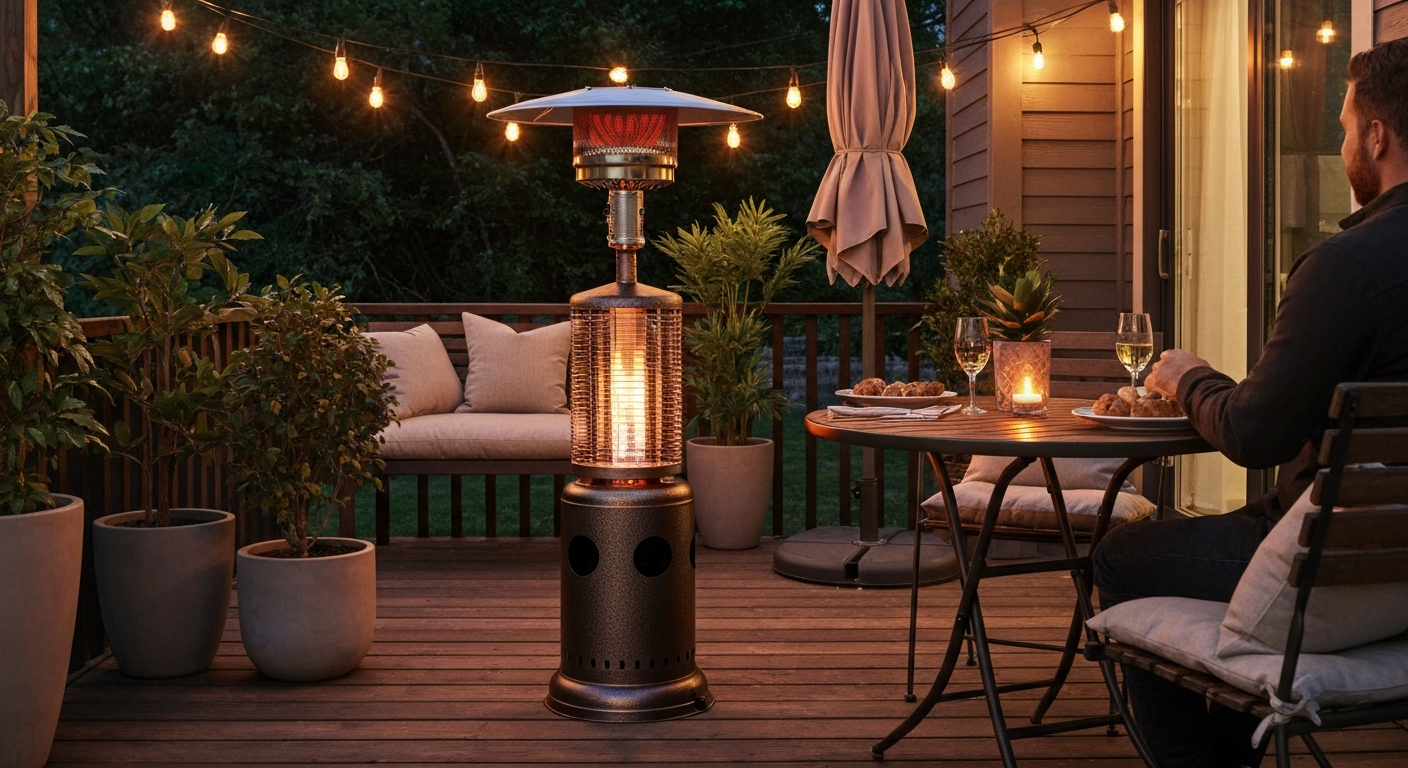
A powder coated table top patio heater gives you a compact, close-range heat source that sits right on your dining or bistro table, warms a 2-to-4-person seating area, and holds up to outdoor conditions better than bare steel thanks to its baked-on finish. Most propane tabletop models output around 11,000 BTU and cover roughly 75 square feet, while electric infrared versions typically run at 1,000–1,500 watts. Either way, the powder coat protects the steel housing from rust and scratches, and it comes in a range of colors so it can actually look good on your patio rather than just sitting there like a camp stove.
Powder Coated Table Top Patio Heater: Review & Buying Guide

Willa Brennan
26 Jul 2026
Who this guide is for
If you have a small patio, a balcony, or a café-style setup where a full-size standing heater would be overkill or simply won't fit, a tabletop model is worth a serious look. This guide walks through everything you need to decide confidently: what powder coating actually does for a heater, how it compares to bronze, stainless, and granite-top finishes, which fuel type makes sense for your situation, which specs matter and which ones are just marketing, and how to narrow down specific brands and models. I've pulled together real performance figures, manufacturer specs, and hands-on testing data so you don't have to piece it together from a dozen product pages.
What exactly is a powder coated tabletop patio heater?
A tabletop patio heater is a compact, freestanding unit designed to sit on a flat surface and deliver close-range radiant heat to the people seated around it. The housing is almost always steel, and powder coating is the most common way manufacturers finish that steel for outdoor use. The process involves applying a dry thermosetting powder electrostatically to the metal, then curing it in an oven at around 350–400°F. The result is a hard, uniform shell that bonds directly to the steel rather than sitting on top of it like a liquid paint film.
What that means practically: powder-coated finishes resist minor impacts, surface abrasion, and UV fading significantly better than standard spray paint. Industry testing under ASTM B117 (salt-spray corrosion) and ASTM D3359 (adhesion) consistently shows that intact powder coatings outperform conventional liquid coatings in outdoor corrosion environments. The key word is intact. Once the coating chips or scratches through to bare steel, moisture gets in and rust develops at that spot. That's not a flaw unique to powder coating, but it is the maintenance reality you need to understand before buying. The Hampton Bay PG155T, one of the most widely stocked powder-coated tabletop propane heaters, uses this type of finish on its steel housing and lists at roughly $149 at major retailers.
Powder coating vs. other finishes: bronze, stainless, and granite top
Finish choice has real consequences for durability, maintenance, and cost, and I think it's worth being honest about the trade-offs rather than just calling powder coating the best option by default. Bronze-finished tabletop heaters use a decorative coating applied over steel, so they share the same underlying vulnerability as powder coat once the surface is breached. They tend to look more traditional and blend well with dark metal outdoor furniture, but you're not getting a fundamentally more durable product. Stainless steel housings, by contrast, don't rely on a protective coating at all. Grades like 304 or 316 stainless are genuinely corrosion-resistant through their material composition, which makes them the better long-term pick for coastal, humid, or year-round-outdoor environments. The trade-off is price: stainless tabletop heaters typically cost more, and the silvery look is not universally preferred. Granite-top variants (like the patio heater with granite top style) take a completely different angle by pairing a stone-look or actual granite surface element with the heater body. Granite is highly heat-tolerant and very heavy, which improves stability but kills portability.
| Finish Type | Corrosion Resistance | Color Options | Maintenance Needs | Typical Cost Impact | Best For |
|---|---|---|---|---|---|
| Powder Coat (steel) | Good when intact; rusts if chipped | Wide range (black, bronze, hammered tones) | Wax/polish periodically; touch up chips | Lowest | Most patios, budget-conscious buyers |
| Bronze Decorative Coat | Similar to powder coat; cosmetic layer over steel | Limited (brown/bronze tones) | Same as powder coat | Low to moderate | Traditional décor styles |
| Stainless Steel (304/316) | Excellent; no coating to chip | Silver/brushed only | Wipe clean; minimal upkeep | Higher | Coastal, humid, or high-use settings |
| Granite Top / Stone Finish | Depends on housing finish beneath stone element | Natural stone tones | Stone element needs no coating care; base may need attention | Moderate to high | Permanent or semi-permanent table setups |
My honest take: for most people on a budget who keep their heater on a covered patio or bring it in during bad weather, powder coat is completely fine. If you're leaving a heater outdoors 12 months a year in a rainy or salty environment, spend the extra money on stainless or at minimum commit to a good weatherproof cover.
Heating technologies for tabletop models
Tabletop heaters come in three main fuel types: propane, electric infrared, and sometimes natural gas (though true tabletop natural gas units are rare because they require a fixed gas line). Each works differently and fits different situations.
Propane tabletop heaters
Propane is the most common fuel for powder-coated tabletop heaters. Most consumer models use a standard 1-lb (16 oz) disposable cylinder that fits inside the base, which keeps the setup self-contained and completely portable. Heat output typically tops out at 11,000 BTU, and manufacturers like Hampton Bay, Mr. Heater, and AZ Patio Heaters quote run times of roughly 1 to 3 hours at maximum output on a single 1-lb cylinder. Some models accept an adapter hose to connect to a larger 20-lb tank, which dramatically extends run time but reduces portability. The heat delivery is real flame-based radiant heat, which feels warm and natural but also means you're dealing with combustion, carbon monoxide risk in enclosed spaces, and an open flame near a dining surface.
Electric infrared tabletop heaters
Electric tabletop infrared heaters, like the Westinghouse 1500W and Sharper Image tabletop models, use a quartz or ceramic infrared element to emit radiant heat directly at people and objects rather than warming the surrounding air. See our guide to infrared table top patio heater for a deeper comparison of electric models. This makes them noticeably more wind-resistant than convective heaters, since the warmth transfers directly rather than relying on heated air that blows away. At 1,000–1,500 watts, they're less powerful in raw output than an 11,000 BTU propane unit, but in a calm, semi-enclosed space the targeted radiant delivery is often more efficient in practice. They require a power outlet within reach, so they're not truly portable in the same way propane units are. They're also the safer choice for covered spaces and any situation where you're uneasy about an open flame.
When to choose each
- Choose propane if you need full portability with no cord, you're using it in an open outdoor space, and you're comfortable managing small propane cylinders
- Choose electric infrared if you have an outlet nearby, want instant heat with no warm-up delay, prefer no open flame (great for covered pergolas or near flammable materials), or want easier controls and quieter operation
- Consider a larger propane tank adapter if you'll use a propane tabletop model frequently and find 1–3 hour run times too limiting
Key performance metrics you actually need to understand
BTU and coverage area
BTU (British Thermal Units) measures heat output per hour. An 11,000 BTU propane tabletop heater, like the Hampton Bay PG155T, claims coverage up to about 75 square feet. In practice, wind, ambient temperature, and how open your space is all reduce effective coverage. In real-world use, a tabletop propane heater at 11,000 BTU is comfortably warming 2 to 4 people seated around a table, not an entire patio. Think of BTU as a rough guide, not a guarantee, and use review-site testing data (temperature measured at 3 feet vs. 5 feet, calm vs. windy conditions) to set realistic expectations.
Run time
For propane tabletop heaters using a 1-lb cylinder, expect roughly 1 to 3 hours at maximum output. Mr. Heater's tabletop model, for example, is commonly quoted at around 2 hours on a 1-lb cylinder. If you're hosting a dinner party, that may mean swapping cylinders mid-evening. Buying cylinders in multipacks reduces per-unit cost, or you can look for a model that accommodates a larger tank via adapter hose. For electric infrared, run time is unlimited as long as you have power.
Power source and efficiency
Propane gives you portability; electricity gives you consistency. At 1,500 watts, an electric infrared tabletop heater draws about 12.5 amps, which fits standard 15-amp outdoor circuits. Infrared heat delivery is directional and efficient for close-range warming: you're heating people, not air. Propane combustion loses some energy to the flue gas, but at close tabletop range the radiant output is still very effective. Neither type is dramatically more efficient than the other at the tabletop scale; the bigger variable is wind and ambient temperature.
Buying criteria: what to check before you order
Size and footprint
Tabletop heaters range from about 12 to 18 inches in base diameter and 18 to 36 inches tall. Measure your table before ordering. A wide base on a small bistro table creates a tipping hazard and just looks awkward. Check the product dimensions, not just the marketing photos.
Stability and weight
A heater that tips over on a table is a fire risk, not just a nuisance. Heavier units with lower centers of gravity are more stable. The 1-lb propane cylinder inside the base actually helps here, adding weight low down. Some models have flat bases with non-slip feet; look for this feature if you'll be using the heater on a smooth glass or tile table.
Ignition and controls
Most propane tabletop heaters use a piezo push-button igniter. These are convenient but can fail over time, especially in cold weather. Check whether the model you're considering has a reliable ignition reputation in user reviews, and verify whether replacement igniters are available. Electric models typically have simple rotary or push-button controls with heat settings. Some higher-end electric tabletop heaters include remote controls or timer functions, which are genuinely useful.
Safety features
- Tip-over/anti-tilt auto shutoff: cuts gas or power if the unit is knocked over — essential for tabletop use near people
- Oxygen depletion sensor (ODS): on propane models, shuts off the unit if oxygen levels drop too low (relevant for semi-enclosed spaces)
- Cool-touch or mesh guard on the heating element: reduces burn risk if someone reaches toward the heater
- CSA/UL certification: confirms the unit has been tested to ANSI Z83.26/CSA 2.37 (for gas-fired outdoor infrared heaters) or relevant UL standards for electric models
Portability and storage
Most tabletop heaters weigh between 6 and 15 pounds, which makes them genuinely easy to move. Look for a carry handle if portability is a priority. For storage, the powder-coated finish benefits from being kept dry, so a heater cover or indoor winter storage will significantly extend the life of the finish. Some models pack down small; others have fixed assemblies that are awkward to store.
Covered vs. uncovered spaces, ventilation, and local code notes
This is where a lot of buyers make costly or dangerous mistakes, so I want to be direct. Propane tabletop heaters produce combustion gases including carbon monoxide. They are outdoor-only appliances and must never be used in a fully enclosed space: not a garage, not a screened room with the doors closed, not a tent. The question is what counts as adequately ventilated. A covered pergola with open sides is generally fine. A three-season room with glass panels mostly closed is not. Manufacturer manuals for models like the AZ Patio Heaters HLDS032 explicitly state minimum clearance requirements and reference NFPA 54 and NFPA 58 for gas appliance installation and LP storage rules. See NFPA 54 / ANSI Z223.1 National Fuel Gas Code (standards reference) for detailed gas appliance installation requirements.
For balconies specifically, NFPA 58 restricts the use and storage of propane cylinders above ground level in residential buildings, and many apartment and condo associations ban them outright. Check your local codes and building rules before buying a propane tabletop heater for a balcony. If you're in a restriction-prone situation, an electric infrared tabletop heater is the practical solution: no combustion, no CO risk, no LP cylinder, and it can be used in covered spaces without ventilation concerns.
For open, uncovered patios, wind is the main performance enemy regardless of fuel type. Propane flame-based heaters are more affected by wind than electric infrared models, since moving air disrupts the combustion and carries heat away. If your outdoor space is consistently windy, infrared tabletop models or a windscreen accessory will serve you better.
Brand and model comparisons: how to choose between the close contenders
The tabletop heater market clusters around a handful of popular form factors and a fairly narrow output range. Here's how the main options actually differ.
Hampton Bay PG155T (11,000 BTU powder coat)
This is the benchmark powder-coated propane tabletop heater at most major retailers. At around $149, it offers 11,000 BTU output, stated coverage of up to 75 square feet, a push-button piezo igniter, and a compact footprint. It runs on a standard 1-lb cylinder seated in the base. The powder-coat finish is available in a few colors. It's a solid, no-surprises choice for occasional use on a residential patio.
East Oak tabletop patio heater
East Oak models tend to emphasize build quality and finish consistency, and they've built a loyal following among buyers who prioritize aesthetics alongside function. If you're comparing an East Oak tabletop model directly against the Hampton Bay, pay attention to base weight, igniter reliability noted in user reviews, and whether it ships with a cover. The East Oak tabletop patio heater is worth a dedicated look if you want a step up in perceived quality.
The Range tabletop patio heater
The Range (the UK-based retailer) stocks its own branded tabletop heaters at competitive price points, which are popular for budget-conscious buyers. The Range tabletop patio heater models typically mirror the 11,000 BTU propane tabletop form factor at a lower price. The trade-off is usually in finish quality and long-term durability of the powder coat compared to premium brands. Fine for occasional residential use; less ideal for commercial café settings or year-round outdoor exposure.
AZ Patio Heaters tabletop models
AZ Patio Heaters produces several tabletop variants including the HLDS032 glass tube model (around 8,000 BTU) and higher-output options. Their manuals are among the most thorough available for safety and maintenance guidance, which is a signal of a more serious manufacturer. The glass tube design on some models adds a visual element but also adds a fragile component that can be damaged or need replacement.
Infrared tabletop variants
Electric infrared tabletop heaters like the Westinghouse 1500W and Sharper Image tabletop model operate on a completely different principle from the propane units above. They're best compared on watts (1,000 vs. 1,500), element type (quartz vs. ceramic), heat settings, and cord length. If you're deciding between an infrared tabletop heater and a propane powder-coat model, the infrared tabletop heater guide goes deeper on the electric side of this decision.
Bronze-finish and granite-top variants
Bronze-finish tabletop heaters occupy roughly the same performance tier as powder-coated steel models but lean toward traditional décor aesthetics. The bronze table top patio heater category is worth exploring if you have a dark wrought-iron or wood-and-metal table setup. Granite-top models (see the patio heater with granite top for a detailed look) trade portability for stability and a premium appearance, and they're better suited to a dedicated, semi-permanent outdoor dining setup than to a heater you'll move around.
Top picks at a glance
| Model | Fuel Type | Output | Coverage (stated) | Run Time | Finish | Approx. Price | Best For |
|---|---|---|---|---|---|---|---|
| Hampton Bay PG155T | Propane (1-lb) | 11,000 BTU | ~75 sq. ft. | 1–3 hrs (1-lb) | Powder coat steel | ~$149 | Most residential patios |
| Mr. Heater Tabletop | Propane (1-lb) | 11,000 BTU | ~75 sq. ft. | ~2 hrs (1-lb) | Powder coat steel | ~$100–$130 | Budget pick, portable use |
| AZ Patio HLDS032 | Propane (1-lb) | ~8,000 BTU | Smaller zone | Varies | Powder coat + glass tube | ~$80–$120 | Decorative/visual appeal |
| Westinghouse 1500W | Electric (120V) | 1,500 W | Close-range 2–4 persons | Unlimited (plug-in) | Powder coat / stainless | ~$80–$150 | Covered spaces, no open flame |
| Sharper Image 1500W IR | Electric (120V) | 1,500 W | Close-range 2–4 persons | Unlimited (plug-in) | Varies | ~$60–$100 | Indoor-outdoor covered use |
Caring for a powder-coated finish
The AZ Patio Heaters owner's manual is unusually explicit about this, and their advice applies broadly: periodically apply a coat of car wax or paste wax to the powder-coated surfaces to create a barrier against moisture and UV. This is especially important if you live in a coastal area or leave the heater outside in humid conditions. Inspect the finish each season for chips or scratches; use a touch-up paint or cold-galvanizing compound on any spots where bare steel is exposed. Clean the housing with mild soap and water only. Avoid abrasive scrubbers that can scratch the coating and give moisture a foothold.
For propane models, the burner and reflector should be checked annually: look for spider webs or debris in the gas orifice (a common cause of ignition failure), and confirm the gas valve and hose show no cracking or wear. Replacement burners, orifices, and igniters are available from the manufacturer for most major brands, and sourcing these parts is a good thing to confirm before you buy a model from a lesser-known brand.
Price and warranty: what to expect
Most powder-coated tabletop propane heaters retail in the $100 to $250 range. The Hampton Bay PG155T sits at around $149 at Home Depot; Mr. Heater models frequently come in closer to $100 to $130; Hanover and Cuisinart models push toward the $200 to $250 range for better build quality and finish consistency. Electric infrared tabletop models span a similar range, from around $60 for simpler units to $150 for more refined designs. Warranties vary more than prices do: budget models often carry a 1-year limited warranty, while mid-range and premium brands offer 2 to 3 years. The warranty coverage matters most for burner assemblies and heating elements, so read the fine print on what's actually covered versus what's excluded as a consumable.
Troubleshooting common issues
- Igniter clicks but won't light: check the cylinder is not empty, the valve is open, the orifice is not blocked by debris, and the igniter electrode is positioned correctly (gap of about 3–4mm from the burner). If the igniter spark is weak, the piezo unit may need replacement.
- Flame goes out shortly after lighting: most likely the thermocouple or ODS sensor is triggering. On a new cylinder this can happen if the regulator is not fully engaged. Try fully depressing the control knob for 30–45 seconds to heat the thermocouple before releasing.
- Uneven or yellow flame: dirty burner orifice or blocked air intake. Allow the unit to cool completely, remove the burner, and clear debris with compressed air. Do not use metal tools in the orifice.
- Powder coat chipping or rusting at a spot: clean the area, let it dry thoroughly, and apply a touch-up coating or rust-inhibiting primer. Left untreated, rust will spread under the surrounding coating.
- Electric infrared element not heating: check the outlet and circuit breaker first, then verify the tip-over switch is fully reset (some require the unit to be placed level and the switch manually re-engaged).
Real-world use cases
For a residential dining patio with a 4-person table, an 11,000 BTU powder-coated propane tabletop heater placed in the center of the table is genuinely effective in calm conditions at temperatures above about 40°F. Below that, or in wind, expect to feel it working but not transforming the experience the way a full-size standing heater would. For a commercial café or wine bar with multiple small tables, electric infrared tabletop units often make more operational sense: no cylinder swaps, no open flame management, and consistent heat per table. For a balcony apartment where propane is restricted, electric infrared is the only realistic choice. And for a backyard fire-pit area where portability and ambiance matter, a propane tabletop model on a side table near seating is a nice complement to, not a replacement for, a larger heat source.
FAQ
What primary research questions must be answered about 'powder coated table top patio heater' to create an accurate buyer’s guide and review?
What exactly is a powder‑coated tabletop patio heater (definition, typical form‑factor, and common materials)?; How does powder coating perform vs. alternative finishes (bronze, stainless, granite/stone) in corrosion resistance, chip/impact resistance, maintenance, and aesthetics?; What heating technologies are used in tabletop models (propane, electric, infrared)—how do they work and what are practical pros/cons for tabletop use?; What objective performance metrics should be measured and reported (BTU or watts, heat/radius at set distances, coverage area, run time on specified fuel/power, ignition reliability, wind sensitivity)?; What are the realistic, use‑case coverage expectations (dining table, 2–4 person seating, small patio, commercial café)?; What safety, code, and installation constraints apply for tabletop propane heaters (clearances, NFPA/ANSI/CSA citations, CO/exhaust risks, permitted cylinder types, balcony rules)?; What are the recommended buying criteria and features to compare (size, stability/tip‑over protection, ignition type, controls, safety shutoffs, portability, weight, base/cylinder access)?; What brand/model‑level comparisons and sibling variants exist (East Oak, The Range, infrared tabletop variants, common MSRP/retail bands)?; What are reasonable price, warranty and spare‑parts/accessory expectations for this category?; How should maintenance, powder‑coat care, and surface repair be performed and documented?; What troubleshooting steps and replacement‑parts/accessory guidance should be provided (igniters, regulators, O‑rings, glass tubes, protective covers)?; Which images, diagrams or measurement visuals are useful (temperature vs distance graphs, clearance diagrams, finish closeups) and where to source properly licensed images?
What authoritative source types should be consulted to define and validate the product definition and common specifications?
Manufacturer product pages and spec sheets (dimensions, weight, BTU/watts, fuel type); Owner’s manuals and installation guides (safety clearances, fuel/cylinder guidance, maintenance); Retailer listings (current street specs and product variants); Category pages for market coverage and price ranges.
Which standards bodies and test procedures are essential for safety, gas use, and finish durability references?
NFPA 54 / ANSI Z223.1 (National Fuel Gas Code) and NFPA 58 (LPG Code) for gas handling and cylinder guidance; ANSI Z83.26 / CSA 2.37 (where applicable) for gas‑fired outdoor infrared heaters; ASTM standards for powder‑coat testing and durability (ASTM B117 salt spray, ASTM D3359 adhesion, ASTM D2794 impact, ASTM D3363 hardness). Also consult the Powder Coating Institute technical guidance.
What third‑party review and testing sources should be used to provide unbiased, real‑world performance data?
Independent review outlets and lab tests (Good Housekeeping, BobVila, Tom’s Guide, HomeClimateLab) that report measured temperature vs. distance, run time, tip‑over behavior and wind sensitivity; Consumer reviews on major retailers for aggregated long‑term reliability signals; Where feasible, replicated hands‑on testing using calibrated thermometers/infrared thermometers and standardized scenarios.
What retailer and marketplace sources are necessary for accurate pricing and model availability context?
Major retailers (Home Depot, Lowe’s, Wayfair, Walmart, Tractor Supply) for current MSRP and sale pricing; Amazon listings and CamelCamelCamel for historical price tracking; Manufacturer web stores for list price and direct‑sold SKUs.
Which manufacturer or materials science sources should be used to compare powder‑coat vs other finishes?
Powder Coating Institute technical pages, manufacturer finish descriptions/spec sheets, stainless steel (304/316) material guides for corrosion resistance, and product spec/distributor pages that list finish options and intended use (coastal vs inland). Peer‑reviewed coating studies (e.g., MDPI papers) for mechanistic insights and laboratory test data.