
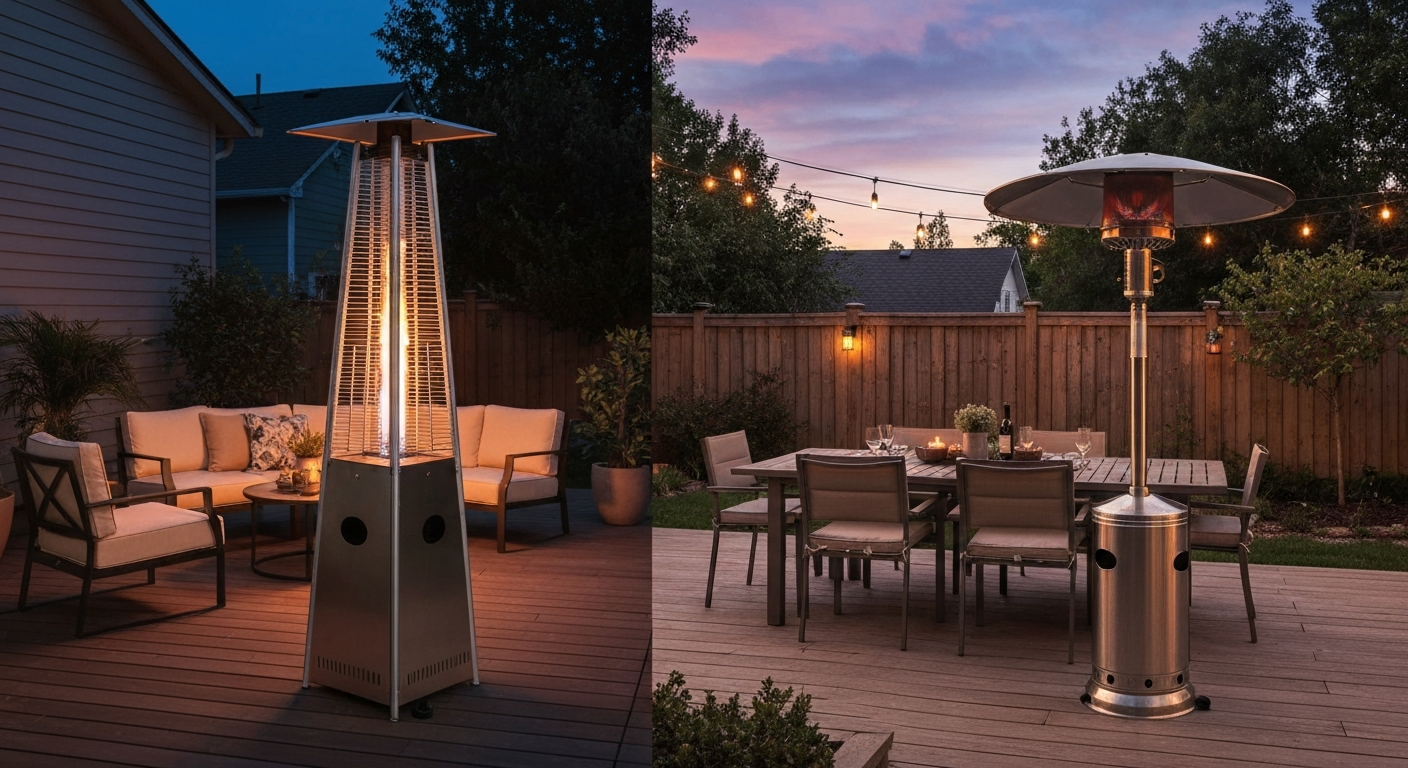
Pyramid patio heaters look great and throw heat in a 360-degree radius, but standard mushroom or umbrella heaters typically push out more BTUs, cost less upfront, and are easier to find parts for. Neither is universally better. Which one you should buy comes down to four things: where your patio is, how windy it gets, what you want it to look like, and how much you want to spend on fuel every time you use it.
Pyramid vs Standard Patio Heater: Which Suits Your Patio?

Willa Brennan
11 Aug 2026
Why this comparison actually matters
Most buyers searching 'pyramid vs standard patio heater' are not just curious about shapes. They are standing in a backyard or on a covered deck trying to figure out whether that tall, striking glass-flame tower is worth the premium, or whether a classic mushroom-top heater will do the job better for less money. I have tested and reviewed both styles extensively, and the honest answer is that they solve slightly different problems. This guide walks through every practical difference: heat output, fuel options, running costs, wind performance, safety, and where each style genuinely shines.
Quick takeaway: pick the right heater for your situation
There is no single winner here, and anyone who tells you otherwise is oversimplifying. Here is the honest situational breakdown before we get into the details.
| Your situation | Better choice | Why |
|---|---|---|
| Open patio, want a focal point, moderate wind | Pyramid (propane) | 360° radiant heat, visual appeal, decent output (~42,000 BTU) |
| Open patio, maximum heat, budget-conscious | Standard mushroom (propane, 48,000 BTU) | Higher output, wider coverage, lower purchase price |
| Covered/screened porch | Electric infrared (wall/ceiling mount) | No combustion gases, no clearance risk, safe in enclosed spaces |
| Windy exposed yard | Standard heater with weighted base OR wall-mount infrared | Lower center of gravity or fixed mount resists tipping |
| Small deck or dining area | Tabletop or pyramid (smaller footprint models) | Proportionate heat for a tight space |
| Natural gas line already installed | Standard NG mushroom or umbrella heater | Eliminates cylinder swaps, lower per-hour fuel cost |
| Aesthetics are the top priority | Pyramid (glass tube) | Simply looks better in most outdoor settings |
What is a pyramid patio heater?
A pyramid patio heater is a freestanding outdoor heater built around a tall, tapered frame, usually between 87 and 92 inches high, with a central glass tube that runs vertically through the body. The flame burns inside that glass tube, which makes it visible from every angle. Propane is the most common fuel, stored in a standard 20-lb LP cylinder hidden inside the base. The Hiland HLDS01 series, one of the most widely sold pyramid models, is rated at approximately 42,000 BTU input and must meet ANSI Z83.26/CSA safety requirements, which include an anti-tilt shutoff that cuts the gas if the unit is knocked over.
Heat radiates outward from the glass flame column in a full 360-degree pattern at roughly mid-body height, which makes pyramid heaters well-suited for round tables or seating groups arranged around a central point. The visible flame adds a firepit-like ambiance that many homeowners specifically want. The tradeoff is that the tall, narrow profile raises the center of gravity compared to a mushroom heater, and the glass tube requires careful handling and occasional replacement if cracked.
What is a standard patio heater?
The term 'standard patio heater' actually covers three distinct designs, and it is worth knowing the difference because their heat distribution patterns are meaningfully different.
Mushroom heaters
The mushroom style has a wide, dome-shaped reflector cap on top of a pole, which redirects radiant and convective heat downward and outward in a wide circle. The Hampton Bay 48,000 BTU heater is a classic example: 93.5 inches tall, a gas consumption of approximately 2.20 lb/hr of propane, and a broad heat umbrella that can cover a seating area of roughly 15 to 20 feet in diameter under calm conditions. These are the most common heaters you will find at home improvement stores and are generally the most affordable freestanding option.
Umbrella heaters
Umbrella heaters are essentially the same concept as mushroom heaters but are sometimes designed to mount to or thread through a patio umbrella pole. Some manufacturers use the terms interchangeably. The heat distribution is similar: a reflector cap pushes heat downward over a central seating area. If you are weighing this style directly against a pyramid, there is a dedicated pyramid vs umbrella patio heater comparison worth reading for a deeper look at those specific trade-offs.
Reflector/infrared heaters
Directional infrared heaters, like the Bromic Tungsten Smart-Heat Gas series (rated 26,000 to 43,000 BTU depending on model, with a freestanding version at 38,500 BTU), use a burner behind a polished reflector to throw a focused beam of radiant heat in one direction. These are not 360-degree heaters. They are designed to point at a specific zone, which makes them highly efficient in breezy or partially covered spaces because the radiant energy hits people directly rather than heating air that then blows away. Bromic publishes 'heat bloom' coverage maps for each model; the Tungsten 300 and 500 series cover roughly 160 to 215 square feet of effective heated area.
Pyramid vs umbrella patio heater: direct comparison
When most people search this comparison, they are choosing between the two most common freestanding styles for an open residential patio. Here is how they stack up across every meaningful variable.
| Feature | Pyramid heater | Standard mushroom/umbrella heater |
|---|---|---|
| Typical BTU output (propane) | ~40,000–42,000 BTU | ~40,000–48,000 BTU |
| Heat distribution | 360° from central glass tube (mid-body) | 360° from top-mounted dome reflector (downward focus) |
| Visual appeal | High — visible flame column | Moderate — functional, utilitarian look |
| Center of gravity / stability | Higher (taller, narrower base) | Lower (wider base, dome weight at top balanced) |
| Glass tube / maintenance | Yes — glass can crack, needs replacement | No glass tube — burner under reflector cap |
| Fuel options widely available | Propane (primary), some NG conversions | Propane, natural gas, electric variants all common |
| Typical retail price (freestanding propane) | $150–$350 | $100–$300 |
| Best for | Centerpiece seating, ambiance, round tables | Rectangular layouts, budget buyers, max heat output |
| Wind sensitivity | Moderate-high (tall profile) | Moderate (similar height, wider base helps) |
| Covered patio use (gas) | Not recommended — same fire-safety rules apply | Not recommended — same fire-safety rules apply |
The practical summary: if you want more raw heat and wider compatibility with natural gas lines, a mushroom/umbrella heater wins. If you want a heater that doubles as an outdoor focal point and you are fine with the slightly lower BTU ceiling, a pyramid is a genuinely good choice. Asking whether pyramid heaters are actually worth buying is a fair question, and the honest answer is yes, with the right expectations. If you’re asking 'are pyramid patio heaters any good,' the short answer is yes, they’re a solid choice when ambiance and 360-degree mid‑body heat matter more than the absolute highest BTU output.
Performance by fuel type: what to actually expect
Both pyramid and standard heaters are available across multiple fuel types, and the fuel choice often matters more than the style for real-world performance. Here is a fuel-by-fuel breakdown.
Propane
Propane is the most common fuel for both styles. A standard 20-lb cylinder holds enough fuel for roughly 8 to 10 hours of runtime on a 40,000-BTU heater. Using the Hampton Bay's published consumption of 2.20 lb/hr of propane and a density of 4. EPA AP‑42 documentation, LPG (propane) properties (4.24 lb/gal) lists liquid propane density as 4.24 lb per U.S. gallon at 60°F, which is commonly used for conversions between lb/hr and gal/hr blank" rel="noopener noreferrer">EPA AP‑42 documentation — LPG (propane) properties (4.24 lb/gal). 24 lb/gallon (per EPA AP-42 reference values), that heater burns through approximately 0.52 gallons per hour. At the EIA national average retail propane price of around $2.67/gallon, you are looking at roughly $1.38 per hour to run a 48,000 BTU mushroom heater. A pyramid at 42,000 BTU burns slightly less, so expect costs closer to $1.20 to $1.25 per hour. Neither is cheap for extended evening use, which is why natural gas is worth considering if you have a line nearby.
Natural gas
Natural gas versions of mushroom and umbrella heaters are widely available. Pyramid heaters in natural gas are less common but do exist as NG conversion kits or dedicated models. The main advantage of natural gas is cost: residential NG is considerably cheaper per BTU than propane and you never swap cylinders. The limitation is that you need a permanent gas line run to your patio, which adds installation cost upfront. Natural gas heaters are fixed in position, so placement planning matters.
Electric
Electric patio heaters, especially infrared models like the Bromic Platinum Smart-Heat Electric (available in 2.3 kW and 3.4 kW variants, requiring 208 to 240V), are the right answer for covered patios and screened porches because they produce no combustion products. Running cost is low: the 2.3 kW Bromic draws 2.3 kW, and at the EIA's approximate U.S. average electricity price of $0.1383/kWh (based on recent EIA data), that is about $0.32 per hour. Even the larger 3.4 kW model costs under $0.50/hr to operate. The covered area per model is modest, roughly 65 to 130 square feet (6 to 12 m² as listed by Bromic), so you may need multiple units for larger spaces. Electric heaters are not available in pyramid style, so this is a standard-heater-only category for most buyers.
Pellet heaters
Pellet-fueled patio heaters are a niche category, essentially compact pellet stoves designed for outdoor use. They produce a real flame and radiant heat but require manual loading of wood pellets. Using EIA's reported average domestic pellet price of approximately $240 to $246 per ton and an industry-standard energy content of about 16 million BTU per ton, the implied fuel cost is roughly $15 per MMBtu. That is competitive with propane but pellet heaters are heavier, require cleaning of ash regularly, and are far less common in both pyramid and standard form factors. They suit buyers who want the atmosphere of a wood flame and do not mind more hands-on operation.
Infrared heaters
Infrared heaters, whether gas or electric, heat objects and people directly rather than warming the surrounding air. This makes them significantly more effective in breezy conditions, a well-documented finding across independent product reviews. Directional gas infrared models like the Bromic Tungsten are rated for wind resistance up to approximately 8 mph before meaningful heat loss occurs. In contrast, a convective mushroom or pyramid heater can feel useless in the same wind because the warm air column disperses immediately. If your patio is exposed, infrared is worth the higher price.
Coverage, BTU ratings, and reading specs without getting fooled
BTU ratings on the box can be misleading. A 48,000 BTU heater does not heat 48,000 cubic feet of space. The number tells you heat input, not delivered warmth at any given distance. Effective coverage depends on the heater's reflector design, the ambient temperature, wind speed, and whether the space is open or semi-enclosed.
As a practical rule of thumb for freestanding gas heaters: a 40,000-BTU heater can meaningfully warm a seating area of roughly 15 to 20 feet in diameter under calm, moderately cool conditions (40 to 55°F ambient). Once you drop below freezing or the wind picks up, that circle shrinks. Bromic actually publishes specific 'heat bloom' diagrams for each of their directional models rather than relying on raw BTU claims, with the Tungsten 300 and 500 series covering approximately 160 to 215 square feet of effective heated area. That approach is more honest and useful than a single BTU number, and it is worth looking for similar data when comparing any heater.
- BTU input rating: total energy consumed per hour, not delivered warmth
- Heat bloom or coverage map: manufacturer's estimate of effective heated area (trust this more than BTU alone)
- Radiant vs. convective: radiant heaters heat people directly; convective heaters warm the air around them
- Efficiency losses: wind, rain, open vs. semi-enclosed spaces all reduce effective coverage by 20 to 50%
- Fuel type matters: electric infrared delivers nearly all input energy as usable heat; gas heaters lose some energy as exhaust
For sizing purposes: a small deck up to 10 by 10 feet typically needs one 40,000-BTU heater or two smaller electric infrared units. A 15 by 20-foot entertaining space needs two to three freestanding heaters or a combination of wall-mount and freestanding units. Very large open patios are better served by multiple strategically placed heaters than by one oversized unit.
Wind, weather, and stability on exposed patios
Wind is the single biggest performance killer for patio heaters, and it also raises safety concerns for freestanding units. Both pyramid and standard mushroom heaters are susceptible to tipping in high winds due to their height. The Hiland HLDS01 pyramid includes a required anti-tilt shutoff under ANSI Z83. ANSI/CSA Z83.26 / CSA 2.37, Gas‑Fired Outdoor Infrared Patio Heaters is the consensus standard that covers scope, clearances, and test criteria for gas‑fired outdoor infrared patio heaters and includes requirements such as anti‑tilt shutoffs; recent editions (CSA/ANSI Z83.26:20 / R2025) also clarify wind‑performance, conversion kits, and altitude provisions ANSI Z83.26 / CSA 2.37 — Gas‑Fired Outdoor Infrared Patio Heaters (standard overview and editions). 26/CSA safety standards, which automatically cuts the gas supply if the unit tips past a safe angle. Most quality mushroom heaters include the same feature. That said, an anti-tilt valve does not prevent the heater from falling over and potentially igniting nearby materials on the way down, so secure placement and a weighted or anchored base are important on any exposed patio.
From a heat delivery standpoint, directional infrared heaters outperform both pyramid and mushroom styles in windy conditions. Because infrared radiation travels in a straight line to the target (rather than warming surrounding air), a moderate breeze does not strip away the warmth the way it does with convective heaters. Bromic rates the Tungsten Smart-Heat Gas models as wind-resistant up to approximately 8 mph; beyond that, even infrared models start to lose effectiveness. If your patio regularly sees winds over 10 mph, a wall-mounted or ceiling-mounted infrared heater is the most practical solution.
- On exposed patios, choose heaters with wide, heavy bases or anchor options
- Always verify anti-tilt safety shutoff is present and functioning on any freestanding gas heater
- Never use freestanding propane or natural gas heaters in enclosed, screened, or minimally ventilated spaces — NFPA guidance and most local fire codes prohibit this
- For consistently windy spots (over 8–10 mph), directional infrared wall mounts are worth the extra installation cost
- In wet climates, choose a heater with an IP-rated weather-resistant finish; most standard powder-coated steel heaters will rust if left uncovered season after season
- Store or cover any freestanding heater when not in use, especially pyramid models with glass tubes exposed to the elements
Safety and installation: what you need to know before you buy
The most important safety rule for gas patio heaters, whether pyramid or standard, is ventilation. Both the NFPA 1 fire code and most manufacturers explicitly prohibit the use of open-flame gas heaters in enclosed or more-than-minimally enclosed spaces. Many homeowners do not realize that a fully screened porch or a patio with a solid roof on three sides can be classified as an enclosed space under local fire code. If your outdoor space is enclosed or partially enclosed, an electric infrared heater is the safe choice. Full stop.
- Confirm clearances: most gas patio heaters require minimum side clearances from combustibles (check your specific manual; Hampton Bay's 48,000 BTU model lists specific side clearance minimums)
- Verify the anti-tilt shutoff is present and tested before first use on any freestanding gas model
- Use only the correct LP cylinder size specified in the manual (standard freestanding heaters use a 20-lb tank)
- Never use propane or natural gas heaters in enclosed, screened, or significantly covered spaces
- Check local fire code before permanently installing a natural gas line connection
- Ensure the heater meets ANSI Z83.26 / CSA 2.37 certification for compliance with U.S. and Canadian safety standards
- Keep all combustibles (furniture cushions, umbrellas, plants, fabrics) at least the manufacturer-specified minimum distance from the heater
- Inspect the burner, hose, and regulator for cracks or wear at the start of each season
Noise, durability, and maintenance
Neither pyramid nor standard mushroom heaters are particularly noisy. The main sound is a low hiss from the burner, which most people find inoffensive and even pleasant outdoors. Electric infrared heaters are completely silent. Pellet heaters have a feeding mechanism that produces occasional clicking or grinding noise, which can be noticeable in a quiet evening setting.
Durability differences between pyramid and mushroom heaters come down primarily to the glass tube. The central glass flame column on a pyramid heater is the most fragile component and the most common reason owners need to make a repair. Replacement glass tubes are available for most major brands but add a maintenance cost that mushroom heater owners simply do not have. Stainless steel or hammered bronze finish mushroom heaters tend to hold up better than painted steel models over multiple seasons, especially in coastal or humid climates. For both styles, annual maintenance is straightforward: clean the burner screen, check the hose and regulator, wipe down the reflector, and apply a protective cover when the heater is stored.
Cost comparison: purchase price and running costs
| Heater type | Typical purchase price | Fuel | Approx. running cost/hr | Notes |
|---|---|---|---|---|
| Pyramid propane (e.g., Hiland HLDS01) | $150–$350 | Propane | ~$1.20–$1.25/hr | 42,000 BTU; 20-lb LP cylinder |
| Mushroom/umbrella propane (e.g., Hampton Bay 48K) | $100–$300 | Propane | ~$1.38/hr | 48,000 BTU; 0.52 gal/hr at ~$2.67/gal |
| Mushroom natural gas (standing) | $200–$500 | Natural gas | Lower than propane | Requires permanent gas line; no cylinder cost |
| Electric infrared wall/ceiling (e.g., Bromic Platinum 2.3 kW) | $400–$900+ | Electricity | ~$0.32/hr (2.3 kW at ~$0.14/kWh) | Safe for covered patios; fixed mount |
| Pellet patio heater | $300–$700 | Wood pellets | Requires ash cleaning; niche option | |
| Tabletop propane (small) | $50–$150 | Propane (1-lb cylinders) | ~$0.50–$0.80/hr | Low output; suited for very small areas |
Running costs matter more than purchase price for frequent users. If you run a patio heater four nights a week for five months, the fuel cost can easily exceed the purchase price of the unit itself. Natural gas is the most economical fuel for high-use situations. Electric infrared is the cheapest per-hour option and also the safest for covered spaces. Propane is the most flexible and portable but costs the most per BTU delivered.
Aesthetics and placement: where each style works best
Aesthetics are a legitimate purchase criterion, not a superficial one. A pyramid heater's visible flame column genuinely transforms the look of an outdoor space in a way a mushroom heater does not. If you are building a designed outdoor living space with a specific visual scheme, the pyramid's clean vertical lines and warm amber glow integrate better with most furniture styles. Mushroom heaters are utilitarian by design; they are recognizable and functional but rarely described as beautiful.
For placement, the 360-degree heat output of both pyramid and mushroom heaters means they work best in the center of a seating group rather than at the perimeter. A round or square table benefits most from a central pyramid heater placed at the center or edge. Rectangular dining layouts often do better with two mushroom heaters at either end of the table. For covered patios or pergolas, ceiling-mounted or wall-mounted electric infrared heaters provide the cleanest look and eliminate any floor footprint entirely.
Buying checklist: what to prioritize before you purchase
- Measure your patio and decide how many square feet you actually need to heat
- Confirm whether your space is open, partially covered, or fully covered — this determines which fuel types are safe to use
- Check wind exposure: consistently windy spots favor directional infrared over freestanding convective heaters
- Decide on fuel: propane for portability, natural gas for low running cost if you have a line, electric for covered spaces
- Set your BTU target: roughly 40,000–48,000 BTU for a standard open residential patio seating area
- Verify ANSI Z83.26 / CSA certification on any gas model you consider
- Check for anti-tilt shutoff on all freestanding gas heaters
- Factor in fuel running costs over a season, not just the sticker price
- For pyramid models, confirm glass tube replacement parts availability before buying
- Choose a finish (stainless, hammered bronze, painted steel) appropriate for your climate
Recommended types for common patio sizes and budgets
Small open patio or balcony (under 100 sq ft, limited budget): A tabletop propane or electric heater is proportionate and avoids overcrowding the space. Tabletop models are worth a closer look if you are in this situation. For a step up in heat without a full-size heater, a smaller pyramid model is a strong aesthetic choice at this scale.
Mid-size open patio (100 to 250 sq ft, mid-range budget): One full-size pyramid propane heater or one standard mushroom propane heater at 40,000 to 48,000 BTU is the right size. If ambiance matters, buy the pyramid. If budget and maximum output matter, buy the mushroom. Both will need a second unit if the patio is on the larger end of this range.
Large open patio or entertaining space (over 250 sq ft): Two or more full-size heaters, or a combination of a central freestanding unit and one to two perimeter directional infrared heaters. For best mushroom heater options at this scale, there are dedicated reviews worth consulting. Natural gas connections make the most economic sense at this usage level.
Covered or screened patio (any size): Electric infrared only for gas safety reasons. Wall or ceiling-mounted models like the Bromic Platinum Smart-Heat Electric (2.3 kW or 3.4 kW) are the practical standard. Budget roughly $400 to $900 per unit plus installation for quality models, offset by very low running costs of around $0.32 to $0.47 per hour.
FAQ
What is a pyramid patio heater and how does it differ from standard (mushroom/umbrella/reflector/tabletop) patio heaters?
A pyramid patio heater is a freestanding tall unit with a visible vertical glass or quartz tube that surrounds a flame or radiant element; it directs heat upward and radiates around the body. Standard heaters include mushroom/umbrella (360° reflector over a burner), reflector/wall/ceiling infrared (directional), and tabletop units (small, low‑output). Pyramid models emphasize visible flame aesthetic and mid‑range radiant/convective heat; mushroom units provide broad 360° coverage via convective and radiant output, while infrared reflectors are more directional and efficient in breezy or semi‑covered spaces.
How do pyramid and mushroom/umbrella heaters compare on raw performance and coverage (BTU and effective area)?
Typical freestanding propane pyramid and mushroom units are in the 40,000–48,000 BTU range (e.g., Hiland/AZ HLDS01 ≈42,000 BTU; Hampton Bay mushroom ≈48,000 BTU). That input generally yields usable warmth for a roughly 100–200 ft² zone depending on wind and placement. Directional infrared commercial units (Bromic Tungsten) are rated by 'heat‑bloom' rather than raw BTU and can effectively warm 160–215 ft² with 26,000–43,000 BTU equivalent performance because they concentrate radiant energy.
Which fuel types are available and how do they affect performance and running cost?
Common fuels: propane (portable, high BTU, common for freestanding units), natural gas (lower running cost if plumbed; steady supply), electric (infrared or resistive — lower operating cost in many areas, instant on; e.g., Bromic Platinum electric 2.3 kW ≈2.3 kW draw), pellet (less common, wood aroma, variable output). Running cost examples: a 48,000 BTU propane unit consuming ≈2.2 lb/hr → ≈0.52 gal/hr; at a sample propane price ($2.67/gal) ≈$1.38/hr. A 2.3 kW electric unit at U.S. avg ≈$0.14/kWh ≈$0.32/hr. Use local energy prices (EIA data) for precise estimates.
Are pyramid heaters any good? When are they the best choice?
Yes—pyramid heaters are good when you want visible flame aesthetics, portable installation, and an all‑around heat source for open patios. They perform well for casual backyard gatherings on calm evenings and add ambience. They are less efficient than directional infrared in windy or partially covered spaces, and can have higher running costs than electric units depending on fuel prices.
Are tabletop patio heaters any good?
Tabletop heaters are useful for small, close‑range personal warmth (e.g., 1–2 people around a table). They are low‑output (often ≤15,000 BTU for gas models) and not suitable as the primary heat source for larger patios. Choose them for small dining tables, short‑duration use, or complementing a larger heater.
How does wind and weather affect heater choice?
Wind reduces effective coverage for convective/mushroom/pyramid units because it disperses warm air and cools radiative surfaces. Directional infrared (wall/ceiling or focused gas/electric infrared) performs better in breezy conditions because it sends radiant energy directly to people. For exposed, windy patios prioritize directional infrared or multiple smaller heaters closely aimed at seating zones.