
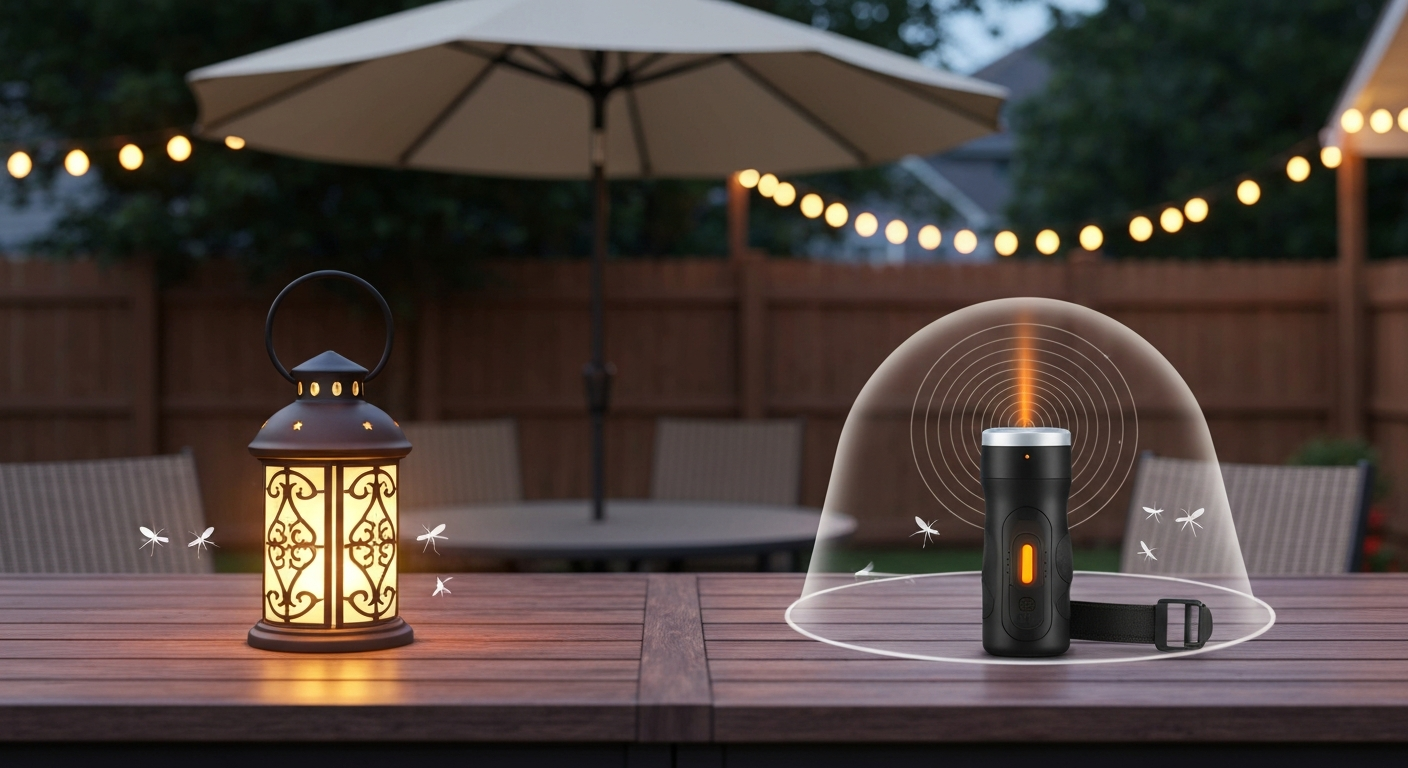
Both the Thermacell Patio Shield and the MR450 use the same core technology: a butane cartridge heats a repellent mat soaked in allethrin, releasing an invisible barrier that mosquitoes avoid. Both claim a 15-foot protection zone after a 10–15 minute warm-up. The real differences come down to form factor, where and how you place them, upfront cost, and a few design touches the MR450 adds (like its ZoneCheck indicator glow). If you have a standard patio table setup and want a device that sits in the center of your seating area, the Patio Shield's tabletop or lantern-style variants are the better fit. If you want a more rugged, handheld unit that pulls double duty on the patio and on camping trips, the MR450 is worth the slightly higher price.
Thermacell Patio Shield vs MR450: Buyer Guide for Patios & Outdoor Seating

Head-to-Head Summary and Verdict
The Patio Shield and MR450 are both fuel-powered, mat-based mosquito repellers from Thermacell. They share the same active ingredient (allethrin), the same claimed 225 sq ft protection zone, and the same refill system. Where they diverge: the Patio Shield line is designed specifically for stationary patio use, offered in lantern, torch, and tabletop styles meant to blend into outdoor decor. The MR450 is a handheld, clip-ready device built to go wherever you do. It includes a ZoneCheck indicator (an orange glow that confirms the unit is active and heating), which is a genuinely useful cue the Patio Shield base unit doesn't have. Both retail in roughly the same price range, with the Patio Shield base coming in around $26.99 and the MR450 around $34.99 on Thermacell's own site.
My verdict: for a fixed patio seating area, pick the Patio Shield variant that fits your setup, because its form factor is purpose-built for that role and it costs less. For flexibility, durability, and the peace of mind that comes with the ZoneCheck glow, the MR450 earns its extra few dollars. Neither unit is the right answer if you have a large, open, or consistently windy patio, in that situation, I'd point you toward Thermacell's rechargeable E-series or multiple units spread across the space.
How These Thermacell Units Work
The operating principle is the same across both devices. You screw in a small butane fuel cartridge at the base. That cartridge feeds a tiny metal heating grid inside the unit. You press a mat, a small pad pre-loaded with allethrin (a synthetic pyrethroid), onto the grid. When you turn the device on, the butane heats the grid, which in turn heats the mat and slowly vaporizes the allethrin into the surrounding air. Mosquitoes that enter this vapor cloud find it repellent and divert away. They don't necessarily die on contact, they just avoid the area.
It takes about 10 to 15 minutes for the concentration to build to effective levels, so you want to turn the unit on before you sit down outside, not after you're already getting bitten. Once it's running, you have roughly 4 hours per mat. Each cartridge lasts approximately 12 hours, meaning one cartridge powers three mat changes. Wind is the main enemy here: it disperses the vapor and shrinks your effective zone, sometimes significantly. Semi-enclosed patios, covered decks, and still evenings are where these devices perform best.
Design and Build: Size, Materials, and Aesthetics
The Patio Shield line is the more design-conscious of the two. Thermacell offers it in several forms, a tabletop base, a lantern, and a torch, each intended to look like it belongs on your patio rather than like camping gear that wandered indoors. The lantern and torch variants especially blend in with standard patio lighting. Build quality is solid plastic, lightweight, and the lantern versions have a decorative outer shell that doubles as light diffusion when the unit is active. Colors like Glacial Blue are intended to coordinate with outdoor furniture.
The MR450 is a more utilitarian design: a compact, handheld unit with a rubberized grip, a belt clip, and a more tool-like look. It's slightly heavier than the Patio Shield base but still very portable. Its signature feature is the ZoneCheck indicator, an orange glow visible through a small window on the side that tells you the unit is on and warming up. It's a small thing, but it removes guesswork, you don't have to wonder if you forgot to turn it on. The MR450 is less decorative but more rugged, and it clearly prioritizes function over fitting in with your patio aesthetic.
Repellent Systems and Refill Types: Mats, Cartridges, and Fuel
Both units use the same Thermacell butane cartridge and allethrin mat system, which means refills are interchangeable and widely available at Home Depot, Lowe's, Target, REI, and Thermacell's own store. The active repellent ingredient in fuel-powered mats is allethrin at 21. Thermacell’s Ingredients & Safety page states fuel-powered repellers use allethrin while rechargeable/liquid cartridge systems use metofluthrin, and that these ingredients are EPA-reviewed for the labeled outdoor (non-skin) uses when used as directed. 97% concentration (d-cis/trans allethrin). This is worth knowing because Thermacell's rechargeable E-series devices (like the E55) use a different active ingredient, metofluthrin, delivered in a liquid cartridge. The two systems are not interchangeable.
Both the Patio Shield and MR450 ship with one 12-hour fuel cartridge and three 4-hour repellent mats, giving you a full 12 hours of starter protection right out of the box. Refill economics are roughly equivalent for both since they use the same consumables. Thermacell's site (as of July 2026) lists a mixed mat-and-fuel refill pack at around $18.99 and a butane-only 4-pack at $22.99. Buying larger value packs brings the per-hour cost down meaningfully, so if you're a heavy patio user through the summer, stocking up in bulk is the smarter move.
Power Source, Runtime, and Claimed Coverage Areas
No batteries required for either unit. Power comes entirely from the butane cartridge, which is also what makes these work during power outages or in off-grid situations. The rated runtime is 4 hours per mat and 12 hours per cartridge, so in practice you'll swap mats every 4 hours while one cartridge carries you through three mat cycles. Both units are marketed with the same 15-foot protection radius, which translates to approximately 225 square feet. That's roughly enough for a standard 4-to-6 person patio dining set if you place the device centrally and the air is reasonably calm. In open or breezy conditions, expect that effective zone to shrink.
Mounting, Placement Options, and Portability for Patio Use
This is where the two products diverge most practically. The Patio Shield is designed to stay in one spot. The tabletop base sits flat on a table surface. The lantern and torch variants can be hung or staked into the ground, which makes them useful for defining the perimeter of a seating area or adding ambient light. They're not really meant to be packed up and moved around; they're patio furniture accessories.
The MR450 is built for movement. Its belt clip lets you attach it to a bag, a camp chair, or a belt loop, and its compact size means it goes easily into a backpack. On the patio, you can set it on a table just like the Patio Shield, but you can also clip it to an umbrella pole, a chair arm, or a side table. It's genuinely dual-purpose in a way the Patio Shield is not. If you want one device that covers the patio on weeknights and the campsite on weekends, the MR450 is the obvious pick.
Side-by-Side Specs and Performance
| Feature | Thermacell Patio Shield | Thermacell MR450 |
|---|---|---|
| Approx. retail price (MSRP) | ~$26.99 (base) | ~$34.99 |
| Power source | Butane cartridge (no batteries) | Butane cartridge (no batteries) |
| Active repellent ingredient | Allethrin (21.97%) | Allethrin (21.97%) |
| Claimed protection zone | 15 ft radius / ~225 sq ft | 15 ft radius / ~225 sq ft |
| Warm-up time | 10–15 minutes | 10–15 minutes |
| Mat runtime | 4 hours per mat | 4 hours per mat |
| Cartridge runtime | 12 hours per cartridge | 12 hours per cartridge |
| Included in box | 1 cartridge + 3 mats (12 hr total) | 1 cartridge + 3 mats (12 hr total) |
| Refill system | Standard fuel-powered mats/cartridges | Standard fuel-powered mats/cartridges |
| Repellent system compatibility | Fuel-powered mats only | Fuel-powered mats only |
| ZoneCheck indicator | No (varies by SKU) | Yes (orange glow) |
| Form factor / style | Lantern, torch, tabletop, base | Handheld, clip-ready |
| Portability | Limited (patio-stationary) | High (belt clip, compact) |
| Best placement | Table surface, stake, hanging | Table, belt clip, chair arm, umbrella pole |
| Outdoor-only use required | Yes | Yes |
| Works in windy/open areas | Reduced effectiveness | Reduced effectiveness |
Pros and Cons: Patio Shield vs MR450
Thermacell Patio Shield
- Lower upfront cost (~$26.99 for the base)
- Multiple form factors (lantern, torch, tabletop) that suit different patio aesthetics
- Lantern variants add ambient light as a secondary benefit
- Torch/stake versions let you place the repellent at garden or seating perimeter
- Same proven 15 ft zone and allethrin system as other Thermacell fuel units
- Limited portability — not designed to travel with you
- No ZoneCheck indicator on most SKUs (you have to trust it's working)
- Refill cost accumulates quickly for heavy users
Thermacell MR450
- ZoneCheck orange glow indicator confirms the device is active and heating
- Rugged, handheld design with belt clip for true portability
- Dual-purpose: works on the patio and off-grid (camping, tailgating, hiking)
- Same 15 ft protection zone and refill system as Patio Shield
- Slightly higher upfront price (~$34.99)
- More utilitarian look — won't blend into patio decor
- No light output — purely functional
- Still loses effectiveness in wind and large open spaces like the Patio Shield
Real-World Use Cases and Best-For Recommendations
For a covered or semi-enclosed patio up to about 225 sq ft, either unit works well, and the Patio Shield is the more natural fit. Its decorative designs integrate with patio furniture, and the torch or lantern versions let you stake or hang them to maximize the zone's positioning relative to your seating. Turn it on before you sit down, and on a still evening under a pergola or covered porch, you'll notice a clear reduction in mosquito activity within 15 minutes. Recent standardized field trials and systematic reviews of volatile pyrethroid spatial repellents, including Thermacell‑type emitters (heat‑activated metofluthrin/allethrin), report strong reductions in mosquito landings and household entry under test conditions (Volatile pyrethroid spatial repellents for preventing mosquito bites: a systematic review and meta‑analysis (PMC)).
For a larger open patio or deck without shelter, one device of either type will struggle. Wind disperses the vapor and shrinks the effective zone. In this scenario, you're better off deploying two units at opposite ends of the seating area, or reconsidering whether a fuel-powered mat unit is the right tool at all. Thermacell's E-series rechargeable units or patio-specific models with higher output may serve you better. If budget is tight and you're committed to the mat system, place units upwind of the seating area to compensate for drift.
For someone who splits time between the patio and outdoor activities away from home, the MR450 is the smarter single purchase. You get the same patio functionality plus genuine portability, and the ZoneCheck indicator is a real convenience when you're managing a campsite or a tailgate and have other things to think about.
Ongoing Costs: Replacement Mats, Cartridges, and What You'll Actually Spend
Since both devices use the same refill consumables, running costs are identical once you've made your initial purchase. Each mat lasts 4 hours and each cartridge lasts 12 hours (three mat changes). At Thermacell's own store pricing as of July 2026, a mixed refill pack runs about $18.99. A butane-only 4-pack is about $22.99. If you're outside for 3 to 4 hours per evening, two to three evenings a week, you're burning through mats at a noticeable rate over a full summer. Buying larger value or mega refill packs reduces the per-hour cost, so plan ahead at the start of the season rather than buying single packs reactively.
To put rough numbers on it: at 4 hours of use per evening and three evenings per week through a 12-week summer, that's roughly 144 hours of use. At 4 hours per mat, that's 36 mats. Buying in bulk is not optional if you want to avoid frequent trips to the hardware store. Neither device requires batteries, which is one less consumable to track.
Maintenance, Safety Notes, and Proper Handling
Both units have the same basic maintenance requirements: replace the mat when it turns white (indicating allethrin is depleted), replace the cartridge when the device stops heating properly, and keep the heating grid clean of debris. Thermacell recommends against using non-Thermacell mats or cartridges, since compatibility and output are calibrated to their specific products.
Safety is straightforward but worth repeating: these are outdoor-only devices. Using them in enclosed spaces like tents, garages, or screened rooms with limited airflow is not safe. Allethrin concentrations that are harmless outdoors can build to problematic levels in a confined space. Keep the unit away from open flames (the butane cartridge makes this obvious), and store cartridges in a cool, dry place away from heat sources. If you have pets, particularly cats, be aware that pyrethrins and pyrethroids are toxic to cats at higher concentrations, use the device in well-ventilated outdoor areas where cats are not confined.
Setup Tips and Common Troubleshooting
- Screw the butane cartridge in firmly but not over-tight — just snug enough to seal. A loose cartridge is the most common cause of the unit not heating.
- Place the mat flat on the heating grid before turning on. A mat that isn't fully seated won't vaporize evenly.
- Turn the device on at least 10–15 minutes before you need protection. The zone takes time to build.
- Position the unit upwind of your seating area when there's a light breeze, so the vapor drifts toward you rather than away.
- If the unit produces no heat after several minutes, check that the cartridge is properly engaged and the mat is correctly installed. A soft hiss or slight warmth near the grid confirms butane is flowing.
- On the MR450, the ZoneCheck orange glow confirms the unit is active. No glow after a minute or two usually means a cartridge connection issue.
- Spent mats turn white. Blue or green color means the mat still has repellent. Replace when white or at the 4-hour mark, whichever comes first.
- If performance seems weak, check for wind. A single unit has a hard time competing with more than a light breeze — reposition closer to your seating or add a second unit.
Patio Shield Reviews at a Glance
Across major retailers including Home Depot, Target, and REI, Patio Shield SKUs carry hundreds to thousands of user reviews and generally score well. For aggregated user feedback across retailers, see Thermacell Patio Shield reviews for a quick look at ratings and common pros and cons. The most consistent positive theme is genuine mosquito reduction within the claimed 15-foot zone on calm evenings, with many reviewers describing it as noticeably more effective than citronella candles or wristbands. Recurring complaints center on three areas: refill cost relative to use time, reduced effectiveness in windy or very large open spaces, and occasional mat or cartridge quality issues. A smaller but persistent subset of reviews mentions unit failures or inconsistent heating, which Thermacell typically addresses through their warranty and satisfaction guarantee. The decorative design of lantern and torch variants draws specific praise from buyers who want the repellent to look intentional rather than industrial.
Patio Shield vs MR300: Quick Comparison
The MR300 is Thermacell's simpler, more budget-oriented handheld unit. It covers the same 15-foot zone and uses the same mat-and-cartridge system, but it lacks the ZoneCheck indicator that the MR450 has, and it has a more basic build quality. If you're choosing between the Patio Shield and the MR300, the Patio Shield wins on aesthetics and patio-specific design, while the MR300 offers very basic portability at a typically lower price. The MR450 improves on the MR300 in build, indicator feedback, and durability. For a deeper look at how the Patio Shield and MR300 stack up across coverage, cost, and use cases, the dedicated Patio Shield vs MR300 comparison covers those details fully.
Patio Shield vs Radius: Quick Comparison
The Thermacell Radius is a rechargeable device that uses a liquid metofluthrin cartridge rather than butane and allethrin mats. It's quieter, has no butane smell, and the liquid refills last longer per cartridge than mat-based systems. For patio use specifically, the Radius is often more convenient because you charge it via USB and swap a liquid cartridge rather than managing mat changes. The Patio Shield's advantage is lower upfront cost and the option to choose a lantern or torch form that adds visual appeal. If convenience and runtime trump aesthetics, the Radius is worth the higher initial investment. The Patio Shield vs Radius comparison goes deeper into runtime, refill costs, and which suits different patio setups. For a detailed comparison of Thermacell Patio Shield vs Radius, consult our dedicated guide that breaks down runtime, refill costs, and which model best fits different patio setups.
Patio Shield vs E55 (and How the MR450 Relates)
The E55 is Thermacell's rechargeable, battery-powered unit designed specifically for patio and backyard use. It uses metofluthrin in a liquid cartridge format, runs on a rechargeable battery (no butane), and is marketed with a larger effective zone than the standard fuel-powered mat units. Independent reviewers including Wirecutter have pointed to the E-series as the more convenient option for stationary patio setups compared to butane-and-mat units, citing quieter operation, no fuel odor, and less frequent refill changes. The MR450, as a butane-and-mat device, is in the same product tier as the Patio Shield rather than competing with the E55, it's a fuel-powered option that trades convenience for portability and off-grid capability. For a full breakdown of how the Patio Shield and E55 differ in coverage, cost, and technology, the Patio Shield vs E55 comparison covers the rechargeable-vs-fuel question directly.
Buying Checklist: What to Compare at the Point of Purchase
- Patio size and shelter: is your seating area under 225 sq ft and at least partially enclosed? If yes, one unit of either type should work. If no, plan for two units or consider a higher-output rechargeable device.
- Wind exposure: consistently breezy patios reduce effectiveness of all mat-based units significantly. Factor this in before committing to the mat system.
- Form factor priority: do you want a device that looks like patio decor (choose Patio Shield lantern or torch) or one that can travel with you (choose MR450)?
- Budget: Patio Shield base starts lower (~$26.99). MR450 costs a bit more (~$34.99) but adds the ZoneCheck indicator and greater portability.
- Refill stock: both use the same consumables. Buy a bulk refill pack at purchase to reduce per-hour costs and avoid mid-season stock-outs.
- Dual-use need: if you camp, fish, hike, or tailgate, the MR450's portability pays off. If the device never leaves your patio, save money with the Patio Shield.
- Pet safety: pyrethroids are toxic to cats at higher concentrations. Confirm your patio is open and well-ventilated.
- Indicator feedback: if you want visible confirmation the unit is active, the MR450's ZoneCheck glow is a practical advantage.
Related Outdoor Comfort Resources
Mosquito control is one piece of the outdoor comfort puzzle, and it works best alongside the right patio heating setup. On Patio Heater Reviews, you'll find detailed guides comparing propane, electric, and infrared patio heaters across different patio sizes and coverage needs, particularly useful if you're trying to extend your evenings into cooler months when mosquitoes are less of a concern but warmth still matters. Tabletop heater comparisons, buying guides for covered vs. uncovered spaces, and fuel-type breakdowns are all available to help you build a complete outdoor setup rather than solving just one problem at a time.
Final Takeaway and Next Steps
Here's how I'd simplify this decision: if your patio is covered or semi-enclosed, under about 225 sq ft, and you want a device that looks at home on the table or staked in the garden, the Patio Shield is the right call, and the lower price makes it easier to buy a second unit if you need more coverage. If you want one device that works on the patio tonight and at the campsite this weekend, spend the extra few dollars on the MR450, the ZoneCheck indicator and portable form factor genuinely earn it. Both are solid, well-proven products in the same technology tier.
Before you buy, check whether a butane-and-mat unit is the right system for your conditions. If you have a large, open, or consistently windy patio, either device will disappoint you. In that case, look at Thermacell's Radius or E-series rechargeable options, consider multiple units, or pair a single device with a more sheltered seating arrangement. Whatever you choose, stock up on refills at the start of the season, the single biggest complaint from long-term Thermacell users isn't the performance, it's running out of mats mid-evening.
FAQ
Quick verdict: Thermacell Patio Shield vs MR450 — which should I buy for a patio?
Head‑to‑head: both use Thermacell’s fuel+mat system and claim the same ~15‑foot protection zone, so for sheltered patios of up to ~225 sq ft either will work. Choose the Patio Shield (lantern/torch/tabletop variants) if you want a more decorative, stationary device that blends with patio furniture and generally costs slightly less. Choose the MR450 if you want a compact, rugged, highly portable unit (and the armored styling) for mixed use (patio + yard + camping). If convenience, quiet operation and fewer refills matter more than off‑grid fuel use, consider Thermacell’s rechargeable E‑series instead.
How does each unit work in plain language?
Both are heat‑activated spatial repellents: you insert a small butane fuel cartridge and a repellent mat that contains allethrin. The butane heats a metal plate which warms the mat, releasing a vaporized pyrethroid that creates a protective zone over minutes. Expect about a 10–15 minute warm‑up for a steady zone and a nominal 15‑foot radius of reduced mosquito landings when conditions are favorable.
What are the main design differences between the Patio Shield and MR450?
Patio Shield: styled as a lantern/torch/tabletop unit with finishes meant for patio décor, designed to sit or hang in one place. MR450: compact, rugged “armored” portable repeller with a smaller footprint, latch/cover features for travel, and more plainly utilitarian styling. Functionally they use the same fuel+mat method but their form factors target different use scenarios (decorative/static vs portable/durable).
What fuel/repellent cartridges and mats do they use and how do refills compare?
Both use Thermacell butane fuel cartridges plus allethrin‑based repellent mats for fuel‑powered models. Starter packs often include a 12‑hour fuel cartridge and three 4‑hour mats. Refills are sold as mixed mat+fuel packs or butane‑only multi‑packs. Prices vary by pack size and retailer; mixed refill packs and butane 4‑packs let you estimate per‑hour costs. Running‑costs are typically higher than rechargeable liquid systems per hour when using small mat packs, but value packs reduce per‑hour price.
What about power source and runtime?
Both are butane‑powered (no batteries required). Typical included starter fuel cartridge provides ~12 hours (depends on model packaging), mats usually listed as 4 hours each. You’ll need to replace mats regularly (every 3–4 hours of continuous use per mat) and replace the butane cartridge when depleted. No mains power required, which is an advantage for off‑grid use.
How big an area do they protect and how long until protection starts?
Thermacell advertises roughly a 15‑foot radius (≈225 sq ft) protection zone for fuel‑powered models after a 10–15 minute warm‑up. Real‑world coverage depends on wind, airflow, and mosquito pressure—sheltered patios achieve closer to the claimed zone; open, windy spaces will reduce effective coverage and may require multiple units.