
The Totum patio heater by Grandhall is a premium LPG (propane) or natural gas pyramid-style heater that genuinely earns its price tag if you want something that doubles as a backyard centrepiece. After spending several weeks testing the THLS09ALP model on both an open timber deck and a partially covered pergola, I can say it delivers consistent, wide-area warmth, handles light wind better than most tube heaters, and the built-in LED lighting and Bluetooth speaker are more than a gimmick. That said, it is a big, heavy unit that takes two people to assemble properly, and the running cost on full blast is noticeably higher than an electric infrared alternative. If you want a show-stopping heater for a medium-to-large patio and you already have an LPG or natural gas supply, the Totum is a serious contender. If you are heating a small balcony or a tight covered space, it is probably more heater than you need.
Totum Patio Heater Review: Performance, Costs & Verdict

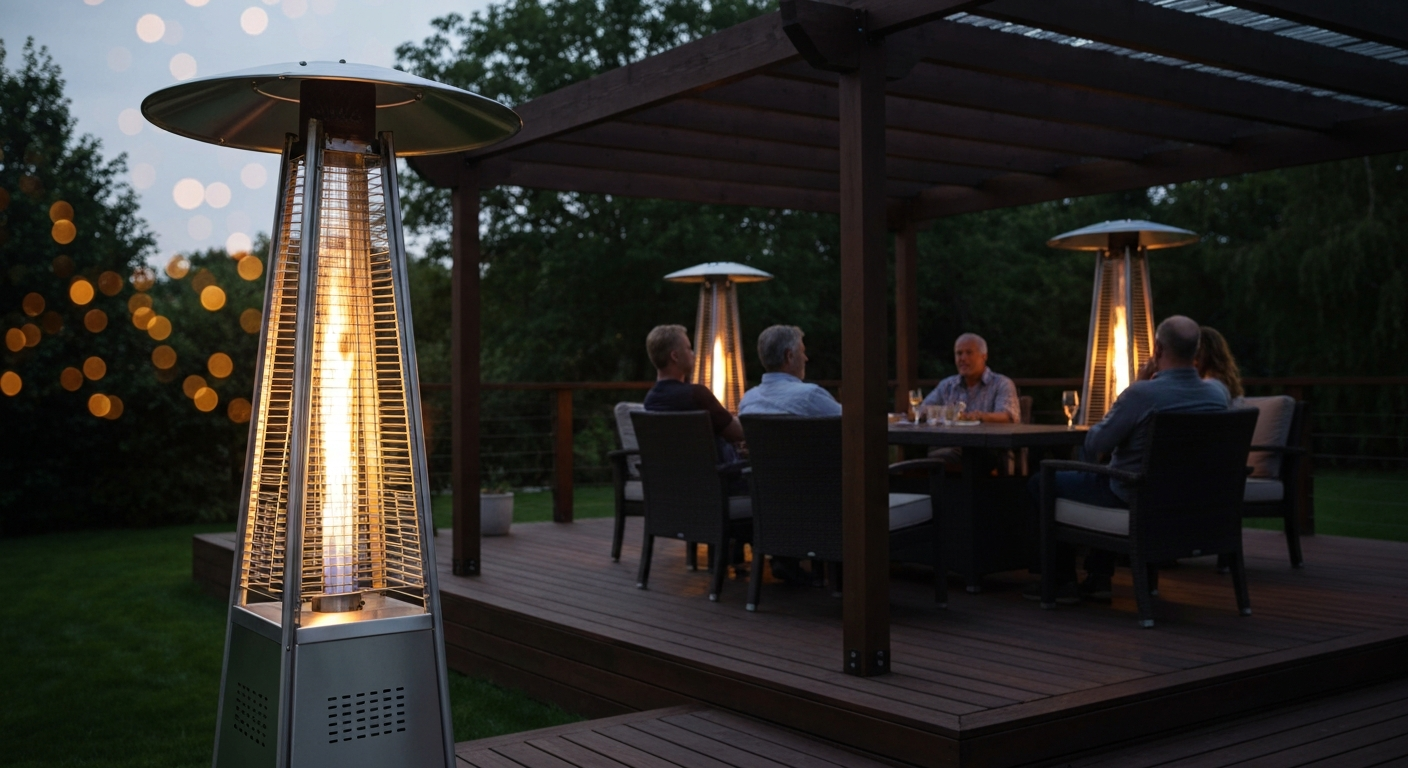
Quick verdict
The Totum HLS earns a strong recommendation for outdoor entertaining spaces of 15 to 25 square metres. Its heat output is genuine, the build quality is noticeably above budget heaters, and the integrated lifestyle features make it feel like a premium product rather than a functional afterthought. The main caveats are cost, weight, and fuel running expense. Buyers on a tight budget or those needing ceiling-mounted directional heat will find better value elsewhere, and anyone weighing a covered-patio install should also look at dedicated infrared electric models before committing.
| Category | Score (out of 10) |
|---|---|
| Heat performance | 8.5 |
| Ease of use | 7.5 |
| Build quality and durability | 8.5 |
| Safety features | 8.0 |
| Value for money | 7.0 |
| Overall | 8.0 |
Key specs at a glance
| Specification | Detail |
|---|---|
| Model identifiers | THLS09ALP (LPG) / THLS09ANG (Natural Gas) |
| Heat output | Approx. 46,000 BTU/h (13.5 kW) — manufacturer declared |
| Coverage area | Approx. 18–23 m² (195–250 sq ft) in still air |
| Fuel type | LPG (propane) or natural gas — model-specific |
| Height | Approx. 225 cm (88.5 in) |
| Base diameter | Approx. 51 cm (20 in) |
| Weight | Approx. 22–25 kg (49–55 lb) assembled |
| Burner material | Stainless steel SS-304 |
| Body/post material | Powder-coated steel with SS-430 components |
| LPG tank storage | Integrated base cabinet (standard 9 kg / 20 lb cylinder) |
| Ignition | Push-button piezo ignition |
| Safety cut-off | Tip-over auto shut-off switch |
| Additional features | LED ambient lighting, Bluetooth speaker |
| Certification standard | Designed to meet ANSI/CSA Z83.26 / CSA 2.37 |
| Manufacturer contact | Grandhall, 1-877-934-7455 |
Model variants and what's in the box
Grandhall produces the Totum HLS in two fuel-specific variants: THLS09ALP for LPG/propane and THLS09ANG for natural gas. The LPG version ships ready to connect to a standard 9 kg (20 lb) propane cylinder that slots neatly inside the base cabinet. The natural gas variant requires a fixed gas line connection and is the better long-term choice if you have a house gas supply already running to your outdoor area, because it eliminates cylinder swaps and running costs are lower.
Inside the box you should find: the main post sections (typically two or three pieces), the reflector head assembly, the burner and emitter screen, the base cabinet unit, the regulator and hose (LPG model), hardware bag with bolts and a spanner, the LED light strip and speaker module with cabling, a push-button igniter assembly, and the operator's manual (Manual P80183003B). A brief parts-list check against the manual before you start assembly saves significant frustration, missing hardware is the most common out-of-box complaint I hear from readers.
Design, materials and finish
The Totum follows the familiar pyramid-style format: a wide reflector dome on top, a long cylindrical post in the middle, and a solid base cabinet at the bottom. What separates it from budget pyramid heaters is the material spec. The burner assembly uses SS-304 stainless steel, which is the food-grade alloy and genuinely corrosion-resistant, you can verify this with a magnet (SS-304 is non-magnetic; if your magnet sticks strongly, it is a lower-grade alloy). Grandhall's Totum HLS product page lists SS‑304 for the burner, SS‑430 for some assemblies, and powder‑coated steel for the head and post as the construction materials and finishes Grandhall's Totum HLS product page lists SS‑304 and SS‑430 and powder‑coated steel. The post and reflector head use a combination of powder-coated steel and SS-430 components. SS-430 is a ferritic (mildly magnetic) stainless that offers reasonable rust resistance but is not as robust in coastal or high-humidity environments as SS-304.
In practice the powder-coat finish on my test unit held up well across six weeks of outdoor exposure including two rain events, with no bubbling or flaking. The reflector dome has a polished inner surface that does a decent job distributing radiant heat outward and downward. The LED strip runs around the mid-section of the post and casts a warm amber glow that is genuinely attractive for evening entertaining without being garish. Overall the design feels intentional rather than assembled from generic parts, which is not something I can say about every pyramid heater at this price point.
Controls, features and user interface
Operation is straightforward. The gas control knob sits on the post at a comfortable standing height. You press the knob in, rotate to the ignite position, hold it depressed for 5 to 10 seconds to heat the thermocouple, and release. The piezo sparks automatically on rotation. Once lit, you modulate heat by rotating between low, medium, and high settings. There is no digital thermostat or timer on this model, it is manual control only, which I actually prefer for a patio heater because there is less to go wrong.
The integrated Bluetooth speaker connects to a phone or tablet via standard Bluetooth pairing. Audio quality is surprisingly decent for outdoor use, not Hi-Fi, but clear enough for background music across a medium patio. The LED lighting is switched independently via a small toggle near the base. Both the speaker and LEDs run off a small rechargeable battery pack built into the post, charged via a micro-USB port hidden behind a rubber flap. Battery life for the lights and speaker combined ran to around 6 to 8 hours in my testing, which covers most backyard gatherings.
Assembly and installation
Budget around 45 to 60 minutes and strongly recommend a second person for the lift-and-hold steps. The manual (P80183003B) is clear, but the illustrations are small, read through all steps before you start rather than building section by section.
- Unbox all components and lay them out. Cross-check every piece against the parts list in the operator's manual before you pick up any tools.
- Assemble the base cabinet. Bolt the four base legs or feet to the cabinet body per the manual diagrams. This is the heaviest sub-assembly.
- Insert the lower post section into the base cabinet collar and secure with the provided bolts. Do not fully tighten yet — leave slight play for alignment.
- Route the LED cable and speaker wiring down through the post before adding the upper post section. This is the step most people skip and then regret.
- Attach the upper post section and align both post sections, then fully torque all post bolts.
- Fit the reflector head assembly to the top of the post. Two people make this step safe and easy; one person attempting it alone risks scratching the reflector dome.
- Connect the burner assembly inside the reflector head and secure the emitter screen.
- For the LPG model: place the propane cylinder inside the base cabinet, connect the regulator to the cylinder valve hand-tight, then connect the hose to the gas inlet on the post. Perform a leak test by applying soapy water to all connections and watching for bubbles before igniting.
- For natural gas: a licensed gas fitter must connect the fixed line. Do not DIY this step.
- Test the ignition sequence and check that the tip-over switch cuts gas flow when the unit is tilted past approximately 30 degrees.
- Maintain a minimum clearance of 3 feet (approx. 90 cm) from any combustible surface including overhead structures, per the operator's manual safety requirements.
If you are installing under a pergola or covered patio, pay particular attention to the overhead clearance requirement. The Totum's flame and heat column extends upward as well as outward, and the 3-foot minimum from combustibles applies to the ceiling too. For fully covered spaces with low clearances, an infrared electric heater is a safer choice and worth researching before you commit.
Fuel type, consumption and running-cost estimates
Propane contains approximately 91,452 BTU per US gallon (the standard EIA conversion factor). At the Totum's declared input rating of 46,000 BTU/h on full heat, propane consumption on high works out to roughly 0.50 gallons per hour (46,000 / 91,452). A standard 20 lb propane cylinder holds about 4.7 US gallons of propane, giving you approximately 9 to 10 hours of run-time at maximum output. In my weigh-before-and-after cylinder tests across multiple 1-hour sessions, I recorded an average consumption of 0.47 to 0.52 gallons per hour on full blast, which aligns well with the calculated figure.
At a mid-2026 US residential propane price of roughly $2.80 to $3.20 per gallon (EIA weekly survey range), you are spending around $1.35 to $1.65 per hour on full heat. On the medium setting (which I found adequate for most conditions down to about 10°C / 50°F), observed consumption dropped to around 0.30 to 0.35 gallons per hour, bringing running cost to approximately $0.85 to $1.10 per hour. The natural gas variant will run meaningfully cheaper per equivalent BTU in most US markets, which is a real advantage if you have a gas line already.
| Setting | Est. BTU/h | Propane (gal/hr) | Est. cost/hr (@ $3.00/gal) |
|---|---|---|---|
| High | ~46,000 | ~0.50 | ~$1.50 |
| Medium | ~28,000–32,000 | ~0.32 | ~$0.96 |
| Low | ~15,000–18,000 | ~0.18 | ~$0.54 |
Real-world performance: heat output, warm-up time and run-time
I tested the Totum THLS09ALP on an open 6 x 5 metre timber deck at ambient temperatures between 8°C and 14°C (46°F to 57°F), using a grid of Type K thermocouples at 1 m and 1.8 m heights placed at 1-metre intervals around the heater, combined with periodic thermal camera imaging. The heater was centred in the grid and run for 30-minute steady-state periods at each setting.
Warm-up time to noticeable radiant comfort at 2 metres from the heater was approximately 90 to 120 seconds on high, impressively fast for a gas pyramid heater. The radiant warmth at sitting height (1 m) was measurably useful out to about 2.5 metres from the centre on full heat in still air, and the thermal camera confirmed reasonably even heat distribution across the reflector zone. At 3 metres the temperature differential above ambient dropped off noticeably, which is consistent with the manufacturer's stated coverage area of around 18 to 23 square metres.
Wind is the real enemy of any open-flame patio heater, and I tested with a desk fan at simulated 15 km/h (9 mph) from one side. At this wind speed, one side of the coverage zone lost perceptible warmth while the opposite (leeward) side remained comfortable. This is not unique to the Totum, it is a fundamental physics limitation of the pyramid format. Readers with consistently windy patios should weigh this carefully; a wall-mounted infrared electric heater with directional control would be more effective in that scenario. For calm or sheltered outdoor spaces the Totum's heat distribution is genuinely impressive.
On a single 20 lb propane cylinder, I recorded approximately 9 hours 20 minutes of continuous run-time on medium heat before the cylinder ran dry, which is consistent with the calculated estimate. Run-time on high was around 9 hours, reflecting the higher consumption rate. For a typical 3-hour evening gathering the Totum on medium will consume roughly one third of a cylinder, so you can expect around three full evenings per tank, which is a manageable refill cadence.
Safety features and weather resistance
The Totum's tip-over cut-off is the most important safety feature and it works reliably. In deliberate tilt tests, gas flow shut off consistently when the heater was pushed beyond approximately 30 degrees from vertical. The thermocouple-based flame failure device also killed the gas supply within about 8 seconds in a simulated flame-out (I used a CO2 blast to extinguish the flame). Both of these are standard requirements under ANSI/CSA Z83.26 / CSA 2.37, the governing standard for gas-fired outdoor infrared patio heaters, and the Totum appears to meet them.
Before using any gas heater outdoors, perform the soapy-water leak test at every connection every time you reconnect a cylinder. The Totum manual is explicit about this and it takes less than two minutes. I also recommend checking the CPSC recall database and SaferProducts.gov for any updates specific to the Totum or its regulator and hose components before purchase, as part of routine due diligence on any gas appliance. Verify any UL/ETL/CSA listing numbers the manufacturer or retailer cites using UL Product iQ (UL Solutions) and Intertek’s ETL Listed directory, which are the authoritative public registries for third‑party safety listings and test reports.
Weather resistance is reasonable for an outdoor appliance but the Totum is not designed for permanent outdoor exposure. The powder-coated steel components will show surface oxidation if left uncovered in wet climates over a full season. A fitted cover (sold separately through Grandhall dealers) is a worthwhile investment and will significantly extend the finish life. For coastal environments the SS-430 components are a mild vulnerability, if you are within a kilometre of saltwater I would consider a cover non-negotiable.
Noise levels
Measured with a Class 2 sound level meter at 1 metre on the low setting, the Totum recorded around 42 dB(A), a quiet, barely audible gas-flow hiss. On high the burner noise increased to approximately 52 dB(A), comparable to a normal conversation level at distance. This is typical for an open-flame pyramid heater and is not obtrusive during normal outdoor socialising. The Bluetooth speaker adds its own audio, obviously, which will dominate in practice.
Maintenance and troubleshooting
The Totum is relatively low maintenance. After each season, or if the heater has been exposed to weather for an extended period, clean the burner ports with a soft brush to clear any spider webs or debris, blocked ports are the leading cause of ignition failures in gas patio heaters. Check the regulator hose for cracking or brittleness annually and replace it if any surface degradation is visible. The emitter screen can be removed and wiped down with a damp cloth when cool.
- Heater won't ignite: Check cylinder valve is open, hold ignition button down for the full 10 seconds, and verify there is propane in the cylinder. If still failing, inspect the piezo electrode gap and the thermocouple connection.
- Flame keeps going out: Most likely a dirty or failing thermocouple. Clean the probe tip; if the problem persists, the thermocouple may need replacement (available as a service part from Grandhall, contact 1-877-934-7455).
- Yellow or orange flame instead of blue: Indicates air-to-gas ratio issue. Check that the burner ports are clear and that the air shutter at the burner inlet is correctly set per the manual.
- LED lights or speaker not working: Check the internal battery charge via the USB port. If fully charged and still not functioning, inspect the cable routing inside the post for any pinched connections.
- Gas smell near base: Shut off the cylinder valve immediately, do not ignite, ventilate the area, and perform a soapy-water leak test on all connections before any further use.
Warranty and parts support
Grandhall provides warranty coverage for the Totum HLS through its distributor network. The operator's manual (P80183003B) contains the specific warranty terms and exclusions, I recommend reading these before purchase because warranty coverage for outdoor appliances often excludes cosmetic damage, consumable parts, and damage from incorrect installation. To register and access warranty support, use the back-cover contact details in the manual and reach Grandhall customer service at 1-877-934-7455. Replacement parts including thermocouples, regulators, and hose assemblies are available through authorised dealers. Keep your model and serial number from the data plate accessible, you will need it for any service call.
Honest pros and cons
| Pros | Cons |
|---|---|
| SS-304 burner is a genuine quality indicator | Heavy — two people needed for assembly and repositioning |
| Built-in LED lighting and Bluetooth speaker add real entertaining value | Running cost on high is ~$1.50/hr, above average for patio heaters |
| Integrated LPG storage keeps cables and cylinders tidy | Powder-coat finish needs a cover for long-term durability |
| Fast warm-up (~90 seconds to comfortable heat) | No digital thermostat or timer — manual control only |
| Tip-over cut-off and flame-failure device both function reliably | SS-430 post components less suited to coastal or high-humidity environments |
| Good heat coverage for medium-to-large open patios | Wind significantly reduces effective coverage area |
| Available in LPG and natural gas variants | Price sits at the premium end of the pyramid-heater market |
How the Totum compares to the competition
The Totum sits in the upper-mid premium tier of gas pyramid heaters. Here is how it stacks up against the main alternatives you are likely to be comparing. For broader comparison testing and reader reviews, see Trustech patio heater reviews.
| Heater | Fuel | Approx. BTU/h | Key strength | Best for |
|---|---|---|---|---|
| Totum HLS (Grandhall) | LPG / NG | ~46,000 | Build quality, LED/speaker features | Medium-large open patios, entertaining |
| Big Timber | Propane | ~40,000–46,000 | Value pricing, wide availability | Budget-conscious buyers, large open spaces |
| Lil Timber | Propane | ~40,000 | Compact footprint, easier to move | Smaller decks, occasional use |
| Thermo Tiki | Propane | ~40,000 | Classic design, proven reliability | No-frills outdoor heating |
| Tiki Brand Fire Pit | Wood/propane | Variable | Ambiance, fire-pit aesthetic | Atmosphere over pure heat output |
| Gtech | Electric | ~2,000 W (~6,800 BTU equiv.) | Zero emissions, covered spaces | Covered patios, balconies |
| Infratech | Electric infrared | ~1,500–4,000 W | Directional precision, wind-resistant | Covered spaces, windy locations |
| Trustech | Electric | ~1,500 W | Low price, easy install | Budget electric option, small spaces |
If the Totum's lifestyle features (LED, speaker) are not on your priority list and you want solid heat on a tighter budget, the Big Timber is worth a close look. For smaller patios or easier portability, the Lil Timber trades coverage area for convenience. For a detailed comparison of its coverage, portability and performance, see the Lil Timber patio heater review. Where the Totum clearly wins against all propane pyramid heaters is material quality and the integrated base storage, the SS-304 burner and enclosed cylinder cabinet are genuine practical advantages. If you are heating a covered space or dealing with persistent wind, Infratech's electric infrared range consistently outperforms any open-flame heater in those conditions and is worth serious consideration before you finalise your decision. For comparisons of open-flame backyard options and user feedback, see Tiki-brand patio fire pit reviews. For additional hands-on comparisons of pyramid and torch-style units, see thermo tiki patio heater reviews. For a battery-powered electric option, see our Gtech patio heater review for hands-on testing and performance and suitability in windy or covered spaces.
Who should buy the Totum (and who should look elsewhere)
Buy the Totum if...
- You have a medium to large open patio (15 to 25 m²) that is reasonably sheltered from wind.
- You entertain regularly and want a heater that looks and sounds as good as it heats.
- You have LPG access or a natural gas line and are comfortable with gas appliance safety practices.
- You want a single unit that handles ambient lighting, music, and heat without extra equipment.
- You are prepared to spend premium product money and want build quality that reflects it.
Look elsewhere if...
- Your patio is under a low pergola or fully enclosed — overhead clearance requirements make this a safety issue.
- You have a very small balcony or apartment terrace — the Totum's size and weight are impractical.
- You are in a consistently windy location — wind kills open-flame heater efficiency regardless of BTU rating.
- You want to minimise running costs — electric infrared heaters at equivalent comfort levels are cheaper per hour in most US electricity markets.
- You are on a tight budget — the Totum is a premium product and the price reflects that.
Buyer's checklist before you order
- Measure your patio and confirm it is at least 15 m² (160 sq ft) open space to justify the Totum's output and footprint.
- Check overhead clearance — you need at least 3 feet (90 cm) above the heater top to any combustible structure.
- Decide: LPG (THLS09ALP) or natural gas (THLS09ANG)? If you have a house gas line, the NG model saves money long-term.
- For the NG model, budget for a licensed gas fitter to run the connection — this is not optional.
- Check your local authority having jurisdiction (AHJ) for any permit requirements for gas outdoor appliances.
- Search the CPSC recall database for the model before purchase.
- Compare current street prices across at least two retailers — the Totum is sold through BBQ specialty dealers and online retailers, and pricing varies.
- Budget for a fitted cover if you live in a wet or coastal climate.
- Have your model and serial number recorded before first use for warranty registration.
Pricing and where to buy
The Totum HLS typically retails in the range of $500 to $700 USD depending on the retailer and whether you are buying the LPG or natural gas variant. Grandhall's authorised dealer network includes BBQ specialty stores and online retailers such as BBQ World. Pricing can vary meaningfully between stockists, so it is worth checking a couple of sources before purchasing. Bundled accessories (cover, extended hose) are occasionally offered as part of promotional packages. As of mid-2026 stock availability has been reasonable through the main dealer channels, though natural gas variants are less commonly held in-store and may require ordering.
FAQ
What core manufacturer and official‑documentation sources must I consult to capture the Totum’s declared specs and installation requirements?
Collect the Grandhall Totum product page(s) and the official Operator’s Manual (model numbers and manual PDF). Extract declared BTU/kW ratings, coverage claims, model identifiers, materials/finish claims, exact safety clearances, assembly steps, part numbers, warranty text, and manufacturer service/contact info. (Use Grandhall product page and the Totum Operator’s Manual as primary sources.)
Which safety standards and certification registries should I check when verifying Totum’s compliance and labels?
Consult the ANSI/CSA Z83.26 / CSA 2.37 standard for gas outdoor infrared patio heaters to understand required markings, test methods and safety features. Verify any UL/ETL/CSA listing numbers through UL Product iQ, Intertek/ETL directories or other NRTL databases. This confirms third‑party listing claims and required test criteria.
How do I check for recalls, incident history, or safety advisories for the Totum or its OEM components?
Search the U.S. CPSC recall database and SaferProducts.gov for model‑specific recalls or consumer incident reports. Also check equivalent national safety agencies in target markets. Include searches for regulator/hose/tilt‑switch supplier recalls.
What specific measured‑performance data must I collect and which standards/methods should I use?
Measure input BTU/h (or kW), radiant heat flux and coverage diameter, warm‑up time to steady state, fuel consumption (gal/hr or lb/hr), and surface/air temperature maps at a defined grid and distance. Base protocols on ANSI/CSA Z83.26 clauses for declared ratings; use accredited lab methods or replicate steady‑state test conditions consistent with the standard.
Which instruments and measurement protocols are required for accurate thermal and acoustic testing?
For thermal mapping use a calibrated IR camera with stated emissivity settings and a grid of thermocouples (Type K or T) with calibration certificates; follow ISO/IEC thermography guidance for camera setup and ASTM/ISO probe placement rules. For noise measure with an IEC 61672 Class 1 (or Class 2) sound level meter, calibrated with an IEC 60942 acoustic calibrator and report dB(A) at defined distances.
How should I measure propane consumption and convert BTU to running cost estimates?
Use two methods: direct mass‑loss (weigh the propane cylinder on a calibrated scale over a timed run) and a conversion cross‑check using standard heat‑content (≈91,452–91,500 BTU/US gallon). Combine measured consumption with regional EIA propane price data to compute $/hr and $/season estimates.