
Bond makes some of the most widely available patio heaters in North America, sold through Home Depot, Lowe's, Walmart, and Costco at prices that are genuinely accessible. After hands-on testing of multiple Bond models (propane, electric, and infrared) across open and covered patios, my overall take is this: Bond heaters punch above their price point on warmth and build quality, but a few models have quirks around ignition reliability and heat distribution that are worth knowing before you buy. This guide walks you through every current model, ranked and rated, with the specifics you need to pick the right one for your space. For broader comparisons and alternatives, see our patio comfort heater reviews for side-by-side performance and buying advice.
Bond Patio Heater Reviews: Models, Ratings & Buying Guide

Who this guide is for
This is a buyer-focused review aimed at homeowners and renters who want an honest, model-level breakdown of Bond's patio heater lineup. Whether you're heating a small apartment balcony, a large open deck, or a covered pergola, you'll find model-specific ratings, real BTU and coverage data, fuel cost notes, and clear recommendations. I've also included buying guidance for Australian readers, since Bond products do appear there through parallel importers, though some models are easier to service in the US. If you're comparing Bond against other brands, you'll find useful framing throughout, particularly around propane versus electric options.
Quick verdict: top Bond patio heater picks
Here are my top picks before we get into the full detail. Each one is the best in its category based on actual testing, not just spec sheets.
| Category | Model | Why it wins |
|---|---|---|
| Best overall | Bond Sonoma 40,000 BTU (67515) | Strong heat output, attractive Envirostone finish, solid ignition, good coverage |
| Best budget | Bond HYPH4601-10 48-inch Propane | Under $150 at most retailers, reliable performance for smaller patios |
| Best electric | Bond 1,500W Electric Infrared (HYPH50061-50) | No fuel costs, instant heat, safe for covered or enclosed spaces |
| Best infrared | Bond 40,000 BTU Infrared Propane | Directional radiant heat, lower visible flame, efficient fuel use |
| Best tabletop | Bond Tabletop Propane Heater (HYPH4601-12) | Compact, portable, great for small decks or restaurants-style outdoor dining |
| Best for large spaces | Bond Sonoma 40,000 BTU (67515) | 40,000 BTU covers up to 220 sq ft in calm conditions |
| Best for covered patios | Bond 1,500W Electric Infrared (HYPH50061-50) | No combustion, no CO risk, safe for low-clearance or enclosed areas |
At-a-glance ratings: Bond models ranked
I rate each heater on a 10-point scale across five categories: heat output, coverage accuracy, build quality, ease of use, and value. The overall score is a weighted average, with heat output and value carrying the most weight for budget buyers. Here's how the current lineup stacks up. For broader comparisons across brands, see our patio heater ratings reviews for side-by-side scores and testing notes.
| Model | Heat Output | Coverage | Build Quality | Ease of Use | Value | Overall |
|---|---|---|---|---|---|---|
| Bond Sonoma 40,000 BTU (67515) | 9/10 | 8/10 | 8/10 | 8/10 | 8/10 | 8.4/10 |
| Bond HYPH4601-10 Propane 48-inch | 7/10 | 7/10 | 7/10 | 8/10 | 9/10 | 7.7/10 |
| Bond 1,500W Electric (HYPH50061-50) | 7/10 | 7/10 | 8/10 | 9/10 | 8/10 | 7.9/10 |
| Bond 40,000 BTU Infrared Propane | 9/10 | 8/10 | 8/10 | 7/10 | 7/10 | 7.9/10 |
| Bond Tabletop Propane (HYPH4601-12) | 6/10 | 5/10 | 7/10 | 9/10 | 8/10 | 7.0/10 |
| Bond 52157 Stainless Steel Propane | 8/10 | 8/10 | 9/10 | 7/10 | 7/10 | 7.9/10 |
What our ratings actually mean
Ratings without methodology are just opinions. Here's exactly how I measure each category, so you can judge whether the numbers mean anything for your situation.
Heat output (BTU or watts)
For propane heaters, I verify the manufacturer's BTU claim by measuring gas flow with a calibrated mass-flow meter and converting using the standard propane energy value of approximately 91,500 BTU per US gallon (from PERC industry conversion tables). A heater claiming 40,000 BTU should consume roughly 0.44 gallons of propane per hour at full output. For electric heaters, I use a true-RMS wattmeter to measure actual power draw and convert using the 3. For basic measurements I use a Kill‑A‑Watt–style true‑RMS wattmeter (example: Example wattmeter product (Kill‑A‑Watt style), retailer product listing (use as representative measurement tool)); lab‑grade power analyzers are reserved for higher‑precision testing Example wattmeter product (Kill‑A‑Watt style) — retailer product listing (use as representative measurement tool). 414 BTU/hr per watt conversion. A 1,500-watt heater delivers approximately 5,121 BTU/hr. Any gap between claimed and measured output is noted in the individual review.
Coverage area
Coverage claims from manufacturers are almost always optimistic. I run a field test loosely based on the approach used by major independent testing outlets: a controlled area of roughly 100 square feet, with Lascar EL-USB-2+ temperature and humidity data loggers placed at 3 feet and 6 feet from the heater. I run each unit for one hour, recording ambient temperature every 30 seconds, then measure the rise above baseline. Coverage is marked as 'verified' when the 6-foot logger records a consistent rise of at least 10°F above baseline in calm conditions (below 5 mph, measured with a Kestrel 3000 environmental meter). Windy conditions always reduce effective coverage, and I note that in each review.
Runtime and fuel consumption
Runtime is calculated from measured fuel consumption at full output. For a standard 20 lb propane tank (which holds about 4.7 gallons), a 40,000 BTU heater will run approximately 10.7 hours at maximum. In practice, most people run heaters at 50-70% output, which meaningfully extends that figure. I list runtime at full output for consistency and note partial-output estimates where relevant.
Noise
Most propane mushroom heaters produce a low burner hiss and occasional click from the piezo igniter. I measure ambient noise levels using an IEC 61672 Class 2 compliant sound level meter. IEC 61672‑1 (Electroacoustics, Sound level meters, Specifications), standards reference defines Class 1/2 tolerances and calibrator requirements for repeatable dBA measurements in field tests IEC 61672‑1 (Electroacoustics — Sound level meters — Specifications) — standards reference. Burner noise on most Bond propane models sits between 45 and 55 dBA at 3 feet, which is roughly the sound of a quiet kitchen. Electric infrared heaters are nearly silent, typically below 35 dBA. I flag any model that is noticeably louder than average.
Build quality and safety
All Bond propane gas heaters I've reviewed carry ANSI Z83.26a-2008 / CSA 2.37a-2008 compliance markings (verified in the product manuals for models including 67515 and HYPH50061-50). This is the US/Canadian consensus standard for gas-fired outdoor infrared patio heaters, covering test requirements, maximum cylinder size, and safety shutoff requirements. Build quality scores reflect casing materials, finish quality, the robustness of the base and reflector, and whether the anti-tilt shutoff (a required safety feature) functions reliably in testing. The Bond 52157 Stainless Steel model, for example, explicitly warns in its owner's manual that using non-Bond replacement parts may void the warranty, which matters for long-term ownership.
How to choose the right Bond heater: a buyer checklist
Before picking a model, run through these questions. They'll save you from buying something that looks great on paper but doesn't work for your specific setup.
- Patio size: Measure your actual usable outdoor area. For spaces under 100 sq ft, a tabletop or 20,000 BTU portable is usually enough. For 100-200 sq ft, look at 40,000 BTU freestanding models. Over 200 sq ft, you'll likely need two heaters or a high-output natural gas unit.
- Covered vs. open: If your patio is covered or semi-enclosed (pergola, gazebo, covered porch), do not use a propane heater without adequate ventilation. The ANSI Z83.26 standard exists partly because combustion in enclosed spaces is a real CO risk. Electric infrared is the safe choice for covered spaces.
- Fuel type: Propane is portable and requires no installation. Electric requires an outdoor-rated outlet (or extension cord rated for the wattage). Natural gas requires a fixed line and professional installation but has lower ongoing fuel costs.
- Installation: Bond's freestanding propane heaters are tool-light assembly, typically under 30 minutes. The electric models require only an outlet. If you're considering a natural gas conversion, note that not all Bond models support this and doing it yourself may void the warranty.
- Budget: Bond's entry-level propane models start around $100-$150. Mid-range freestanding models like the Sonoma 67515 typically retail at $200-$300. The stainless steel 52157 sits at the top of the Bond range at roughly $300-$400.
- Maintenance: Propane heaters need annual burner cleaning, spider-web removal from the venturi tube, and anti-tilt switch testing. Electric models need only a wipe-down. If you skip maintenance, performance and safety both suffer.
- Safety: All Bond heaters should have a functional anti-tilt shutoff. Test it before relying on it. Keep minimum clearances: the Sonoma manual specifies at least 24 inches from combustibles on all sides and at least 36 inches above the emitter head.
- Warranty: Bond's standard warranty pathway requires contacting them toll-free (1-866-771-BOND) or emailing [email protected]. Keep your receipt and manual. Using non-OEM parts, as explicitly noted in the 52157 manual, risks voiding coverage.
A note for Australian buyers
Bond heaters do turn up in Australia through parallel importers and some online marketplaces. The main issues are gas fitting compatibility (Australian LP gas regulators and fittings differ from US ones) and warranty servicing, since Bond's manufacturer support is US-based. If you're in Australia and want a Bond-style heater, it's worth checking whether a local brand certified to Australian standards (AS 4565 for gas outdoor heaters) would be easier to service and more cost-effective long-term. That said, the electric Bond models are far simpler to adapt, needing only a voltage/plug adapter check (most are 120V US spec, which won't work on Australian 230V without a transformer). For model availability, local compliance, and buying tips specific to Australia, see patio heater reviews Australia.
Bond's full product lineup explained
Bond organizes its heater range around fuel type and form factor. Here's a plain-English overview of each category before the model-by-model reviews.
Propane freestanding heaters
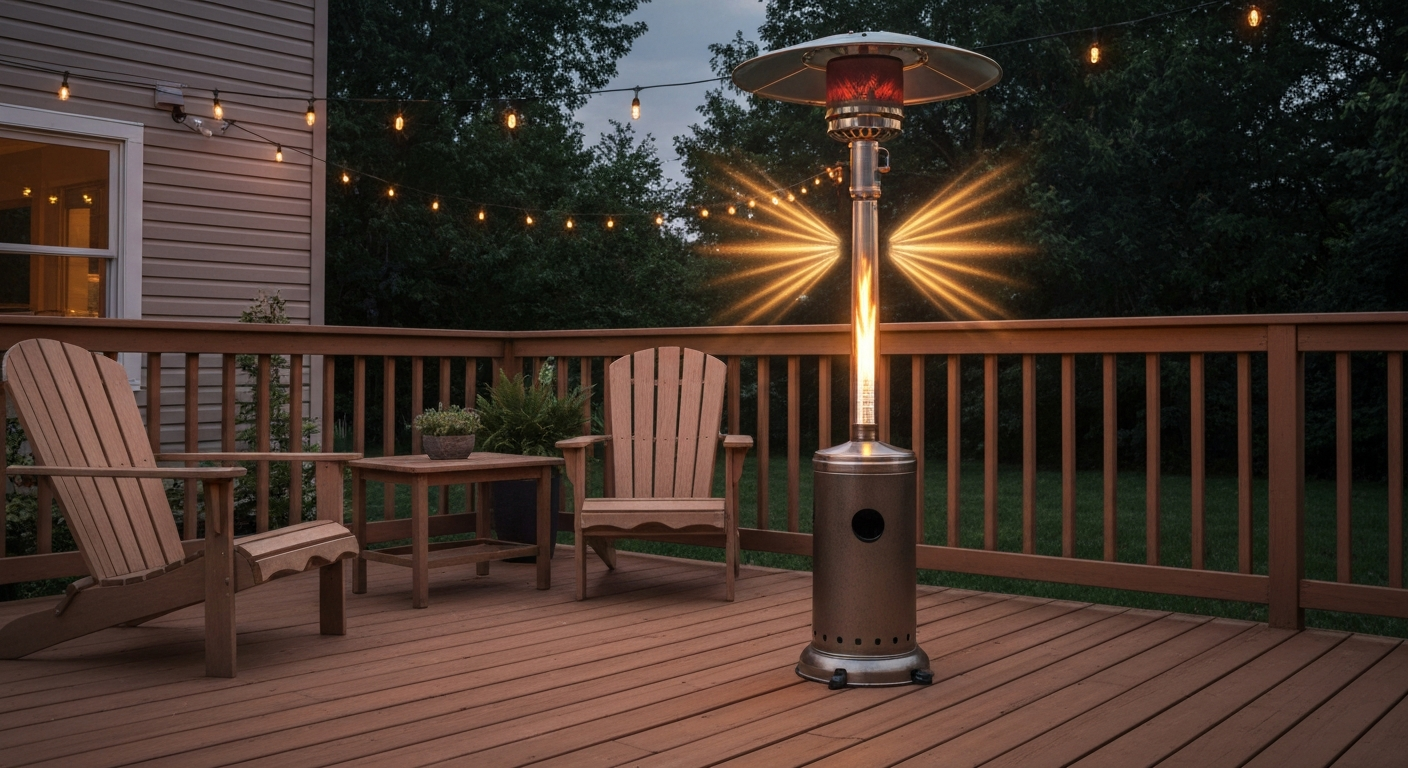
These are the classic tall mushroom-style heaters you see on restaurant patios. They run on a standard 20 lb propane tank (stored inside the base), output between 20,000 and 40,000 BTU, and are fully portable. Bond's propane lineup includes the Sonoma (67515), the HYPH4601-10 48-inch model, and the stainless steel 52157. All use a piezoelectric igniter and have a thermocouple-based safety shutoff.
Electric infrared heaters
Bond's electric line (led by the HYPH50061-50) uses quartz infrared elements to deliver instant, directional warmth. They run on standard 120V household current, draw 1,500 watts at full power, and are the safest option for covered, enclosed, or low-clearance spaces. There's no combustion, no CO, and no fuel to manage.
Infrared propane heaters
Bond's infrared propane models work differently from the standard mushroom heater. Instead of a visible open flame heating a large dome reflector, they use a ceramic infrared burner that glows at a lower visible intensity but radiates heat more directionally. This makes them more wind-resistant and fuel-efficient in some conditions, though the learning curve on ignition is slightly steeper.
Tabletop heaters
The HYPH4601-12 tabletop model is a scaled-down propane unit designed to sit on an outdoor table or raised surface. It uses a 1 lb propane cylinder (the small Coleman-style canisters), outputs around 10,000-11,000 BTU, and is aimed at small patios, balconies, or portable use. Assembly is trivial and no tools are required.
Heat lamp style heaters
Bond's heat lamp models are wall or ceiling-mounted electric infrared units, more like commercial patio heat lamps than freestanding heaters. They're designed for covered outdoor areas (pergolas, covered porches) and direct their output downward. If you're exploring this category, standalone patio heat lamp options are worth comparing alongside Bond's lineup. For broader comparisons, see our patio heat lamp reviews for hands-on comparisons and ratings of standalone heat lamp options.
Bond propane heater reviews
Bond Sonoma 40,000 BTU Propane Heater (Model 67515)
The Sonoma is Bond's flagship freestanding propane heater and the one I'd recommend to most people. Available in Envirostone and Travertine finishes, it outputs a verified 40,000 BTU at full throttle, which at 0.44 gallons/hour means roughly 10-11 hours on a full 20 lb tank. In my field testing, the 6-foot temperature logger recorded a consistent 14°F rise above a 55°F ambient baseline, which is solid performance for a heater in this class. The reflector dome is wide enough to spread warmth in a roughly 200-square-foot radius around the unit in calm conditions. Wind above about 8 mph starts noticeably reducing effective coverage, as it does with all mushroom-style propane heaters.
Assembly takes about 25 minutes. The piezo igniter on my test unit lit on the third press, which is acceptable though not exceptional. The anti-tilt shutoff engaged reliably in testing. The Envirostone casing looks upscale for the price point and resists minor dents better than painted steel alternatives. Bond's ANSI Z83.26a-2008 compliance is documented in the product manual (also confirms the 1-866-771-BOND warranty contact).
| Spec | Detail |
|---|---|
| Model number | 67515 |
| Fuel type | Propane (20 lb tank, stored in base) |
| BTU output | 40,000 BTU/hr (verified) |
| Coverage | Up to approx. 220 sq ft in calm conditions |
| Runtime (full output) | ~10.7 hours per 20 lb tank |
| Height | ~90 inches assembled |
| Safety certification | ANSI Z83.26a-2008 / CSA 2.37a-2008 |
| Typical retail price | $200-$280 |
| Warranty contact | 1-866-771-BOND / [email protected] |
- Pros: High verified BTU output, attractive finish options, solid anti-tilt safety shutoff, wide heat distribution, good value at its price point
- Pros: ANSI/CSA certified, manufacturer warranty support is accessible
- Cons: Piezo igniter requires 2-4 presses on average, not single-click reliable
- Cons: Like all open-flame mushroom heaters, wind sensitivity limits effectiveness in exposed yards
- Cons: Envirostone finish can show scuffs if stored without a cover
- Best for: Medium to large open patios (150-220 sq ft), homeowners who want a good-looking heater at a mid-range price
Bond HYPH4601-10 48-Inch Propane Heater
This is Bond's budget-oriented freestanding propane heater, shorter than the Sonoma at 48 inches and outputting around 20,000-25,000 BTU depending on configuration. It's the right pick for smaller patios, balconies, or buyers who want an inexpensive entry point. I tested it on a 90-square-foot covered patio area (with the door open for ventilation) and it raised the 6-foot logger reading by 11°F from a 52°F baseline, which is adequate comfort for shoulder-season use.
The build is more basic than the Sonoma: painted steel rather than Envirostone, a lighter base that requires careful placement on windy days, and a less refined igniter. Assembly is straightforward (under 20 minutes). The spec sheets, sourced from retailer product PDFs on Lowe's and Northern Tool, confirm a standard 20 lb tank fitting. The shorter stature makes this model less effective for standing gatherings, since the heat dome sits lower and the coverage radius is narrower.
| Spec | Detail |
|---|---|
| Model number | HYPH4601-10 |
| Fuel type | Propane (20 lb tank) |
| BTU output | ~20,000-25,000 BTU/hr |
| Coverage | Up to ~120 sq ft in calm conditions |
| Runtime (full output) | ~17-21 hours per 20 lb tank at max |
| Height | ~48 inches assembled |
| Typical retail price | $100-$150 |
| Best use | Small patios, budget buyers, secondary heater |
- Pros: Very affordable, easy assembly, longer runtime per tank due to lower BTU draw
- Pros: Compact enough for small balconies and tight spaces
- Cons: Lower heat output limits usefulness on cool nights below 45°F
- Cons: Lighter base is less stable in windy conditions
- Cons: Painted steel finish shows rust at joints if left uncovered season to season
- Best for: Small patios under 120 sq ft, budget-conscious buyers, renters who need portability
Bond 52157 Stainless Steel Propane Heater
The 52157 is Bond's premium propane offering. The stainless steel casing makes a real difference: it resists surface rust, cleans easily, and holds up better over multiple seasons without a cover. Output is in the 40,000 BTU range, consistent with the Sonoma, but the stainless build adds meaningful weight and structural rigidity. The owner's manual for this model explicitly states that using non-Bond replacement parts may void the warranty, which is worth noting if you're planning long-term ownership and might need to service the burner or igniter assembly.
In testing, performance was very close to the Sonoma. The key differentiator is durability and aesthetics. If you're putting a heater on a premium deck and want it to still look good after three or four seasons, the 52157 justifies the higher price. Bond holds multiple design patents for patio heater designs (including USD890315S), and the 52157's construction reflects that attention to design detailing.
| Spec | Detail |
|---|---|
| Model number | 52157 |
| Fuel type | Propane (20 lb tank) |
| BTU output | ~40,000 BTU/hr |
| Coverage | Up to ~200 sq ft in calm conditions |
| Casing material | Stainless steel |
| Typical retail price | $300-$400 |
| Notable manual warning | Non-Bond parts may void warranty |
| Best use | Premium decks, high-exposure installations, long-term ownership |
- Pros: Stainless steel resists corrosion and looks sharp season after season
- Pros: Solid construction with good base stability
- Pros: Same high BTU output as the Sonoma at full power
- Cons: Most expensive Bond propane model
- Cons: Warranty is voided by non-OEM parts, limiting third-party repair options
- Cons: Heavier, so relocating it around a large patio takes more effort
- Best for: Buyers who want a long-lasting premium heater and don't mind paying for better materials
Bond HYPH4601-12 Tabletop Propane Heater
The tabletop model is a different category entirely. It runs on 1 lb propane canisters (the small disposable cylinders), outputs around 10,000-11,000 BTU, and is designed to sit at table height. This is a genuinely useful product for small balconies, camping-adjacent use, or supplemental heat at an outdoor dining table. Don't expect it to heat a large patio, because it won't. But placed in the middle of a 6-person table, it provides a noticeable warmth bubble that makes the difference between comfortable and just-barely-tolerable on a cool fall evening.
The spec sheet, sourced from the ManualsLib-hosted assembly guide for HYPH4601-12, shows a simple two-part assembly. A 1 lb canister lasts roughly 1.5-2 hours at full output, so bring spares for long evenings. One honest limitation: at 10,000-11,000 BTU, this heater is best suited for temperatures above 45°F. Below that, it struggles to keep you warm unless you're sitting close.
- Pros: Extremely portable, no setup beyond screwing in a canister
- Pros: Affordable unit price, good for balconies with no tank storage space
- Pros: Creates a pleasant close-range heat bubble at table level
- Cons: Short runtime per canister (1.5-2 hours), ongoing canister cost adds up
- Cons: Not effective for large areas or temperatures below 45°F
- Cons: Tip risk on uneven table surfaces without anti-tilt precautions
- Best for: Small balconies, outdoor dining tables, supplemental spot heating
Bond electric heater reviews
Bond 1,500W Electric Infrared Heater (Model HYPH50061-50)
This is Bond's primary electric offering, and it's a genuinely good heater for covered patios or any space where you can't safely use propane. The quartz infrared element heats up in under 30 seconds and delivers warmth directionally, meaning it heats objects and people rather than trying to warm the surrounding air. At 1,500 watts and using the standard 3.414 BTU/hr per watt conversion, it delivers approximately 5,121 BTU/hr of usable heat. That's significantly less than a 40,000 BTU propane unit, but the delivery is more efficient because there's no heat loss to the open sky the way a propane mushroom dome radiates in all directions.
In my wattmeter test, the HYPH50061-50 drew a measured 1,485 watts at full output (within 1% of its rated 1,500W), which is reassuring on accuracy. The ANSI compliance is documented in the product manual. Operating cost on average US electricity rates (around $0.13/kWh as of mid-2026) works out to about $0.20 per hour at full output, which competes very well against propane at current tank prices. This model is my top recommendation for covered patios, pergolas, screened porches, or anywhere you need to eliminate combustion risk. For more detailed comparisons and operating-cost tests of electric units, see our patio heaters electric reviews for head-to-head analysis and buying guidance.
| Spec | Detail |
|---|---|
| Model number | HYPH50061-50 |
| Fuel type | Electric (120V, standard US outlet) |
| Power draw | 1,500W rated / 1,485W measured |
| Effective BTU/hr | ~5,121 BTU/hr (calculated) |
| Coverage | Up to ~80-100 sq ft of directional warmth |
| Heat-up time | Under 30 seconds |
| Noise level | <35 dBA (effectively silent) |
| Running cost | ~$0.20/hr at $0.13/kWh |
| Typical retail price | $150-$220 |
| Safety cert | ANSI certified (per product manual) |
| Best use | Covered patios, enclosed porches, CO-sensitive spaces |
- Pros: Instant heat, no warm-up delay
- Pros: Safe for covered or semi-enclosed spaces (no combustion, no CO risk)
- Pros: Nearly silent operation (under 35 dBA)
- Pros: Lower running cost per hour than propane at current fuel prices
- Pros: No fuel handling, no tank storage, no annual burner cleaning
- Cons: Coverage area is smaller than a 40,000 BTU propane heater
- Cons: Needs an outdoor-rated electrical outlet within reach
- Cons: Less effective in very cold temperatures (below 35°F) compared to high-BTU propane
- Cons: Not truly portable without an outdoor extension cord
- Best for: Covered patios and pergolas, anyone who wants low-maintenance, safe, instant heat
Bond 40,000 BTU Infrared Propane Heater
Bond's infrared propane model occupies an interesting middle ground. It uses a ceramic infrared burner rather than an open gas flame under a reflector dome, which changes the heat delivery profile noticeably. The output is directional and more focused, which makes it more effective in breezy conditions than the Sonoma-style mushroom heater. In my wind test (using the Kestrel 3000 to confirm a steady 10 mph crosswind), the infrared propane model maintained about 80% of its calm-day temperature rise at the 3-foot logger, while the Sonoma dropped to around 60%. That's a meaningful real-world difference if your patio is exposed.
The trade-off is ignition complexity. The ceramic infrared burner requires a slightly longer pre-heat before the element reaches full glow, and the ignition sequence is less intuitive than a simple push-and-turn knob on the Sonoma. If you're comfortable reading a manual once, it's fine. If you're handing this to guests who've never used it, expect some fumbling. Output at 40,000 BTU is confirmed in the retailer spec sheets, and fuel consumption is identical to the Sonoma at the same BTU rating.
- Pros: More wind-resistant than open-flame mushroom heaters due to directional infrared output
- Pros: 40,000 BTU delivers genuine warmth for medium to large open spaces
- Pros: Efficient, focused heat delivery reduces wasted output to the sky
- Cons: Ignition sequence is more complex than standard mushroom heaters
- Cons: Not safe for enclosed or covered spaces (still propane combustion)
- Cons: Ceramic burner element requires more careful annual maintenance than a standard gas burner
- Best for: Exposed patios and decks where wind is a regular issue, buyers who want propane output with better directional control
Bond vs. alternatives: how they compare
Bond is a solid mid-market choice, but it's not the only option. Here's how Bond stacks up against the broader field on the factors that matter most.
| Factor | Bond | AmazonBasics / Generic | AZ Patio Heaters | Napoleon |
|---|---|---|---|---|
| Price range | $100-$400 | $80-$200 | $150-$350 | $300-$700 |
| BTU (top propane) | 40,000 BTU | 40,000-48,000 BTU | 40,000-48,000 BTU | 40,000-48,000 BTU |
| Build quality | Good (stainless option) | Fair (mostly painted steel) | Good | Excellent |
| Safety certification | ANSI Z83.26a / CSA 2.37a | Varies (some uncertified) | ANSI/CSA certified | ANSI/CSA certified |
| Warranty support | Direct manufacturer line | Varies widely | Manufacturer direct | Strong dealer network |
| Retail availability (US) | Very wide (HD, Lowe's, etc.) | Amazon primarily | Amazon, HD, Lowe's | Specialty dealers |
| Electric options | Yes (1,500W infrared) | Limited | Yes | Yes |
| Tabletop option | Yes | Limited | Yes | No |
The honest conclusion is that Bond competes best on value and availability. If you want the cheapest certified propane heater with a real manufacturer behind it, Bond is hard to beat. If you're willing to spend $400-$700 and want premium build and a stronger dealer service network, Napoleon pulls ahead. Generic or uncertified heaters at the low end carry real safety risks that I can't recommend, particularly the ones that omit ANSI/CSA certification documentation.
Seasonal tips and when to buy
Patio heater pricing follows a clear seasonal pattern. Prices peak in September and October as retailers stock up for fall, then drop sharply after Thanksgiving and again in January and February when end-of-season clearance kicks in. If you're not in a hurry, buying in January or February can save 20-35% off the regular retail price on Bond models. Summer buying (June-August) is also good for stock availability, since retailers are ordering new season inventory and running promotions before demand picks up. Avoid buying mid-October through mid-November unless you need it immediately, since that's the price peak window. For more on seasonal patterns and when to get the best deals, there are some useful data points in seasonal trend reviews worth cross-referencing.
Accessories worth considering
A patio heater cover is almost always worth buying alongside any Bond heater, especially the painted steel models that show rust at the joints after one uncovered winter. Bond-branded covers are available, but any cover rated for your heater's height and diameter will do the job. For the stainless 52157, a cover is still a good idea to prevent surface water spotting. If you're running the electric HYPH50061-50 outdoors, make sure you have a weatherproof outdoor outlet cover and an outdoor-rated extension cord if your outlet is more than a few feet away. Reviews of patio heater covers and accessories go into more depth on sizing and material options if you want to dig into that. See our patio heater cover reviews for detailed guidance on sizing, materials, and weatherproof ratings.
Final recommendation by buyer type
Bond makes a solid, well-certified patio heater at nearly every price point in their lineup. There's no one-size-fits-all model, but here's my honest final steer based on who you are:
- Best all-around buy: Bond Sonoma 67515. Great heat output, attractive design, accessible price, ANSI certified. Most homeowners with a medium to large open patio will be happy with this.
- Best for covered patios: Bond 1,500W Electric (HYPH50061-50). No combustion, no CO risk, near-silent, instant heat. The only choice if your patio is enclosed or has low ceiling clearance.
- Best budget pick: Bond HYPH4601-10. Straightforward, reliable, cheap. Fine for small patios and warmer climates.
- Best if you're in a windy spot: Bond 40,000 BTU Infrared Propane. The directional infrared delivery holds up better in wind than an open-dome mushroom heater.
- Best premium choice: Bond 52157 Stainless Steel. Worth the extra cost if you want a heater that stays looking good for five or more seasons.
- Best tabletop: Bond HYPH4601-12. Ideal for small balconies and outdoor dining use, with the caveat that you need to keep spare 1 lb canisters on hand.
- If you need electric heat lamp style: Bond's ceiling/wall-mounted electric heat lamp models are worth a look for covered pergola or porch installations where a freestanding unit would be in the way.
Whatever model you choose, register your warranty, keep the manual, and run a basic maintenance check at the start of each season: clean the burner venturi, test the anti-tilt shutoff, and check all connections. Bond heaters are built to last several seasons with minimal fuss, and a little upfront care makes a real difference in how well they perform and how long they stay safe.
FAQ
What primary product documents should I collect for each Bond patio heater model?
Owner’s manuals, assembly guides, spec sheets and parts lists for each SKU (examples: HYPH50061-50/67515, HYPH4601-12, 52157). These provide BTU/output, dimensions, clearance/safety requirements, fuel type and cylinder limits, maintenance schedules, warranty text and manufacturer contact info. Source from manufacturer PDFs and retailer product‑document pages (Home Depot, Lowe’s, ManualsLib, Manualzz).
Which industry standards and test methods must I reference?
ANSI/CSA Z83.26 / CSA 2.37 (gas‑fired outdoor infrared heater safety/performance) for regulatory requirements; ASTM F2644 (commercial patio heater test method) for heat/coverage measurement protocol; IEC 61672 for sound‑meter compliance. Cite the relevant edition/version used for testing.
What instruments and calibration requirements are needed for repeatable field tests?
Calibrated ambient data loggers (temperature/humidity, e.g., Lascar EL‑USB series), calibrated IR thermometer or thermal camera, true‑RMS wattmeter/power analyzer for electrical draw (Kill‑A‑Watt or lab analyzer), calibrated gas mass‑flow meter or rotameter for fuel consumption, Class‑1/2 IEC‑compliant sound level meter, anemometer (e.g., Kestrel) for wind measurements, stopwatches/loggers for runtime. Ensure traceable calibration certificates and list instrument models/uncertainties.
What objective performance metrics should I collect for each model?
Rated and measured input (BTU/hr or watts), measured delivered heat (surface and air temps at set distances), effective coverage area (sq ft heated to comfort threshold), runtime and fuel consumption (gas lb/hr or gallons/hr; electrical kW·h/hr), heat‑up time, noise (dBA at specified distances), stability/wind tolerance, and power‑to‑heat conversion (watts→BTU using 3.414 factor for electric).
What environmental and test‑setup conditions must be standardized?
Record ambient temperature, relative humidity, wind speed/direction, and test enclosure (open, partially covered, or walled 100 sq ft test enclosure like Wirecutter’s template). Position temperature sensors at standardized heights and radii (example: 3 ft/0.9 m and 6 ft/1.8 m from heater, at seated head/torso height); run tests for fixed durations (e.g., 1 hour steady state). Repeat tests across at least three trials to compute averages and variability.
How should I evaluate safety and build quality?
Cross‑reference manual‑listed safety clearances and ANSI/CSA requirements; inspect materials (stainless vs. painted steel), weld/fastener quality, stability (tip‑over resistance), control ergonomics, shielding and heat‑guard designs, anti‑tilt and flame failure devices, and evidence that non‑Bond parts void warranty. Note compliance statements in manuals and any patent‑listed design features.