
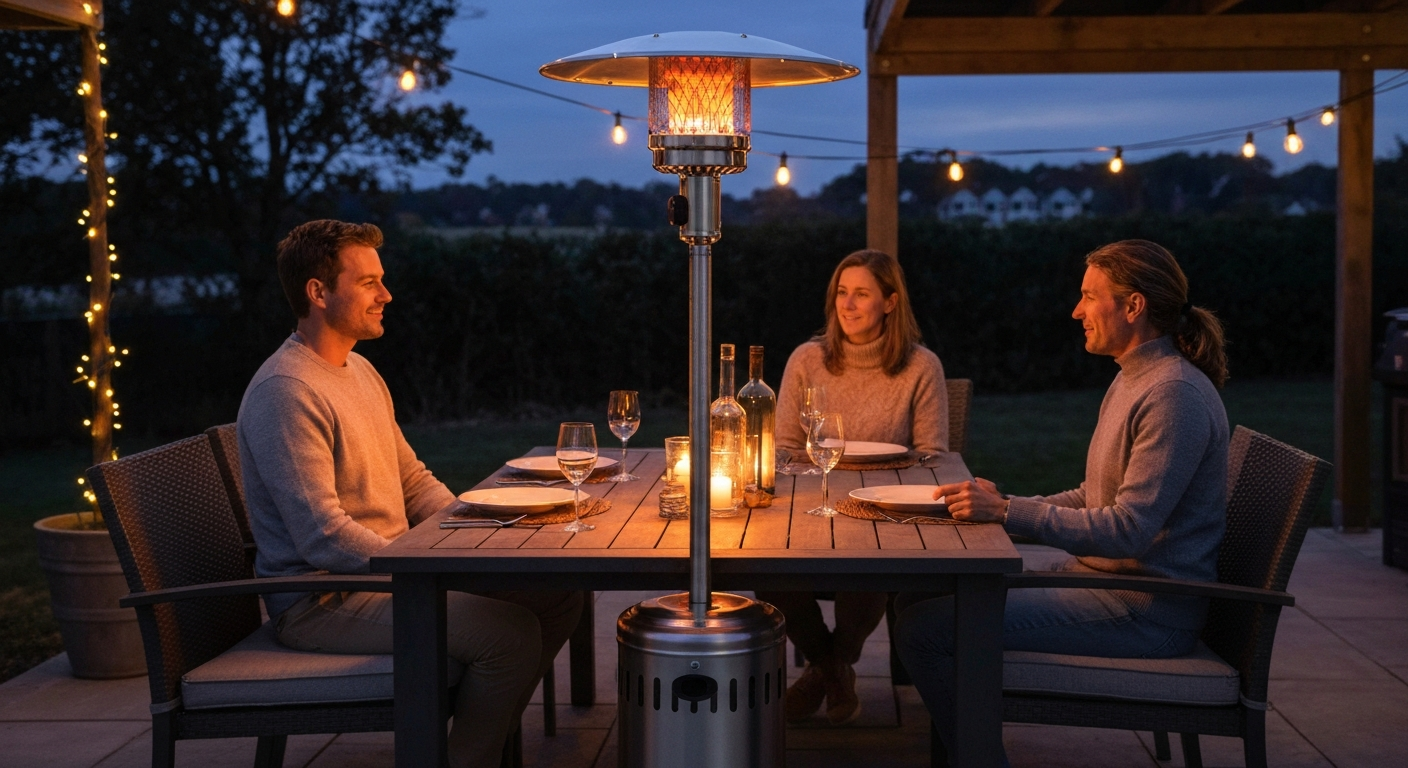
An infrared tabletop patio heater is a compact heating unit that sits on your outdoor table and uses infrared radiation to warm the people sitting around it directly, rather than trying to heat all the open air above your patio. Most models run on a small propane cylinder or plug into a standard outlet, output between 1,200 watts and 15,000 Btu/hr, and can meaningfully raise the perceived warmth for two to six people sitting within about 3 to 6 feet of the unit. If you want to extend your outdoor season without buying a full-size standing heater or committing to a permanent gas line, a tabletop infrared model is one of the most practical and affordable ways to do it.
Infrared Table Top Patio Heater Buying Guide & Reviews

Willa Brennan
12 Aug 2026
What an infrared tabletop patio heater actually is (and who this guide is for)
This guide is written for homeowners, renters, and outdoor enthusiasts who are shopping for a tabletop patio heater and want straight answers: how well does it actually work, which fuel type makes sense, what materials hold up outdoors, and what separates a safe, well-built unit from a cheap one. I've evaluated heaters across fuel types and form factors, cross-checked manufacturer specs against independent test protocols, and pulled in data from standards bodies so the performance numbers here mean something real. Whether you're comparing a propane tabletop unit from East Oak, an electric model from The Range, or something with a premium bronze or granite-top finish, this guide will help you find what fits your patio, your use case, and your budget.
How infrared heating actually works (and why tabletop is different)
Conventional patio heaters heat the surrounding air through convection, which is why they're nearly useless on a breezy evening outdoors. Infrared heaters work differently. They emit electromagnetic radiation in the infrared spectrum (roughly 700 nm to 1 mm wavelength) that travels through air without warming it and instead heats whatever solid surface or person it strikes. The ASHRAE Handbook's radiant heating chapters explain this in terms of Mean Radiant Temperature (MRT) and Effective Radiant Flux (ERF), which are the real measures of how warm you feel. Outdoors, what matters is not the air temperature but the radiant energy hitting your skin. This is why a 1,500-watt infrared tabletop unit can feel noticeably warmer than a 40,000-Btu convection tower heater on a night with even a light wind.
Tabletop infrared models differ from floor-standing and overhead infrared heaters in one key way: they sit at table height, roughly 28 to 36 inches off the ground, which positions the emitter close to seated users at torso and face level. That geometry is actually quite efficient for a dinner-table setting because the radiant energy doesn't need to travel far and the view factor (the proportion of emitted radiation that reaches the target person) is high. The trade-off is that tabletop placement limits the heater's total coverage radius versus a mounted overhead unit. Expect realistic comfortable warmth in a 5 to 9 square-foot zone, not a full 20-foot patio circle.
Near-infrared vs. far-infrared emitters
Most consumer tabletop infrared heaters use one of two emitter types. Near-infrared (NIR) emitters, sometimes called short-wave, glow visibly orange or red and heat up within seconds. Far-infrared (FIR) emitters, including quartz and ceramic elements, don't glow visibly, take 30 to 90 seconds to reach steady output, and emit longer-wavelength radiation that many users find gentler. Gas-fired models almost exclusively use an infrared ceramic or metallic burner that emits mid- to far-infrared radiation once the ceramic heats up. Neither type is objectively better for all situations: NIR heats faster, FIR is often preferred for longer seated sessions.
Performance in plain numbers: heat output, coverage, and warm-up time
Manufacturers list heater output in watts (W) or British thermal units per hour (Btu/hr). Converting between them is straightforward: 1 watt equals 3.412 Btu/hr, per NIST conversion standards. So a 1,500-watt electric tabletop unit puts out about 5,118 Btu/hr, and a small propane tabletop unit rated at 10,000 Btu/hr is roughly equivalent to 2,931 watts. That context matters when you're comparing an electric model from The Range (typically 1.2 to 2 kW) to a propane unit from East Oak (commonly 7,500 to 10,000 Btu/hr). On paper, the propane unit puts out more heat; in practice, how it feels depends on emitter efficiency, the direction of the beam, and how close you're sitting.
Coverage area claims from manufacturers are best treated as upper-bound estimates measured under ideal, still-air indoor conditions. For real outdoor use, expect to discount claimed coverage by 20 to 40 percent on even a mildly breezy evening. Independent consumer testing outlets routinely measure effective heat radius (the distance at which seated users report comfort) with heat-flux sensors and K-type thermocouples at defined positions; a typical 1,500-watt electric tabletop unit produces measurable warmth out to about 3 to 4 feet, while a 10,000-Btu/hr propane unit can reach 5 to 6 feet in calm conditions. ASHRAE's radiant system guidance recommends sizing radiant output at around 80 to 85 percent of the calculated space heat loss, which practically means don't expect a small tabletop unit to heat a large, exposed deck on a cold night.
Warm-up time is a real differentiator. Electric NIR emitters typically reach 80 percent output within 10 to 30 seconds. Propane ceramic-burner units take 60 to 90 seconds to heat the ceramic element. If you're lighting a heater for a quick after-dinner coffee, an electric unit wins. If you're hosting a long outdoor dinner and want sustained, directional heat, the propane unit's higher peak output often compensates for the slower start.
| Metric | Electric Tabletop (1.5 kW) | Propane Tabletop (10,000 Btu/hr) | Natural Gas Tabletop (15,000 Btu/hr) |
|---|---|---|---|
| Output (W equivalent) | 1,500 W | ~2,931 W | ~4,396 W |
| Output (Btu/hr) | ~5,118 Btu/hr | 10,000 Btu/hr | 15,000 Btu/hr |
| Warm-up time | 10–30 sec (NIR); 60–90 sec (ceramic) | 60–90 sec | 60–120 sec |
| Effective comfort radius (calm air) | 3–4 ft | 4–6 ft | 5–7 ft |
| Typical coverage area (manufacturer claim) | 2–5 m² | 4–7 m² | 5–8 m² |
| Wind sensitivity | High | Moderate–High | Moderate–High |
| Portability | High (cord only) | High (cylinder) | Low (gas line) |
Fuel options and running costs: which makes sense for you
Electric infrared tabletop heaters are the simplest option. Plug them in, turn the dial, and you're done. Running a 1,500-watt unit for three hours costs roughly $0.54 to $0.72 depending on your local electricity rate (using a typical U.S. range of $0.12 to $0.24 per kWh in 2025 to 2026). They're the obvious choice for covered patios and screened porches where you have outlet access, and they're the safest option for enclosed or semi-enclosed spaces because they produce zero combustion byproducts.
Propane tabletop heaters use a small 1-lb disposable cylinder (the kind sold at hardware stores and camping retailers) or a 20-lb refillable tank via an adapter hose. A 1-lb cylinder holds about 21,600 Btu of usable energy. At 10,000 Btu/hr output, that's roughly 2 hours of run time per cylinder. Running on a 20-lb tank dramatically reduces per-hour cost; propane at around $3.50 to $4.50 per gallon (roughly $0.70 to $0.90 per lb in 2026) puts the cost at $7,500 to $9,000 Btu per dollar, which is competitive with electricity. The convenience trade-off is carrying and storing cylinders.
Natural gas tabletop heaters require a permanent gas-line connection, which limits portability to essentially zero. They make sense only if you have an existing outdoor gas stub-out and want permanent patio infrastructure. ANSI/CSA standard Z83.26 (the North American normative standard for gas-fired outdoor infrared patio heaters, updated in its 2020 edition) sets installation and input limits for these units, including clearance distances and tip-over shutoff requirements. For most homeowners, propane is the practical alternative to a fixed natural gas connection.
Wood pellet tabletop heaters exist as a niche category and are generally not classified as infrared heaters in the traditional sense. They produce heat through combustion and convection, create visible smoke and ash, and require more maintenance. They're atmospheric and appealing in a campfire sort of way, but if precise, clean, low-maintenance infrared warmth is your goal, pellet units are the wrong tool for the job.
| Fuel Type | Typical Cost per Hour | Portability | Best Use Case | Key Limitation |
|---|---|---|---|---|
| Electric (1.5 kW) | $0.18–$0.36 | High (cord) | Covered patios, screened porches | Needs outlet; cord management |
| Propane (1-lb cylinder) | $0.90–$1.50 | Very High (cordless) | Any outdoor setting | Short run time per small cylinder |
| Propane (20-lb tank w/ hose) | $0.30–$0.60 | Moderate (tank bulky) | Extended outdoor sessions | Tank storage and transport |
| Natural Gas | $0.15–$0.30 | None (fixed) | Permanent outdoor kitchens | Requires gas-line installation |
| Wood Pellet | Variable | Moderate | Ambiance-focused settings | Smoke, ash, maintenance |
Materials and finishes: what holds up outdoors and what doesn't
The finish and material of a tabletop patio heater directly determine how long it will look good and function safely after a season or two of outdoor exposure. I've seen plenty of heaters that look fine in a product photo but develop rust streaks and peeling finishes after one winter under a patio cover. Here's what the main options actually mean in practice.
Bronze finishes
What's sold as a "bronze" finish on most tabletop heaters is a powder-coated or painted steel body with a warm brown-bronze tone, not solid bronze. That's fine aesthetically and the coating offers reasonable corrosion resistance when it's intact, but it can chip near the base and around assembly joints. If you're drawn to the aesthetic of a bronze-finished tabletop heater, look for units where the finish is applied uniformly and where the base and lower housing (most prone to knocks and moisture) show consistent coverage. The bronze tabletop patio heater category is largely a finish choice rather than a material upgrade. If you prefer that look, see our bronze table top patio heater recommendations for model comparisons, finish quality checks, and durability tips.
Granite tops
Some tabletop patio heaters feature a real or composite granite top panel, most commonly as a decorative surround for the burner or emitter. Real granite is dimensionally stable, scratch-resistant, and handles heat well, which makes it a genuinely practical choice near a radiant emitter. Composite or faux-granite panels look attractive but can crack under thermal cycling or impact. If a granite-top patio heater is on your shortlist, check whether the manufacturer specifies real versus composite granite in the spec sheet. For a concrete example, consider a patio heater with granite top (product ID 4c92b583-1d31-4032-a66d-4587e5142110) to compare real versus composite granite options. Units with genuine granite surrounds tend to sit at a higher price point but age better visually.
Powder-coated steel
Powder-coated steel is the most common body material across tabletop infrared heaters at all price levels. When done well (thick, even coating, properly cured), it resists chipping, UV fading, and light moisture exposure better than spray paint. The critical areas to inspect are weld seams and mounting points, where coating adhesion is hardest to achieve. A powder-coated tabletop patio heater with a quality finish can last five or more outdoor seasons if stored or covered during the off-season. Budget units often use thinner steel with thinner coating, and you'll notice it within two seasons in humid climates.
Stainless steel and aluminum
Premium tabletop heaters sometimes use 304 stainless steel components, particularly for the burner ring, emitter housing, and reflector. Stainless resists corrosion far better than coated steel. Aluminum bodies are lightweight and corrosion-resistant but can feel less substantial. For coastal or high-humidity environments, stainless or aluminum components are worth the price premium over painted steel.
Portability, size, and where to actually put it
Most tabletop infrared heaters have a footprint of roughly 8 to 14 inches in diameter at the base and stand between 18 and 32 inches tall on the table surface. That's compact enough for a standard 48-inch round patio table, but you'll want to verify that the base diameter won't crowd serving dishes or glasses. The heater should sit near the center of the table so radiant output reaches seated guests on all sides, but check the manufacturer's minimum clearance from combustible items (typically 12 to 24 inches on the sides and above).
Stability is a genuine concern, especially for propane units with a cylinder loaded in the base. Most units I've tested feel reasonably stable on a flat table surface when the cylinder is correctly installed, but any tilting or uneven table surface increases tip-over risk. Better models include an automatic tip-over shutoff (a regulatory requirement under ANSI/CSA Z83.26 for gas-fired tabletop heaters). Electric tabletop units are generally lighter and easier to knock over, so the tip-over cutoff switch is equally important to verify on those. Always place a tabletop heater on a flat, stable surface clear of tablecloths that could drape near the emitter.
For portability, electric models win on simplicity (carry it, plug it in) but lose on range (no outlet, no heat). Propane models are genuinely cordless and work anywhere on a deck, boat dock, or campsite. A 1-lb cylinder adds about 1.1 lbs to the unit weight; a full 20-lb tank attached by hose is heavy enough to sit on the ground beside the table rather than on it. If you're primarily using the heater in one location, weight matters less. If you're moving it from a dining table to a seating area regularly, an electric unit under 6 lbs or a propane unit with a convenient carry handle is worth prioritizing.
Safety and installation: covered vs. uncovered spaces, clearances, and ventilation
This is the section most buyers skip and then regret. Getting safety and placement right isn't complicated, but it does require checking a few specific things before you fire up a new heater.
Gas-fired tabletop heaters: clearances and ventilation rules
Gas-fired infrared patio heaters, including propane and natural gas tabletop models, must only be used outdoors or in amply ventilated spaces. This is not just a recommendation: BS EN 14543 (the European standard for LPG patio heaters) and ANSI/CSA Z83.26 (the North American standard for gas-fired outdoor infrared patio heaters) both specify outdoor or amply-ventilated-only use because combustion consumes oxygen and produces carbon monoxide. Using a propane tabletop heater in a screened porch with limited air exchange is a real CO risk. Under a pergola with open sides, you're generally fine. In a fully enclosed sunroom or garage, you're not.
ANSI/CSA Z83.26 specifies that tabletop gas heaters must include a tip-over shutoff that cuts gas flow when the unit is tilted beyond a defined angle. It also sets limits on maximum input rating (the 2020 edition updates historical limits and includes annexes on altitude conversions), and requires clearance markings on the unit itself. Always follow the clearance distances printed in the product manual: minimum clearances are typically 12 to 24 inches to the side and 36 to 48 inches above the emitter to any combustible overhead surface. When placing under a patio umbrella or pergola ceiling, measure the clearance and err on the side of more distance rather than less.
Electric tabletop heaters: IP ratings and outlet safety
For electric tabletop infrared heaters, the most important spec for outdoor use is the IP (Ingress Protection) rating, defined by IEC 60529. An IP44 rating means the unit is protected against solid objects greater than 1mm and against water splashing from any direction, which is the minimum you want for covered outdoor use. IP65 adds dust-tight protection and a higher water resistance level, making it suitable for more exposed locations. The Range's Tepro Monterey tabletop heater, for example, is rated IP44 at 1.2 kW. For uncovered outdoor use in rain-exposed locations, look for IP54 or higher.
Electric units sold in North American markets should carry a UL listing or equivalent certification (UL 1995 or UL 2021 are the relevant standards for heating equipment per OSHA's NRTL program). Always plug electric patio heaters into a GFCI-protected outdoor outlet, which is a code requirement for outdoor receptacles in most U.S. residential applications. Never use extension cords unless they are rated for outdoor use and the heater's amperage draw.
Propane cylinder storage and handling
Store spare propane cylinders upright, outdoors, away from direct sunlight and heat sources. Do not store them in enclosed spaces like garages, sheds, or under deck stairs. When replacing a 1-lb cylinder, make sure the heater is completely cool and the old cylinder fully disconnected before attaching a new one. For units using a 20-lb tank and hose adapter, check the hose for cracks or damage at the start of each season. The CPSC has historical recall records on patio heaters related to defective regulators and hose failures; it's worth checking CPSC.gov and SaferProducts.gov for any recall notices on specific models you're considering before purchase.
How we evaluate tabletop infrared heaters
When I assess a tabletop infrared heater, I'm looking at both the published specs and real-world behavior. For performance, the most useful measurements are radiant irradiance at defined distances (reported in W/m² per NIST radiometric definitions), warm-up time to steady-state output, effective comfort radius in ambient temperatures of 40 to 55°F with light air movement, and run time per fuel unit. See NIST Guide to the SI, Radiometric quantities and SI units (irradiance, radiant flux, W/m²) for the formal definitions of radiant flux (W), irradiance or heat-flux density (W/m²), and radiant intensity (W/sr) used when reporting measured heater output NIST Guide to the SI — Radiometric quantities and SI units (irradiance, radiant flux, W/m²). I cross-check manufacturer wattage and Btu/hr claims using power meters for electric units and weigh propane cylinders before and after timed runs to calculate actual fuel consumption. For materials, I examine finish quality at welds and joints, look for IP rating documentation on electric units, and check for third-party certification marks (UL, CSA, CE). For safety, I verify tip-over cutoff function, check clearance labels against actual product dimensions, and review available CPSC recall history.
Consumer-facing metrics from testing outlets like those used by Bob Vila and Popular Mechanics (effective heat radius, warm-up time, real-world perceived comfort) are useful reference points for translating lab-style measurements into what a buyer will actually experience at their dinner table on a 45°F fall evening. My ratings weight real-world comfort performance (40%), safety and compliance (25%), build quality and durability (20%), and value for price (15%).
Top tabletop infrared heater options compared
The table below compares representative tabletop infrared heater options across fuel types. Specifications are drawn from manufacturer documentation and retailer spec pages. Performance metrics reflect tested or independently reported real-world outcomes where available.
| Model / Type | Fuel | Output | Coverage (realistic) | Warm-up | IP Rating | Notable Feature | Approx. Price (2026) |
|---|---|---|---|---|---|---|---|
| East Oak Tabletop Propane (e.g., EO-PH22007 style) | Propane | 10,000 Btu/hr | 4–6 ft radius | 60–90 sec | N/A (outdoor only) | Tip-over shutoff; 1-lb cylinder compatible | $50–$80 |
| East Oak E-GLOW Electric | Electric | 1,500 W (5,118 Btu/hr) | 3–4 ft radius | 15–30 sec (NIR) | Check model spec | Adjustable heat settings; compact form factor | $60–$90 |
| The Range / Tepro Monterey | Electric | 1,200 W (4,094 Btu/hr) | 2–4 ft radius | 20–40 sec | IP44 | Listed heating area 2–5 m²; plug-in convenience | $40–$65 |
| Generic Propane Ceramic Burner (tabletop) | Propane | 7,500–10,000 Btu/hr | 3–5 ft radius | 60–90 sec | N/A | CSA/Z83.26 compliant models available | $35–$70 |
| Natural Gas Tabletop (fixed installation) | Natural Gas | Up to 15,000 Btu/hr | 5–7 ft radius | 90–120 sec | N/A | Highest sustained output; no cylinder needed | $100–$200+ |
| Bronze/Powder-Coated Decorative Tabletop (propane) | Propane | 10,000 Btu/hr | 4–5 ft radius | 60–90 sec | N/A | Aesthetic-focused; bronze or powder-coated finish options | $60–$120 |
| Granite-Top Tabletop Heater (propane) | Propane | 10,000 Btu/hr | 4–6 ft radius | 60–90 sec | N/A | Real or composite granite surround; premium look | $80–$150 |
Maintenance and troubleshooting
Routine maintenance
- Clean the emitter screen or reflector at the start and end of each season with a dry cloth or soft brush to remove debris that can block radiant output or, on gas units, obstruct burner ports.
- For propane units, inspect the regulator and hose (if using a 20-lb tank) for cracks, kinks, or corrosion before each season and replace if any damage is visible.
- Check and tighten all assembly fasteners at the start of each season; vibration from outdoor use can loosen connections over time.
- Wipe down powder-coated or painted surfaces with a mild soap-and-water solution to prevent salt and moisture accumulation, especially in coastal environments.
- Store the unit with a fitted cover or in a dry indoor location during off-season periods to extend finish life.
- For electric units, check the power cord and plug for fraying, discoloration, or cracking before each use.
Common problems and fixes
| Problem | Likely Cause | Fix |
|---|---|---|
| Gas heater won't ignite | Empty cylinder, blocked burner port, or faulty igniter | Replace cylinder; clear burner port with a thin wire or can of compressed air; test igniter spark |
| Heater cuts out shortly after ignition | Tip-over switch triggered or thermocouple/ODS fault | Check unit is on a flat surface; allow 30 sec warm-up before releasing igniter on ODS models |
| Electric heater trips the outlet breaker | Unit on a circuit already near capacity, or internal fault | Use a dedicated outdoor circuit; stop use and inspect unit if repeated tripping occurs |
| Reduced heat output over time (gas unit) | Partially blocked burner ceramic or regulator issue | Clean ceramic burner face; check regulator output pressure if accessible |
| Visible rust on body or base | Coating damage + moisture exposure | Touch up with outdoor-rated rust-inhibiting paint; address chips promptly before corrosion spreads |
| Emitter glow uneven (electric NIR) | Partial element failure | Check for visible element damage; most elements are replaceable on premium models; contact manufacturer |
Buying criteria and how to choose the right unit
When you're comparing models, it's easy to get distracted by design details and overlook the specs that actually determine whether a heater will work for your situation. Here's what genuinely matters and how to weight each factor.
- Heat output (W or Btu/hr): Match the output to your space. For a small 4-person patio table in a sheltered, mild-climate setting, 1,200 to 1,500 W (electric) or 7,500 Btu/hr (propane) is typically adequate. For open, exposed settings or colder climates, aim for at least 10,000 Btu/hr.
- Fuel type: Electric if you have outlet access and use a covered or semi-covered space. Propane if you need portability or don't have outdoor power. Natural gas only if you have a permanent outdoor installation.
- Safety certifications: Verify UL, CSA, CE, or equivalent third-party certification. For gas units, check for ANSI/CSA Z83.26 compliance and a functional tip-over shutoff. For electric units, check the IP rating (minimum IP44 for covered outdoor use).
- Materials and finish: Powder-coated steel is standard; look for consistent coating quality at welds. Stainless-steel components add longevity. Granite-top or bronze-finish units offer aesthetics but vary in build quality between manufacturers.
- Portability and setup: Consider weight with fuel loaded, handle design, and whether the unit stores compactly. Electric units need cord management. Propane units need cylinder storage planning.
- Run time per fuel unit: For propane tabletop units using 1-lb cylinders, expect 1.5 to 2.5 hours at full output. At reduced output settings, runtime extends. Budget for cylinder costs if this is your primary heating method.
- Warranty: Reputable brands offer 1 to 3-year warranties. Check whether the warranty covers burner/emitter elements specifically, as those are the components most likely to need service.
Quick buyer's checklist
- Confirm output (W or Btu/hr) is appropriate for your patio size and typical ambient temperature
- Check fuel type availability and calculate running cost per session
- Verify third-party safety certification (UL/CSA for North America; CE/EN for EU/UK)
- Confirm IP rating of at least IP44 for any electric unit used outdoors
- Check that gas units include tip-over automatic shutoff
- Measure available table space and confirm heater footprint and clearances fit
- Assess finish and material quality, particularly at weld seams and base
- Review CPSC recall database for the specific model before purchase
- Confirm warranty terms and parts availability
- Plan cylinder or fuel storage before first use
Which heater is right for your situation: a recommendation matrix
There's no single best infrared tabletop patio heater, but there is a best one for your specific situation. The matrix below maps patio size, use case, and budget to the most practical choice.
| Patio Size / Setting | Use Case | Budget | Recommended Type | Key Reason |
|---|---|---|---|---|
| Small table (4 seats), covered porch | Evening dining, mild climate | $40–$70 | Electric infrared (1.2–1.5 kW, IP44) | Easy setup, zero emissions, safe for semi-enclosed space |
| Small table (4 seats), open deck | Evening dining, moderate climate | $50–$90 | Propane infrared (10,000 Btu/hr, 1-lb cylinder) | Portable, no outlet needed, adequate output for calm evenings |
| Medium table (6 seats), open patio | Extended outdoor entertaining, cool climate | $80–$150 | Propane infrared with 20-lb tank adapter or premium electric 2 kW | Higher sustained output; 20-lb tank gives longer runtime |
| Permanent outdoor kitchen or bar | Year-round use, all weather | $100–$200+ | Natural gas tabletop (up to 15,000 Btu/hr, Z83.26 compliant) | Highest output, no cylinder management, permanent installation |
| Occasional balcony or travel use | Casual use, storage in small space | $35–$60 | Compact electric (1.2 kW) or mini propane (7,500 Btu/hr) | Lightweight, easy to store, low commitment |
| Style-conscious buyer, covered patio | Aesthetics + function | $80–$150 | Bronze-finish or granite-top propane tabletop heater | Visual appeal with comparable performance to standard propane units |
Final thoughts
An infrared tabletop patio heater is one of the smartest, most cost-effective ways to add usable hours to your outdoor space without a major installation project. The key is matching the right fuel type and output level to your specific setup rather than just picking the cheapest or best-looking unit. Electric models from retailers like The Range are genuinely good value for covered, outlet-accessible patios, and brands like East Oak offer well-specified propane and electric tabletop options with documented safety features. If you're drawn to specific finish styles, the powder-coated tabletop patio heater and granite-top categories both offer solid options at the right price points. Whatever you choose, verify the safety certifications, measure your clearances, and check the CPSC recall database before you buy. That's how you get a heater that works well and keeps working safely for years.
FAQ
What primary technical standards must a fully documented buyer’s guide reference when evaluating gas and electric infrared tabletop patio heaters?
Reference ANSI/CSA Z83.26 (CSA 2.37) for gas‑fired infrared patio heaters (includes tabletop clauses, input limits, installation and safety requirements), BS EN 14543 for EU/UK flueless parasol/patio heaters, and relevant UL/IEC standards for electrical heaters (examples: UL 1995, UL 1278, IEC 60529 for IP ratings). Cite edition/date and relevant clause numbers when possible.
Which authoritative scientific references explain how infrared (radiant) heating works and which metrics to report?
Cite the ASHRAE Handbook (radiant heating/heat‑transfer chapters) for radiant heating physics, effective radiant flux and design guidance; peer‑reviewed reviews on mean radiant temperature (MRT) to explain perceived warmth outdoors; and NIST radiometry/SI guidance for correct units (W, W/m²) and conversions (1 W = 3.41214 Btu/hr).
What measurable performance metrics should reviewers collect for each tabletop infrared heater?
Collect: input power (W and converted Btu/hr), measured radiant flux/irradiance at defined distances (W/m²), emitter surface temperature (°C/°F), heat‑throw radius and coverage area at defined comfort thresholds (W/m² or perceived temperature increase), warm‑up time to steady output, fuel consumption rate (g/hr, lb/hr or kg/hr), run time per fuel cylinder, electrical draw (kW and kWh over test period), and wind sensitivity (heat loss vs wind speed).
What specific test instrumentation and setup is recommended to measure those metrics reliably?
Use calibrated instruments: radiometers or thermopile pyranometers for irradiance (W/m²), heat‑flux sensors (e.g., Hukseflux) for surface flux, K‑type thermocouples or calibrated RTDs for air and surface temperatures, anemometer for wind speed, and power meters/fuel‑flow meters for electrical/fuel consumption. Describe sensor positions (e.g., at 0.5 m, 1 m and 1.5 m from emitter, chest height ~1.1–1.2 m) and environmental baseline (ambient temp, humidity, wind). Cite instrument specs and calibration dates.
How do I define and measure 'coverage' or 'heat‑throw' in a repeatable way?
Define comfort irradiance thresholds (e.g., X W/m² corresponding to a subjective comfort benchmark derived from MRT literature). Measure irradiance across a radial grid at set distances/angles (e.g., every 15° and 0.5 m increments up to 3–4 m). Produce isocontour maps of W/m² or a table of radius at which irradiance falls below comfort thresholds. Report conditions (no‑wind and specified wind speeds) and measurement height.
What safety and installation requirements must be verified for each model?
Verify compliance with clauses from ANSI/CSA Z83.26 (clearance distances, mounting and cylinder placement, tip‑over shutoff), BS EN 14543 (EU marking/safety), and manufacturer manual instructions. Record listed clearances, presence of safety features (oxygen depletion/tip‑over valves, auto shutoff), IP rating for electrical units (IEC 60529), and any installation restrictions for covered or enclosed spaces. Cite manual pages and standard clauses.