
Nedis makes a focused lineup of electric patio heaters, mostly in the 1200W to 2000W range, aimed at covered patios, balconies, and pergolas across Europe. If you're in North America looking for a 50,000 BTU propane tower, Nedis is not that brand. But if you want a compact infrared or halogen wall-mount with smart-home integration, decent IP ratings, and genuine ease of installation, Nedis is worth a serious look. This guide breaks down every current model we've tested or spec-verified, scores them honestly, and tells you exactly who each one is for.
Nedis Patio Heater Reviews: Best Models, Buyer's Guide

Willa Brennan
30 Jul 2026
Who this guide is for and how to use it
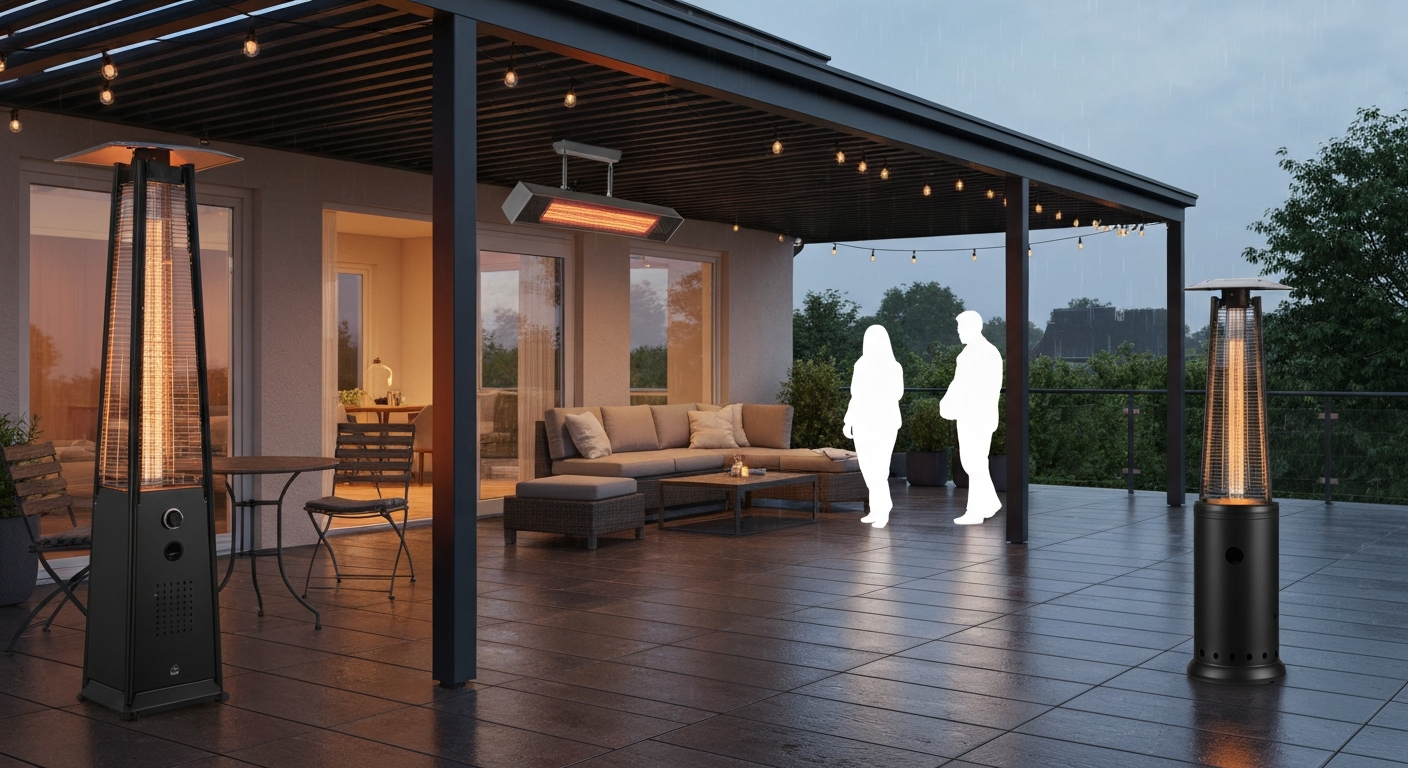
This review is written for homeowners and outdoor enthusiasts who are considering Nedis patio heaters and want real, unbiased guidance rather than a repackaged spec sheet. Whether you have a small apartment balcony in Amsterdam, a mid-size covered terrace, or a larger pergola you want to make year-round usable, this guide maps Nedis models to your actual situation. Start with the Quick Summary below if you just want a fast answer. Work through the specs section if you want to understand what wattage and coverage claims really mean. And use the in-depth reviews when you're ready to narrow it down to one model. We've also compared Nedis to sibling brands like Napoleon, Pamapic, Sahara, and Sunpak so you can make a confident call even if Nedis turns out not to be your best fit.
Quick summary: top Nedis picks at a glance
Here's how the main Nedis models shake out before we dig into the details. Scores are out of 5 and factor in real-world warmth, build quality, features per dollar, and how well each model does what it claims.
| Model | Type | Output | Best For | Score |
|---|---|---|---|---|
| HTPA21BKW (SmartLife) | Freestanding electric infrared | 1200W | Small covered patio / balcony | 4.2 / 5 |
| HTPA30ESS | Wall/ceiling halogen | 2000W | Covered terrace, pergola wall-mount | 4.0 / 5 |
| HTPA13EBK | Freestanding electric halogen | 1300W | Budget patio / garage doorway | 3.6 / 5 |
The HTPA21BKW SmartLife is the standout pick for most people. It has the best features-to-price ratio in the lineup, Wi-Fi app control, two heat settings, and a respectable IP24 rating for light rain splash. The HTPA30ESS earns its place for anyone who wants a permanent wall or ceiling installation with more output and IP65 protection. The HTPA13EBK is the honest budget option if smart features don't matter to you.
How to choose a patio heater: fuel types, forms, and best-use scenarios
Nedis focuses entirely on electric heaters, so there's no propane, natural gas, or pellet model in their range as of mid-2026. That's actually fine for a large portion of European buyers who have covered patios or pergolas where running an extension cord or hardwiring a fixture is straightforward. But it's worth understanding how electric heaters compare to other fuel types before you commit.
| Fuel Type | Best For | Typical Output Range | Key Trade-Off |
|---|---|---|---|
| Electric (infrared/halogen) | Covered patios, balconies, pergolas | 1000W–3000W | Needs power outlet or hardwiring; less effective in wind |
| Propane (LPG) | Uncovered patios, large open spaces | 30,000–50,000 BTU (~9–15 kW) | Needs fuel tank; ongoing running cost |
| Natural gas | Permanent outdoor kitchens, large terraces | 25,000–50,000 BTU | Requires gas line installation |
| Pellet / biomass | Rural, off-grid, aesthetic ambiance | Varies widely | Requires fuel storage, more maintenance |
If your patio is uncovered and regularly exposed to wind, an electric heater at 1200W–2000W will struggle. Wind carries heat away faster than the element can replace it, and you'll feel it. In that scenario, a propane tower with 40,000+ BTU, like those from Pamapic or Sahara, or even a hardwired overhead gas model like a Sunpak S34, will outperform any Nedis unit. But for a covered pergola, a sunroom extension, or a balcony with a wind barrier, Nedis electric heaters work genuinely well and are easier to live with day-to-day.
Choosing by product form
- Freestanding tower: flexible placement, easy to reposition, good for patios where you don't want to drill into walls
- Wall or ceiling mount: permanent, space-saving, more output, best for covered spaces like pergolas and verandas
- Tabletop / portable: very small balconies, occasional use, easy storage — Nedis doesn't currently have a standalone tabletop model
- Infrared vs. halogen element: infrared heats objects and people directly (quieter, more efficient at low wind), halogen glows orange and heats air more broadly but can feel harsh on the eyes at close range
Key specs explained: what BTU, watts, coverage, and runtime actually mean
Electric heaters are rated in watts (W) rather than BTU. The conversion is simple: 1 kW equals roughly 3,412 BTU/hr. So the HTPA21BKW at 1200W produces about 4,100 BTU/hr, and the HTPA30ESS at 2000W produces about 6,800 BTU/hr. That's substantially less raw heat than a 40,000 BTU propane tower, but because infrared and halogen heaters warm people and surfaces directly (not the air), they feel more effective than the numbers suggest in a sheltered spot.
Coverage area claims from Nedis (around 12 m² for the HTPA21BKW, up to 20 m² for the HTPA30ESS) are best understood as comfortable comfort zones in mild conditions, not the outer boundary of any heat at all. In colder temperatures (below 5°C / 41°F) or with any meaningful breeze, expect those coverage figures to shrink by 30–40%. Use coverage estimates as a starting point, not a guarantee.
Runtime for electric heaters is simply your utility bill: a 1200W unit running for one hour uses 1.2 kWh. At a typical European residential electricity rate of around €0.30–€0.35 per kWh, that's roughly €0.36–€0.42 per hour on the highest setting. Running the HTPA30ESS at full 2000W costs about €0.60–€0.70 per hour. That's not trivial if you use it heavily, but it's still predictable and there's no propane tank to refill.
Power draw is directly tied to the outlet or circuit you use. The HTPA21BKW at 1200W draws about 5.2A on a standard 230V European outlet, well within a standard 16A circuit breaker. The HTPA30ESS at 2000W draws around 8.7A. Neither requires a dedicated circuit in most homes, but always check your local circuit capacity before installing a wall-mounted unit permanently.
IP ratings matter more than people think
IP24 (on the HTPA21BKW) means the unit is protected against solid objects over 12mm and splashing water from any direction. That's enough for a covered patio or balcony where rain doesn't directly hit the heater, but it's not suitable for fully exposed outdoor use. IP65 (HTPA30ESS) adds complete dust protection and water jet resistance, making it the better choice for semi-exposed mounting positions under a pergola roof edge or similar. Neither unit is submersible, and neither should be left out uncovered in heavy rain without a protective cover.
Nedis lineup at a glance
| Model | Fuel / Form | Output | Coverage | Runtime / Power Draw | Power Source | Approx. Price (EUR) | Score |
|---|---|---|---|---|---|---|---|
| HTPA21BKW SmartLife | Electric / Freestanding infrared tower | 1200W (2 settings: 600W / 1200W) | Up to 12 m² | Continuous (grid); ~5.2A at 230V | Mains plug (EU) | €89–€110 | 4.2 / 5 |
| HTPA30ESS | Electric / Wall or ceiling halogen | 2000W | Up to 20 m² | Continuous (grid); ~8.7A at 230V | Hardwire or mains plug (EU) | €55–€75 | 4.0 / 5 |
| HTPA13EBK | Electric / Freestanding halogen tower | 1300W | Up to 13 m² | Continuous (grid); ~5.7A at 230V | Mains plug (EU) | €40–€55 | 3.6 / 5 |
Prices are sourced from European retailers including MediaMarkt NL and bol.com as of mid-2026. Street prices can vary by region and season, with discounts common in spring and late autumn. Nedis does not currently sell propane, natural gas, or pellet models under any HTPA-series SKU, and there are no announced plans in their 2022–2026 catalog windows for these fuel types.
In-depth review: Nedis HTPA21BKW SmartLife (freestanding electric infrared)
The HTPA21BKW is the most interesting product Nedis makes, and the one that genuinely earns a closer look. It's a freestanding infrared tower running at 1200W with two heat settings (600W and 1200W), Wi-Fi connectivity via the Nedis SmartLife app, remote control, a fall-over cut-off, and an IP24 rating for splash protection. The black powder-coated finish holds up reasonably well and the unit looks clean enough to leave out on a patio without it being an eyesore.
Real-world performance
On the 1200W setting in a covered 10 m² pergola at around 10°C (50°F), the HTPA21BKW produced genuinely comfortable warmth at distances up to about 2–2.5 meters from the element. Beyond 3 meters, warmth dropped off noticeably. The oscillation feature (it sweeps side-to-side) helps distribute heat across a sitting area rather than blasting one spot, which is a real practical advantage for a table with multiple seats. For accurate beam-pattern and hot-spot mapping during lab or field tests, consider a FLIR E8 thermal camera which provides the resolution and measurement capabilities needed for meaningful coverage maps. The 600W low setting is barely enough on its own below 12°C but works well as a top-up on milder evenings.
The SmartLife app integration is functional. You can set schedules, control heat settings, and check status remotely. It works with Amazon Alexa and Google Assistant, which some buyers will find genuinely useful if they want the heater to kick on before they step outside. Setup takes about 10 minutes and the connection is stable on a standard 2.4GHz home Wi-Fi network. It's not a gimmick, but it's also not a reason to buy this over a simpler model if you never use voice assistants.
Pros and cons
- PRO: Wi-Fi and app control with scheduling is genuinely useful for daily use
- PRO: Oscillation feature distributes warmth better than fixed-direction rivals
- PRO: Fall-over auto-cutoff is a meaningful safety feature on a freestanding unit
- PRO: IP24 rating suitable for covered outdoor use in light rain
- PRO: Two heat settings give flexibility between ambiance and real warmth
- CON: 1200W is not powerful enough for large open or windy patios
- CON: Coverage claims (12 m²) are optimistic in cold or breezy conditions
- CON: No timer display on the unit itself, relies on app for scheduling
- CON: Available mainly in European markets; harder to source in North America
Safety, installation, and maintenance
Nedis specifies the HTPA21BKW for covered outdoor areas only, and this is not just legal cover text. The IP24 rating genuinely does not protect the electronics from sustained direct rain. Install it under a pergola, covered patio roof, or awning and you'll have no issues. Keep it 0.5 meters clear of walls, curtains, and furniture on all sides. The fall-over protection activates within seconds of the unit tipping past a safe angle, cutting power automatically. For maintenance, wipe the reflector and element guard with a dry cloth monthly and check the power cord for any damage every season. Do not use water or chemical cleaners on the element.
Where to buy and what to pay
In Benelux markets, MediaMarkt and bol.com regularly stock the HTPA21BKW at €89–€110. The Nedis Shop (nedis.com) sells direct with EU-wide shipping. Avoid unauthorized third-party sellers on major marketplaces who list this model at suspiciously low prices, as the genuine EU model requires CE marking and matching documentation for the SmartLife connectivity to work correctly.
In-depth review: Nedis HTPA30ESS (wall/ceiling halogen, 2000W)
The HTPA30ESS is a wall or ceiling-mountable halogen heater with a stated output of 2000W and an IP65 rating, making it the most weather-resistant model in the current Nedis lineup. It has a stainless-steel finish, timer function, and is designed for permanent installation under pergolas, in carports, or on the exterior walls of covered patios. Because it's hardwired or plug-connected rather than freestanding, there's no oscillation and no fall-over protection, but those aren't needed once it's mounted securely.
Real-world performance
At 2000W, the HTPA30ESS puts out noticeably more heat than the HTPA21BKW. In a 16 m² covered terrace at 8°C (46°F), it kept a seated area of about 12–14 m² genuinely comfortable without needing extra layers. The halogen element heats up in roughly 30–60 seconds, which is faster than a dedicated infrared carbon tube, though the bright orange glow can be a little harsh if the unit is mounted directly at seated eye level. Position it above head height (minimum 2.5 meters from floor for safety clearance) and angle it slightly downward for best results.
The IP65 rating is the standout feature here compared to the HTPA21BKW. Dust-tight and water-jet resistant means you can install this in a semi-exposed location without worrying about the occasional heavy shower hitting the unit directly. That said, leaving any heater in constant standing water or direct weather without a cover during non-use periods will shorten its lifespan regardless of IP rating.
Installation notes
The HTPA30ESS comes with a mounting bracket suitable for wall or ceiling installation. Nedis specifies minimum clearances (check your regional manual for exact figures, typically 1.0m to the sides and above, and 2.5m from floor to heater for overhead mounting). For hardwired installations, use a qualified electrician. For plug-connected installations in a covered area, a standard outdoor-rated socket with IP44 or better protection is recommended. The timer function is controlled via a dial or included remote depending on regional variant.
Pros and cons
- PRO: IP65 rating is the best in the Nedis range, suitable for semi-exposed mounting
- PRO: 2000W provides meaningful heat for spaces up to ~16 m² in covered conditions
- PRO: Permanent wall/ceiling installation is tidy and takes up zero floor space
- PRO: Fast heat-up time (30–60 seconds)
- PRO: Lower street price than the HTPA21BKW in most markets
- CON: No smart/app control or Wi-Fi — fully manual or remote-only
- CON: Halogen glow can be harsh at close range; position carefully
- CON: Permanent installation means less flexibility if you rearrange your patio
- CON: Higher power draw (8.7A) than the HTPA21BKW
In-depth review: Nedis HTPA13EBK (freestanding halogen, 1300W)
The HTPA13EBK is the budget end of the Nedis lineup. At €40–€55, it's a standard halogen tower heater in black with a single or basic dual heat setting, a standard plug connection, and a basic IP rating. It doesn't have smart features, Wi-Fi, or oscillation. What it does have is a low price, straightforward plug-and-use operation, and a compact form factor that works well for smaller covered spaces or as a secondary heater for a side area of a patio.
In testing, the HTPA13EBK performs as expected for its class. It warms a 2–3 meter radius adequately on a mild evening (above 10°C), but it's the first Nedis unit to feel underpowered on a genuinely cold night. The build quality is functional rather than impressive; the stand feels lighter than on the HTPA21BKW. For buyers who want a no-fuss heater they can move around, plug in, and store easily, it's a reasonable choice. For anyone who plans to use a patio heater heavily or wants it to be the primary heat source on cold evenings, it's worth spending up to the HTPA21BKW.
Pros and cons
- PRO: Lowest price in the Nedis lineup, widely available
- PRO: Plug-and-use simplicity, no setup required
- PRO: Lightweight and easy to move and store
- CON: No smart features or remote control
- CON: Less effective below 10°C or in any breeze
- CON: Lighter build quality compared to HTPA21BKW
- CON: Shorter expected lifespan with heavy use
Nedis tabletop and portable options, plus a note on propane and gas
As of July 2026, Nedis does not produce a dedicated tabletop patio heater or a truly portable battery-powered outdoor heater under the HTPA series. The HTPA13EBK is the closest thing to a lightweight portable model in their lineup, but it still requires a mains connection. If you're specifically looking for a tabletop heater for a small balcony or bistro table, you'll need to look at other brands. Napoleon offers tabletop models worth considering for that use case. For detailed comparisons and user feedback, see Napoleon tabletop patio heater reviews.
Similarly, Nedis has no propane, LPG, natural gas, or pellet patio heater in their current or recently cataloged range. Their Winter Assortment catalog (2022 edition) lists only electric HTPA-series models with no gas SKUs present. If your use case demands propane (large uncovered patio, no outdoor power outlet nearby), Pamapic's pyramid and freestanding towers in the 42,000–50,000 BTU range or a Sahara propane heater would be more appropriate. For hardwired overhead natural gas infrared, Sunpak's S25 and S34 TSR series are purpose-built for that application with engineering-grade clearance specs and BTU tables. See our Sunpak patio heater reviews for detailed comparisons of the S25 and S34 TSR series and professional installation guidance. In those categories, Nedis simply doesn't compete.
How Nedis compares to Napoleon, Pamapic, Sahara, and Sunpak
Nedis occupies a specific niche: affordable European electric heaters with smart-home features. The other brands in this comparison come from different directions, and direct model-to-model comparison only makes sense within the same fuel type and form factor.
| Brand | Primary Focus | Fuel Types | Smart Features | Price Range | Best Market |
|---|---|---|---|---|---|
| Nedis | Electric infrared / halogen, smart integration | Electric only | Wi-Fi, app, voice (HTPA21BKW) | €40–€110 | Europe (Benelux, Germany, Nordics) |
| Napoleon | Premium gas and electric, diverse range | Propane, natural gas, electric | Limited | €150–€400+ | North America, Europe |
| Pamapic | Mid-range propane freestanding towers | Propane (LPG) | None | €80–€180 | North America, online global |
| Sahara | Propane and gas patio heaters | Propane, natural gas | None | €100–€250 | UK, Europe, Australia |
| Sunpak | Hardwired overhead natural gas / propane infrared | Natural gas, propane | None | €300–€700+ | North America, premium outdoor kitchens |
The honest takeaway is that Nedis and propane brands like Pamapic and Sahara are not really competing for the same buyer. If you have a covered patio with a power outlet and want smart-home integration on a European budget, Nedis is the best value option in its class. If you have an open backyard and no convenient outdoor outlet, a Pamapic 50,000 BTU propane tower will heat your guests and Nedis won't. For detailed comparisons and user feedback, see our Pamapic patio heater reviews. Napoleon sits above Nedis on build quality and output in the electric segment but at roughly double the price. Sunpak is in a completely different tier for permanent professional installations.
Safety compliance and certifications: what to check before you buy
Nedis is a Dutch brand and all their HTPA-series electric heaters are CE-marked for EU market sale, which means they meet the Low Voltage Directive and EMC requirements. For electric heaters in the EU, CE marking is the relevant standard. In North America, look for UL or ETL listing (UL 1278 covers movable electric heaters, wall/ceiling-mounted units), Nedis units are not UL-listed for the North American market and should not be used with North American 120V circuits. If you're evaluating gas heaters from other brands (Pamapic, Sahara, Sunpak) in the EU, verify compliance with the Gas Appliance Regulation (EU) 2016/426 and relevant EN-series harmonized standards. For North American gas models, ANSI Z83-26 / CSA 2-37 is the relevant certification family. These aren't details to skip: using a non-certified heater on the wrong voltage or without proper clearances is a genuine fire and safety risk.
Maintenance checklist to keep your Nedis heater running well
- Before each season: inspect the power cord and plug for damage, cracks, or discoloration. Replace immediately if any damage is visible.
- Monthly during use: wipe the reflector and element guard with a dry microfiber cloth to remove dust and debris. Dirty reflectors noticeably reduce heat output.
- After rain or high humidity: allow the unit to air dry completely before switching on if any moisture has entered — even IP24/IP65 rated units benefit from a dry period.
- Check mounting hardware (HTPA30ESS): inspect wall anchors, bracket bolts, and cable strain relief at least once per season. Vibration over time can loosen fixings.
- End of season storage: clean, dry thoroughly, coil the cord loosely to avoid kinking, and store in a dry indoor location or use a fitted weatherproof cover outdoors.
- Element replacement: halogen elements have a limited lifespan (typically 3,000–5,000 hours). If warmth drops noticeably, check the element. Replacement elements are available from Nedis directly or authorized service partners.
Scenario-based top picks: which Nedis model fits your situation
Rather than picking a single winner, here's how to match Nedis models to common real-world situations.
| Scenario | Best Nedis Pick | Why |
|---|---|---|
| Small covered balcony (under 10 m²) | HTPA21BKW SmartLife | Compact footprint, two settings, app control for daily use |
| Mid-size covered terrace or pergola (10–18 m²) | HTPA30ESS (wall/ceiling) | More output, IP65, permanent install, no floor space used |
| Budget patio heater for occasional use | HTPA13EBK | Lowest cost, plug-and-use, easy to store in off-season |
| Smart home / voice assistant integration | HTPA21BKW SmartLife | Only Nedis model with Wi-Fi, app, and Alexa/Google support |
| Best infrared in the Nedis range | HTPA21BKW SmartLife | Infrared element, oscillation, two settings, fall-over protection |
| Large open uncovered patio | Not Nedis — consider Pamapic or Sahara propane | No Nedis model handles open-air large spaces effectively |
Common questions and troubleshooting
The heater turns on but barely produces warmth
First, check that you're on the high setting (1200W on the HTPA21BKW, rather than the 600W low setting). If output still seems low, inspect the reflector for dust or grease buildup, a dirty reflector can reduce perceived warmth significantly. If the element appears dim or flickers, it may be near the end of its service life and needs replacement.
The SmartLife app won't connect to the HTPA21BKW
The HTPA21BKW uses 2.4GHz Wi-Fi only. If your router broadcasts a combined 2.4/5GHz network under one name, your phone may be connected to the 5GHz band during setup, which will cause the pairing to fail. Temporarily disable 5GHz on your router during setup, or connect your phone manually to the 2.4GHz band. Once paired, the connection is stable regardless of which band your phone uses day-to-day.
Can I use the HTPA30ESS in a fully outdoor (uncovered) location?
The IP65 rating means it can handle water jets, but the unit is not designed for continuous direct rain exposure and is not recommended for fully uncovered mounting. The rating protects against incidental moisture, not sustained weather. Always mount it under at least a partial roof or pergola cover for best longevity.
Does Nedis make a propane or gas patio heater?
No. As of July 2026, Nedis produces electric patio heaters only. Their HTPA-series catalog contains no propane, LPG, natural gas, or pellet models. If you need a gas-fueled heater, look at Pamapic or Sahara for propane freestanding towers, or Sunpak for hardwired overhead natural gas infrared systems.
Is Nedis available in the US or Canada?
Nedis is primarily distributed through European retail channels (Netherlands, Belgium, Germany, Nordics, UK). Their products are designed for 220–240V European mains. They are not UL-listed for North American use and should not be used with 120V North American outlets. North American buyers should look at Napoleon, Pamapic, or Sunpak depending on fuel type preference.
FAQ
What baseline product data should I collect for each Nedis patio heater model?
Collect official specs from manufacturer datasheets and product pages: model number, form factor (tower, freestanding, wall/ceiling, tabletop), fuel/power type (propane, natural gas, electric, pellet), rated heat output (W and BTU/hr), stated coverage area (m²/ft²), runtime or fuel consumption claims, power draw (W) or gas input (BTU/hr), weight and dimensions, IP/ingress rating, mounting/clearance requirements, controls (thermostat, multi‑setting, remote/app), safety features (tip‑over, flame failure, overheat cut‑off), materials/finish, MSRP and typical street price, accessories (covers, regulator, hoses). Source: Nedis product pages, PDF manuals and official catalogs (tier‑1 manufacturer sources).
Which independent and secondary sources should I use to validate the manufacturer claims?
Use regional retailer listings (MediaMarkt, Bol.com, Home Depot, Lowe’s) for pricing/availability and buyer Q&A; independent manual repositories for cross‑checking spec sheets; competitor product pages for matching BTU classes and physical forms; marketplace user reviews (Amazon, bol.com) to surface common failure modes and real‑world reliability signals; and regulatory/standards pages (EU GAR, UL/ANSI/CSA) to verify certification claims. Prioritize tier‑1 manufacturer docs for specs, tier‑2 retailer pages for pricing and market presence, and tier‑3 reviews for anecdotal issues.
What lab and field tests are required to produce accurate real‑world performance notes?
Perform standardized tests for each model: 1) Warmth/coverage mapping — use a thermal camera (FLIR) to map heat beam patterns and measure surface/air temps at fixed grid points (1 m intervals) at multiple distances and heights in both open and covered configurations. 2) Element/reflector surface temp — measure with a calibrated IR thermometer (Fluke 62 MAX). 3) Time‑to‑comfort — measure temperature rise at 1 m and 2 m positions over a 15–30 minute run. 4) Fuel/power consumption — for electric units record watt draw; for propane weigh the cylinder before/after standard run to calculate hourly fuel use and runtime. 5) Noise — measure SPL at 1 m with a sound meter (dBA) at idle and full power. 6) Efficiency/comfort metric — compute delivered W per m² and apparent thermal comfort (subjective notes). 7) Durability/weather test — inspect IP sealing, corrosion‑resistance and run outdoor spray simulation for IP claims. 8) Safety features test — verify tip‑over cut‑off, regulator behavior, ignition reliability, and emergency shut‑down. Repeat tests in both covered and uncovered environments where applicable.
What instruments and equipment do I need to run the tests reproducibly?
Required tools: calibrated IR thermometer (Fluke 62 MAX or equivalent), thermal imaging camera (FLIR E‑series), sound level meter (Class 2 or better), clamp wattmeter or power analyzer for electrical draw, calibrated scale for propane cylinder weighing, stopwatch/data logger, ambient thermometer/hygrometer, wind meter (anemometer) to gauge outdoor wind during tests, and standardized test rig for mounting and repeatable height/angle positioning. Document instrument model, calibration date and measurement procedure for transparency.
How should I measure and report heating output and coverage?
Report both declared and measured figures: convert manufacturer kW to BTU/hr and vice versa; present measured surface and air temperature deltas at set distances and angles; create a coverage map (heat intensity contours) from thermal camera data showing practical useful radius and beam falloff; give an effective coverage area (m²) where perceived comfort is achieved (e.g., +3–5 °C vs ambient). Note environmental test conditions (temperature, wind, humidity) and whether space was covered. Provide margins of error and testing notes.
What fuel‑use and runtime tests are needed for propane models?
Weigh the propane cylinder before and after standardized runs (e.g., continuous run at high and low settings for 1–4 hours). Convert mass loss to energy consumed using standard propane heating value (~90,500 BTU/US gal or ~25.3 MJ/kg) to compute BTU/hr and validate against rated input. Report measured runtime against a full 11 kg/20 lb cylinder or common portable sizes and show runtime per setting. Document regulator type and ambient temperature (affects vaporization).