
If you're searching for a Cuisinart tabletop patio heater, the model most buyers land on is the COH-500P (also sold as the COH-500 at some retailers). It's a compact, propane-powered tabletop unit rated at 11,000 BTU, covers roughly 30 square feet of effective warmth, and runs about 2 hours on a standard 1-lb propane cylinder. It's genuinely portable, reasonably priced between $99.99 and $149.99 depending on the retailer, and it comes with a tip-over safety shutoff and a thermocouple flame failure device. If you've also been seeing the model number HPS-C-PC in your search results, that's a Hampton Bay unit sold through Home Depot, it shares the same 11,000 BTU output and ANSI/CSA certification class, but it's a different brand at a slightly higher price point. See the table top patio heater model hps-c-pc model page for full specs and Home Depot details (internal ref 17a23952-6e76-497a-8464-d6240e2e750a). This article covers both, plus how they stack up against electric and pyramid-style alternatives.
Table Top Patio Heater Cuisinart Review: HPS-C-PC Guide 2026

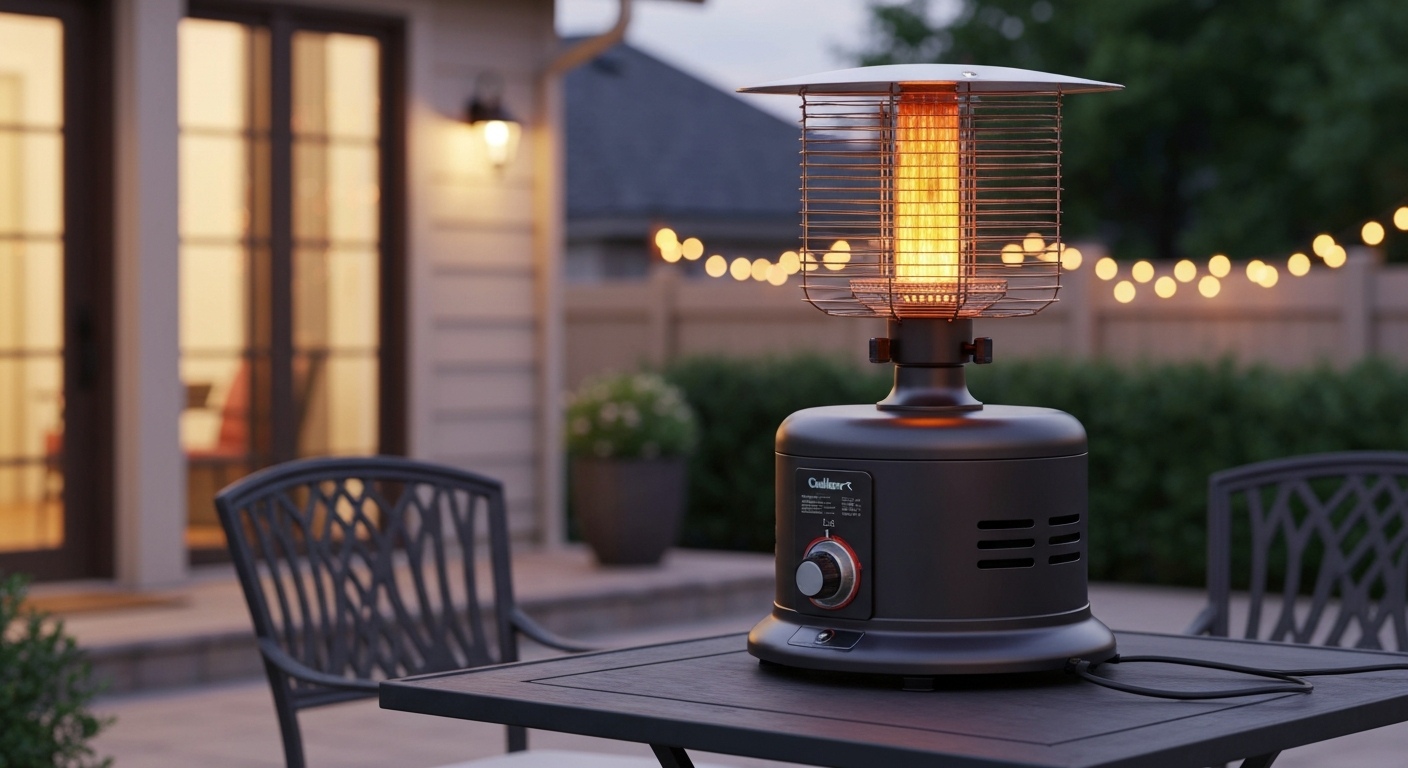
Quick summary: who the Cuisinart tabletop heater is for
The Cuisinart COH-500P is built for people who want portable, on-demand heat at the table, a small balcony dinner, a deck happy hour, or a camping trip where you want something more comfortable than a campfire. It's not a whole-patio solution. At 30 square feet of effective coverage, it heats the people immediately around it, not the space itself. That's actually fine for most tabletop use cases: you're close to it, the radiant heat feels immediate, and you can pack it up and move it indoors when you're done. Renters love it because there's no installation, no gas line, no electrician needed. It also works well on covered patios where a taller freestanding heater might create clearance problems.
It's less ideal for windy open-air spaces (more on that in the performance section), for large patios needing wide coverage, or for anyone who wants electric-only operation, this one is propane only. If you're weighing a propane tabletop against an electric or pyramid-style alternative, there's a full comparison section below.
Verified specifications and at-a-glance specs
The specs below come from Cuisinart's official product listing, the COH-500 owner's manual, and cross-verified retailer listings. The HPS-C-PC column reflects the Hampton Bay manual and Home Depot product page.
| Specification | Cuisinart COH-500 / COH-500P | Hampton Bay HPS-C-PC |
|---|---|---|
| Heater type | Propane tabletop infrared | Propane tabletop infrared |
| BTU output | 11,000 BTU/hr | 11,000 BTU/hr |
| Effective coverage | ~30 sq. ft. | ~30 sq. ft. |
| Dimensions (L x W x H) | 17" x 17" x 27" | Not individually listed; similar form factor |
| Primary fuel | 1-lb propane cylinder | 1-lb propane cylinder |
| 20-lb tank compatible | Yes, with optional adapter/hose | Yes, with optional adapter/hose |
| Estimated runtime (1-lb) | ~2 hours (manufacturer stated) | ~2 hours (comparable estimate) |
| Certification | CSA certified | ANSI Z83.26-2007 / CSA 2.37-2007 |
| Safety: tip-over shutoff | Yes (tilt switch) | Yes |
| Safety: thermocouple/ODS | Yes (thermocouple) | Yes (thermocouple/flame failure) |
| Finish | Not specified (varies by retailer) | Powder-coated bronze |
| Warranty | 1-year limited | 1-year limited |
| Approximate retail price | $99.99–$149.99 | ~$179.00 (Home Depot) |
| Where to buy | Home Depot, Best Buy, Cuisinart.com | Home Depot (exclusive) |
One thing worth noting: the COH-500 and COH-500P appear to be the same unit sold under slightly different SKUs across retail channels. The owner's manual references the COH-500 designation, and the official Cuisinart product page uses COH-500P. The manufacturer listed in the COH-500 owner's manual is The Fulham Group, which handles OEM production for Cuisinart's outdoor line.
What's in the box
When your Cuisinart COH-500P arrives, here's what you should find inside the packaging:
- Tabletop heater unit (head and burner assembly)
- Tabletop base (the weighted ring base that keeps the unit stable on a flat surface)
- Protective cover (included with the COH-500P; this is the 'with cover' variant some listings call out separately)
- Owner's manual with ignition instructions, leak-test procedure, safety warnings, and warranty information
- Regulator and hose for 1-lb cylinder attachment (typically pre-fitted or included — verify your SKU)
What is NOT included: an adapter hose for connecting to a larger 20-lb propane tank. Cuisinart and Hampton Bay both state in their product pages and manuals that this optional hose/regulator must be purchased separately. If you plan to use the heater for extended sessions and want to avoid swapping out 1-lb cylinders every couple of hours, budget an extra $15–$25 for a compatible low-pressure adapter hose. The manual provides guidance on routing the hose through the base for stability when using the larger tank.
Design, materials, and portability
At 17 inches square and 27 inches tall, the COH-500P is genuinely compact for a propane heater. It doesn't dominate a table the way a pyramid-style heater dominates a patio. The base ring gives it enough stability for everyday use on a level surface, but you'll feel the difference if you put it on an uneven deck plank or a slight slope, the tilt shutoff will thank you for checking the surface first.
The build quality is functional rather than premium. The materials are consistent with what you'd expect at this price point: a metal head assembly, a painted finish (the Hampton Bay HPS-C-PC gets a powder-coat in bronze, which is more durable), and a lightweight base. The included protective cover is a genuinely useful accessory, it keeps the burner and reflector clean between uses and makes storage cleaner. The heater is light enough to carry with one hand using the handle, and a 1-lb propane cylinder screws into the base directly, so you don't need any tools. If you're camping or tailgating, the whole setup fits easily in a standard tote bag.
Travel considerations: always disconnect and remove the propane cylinder before transporting. The 1-lb cylinders are DOT-approved for transport in a vehicle, but you should never leave a connected cylinder in a hot car. The heater head and base separate for flatter packing.
Assembly and first-time operation
Setup is about as simple as outdoor appliances get. Here's the process as documented in the COH-500 owner's manual:
- Attach the base ring to the heater column if not pre-assembled (a few screws, included).
- Screw a 1-lb propane cylinder (not included) into the cylinder fitting at the base — hand-tight only, no tools needed.
- Place the unit on a stable, flat, non-combustible surface outdoors. Confirm clearances: minimum 3 feet from combustible sides, 2 feet above the unit (per the HPS-C-PC manual; the Cuisinart manual mirrors these general requirements).
- Turn the control knob to the PILOT/IGNITE position.
- Press and hold the knob in while pressing the igniter button. Hold for 15–30 seconds to allow the thermocouple to heat up and hold the flame.
- Once the pilot flame is established and stable, turn the control knob to your desired heat setting.
- Before each use, perform a quick visual leak check: apply soapy water to the cylinder connection and look for bubbles before lighting.
Ignition reliability: In practice, most users get a light on the first or second try when the cylinder is fresh and the unit hasn't been sitting unused for a season. If the igniter clicks but doesn't catch, the most common culprits are a low or empty cylinder, a dirty thermocouple tip, or a gap that's developed in the igniter electrode. The piezo igniter can wear over time, if it stops producing a spark, a long-reach lighter works fine as a workaround while you order a replacement igniter (typically available as a spare part through the manufacturer or large hardware retailers).
Safety features and wind sensitivity
Both the Cuisinart COH-500 and the Hampton Bay HPS-C-PC meet ANSI Z83.26/CSA 2.37 certification requirements for gas-fired outdoor infrared tabletop heaters. That certification involves real performance and failure-mode testing, not just paperwork, so these aren't uncertified imported heaters you have to take on faith.
- Tip-over automatic shutoff: a tilt switch cuts gas flow if the heater tips past a set angle. This is one of the most important safety features for a tabletop unit that can get bumped at a dinner party.
- Thermocouple flame failure device: if the flame goes out for any reason (gust of wind, cylinder running low), the thermocouple cools and closes the gas valve within seconds, stopping gas from continuing to flow unburned.
- Burner screen guard: the COH-500P listing explicitly references a burner screen that reduces direct contact risk with the heating element.
- CO hazard awareness: both manuals are explicit that these are outdoor-use-only units. They produce combustion byproducts including carbon monoxide. Never use under an enclosed structure, in a garage, or in any space without substantial ventilation.
- Minimum clearances: 3 feet from combustible materials on the sides, 2 feet above the unit. These are minimums — give it more room if you can, especially on a covered patio with a fabric umbrella overhead.
Wind sensitivity is the real-world trade-off with any propane tabletop heater. The thermocouple flame failure device will do its job if a gust kills the flame, but that means the heater shuts off, not just dims. In testing, a consistent breeze above about 10–12 mph makes maintaining a stable flame difficult. Partial wind screening (a patio wall, a fence, or positioning the heater away from the prevailing wind) helps significantly. If your primary location is a fully exposed rooftop or windy coastal deck, an electric tabletop heater or a heavier freestanding model will serve you better.
Performance: what the numbers actually mean
| Metric | Cuisinart COH-500P | Notes |
|---|---|---|
| BTU output | 11,000 BTU/hr | Manufacturer rated; CSA certified |
| Effective coverage area | ~30 sq. ft. | Manufacturer stated; applies at close range (2–4 ft radius from unit) |
| Runtime on 1-lb cylinder | ~2 hours at full output | Manufacturer stated average; varies with heat setting |
| Runtime on 20-lb tank (estimated) | ~50–55 hours at full output | Calculated: 1-lb ≈ 21,594 BTU energy; 20-lb ≈ ~432,000 BTU / 11,000 BTU/hr |
| Ignition reliability (new unit) | Good; 1–2 attempts typical | Based on user review patterns and manual guidance |
| Wind resistance | Low to moderate | Flame failure shutoff activates in sustained wind above ~10–12 mph |
| Heat-up time | 1–2 minutes to full warmth | Infrared radiant heat felt quickly at close range |
| Noise level | Very low (soft burn hiss) | No fan or blower; near-silent operation |
The 2-hour runtime on a 1-lb cylinder is the number that surprises most first-time buyers. A 1-lb propane cylinder holds approximately 21,600 BTU of usable energy. At 11,000 BTU/hr at full output, the math works out to roughly 2 hours, exactly what Cuisinart states. Running the heater at a lower setting extends that meaningfully. The upside of the 20-lb tank adapter is obvious: at full output, a 20-lb tank gives you 50+ hours of runtime, which is far more practical for regular patio use.
Fuel and style variants: propane vs electric vs pyramid
Tabletop patio heaters aren't all the same category, even though they share a form factor. The three main variants you'll encounter are propane tabletop, electric tabletop, and pyramid-style tabletop. For electric options, see our table top patio heater electric review for plug-in models that perform better in covered or windy spaces. Here's how they compare in practical terms:
| Feature | Propane Tabletop (e.g., COH-500P) | Electric Tabletop | Pyramid-Style Tabletop |
|---|---|---|---|
| Fuel / power | Propane cylinder (1-lb or 20-lb via adapter) | 120V AC outlet required | Propane (typically 1-lb cylinder) |
| BTU / wattage | ~10,000–11,000 BTU | ~1,000–1,500W (3,400–5,100 BTU equiv.) | ~10,000–11,000 BTU (similar class) |
| Portability | High — no cord, no outlet needed | Limited by cord length and outlet access | Moderate — heavier, decorative base |
| Wind sensitivity | Moderate — flame can be extinguished | None — electric element unaffected | Similar to standard propane tabletop |
| Visual appeal | Functional/minimal | Compact and modern | High — flame tower is a focal point |
| Indoor/outdoor safe? | Outdoor only (CO hazard) | Can be used in covered/enclosed spaces | Outdoor only (CO hazard) |
| Cost per use | ~$1–$2/hour (1-lb cylinders retail) | ~$0.12–$0.18/hour (at avg. electricity rate) | ~$1–$2/hour (same propane economics) |
| Setup | No outlet needed; instant | Needs outlet; plug-in only | Similar to propane tabletop |
| Approx. price range | $99–$180 | $50–$130 | $80–$160 |
The right choice depends heavily on where you'll use it. Propane tabletop heaters like the COH-500P win on portability and are great when there's no outlet nearby. Electric tabletop models are the better pick for covered patios, screened porches, or any space where you're concerned about combustion byproducts or wind, they don't produce CO and the heating element can't be blown out. Pyramid-style tabletop heaters offer the best ambiance (the visible flame column is genuinely attractive at a dinner table) but they're bulkier and serve more of a decorative-plus-heating role than a pure warmth solution.
Cuisinart COH-500P vs common alternatives
| Model | Type | BTU | Runtime (1-lb) | Key safety features | Price (approx.) | Best for |
|---|---|---|---|---|---|---|
| Cuisinart COH-500P | Propane tabletop | 11,000 | ~2 hrs | Tip-over shutoff, thermocouple | $99–$150 | Portable use, camping, balconies |
| Hampton Bay HPS-C-PC | Propane tabletop | 11,000 | ~2 hrs | Tip-over shutoff, thermocouple, CSA certified | ~$179 | Deck/patio, powder-coat durability |
| Fire Sense 60262 | Propane tabletop | 10,000 | ~3 hrs | Piezo ignition, auto-shutoff/tilt valve, ODS | ~$70–$90 | Budget pick, slightly longer runtime |
| Generic electric tabletop (1,500W class) | Electric tabletop | ~5,100 BTU equiv. | Unlimited (plug-in) | Overheat protection, tip-over switch | $50–$130 | Covered spaces, no propane access |
| Pyramid tabletop (propane) | Propane pyramid tabletop | ~10,000–11,000 | ~2 hrs | Tip-over shutoff, thermocouple | $80–$160 | Ambiance + warmth, dinner tables |
Short takeaways: the Cuisinart COH-500P is the best value in the Cuisinart family and a solid mainstream pick, especially when you can find it at the $99.99 Home Depot price. The Hampton Bay HPS-C-PC is a step up in finish quality and comes with its own accessories, but at $179 you're paying a significant premium for what is functionally a very similar heater. The Fire Sense 60262 undercuts both on price and ekes out a slightly longer runtime on a 1-lb cylinder, making it a legitimate budget alternative. Best Buy lists the Fire Sense Portable Tabletop Patio Heater 10,000 BTU (Model 60262) as a 10,000 BTU tabletop propane heater with piezo ignition, an auto‑shutoff/tilt valve (and some descriptions noting ODS compliance), and about a 3‑hour runtime on a 1‑lb cylinder Fire Sense Portable Tabletop Patio Heater 10,000 BTU (Model 60262) — Best Buy. If wind is your primary concern, an electric tabletop heater is the smarter buy regardless of price.
Recommended use cases by patio size and environment
Small balcony (under 50 sq. ft.)
This is the COH-500P's sweet spot. A 30 sq. ft. effective warmth zone is almost the entire usable area of a small apartment balcony. The heater sits on a bistro table, two people face it, and it's genuinely comfortable down into the low 40s Fahrenheit with calm air. Just confirm your balcony has adequate clearance above the unit and isn't directly in a wind tunnel between buildings.
Small uncovered deck (50–150 sq. ft.)
One tabletop heater will warm the immediate dining area but won't heat the full deck. That's fine if you're entertaining at one table. In calm conditions it works well; in wind, expect reliability issues. Consider positioning it with a natural wind break (fence, wall, or outdoor privacy screen) if your deck is exposed.
Covered patio or pergola
Covered patios are well-suited for propane tabletop heaters in terms of wind protection, less wind means more reliable flame. However, confirm that your covered structure is open-sided or adequately ventilated. CO accumulation in a poorly ventilated covered space is a real hazard. A solid roof with walls on two or more sides is borderline, in that situation, an electric tabletop heater is the safer choice.
Windy or exposed spaces
Coastal decks, rooftop terraces, and open hilltop patios are genuinely difficult environments for any propane tabletop heater. The flame failure shutoff will repeatedly kill the heater in sustained wind. An electric tabletop model or a larger, weighted freestanding propane heater is a better solution for these environments.
Portability, travel, and storage
The Cuisinart COH-500P is one of the more travel-friendly propane heaters available. Here's a practical checklist for moving, transporting, and storing it safely:
- Always turn off the control knob and wait for the burner to cool completely before disconnecting the propane cylinder.
- Disconnect the cylinder before moving the heater — even a short move across the patio.
- 1-lb propane cylinders are DOT-approved for vehicle transport, but keep windows cracked and never leave them in a hot, sealed car.
- Do not transport the 20-lb tank adapter assembly while still connected to a full tank in an enclosed vehicle trunk.
- Use the included protective cover during storage to keep the burner and reflector clean.
- Store the heater indoors or in a dry covered area during winter — moisture in the burner assembly can cause ignition issues the following season.
- Remove the propane cylinder before long-term storage; store cylinders outdoors in a cool, ventilated area away from heat sources.
- Before packing for a trip, give the cylinder connection a quick soapy-water leak check when you reconnect on arrival.
Maintenance, cleaning, and troubleshooting
Tabletop propane heaters need relatively little maintenance, but a few seasonal checks make a big difference in reliability:
- Season-start inspection: check the burner screen and reflector for debris, spider webs, or corrosion. Insects love to nest in burner orifices over winter — a clogged orifice causes weak or no flame.
- Clean the reflector with a soft damp cloth (no abrasives). A clean reflector maintains the infrared output efficiency.
- Inspect the igniter electrode tip: it should be clean and positioned close to the burner. Bent or corroded electrodes are the most common ignition failure cause.
- Check the thermocouple for soot buildup — gently wipe it with a dry cloth. A sooty thermocouple can fail to hold the pilot flame.
- Test the cylinder connection with soapy water before each season's first use: apply to the fitting, open the gas slightly without igniting, and look for bubbles indicating a leak.
- If the flame is yellow or orange instead of blue with orange tips, the air-to-gas ratio is off — check for a partially blocked burner orifice.
- Regulator issues: if the heater lights but produces very low heat, the cylinder may be cold (propane vaporizes poorly below 0°F) or the regulator may have triggered its over-pressure protection. Disconnect, wait 30 seconds, and reconnect.
- Replacement parts (igniter, thermocouple, regulator hose) are available through Cuisinart customer service and major hardware retailers.
Pricing, warranty, and value
The Cuisinart COH-500P has a manufacturer MSRP of $149.99 on the official Cuisinart site. Home Depot lists the COH-500 as low as $99.99 on promotional pricing. The Hampton Bay HPS-C-PC is priced at approximately $179.00 at Home Depot. On Best Buy, the Cuisinart COH-500 carries a strong 4.9/5 rating from verified reviewers (a small but positive sample), suggesting real-world satisfaction is high for buyers whose expectations match the product's intended use.
Both the Cuisinart and Hampton Bay units carry a 1-year limited warranty, as documented in their respective owner's manuals. The HPS‑C‑PC Owner's Manual (Front pages and warranty section), Home Depot PDF lists ANSI Z83.26/CSA 2.37 on the front page and includes 1‑year limited warranty language in the warranty section HPS‑C‑PC Owner's Manual (Front pages and warranty section) — Home Depot PDF. This is standard for this product category. Warranty claims typically go through the manufacturer's customer service channel rather than the retailer. Replacement parts (thermocouple, igniter assembly, regulator hose) are available through Cuisinart customer service and Home Depot for the Hampton Bay unit, this is worth factoring in, since an igniter replacement costing $8 is much better than replacing the whole unit after one season.
Value assessment: at $99.99 the COH-500 is hard to argue with for what it does. At $149.99 MSRP it's still competitive. At $179.00 for the HPS-C-PC, you're paying for a more durable powder-coat finish and the Hampton Bay supply chain at Home Depot, which is convenient if you want in-store pickup or easy returns. Neither is a bad purchase; it comes down to how much you value finish quality and where you prefer to shop.
Pros, cons, and who it's best for
Pros
- Genuinely portable — no outlet, no installation, works anywhere you can use propane outdoors
- CSA certified to ANSI Z83.26/CSA 2.37 — real safety testing, not just a sticker
- Tip-over shutoff and thermocouple flame failure device are standard, not optional
- Compact enough to sit on a dining table without dominating the space
- Compatible with 20-lb propane tank via optional adapter for extended runtime
- Included cover is a practical accessory that protects the unit and extends its lifespan
- Easy ignition and simple operation — no special skills required
- Widely available with accessible replacement parts
Cons
- Only ~2 hours of runtime on a 1-lb cylinder at full output — can feel short during longer evenings
- Wind sensitivity is a real limitation; sustained breeze above 10–12 mph will trip the flame failure shutoff repeatedly
- 30 sq. ft. effective coverage won't heat a full deck — it's a personal/tabletop heater, not a space heater
- Outdoor-only use due to CO production — can't be used in a garage, sunroom, or enclosed porch
- 20-lb tank adapter is not included and must be purchased separately
- Build materials feel functional rather than premium at MSRP pricing
- 1-year warranty is short for an outdoor appliance used across multiple seasons
Best-candidate buyer profiles
- Renters who can't install permanent gas lines or hardwired electric heaters
- Apartment dwellers with small balconies wanting a table-level heat source
- Campers and tailgaters who want a propane heater that doubles as an outdoor space heater
- Homeowners with a small covered patio who want something portable and storable
- Anyone supplementing a larger patio setup with a close-proximity tabletop heat source
Buying checklist and quick decision matrix
| Question | If Yes... | If No... |
|---|---|---|
| Do you have access to a 120V outlet at your patio? | Electric tabletop is also viable | Propane tabletop is your best portable option |
| Is your space covered with good ventilation? | Propane tabletop is safe with clearances observed | If enclosed or poorly ventilated, choose electric |
| Is wind a consistent issue in your location? | Strongly consider electric tabletop instead | Propane tabletop performs reliably |
| Do you need to heat more than ~30 sq. ft.? | You need multiple units or a freestanding heater | Tabletop is sufficient |
| Do you want 3+ hour sessions without cylinder swaps? | Buy the 20-lb adapter hose separately ($15–$25) | 1-lb cylinders are convenient for shorter sessions |
| Is portability (camping, travel) a priority? | COH-500P is an excellent match | Consider a heavier, higher-output freestanding unit |
| Do you want a decorative flame element? | Look at pyramid-style tabletop options | The COH-500P's functional design is a better fit |
| Is budget under $100? | Watch for COH-500 at Home Depot promotional pricing | COH-500P at MSRP or HPS-C-PC are both solid buys |
Final recommendation by scenario
For a small balcony or apartment deck where portability and renter-friendliness matter most, the Cuisinart COH-500P at $99.99–$149.99 is the top pick. It's compact, safety-certified, easy to use, and the included cover makes it practical to store between uses. If you can catch it at the Home Depot promotional price, it's excellent value.
If you're occasionally dealing with wind and want a slightly more durable finish, the Hampton Bay HPS-C-PC is the step-up option at ~$179. The powder-coat bronze finish holds up better outdoors, and the ANSI/CSA certification is identical. The price premium is real but defensible if longevity matters to you.
If you're in an electric-only space (covered screened porch, indoor-adjacent patio with poor ventilation, or a space where you just don't want to deal with propane), skip both and go with an electric tabletop heater in the 1,000–1,500W range. The operating cost is a fraction of propane, there's no flame failure in wind, and you can use it in a wider range of environments safely.
For buyers who want the ambiance of a visible flame at the table, a propane pyramid-style tabletop heater is worth a look. They sit in the same BTU class as the Cuisinart but prioritize the aesthetic of a flame tower over pure portability. If the table centerpiece look appeals to you, it's a legitimate trade-off.
Quick answers to common questions
Can I use the Cuisinart COH-500P indoors or in a garage? No. These are outdoor-only heaters. Propane combustion produces carbon monoxide, which accumulates to dangerous levels in enclosed or semi-enclosed spaces. The manuals are explicit about this, and both the Cuisinart and Hampton Bay units carry CO hazard warnings. Use them outdoors only, with open-air or substantially cross-ventilated coverage.
Can I leave it outside year-round? Technically it can tolerate outdoor conditions, but it will age faster without protection. Use the included cover when not in use, and store it indoors or in a dry shed over winter. Moisture in the burner orifice and regulator causes most of the ignition problems people report after off-season storage.
Can I use a different propane tank? Yes. The heater is designed for standard 1-lb propane cylinders (the green Coleman-style screw-top cylinders). With an optional low-pressure adapter hose (not included), you can connect it to a 20-lb propane tank for dramatically extended runtime. Use only CSA-approved hoses with the correct pressure rating. Do not attempt to use a high-pressure regulator or non-standard adapters.
Where can I get replacement parts? Cuisinart customer service handles warranty claims and sells replacement parts for the COH-500 line. The Hampton Bay HPS-C-PC parts (igniter, thermocouple, hose/regulator) are available through Home Depot's special-order system and some third-party appliance part suppliers. Keep your model number and purchase receipt, they'll need it.
Is the HPS-C-PC a Cuisinart product? No. The HPS-C-PC is a Hampton Bay product sold through Home Depot. It appears in searches alongside the Cuisinart COH-500P because both are propane tabletop heaters in the same BTU class, priced in a similar range, and sometimes described with similar terminology. The model-number page for the HPS-C-PC covers that unit specifically.
Related patio heater reviews and further reading
If this review has you leaning toward a tabletop propane heater but you want to compare more options in that category, the tabletop propane patio heaters guide covers the broader market including competitors at different price points and BTU levels.
If wind resistance or covered-space use is a priority, the electric tabletop patio heater review breaks down the best plug-in options, including models that work in partially enclosed spaces where propane isn't appropriate.
For buyers interested in ambiance as much as warmth, the tabletop pyramid patio heater guide covers flame-tower designs that work well as dining table centerpieces, with honest comparisons of the trade-offs versus functional propane tabletop units like the Cuisinart.
If you've specifically landed on the Cuisinart portable tabletop patio heater with cover as a purchase target, there's a dedicated review focused on the cover accessory, SKU differences, and value comparison between the 'with cover' and base configurations. And if the Hampton Bay HPS-C-PC is your shortlisted unit, the detailed HPS-C-PC model review covers the manual specifications, clearance requirements, and Home Depot purchasing details in full.
FAQ
What verified specifications should I include for the Cuisinart tabletop patio heater (COH-500 / COH-500P)?
Include manufacturer model name/number, rated heat input (11,000 BTU/hr), fuel type (1-lb propane cylinder; optional connection to 20-lb tank via adapter), advertised coverage (up to ~30 sq ft), physical dimensions (approximately 17"W × 17"L × 27"H), certifications (CSA/ANSI compliance listed in manual), ignition type, safety features noted (anti-tilt/automatic shutoff, thermocouple/pilot), and stated warranty (1-year limited). Verify these from the Cuisinart product page and the COH-500 owner’s manual.
What hands-on performance metrics are most useful and how do I verify them?
Measure and report: effective coverage area (where occupants feel meaningful warmth in sq ft), measured or manufacturer BTU (11,000 BTU/hr), run-time on a 1-lb cylinder (manufacturer ~2 hours average; verify with timed burn tests), ignition reliability (percent successful starts during X attempts and any required priming), and wind sensitivity (qualitative: stable/unstable flame in X mph winds). Verify BTU/run-time/specs with the manual and product page; validate runtime and ignition with controlled hands-on tests (timed runs with known cylinder start/stop and logging conditions). Use standard energy conversion references (EIA) if converting fuel mass/volume to heat energy for validation.
What safety details and features must be documented?
Document all built-in safety features: tip-over/anti-tilt automatic shutoff, thermocouple/pilot protection, burner screens/guards, and any oxygen-depletion sensor (ODS) claims. Include required clearances to combustibles (manufacturer guidance; e.g., manuals often state 3 ft sides, 2 ft top) and explicit 'for outdoor use only' warnings and CO hazard warnings. Report stability tests (tendency to tip), and wind/fuel-leak test procedures from the manual (leak test, pilot/ignition sequence). Cite the product manual and ANSI/CSA standard references where applicable.
How should I compare fuel and style variants (propane tabletop, electric tabletop, pyramid-style)?
Compare along these axes: heat output (BTU for gas vs wattage for electric), run-time or runtime constraints (propane cylinder duration vs continuous electric supply), portability (propane 1-lb cylinders are very portable; electric needs outlet), safety (electric has no combustion/CO risk; gas needs ventilation and leak checks), wind resistance (pyramid and enclosed reflectors may be less wind-sensitive), and price/operating cost. For tabletop gas units like COH-500, highlight 11,000 BTU and 1-lb cylinder use; for electric, note no fuel but limited heat radius. Use manufacturer specs and competitor product pages (e.g., Fire Sense) and reference ANSI/CSA standards for tabletop gas limits.
What should I include about portability, included accessories, and installation/operation?
Describe weight and dimensions, whether a storage/transport cover is included (note: check retailer listing/manual for included cover—if not listed, assume not included), ease of swapping 1-lb cylinders, ability to connect to a 20-lb tank (adapter/hose not included), assembly complexity, and mounting/placement guidance. Include step-by-step ignition and leak-test procedures verbatim-summarized from the owner’s manual, plus tips for safe placement (level surface, away from winds and combustibles). Cite the COH-500 manual and product pages for exact assembly and accessory listings.
What maintenance and storage guidance is necessary?
Include routine cleaning of reflector and burner screen per manual, drain/clear any debris from base, check and tighten connections and hose when using a larger tank, perform leak-check procedures before each cylinder change, cover/store indoors when not in use to extend life, and winterize steps if applicable. Also include recommended replacement intervals for fuel cylinders and signs of corrosion or burner blockage that require service. Base these recommendations on the COH-500 owner’s manual maintenance section.