
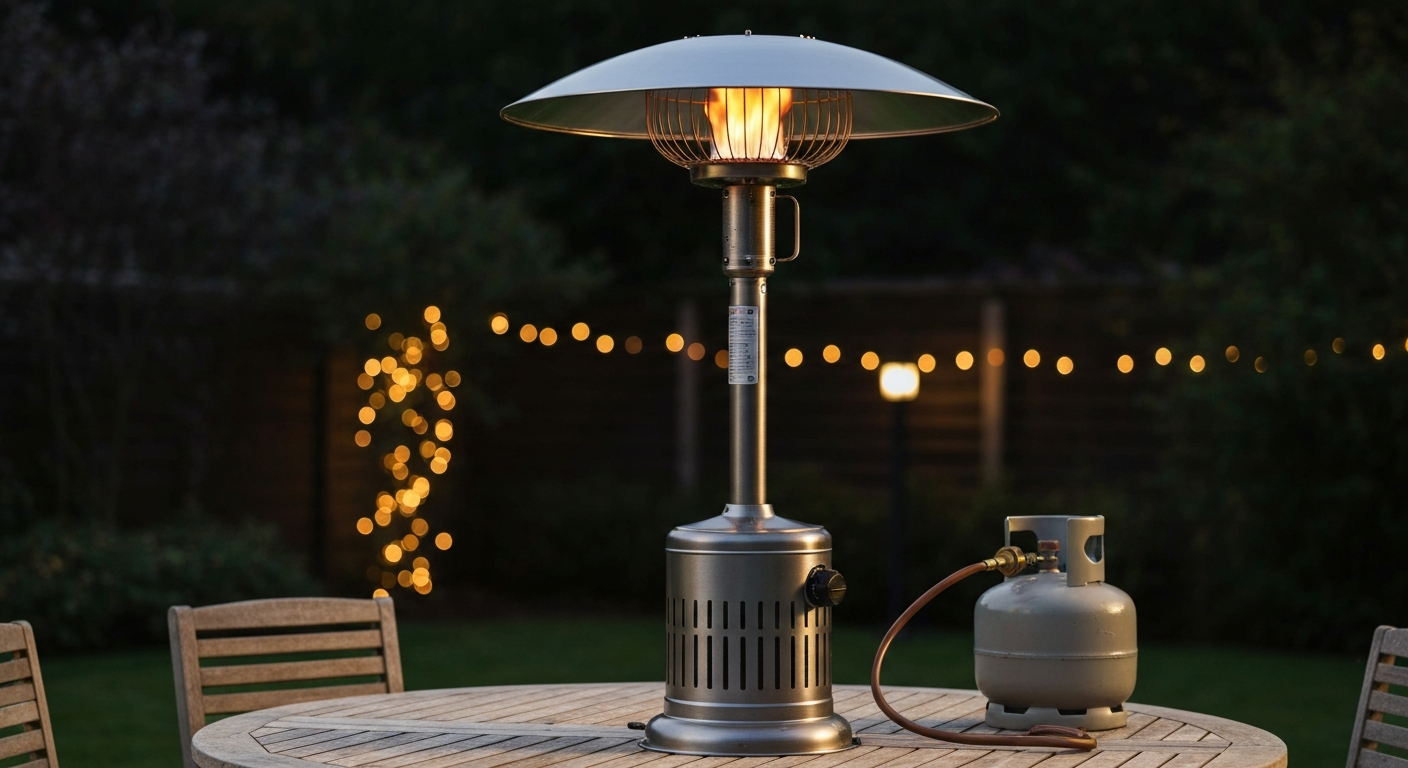
The Firefly 4kW tabletop gas patio heater is a compact, propane/LPG-powered outdoor heater designed to sit on a garden table and throw heat across roughly 5 to 10 square metres. For more information and comparisons, see our detailed guide to 4kw table top patio heaters which covers specs, safety, and alternatives. It runs on a standard 13 kg propane bottle (or compatible LPG canisters), produces a nominal 4,000 watts (about 15,000 Btu/h), and is CE-marked for outdoor use. It suits small patios, garden tables, and courtyard seating where a full-size freestanding heater would be overkill, but it is not suitable for covered balconies of flats, enclosed spaces, or indoor use.
4kW Table Top Gas Patio Heater Firefly Review & Guide

Willa Brennan
9 Aug 2026
Who this review is for
If you are shopping for a portable, gas-powered heater that lives on your garden table rather than standing on the patio floor, this guide is written for you. I will walk through the Firefly 4kW unit in detail, specs, real-world performance, safety, setup, running costs, and honest pros and cons, and then compare it with the closest alternatives: the Garden Glow 4kW tabletop gas heater, Fire Sense tabletop propane models, Firefly tabletop electric options, and the Kettler lantern and tabletop range. See kettler universal lantern patio heater 80cm reviews for user feedback on Kettler's lantern and tabletop range. See our dedicated Firefly table top electric patio heater review for specs, balcony-safe alternatives, and running-cost comparisons. By the end, you will have a clear answer on whether this specific heater fits your space, your budget, and your fuel preference.
Product overview: the Firefly 4kW tabletop gas heater
The Firefly 4kW tabletop gas heater belongs to a family of re-badged OEM units that share a near-identical mechanical footprint across several retail brands. The unit stands approximately 880 to 960 mm tall (depending on the specific revision), with a reflector/head diameter of around 535 mm. Published retail dimensions from PatioMate and OEM spec sheets consistently list the body as roughly 530 x 530 x 880 mm, which is compact enough to sit on most large garden tables without dominating the surface. The declared nominal heat input is 4.0 kW (15,000 Btu/h) at maximum burner setting, making it meaningfully more powerful than a 2.1kW electric tabletop alternative but much more modest than a full-size 13kW freestanding patio heater.
Design-wise, the heater uses a mushroom-style radiant reflector at the top of a central column. The burner assembly sits inside a protective cage or screen, the gas feed runs through the column, and a regulator/hose assembly connects at the base to your fuel supply. Build quality on this class of unit is functional rather than premium, expect powder-coated steel, a modest reflector, and push-button or piezo ignition depending on the revision. The Firefly branding is applied to this OEM design by the UK/Ireland retail channel; the manufacturer behind the generic unit is Universal Innovations, based in Kilcoole, Co. Wicklow, Ireland, and the CE approval number on the declaration of conformity is 0086.
One important note on the Firefly brand name: in 2025, the US Consumer Product Safety Commission issued a recall on 'Firefly Fuel' branded 32-oz fuel bottles (a completely separate product and company from Safe & Green). That recall has nothing to do with the Firefly tabletop heaters sold in the UK and Ireland. Just worth knowing if you see that headline in a search result, the products are unrelated.
Core specifications at a glance
| Specification | Detail |
|---|---|
| Nominal heat output | 4.0 kW (approx. 15,000 Btu/h) |
| Fuel type | LPG — propane (G31) or butane/propane mix (G30) |
| Gas consumption (max) | Approx. 286–324 g/h (varies by gas type; propane G31 approx. 286 g/h per comparable manual) |
| Injector size | 1.1 mm |
| Regulator outlet pressure | 37 mbar (standard UK/Ireland propane regulator) |
| Overall height | Approx. 880–960 mm |
| Reflector diameter | Approx. 535 mm |
| Minimum table diameter | 90 cm (per manufacturer instructions) |
| Ignition | Piezo push-button (typical for this OEM class) |
| Certification | CE (approval no. 0086); references BS EN 14543:2005+A1:2007 |
| Manufacturer | Universal Innovations, Kilcoole, Co. Wicklow, Ireland |
Fuel, ignition and how long it will run
The Firefly 4kW runs on LPG, specifically propane (G31) or a butane/propane mix (G30), both widely available in the UK and Ireland. The unit is designed to work with a standard 13 kg propane bottle connected via a 37 mbar regulator and hose, which you typically buy separately or source from a DIY or garden centre. It is not designed for screw-in EN417 threaded camping canisters (100 g, 230 g, or 450 g cartridges), those are a different connector format and a different pressure regime. Retail listings for threaded EN417 canisters (including the Companion 450 g Butane/Propane Gas Cartridge (EN417), product listing and spec (retailer)) document the 450 g Lindal B188 7/16" UNEF screw thread connection used for these camping cartridges Retail listings for threaded EN417 canisters (including the Companion 450 g Butane/Propane Gas Cartridge (EN417) — product listing and spec (retailer)) document the 450 g Lindal B188 7/16" UNEF screw thread connection used for these camping cartridges.. Make sure your regulator and hose are rated for propane and meet local gas safety codes before connecting anything.
Ignition is piezo push-button on most variants of this OEM class: you hold down the control knob to open the gas flow, press the igniter button, and hold for a few seconds to allow the thermocouple to heat up before releasing. If the flame goes out unexpectedly, the thermocouple-based flame failure device should cut the gas within a few seconds. Some users find the ignition takes two or three attempts in cold ambient temperatures, which is normal for piezo systems on small gas heaters.
Runtime is the figure most buyers want upfront. At full 4kW output, gas consumption sits at roughly 286 to 324 g/h depending on which gas type you are using. Working from a 13 kg propane bottle at maximum output, PatioMate's worked example (using approximately 0.33 kg/h consumption) gives around 39 hours of run time per bottle. That is a reasonable ballpark figure at full power. In practice, most people do not run the heater on maximum the entire time, dialing it back to a lower flame setting reduces consumption proportionally and extends the bottle life noticeably. If you run at roughly half power, you could realistically double that estimate, though exact consumption at lower settings is not published in the manual.
What to expect in real-world use
Advertised heat coverage for this class of heater is 5 to 10 square metres. That range exists because performance is heavily influenced by conditions, ambient temperature, wind speed, and how close people are sitting to the reflector. On a calm evening at around 10 to 12°C, seated within 1 to 1.5 metres of the heater, you will feel meaningful warmth from the radiant output. Move 2 metres away on a 15 mph wind night and the difference is dramatic. Radiant gas heaters warm objects and people directly in the beam; they do not heat the air, so any breeze carries that warmth away quickly.
Warm-up time is almost immediate compared to electric convective heaters. Within 30 to 60 seconds of lighting, the reflector is producing useful radiant heat. There is no warm-up delay of the kind you get with some ceramic or quartz electric heaters. This is one of the genuine practical advantages of gas over electric at this output level.
Wind tolerance is the biggest variable and the honest limitation. Tabletop gas heaters of this size and design are not wind-rated appliances. In a sheltered courtyard or on a still evening, a 4kW unit performs well for a table of two to four people. On an exposed garden terrace with a consistent breeze above around 10 to 12 mph, you will likely find the effective warmth drops off significantly. If your patio is consistently exposed, either look at a windbreak, a larger floor-standing unit, or an infrared electric heater that can be mounted closer to the seating area. Independent consumer lab test protocols (as used by organisations like the Good Housekeeping Institute) typically record ambient temperature, wind speed with an anemometer, and sensor readings at fixed distances of 0. Good Housekeeping Institute's patio heater tests document use of anemometers, infrared and contact temperature sensors and measurements at set distances (for example 0.9 m and 1.8 m) to record radiant performance, surface temperatures, wind speed, and run-time. 5 m, 1.0 m, 1.5 m, and 2.0 m at seated height, a useful framework if you want to do a structured comparison yourself after purchase.
Safety features, clearances and certifications
The Firefly 4kW carries CE certification with approval number 0086, and the product documentation references BS EN 14543:2005+A1:2007, the harmonised European/UK standard for patio heaters with gas fuel. This is the baseline certification you should expect on any LPG tabletop heater sold in the UK or Ireland. If a unit does not reference this standard on its documentation, treat that as a red flag.
On safety features, the key ones to confirm before buying any 4kW tabletop gas heater are: a flame failure device (thermocouple cutoff that shuts the gas off if the flame is extinguished), a tip-over or anti-tilt automatic shutoff, and a burner guard or protective screen around the burner head. The Firefly and most units in this OEM class include thermocouple flame failure as standard. Check the specific product listing or manual for tip-over protection, as not all variants in this product class include it and it is an important safety layer.
Placement rules from the manufacturer manual are worth following carefully. The minimum recommended table diameter is 90 cm, do not place this heater on a small bistro table. The unit must only be used outdoors or in an amply ventilated area; the manual explicitly prohibits indoor or enclosed use. Minimum clearances to combustibles and overhead structures should be confirmed in your specific unit's manual. Annual leak testing with a soap solution and servicing after every 100 operating hours (or annually, whichever comes first) is specified in the Universal Innovations manual.
Balcony use is a separate and important issue. Multiple UK housing providers and local councils explicitly prohibit open-flame patio heaters on flat balconies. Winchester City Council's tenant handbook, for example, directly states that barbecues and patio heaters are prohibited on flat balconies. US local fire codes (such as Howard County amendments) similarly forbid open-flame fueled devices on balconies. If you rent a flat or live in a managed building, check your tenancy agreement or building rules before purchasing a gas tabletop heater for a balcony. An electric tabletop heater, such as the Firefly tabletop electric range or a Kettler model, is likely the safer and rules-compliant alternative for that setting.
Setup, canister connections and routine maintenance
Assembly and first-time setup
- Unbox the unit and lay out all components — column sections, reflector head, base plate, burner assembly, regulator and hose (if included), and hardware.
- Assemble the column sections according to the manual sequence, ensuring each join is secure before adding the next section.
- Attach the burner/reflector head assembly to the top of the column.
- Feed or connect the gas hose through or along the column base to the burner inlet, ensuring the hose is not kinked or pinched.
- Connect the 37 mbar propane regulator to your LPG bottle — hand-tighten and then wrench-tighten as specified.
- Before lighting for the first time, perform a leak check: apply a soap-and-water solution to all connections and turn the gas on briefly (do not ignite). If any connection bubbles, turn the gas off immediately, disconnect, and re-seat or replace the fitting.
- Place the assembled heater on a level, stable table with a minimum diameter of 90 cm, in a clear outdoor area.
- Follow the ignition sequence in the manual: press and hold the control knob, press the piezo igniter, and hold for several seconds after the flame appears before releasing.
Replacing or swapping canisters
Always turn the burner off and allow the heater to cool fully before disconnecting a gas bottle. Turn the bottle valve off, then unscrew the regulator. When connecting a new bottle, check the regulator and hose for visible damage or cracking before reconnecting. Repeat the soap-solution leak test each time you connect a new bottle. Store empty or connected bottles upright in a ventilated, shaded outdoor area away from heat sources, never store LPG cylinders indoors.
Cleaning and seasonal storage
After each use, allow the heater to cool completely and wipe down the reflector and column with a damp cloth to remove grease or debris. Check the burner screen for blockages (insects and debris can restrict airflow and affect combustion). Before storing for winter, disconnect the gas supply, clean all surfaces, inspect the hose and regulator for cracks or brittleness, and store the heater in a dry location, ideally with a cover over the reflector head. If the hose shows any signs of cracking or if the regulator is more than a few years old, replace both before the next season. Servicing is recommended after every 100 operating hours or annually.
Running costs and value for money
Gas consumption at maximum output is approximately 286 to 324 g/h. Using propane at a typical UK retail price of around £0.085 to £0.10 per 100g (based on a 13 kg refillable bottle costing approximately £30 to £35 with exchange), the running cost at full power works out to roughly £0.24 to £0.33 per hour. That makes the Firefly 4kW a comparatively economical heat source per usable kW when set against electric tabletop heaters running from mains electricity at current UK electricity prices (around 24p per kWh as of mid-2026), where a 2.1kW electric unit would cost approximately £0.50 per hour at full output. Gas wins on hourly running cost at this output level, provided you are buying LPG efficiently.
The upfront purchase price of the Firefly 4kW tabletop gas heater typically sits in the £60 to £100 range at major UK retailers, putting it in the budget-to-mid tier for gas tabletop heaters. You will also need a 37 mbar propane regulator and hose if not supplied, and a 13 kg propane bottle on your first purchase (bottle plus initial gas, approximately £40 to £60 depending on your supplier). Replacement parts, regulator hoses, burner screens, igniter components, are generally available through the retailer or garden centre channels, though availability varies. Confirm parts availability with the retailer before purchasing if long-term serviceability matters to you.
On overall value, the unit is competitive for what it delivers: a portable, 4kW gas radiant heater with CE certification, reasonable run times, and low hourly fuel costs. It is not a high-end product, the build quality reflects the price, but it does what it says for a small outdoor table setting. For a buyer who already owns an LPG bottle (many do, for a gas barbecue), the incremental cost is low.
Pros and cons of the Firefly 4kW tabletop gas heater
- PROS: Compact footprint sits neatly on any table with a 90 cm or larger diameter
- PROS: 4kW output provides immediate, noticeable radiant warmth within seconds of lighting
- PROS: Low hourly running cost compared with electric alternatives at equivalent output
- PROS: Portable and not permanently fixed — easy to move between table locations or store away
- PROS: CE-certified with flame failure device; references BS EN 14543 standard
- PROS: Compatible with standard 13 kg propane bottles widely available in the UK and Ireland
- CONS: Performance drops noticeably in wind above around 10–12 mph
- CONS: Requires LPG bottle management — buying, storing, and swapping cylinders
- CONS: Not suitable for balcony use in most flats or managed properties
- CONS: Build quality is functional rather than premium at this price point
- CONS: Regulator and hose often sold separately — confirm what is included in the box
- CONS: Annual maintenance and leak testing required; hoses and regulators need periodic replacement
How it compares to the main alternatives
This class of 4kW tabletop gas heater is essentially an OEM design sold under multiple brand names. The Garden Glow 4kW tabletop patio heater, for example, shares near-identical specifications and almost certainly the same mechanical origin, same output, same reflector diameter, same regulator requirements. The practical differences come down to retail price, included accessories, and after-sales support. If you are deciding between the Firefly and the Garden Glow 4kW, compare what each retailer includes in the box (regulator, hose, or neither) and the returns/warranty policy rather than the heater hardware itself.
Fire Sense tabletop propane heaters, primarily sold in the US market, cover similar output territory but carry CSA/P65 certifications for North American markets rather than CE/EN 14543. Their published owner manuals specify clearances in inches (18 to 24 inches typical) and include ODS (oxygen depletion sensor) and auto-shutoff features on some models. For UK buyers, Fire Sense is less accessible as a retail option, but the safety feature list is a useful benchmark, ODS, flame failure, and tip-over protection are what you should look for on any unit.
The Firefly tabletop electric heater range and the 2.1kW electric tabletop models with rattan bases are the most relevant alternatives for buyers who need something balcony-safe, apartment-friendly, or simply prefer no gas handling. Electric tabletop heaters are lower-maintenance, safer for covered spaces (with adequate ventilation per manufacturer guidance), and often more aesthetically varied (including rattan-style bases that look at home with garden furniture). If you prefer an electric option with a woven-look stand, consider a 2.1kw table top electric patio heater with rattan base as a balcony-safe alternative. The trade-off is a higher hourly running cost at equivalent or lower output, and no radiant heat from an LPG flame, which some people genuinely prefer on a cold evening. The Kettler tabletop and Kalos lantern range also falls into the electric category, the Kettler units typically carry IP ingress ratings for all-weather outdoor use and come with polished product booklets and parts support, which is reassuring if longevity matters more than upfront price.
| Heater | Fuel / Type | Heat Output | Approx. Coverage | Portability | Balcony Safe? | Typical Price Range |
|---|---|---|---|---|---|---|
| Firefly 4kW tabletop gas | LPG (propane/G31) | 4 kW | 5–10 m² | High (bottle needed) | No (open flame) | £60–£100 |
| Garden Glow 4kW tabletop gas | LPG (propane/G31) | 4 kW | 5–10 m² | High (bottle needed) | No (open flame) | £60–£100 |
| Fire Sense tabletop propane (US) | Propane | ~4 kW (varies by model) | ~5–9 m² | High (bottle needed) | No (open flame) | USD $60–$120 |
| Firefly tabletop electric | Electric (mains) | Varies (up to 2 kW typical) | 3–6 m² | High (cable) | Check model specs | £40–£80 |
| 2.1kW electric tabletop (rattan base) | Electric (mains) | 2.1 kW | 3–5 m² | Moderate (cable) | Generally yes (check) | £50–£90 |
| Kettler Kalos / tabletop electric | Electric (mains) | Varies by model | 3–6 m² | Moderate (cable) | Generally yes (check) | £80–£200+ |
Best use cases and who should buy it
The Firefly 4kW tabletop gas heater is best suited to a small, reasonably sheltered outdoor garden table, a courtyard, a sheltered side patio, or a back garden seating area where you are not fighting a persistent breeze. For two to four people sitting within about 1.5 metres of the unit on a calm evening, it delivers genuine warmth quickly and economically. It is a solid choice if you already own a propane bottle for a gas barbecue and want a low-cost, portable heater that does not require any fixed installation.
It is not the right choice for a balcony flat, local regulations and tenancy agreements in the UK and many US municipalities prohibit open-flame heaters in those settings. For balconies and covered porches with restricted ventilation, a Firefly tabletop electric heater or a Kettler electric model is the appropriate alternative. If you prefer a named option, consider the Kettler table top patio heater as a compact, mains-powered alternative suitable for balconies and covered porches. If aesthetics matter and you want something that sits naturally alongside rattan or wicker garden furniture, a 2.1kW electric tabletop heater with a rattan-style base is worth considering alongside the gas option.
For a larger, more exposed patio where you need consistent warmth across a wider area in variable wind conditions, a 4kW tabletop heater of any type will disappoint, at that point, a floor-standing 13kW gas heater or a wall-mounted infrared electric heater is a more practical solution. Use the 4kW tabletop format where intimacy and portability matter, not where you need to heat a large open space.
Practical buying checklist
- Confirm the unit includes a CE mark and references BS EN 14543: 2005+A1:2007 on its documentation
- Check whether a 37 mbar propane regulator and hose are included or need to be purchased separately
- Verify your table has a minimum diameter of 90 cm before ordering
- Confirm the presence of a thermocouple flame failure device in the product specification
- Check for tip-over/anti-tilt shutoff — not all variants include this; it is worth having
- If you rent or live in a flat, review your tenancy agreement for open-flame patio heater restrictions before buying a gas model
- Assess your typical outdoor wind conditions — if exposed, consider an electric alternative or a windbreak
- Factor in the cost of a 13 kg propane bottle and regulator if you do not already own one
- Ask the retailer about replacement parts availability (regulator hose, igniter, burner screen) before committing
- Register the product for warranty after purchase and retain the receipt
Warranty, replacement parts and a note on fuel compatibility
Warranty terms on this class of budget-to-mid tabletop gas heater typically run to one year from the date of purchase, covering manufacturing defects. Warranty does not generally cover damage from incorrect gas connections, use with non-specified regulators, or failure to carry out recommended annual servicing. Keep your receipt and register the product with the retailer where possible. Replacement parts, hose and regulator assemblies in particular, are consumable items that should be replaced if they show any sign of cracking, brittleness, or wear, regardless of age.
A common question is whether the heater can use EN417 screw-in camping gas cartridges (the 100 g, 230 g, or 450 g threaded cartridges used in camping stoves). The answer for this class of heater is no. Those cartridges use a Lindal B188 valve and are designed for low-pressure portable camping appliances. This heater requires a 37 mbar regulator connected to a full LPG bottle. Attempting to use screw-in cartridges with an incompatible adaptor is unsafe and voids any certification. Stick with a proper 13 kg propane bottle and a correctly rated 37 mbar regulator.
FAQ
What primary manufacturer documents do I need to author an accurate, evidence‑based review of the Firefly 4kW table top gas patio heater and its re‑badged siblings?
Obtain the official assembly/user manual and CE/Declaration of Conformity for the exact model (manufacturer PDF). These list nominal heat input (4.0 kW), gas consumption, injector size, regulator/outlet pressure (e.g., 37 mbar), detailed safety/clearance warnings, installation/maintenance instructions, and certification numbers (CE/EN references). Use the manual for any variant you review (Firefly, OYPLA/generic OEM, Fire Sense re‑badges). Keep the exact PDF URLs or document versions as citations.
Which international and regional safety standards and regulations should I cite and check?
Reference the harmonised/consensus standards used for gas patio heaters in your market: for the EU/UK cite BS EN 14543 (EN 14543:2005 +A1:2007). For North America check CSA/ANSI standards applicable to portable patio heaters and applicable state/local codes (and any local building/fire marshal guidance). Also cite EN417 for threaded gas cartridge specs if discussing canister compatibility. Include local tenancy/landlord or municipal guidance on balconies and open‑flame devices (e.g., council tenant handbooks, fire marshal bulletins).
What authoritative retailer/spec aggregator sources are useful?
Use retailer/manufacturer product pages and trusted aggregator pages (example: PatioMate, major retailer listings, Amazon product detail pages) to cross‑check published dimensions, claimed coverage area, advertised runtime, and listed safety features. Treat these as secondary confirmation of specs and ensure they match the official manual before quoting numbers.
What independent lab or consumer testing protocols should I use to evaluate real‑world performance (coverage, warm‑up, wind tolerance, run‑time)?
Adopt standard consumer‑lab methods similar to Good Housekeeping / Better Homes & Gardens: record ambient conditions (air temp, RH, wind using an anemometer), place temperature sensors (data‑loggers or thermocouples) at fixed radial distances and seated height (e.g., 0.5 m, 1.0 m, 1.5 m, 2.0 m), use an infrared thermometer for surface/reflector temps, and measure run‑time by mass loss of the gas cylinder or timed flow at fixed heat setting. Repeat tests at multiple wind speeds (calm <0.5 m/s, light breeze 1–3 m/s) and report results as ranges. Document instruments, calibration, and test dates.
How should I verify declared heat output and fuel consumption claims?
Compare the declared nominal heat input (kW/BTU) and the listed gas consumption (g/h or kg/h) from the official manual. Independently confirm gas consumption by pre/post mass measurement of the gas cylinder (digital scale with 10 g resolution) while running at full setting for a timed interval, then extrapolate to g/h. Report any variance from the manual and discuss measurement uncertainty and environmental influences (wind, temperature).
What safety and feature checks should be performed and documented?
Confirm presence and function of safety features listed in the manual: flame failure/thermocouple cut‑off, tilt/anti‑tip switch, pilot shutdown, burner guards, and supplied/required regulator/hose specification. Test practical safety behaviours: leak test procedure (soap solution per manual), ignition reliability (cold start cycles), and verify shut‑off on tilt. Record certification markings (CE number, BS EN references, CSA/UL where relevant) and capture high‑resolution photos of the label/placard.