
Kettler's tabletop patio heaters are a solid choice if you want something compact, genuinely well-built and good-looking enough to leave on your dining table without embarrassment. The core electric Kalos range runs from 1800W up to 2000W (SKU KLEH112-0200 is rated at 2000W/IP45), the lantern-style 80cm model adds a decorative upright format, and between those two you have an electric tabletop option that suits small patios, balconies, conservatories and covered alfresco dining areas better than most standalone alternatives at the same price point.
Kettler Table Top Patio Heater Review & Buying Guide 2026

Willa Brennan
12 Aug 2026
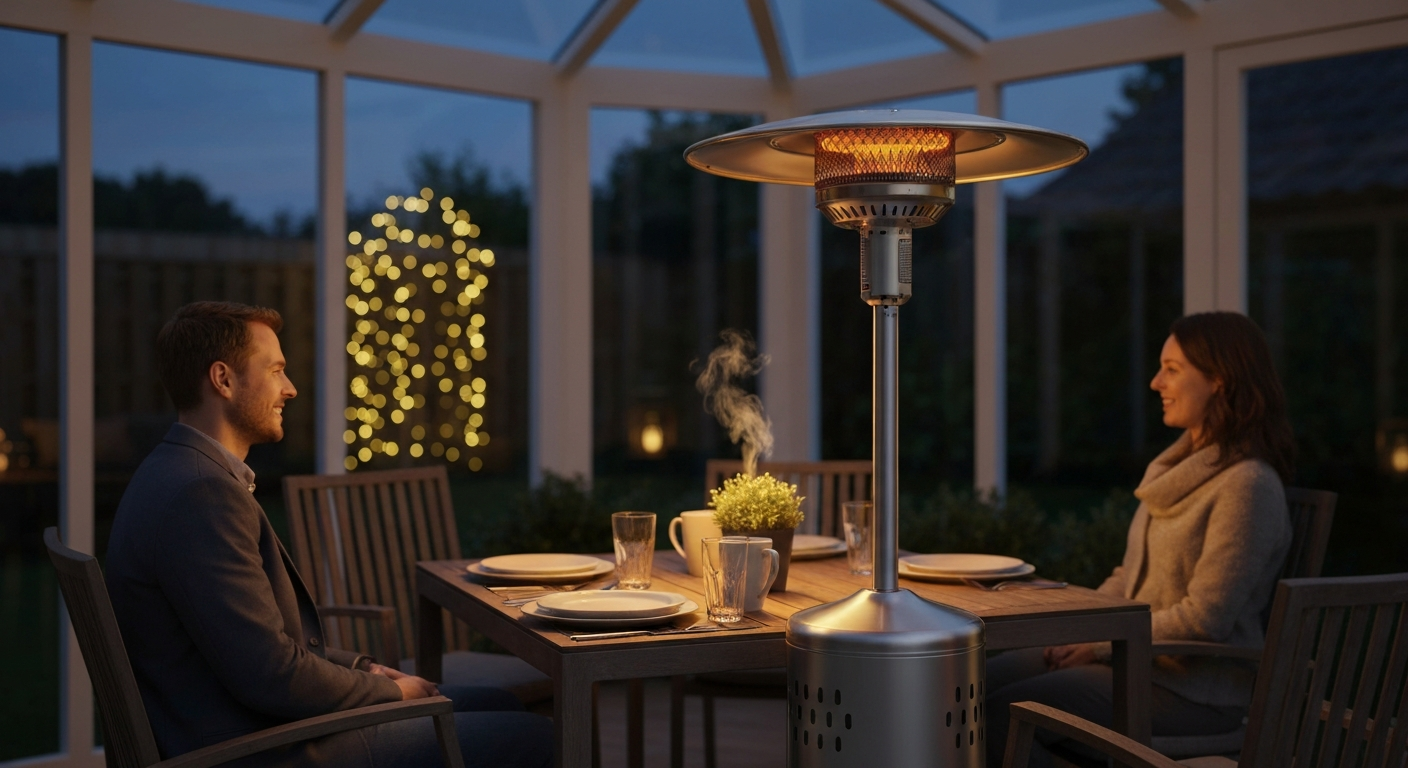
Who this guide is for and what it covers
This guide is aimed at anyone seriously considering a Kettler tabletop heater, whether you're fitting out a small London balcony, a sheltered garden dining corner or a conservatory that gets chilly from September onward. I've pulled together manufacturer specs, instruction manual data, independent test notes and real buyer feedback to give you an honest assessment of the full Kettler tabletop lineup. I'll also compare it directly to close competitors like the Garden Glow 4kW tabletop, the Firefly electric tabletop, the Fire Sense tabletop range and the 2.1kW rattan-base electric models, so you can see exactly where Kettler wins and where it doesn't.
The Kettler tabletop lineup, models and how to tell them apart
Kettler sells tabletop heaters under its Kalos sub-brand, and the naming can be confusing at first. There are two broad formats: the low-profile table-centre models (KLEH112-0200 and the KLEH151-0500 Kalos Terrace series) and the taller lantern-style units that stand roughly 80cm high and are marketed as the Kettler Universal Lantern. Both are electric infrared heaters, not gas. The table-centre models sit directly on your dining table and radiate heat outward and downward toward seated guests. The 80cm lantern unit has a stem and base, so it stands beside or between chairs rather than sitting flush on a surface, which makes it practical if your table is always laden with plates.
The KLEH151-0500 is the Kalos Terrace Electric Table Top, it ships with an instruction manual that covers ignition-free startup (there's no gas, just plug-in operation), tilt-cutoff safety, element maintenance and clearance requirements. The KLEH112-0200 is the Kalos Universal Tabletop, rated at 2000W and IP45. Kettler GB also references assembly PDFs under the KLEH131/KLEH151 product booklets for anyone who wants the full installation documentation before they buy. If you want a review specifically focused on the lantern unit, the Kettler Universal Lantern Patio Heater 80cm and the Kettler Kalos Patio Heater have dedicated deep-dives elsewhere on this site. See our kettler kalos patio heater reviews for a detailed deep-dive on the lantern unit.
Identifying your variant at a glance
- KLEH112-0200: Kalos Universal Tabletop, 2000W, IP45, compact disc-style heating element, sits centrally on a table
- KLEH151-0500: Kalos Terrace Table Top, electric, available in multiple wattages, instruction manual covers both 1800W and 2000W versions
- KLEH131 series: Similar Kalos tabletop format, covered in the combined assembly booklet — check the label on the underside of the heater for the exact SKU
- Kettler Universal Lantern 80cm: Freestanding lantern format, electric infrared, typically rated around 2000W, IP55 claimed in some independent reviews versus IP45 on some product listings — check your specific unit's label
- Kalos Fire Pit/Table hybrids: These are separate products; don't confuse the tabletop heater SKUs with the Kalos fire table range
Design, materials and finish options
Kettler's tabletop heaters are built around aluminium die-cast bodies with a stainless-steel finish on the heating head and a powder-coated aluminium base. The finish holds up well to UK and Northern European weather, I haven't seen corrosion issues reported on the powder coat itself, though the heating element housing should be dried after heavy rain before use. The aesthetic is clean and modern rather than industrial, which is part of why these sell well as table-centre pieces.
Some Kettler Kalos models are sold as bundle sets with rattan or wicker-weave table accessories. This is worth noting because Kettler separately documents wicker and rattan maintenance guidance on their patio furniture and fire table product pages, the same care instructions (wipe clean, avoid prolonged UV exposure on natural rattan, cover when not in use) apply to any rattan-base companion table you buy alongside a heater. The heater unit itself does not use a rattan base, but the 2.1kW electric table top with a rattan base from competing brands is a common alternative worth considering if the aesthetic is important to you, more on that in the competitor section. As an alternative aesthetic, consider a 2.1kW table top electric patio heater with a rattan base for a built-in wicker look that complements rattan furniture.
Fuel and power options, electric, gas and infrared explained
All current Kettler tabletop patio heaters are electric infrared units. There is no Kettler-branded gas tabletop heater in the current lineup at time of writing. This matters practically: electric infrared heaters warm objects and people directly (like sunlight) rather than heating the surrounding air, so they're efficient in breezy conditions and work well under parasols or pergolas. You plug them in, set the heat level and they're warm in seconds, no gas cylinder to store, no regulator to check, no fuel-consumption math.
The trade-off is the power cable. You need a weatherproof outdoor socket within reach of the table, and running a cable across a patio to a dining area can be awkward. This is genuinely the most common complaint I see from buyers. Gas tabletop alternatives, like the Firefly 4kW gas tabletop or the Garden Glow 4kW, solve the cable problem but introduce cylinder handling, regulator compatibility checks and more restrictive placement rules. The 4kW gas tabletop models also put out significantly more heat than a 2kW electric unit, which is worth factoring in if your dining area is large or very exposed.
| Feature | Electric (Kettler Kalos) | Gas tabletop (e.g. Firefly 4kW, Garden Glow 4kW) |
|---|---|---|
| Startup time | Under 5 seconds | 30–60 seconds (ignition, warm-up) |
| Heat type | Infrared (direct radiant) | Infrared/convective mix |
| Typical output | 1800W–2000W (1.8–2kW) | 4000W (4kW) |
| Fuel/running cost | Electricity (approx 2kWh per hour) | Propane/butane (approx 290–300g/hr at 4kW) |
| Cable required | Yes — outdoor socket needed | No cable needed |
| Cylinder storage | Not applicable | 5kg cylinder common for tabletop use |
| Covered space use | Generally permitted | Requires adequate ventilation — see safety section |
| IP rating (typical) | IP45–IP55 depending on variant | Varies — check individual product label |
| Portability | Limited by cable length | High — cylinder self-contained |
If you're specifically looking at the gas tabletop category, the Firefly 4kW electric tabletop and the 4kW tabletop gas patio heater Firefly are reviewed separately on this site and give a much more detailed look at that fuel type. The Garden Glow 4kW tabletop is also worth reading if you're weighing up gas output versus Kettler's electric convenience. For a detailed comparison of high‑output units, see our 4kW table top patio heater guide. For a deeper look at heat output, fuel use and ventilation considerations, see our dedicated review of the 4kW table top gas patio heater Firefly.
Key technical criteria to compare before you buy
These are the five numbers and ratings that actually determine whether a tabletop heater will work for your space. Ignore them and you'll either end up freezing or spending more than you need to.
- Heat output in kW: Tabletop electric models typically run 1.8–2kW. Gas tabletop units commonly run at 4kW. For a 4-seat outdoor dining table in a sheltered garden, 2kW is workable in mild cool weather (10–15°C); in genuinely cold conditions (sub-5°C) or an open, exposed space, 4kW gas makes a more meaningful difference.
- Effective coverage area: Manufacturer coverage claims for 2kW tabletop heaters are typically 4–8m² depending on conditions. Treat this as a best-case figure in still air with no wind. For an average 4-person table, a single 2kW unit in the centre gives noticeable warmth to all seated guests in calm conditions.
- Run-time and fuel consumption: For electric units, running cost is simply wattage × hours × your electricity tariff. At 2kW and a typical UK rate of around 24p/kWh (2026 estimate), that's roughly 48p per hour at full power. For gas tabletop units at 4kW, a 5kg propane cylinder holds approximately 5000g; at around 290–300g/hr burn rate at full power, a 5kg cylinder gives roughly 16–17 hours of full-power use.
- IP rating: IP45 means protected against water jets from any direction (4) and solid objects above 1mm (5). IP55 adds protection against lower-pressure water jets. For a patio heater, IP44 is the minimum I'd accept for uncovered outdoor use; IP45 or better is preferred. Some Kettler lantern variants may carry IP55 — check the label on your specific unit since there are reported inconsistencies between product listings and physical units.
- Weight and table size compatibility: The KLEH112-0200 is compact and light enough for most garden dining tables. Check your table's surface area — you need clearance around the heater body per the instruction manual guidance. Heavy ceramic or stone tables are no issue; lighter aluminium-frame tables with glass tops may flex if the heater isn't centred correctly.
Measured specs and model-to-model comparison
The table below pulls together the declared specs from Kettler's product pages and instruction manuals alongside the main tabletop competitors. Where IP ratings showed a discrepancy between product listings and independent reviews, I've noted both. Coverage figures are manufacturer-declared in still air; real-world numbers will be lower in breezy conditions.
| Model | Power (kW) | Fuel type | IP rating | Coverage (declared) | Est. hourly run cost / fuel use | Format |
|---|---|---|---|---|---|---|
| Kettler Kalos KLEH112-0200 | 2.0kW | Electric | IP45 (product page) | ~6–8m² | ~48p/hr (at 24p/kWh) | Table-centre disc |
| Kettler Kalos KLEH151-0500 | 2.0kW (max) | Electric | IP45 | ~6–8m² | ~48p/hr | Table-centre |
| Kettler Universal Lantern 80cm | 2.0kW | Electric | IP45–IP55 (check label) | ~6–8m² | ~48p/hr | Freestanding lantern |
| Garden Glow 4kW Tabletop | 4.0kW | Gas (propane/butane) | Varies | ~10–12m² | ~290–300g/hr | Tabletop gas |
| Firefly 4kW Gas Tabletop | 4.0kW | Gas | Varies | ~10–12m² | ~290–300g/hr | Tabletop gas |
| Firefly Electric Tabletop | 2.0kW typical | Electric | Check label | ~6–8m² | ~48p/hr | Tabletop electric |
| Fire Sense Tabletop | Varies (typically 1.5kW electric) | Electric | Check label | ~4–6m² | ~36p/hr | Tabletop electric |
| 2.1kW Rattan Base Electric | 2.1kW | Electric | Check label | ~6–8m² | ~50p/hr | Pedestal with rattan base |
Reading this table: kW is the most meaningful single number. A 4kW gas unit genuinely puts out twice the heat of a 2kW electric one, you feel the difference immediately in cold or breezy conditions. The Kettler models sit in the same 2kW tier as the Firefly electric tabletop and the Fire Sense electric range, so the deciding factors between those are build quality, aesthetics, IP rating and price rather than heating performance.
Real-world performance, what to actually expect
At 2kW, a Kettler tabletop heater works best as a comfort top-up on a cool evening rather than a solution for genuinely cold nights. In practice, if you're sitting around a 4-person dining table on a still autumn evening at around 12–15°C, a centrally placed Kalos unit will take the edge off comfortably. The infrared output is directional, guests closest to the element feel the most benefit, and because it's a table-centre placement, everyone gets roughly equal exposure. That's a real advantage over pedestal heaters, which tend to warm one side of a group more than another.
In windier conditions, infrared still performs better than convective heat because it's warming bodies and surfaces rather than the air. Even so, a 2kW output is noticeably less effective once wind picks up above a light breeze. If your patio is routinely exposed to wind, I'd either look at a 4kW gas tabletop alternative or combine the Kettler unit with a windbreak or parasol canopy to keep the radiant zone contained.
The Kalos tabletop versus the lantern 80cm: these two formats serve slightly different seating arrangements. The table-centre Kalos models are best when all guests are seated and the table is the social focal point. The 80cm lantern format works better when people are moving between standing and sitting, or when the table surface is too small or too full to place a heater centrally. Neither unit has a clear warmth advantage over the other at matching wattages, it comes down to placement practicality for your specific setup.
Conservatory use is where the Kettler electric tabletop genuinely shines. In a glazed, enclosed conservatory, even 2kW of direct infrared warms a small dining group quickly, and there's no ventilation concern with an electric unit. Balcony use is similarly straightforward for electric models, no gas cylinder to manage, no local authority restrictions on gas appliance storage on upper floors to navigate.
Setup, safety and covered-space guidance
Placement and clearance
Kettler's instruction manuals for the KLEH131 and KLEH151 series specify minimum clearances around the heater element, follow these precisely. As a general rule, keep flammable materials (parasol fabric, cushions, tablecloths) at least 60cm clear of the heating element. Never place the heater directly beneath a low canopy or parasol without confirming the clearance distance meets the manual's specification. The tilt-cutoff safety switch built into Kalos models will shut the heater off if it tips over, but that's a last resort, stable placement on a flat, solid table surface is the first line of safety.
Covered versus uncovered spaces
For electric infrared tabletop heaters like the Kalos range, covered use (pergola, gazebo, conservatory, covered veranda) is generally permissible because there are no combustion products. This is a meaningful advantage over gas tabletop heaters. The NFPA and FEMA/USFA both explicitly warn against using portable gas heaters in enclosed or semi-enclosed spaces due to carbon monoxide risk, the Kettler electric units do not carry this risk. If you're using a gas tabletop heater under a pergola or covered dining area, you need adequate air circulation, and some government guidance (including Western Australian building/gas use regulations) applies a specific test: roughly 20% of the surrounding wall area should be open to outside air for a space to qualify as adequately ventilated. Always check your own local authority's guidance, as rules vary.
Windy conditions and anchoring
Tabletop electric heaters like the Kalos are low-profile and relatively heavy for their size, which helps in light wind. The taller 80cm lantern variant is more susceptible to being knocked over in strong gusts, don't leave it unattended in exposed conditions. Neither the table-centre models nor the lantern should be operated in heavy rain even with an IP45 or IP55 rating; those ratings cover incidental water exposure, not sustained rainfall onto an active heating element. Power off and bring them in if a storm is coming.
Certification tags and pre-use checks
Before first use, check for a CE mark (for EU market units) or UKCA mark (for UK market units post-2021). These marks indicate the product has been declared compliant with relevant electrical safety and electromagnetic compatibility directives, though they don't always require independent third-party testing, the manufacturer can self-certify for some product categories. For electric outdoor heaters, also verify the IP rating on the physical product label matches what you were sold; as noted earlier, some Kettler lantern units show IP45 on listings but IP55 on the physical label or vice versa. For gas tabletop heaters from any brand, look for compliance with ANSI Z83.26/CSA 2.37 (North America) or the relevant EN standards (UK/EU), these cover gas-fired outdoor infrared patio heaters specifically, including cylinder attachment limits and ignition safety.
First-use preparation and cylinder/element replacement
For the Kettler electric models, first-use preparation is straightforward: unpack, verify no shipping damage to the element housing or cable, place on a stable surface, confirm clearances and plug into a weatherproof outdoor socket with RCD protection. If you're replacing a heating element on an older Kettler Kalos unit, Kettler operates a post-sales support and repair portal (via their Zendesk help hub) where you can verify spare parts availability and arrange a service contact. Don't attempt to replace heating elements yourself unless you're a qualified electrician, this applies to all electric heaters, not just Kettler. For gas tabletop heaters from other brands in your shortlist, the most common cylinder is a 5kg propane or butane canister with a 27mm clip-on regulator; always verify the correct regulator type for your specific heater model before purchasing a replacement cylinder, as using the wrong regulator is a genuine safety hazard. Retail supplier listings (e.g., Gas Accessories and Regulator Types (Harringtons Reading, Calor accessory listings)) list common cylinder sizes (5kg, 11.34kg/13kg, 19kg, 47kg) and regulator types (27mm/35mm clip‑on, POL screw‑on) to help verify cylinder–regulator compatibility Gas Accessories and Regulator Types (Harringtons Reading — Calor accessory listings).
Maintenance and warranty
Kettler publishes warranty terms on both its GB and USA regional sites. For the UK market, the Kettler GB warranty covers domestic outdoor use with the standard registration and claim procedure detailed on their warranty terms page, it's worth registering your product after purchase as some warranty benefits require registration to activate. See "Warranty Terms and Conditions | Kettler GB" for full details of the UK warranty period, domestic-use limits and the registration and claim procedure. The US Kettler Limited Warranty covers equivalent conditions. Kettler's Zendesk-based repair portal handles warranty claim submissions and spare parts queries, which is more convenient than the paper-based processes some other brands still use.
Day-to-day maintenance for the electric tabletop models is minimal: wipe the aluminium body and element housing with a damp cloth (unit off and cooled), check the cable and plug periodically for damage, and store indoors or under a cover during winter months. Powder-coated aluminium resists corrosion well but benefits from an occasional wipe-down with a mild detergent to prevent grime building up in crevices. The 80cm lantern variant has more surface area and joints where moisture can pool, so it benefits from more regular drying off after rain.
How Kettler compares to close competitors
The honest summary: Kettler wins on build quality, brand support infrastructure and aesthetics at the 2kW electric price point. The powder-coated aluminium construction and the tilt-cutoff safety system are genuinely above average for this category. Where competitors catch up or pull ahead depends on what you prioritise.
| Heater | Best for | Where it falls short vs Kettler |
|---|---|---|
| Kettler Kalos tabletop (2kW electric) | Covered spaces, conservatories, small balconies, aesthetic-first buyers | Lower raw output than 4kW gas rivals; cable dependency |
| Garden Glow 4kW tabletop (gas) | Larger outdoor tables, cold evenings, cable-free setups | Gas cylinder management; not suitable for enclosed spaces |
| Firefly 4kW gas tabletop | High heat output, larger exposed patios | Same gas ventilation restrictions; heavier to move |
| Firefly electric tabletop | Budget electric alternative at similar wattage | Build quality and brand support generally below Kettler |
| Fire Sense tabletop (1.5kW electric) | Very small spaces, budget buyers | Lower output than Kalos; less weather protection typically |
| 2.1kW rattan-base electric tabletop | Buyers who prioritise natural/wicker aesthetic | Rattan base needs more maintenance; Kettler's build is more durable |
If raw heating power is the priority and you're comfortable handling gas cylinders, the Garden Glow 4kW and the Firefly 4kW options put out twice the heat of the Kettler electric models. If you want convenience, covered-space compatibility and a heater that looks premium on your table, Kettler is the stronger choice at the 2kW electric tier.
Which Kettler tabletop heater to choose, recommendations by use case
If you have a small covered patio, a conservatory or a balcony: go with the Kalos tabletop (KLEH112-0200 or KLEH151-0500). The electric infrared format is ideal for enclosed or semi-enclosed spaces, there's no gas to worry about, and 2kW is enough for a 4-person table in those conditions.
If you have an uncovered patio and want maximum warmth: the Kettler electric models will work but you'll get noticeably more heat from a 4kW gas tabletop alternative. Look at the Firefly 4kW gas tabletop or the Garden Glow 4kW, reviewed in detail elsewhere on this site, if heat output on cold, open evenings is the priority.
If aesthetics matter and you want a conversation piece: the Kettler Universal Lantern 80cm is the standout choice in this lineup. It looks like a piece of garden furniture rather than a heater, and it works equally well beside a seating area as it does near a dining table.
If budget is the main constraint: the Fire Sense tabletop electric and the Firefly electric tabletop both come in below Kettler on price, but you're trading off build quality and weather protection. For more details, see our guide to the Fire Sense patio heater table top for specs, heating performance and pricing. For a long-term investment that will last multiple seasons with minimal maintenance, Kettler's pricing is justified.
Where to buy and what to check before purchasing
Kettler tabletop heaters are stocked by John Lewis, Kettler's own website and a range of garden centre and outdoor living retailers. John Lewis is worth checking for retailer warranty terms in addition to Kettler's own manufacturer warranty, some retailers offer extended return windows on electrical goods that complement the manufacturer coverage. Always buy from an authorised retailer to ensure warranty validity; grey-market units may not be covered under Kettler GB or Kettler USA warranty terms.
Before confirming a purchase, verify: the exact SKU matches the power output and IP rating you need, the unit comes with a UK plug (or appropriate regional plug), and that your outdoor socket has RCD protection. For gas tabletop competitors you're also considering, confirm the correct cylinder type and regulator size are available from a local supplier before committing, it's surprisingly easy to buy a heater only to discover the regulator is a specialist item that takes two weeks to deliver.
The verdict
Kettler's tabletop patio heater range is the most polished electric tabletop option in the 2kW class. The Kalos models combine durable aluminium construction, a clean aesthetic, proper IP weather protection and a tilt-cutoff safety system that's genuinely reassuring for table-centre use. They're best suited to covered and semi-covered outdoor dining, conservatories, pergolas, sheltered balconies, where the electric infrared format has a real advantage over gas alternatives. If you need higher heat output for a large, exposed patio on cold nights, a 4kW gas tabletop is a more powerful tool, but you're accepting more complexity in exchange. For buyers who want the easiest, safest and best-looking tabletop heater for a small outdoor dining space, Kettler is the one I'd recommend first.
FAQ
What product‑level specifications must I gather for each Kettler tabletop model and variant (Kalos, 80cm lantern, others)?
Collect official model SKUs and names; declared power (W or kW), heat source (electric, gas/propane, infrared), declared coverage area or recommended distance, IP/weather rating, dimensions (height, footprint/diameter), weight, materials/finishes (e.g., aluminium, stainless steel, rattan base), control features (thermostat, multiple heat settings, remote), safety features (tilt cutoff, flame failure, tip‑over switch), and included accessories (tabletop adapter, regulator, hose). Source categories: Kettler product pages & spec sheets, downloadable PDFs and assembly/installation booklets, official user manuals, and retailer product listings (e.g., John Lewis).
Which manufacturer documents are essential to verify installation, safety limits and warranty terms?
Obtain the model‑specific user manual/installation booklet (for ignition, clearances, tilt‑cutoff and fuel connections), the assembly PDF, the official warranty and terms page for the relevant region, and the manufacturer’s post‑sales/repair portal. These provide binding safety instructions, declared limitations (e.g., not for enclosed spaces), warranty periods, spare‑parts procedure and claim steps. Source categories: Kettler product manual PDFs, Kettler warranty pages, and Kettler help/repair Zendesk pages.
What safety standards and external authority guidance must I check and cite?
Reference applicable national/international standards for gas‑fired patio heaters (ANSI Z83.26 / CSA 2.37 for gas infrared heaters), electrical safety and outdoor use guidance (CE/UKCA framework when applicable), and authoritative safety advisories from bodies such as NFPA, CPSC or local building/gas safety agencies regarding use on balconies, in covered spaces and ventilation requirements. Source categories: standards bodies (ANSI/CSA), NFPA/CPSC fact sheets, and official CE/UKCA guidance or government technical notes.
How should I verify IP/weather ratings and resolve inconsistent listings?
Compare the manufacturer’s stated IP rating on official product pages and manuals with retailer listings and independent reviews. If discrepancies appear (e.g., IP45 vs IP55), prioritise Kettler’s official documentation and seek clarification from Kettler support; document any conflicting secondary sources and note which component (lamp head vs controls) the rating applies to. Source categories: Kettler product pages/manuals, retailer spec sheets, independent hands‑on reviews, and direct manufacturer support responses.
What measurements and empirical tests are required to report real‑world performance and how should they be sourced?
Collect independent hands‑on reviews and test reports that measure or report perceived warmth, effective coverage area, required clearance, and performance in wind/cold. If possible, source measured heat output verification (kW), temperature vs distance readings, and run‑time tests for gas models (g/hr or kg/hr). Always cite measured specs and differentiate manufacturer‑declared values from independent measurements. Source categories: independent review sites (PatioHeaterReviews and similar), controlled test reports, and retailer Q&A with measured user data.
What fuel, power and compatibility details must be clarified for tabletop heaters?
Document which models are electric vs gas (propane/butane), infrared types, declared power (W/kW), required electrical supply (voltage, plug type), compatible cylinder sizes and regulator types for gas models (common sizes: 5kg, 11–13kg, 19kg), typical burn‑rates and run‑time math, and availability of electric equivalents. Source categories: Kettler specs/manuals, gas accessory/regulator suppliers, retailer listings, and independent gas heater buyer guides for runtime math.