
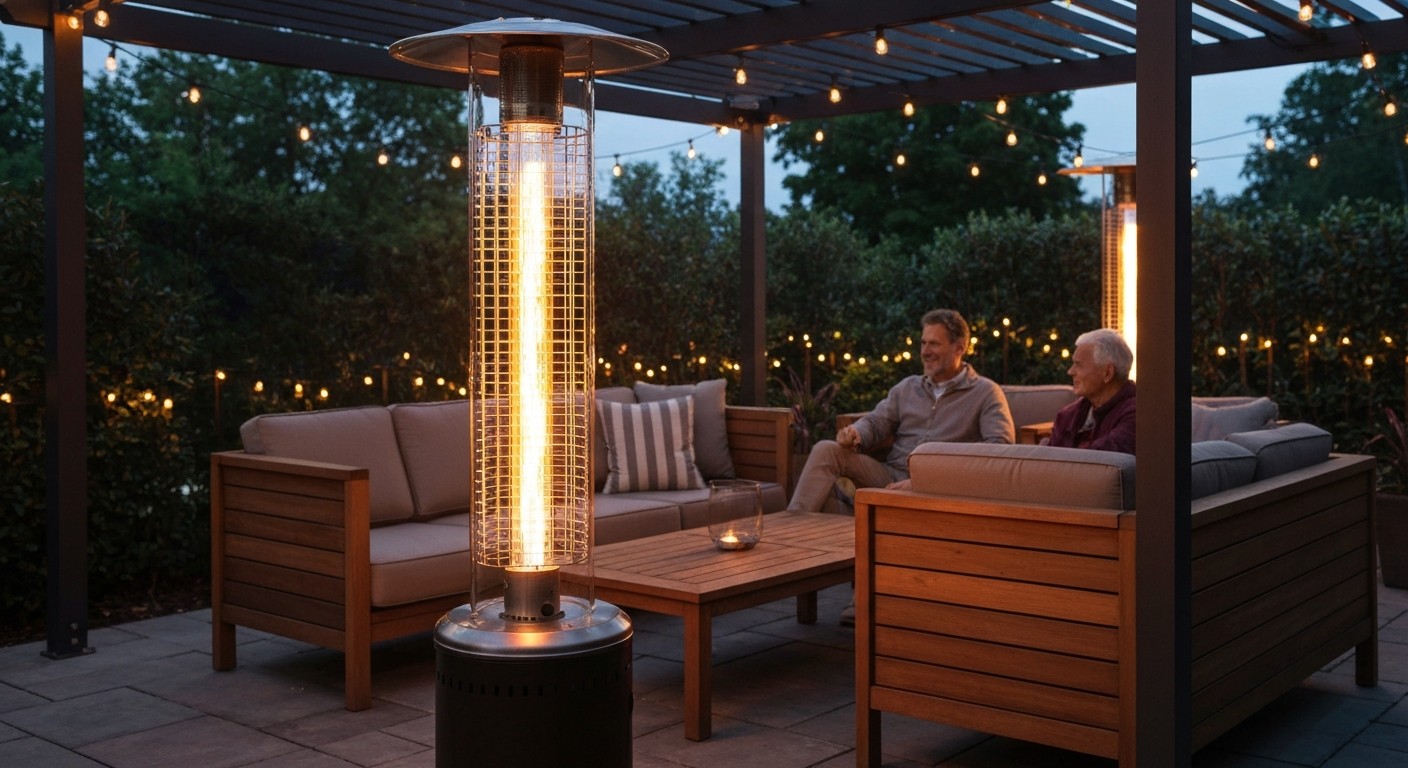
Glass tube (quartz) patio heaters are a specific style of radiant heater, not a separate category from patio heaters altogether. They burn propane or natural gas and heat you through infrared radiation emitted from a glowing quartz or borosilicate glass tube element, rather than warming the surrounding air. Compared to a conventional mushroom-style gas heater, a tall electric infrared panel, or a pellet-fired unit, glass tube models offer a narrower, more directional heat footprint, a visible flame-like glow, and a slim profile that fits nicely in both residential and commercial outdoor spaces. Whether one is right for you depends on your patio size, fuel access, budget, and how much wind or weather you are dealing with.
Glass Tube Heater vs Patio Heater: Compare Quartz, Gas, Electric

Willa Brennan
7 Aug 2026
Who this comparison is for and what you will learn
If you have been searching for a patio heater and keep bumping into the term "glass tube" or "quartz tube" without a clear explanation of how those models differ from a standard propane tower heater, an electric wall mount, or a hard-plumbed natural gas unit, this article is for you. I will walk through how glass tube heaters actually work, how their heat output and coverage compare with gas, electric, infrared, and pellet alternatives, what installation and safety rules apply, and how to match heater type to patio size, mounting style, and budget. By the end you will have a concrete short-list process rather than a pile of spec sheets.
Quick take: glass tube (quartz) vs other patio heater types at a glance
Glass tube quartz heaters sit in an interesting middle ground. They share fuel types with conventional gas heaters but deliver heat more like an electric infrared panel. Here is a condensed overview before we get into the detail.
| Feature | Glass Tube / Quartz Gas | Conventional Gas (Mushroom/Pyramid) | Electric Infrared (Hardwired) | Electric Plug-In Radiant | Pellet |
|---|---|---|---|---|---|
| Fuel | Propane or NG | Propane or NG | Electric (240V or 120V) | Electric (120V) | Wood pellets |
| Typical output | 10,000–40,000 BTU | 30,000–46,000 BTU | 1,500–6,000 W (5,100–20,500 BTU equiv.) | 750–1,500 W | Up to ~50,000 BTU |
| Heat type | Radiant (infrared) | Radiant + convective | Radiant (infrared) | Radiant (infrared) | Convective + radiant |
| Coverage (approx.) | 100–200 sq ft | 150–225 sq ft | 100–200 sq ft per unit | 50–100 sq ft | 200–400 sq ft |
| Mounting options | Freestanding, wall, ceiling | Freestanding (mostly) | Wall, ceiling, pendant | Tabletop, freestanding | Freestanding |
| Use under cover | Yes (with clearances) | Yes (with clearances) | Yes (preferred) | Yes | Ventilation required |
| Portability | Moderate | High (tank integrated) | Low (hardwired) | High | Low–moderate |
| Avg. running cost (US) | ~$1.00–$2.50/hr (propane) | ~$1.00–$2.80/hr (propane) | ~$0.35–$0.75/hr | ~$0.10–$0.18/hr | ~$0.50–$1.00/hr |
| Lifespan (typical) | 5–12 years | 5–15 years | 10–20 years | 3–7 years | 5–10 years |
| Best for | Covered patios, restaurants, ambiance | Open yards, portable use | Covered patios, commercial | Balconies, small spaces | Rural/off-grid, open spaces |
A few numbers in that table deserve a quick note. Running costs assume U.S. average propane prices around $3.00–$4.50 per gallon (as reported by EIA Short-Term Energy Outlook data) and average residential electricity at roughly $0.14–$0.17 per kWh. Your actual costs will shift with local prices, so treat these as order-of-magnitude guides rather than exact figures.
How glass tube (quartz) heaters work vs gas, electric, infrared and pellet heaters
A glass tube heater burns propane or natural gas inside a sealed quartz or borosilicate glass tube. The combustion heats the tube to a high temperature and it glows, emitting longwave infrared radiation. That radiation travels in a line-of-sight beam and warms objects and people directly rather than heating the air. This is the same principle as an electric quartz infrared heater, except the energy source is combustion instead of an electrical element. The visual result is a warm amber glow that many people find attractive, which is partly why these heaters are popular in restaurant and bar settings.
Conventional gas mushroom or pyramid heaters also produce infrared radiation, but a large portion of their heat escapes upward and sideways as hot air convection. That convective component is wasted in a breeze. Electric infrared panels (like those from Infratech or Heatstrip) work on the same radiant principle as glass tube heaters, but use an electrical resistance element inside a quartz or carbon tube rather than combustion. Because there is no flame and no combustion byproduct, electric infrared units are generally the cleanest option for covered or semi-enclosed spaces.
Pellet heaters are fundamentally different. They burn compressed wood pellets and deliver most of their heat through convection, circulating warm air like a furnace rather than targeting occupants with radiation. That makes them excellent for warming a large open area but less efficient for spot-heating a few chairs on a windy deck. Research published in Building and Environment (Rhee, Olesen and Kim) confirms that radiant heat increases mean radiant temperature and produces higher perceived comfort outdoors at a given air temperature compared with convective heating alone, which is the scientific underpinning for why targeted radiant heaters (glass tube or electric infrared) tend to feel more effective per BTU in exposed conditions.
Design, materials and mounting styles
Freestanding
Most glass tube gas heaters sold at retail, including pyramid-style models from Style Selections (the PG212H and similar units rated around 42,000 BTU), are freestanding with an integrated propane tank compartment in the base. The glass tube runs up the center of a decorative metal column, giving a lantern-like aesthetic that differs sharply from the flat mushroom dome on a traditional gas tower. Enders (the Vulano and related models) uses a similar integrated-cylinder freestanding approach with LPG/NG options and stainless or powder-coated steel construction. These are heavy enough to stand in moderate wind but should still be tethered or positioned against a wall in gusty conditions.
Wall and ceiling mount
Some glass tube and quartz infrared gas heaters are designed to mount on a wall bracket or be suspended from a ceiling, keeping the floor clear. This is common in commercial installations, covered terraces, and pergola setups. Electric infrared heaters (Infratech, Heatstrip, Solaira ICR series) dominate the ceiling and wall category because hardwiring is straightforward and there are no combustion products to manage. Heatstrip's installation manual, for example, specifies minimum clearances of 50 to 150 mm behind a flush-mount enclosure depending on model, plus minimum mounting height rules to keep the element safely above head level. The same clearance discipline applies to glass tube gas models mounted under a covered structure.
Tabletop
Tabletop glass tube heaters exist, typically running on a small propane cylinder, but the category is dominated by electric radiant models. Tabletop electric units are convenient for balconies where you cannot run a large gas line, but their output is low (750–1,500 W, equivalent to roughly 2,500–5,100 BTU) and they warm a radius of only a few feet. They are a supplement to a main heater rather than a standalone solution for any space larger than a small bistro table for two.
Heat output, coverage and heat distribution: BTU, watts, footprint and real-world comfort
Output numbers on a spec sheet do not tell the whole story because how heat is distributed matters as much as the total quantity. A 42,000 BTU glass tube heater channels most of that energy radially outward from the tube, creating a roughly cylindrical warm zone that extends perhaps 8 to 10 feet in diameter at a comfortable intensity. Bromic's Tungsten Smart-Heat freestanding gas heater, rated at 38,500 BTU, advertises coverage up to approximately 215 square feet, which aligns with a roughly 15-foot diameter circle under ideal still-air conditions. In practice, wind cuts that coverage noticeably because even radiant heat loses some effectiveness when cold air rushes across skin.
Electric infrared units at 3,000 W (about 10,200 BTU equivalent) cover a smaller but very focused zone, typically 100 to 150 square feet per fixture, and multiple fixtures are often staggered across a ceiling to cover a larger area. The advantage is that mounting height and beam angle are adjustable, allowing you to direct heat precisely where people sit. A single freestanding gas heater cannot do this: it heats in 360 degrees whether or not all of those degrees are occupied, which wastes output if your seating faces only one way.
Pellet heaters produce the most raw BTU in the category, sometimes exceeding 50,000 BTU, but because most of that is convective, wind disperses it quickly in open areas. They work best in semi-enclosed spaces where the warm air has somewhere to collect. For a covered outdoor kitchen or a three-season room, a pellet heater can efficiently warm the whole space. For an open terrace with four chairs, it is overkill and poor value.
Efficiency, fuel costs and what you actually pay per hour
Gas heaters (glass tube or conventional) burn propane at roughly 1 gallon per approximately 91,500 BTU of heat content. At U.S. average retail propane prices of $3.00 to $4.50 per gallon (EIA Short-Term Energy Outlook data), a 40,000 BTU heater running at full power consumes about 0.44 gallons per hour, costing roughly $1.30 to $2.00 per hour. A natural-gas hard-plumbed unit running at 40,000 BTU costs considerably less, around $0.40 to $0.60 per hour at current U.S. average residential gas prices, which is a compelling long-term cost advantage if you can invest in the gas line infrastructure.
Electric infrared heaters at 3,000 W cost roughly $0.42 to $0.51 per hour at $0.14 to $0.17 per kWh. That sounds cheap, but a single 3,000 W unit heats a smaller footprint than a 40,000 BTU gas heater, so you may need two or three fixtures to cover the same area, which brings total running cost closer to $0.85 to $1.50 per hour for the zone. Plug-in electric radiant tabletop units at 1,500 W cost about $0.21 to $0.26 per hour, making them the cheapest to run but also the least powerful by a wide margin.
| Heater type | Typical output | Est. fuel/energy cost per hour (US avg.) | Notes |
|---|---|---|---|
| Glass tube propane | 30,000–42,000 BTU | $1.30–$2.00 | Based on $3.50/gal propane avg. |
| Glass tube / NG hard-plumbed | 30,000–42,000 BTU | $0.40–$0.60 | Based on ~$1.10/therm avg. |
| Conventional propane tower | 30,000–46,000 BTU | $1.30–$2.50 | Higher output = higher fuel use |
| Electric infrared (hardwired, 3000W) | 10,200 BTU equiv. | $0.42–$0.51 per unit | Multiple units often needed |
| Plug-in electric radiant (1500W) | 5,100 BTU equiv. | $0.21–$0.26 | Best for small zones only |
| Pellet (mid-size freestanding) | ~40,000–50,000 BTU | $0.50–$1.00 | Pellet prices vary regionally |
One efficiency point worth calling out: glass tube radiant heaters, like electric infrared, lose less heat to wind than convective heaters because most of their energy is delivered as radiation rather than warmed air. So while their rated BTU may be similar to a conventional gas tower, they can feel noticeably more effective on a breezy night. That said, a strong sustained wind will still reduce comfort for anyone sitting in the periphery of the heat cone.
Installation, setup and venting: covered vs uncovered spaces
This is where heater type makes the biggest practical difference. Electric infrared heaters produce zero combustion byproducts and can be safely installed under covered patios, pergolas, and even enclosed three-season rooms as long as manufacturer clearances are respected and the unit carries appropriate IP ratings for damp locations. Consumer Reports' Patio Heater Options: Electric, Propane, Natural Gas - Consumer Reports notes electric hardwired units are often preferred for covered or semi‑enclosed spaces because they produce no combustion byproducts and can be safely mounted with manufacturer clearances. Hardwired units (typically 240 V) require a licensed electrician to run a dedicated circuit but have no ongoing fuel logistics.
Gas heaters, including glass tube models, produce carbon monoxide and require adequate ventilation. NFPA 54 (National Fuel Gas Code, ANSI Z223.1) and NFPA 58 (LP-Gas Code) are the U.S. model standards governing natural gas and propane installation respectively, and both set minimum ventilation, clearance, and piping requirements. Most manufacturers of glass tube gas heaters state explicitly that their units can be used under a covered patio when the manufacturer's minimum clearances and ventilation requirements are met. Bromic's installation manual for its Smart-Heat series, for example, includes specific clearance tables for ceiling and pole mounts under covered structures. If you are uncertain whether your covered space qualifies, the safest default is to consult a licensed HVAC or gas contractor rather than guessing from spec-sheet numbers alone.
Pellet heaters require the most intensive installation of any category. They need a fuel feed system, ash management, and in some configurations a flue or vent pipe. They are rarely practical for a simple patio setup unless the space is purpose-built around the heater.
For freestanding propane glass tube heaters, setup is straightforward: assemble the unit, attach the propane tank, confirm all connections are leak-free with soapy water or a gas detector, and position it away from combustible surfaces. Most manufacturers specify minimum horizontal clearances from walls and overhead clearances from pergola beams. Check your specific model's manual, because clearance requirements vary significantly between a 10,000 BTU tabletop unit and a 42,000 BTU pyramid heater.
Safety considerations and certifications
Glass tube heaters carry a specific hazard that conventional dome-style gas heaters do not: a cracked or shattered glass tube can release the combustion flame directly and potentially scatter hot glass fragments. This is uncommon but worth understanding. Borosilicate glass tubes are designed to withstand thermal cycling, but physical impact from hail, a falling branch, or a tipped heater can crack them. Always inspect the tube before each season and replace at the first sign of cracking. Many manufacturers sell replacement tubes directly, and the repair is a straightforward owner task on most freestanding models.
All gas heaters should carry certification to the relevant standard. In the U.S., look for CSA (Canadian Standards Association) or AGA certification, both of which test gas appliances to ANSI standards. Electric heaters should carry a UL or ETL listing. UL 2021 covers fixed and location-dedicated electric room heaters (the standard most often cited on hardwired electric infrared patio heaters), while UL 1278 covers movable and wall or ceiling-hung electric room heaters. Intertek (ETL) certifications follow the same ANSI standards. When a model lists a UL/ETL/cETLus mark on its spec sheet, that means an independent lab has verified it meets the standard, not just that the manufacturer claims it does.
Tip-over protection is standard on most freestanding propane heaters and cuts gas flow when the unit tilts beyond a set angle. Oxygen depletion sensors (ODS) are common on some glass tube and conventional gas models and shut the burner down if oxygen levels drop below safe thresholds, which is relevant for partially enclosed spaces. CO detectors are an inexpensive added layer of protection any time a gas appliance is used near a structure. The CPSC maintains a searchable recall database and has logged past issues with propane heater regulators and gas connections on various brands, so it is always worth a quick search on any specific model you are considering before purchase.
- Check for CSA/AGA certification on gas models and UL or ETL listing on electric models
- Inspect the glass or quartz tube for cracks before every season and after any physical impact
- Confirm tip-over shutoff is functional before each use
- Use a gas leak detector or soapy water on all propane connections at initial setup and after each tank swap
- Install a CO detector inside any adjacent interior space when using a gas heater near a door or window
- Observe manufacturer minimum clearances to combustibles overhead, behind, and to the sides
- Check CPSC recall listings for the specific brand and model before buying
Maintenance, lifespan and common repairs
Glass tube heaters have one consumable that other heater types do not: the glass or quartz tube itself. Expect to replace it every three to seven years under normal use, or sooner if the heater is used heavily in a commercial setting. Replacement tubes typically cost $20 to $80 depending on model, and the swap usually takes under 30 minutes with basic hand tools. This is an honest trade-off compared to a conventional gas dome heater, which rarely needs part replacement but produces less targeted radiant heat.
Conventional gas heaters require periodic burner cleaning (spider webs and debris inside the burner head are a surprisingly common cause of poor ignition or yellow flames), regulator replacement every five to seven years, and annual inspection of the igniter and thermocouple. Electric infrared heaters are the lowest-maintenance option by far: no moving parts, no combustion residue, and element lifespans of 5,000 to 10,000 hours are common. At two to three hours of use per evening, that translates to eight to fourteen years before an element replacement.
Pellet heaters require the most regular maintenance: ash removal after each use, annual cleaning of the burn pot and heat exchanger, and occasional auger or fan motor service. They have the highest mechanical complexity of any heater in this comparison.
| Heater type | Primary maintenance task | Typical consumable replacement | DIY-friendly? |
|---|---|---|---|
| Glass tube / quartz gas | Glass tube inspection and replacement | Tube: every 3–7 years ($20–$80) | Yes |
| Conventional gas tower | Burner cleaning, regulator check | Regulator: every 5–7 years | Mostly yes |
| Electric infrared (hardwired) | Wipe-down, bracket check | Element: 8–15 years | Yes (element swap) |
| Plug-in electric radiant | Reflector cleaning | Element: 3–7 years (unit often replaced) | Varies |
| Pellet heater | Ash removal, burn pot and auger cleaning | Igniter, auger: 3–6 years | Moderate – some electrical |
Weather resistance, corrosion and durability
IP (Ingress Protection) ratings, defined by IEC 60529, tell you exactly how well a heater resists water and dust intrusion. An IP44 rating means the unit is protected against solid objects over 1 mm and against water splashing from any direction, which is adequate for a covered patio in moderate rain. IP65 adds complete dust protection and protection against low-pressure water jets, making it suitable for exposed outdoor walls in most climates. If a heater's marketing says "weatherproof" without specifying an IP rating, treat that claim skeptically and check the installation manual.
Freestanding propane glass tube heaters are generally not IP-rated because they are intended to be moved or covered when not in use. Stainless steel columns resist rust better than powder-coated steel in coastal or high-humidity environments, but no freestanding propane unit is designed for permanent outdoor exposure in rain or snow. Electric infrared heaters designed for permanent ceiling or wall mounting typically carry IP44 or IP65 ratings and are built to stay outdoors year-round without a cover, which is a practical advantage in climates where taking equipment in and out is inconvenient.
Wind is a durability factor beyond IP ratings. Freestanding heaters over about 7 feet tall with a relatively small base footprint can tip in sustained winds above 20 mph. If your patio is exposed, consider a model with a wider base, a weighted tank position, or a wall/ceiling mount instead. Some premium freestanding glass tube heaters include a wind guard around the burner assembly, which improves flame stability at moderate wind speeds.
Matching heater type to patio size and layout
Small balconies (under 80 square feet) are best served by a tabletop electric radiant heater or a compact wall-mounted infrared unit. A full-size freestanding propane heater is physically too large and thermally too powerful for this use case, and propane logistics on a high-rise balcony can be awkward. Check local fire codes, as some municipalities restrict propane containers on elevated balconies above certain floor levels.
Mid-size covered patios (80 to 200 square feet) with a pergola or solid roof are the sweet spot for both glass tube gas heaters and hardwired electric infrared. A single 38,000 to 42,000 BTU glass tube propane heater positioned centrally can cover most of this area, and the amber glow adds to the evening ambiance. If the space is fully covered and enclosed on two or more sides, I would lean toward electric infrared for its zero-combustion-product advantage and the ability to mount it out of the way overhead.
Large open terraces (200+ square feet) generally need multiple heaters regardless of type. A pair of conventional 46,000 BTU propane tower heaters placed at opposite ends of a long table works well and avoids running new wiring. Multiple ceiling-mounted electric infrared fixtures on a covered terrace give the best coverage uniformity and wind resistance. Pellet heaters can work here if the budget exists for a quality unit and the space has at least partial wind protection.
Pros and cons: glass tube (quartz) vs gas, electric and infrared
| Heater type | Pros | Cons |
|---|---|---|
| Glass tube / quartz gas | Targeted radiant heat, attractive amber glow, performs better than convective heaters in light wind, freestanding portability, no wiring needed | Glass tube is a wear item, CO output limits enclosed use, propane running costs higher than electric or NG, limited IP ratings on most models |
| Conventional propane tower | High BTU output, wide coverage, portable, easy setup, widely available parts | Less targeted heat, much of output lost upward and in wind, bulky, not ideal for small spaces |
| Natural gas hard-plumbed | Lowest running cost of gas options, no tank swaps, consistent pressure | Requires professional gas line install, fixed location, high upfront cost |
| Electric infrared (hardwired) | No combustion products, preferred for covered/enclosed spaces, low maintenance, long element life, IP-rated models available | Requires electrician for 240V install, lower BTU equivalent per fixture, multiple units needed for large areas |
| Plug-in electric radiant | Extremely easy setup, lowest running cost, very portable, safe for any enclosed space | Low output, small coverage, not suitable as primary heater for anything over ~80 sq ft |
| Pellet heater | High raw BTU, ambient ambiance, renewable fuel option | High maintenance, complex install, not wind-resistant, limited portability, ash management required |
Buying guide: features to prioritize and what each budget tier gets you
Under $150 you are in plug-in electric radiant or very basic tabletop propane territory. Useful for supplemental heat on a small balcony, but not a primary heating solution for any meaningful gathering space. Build quality at this price point is modest and lifespans are shorter.
From $150 to $400 you can find solid freestanding propane glass tube heaters including Style Selections pyramid models and comparable units from Living Accents. At this price, look for a stainless steel column (not just powder coat), a sturdy base with integrated tank storage, a tip-over shutoff switch, and a push-button piezo or electronic igniter. Check that replacement glass tubes are available from the manufacturer or aftermarket before committing to a specific model.
From $400 to $900 the quality jump is real. Enders models like the Vulano use better materials, more robust gas fittings, and more stable base designs. You also start to see commercial-grade electric infrared panels (Solaira ICR series, Infratech single-element units) at the upper end of this range. If you are buying for a covered patio and can run 240V wiring, this is where hardwired electric infrared becomes genuinely competitive: lower running costs, no fuel logistics, and a unit that can stay mounted outdoors year-round.
Above $900, Bromic (Tungsten Smart-Heat and Platinum series), Infratech dual-element units, and Heatstrip premium models are the benchmarks. These are commercial-quality builds designed for restaurants and permanent residential installs. The Bromic Tungsten Smart-Heat freestanding at 38,500 BTU is one of the most thoroughly documented gas heaters in terms of installation manuals, clearance tables, and safety certification. The price is significantly higher than a retail box-store heater, but the longevity and heat quality justify it for a permanent outdoor living space.
- Confirm fuel type availability at your property before choosing (propane tank logistics vs NG line vs 240V electric circuit)
- Check that replacement glass or quartz tubes are available for any specific glass tube heater model you are considering
- Look for tip-over shutoff on all gas models and ODS (oxygen depletion sensor) for any use near enclosed spaces
- Verify IP rating on electric models intended for permanent outdoor mounting (IP44 minimum, IP65 for exposed locations)
- For covered patios, confirm the model's installation manual explicitly permits under-cover use and review clearance requirements
- Check CPSC recall listings for the specific brand and model
- For natural gas hard-plumbed units, budget for professional installation costs in your total cost comparison
Brand and model recommendations by category
Freestanding glass tube and propane heaters
Style Selections (sold through Lowe's) offers accessible entry-level pyramid and glass tube propane heaters in the $150 to $350 range. The PG212H at 42,000 BTU is a reasonable starting point if you want a glass tube aesthetic without a large budget. Living Accents models available through Ace Hardware occupy similar pricing and are worth comparing on assembly quality and parts availability. Enders (the Vulano series and related LPG models) is a step up in build quality with better metal finishes and more stable base geometry, and the brand publishes more detailed specification documentation, which makes it easier to verify what you are buying. See Enders Elegance patio heater reviews for hands-on assessments and model-specific details on build quality and performance. For premium freestanding gas, Bromic Tungsten Smart-Heat Freestanding at 38,500 BTU and approximately 215 sq ft coverage is the benchmark, with full installation manuals covering covered-patio clearance requirements.
Wall and ceiling mount electric infrared
Infratech is the most thoroughly documented brand in U.S. electric infrared patio heating, with complete installation literature covering clearances, mounting heights, and spacing guidance for coverage planning. The WD3024 at 3,000 W is a popular single-element ceiling or wall mount. Heatstrip Design and Premium series are well-regarded in both residential and commercial applications with detailed owner manuals covering flush, beam, and pole mount configurations. Solaira ICR series hardwired units carry UL/ETL/CSA listings (referenced as UL 2021 and CSA C22.2) and are a solid choice where certifications need to be documented for a building permit or landlord approval.
Tabletop and portable electric
For balconies and small supplemental zones, plug-in portable radiant heaters from brands like Dr. Infrared Heater or De'Longhi are widely available and adequate for their limited purpose. Do not expect them to heat a group; expect them to warm one or two people sitting within about 4 feet. A better investment for a slightly larger budget is a small wall-mounted electric infrared unit rated around 1,500 W with an IP44 rating, which will outlast a portable unit significantly.
Suggested visuals and diagrams for this comparison
If you are using this article to build out a publication or landing page, the following visuals add significant clarity for readers comparing heater types.
- Heat footprint diagrams: overhead view showing approximate radiant coverage zones for a 40,000 BTU freestanding glass tube heater vs a 3,000 W ceiling-mounted electric infrared unit vs a conventional mushroom dome heater at the same BTU, drawn to consistent scale on a 20x20 ft patio outline
- Cross-section diagram: how a glass/quartz tube combustion heater generates infrared radiation, compared side-by-side with an electric infrared element cross-section, labeling the glass tube, burner, reflector, and infrared output direction
- Installation clearance diagram: overhead and side-view sketches showing minimum clearances from combustibles for a freestanding glass tube gas heater under a covered pergola, with ceiling height, side clearances, and horizontal clearance to walls labeled
- Close-up product photos: glass/quartz tube detail on a pyramid-style propane heater (showing tube color and glow), mushroom dome burner on a conventional tower heater, and an electric infrared element inside a quartz tube for side-by-side visual comparison of heating elements
- Running cost comparison chart: bar chart showing estimated hourly running cost for each heater type at U.S. average fuel prices, using the data in the efficiency table above
- IP rating infographic: quick visual of IEC 60529 IP44 vs IP65 protection levels with icons for rain, dust, and pressure washing
Quick spec checklist and side-by-side comparison template
Use the template below to evaluate any two heater models side by side before purchasing. Fill in the columns with the values from each model's spec sheet and installation manual.
| Spec to check | Model A | Model B |
|---|---|---|
| Brand and model name | ||
| Fuel type (propane / NG / electric) | ||
| Rated output (BTU or watts) | ||
| Estimated coverage (sq ft) | ||
| Heat delivery type (radiant / convective / mixed) | ||
| Mounting style (freestanding / wall / ceiling / tabletop) | ||
| Safety certifications (CSA / AGA / UL / ETL) | ||
| Tip-over shutoff (yes/no) | ||
| ODS sensor (yes/no, gas only) | ||
| IP rating (electric) or covered-patio approval (gas) | ||
| Glass/quartz tube replaceable? Part number? | ||
| Estimated running cost per hour | ||
| Warranty (years) | ||
| Approx. retail price | ||
| CPSC recall history (check recall.gov) |
Next steps and further reading
The best next step is to narrow your choice to one or two heater types based on your fuel access and patio layout, then read detailed model-specific reviews before buying. If glass tube quartz heaters are on your short list, a dedicated glass tube patio heater review will walk through real-world performance, tube replacement experience, and heat distribution across several tested units. For real-world performance, tube replacement experience, and heat distribution across tested units, see a dedicated glass tube patio heater review (ba649ecb-8ebf-4794-b97f-65ad256fe277). For hands-on tests and buyer guidance, see Well Traveled Living patio heater reviews for detailed performance, tube replacement experience, and coverage measurements. For model-specific hands-on testing and comparative ratings, see Home Appliance Guys patio heater reviews. For natural gas options, gas patio heater reviews cover hard-plumbed models in more depth, including installation cost estimates. If specific brands are on your list, Enders Elegance patio heater reviews, Living Accents patio heater reviews, Style Selections gas patio heater reviews, and Well Traveled Living patio heater reviews each provide model-specific data and hands-on assessment you will not get from a manufacturer spec sheet. For quartz-element specifics, a quartz glass tube patio heater review digs into the material differences between borosilicate and standard glass tubes, which matters for longevity.
No single heater type is universally best, and anyone who tells you otherwise is selling you something. Glass tube quartz heaters earn their place for covered and semi-covered patios where radiant heat, good aesthetics, and propane portability all matter simultaneously. Electric infrared is often the better answer for permanently covered spaces where wiring is feasible. Conventional gas towers remain the most practical choice for open yards where portability and high BTU output are the priority. Match the heater to the space, not the other way around, and you will spend your money once rather than twice.
FAQ
What specific product specifications are essential to compare glass/quartz‑tube heaters with other patio heater types?
Collect model‑level specs: rated heat output (BTU/hr and watts), nominal fuel type (propane, natural gas, electricity, pellet), power/flow requirements (V/Hz/amps or gas pressure/BTU input), declared coverage area or recommended mounting height, mounting options (freestanding, tabletop, wall/ceiling), physical dimensions/weight, materials and finish, IP/ingress protection rating, listed safety/clearance distances, and manufacturer‑claimed efficiency or radiant/convective descriptions. Source these from manufacturer spec sheets and downloadable product manuals.
Which authoritative standards and certification documents should be checked when assessing safety and covered‑space suitability?
Check applicable standards and listings: UL/ETL/cETL (UL 1278, UL 2021 or equivalent) for electric/infrared heaters, IEC 60529 for IP ratings, NFPA 54 (National Fuel Gas Code) and NFPA 58 (Liquefied Petroleum Gas Code) for gas installations, and local building/fire codes. Verify model‑specific certification/listing files and manufacturer installation manuals that state clearances and approved installation environments (covered vs uncovered).
What installation and clearance information must be collected to evaluate whether units are safe under covered patios?
Gather manufacturer installation manuals for minimum clearances to combustibles (top, sides, rear), permitted mounting heights and locations (ceiling, wall, pole), ventilation requirements, fuel‑line and gas‑pressure instructions, and explicit statements about use under roofs/awnings. Also record any mandatory professional installation or hard‑plumb requirements. Use these sources plus NFPA/ANSI code references to determine permitted covered‑space use.
How should heat performance, coverage and comfort be objectively compared across heater types?
Use manufacturer output (BTU and watts) and recommended mounting/spacing guides to map theoretical coverage. Augment with peer‑reviewed literature on radiant vs convective comfort (mean radiant temperature effects) and real‑world test data where available (independent lab or retailer performance tests). Present both nominal coverage and expected perceived comfort differences for seated vs standing occupants and describe how radiant (IR/quartz/glass‑tube) heat differs from convective gas/electric warm‑air output.
What data and method are required to calculate and compare running costs by fuel type?
Collect local or national energy prices (EIA for electricity, propane and natural gas price series) and model energy consumption (kW or BTU input per hour). Convert units consistently (1 kW = 3412 BTU) and compute cost per hour and per typical evening (e.g., 4 hours). Include assumptions (fuel price, appliance firing fraction/thermostatic control, percent radiant usable heat) and show worked examples with sensitivity to fuel price variation.
Which safety history and recall checks should be performed for brands and models?
Search CPSC and national recall databases, manufacturer recall pages, and consumer safety bulletins for model/brand histories (gas regulator leaks, tip‑over hazards, electrical faults). Also check consumer‑review marketplaces and vetted independent review sites for common failure modes. Document any active recalls or significant historical safety issues before recommending models.