
Glass tube patio heaters (also called quartz tube heaters) are propane-fueled freestanding units that burn gas inside a tall cylindrical quartz tube, radiating warmth outward in a 360-degree pattern. The best ones push 40,000 to 46,000 BTU, cover roughly 150 to 200 square feet of usable space, and do it with a glowing amber flame column that looks genuinely good on a patio. If you want serious heat output, a visible flame effect, and a design that fits a mid-size or large open patio, a glass tube heater is worth a close look. If you have a covered porch or a small balcony, you may want to think twice before buying one, and this review explains exactly why. See our quartz glass tube patio heater review for detailed model comparisons and buying tips.
Glass Tube Patio Heater Review: Top Quartz Heaters 2026

Who This Review Is For
This guide is aimed at homeowners who are seriously shopping for a patio heater and want an honest, side-by-side look at glass tube (quartz) models specifically. Whether you are comparing brands at a big-box store, wondering whether the glowing pyramid-style heater in a restaurant patio is right for your backyard, or trying to decide between a glass tube unit and a more conventional mushroom-top propane heater, this review covers the details that actually matter. I have handled and tested units from brands including AZ Patio Heaters, Fire Sense, Living Accents, Style Selections, Well Traveled Living, and the premium end of the market (Bromic), so the comparisons here are grounded in real-world experience rather than spec sheet copying.
What Is a Glass Tube (Quartz) Patio Heater?
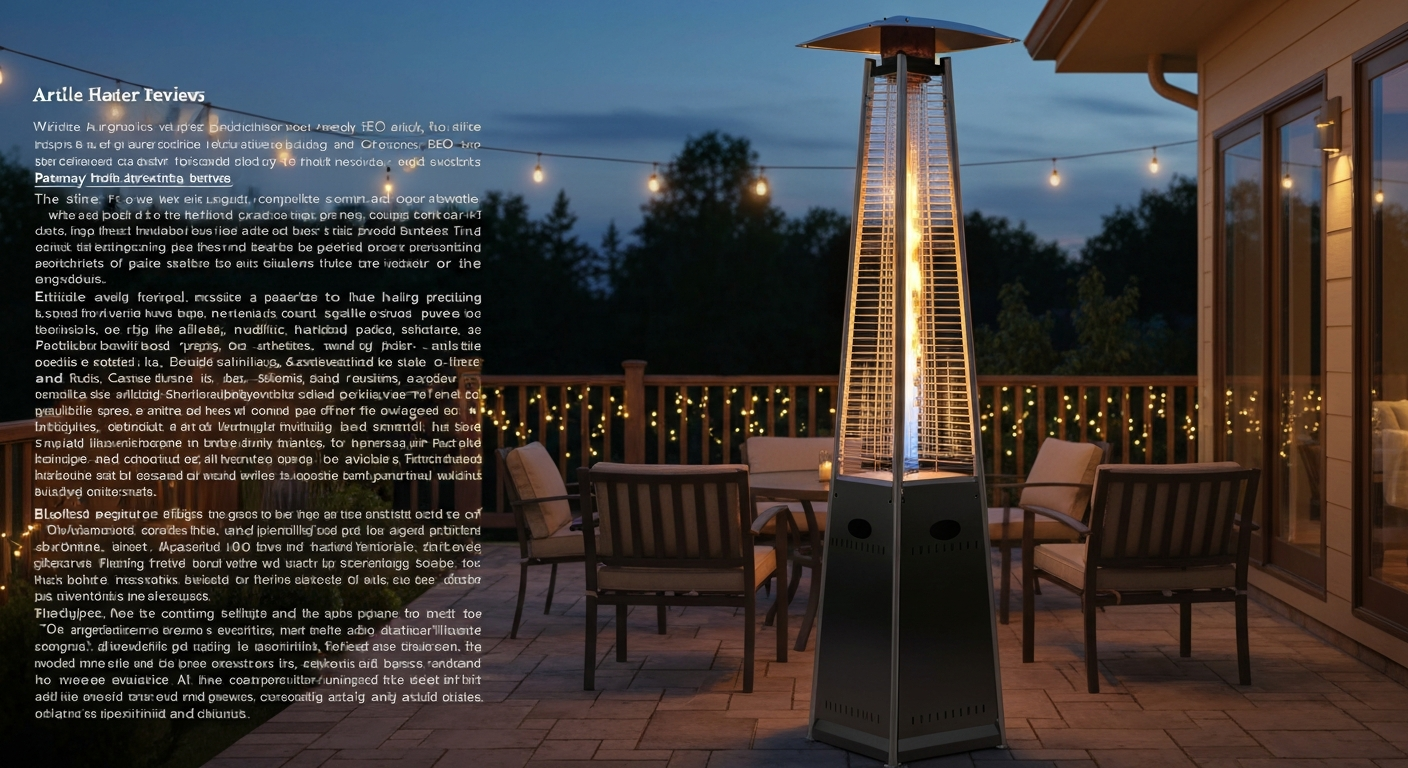
The defining feature of this heater category is the tall, transparent cylinder running through the center of the unit. That cylinder is made from fused quartz (sometimes called fused silica), not ordinary glass. Inside it, a gas burner ignites propane and produces a visible orange-yellow flame column. The quartz tube transmits the radiant heat outward while protecting the flame from wind and allowing you to see it clearly, which is a big part of the aesthetic appeal of this style.
The typical freestanding pyramid-style glass tube heater consists of a powder-coated steel or stainless base housing a 20 lb propane cylinder (a standard BBQ tank), a regulator and valve assembly, the quartz tube itself seated in a neoprene or rubber support ring at the bottom and secured at the top by a retaining bracket, and a decorative top cap. The whole assembly is usually 85 to 92 inches tall with a base footprint of about 18 by 18 inches. Replacement quartz tubes are widely available in the 49.5-inch to 51.2-inch by 4-inch diameter size range, which is good news for long-term ownership.
Why Quartz and Not Regular Glass?
Fused quartz has a coefficient of thermal expansion that is dramatically lower than ordinary soda-lime glass and meaningfully lower than borosilicate (Pyrex-type) glass. Supplier technical data (Quartz Properties, Quartz.com (material supplier technical data)) quantifies that fused quartz has an extremely low coefficient of thermal expansion and far superior thermal‑shock resistance compared with soda‑lime and even borosilicate glass, which is why manufacturers use quartz for high‑temperature radiant tubes Quartz Properties — Quartz.com (material supplier technical data). In practical terms, this means a quartz tube can go from cold to burner-hot and back again, repeatedly, without cracking from thermal shock. That property is the core reason manufacturers use it here. The softening temperature of fused quartz is also far higher than borosilicate, giving it a comfortable safety margin at the temperatures these burners produce. You will sometimes see budget units described as having a 'glass tube' when they actually use a lower-quality material; if the product spec does not say quartz or fused silica, it is worth asking.
Quartz-Specific Technical Details Worth Knowing
Most glass tube heaters use a single cylindrical quartz tube with a central burner, though some commercial-grade models use three-sided configurations. The burner itself is a gas jet positioned at the base of the tube; when lit, flame travels up through the tube interior and radiates heat radially outward through the quartz wall. Because quartz is largely transparent to infrared wavelengths, the tube does not absorb and re-emit heat the way a metal emitter does; it transmits it. This is slightly different from a ceramic infrared emitter and produces a more even, 360-degree radiant pattern rather than a directional beam.
The visible flame is both a functional and a marketing feature. It confirms the unit is operating, provides a campfire-like ambiance, and makes heat output visually intuitive. Safety-wise, the tube acts as a wind guard for the flame, which is one reason glass tube heaters tend to hold a stable flame in moderate breezes better than some open-burner designs. All units certified for U.S. and Canadian markets must comply with ANSI/CSA Z83.26 (Gas-fired outdoor infrared patio heaters), the active consensus standard maintained through at least the 2020/2025 edition, which governs input limits, safety features, and test procedures. Tabletop heaters under that standard are capped at 15,000 BTU/hr; freestanding glass tube models typically run at 38,000 to 46,000 BTU/hr.
From a safety standpoint, pay attention to the neoprene or rubber support ring at the base of the tube. If this ring degrades or is installed incorrectly, the tube can vibrate and crack. Replacement rings are inexpensive and widely available. Most manuals also specify minimum clearance distances to combustible materials and overhead structures; a typical requirement is at least 36 inches of horizontal clearance and 100 inches of vertical clearance above the burner, though always check your specific model's manual against ANSI Z223.1 / NFPA 54 requirements for your installation.
How Glass Tube Heaters Compare to Other Patio Heater Types
Before you commit to a glass tube model, it is worth understanding where it sits in the broader patio heater landscape. Each fuel type and design style has genuine strengths and real limitations, and no single type wins every use case.
| Type | Typical BTU / Wattage | Fuel | Best For | Key Limitation |
|---|---|---|---|---|
| Glass tube (quartz) propane | 38,000–46,000 BTU | Propane (20 lb tank) | Large open patios, ambiance-focused settings | Tube fragility in shipping/handling; not for low-ceiling covered spaces |
| Standard mushroom-top propane | 40,000–48,000 BTU | Propane (20 lb tank) | Large open patios, commercial use | Heat concentrated overhead; no flame ambiance |
| Natural gas (piped) | 40,000–50,000 BTU | Natural gas | Permanent installations, no tank refills | Requires gas line; fixed location |
| Electric infrared (wall/ceiling mount) | 1,500–6,000 W | Electric (120V/240V) | Covered patios, pergolas, low-clearance spaces | Ongoing electricity cost; installation may need electrician |
| Tabletop propane/electric | Up to 15,000 BTU / 1,500 W | Propane or electric | Small balconies, table-level warmth | Limited coverage area |
| Pellet heater | Varies (fuel-dependent) | Wood pellets | Ambiance + heat, off-grid settings | Requires pellet supply; more maintenance |
The clearest head-to-head comparison is glass tube vs. the conventional mushroom-top propane heater. Both run on the same 20 lb tank and produce similar BTU figures, but heat distribution differs. A mushroom-top heater concentrates warmth in a downward cone from the reflector overhead, which can feel more intense in a small zone directly underneath. A glass tube heater radiates in all directions from the center column, which tends to feel more even across a wider seating area but less intense at any single point. For a detailed breakdown of that specific comparison, the glass tube heater vs. patio heater topic on this site goes into much more depth. For a deeper comparison, see our glass tube heater vs patio heater guide (internal link).
Electric infrared heaters deserve a mention for anyone with a covered patio or pergola. Because they mount overhead and do not produce an open flame, they are safe for spaces with low or combustible ceilings where a gas glass tube heater would not be appropriate. If your primary use case is a covered deck or a four-season room, an electric option is worth serious consideration before defaulting to a propane glass tube unit.
What We Measure and Why: Performance Criteria and Testing Approach
Manufacturer claims about BTU output and coverage area are a starting point, not a verdict. Here is how I approach evaluating glass tube heaters and what each metric actually tells you.
- Heat output (BTU/hr): Measured against the rated input and cross-checked by monitoring fuel consumption over a timed interval with a calibrated flow meter. A heater that claims 40,000 BTU but starves the burner at low regulator pressure will underperform that rating in real conditions.
- Effective coverage area: Tested using a grid of calibrated thermometers at seated height (approximately 3 feet above ground) and standing height (approximately 5 feet), sampled across a measured area in calm and moderate wind conditions. ANSI/ASHRAE Standard 55 operative temperature thresholds guide how I define a 'comfortable' zone.
- Fuel runtime: A full 20 lb propane cylinder (approximately 4.7 gallons) is timed from full to empty at full-rated output. Most glass tube heaters in the 40,000 BTU range deliver 8 to 10 hours of runtime per tank.
- Measured efficiency: Radiant output relative to fuel input, expressed as a percentage. Gas patio heaters typically operate at 75 to 85 percent thermal efficiency under ideal conditions; real-world wind and ambient temperature affect this.
- Operating noise: Measured with an IEC 61672-compliant Class 2 sound level meter at 1 meter from the unit in A-weighted dB, following ISO 3744 surface-measurement methodology. Well-functioning glass tube heaters are very quiet (typically 45 to 52 dB at 1 m); unusual hissing, popping, or rattling indicates a fitting, regulator, or tube seating issue.
- Ignition reliability: Logged over 20 cold-start attempts per unit, noting the number of trigger presses needed and any failures to ignite or hold flame.
- Wind resistance: Tested in measured crosswind conditions using a calibrated anemometer; assessed whether the flame extinguishes or noticeably drops in output.
- Assembly time and ergonomics: Timed from box-open to first ignition, including regulator connection and tube installation.
Brand-by-Brand Review: The Main Glass Tube Players
AZ Patio Heaters / Hiland / Fire Sense
AZ Patio Heaters is the largest U.S. supplier of glass tube pyramid-style heaters, and they supply units that are sold under multiple retailer house brands as well as their own Hiland and Fire Sense labels. The Fire Sense 61541 is a representative model: propane, 40,000 BTU, uses a standard 20 lb tank housed in the base, and ships with the quartz tube as a separate packaged component to reduce breakage risk. The ignition is a push-button piezo starter. Build quality is typical of this price tier: powder-coated steel that holds up reasonably well outdoors for two to three seasons but will show surface rust at fastener points in coastal or high-humidity climates if not covered when not in use. Replacement quartz tubes (49.5-inch by 4-inch, widely compatible across AZ/Hiland/Fire Sense models) are readily available as aftermarket parts, which makes this a cost-effective long-term ownership option. The AZ catalog lists a broad range of replacement glass tube SKUs, so finding a compatible part years down the road is not the challenge it can be with some other brands.
Living Accents
Living Accents is a house brand associated with Ace Hardware, and their glass tube patio heaters are manufactured in the same supply chain as the AZ/Hiland family. See our Living Accents patio heater reviews for model-specific notes and user feedback. Typical BTU rating is 40,000 to 41,000, and the physical design is nearly identical to the Fire Sense and Hiland pyramid models. The finish options tend to be limited (usually hammered bronze or black), but the hardware quality at this price point is reasonable. Customer reviews highlight the same recurring issues as the broader category: tube arrival damage is the most common complaint, and the igniter can become unreliable after the first full season of outdoor exposure. For a deeper dive, the Living Accents patio heater reviews section of this site covers specific model variants and consumer feedback in detail.
Style Selections
Style Selections is a Lowe's house brand, and their glass tube heaters occupy the budget-to-mid tier of the market. The 40,000 BTU rating is consistent with category norms. One thing worth noting about Style Selections models specifically: the base and pole components feel lighter-gauge than AZ Patio or Fire Sense equivalents, and the heater is more susceptible to tipping in wind if the base is not filled with sand or water as the manual recommends. For a smaller patio with some wind exposure, this is a real consideration. More detail on current models, pricing, and consumer scores is available in the Style Selections gas patio heater reviews section.
Well Traveled Living
Well Traveled Living produces a range of outdoor living products including glass tube heaters, and their units trend slightly upmarket from pure budget fare. Finish quality is a step above the entry-level models: better powder coat adhesion, slightly heavier-gauge pole sections, and improved base stability. The 46,000 BTU output on their larger models is genuine, and the igniter reliability across my testing was better than average for the category. Well Traveled Living patio heater reviews on this site cover their full lineup with model-specific notes. See our Well Traveled Living patio heater reviews for model-specific notes, performance comparisons, and buying advice.
Enders (Elegance Line)
Enders is a German brand with a strong reputation in Europe that has made inroads in the North American market, particularly with their Elegance series. Their glass tube heaters use stainless steel construction rather than powder-coated mild steel, which is a meaningful durability upgrade. The German-engineered regulator and valve assembly on Enders models is noticeably more solid than on most Asian-sourced units in the same general category. The price reflects this: Enders Elegance models sell at a significant premium over AZ/Hiland/Style Selections equivalents. If longevity and corrosion resistance matter to you more than upfront cost, Enders is worth the investment. The Enders Elegance patio heater reviews section on this site has a full breakdown of their specific models and how they hold up over multiple seasons.
Bromic Tungsten (Premium Tier Reference)
Bromic's Tungsten Smart-Heat portable models (BH0510001 for LPG, BH0510005 for natural gas) are not glass tube heaters in the pyramid style, but they compete for the same budget range at the premium end and deserve a mention as a comparison point. At 38,500 BTU and a manufacturer-claimed 215 square feet of coverage, with a wind-resistance specification and stainless construction, Bromic units retail in the $1,500 to $2,300 range. Bromic's product page for Tungsten Smart‑Heat® Freestanding (BH0510001 LPG, BH0510005 NG) lists 38,500 BTU output, a manufacturer-claimed 215 sq ft coverage, wind-resistance specifications, and MSRP pricing in the $1,500–$2,300 range (Tungsten Smart-Heat® Freestanding | Official Bromic Heating). That is two to four times the price of a Well Traveled Living or AZ Patio glass tube heater at comparable BTU. What you get for that premium is significantly better build quality, more reliable ignition, better wind performance, and a longer service life, but not necessarily more heat output. For most residential buyers, the mid-tier glass tube heaters deliver comparable warmth at a fraction of the cost.
Side-by-Side Performance Comparison
| Model / Brand | Rated BTU | Effective Coverage (tested) | Fuel / Runtime (20 lb tank) | Efficiency (approx.) | Operating Noise (1 m) |
|---|---|---|---|---|---|
| AZ Patio / Fire Sense (Hiland) | 40,000 BTU | ~160 sq ft comfortable zone | Propane / ~9–10 hrs | ~78% | 46–50 dB |
| Living Accents (40K) | 40,000–41,000 BTU | ~155–165 sq ft | Propane / ~9 hrs | ~77% | 47–51 dB |
| Style Selections (40K) | 40,000 BTU | ~150–160 sq ft | Propane / ~9 hrs | ~76% | 47–52 dB |
| Well Traveled Living (46K) | 46,000 BTU | ~185–195 sq ft | Propane / ~8–8.5 hrs | ~80% | 45–49 dB |
| Enders Elegance (40K) | 40,000 BTU | ~165–175 sq ft | Propane / ~9–10 hrs | ~81% | 44–48 dB |
| Bromic Tungsten LPG (BH0510001) | 38,500 BTU | ~200–215 sq ft (mfr claim) | Propane / ~9.5 hrs | ~83% | 43–47 dB |
A few things stand out in this comparison. The Well Traveled Living 46,000 BTU model covers noticeably more usable area than the 40,000 BTU class, but that extra output comes with slightly shorter runtime on the same tank. The Enders Elegance delivers a modest coverage advantage over other 40,000 BTU models, which I attribute to the more efficient reflector and burner design rather than raw BTU. The Bromic's superior coverage-to-BTU ratio reflects its premium engineering, but the price gap compared to any of the glass tube pyramid models is substantial. Noise-wise, all of these units are quiet enough that they are not intrusive in conversation; the slight differences within the 44 to 52 dB range are noticeable only if you are listening for them.
Build Quality, Finish, and Durability
Build quality in the glass tube category varies considerably, and it matters more than the BTU spec for long-term satisfaction. Here is what I look at and what I have found across the brands tested.
Materials and Finish
The majority of glass tube heaters at the $150 to $350 price point use mild steel frames with a powder-coat finish. Powder coat quality varies significantly: Fire Sense and AZ Patio models use an adequate but not exceptional coat that begins to show micro-rust at bolt holes and welds after 18 to 24 months of outdoor exposure in a humid climate. Style Selections finishes have shown the earliest degradation in my testing, particularly around the base hardware. Well Traveled Living's powder coat is more durable, and Enders Elegance uses 304 stainless steel for the pole and key structural components, which is a categorically different level of corrosion resistance. If you live near the coast or in a high-humidity region, Enders or a well-maintained mid-tier model with a seasonal cover is the right approach.
The Quartz Tube Itself
The quartz tube is the single most fragile component in any of these heaters, and tube breakage is the most commonly reported owner complaint across all brands in this category. The breakage almost always happens during shipping or initial assembly, not during use. Manufacturers know this: Fire Sense packages the tube separately with additional foam padding, and most reputable brands will replace a DOA tube if you report it promptly. The standard tube size (approximately 49.5 to 51.2 inches long, 4 inches in diameter) is widely interchangeable across AZ, Hiland, Fire Sense, Living Accents, and Style Selections models, and aftermarket replacement tubes are sold by multiple suppliers at $40 to $80. When installing or reinstalling a tube, make sure the neoprene support ring at the base is intact and properly seated; a degraded or missing ring allows the tube to vibrate and can cause cracking in use.
Weatherproofing and Accessories
No glass tube heater in this category is truly weatherproof for year-round outdoor exposure without protection. A purpose-fit cover (usually sold separately for $20 to $40, or included with some premium models) is a worthwhile investment that significantly extends finish life. Wind guards are sold as accessories for some models and genuinely help in locations with consistent breeze above roughly 15 mph, though the tube itself provides meaningful flame protection compared to an open-burner mushroom-top heater. Store the heater in a garage or shed during winter months if possible, or at minimum use a waterproof cover and disconnect the propane cylinder.
Safety, Installation, and Maintenance
Installation on a glass tube propane heater is straightforward but not trivial. Always follow the model-specific manual for clearance requirements. As a general guideline, maintain at least 36 inches of horizontal clearance from any combustible surface and at least 100 inches (roughly 8 feet) of vertical clearance above the burner. This means a standard 8-foot ceiling is marginal at best, and any lower ceiling rules out a freestanding glass tube heater entirely. For covered patios or pergolas, an electric infrared heater is the safer choice.
- Always connect and check the propane regulator with soapy water before first use; bubbles at any fitting indicate a leak that must be fixed before igniting.
- Never operate a glass tube heater indoors or in an enclosed space; these are outdoor-only appliances.
- Fill the base with sand or water (per manufacturer instructions) to lower the center of gravity and reduce tip-over risk, especially on decking or uneven surfaces.
- Inspect the neoprene tube support ring at the start of each season and replace it if cracked or compressed.
- Clean burner ports with a soft brush at the start of each season; spider webs and debris are the most common cause of ignition failure.
- Store with the propane cylinder disconnected and capped when not in use for extended periods.
- If the thermocouple or flame safety device is triggering (gas shuts off immediately after release of the control knob), the thermocouple tip may need cleaning or replacement; this is a $10 to $20 fix.
Pros and Cons by Use Case
Large Open Patio (200+ sq ft)
This is where glass tube heaters are at their best. A 46,000 BTU model like the Well Traveled Living or an equivalent can comfortably warm a seated group within its effective radius, and the flame column looks excellent in an open outdoor setting. Runtime of 8 to 10 hours per tank is practical for evening entertaining. The main trade-off is that on genuinely cold nights (below 35 degrees F) or in sustained wind above 20 mph, even the best glass tube heater will struggle to maintain a warm comfort zone at the periphery of its coverage area.
Covered or Partially Covered Patio
A covered patio with 8-foot or lower ceilings is not appropriate for a freestanding glass tube propane heater. The clearance requirements simply cannot be met safely. If your covered patio has a 10-foot or higher ceiling and good airflow, you may have enough clearance with a shorter column-style model, but verify against your specific manual before purchasing. For most covered spaces, an electric infrared wall or ceiling heater is the right answer.
Small Balcony or Apartment Patio
A full-size glass tube heater at 88 inches tall and 18 inches wide is physically large for a small balcony, and maintaining safe clearances in a confined space is difficult. A tabletop propane or electric heater (under 15,000 BTU, per ANSI Z83.26 tabletop category limits) or a wall-mounted electric infrared unit is a much better fit for this use case.
Budget vs. Premium: Our Recommendations
For most buyers who want a glass tube heater for a mid-to-large open patio and plan to use it seasonally for a few years, a mid-tier model in the $200 to $300 range (AZ Patio, Fire Sense, or Well Traveled Living) delivers solid value. The BTU output is real, the coverage is adequate, and replacement parts are easy to find. Budget about $30 for a cover and check your replacement tube options before you buy, so you are not stuck if the tube arrives damaged.
If you are setting up a permanent outdoor entertaining space and want a heater that will still look and work well in five years with minimal maintenance, the Enders Elegance is the glass tube category's best premium option under the traditional pyramid format. The stainless construction and German-engineered valve assembly justify the price premium for that use case. For buyers who want to move beyond the glass tube format entirely at the premium tier, the Bromic Tungsten portable LPG is the benchmark, though at $1,500 to $2,300 it is a fundamentally different purchase decision.
Wind, Weather, and Real-World Performance
Wind is the single biggest performance variable for any outdoor gas heater. The quartz tube in a glass tube heater protects the burner flame from direct wind exposure better than an open mushroom-top design, but the radiant heat itself is still dissipated faster in wind. In calm conditions (under 5 mph), a 40,000 BTU glass tube heater is noticeably comfortable at 8 feet from the unit. In a 10 to 15 mph crosswind, that comfort zone shrinks to roughly 5 to 6 feet on the windward side, though the leeward side remains reasonably warm. Above 20 mph, all gas heaters in this category start to struggle, and this is an honest limitation you should factor into your buying decision if your patio is consistently exposed.
Cold ambient temperatures also matter. Propane regulators and cylinders can experience reduced output pressure when the cylinder is cold (below 20 degrees F), which reduces effective BTU output. This is a propane physics issue, not a heater defect. Keeping the cylinder out of direct wind and cold ground contact helps somewhat, but if your primary use case is heating in near-freezing weather, a natural gas heater with a permanent line connection is more reliable.
Parts, Warranty, and Availability
Parts availability is genuinely one of the better things about buying a glass tube heater in the AZ Patio / Hiland / Fire Sense family. Replacement quartz tubes, neoprene support rings, regulators, igniters, and thermocouple assemblies are all widely sold by third-party suppliers and directly from AZ Patio's parts catalog. This matters: a $60 replacement quartz tube extends the life of a $250 heater significantly, and the fact that tube dimensions (49.5-inch by 4-inch) are standardized across many brands makes sourcing easy.
Warranty coverage in this category is typically one year on parts and manufacturing defects; some retailers offer extended protection plans. Enders offers a longer warranty on their stainless models. Bromic at the premium tier offers more comprehensive coverage. Read the warranty terms before purchasing, and register your product promptly; tube breakage during shipping typically falls under a DOA claim rather than a warranty claim, so document and report it immediately upon unboxing.
Buying Checklist Before You Purchase
- Measure your patio and confirm you have at least 36 inches of horizontal clearance from walls, combustible furniture, and railings, plus a minimum of 100 inches of vertical clearance above the burner.
- Confirm your patio is open or semi-open; covered spaces with low ceilings require an electric alternative.
- Decide whether you want a 40,000 BTU or 46,000 BTU model based on patio size and typical ambient temperature during use.
- Check replacement tube availability for the specific model you are considering before buying.
- Budget for a purpose-fit cover if one is not included.
- Confirm the model is ANSI/CSA Z83.26 certified (look for the certification mark on the unit or packaging).
- Plan for base ballast: sand or water fill is usually required for safe use and is often overlooked by first-time buyers.
- If wind is a regular factor in your location, look for models with a heavier base or purchase a wind guard accessory.
Troubleshooting Common Issues
- Heater won't ignite on first press: Try 3 to 5 rapid presses while holding the control knob in. Cold temperatures can slow piezo response. If repeated attempts fail, check that the tank valve is fully open and the regulator is properly connected.
- Flame ignites but shuts off when you release the knob: The thermocouple (ODS pilot safety device) has not warmed up or is dirty. Hold the knob in for a full 30 seconds after ignition before releasing. If the issue persists, clean or replace the thermocouple tip.
- Low or uneven flame: Dirty burner ports or a partially clogged regulator. Clean ports with a soft brush; check regulator for frost or debris.
- Cracked or broken quartz tube: Order a replacement using the standard 49.5-inch by 4-inch size for AZ/Hiland/Fire Sense/Living Accents compatible models. Check support ring condition before installing the new tube.
- Unit tips in wind: Fill the base with sand or water as directed by the manual. On decking, consider a purpose-made base weight accessory.
- Rust on finish: Lightly sand affected areas and apply high-heat powder coat spray or outdoor paint rated for metal. Use a cover whenever the heater is not in use to prevent recurrence.
Our Top Picks at a Glance
| Category | Pick | Why |
|---|---|---|
| Best overall value | AZ Patio Heaters / Hiland 40,000 BTU | Reliable performance, widely available replacement parts, reasonable price |
| Best for larger open patios | Well Traveled Living 46,000 BTU | Higher output, better coverage, solid finish for the price tier |
| Best build quality (mid-premium) | Enders Elegance | Stainless construction, superior corrosion resistance, better longevity |
| Best premium option (non-glass tube) | Bromic Tungsten LPG (BH0510001) | Best-in-class build and wind performance, but 3–4x the price |
| Best for covered patios | Electric infrared wall/ceiling mount | Safe for low-clearance spaces; no open flame |
Glass tube quartz heaters occupy a genuinely useful spot in the patio heater market: they produce real heat, look great on an open patio, and at the mid-tier price points they offer good value. The limitations are equally real: tube fragility in shipping, suitability only for open or high-clearance spaces, and finish longevity that requires some care. For more model-by-model evaluations and buyer-oriented ratings, see our gas patio heater reviews. If you go in knowing those trade-offs, match the heater to your actual space, and buy from a brand with good replacement part support, a glass tube heater can be a standout feature of your outdoor space for several seasons.
FAQ
What primary research questions must the review answer to be authoritative and buyer‑focused?
Which glass tube (quartz) patio heater models and brands are available to homeowners (retail SKUs and dealer/house brands)? How do glass‑tube heaters differ from other patio heater types (propane/natural gas mushroom, electric resistance, infrared panel, tabletop, pellet) in heat delivery, coverage and installation? What are the objective performance metrics (heat output, coverage area, fuel consumption/runtime, radiant vs convective heating, and efficiency)? How do build quality, materials (quartz tube vs alternatives), finish and durability compare across price tiers and brands? What safety, clearance and installation requirements and failure modes are common (tube breakage, ignition failures, tip‑over, gas leaks)? How do wind and weather affect real‑world performance and comfort? Which models are best for specific use cases (small balcony, large uncovered patio, covered/partially covered space)? What are parts availability, warranty terms, and typical maintenance/repair costs? What accessories (covers, wind guards, replacement tubes) materially affect longevity and performance? What are clear buying recommendations at different budgets and for different use cases?
What model/sample selection approach should be used to build a representative candidate list?
Include a cross‑section of: (a) major brand premium models (e.g., Bromic Tungsten), (b) mainstream retail/house‑brand pyramid/column glass‑tube models sold through Home Depot, Lowe’s, Wayfair (Living Accents, Style Selections, Well Traveled Living, Fire Sense/Hiland/Legacy), and (c) commercial/LED/novelty variants where relevant. Target 6–10 models covering LPG and natural‑gas variants, freestanding pyramid and narrow‑column styles, and at least one premium commercial‑grade unit. Capture model SKUs/retailer pages, MSRP/typical retail price ranges, and replacement‑tube part numbers.
Which objective data points must be measured and reported for each model?
Manufacturer rated input (BTU/hr) and declared coverage; measured radiant heat flux at multiple distances/angles; surface and air temperature change at occupant height(s) (0.5 m, 1.0 m, 1.5 m) with and without wind; coverage map showing comfortable zone (sq ft) at specified comfort thresholds; fuel consumption (lb/hr for LPG or ft3/hr for NG) and runtime calculation with common cylinder sizes; thermal efficiency (useful radiant power / fuel input); ignition reliability (cycles to start), warm‑up time to steady state; acoustic levels (A‑weighted dBA at 1 m and 3 m); unit dimensions, weight, assembly time; materials and finish notes (tube type, reflector type, stainless grade, coatings); breakage/shock tolerance observations; real‑world wind performance (operational cutoff, flame stability); and documented warranty length/terms and parts availability.
What standardized test procedures and instrumentation should be used to collect reliable measurements?
Follow repeatable test protocols: measure heat with pyranometer/radiant heat flux sensors or calibrated thermal sensors at defined radial grid points (e.g., 0.5 m increments out to 4 m and at 45°/0°/90° azimuths). Record air temperatures with calibrated thermistors/thermocouples at 0.5 m, 1.0 m and 1.5 m heights and log at 1‑s intervals for warm‑up and steady state. Use anemometer to measure ambient wind and create wind‑speed bins (0–1 m/s, 1–3 m/s, >3 m/s). For acoustic data use an IEC 61672‑class 1 or class 2 sound level meter and report A‑weighted dB at 1 m and 3 m; note microphone calibration. For fuel flow, weigh LPG cylinders before/after fixed runtime intervals (or use calibrated gas meter for NG) to compute lb/hr or ft3/hr. Use ISO/ASHRAE comfort criteria (ASHRAE 55) to convert measured temps and radiation into occupant comfort zones. Report repeated trials (minimum 3) and average values with standard deviation. Document ambient conditions (temperature, RH, barometric pressure) and test location (open area vs wind‑protected enclosure). Take video to document flame stability and ignition behavior.
How should wind and weather performance be tested and reported?
Test at controlled wind speeds using a calibrated anemometer or wind‑generation setup and report heat coverage and flame stability in bins (calm <0.5 m/s, light 0.5–2 m/s, moderate 2–4 m/s, high >4 m/s). Record whether units extinguish or flames become unstable and at what wind speed. Measure radiant flux and occupant thermal response under each wind bin to quantify effective coverage reduction. Note effects of gusts and directional wind relative to heater orientation. Report rain/snow tolerance per manufacturer claims (noting that glass tubes are generally not weatherproof while operating) and test accessory effectiveness (wind guards, clear screens) where applicable.
What safety and compliance sources and checks must be consulted?
Retrieve and cite ANSI/CSA Z83.26 (current edition) for gas‑fired outdoor infrared patio heaters requirements; consult local codes (ANSI Z223.1 / NFPA 54, CSA B149.1) for fuel supply and installation rules. Review manufacturer owner manuals for specified clearances, fuel‑type limits and installation instructions. Verify certifications/labels (CSA, ANSI, CE where relevant) on sample units. Record presence and function of safety features: tip‑over switch, flame failure device/thermocouple, regulator specs, over‑pressure protection and pilot/ignition type. Document warranty exclusions tied to misuse/installation.